


Key Takeaways
- AI employees in chat cut the hidden tax of rework, handoffs, and slow approvals by putting work, context, and action in one place.
- The biggest gains come from repeatable workflows, such as lead routing, invoice follow-up, support triage, and onboarding, where small delays compound into real monthly cost.
- Governance changes the math. Shared chat context, approval controls, and topic-level memory reduce mistakes that often show up only after money or time has already been lost.
- A team can start with one workflow and one owner, then expand from there without waiting for a full platform rollout or a developer project.
Introduction
A manager who keeps doing work the old way is usually paying for it twice, once in labor and again in mistakes. In a 250-person team, the monthly cost of inaction can easily reach tens of thousands of dollars when manual updates, missed follow-ups, and rework stay buried inside normal operations. The most visible waste is not the task itself. It is the delay between a question, a decision, and the action that should have happened already.
Production AI agents now make that cost visible. The AI agent productivity statistics roundup reports a median gain of 6.4 hours per week per seat for knowledge workers using production AI agents, while Kore.ai’s Agent Productivity Index shows how badly governance gaps can hurt when ownership is unclear. The point is simple: teams do not just lose time when they wait, they also absorb avoidable error costs.
Table of Contents
- Hidden labor from manual handoffs
- Rework from bad context and slow decisions
- Incident recovery and compliance drag
- The cost of waiting by delay period
- What the monthly gap means in practice
- FAQ
- About Zenzap
Hidden Labor From Manual Handoffs
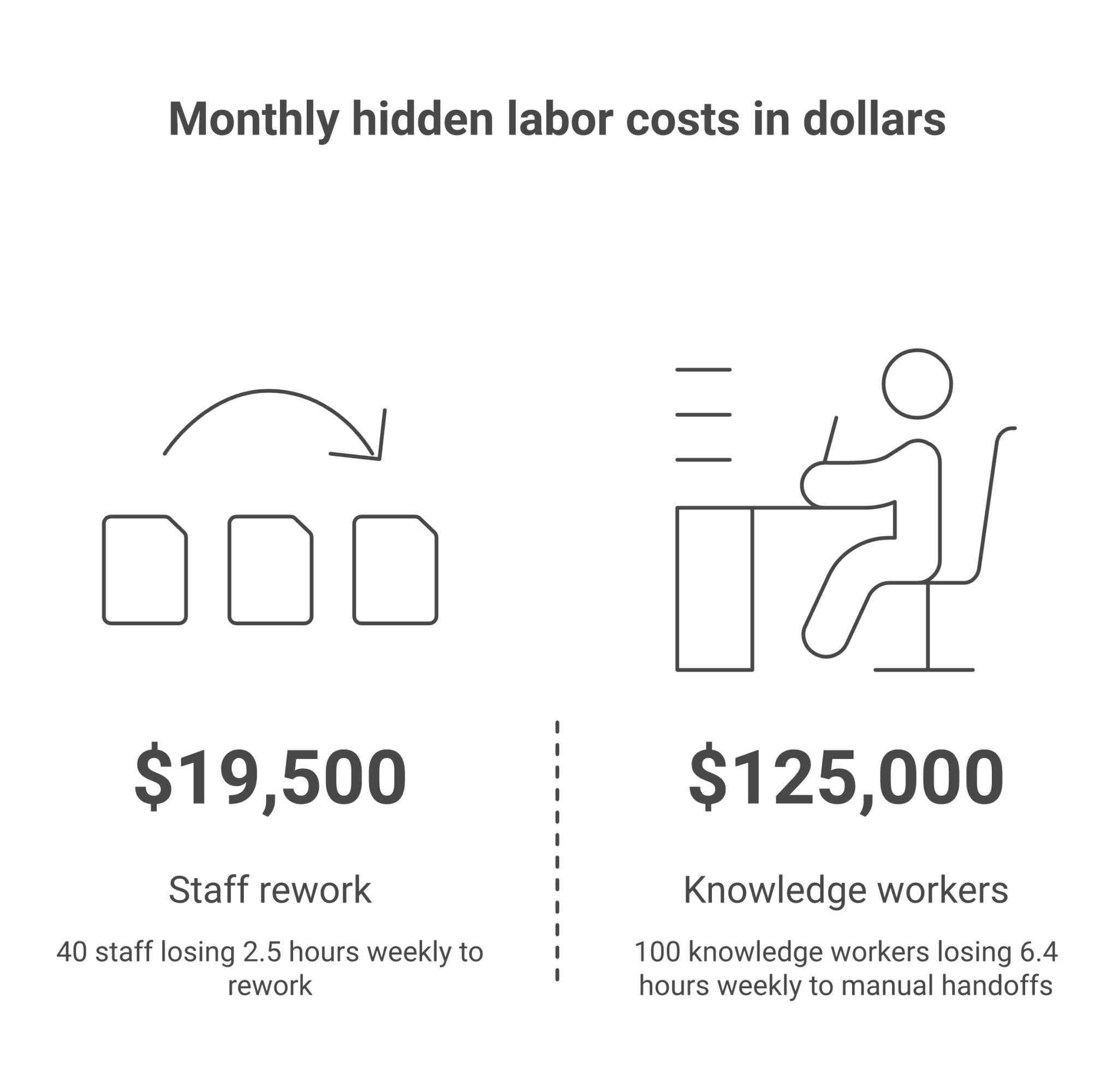
The biggest cost often comes from the work nobody logs as a project. A sales manager forwards context from chat to CRM, an ops lead copies the same update into three places, and someone else chases the next step because the first owner never saw it. In a team of 250 people, if 100 knowledge workers lose 6.4 hours a week, that is 640 hours a week. At a conservative $45 loaded hourly rate, the monthly cost is 640 x $45 x 4.33 = $124,992.
That cost sits in payroll, not in a special budget line. It shows up as slower response time, missed follow-ups, and work that has to be repeated because the first version lived in the wrong place. A chat-native AI employee changes the equation by taking the task from the conversation into the system while the context is still fresh. Zenzap’s chat-to-task workflow guide shows how this kind of handoff can stay inside one thread instead of being rebuilt elsewhere.
Rework From Bad Context And Slow Decisions
Errors get expensive when people act on partial context. A support lead answers from an old thread, finance approves a request without the right backup, or a manager misses a change because the answer was scattered across DMs and email. When those mistakes need a second pass, the cost is not only the fix. It is the time spent finding the gap, correcting it, and explaining it again.
Here the math is plain. If 40 staff members each lose 2.5 hours a week to rework, that is 100 hours weekly. At $45 per hour, the monthly cost is 100 x $45 x 4.33 = $19,485. That figure is conservative, because it counts only time, not the revenue effect of a late reply or a missed lead. Zenzap’s article on building AI employees in chat with shared context makes the same point from the product side, shared context lowers the odds of the second mistake.
- A single missed approval can push a deal, invoice, or customer request into the next cycle, which turns a small delay into a larger cash-flow problem.
- The cost stays invisible because each correction looks minor on its own, so no one records the total until the month is over.
- An AI employee in chat can flag missing fields, summarize the thread, and ask for approval before the error spreads into another tool.
Incident Recovery And Compliance Drag
When a workflow fails, the cleanup cost can exceed the original task. Kore.ai’s Agent Productivity Index report says 72% of enterprise leaders believe the agents running in their organizations introduce unmanaged financial or compliance risk, and 93% of organizations that reversed an agent action described it as costly and disruptive. The same report says 50% detect malfunctions within one to four hours, while 33% need four to eight hours before a failure is even detected.
A team without visibility pays for that delay in incident response hours, audit prep, and rushed fixes. If two people spend 6 hours a month each on cleanup, escalation, and reconstruction, the cost is 12 x $45 = $540 monthly, before any external penalty or customer impact. This is where secure approval paths matter. Zenzap’s team task and chat control features are useful because they keep the action, the approval, and the record in one place.
What the Control Layer Changes
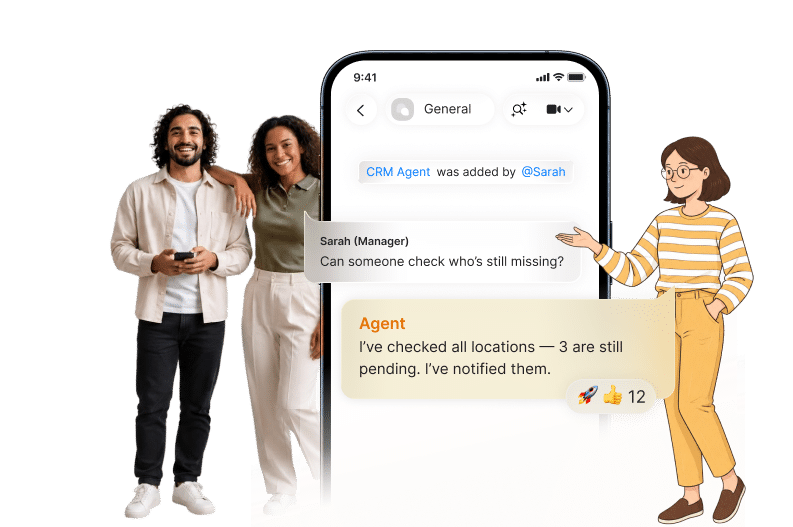
A chat-based AI employee does not remove every risk on day one. It reduces the chance that the team loses track of who approved what, and that reduction is the point. With approval controls, topic-scoped memory, and managed infrastructure, the error cost falls because the system does less guessing and more confirming.
The Cost Of Waiting By Delay Period
Waiting has a price that grows by the month. If the current monthly cost of inaction is $144,977, then the cumulative cost at 3 months is $434,931, at 6 months is $869,862, at 12 months is $1,739,724, and at 24 months is $3,479,448. These numbers come from the three costs above, 124,992 + 19,485 + 540 = 144,977 per month, then multiplied across time.
The table below shows the delay cost against a modeled first-year AI agent cost of $48,000. That AI figure assumes a 50-seat rollout at $80 per seat per month, or 50 x $80 x 12 = $48,000 annually. It is a model, not a market price, and it is used only to compare the cost of waiting with a conservative software budget.
| Delay period | Cumulative cost of inaction | Cost of AI agents that do work for you, connected to your work tools and your team via a secure chat interface | Net cost of waiting |
|---|---|---|---|
| 3 months | 144,977 x 3 = $434,931 | $12,000 | $422,931 |
| 6 months | 144,977 x 6 = $869,862 | $24,000 | $845,862 |
| 12 months | 144,977 x 12 = $1,739,724 | $48,000 | $1,691,724 |
| 24 months | 144,977 x 24 = $3,479,448 | $96,000 | $3,383,448 |
The sharpest conclusion is that delay crosses the full first-year AI budget before the first quarter ends.
What The Monthly Gap Means In Practice
The monthly gap between doing nothing and running AI employees in chat is $144,977 versus $4,000 in a 50-seat model, before any productivity gain is counted. That means the organization is already spending 36.2 times more on drift, rework, and slow handoffs than it would on the modeled AI budget. Even if adoption starts in one department, the payback clock starts immediately because the same workflow repeats every week.
The most practical response is to start where the waste is repeatable. Customer service triage, invoice follow-up, employee onboarding, and lead routing all create visible costs when they stay manual. Zenzap’s workflow examples across customer support and operations point to the same pattern, one chat, one task, one audit trail, less cleanup.
FAQ
Q: Why is the cost of inaction so hard to see?
A: Because the cost is split across payroll, delays, and rework. No single manager sees the full number, so it looks like normal work instead of waste. That is why a monthly model is useful. It turns scattered friction into one number that finance and operations can discuss.
Q: What kind of workflow should get an AI employee first?
A: Start with a workflow that repeats every week and already lives in chat. Lead routing, support triage, invoice follow-up, and onboarding are common examples. Those workflows already have clear inputs and outputs, which makes the savings easier to measure. A shared chat record also makes it easier to see whether the AI employee got the instruction right.
Q: How do approval controls affect ROI?
A: They reduce the cost of mistakes that would otherwise require correction later. A write action that needs approval is slower than a fully automatic action, but it is far cheaper than reversing a bad update after it spreads. That tradeoff is especially useful in legal, finance, healthcare, and any team with audit pressure. It also makes the return easier to defend internally.
Q: Why does chat matter so much for productivity?
A: Chat is where the context already exists. When the AI employee lives in the same thread as the people doing the work, it can read the full conversation, flag gaps, and take action without forcing the team to copy the same message into another system. That cuts handoff time and reduces the odds of acting on an incomplete prompt. It also gives the team one visible place to correct the workflow.
Q: What is the fastest way to measure the savings?
A: Pick one workflow, count the manual steps it removes, and multiply by the hours or incidents it saves each month. Use a loaded hourly rate for labor and the actual cost of rework or incident cleanup where you have it. Then compare that number against the software cost. If the gap is large in month one, the rollout is worth expanding.
About Zenzap
Zenzap gives you AI agents that do work for you, connected to your tools and your team through a secure chat. Setup takes one click: no code, no developer. Unlike Claude or ChatGPT, the agents come already built and connected. You talk to them like a coworker: tag them into chats, correct them once and they remember. They act across your tools, automate workflows, build reports and graphs, summarize chats, flag what needs attention and coordinate people and tasks. One person gets value alone. Add your team, and every correction makes the agent sharper. Agents start in about 300 ms and run on managed infrastructure. Memory stays isolated by topic, and agents never hold credentials. They reach only approved domains, and sensitive actions need your approval.
AI employees in chat do not just save time. They expose the real cost of doing work the slow way, then cut it where the waste repeats every week. The status quo is already a decision, and the business is paying for it in labor, rework, and delay. A secure chat agent changes that by moving work, context, and approval into one visible place.
Now you know the monthly cost of waiting, and you know where the savings come from.