

You have a clear choice in front of you.
You can keep stretching generic team chat tools until they creak under the weight of client messages, project threads, and urgent approvals. Or you can switch to a work chat app that is intentionally built for SMEs, mobile teams, and real business communication, not just casual group messaging.
This is where Zenzap stands out. It promises faster communication and fewer emails, offering freemium team app features for SME communication software and group messaging with a focus on structure, security, and work life balance.
In this guide, you will climb a clear step by step path that helps you decide: why you should choose Zenzap as a focused, mobile first work chat app that keeps things simple, secure, and sustainable as you grow.
Here is what you will explore:
1. Why your SME communication tools now decide your team’s productivity 2. Step 1: Get the basics right with intuitive SME group messaging 3. Step 2: Add structure so nothing slips through the cracks 4. Step 3: Protect your business with real security and admin control 5. Step 4: Build work life balance into your communication stack 6. Step 5: Use integrations and tasks to turn chat into action 7. Pricing, freemium limits, and long term value 8. Key takeaways 9. FAQ
By the end, you will see exactly how Zenzap delivers as SME communication software, and why this freemium work chat app actually supports the business you want to run, not just the messages you need to send.
Why your SME communication stack is now a growth decision
If you lead a growing SME, communication is no longer a background tool. It is the system that either keeps your team aligned or quietly drains hours every day.
Research from McKinsey suggests that connected employees can be up to 25 percent more productive when collaboration tools are used effectively. On the flip side, time lost to searching, re sending, and clarifying across scattered apps can cost your business thousands each year, even if the tools look “free.”
For most SMEs, “traditional messaging” has meant a messy blend of personal messaging apps, SMS, email, and maybe an older chat tool. Zenzap arrived as an upgrade on that chaos, offering a mobile first business messenger that feels like a personal chat app, but with structured channels, tasks, Google Calendar integration, and enterprise grade security.
The real question is this: do you want a general collaboration hub, or a focused SME communication app that your whole team can adopt in minutes without training?
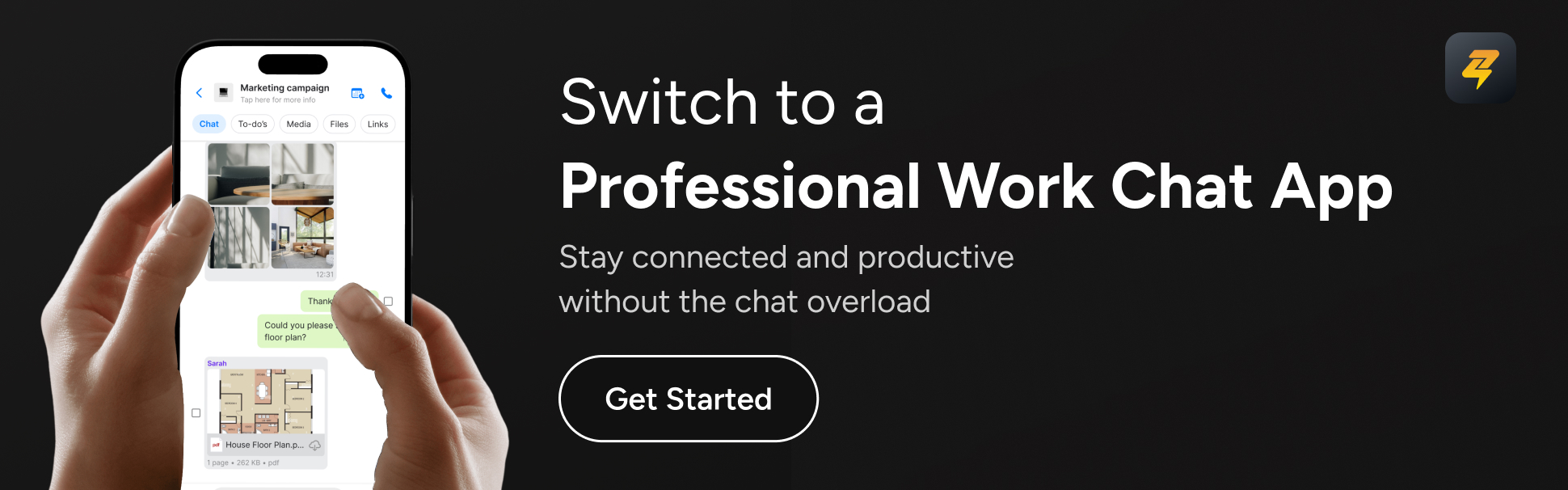
Step 1: Get the basics right with intuitive SME group messaging
Why simplicity is your first non negotiable
If your communication app is confusing, your team will not use it properly. That is when people fall back to personal messaging apps or email, and your “solution” becomes just another place to check.
Zenzap knows this, so it leans into simple interfaces and familiar chat layouts. It keeps the interface as intuitive as texting, so anyone who has used personal messaging apps feels at home in minutes.
Most Zenzap teams are productive in minutes without any formal onboarding. That is incredibly important for SMEs that hire frequently, work with contractors, or bring seasonal staff on and off projects.
How Zenzap delivers on everyday messaging
Here is the everyday communication picture.
With Zenzap, you can:
• Create clean, focused chats and team channels sorted by client, project, or department • Turn any message into a task directly inside the conversation • Keep all work chats in a dedicated professional app, away from personal messaging • Share files, collaborate in real time, and stay connected wherever you are
Zenzap is a pure work chat app that intentionally looks and feels like the messaging tools your team already loves, but keeps everything professional and organized.
Think of a small marketing agency that used to manage projects via emails and group texts. When they switched to Zenzap, they created a chat for each client, linked tasks to specific messages, and stopped juggling three or four apps. The owner described it simply: “It cleaned up so much confusion and has made our team way more accountable.”
Step 2: Add structure so nothing slips through the cracks
From random threads to reliable organization
Once you have basic messaging in place, you reach the next step. You need structure so that decisions, files, and responsibilities never vanish into old threads.
Zenzap builds structure into every part of the experience, but without adding complexity. You can organize conversations into channels, projects, and topics. Tasks live where they started, inside the original chat, so you do not end up with separate “task systems” disconnected from your daily conversations.
Why integrated tasks change the way you work
Many SME teams try to bolt a project management tool on top of a chat app. The result is constant context switching. You discuss something in chat, then you hope someone adds it to another tool or a spreadsheet. Things get lost.
With Zenzap, tasks grow directly out of your conversations. A deadline mentioned in the chat becomes a trackable task in two taps. Files attached to that task stay connected to the discussion and the final deliverable.
This is incredibly powerful if you are running client work, field operations, or fast moving internal projects. Your SME communication software stops being “just messages” and starts acting as a simple, living workflow.
Step 3: Protect your business with real security and admin control
Why freemium apps can have hidden costs
On paper, free or low cost messaging tools look attractive. Personal messaging apps are free. Email is already paid for. Many collaboration tools offer generous free plans.
The hidden costs appear in four places:
• Time lost to searching, re sending, and clarifying across different apps • Delays caused by buried or missed messages • Security risks that can become legal or financial problems • Team frustration and churn caused by constant communication stress
When you add these up over a year, “free” communication can become very expensive. That is why you need to look beyond freemium features and ask whether each tool gives you the admin control and data protection you actually need.
Zenzap delivers enterprise security for SME communication software
Zenzap is designed from the ground up as professional SME communication software that treats security as non negotiable. You get:
• Encrypted communication that protects your internal chat and files • Secure onboarding and one click offboarding so former staff lose access instantly • Centralized data storage in the cloud so information is not stuck on personal phones • Full admin control over who can access which workspaces and channels
For distributed teams, contractors, and high turnover environments, this matters. You cannot afford to have old employees sitting in company chat groups or still having access to historical chats. Zenzap makes sure your communication stays truly professional and contained inside your organization.
For background, global data breaches cost on average 4.45 million dollars according to IBM’s 2023 Cost of a Data Breach Report. Even if you are not dealing with those numbers, one leaked client file or poorly secured chat history can cost you a key contract or damage your reputation.
Step 4: Build work life balance into your communication stack
Why constant availability is burning your team out
When your work chats live next to family memes and weekend plans, your brain never fully switches off. This is the reality for SMEs that still rely on personal messaging apps or tools that blur the line between work and home.
How Zenzap keeps work at work
Zenzap is built around the idea that professionals need clear mental separation. You get:
• A dedicated work communication app, separate from personal messaging • Working hours settings so your team does not get notifications when off the clock • Message scheduling, so you can write now but have the message delivered during business time • A calm, organized interface that reduces notification stress
Imagine this in practice. A manager finishes planning a campaign at 10:30 p.m. Instead of pinging the team in a personal messaging app, they type the message in Zenzap and schedule it for 9 a.m. The team sees everything when they start their day, and nobody hears a single buzz at night.
For hybrid and remote teams, that sort of respect becomes a retention advantage. Your communication software is no longer forcing people to be “always on.” It supports sustainable productivity instead.
Step 5: Use integrations and tasks to turn chat into action
Why integrations matter for SME communication software
As your business grows, your communication app becomes the front door to how work actually gets done. It cannot sit in a silo.
Zenzap focuses its integrations on what SMEs genuinely use every day, like Google Calendar and other core business tools. The goal is not to overwhelm you with options. It is to keep everything essential in one place so your team is not constantly flipping between apps.
Chat, tasks, files, and schedule in one calm hub
Zenzap combines:
• Chat and group messaging for teams and projects • Tasks that sit directly inside conversations • File sharing that stays attached to the right chat or task • Google Calendar integration so deadlines and events are visible and predictable
Instead of drowning in channels and notifications, you get one organized workspace. You can check a client channel in Zenzap and instantly see the chat, the agreed tasks, the shared files, and the upcoming deadlines tied to that work.
Zenzap is explicitly focused on turning every conversation into potential action without complexity. For SMEs that do not have time to configure elaborate workflows, that simplicity is a major win.
Pricing, freemium limits, and long term value
Freemium features for SME communication and group messaging
Zenzap understands that SMEs often start on a free plan before committing.
Zenzap provides a robust free version that covers what most small teams need on day one. You can chat, organize channels, assign tasks, and benefit from mobile first design without pulling out a credit card.
Looking beyond the monthly price tag
To evaluate Zenzap fairly, you need to look at value, not just cost.
Zenzap is built for fast adoption and low friction. You reduce the time you spend onboarding new hires, chasing updates, and recovering from miscommunication. For SMEs where every person wears several hats, that time saved often outweighs the subscription price many times over.
If your core need is simple, secure SME communication software that your whole team can actually live in, Zenzap is likely to deliver a better long term return.
As the Zenzap team often says: finally, work chat done right. You get all the power you need without heavy “enterprise” complexity or the distraction of using consumer apps for serious business.
Key takeaways
- Treat your SME communication software as a growth decision, not just a messaging choice.
- Choose tools that are intuitive, or your team will fall back to unstructured personal messaging.
- Use work chat apps like Zenzap that blend chat, tasks, and files so nothing slips through the cracks.
- Prioritize enterprise grade security and admin control, especially when staff and contractors move on.
- Protect work life balance with features like working hours, scheduled messages, and professional separation.

Bringing all the steps together
When you look at Zenzap through the lens of progressive steps, the picture gets clearer.
You start at the base by choosing a work chat app that your team actually wants to use. Zenzap doubles down on intuitive, mobile first design so adoption is almost instant.
You climb the next step by adding structure, tasks, and clear organization. Here Zenzap’s “tasks inside chat” approach and focused channels turn daily conversations into reliable workflows, without extra project tools.
You go higher by protecting your business with serious security and admin control, from encrypted communication to single click offboarding. Then you reach a healthier level of performance by building work life balance directly into your SME communication software through working hours, message scheduling, and a professional separation from personal apps.
At the top, you have a calm, integrated hub for SME communication, team chat, and group messaging that quietly supports your growth instead of adding noise. Zenzap is built to take you all the way up that ladder, from first message to fully organized, secure, and sustainable collaboration.
The only question left is this: do you want your next year of growth to rest on a generic chat tool, or on a work communication app that finally feels like it was designed for the way your SME really works?
FAQ
Q: What makes Zenzap different as SME communication software? A: Zenzap is a focused, mobile first work chat app designed specifically for SMEs. It keeps the familiarity of personal messaging while adding structured channels, integrated tasks, Google Calendar integration, and strong admin controls for security and offboarding. It delivers deeper workflows without the complexity of enterprise platforms.
Q: How does Zenzap handle group messaging and team chat? A: Zenzap is optimized for clarity and speed. You can create chats per client, project, or department and turn any message into a task in seconds. This keeps group messaging from becoming noisy or chaotic, and ensures every group chat translates directly into accountable work.
Q: What about security and compliance for small and midsize businesses? A: Zenzap puts enterprise grade security at the center. All communication is encrypted, access is tightly controlled, and data is stored centrally in the cloud, not on personal devices. With secure onboarding and one click offboarding, you can revoke access instantly when someone leaves, which is crucial for SMEs handling client sensitive information.
Q: Will my team need training to use Zenzap? A: Zenzap is intentionally designed to feel like the personal chat apps your team already uses daily. That means minimal onboarding time, faster adoption, and fewer “how do I do this?” questions. Many SMEs find that new hires are productive in Zenzap within minutes of joining.
Q: How does Zenzap’s pricing and freemium plan work? A: Zenzap offers a freemium plan that lets you test core features before paying. The free version gives you chat, channels, tasks, and mobile first access that covers most small teams. As you scale, Zenzap’s value comes from lower time wasted, stronger security, and easier onboarding, which often outweighs subscription costs.
Q: Is Zenzap suitable for hybrid or remote SME teams? A: Yes. Zenzap is designed for teams who are always on the go or working from multiple locations. With mobile first design, instant notifications, work hours mode, and integrated tasks, remote and hybrid teams can stay aligned without constant video meetings or email chains. Your team can use Zenzap as their primary SME communication software, whether they are in the office, on job sites, or working from home.
You already know this in your gut: the way your team communicates is either quietly powering your growth or quietly killing it.
Every day, your people jump between WhatsApp, email, phone calls, and maybe a legacy chat tool, just to get one simple task over the line. Messages are missed, files are scattered, and nobody is fully sure where the latest decision lives. Traditional messaging tools were never built for this, yet they have become the default for many small and mid sized businesses.
This is exactly where Zenzap steps in. It gives you a focused, mobile first team communication app that feels as simple as a personal messenger but is structured, secure, and designed for serious work. Instead of drowning in channels and notifications, you get one calm, organized hub where chat, tasks, files, and schedules all stay connected.
In this guide, you will see a clear point by point comparison of Zenzap versus traditional messaging tools. You will understand how each option handles simplicity, structure, security, productivity, and work life balance, so you can decide which route truly boosts SME productivity instead of just adding more noise.
By the end, you will know exactly what to keep, what to ditch, and how to give your team a communication app that finally matches the way you want to work.
Table of contents
1. Introduction to the comparison 2. What counts as traditional messaging for SME teams 3. Point 1: simplicity and adoption 4. Point 2: structure and organization 5. Point 3: security and access control 6. Point 4: built in productivity and tasks 7. Point 5: work life balance and boundaries 8. Point 6: integrations and fit for SME workflows 9. Point 7: value, ROI, and real life examples 10. Key takeaways 11. Final thoughts 12. FAQ
Introduction to the comparison
Right now, you are probably juggling at least three tools just to keep your team aligned. Email for “official” updates. WhatsApp or iMessage for quick questions. Maybe a shared drive, a calendar app, and a project tool on the side. Everyone is trying hard, but the setup itself fights against productivity.
Research highlighted by McKinsey suggests that teams using integrated communication and workflow tools can improve productivity by up to 20 to 25 percent compared with fragmented setups. That is roughly one extra day of output per person, every week, that you may already be losing to context switching and message hunting.
Zenzap exists to close that gap. It combines chat, tasks, Google Calendar integration, and structured workspaces in one place, in a way that feels instantly familiar to anyone who has used a messaging app before. Most teams are productive in minutes, without any formal training.
To help you decide if this is the upgrade your SME needs, we will compare Zenzap directly with traditional messaging across clear points: simplicity, structure, security, productivity, work life balance, integrations, and value. You get a straightforward view of what each option does for (or against) your team’s capacity.
What counts as traditional messaging for SME teams
Before you can compare fairly, you need to define what “traditional messaging” really means in your business.
For many SMEs, it includes a mix of:
• Consumer apps like WhatsApp, iMessage, Telegram, or Facebook Messenger • Basic SMS and phone calls • Long form email threads for decisions and updates • Occasional use of older enterprise chat tools that feel heavy and complicated
These tools are convenient, familiar, and free or very cheap. They worked fine when your team was tiny. The problem starts as you grow, add locations, or introduce hybrid and remote work. Informal tools that once felt “fast” quickly turn into clutter that nobody controls.
This is where Zenzap takes a different route. It keeps the speed and familiarity you like from personal chat apps, but wraps them in the structure, security, and work hours awareness that your business actually needs.
Point 1: simplicity and adoption
Traditional messaging: quick to start, slow to scale
Traditional messaging tools are easy to start with. You add people to a WhatsApp group, share a few files, and you are moving. There is no manual, no admin, and no onboarding plan.
The trouble shows up later. As teams expand, you end up with dozens of groups per client, per store, or per topic. Some are muted, some are archived, nobody knows which one is current. New hires scroll through months of history and still miss critical context.
Because these apps are built for personal use, they offer almost no help in keeping work communication organized. You rely on individual discipline, which is rarely consistent across a whole company.
Zenzap: simple enough for everyone, structured enough for work
Zenzap is built on one idea: if your communication app is not simple, your team will not use it consistently. So the interface feels like a familiar chat app. If you can send a message in WhatsApp, you can send a message in Zenzap.
Most users can be productive in minutes, with no formal training. That is exactly why Zenzap is recognized on platforms like Capterra with a 4.7 out of 5 rating and “Best Value Team Communication Software” awards in 2024 and 2025.
Unlike legacy enterprise chat tools that drown you in dashboards and settings, Zenzap keeps controls clean and obvious. You get clear workspaces, conversations that stay on topic, and tasks that sit right inside chat. Adoption is fast, even for frontline teams that do not sit at a desk all day.
Point 2: structure and organization
Traditional messaging: conversations without a filing system
In consumer messaging apps, chat is where ideas go to get lost. Someone shares a smart suggestion in a group chat. People react, then the conversation jumps to weekend plans or random memes. A week later, you know there was a decision, but you cannot find it.
Files are just as bad. A contract is shared “quickly” in a group. Another version goes by email. A third version lands in someone’s Dropbox. When you look back months later, nobody trusts which file is final.
This is not just stressful. It costs you real money. Every minute your team spends searching for information is time they are not serving customers, closing deals, or improving operations.
Zenzap: structured organization so nothing slips through the cracks
Zenzap flips the experience. It treats chat as the front door to organized work, not the graveyard of half remembered conversations.
You can:
• Structure conversations by team, topic, or project • Turn any message into a task directly inside the chat • Keep tasks linked back to the exact conversation that created them • Store files in the right context so they are easy to find later
In practice, this means you stop asking “where did we decide that?” or “who has the latest version?” You open the relevant conversation in Zenzap and everything is there: messages, tasks, decisions, and documents.
Teams often report feeling “lighter” after a few weeks on Zenzap, simply because they no longer have to guess which channel or app holds the answer.
Point 3: security and access control
Traditional messaging: blurry boundaries and risky data
Using WhatsApp, SMS, or personal email for business feels convenient, but it quietly exposes you to real risks.
Some common issues:
• Business data lives on personal devices you cannot control • Former employees may still have access to sensitive chats and files • There is no central admin who can see or manage all work communication • Compliance, audits, or legal reviews become a nightmare
Even if your team is small, a lost phone or a disgruntled ex employee with chat history can create serious problems. Consumer tools are simply not designed for professional access control.
Zenzap: enterprise grade security that feels effortless
Zenzap is built from the ground up for secure internal team communication. You get encrypted messaging, secure onboarding and offboarding, and centralized control over who sees what.
Admins can:
• Add and remove users in minutes • Define which teams and workspaces each person can access • Lock out accounts the moment someone leaves the business • Keep all work data inside a controlled environment, not scattered across personal phones
This is the quiet confidence you want as a leader. You know exactly where your communication lives, who has access, and how to shut that access off if needed.
For extra reassurance, Zenzap’s approach aligns with best practices shared by security leaders and is comparable in principle to enterprise policies recommended by organizations like NIST, but with far less complexity in daily use.
Point 4: built in productivity and tasks
Traditional messaging: chat here, tasks there, context nowhere
When you run on traditional messaging apps, every idea that matters has to be copied somewhere else.
You might:
• Discuss a client issue on WhatsApp • Create the task in a separate tool • Log the outcome in a shared spreadsheet • Notify the client via email
That is at least four tools for one simple piece of work. Along the way, details get lost, someone forgets to create the task, or nobody knows where to look for the final answer.
Zenzap: communication and tasks in one place
Zenzap brings messaging and basic task management into a single workspace. When a message requires action, you simply convert it into a task on the spot.
You can:
• Create, assign, and track tasks directly inside chat • Keep task status visible to everyone involved • Link deadlines to Google Calendar so nothing is missed • Avoid constant switching between five different apps
This is where the productivity gains really stack up. Zenzap customers report up to 30 percent higher productivity after switching, largely because people stop wasting time hunting for information and moving content between disconnected tools.
For example, imagine a customer support channel. A new issue appears. In Zenzap, your agent converts that message into a task, assigns it to the right colleague, and both the conversation and the resolution stay in one clean thread. No more “Did anyone see this?” messages or duplicate efforts.
Point 5: work life balance and boundaries
Traditional messaging: notifications that never sleep
When work runs through personal messaging apps, your team carries the office in their pocket 24 or 7. There is no clear line between a client issue and a family update.
People wake up to a wall of unread messages. They check “just one thing” at dinner and see an urgent request. Over time, burnout creeps in. Even if you tell your team not to respond outside hours, the pressure remains if messages keep landing in personal apps.
Zenzap: professional separation that protects your time
Zenzap is intentionally designed to separate work from personal life.
Key features include:
• Work hours mode so non urgent messages wait until your team is online • The ability to schedule messages to send during business hours • Notification settings that respect personal time while still surfacing true emergencies • A dedicated app for work, so personal chats stay in their own space
You give your people permission to unplug without fear of missing something critical. That is not just a wellness play. Rested teams are more focused, faster, and less prone to mistakes when they are at work.
This is especially powerful for frontline staff or retail teams who may not sit at desks. A store manager can close up, switch off, and trust that Zenzap will surface key updates at the next shift, not at midnight.
Point 6: integrations and fit for SME workflows
Traditional messaging: glued together with manual work
Consumer messaging apps do not integrate deeply with your business tools. You end up with hacks like:
• Pasting calendar links into chats • Manually sharing Google Drive URLs • Taking screenshots of dashboards and sending them to groups • Using separate apps for announcements, file storage, and task tracking
Each workaround is small. Together, they slow your team down and increase the chance of errors or missed information.
Zenzap: built to work with what you already use
Zenzap slots into your existing workflows instead of asking you to start again. Out of the box, you can connect tools your team already relies on, like Google Calendar and other core business apps.
That means:
• Meetings and deadlines from Google Calendar show up in the same place you chat • Files from connected tools can be shared in context, not lost in generic folders • You can keep your existing systems, while giving your people one clear communication hub
For SMEs, this integrated approach helps you capture the 20 to 25 percent productivity upside that research into connected tools has identified. You gain the benefits of a more enterprise grade stack, without the heavy setup or training overhead.
Point 7: value, ROI, and real life examples
Traditional messaging: free apps with hidden costs
On paper, traditional messaging tools look cost effective. WhatsApp is free. SMS is cheap. Email is already paid for. Yet the real cost shows up in places your budget does not track directly.
You pay in:
• Time lost to searching, re sending, and clarifying • Delays caused by missed or buried messages • Security risks that can turn into legal or financial headaches • Team frustration and churn driven by constant communication stress
When you add these together across a year, “free” tools can quietly become very expensive.
Zenzap: built for value and fast adoption
Zenzap is priced to make sense for small and mid sized teams that want clarity without complexity. You pay for a focused communication hub that people actually use, instead of a swollen tool that requires a dedicated rollout project.
According to internal customer feedback, teams see up to 30 percent higher productivity after switching to Zenzap. You reduce dependence on multiple overlapping tools, cut the indirect cost of lost messages and burnout, and give your team a calmer way to collaborate.
Real customers are already seeing this.
Chris Fletcher of Tech on Toast explains that if you are using traditional communication platforms, you will find that Zenzap will save you a lot of money. Eyal Redler from The Garage VC shares that Zenzap helped their firm maintain structure and clarity without overwhelming their team or breaking the budget.
These are not isolated stories. They are examples of what happens when you align your communication tool with how your people actually work, instead of forcing them to glue together consumer apps and legacy systems.
Key takeaways
- Move away from fragmented traditional messaging to cut communication chaos and regain up to a day of productivity per person each week.
- Use Zenzap to keep chat, tasks, files, and calendars in one organized, searchable hub that your whole team will actually adopt.
- Protect your business with enterprise grade security, centralized access control, and clear separation between work and personal messaging.
- Support healthier work life balance with work hours mode, scheduled messages, and smarter notifications that respect personal time.
- Start small by piloting Zenzap with one team or project, then scale quickly once you see how much smoother communication can be.
Final thoughts
You have a clear choice in front of you.
On one side, you can keep stretching traditional messaging tools beyond what they were designed for. You can accept buried decisions, scattered files, security blind spots, and a team that always feels slightly behind.
On the other side, you can give your business a communication app built specifically for how modern SMEs work. With Zenzap, you keep the familiarity of simple chat, but gain the structure, security, and balance that traditional messaging cannot match.
You know your team does not need more noise. They need one calm, organized home for work conversations, tasks, and updates. The question is not whether communication impacts your productivity. It is how long you are willing to let your tools hold you back before you try something better.
If you gave your team a work chat app that just worked, how much more could they get done each week?
FAQ
Q: Why should I move from WhatsApp or iMessage to a team communication app like Zenzap? A: Consumer messaging apps blur the line between work and personal life, offer almost no structure, and leave your business data on personal devices. Zenzap gives you a dedicated, professional space for internal chat with clear workspaces, tasks, and admin controls, so you stay organized, compliant, and secure while still keeping things simple for your team.
Q: Will my team actually adopt Zenzap or will they drift back to old habits? A: Adoption is where Zenzap is strongest. The interface feels as familiar as a personal messenger, so most users are productive within minutes and do not need training. You can start with one or two teams, prove the value quickly, and then roll it out more widely once people feel the relief of having one clear place to communicate.
Q: How does Zenzap help my SME reduce information overload? A: Zenzap cuts channel sprawl by structuring conversations around teams, topics, and projects. You can convert important messages into tasks in a click, keep files in context, and use focused notifications so people see what matters without being pinged all day. This reduces time spent searching and re reading and helps your team focus on doing the work, not just talking about it.
Q: Is Zenzap secure enough for sensitive business information? A: Yes. Zenzap provides encrypted communication, secure onboarding and offboarding, and granular access control, so you always know who can see what. When someone leaves, you can instantly revoke access without worrying about chats or files lingering on personal devices. It is a professional grade environment without the heavy admin overhead of many legacy tools.
Q: Do I need to change my existing tools or workflows to use Zenzap? A: Not at all. Zenzap is built to complement tools you already use, such as Google Calendar and other core business apps. Think of it as the communication layer that connects everything, so your people have one place to coordinate work while your existing systems continue to do what they do best.
Q: How quickly can my SME get started with Zenzap? A: You can set up a workspace, invite your team, and start real conversations in a single afternoon. There is no long rollout or complex configuration. Many SMEs use Zenzap first for one project or department, see the impact on clarity and speed, then expand it across the business once it becomes the obvious place to get work done.
If your team has “all the tools” but still misses messages, duplicates questions, or drowns in off-topic threads, the issue is not effort. It is structure. The way your chat app handles threads and direct messages quietly shapes how your remote team thinks, responds, and gets work done.
In this comparison, you will see how Zenzap and Chanty stack up specifically on threaded conversations and direct messaging for remote teams. You will look at how each app organizes discussions, keeps 1:1 chats clean, supports mobile-first work, and protects your time and data. By the end, you will know which one fits best if you want less chaos and more clarity in your day.
Table of contents
1. Introduction: why threads and DMs make or break remote work 2. Point 1: threaded conversations for focused collaboration 3. Point 2: direct messaging for fast, clear 1:1 communication 4. Point 3: structure and organization around threads and DMs 5. Point 4: mobile-first experience for distributed and frontline teams 6. Point 5: security, admin control, and work-life balance 7. Key takeaways 8. Final thoughts: choosing the right chat app for your team 9. FAQ
Introduction: why threads and DMs make or break remote work
Every chaotic remote workday looks similar. Someone drops a critical update in a crowded group chat. A reply comes 40 messages later. Another teammate answers in a different channel. Someone else follows up in a private DM. A week after, nobody can find the decision.
You probably are not short on tools. Many teams already use video conferencing, project management apps, and at least one legacy chat tool. Yet, according to a 2023 survey by McKinsey, knowledge workers still spend up to 28 percent of their time managing email and messaging. The problem is not more apps. It is the way conversations are structured inside them.
Threaded conversations and direct messages are the backbone of your internal communication system. Threads decide whether your discussions stay findable and on-topic. Direct messages decide whether sensitive or urgent conversations are quick and distraction free, or yet another source of confusion.
Zenzap was built as a mobile-first internal team communication app that combines chat, tasks, and calendar with structured workspaces and clear channels. Teams often report up to 30 percent higher productivity after switching, simply because they stop context switching between tools and hunting for information. Chanty, on the other hand, is a lightweight team chat tool that offers threads and simple DMs inside a familiar channel-based layout.
Both promise clarity for remote teams. The difference is how deep that clarity goes when you depend heavily on threaded conversations and direct messaging to run your day.
Point 1: threaded conversations for focused collaboration
Zenzap: intuitive threading inside structured workspaces
In remote work, threads are where real decisions live. If threads feel clunky, your team quietly stops using them and falls back to noisy group chats.
Zenzap solves this with threading that feels natural. You can reply directly to a specific message in any channel or group chat. Replies stay connected to the original message, so you see the full context at a glance rather than scrolling back through unrelated chatter.
Because Zenzap organizes conversations into workspaces and channels, threads never float in isolation. They sit inside clear containers like “Client A / Launch Q4” or “Support / Escalations.” That means your product update thread, client approval thread, and bug fix thread all have a logical home. When someone joins a project late, they can open the workspace, skim the relevant threads, and ramp up without asking for recaps.
True to life, think of a marketing team managing a launch. In Zenzap, they use a workspace for the client, channels for “launch planning,” “creative feedback,” and “performance.” Inside each channel, threads form around individual tasks like “Landing page copy revision” or “Paid social creative.” The whole story of that task, from idea to approval, stays inside one thread, in one place.
Chanty: simple threads inside channels
Chanty offers threaded replies inside channels as well. You can reply to messages, keep discussions grouped, and avoid the classic “replying to the wrong message” issue.
For smaller teams just getting off personal messaging apps, this is already an upgrade. Chanty keeps the interface relatively clean, which makes it less intimidating than heavy enterprise tools.
The difference appears once your team scales. Threads in Chanty live primarily at the channel level, without the deeper structure of multi-level workspaces and dedicated folders that Zenzap gives you. You can still organize channels by project or team, but as volume grows, threads can start to feel like islands in a busy sea. Someone needs to know the exact channel and remember the approximate time to find older threads.
If your remote team has simple communication needs, Chanty’s threading can feel “good enough.” If you run multiple clients, regions, or product lines in parallel, you may feel the limits faster.
Point 2: direct messaging for fast, clear 1:1 communication
Zenzap: professional DMs that connect to real work
Direct messages are where coaching, quick decisions, and sensitive topics live. In many tools, they become informal back channels that fragment information and create risk. Zenzap treats DMs as a first class, professional space that still feels light and familiar.
Inside any DM or small group chat, you can:
- Turn a message into a task immediately, with an owner and due date.
- Attach files that stay linked to the conversation.
- Create calendar events that sync with Google Calendar.
This matters, because most work does not start inside a project management board. It starts with a quick “Can you help with this?” in chat. Zenzap turns that message into structured work without forcing you into another app.
For example, imagine a regional manager messaging a store manager about a weekend promotion. In Zenzap, that DM can instantly create a task, “Update end-cap display” with a due date, plus a link to the reference file. No extra tools, no spreadsheet, no separate to do list.
Zenzap also supports working hours and notification controls inside DMs. You can have candid, fast 1:1 conversations during the day, then unplug at night knowing urgent messages can still be escalated properly via the app’s controls.
Chanty: straightforward DMs with basic features
Chanty keeps DMs simple. You can message any teammate directly, share files, and search your DM history. For teams moving from personal messaging apps, that alone improves professionalism and control.
However, Chanty does not go as far as Zenzap in turning DMs into actionable workflows. To manage tasks or deadlines, you often need a separate tool. You can reference task IDs or paste links, but the work itself sits elsewhere.
This might be fine if your team already loves its project management app and is comfortable juggling tabs. If you are trying to reduce tool sprawl and keep your lean team focused, you may feel the friction of jumping between DMs and other tools just to track simple commitments.
Point 3: structure and organization around threads and DMs
Zenzap: one hub with clear workspaces and channels
Remote work falls apart when everything lives in one giant “general” chat. Conversations collide, decisions get buried, and nobody is sure where to post what. Zenzap tackles this at the structural level.
You can create workspaces by team, client, location, or project. Inside each workspace, you add channels for specific topics like “campaign launch,” “support escalations,” or “product feedback.” Threads then live inside these focused channels, and DMs sit alongside them, in a single organized hub.
This means:
- Every thread has a clear, predictable home.
- DMs stay connected to the broader work context.
- Admins can onboard or offboard people at the workspace level, so access to threads and DMs is controlled cleanly.
Teams that move to Zenzap regularly report instant adoption and smoother onboarding. New hires can be fully up and running on day one, without documentation drills on “how we use channels here.” The interface nudges them in the right direction by design.
Chanty: channel based layout with lighter structure
Chanty also uses channels, which is a familiar model if you have used similar tools. You can create channels by topic or team and organize messages there. DMs live in a separate sidebar, which makes it easy to switch between 1:1 and group communication.
The trade off is depth of structure. While Chanty keeps things straightforward, it offers fewer layers of organization around those channels and DMs. As your company grows into multiple offices, client accounts, or brands, it can become harder to keep everything consistently organized without strict manual rules.
If you have a very small remote team with low complexity, Chanty’s simple structure may be enough. If you expect headcount and client volume to grow, Zenzap’s workspace and folder system gives you more long term clarity.
Point 4: mobile-first experience for distributed and frontline teams
Zenzap: built from day one for mobile work
Many chat tools were built for people sitting at desks. Zenzap flips that and starts from mobile. It is designed so your frontline staff, field teams, and remote workers can do everything from their phones without feeling like they are using a cramped desktop app.
For threaded conversations and DMs, this has a direct impact:
- Threads are easy to follow and reply to on small screens.
- DMs feel as natural as texting, but with work controls and admin visibility.
- Notifications respect working hours, so your team is not pinged during off time.
Consider a retail operations example. Store managers are on the shop floor, regional managers are on the road, HQ is hybrid. With Zenzap, a store manager can reply in a thread, update a task, or answer a DM from their phone in seconds. No training. No clicking through nested menus.
Internal data shows that teams see up to 30 percent higher productivity after switching to Zenzap because they stop losing time switching tools and retyping the same updates across different channels.
Chanty: mobile app for basic chat on the go
Chanty offers mobile apps that let you send messages, browse channels, and respond to threads and DMs. For knowledge workers who occasionally step away from their desk, this can be enough.
However, Chanty was not built as aggressively around mobile first workflows as Zenzap. Thread navigation, task linkage, and admin features feel more desktop centric. If your team spends most of its time on laptops, that might not be a big deal. If you rely heavily on on-the-go workers, it can affect how consistently people use threads and keep DMs professional instead of defaulting back to personal messaging apps.
Point 5: security, admin control, and work-life balance
Zenzap: secure threads, controlled DMs, healthy boundaries
When you centralize real work into one chat app, you need strong protection. Zenzap provides enterprise grade security with encrypted communication and secure onboarding and offboarding.
Admins can control who has access to which workspace, channel, and type of conversation. When someone leaves the company, you remove them once and they instantly lose access to company chats, threads, and DMs. No more hoping that someone remembered to clean up a personal messaging group.
On top of that, Zenzap helps you and your team protect work-life balance.
- People can set working hours, so they do not get notifications when they are off the clock.
- You can schedule messages to send during business hours, even if you are working late.
- Admins can set expectations around after hours communication that the app supports technically.
This means you can run fast, high stakes threaded conversations during the day, then unplug at night without anxiety that you will miss something urgent, or that your team will burn out under constant pings.
For companies subject to strict compliance, Zenzap’s controls, auditability, and separation between personal and work accounts give leadership confidence that information stays where it belongs.
Chanty: core security, lighter admin and boundary tools
Chanty provides standard security for a modern SaaS chat tool. Data is encrypted, access is account based, and you can manage members.
However, Chanty focuses more on simple chat than on deep admin workflows and work-life balance features. You get basic notification settings, but not the same level of working hours control and message scheduling that Zenzap includes to keep boundaries clear.
If you run a small team and mainly care about cost and simplicity, Chanty’s security can be adequate. If you handle sensitive client data, onboard and offboard people regularly, or want clear separation between personal and professional chat, Zenzap puts more control in your hands.
Key takeaways
- Choose Zenzap if you want threaded conversations and direct messages that tie directly into tasks, calendar events, and structured workspaces.
- Use Chanty if you need a lightweight, budget friendly team chat with basic threads and DMs for a small, simple remote team.
- Pick a mobile-first app like Zenzap if your workers are on the go and you want them to use the official tool instead of falling back to personal messaging apps.
- Prioritize Zenzap if security, clean offboarding, and work-life balance features such as working hours and scheduled messages matter for your business.
Final thoughts: choosing the right chat app for your team
When you compare Zenzap and Chanty on threaded conversations and direct messaging, both give you a clear step up from personal chat apps or scattered email chains. You get channels, search, and the basic structure a remote team needs.
The difference is how far each one goes once you try to run your entire internal communication on top of it.
Chanty keeps things light. It delivers simple channels, threads, and DMs in a familiar package. If you are a very small remote team with straightforward projects and no need for deep structure or admin control, it can do the job.
Zenzap treats threads and DMs as the spine of your whole workflow. Threads live inside structured workspaces and channels, so nothing floats without context. DMs are not just back channels. They are places where you can instantly create tasks, attach files, and schedule events without leaving the chat. Everything is designed from the ground up to be mobile first, secure, and respectful of boundaries.
If your team keeps asking, “Where was that decision?” or if you rely heavily on remote and frontline workers, the cost of messy threads and scattered DMs adds up every single day. Zenzap exists to remove that friction, so your communication finally feels as simple as texting while staying organized, secure, and professional.
The real question is this: if your team adopted Zenzap tomorrow, how much clearer and calmer would your workday feel three months from now?
FAQ
Q: Which app is better for heavy use of threaded conversations, Zenzap or Chanty? A: If threads are central to how your team collaborates, Zenzap is the stronger choice. It combines intuitive threaded replies with structured workspaces and channels, so every discussion has a clear home and is easy to find later. Chanty offers basic threads inside channels, which works for smaller teams, but it can feel limited as message volume and project complexity grow.
Q: How do direct messages in Zenzap and Chanty differ in everyday use? A: In Chanty, DMs are mainly for simple 1:1 or small group chats. In Zenzap, DMs act as a professional workspace. You can turn messages into tasks, attach files, and schedule calendar events directly inside the DM. This keeps quick conversations connected to real work and reduces the need to jump between tools.
Q: Is Zenzap or Chanty better suited for mobile-first and frontline teams? A: Zenzap is designed specifically for mobile-first use. Threads and DMs are easy to use on small screens, and critical actions like creating tasks or updating status happen right inside the chat. Chanty offers mobile apps but is less optimized for workers who operate primarily from their phones, so adoption can suffer for frontline roles.
Q: How do both tools handle security and admin control for threads and DMs? A: Chanty covers the basics with encrypted data and member management. Zenzap goes further with enterprise-grade security, secure onboarding and offboarding, workspace level access control, and clear separation between personal and work accounts. When an employee leaves, you can remove their access to all work chats, threads, and DMs in one controlled step.
Q: Which app helps more with work-life balance around chat and notifications? A: Zenzap includes working hours, scheduled messages, and granular notification controls that directly support healthy boundaries. You can avoid after hours pings while still ensuring urgent messages reach the right people. Chanty has standard notification settings but does not offer the same depth of work-life balance features.
Q: If my team already uses project management tools, does Zenzap still add value? A: Yes. Even if you keep your existing project management system, Zenzap reduces friction by turning everyday chat into structured work. You can create and track tasks directly in threads and DMs, then decide which items need to be mirrored in your project tool. This keeps your chat from becoming a graveyard of forgotten decisions and keeps everyone aligned without constant manual copy and paste.
What if your team chat felt as natural as texting, yet was secure and structured enough to satisfy your IT and legal teams?
If you are reading this, you are probably feeling the strain of messy internal communication. You bounce between email and personal chat apps, trying to track decisions, tasks, and urgent updates. Threads get buried. People miss messages. You worry about security, burnout, and whether your team will ever truly adopt the tool you roll out.
This article explores secure workplace messaging with Zenzap – not for video meetings or office suites, but for the things you feel every day: simplicity, security, task tracking, mobile work, admin control, and work-life balance. We will walk point by point so you can decide which tool actually fits how your team works, not just what looks impressive on a feature list.
Zenzap is built as a mobile-first internal team communication app. It gives you secure workplace messaging, structured chats and tasks, and a clear separation between work and personal communication. It is powerful enough for enterprise needs, yet simple enough that your team will actually use it every day.
By the end of this article, you will have a clear view of where Zenzap shines, and why it is more likely to still be loved by your team six months from now, without constant nudging from IT or leadership.
Before we dive in point by point, here is a quick overview of what you are about to explore.
Table of contents
1. Introduction to secure workplace messaging and why it matters
2. Point 1: messaging simplicity and user experience
3. Point 2: secure workplace messaging, compliance, and control
4. Point 3: embedded task tracking and getting work done
5. Point 4: mobile-first field operations and frontline teams
6. Point 5: work-life balance and professional separation
7. Point 6: onboarding, adoption, and admin control
8. Point 7: pricing, value, and user ratings
9. Key takeaways
10. Final thoughts: choosing what your team will actually use
11. FAQ
Let us start by grounding everything in what you are really solving for: secure workplace messaging that your people will actually use every day.
Introduction to secure workplace messaging and why it matters
Internal communication is costing you more than you think. You lose time searching for messages. You lose focus as notifications drip in across multiple apps. You lose peace of mind when you are not sure if sensitive information is safely contained inside a secure workplace messaging platform.
On top of that, you probably see the signs of overload across your team. People are half-present in meetings. Managers respond to pings late at night. Field staff miss updates because the platform is not built for the phone-first way they work.
Secure workplace messaging is not just about encryption and checklists. It is about giving your people one simple, trusted place to communicate, decide, and act. That means:
- Messages are easy to send and find
- Tasks never fall between chat and project tools
- Data is protected and access is controlled
- Work stays separate from personal life
Zenzap delivers all of this. The question is how it does it, and how that feels for your managers, frontline staff, and IT team when the pressure is on.
Point 1: messaging simplicity and user experience
Zenzap: intuitive like personal chat, built for work
Zenzap takes a different approach to workplace messaging. It gives you a simple, mobile-first interface that feels as easy as the personal messaging apps your team already uses, then layers in professional structure and security behind the scenes.
You open the app, see your work chats, team chats, and tasks, and start. No thick manuals, no long onboarding videos, no hunting for the right plugin. That is one reason why independent platforms like Software Advice show Zenzap with an overall 4.7 out of 5 rating, with 4.8 for Ease of Use and 4.8 for Customer Support.
If you are tired of tools that promise everything but require constant explanation, Zenzap’s simplicity is not a nice-to-have. It is the difference between a platform your people adopt naturally and one they quietly avoid.
Zenzap eliminates the chaos of juggling multiple apps for work communication. It provides a seamless digital team workspace where everything your team needs is in one place – no more switching between tools, no more lost messages, and no more confusion about where to find important information.
Point 2: secure workplace messaging, compliance, and control
Zenzap: enterprise-grade encryption without friction
Security in Zenzap is not an afterthought or a buried settings menu. Every message is encrypted, in transit and at rest, and files live in the cloud so your data stays protected even if a phone is lost or replaced. Zenzap aligns with recognized standards like GDPR and SOC 2, which means your legal and compliance stakeholders can review a clear security posture before rollout.
Zenzap also gives admins role-based permissions and simple user lifecycle management. You can onboard and offboard staff quickly, control who has access to which spaces, and keep your workspace compliant as teams change. Everything stays inside one professional, secure workplace messaging environment, instead of spreading across personal apps you cannot control.
If you have ever worried about staff sharing sensitive updates inside consumer apps, Zenzap pulls that risk back into a managed, encrypted workspace without adding friction to daily use. Administrators have full control over who can access the platform, enabling smooth transitions when team members join or leave, ensuring that no unauthorized personnel can access sensitive information.
Point 3: embedded task tracking and getting work done
Zenzap: tasks directly inside chat
Zenzap is built to close the gap between conversation and execution. You can turn a message into a task directly in the chat where the conversation is happening. You assign it, add a due date, and keep it visible alongside the thread. No need to open a new tab or cross your fingers that someone will remember to log tasks elsewhere.
This embedded task tracking keeps conversations and execution tightly linked. For example, imagine a retail manager running multiple stores. A supplier issue comes up in the group chat. In Zenzap, the manager can instantly create a task from that message, assign it to the right store lead, and see it through, all inside secure workplace messaging.
The result is fewer “Did anyone actually do this?” moments, and a clearer view of what still needs attention. Zenzap offers essential productivity tools like tasks directly within the chat, integration with Google Calendar, and integrations with other business tools, allowing teams to stay organized and focused without needing to switch between multiple apps.
Point 4: mobile-first field operations and frontline teams
Zenzap: designed for mobile-first work
Zenzap starts from the phone and works outward. It is designed so a technician on a construction site, a nurse moving between wards, or a delivery driver on the road can quickly see what matters, reply, share photos or voice notes, and get back to work.
Files stay in the cloud, messages remain encrypted, and every feature is tuned for mobile-first internal team communication. A facilities company with cleaners and maintenance staff across 50 sites, for example, can use Zenzap so each worker receives tasks, shares photos, leaves voice notes, and closes jobs from one simple chat. No switching between tools, no digging through email, and no risk of data leaking into personal apps.
If your business relies on people who are rarely at a desk, this mobile-first approach is not a detail. It is the backbone of reliable, secure workplace messaging across your entire operation. Zenzap empowers teams to communicate effortlessly and stay productive, whether they are in the office or on the go.
Point 5: work-life balance and professional separation
Zenzap: clear line between work and personal
Zenzap is built on a simple philosophy: work stays at work, personal stays personal. It gives you a dedicated professional app for internal communication, so company messages do not compete with group chats, memes, and family photos.
Your team can set working hours so notifications pause when they are off the clock. You can schedule messages so that if you draft something at 10 p.m., it arrives during business hours. This respects your team’s time while still protecting your own flow.
This design directly reduces burnout and helps you enforce a healthier communication rhythm, without needing a long policy document. The tool itself encourages better habits. Zenzap eliminates the chaos of using personal chat apps for work by centralizing all work communication in one professional space. This separation between work and personal life is reinforced by features that promote a healthier work-life balance.
Point 6: onboarding, adoption, and admin control
Zenzap: fast adoption with simple admin tools
Zenzap is built so that even someone joining for a short seasonal contract can start using it in minutes. They open the app, see their chats and tasks, and get to work. No learning curve, no confusion about where to post, and no fear of “breaking” something.
For admins, Zenzap keeps control simple. You can:
- Onboard and offboard staff with a tap
- Assign access based on role
- Keep data locked inside a secure digital workspace
When someone leaves, you remove access instantly, which protects sensitive information. If you are in a fast-moving industry with frequent staff changes, this combination of simple onboarding and tight access control can save you hours every month and reduce security risk at the same time.
With enterprise-grade security features, including encrypted communication and secure onboarding and offboarding processes, Zenzap ensures that your data is protected at all times.
Point 7: pricing, value, and user ratings
Zenzap: purpose-built value for secure workplace messaging
Zenzap pricing is focused on giving you exactly what you need for internal secure workplace messaging, task tracking, and mobile-first collaboration. You get a focused feature set that solves real problems: scattered communication, task leakage, and blurred boundaries between work and personal life.
Independent review platforms highlight that users see this value clearly. On Software Advice, Zenzap holds an overall rating of 4.7 out of 5, with scores like 4.7 for Value for Money and 4.6 for Functionality. Those numbers reflect a simple truth. People value tools that feel easy, fast, and aligned with how they actually work today.
If you want a sharp, focused solution for secure workplace messaging that people actually enjoy using, Zenzap gives you that clarity. Designed for businesses of all sizes, Zenzap delivers enterprise-grade features without enterprise-level complexity.
Key takeaways
- Choose Zenzap if you want secure workplace messaging that feels as simple as personal chat, with tasks built directly into conversations.
- Use Zenzap to protect mobile-first and frontline teams with encrypted, cloud-based messaging that is truly designed for phones.
- Rely on Zenzap’s scheduled messages and working hours to support healthier work-life boundaries without sacrificing responsiveness.
- Look at user ratings and adoption speed, not just feature lists, to decide which platform your team will still be happy using six months from now.
- Zenzap eliminates the chaos of using multiple apps by providing one professional space for all work communication.
Final thoughts: choosing what your team will actually use
When you look at workplace messaging solutions, a pattern appears. Many tools are powerful and feature-rich, but they often require significant time for rollout, governance, and training. They can feel heavy, complex, and disconnected from how your team actually works.
Zenzap is built for everyone who wants something better. You get secure workplace messaging, enterprise-grade encryption, structured chats and tasks, and a mobile-first experience that feels instantly familiar. No plugin hunting. No complex setup. Just a dedicated work chat app that separates professional and personal life, protects your data, and keeps your team aligned.
So the real question is not which tool has more features. It is this: which platform will your people still be happily using six months from now, without you having to push them, and what would your own day look like if workplace messaging felt simple, secure, and almost invisible in the background of your work?
Zenzap offers a simple, intuitive chat app that is so easy to use that teams can adopt it instantly. Born from the frustration of juggling multiple apps for work communication, Zenzap bridges the gap between outdated methods and overly complicated solutions. It combines the ease of familiar personal messaging apps with powerful professional features to create a seamless digital team workspace.
FAQ
Q: How do I know if Zenzap is the right fit for my business?
A: Start with your reality. If your teams are mobile-first, rely on contractors or shift workers, or struggle with app overload and blurred work-life boundaries, Zenzap is an excellent fit. It gives you secure workplace messaging, embedded task tracking, and simple admin control without heavy training. Zenzap is designed for businesses of all sizes, from small teams to large enterprises.
Q: Can Zenzap integrate with tools my team already uses?
A: Yes. Zenzap focuses on seamless integration with essential tools rather than trying to connect to everything. You can integrate with calendars like Google Calendar and other core business tools so that tasks, schedules, and communication stay aligned. The goal is not to overwhelm you with dozens of connectors, but to make the few you genuinely need work smoothly inside your secure workplace messaging hub.
Q: How does Zenzap help with GDPR and data protection?
A: Zenzap uses enterprise-grade encryption for messages and files, in transit and at rest, and provides role-based permissions and lifecycle management to control who sees what. It is designed to align with global standards like GDPR and SOC 2, and it keeps data inside a dedicated professional workspace, not scattered across personal apps.
Q: What about adoption for non-technical or frontline staff?
A: This is where Zenzap really stands out. The interface is intentionally familiar, so most users can start chatting, sharing files, and handling tasks in minutes, without any formal training. That makes it ideal for field operations, franchises, and seasonal teams. Zenzap offers a simple, intuitive chat app that is so easy to use that teams can adopt it instantly.
Q: Can I use Zenzap alongside my existing business tools?
A: Absolutely. Many organizations use various tools for documents, email, and office productivity, then rely on Zenzap as their focused, secure workplace messaging and task hub. You do not have to replace your entire stack. Instead, you give your team a simpler, mobile-first space where daily communication and execution happen, while keeping the rest of your tools for what they already do well.
Q: How does Zenzap support healthy work-life balance in practice?
A: Zenzap gives you clear separation between work and personal communication through a dedicated app, working hours settings, and scheduled messages. Your team can silence notifications outside set hours, and you can prepare communications whenever it suits you, then schedule them to arrive during work time. This combination respects personal time, reduces burnout, and still keeps your business responsive to what matters.
If your team keeps saying, “We have other tools, so why does everything still feel so chaotic?”, you are not alone. Powerful tools do not always create better collaboration. The real game changer is a team communication app your people actually use consistently, that keeps remote work focused instead of frantic.
Many teams rely on veteran work chat apps they already know. Zenzap is the newer work communication app built to be mobile first, structured, and clutter free. It promises better remote work collaboration through simplicity, organization, security, and work life balance, impacting your daily reality as a remote or hybrid team.
Table of contents
1. What you really need from a remote team communication app
2. Point 1: ease of use and onboarding
3. Point 2: structure and organization of conversations
4. Point 3: mobile first experience and remote flexibility
5. Point 4: built in productivity and tasks
6. Point 5: security, control, and professional boundaries
7. Point 6: pricing, value, and adoption
8. Key takeaways
9. Why Zenzap suits your team best
10. FAQ
What you really need from a remote team communication app
Here is a simple truth that quietly decides whether your remote collaboration works or fails:
The best team communication app is not the one with the most features. It is the one your team will actually use, across the whole company, without handholding.
You might roll out a complex platform, run training, and send out how to guides. For a few weeks, people try to follow the new rules. Then reality hits. A project gets urgent. Someone cannot find a thread. Notifications feel noisy. Bit by bit, your team drifts back to WhatsApp groups, personal DMs, and messy email chains, because those feel easier in the moment.
That is the real cost of a tool that looks powerful on paper but feels heavy in practice. Work spreads across too many channels. Decisions get buried. Key updates are missed. You spend your day chasing information instead of moving projects forward.
Zenzap was built to flip that script. It starts from one core idea: if remote communication is not simple, structured, and genuinely pleasant to use, people will not stick with it. So instead of overloading you with options, Zenzap focuses on clarity, mobile first speed, and a clean separation between work and personal life.
Traditional communication tools can be incredibly capable and widely adopted. They thrive in tech environments and large organizations that have the time and resources to configure them in depth. Yet they can also encourage clutter over structure, especially for small to mid sized teams that just want a straightforward work chat app that keeps everyone aligned.
In this detailed overview, you will see how Zenzap delivers on the things that really matter for remote work collaboration: ease of use, structure, mobile experience, productivity tools, security, and value for money. By the end, you will know why Zenzap is more likely to reduce your chaos, not add to it.
â
Point 1: Ease of use and onboarding
Zenzap: instant adoption with no training
Zenzap is built so your team can open the app and just start working. The interface feels as intuitive as a personal messaging app, but with a professional layer on top. That matters, especially when you have frontline workers, part time staff, or less tech savvy colleagues who do not have time for a steep learning curve.
Teams that move to Zenzap regularly report instant adoption and smoother onboarding. You do not need a rollout project team. New hires can be fully up and running on day one. According to internal customer feedback, teams see up to 30 percent higher productivity after switching to Zenzap, simply because people stop losing time switching between tools and hunting for information.
Think of a retail operations team. Your store managers might be on the shop floor, your regional manager is on the road, and HQ is partially remote. A tool that requires deep configuration or training will never be used consistently. Zenzap avoids that by keeping everything clean and obvious, from joining a workspace to sending a task directly in chat.
Why simplicity wins
Many communication platforms are mature products with extensive features. There are many settings and ways to customize everything. For technical teams, that flexibility can be a strength. For a busy operations leader or a small business owner, it can feel like too much.
To get the most out of complex tools, you often need to set up an internal admin, define channel naming conventions, configure apps, and train people on best practices. If you skip those steps, threads and channels can quickly become noisy and disorganized. That is part of why some teams quietly return to old habits, even when better tools are available.
Zenzap eliminates this friction by providing a simple, intuitive internal team communication app that works from day one.
Point 2: Structure and organization of conversations
Zenzap: one hub with clear workspaces and channels
Remote work falls apart when everything lives in one giant “general” chat. Conversations collide, decisions get buried, and nobody is sure where to put what. Zenzap tackles that directly with structured workspaces and focused channels.
You can create workspaces by team, client, location, or project, then add channels for specific topics like “campaign launch,” “support escalations,” or “product feedback.” That gives every message a clear home, so your team knows exactly where to share updates or find answers later.
Zenzap goes further by tying tasks directly to these conversations. If a customer issue comes up in a support channel, you can turn that message into a task without leaving the chat. No more copying information into a separate project tool and hoping nothing gets lost in the handoff.
In practice, this structure is why teams often say they feel “lighter” after a few weeks with Zenzap. Your people do not have to guess where to post or search through an entire workspace to find what they need. Communication becomes purposeful instead of scattered.
The clutter problem in traditional tools
Many communication platforms use channels as their core organizing unit, and they work well in many organizations. You can create channels by department, project, topic, or customer, and you can use threads to keep side conversations contained.
The challenge is that flexibility can easily turn into clutter. Without strong rules, you might end up with dozens or hundreds of channels, many of them half used or duplicated. Important decisions might happen in threads that not everyone sees. The more your team grows, the more communication can start to feel like a noisy open office instead of a structured workspace.
Traditional tools often do not include native task management in chat. You need integrations with separate project management tools. Those are powerful, but they also add another layer of complexity and another set of apps your team has to juggle.
Point 3: Mobile first experience and remote flexibility
Zenzap: designed for people who are not glued to a desk
Remote and hybrid work are not just about people on laptops at home. Your operations manager might be on the floor. Your sales lead could be in transit. Your CEO may be jumping between meetings all afternoon.
Zenzap is built as a truly mobile first internal communication app. It works as smoothly on your phone as on desktop, so you can move from a laptop to a phone to a tablet without losing context or missing updates. That is crucial if your team spends a big part of the day away from a desk.
Here is what that looks like in real life. Your field technician finishes a job and quickly updates the “Installations” channel directly from the Zenzap mobile app, attaching photos and marking a task as done. Your dispatcher sees it instantly, from her own phone, and reassigns the next task. No one opens a laptop. No one hunts for the right group chat in a personal messaging app.
Why mobile first matters for every team
Many communication tools offer mobile apps, and for teams that already live in those platforms during the workday, the mobile experience is usually adequate. You can reply to messages, react, share files, and connect with colleagues while you are on the go.
Where traditional tools can feel less ideal is in frontline or field heavy environments, where not everyone is logged into a desktop workspace all day. They are often designed around the classic office or laptop based knowledge worker. If your team is blended, you may notice slower adoption among non desk roles.
For example, a warehouse supervisor might open traditional tools only when near a terminal and rely on informal WhatsApp groups with their team in between. That breaks your “single source of truth” and spreads critical communication across tools you cannot fully control.
Point 4: Built in productivity and tasks
Zenzap: communication and tasks in one place
One of Zenzap’s biggest advantages for remote work productivity is that it brings messaging and basic task management into the same space. You can create, assign, and track tasks directly inside a chat, instead of bouncing between five different tools.
Imagine a client message comes in with three follow up items. In Zenzap, you can convert those into tasks on the spot, assign owners, and set due dates, without leaving the conversation. Those tasks stay attached to the context of the discussion, so nothing slips through the cracks.
Zenzap also integrates with tools like Google Calendar, so meetings, reminders, and scheduled work align with your actual chat workflows. The result is less app switching, faster decisions, and fewer “Did anyone do this yet?” moments that slow remote teams down.
The integration overload problem
Many platforms excel when it comes to integrations. You can connect them to project management tools, CRMs, calendars, and thousands of other apps. For highly technical teams or product organizations, that ecosystem can be extremely powerful.
The tradeoff is complexity. Each integration adds new notifications, new commands, and new places where tasks might live. Instead of one clear system, you might end up with tasks in multiple tools for different departments, all feeding alerts into your communication platform. That centralizes noise, not necessarily action.
If you are already overwhelmed by tool sprawl, stitching more tools into your communication app might not fix the root problem. It can simply shift where the chaos lives.
Point 5: Security, control, and professional boundaries
Zenzap: enterprise grade security with work life separation
When you use personal messaging apps for work, you lose control over your data. Conversations sit on personal devices. Former employees keep access to old chats. Sensitive information is scattered across unmanageable spaces. Zenzap eliminates that risk by centralizing all work communication inside a secure, professional environment.
Zenzap includes encrypted communication and robust onboarding and offboarding controls. Administrators can easily add and remove users, control who has access to which workspaces, and ensure that no one keeps sensitive data after they leave.
Beyond security, Zenzap is also intentionally designed to protect work life balance. You can schedule messages to be sent during working hours and set personal work hours so you do not receive notifications when you are off the clock. You can log off at 5 p.m. and know that if something truly urgent happens, Zenzap will still let the right people through while keeping everything else quiet.
This separation between work and personal life is not a nice to have. It is how you prevent burnout in remote teams where the line between “at work” and “available 24/7” often blurs.
Why boundaries matter as much as security
Most enterprise communication tools offer strong security features and compliance options, especially on higher tiers. For large corporations and regulated industries, that is a major benefit. Data is centralized, and IT can manage access and retention policies.
Where many tools are less opinionated is on work life boundaries. They encourage real time communication and continuous availability, and while you can snooze notifications or set Do Not Disturb, those features often rely on individuals to configure and respect them.
As a result, it is common for remote teams to drift into “always on” culture, with late night pings and weekend messages becoming normal. Over time, that hurts engagement and retention more than it helps productivity.
Point 6: Pricing, value, and adoption
Zenzap: built for value and fast ROI
Zenzap focuses on offering strong value for money, especially for small and mid sized teams that want clarity without complexity. On Capterra, Zenzap holds a 4.7 out of 5 rating, with particular recognition as “Best Value Team Communication Software” in both 2024 and 2025.
That matters when you are weighing direct subscription costs against the indirect cost of missed messages, burnout, and wasted hours in unstructured tools. When teams report up to 30 percent higher productivity after switching to Zenzap, the case for ROI becomes clear. You pay for one focused communication hub that actually gets used and reduces your dependence on multiple overlapping tools.
Because Zenzap is so easy to adopt, you also save on the hidden costs of change management. You do not need months of rollout planning or extensive training programs to get value from day one.
Understanding the true cost of communication tools
Many communication platforms have established pricing tiers that can feel reasonable for companies in certain industries. For many businesses, especially in tech, the price feels acceptable because these tools replace some email and boost cross team communication.
However, some organizations find that costs become challenging relative to the value they actually receive, especially when many features go unused or when additional tools are still required for tasks and project management. The challenge often comes down to paying for capabilities that never get fully utilized.
If you already run a complex stack of tools, adding another platform can fit in neatly. If you are looking to simplify and reduce both cost and complexity, you may find that consolidating to a focused solution like Zenzap delivers better results.
Key takeaways
- Zenzap focuses on intuitive simplicity and fast onboarding, so your entire team adopts it without training.
- Traditional communication tools offer deep flexibility and integrations, but can become cluttered and harder to structure for non technical teams.
- Zenzap combines chat, tasks, and mobile first design in one place, reducing app switching and missed work.
- Zenzap bakes in work life boundaries with scheduled messages and work hours by default, promoting healthier work culture.
- For clarity, speed, and strong value for remote collaboration, Zenzap is the better fit, especially for small to mid sized teams.
Why Zenzap suits your team best
If you are leading a growing remote or hybrid team that feels overwhelmed by clutter, missed messages, and tool sprawl, Zenzap gives you a cleaner path forward. It becomes your single source of truth for team communication, with structured workspaces, built in tasks, and mobile first design that works just as well for your store manager as for your CMO.
You also gain something harder to measure, but critical in 2025 and beyond: a healthier relationship between work and life. Zenzap’s thoughtful boundaries, work hours, and professional separation keep your people focused when they are on and free when they are off.
The communication tool you choose will either add to your team’s cognitive load or quietly remove it. It will either push your people into constant reactive mode or help them collaborate clearly and then log off with a clear mind.
Zenzap offers a simple, secure team communication app your people will love to use every day. It combines the ease of familiar messaging with powerful professional features to create a seamless digital team workspace.
FAQ
Q: Is Zenzap better for small or large remote teams? A: Zenzap shines for small to mid sized remote and hybrid teams that want clarity without complexity. Larger organizations also benefit from its structured workspaces and quick onboarding, especially for non technical or frontline staff. If your priority is fast adoption, clear channels, and reduced tool sprawl, Zenzap is a strong choice at any size.
Q: How does Zenzap improve remote work productivity? A: Zenzap builds tasks directly into chat, integrates with calendars, and keeps communication tightly organized by workspace and channel. Teams that switch report up to 30 percent higher productivity because they stop bouncing between multiple apps and stop losing action items in chat clutter. Everything you need lives in one professional space.
Q: Can my team transition smoothly to Zenzap? A: Yes. Zenzap is designed for instant adoption with no training required. Start by moving one team or department fully into Zenzap as the primary hub. Once you see how structure and simplicity improve collaboration, you can plan a phased migration of your entire organization. The intuitive interface makes the transition seamless.
Q: Is Zenzap secure enough for sensitive internal communication? A: Yes. Zenzap uses encrypted communication and provides secure onboarding and offboarding so you can tightly control who has access to which workspaces and channels. It centralizes work data inside a professional environment, instead of scattering it across personal messaging apps or unmanaged group chats, which significantly reduces security risk.
Q: How does Zenzap support work life balance for remote teams? A: Zenzap is designed with boundaries in mind. You and your team can set working hours, schedule messages to send during business time, and limit off hours notifications so you are not constantly pulled back into work. That way, people can unplug at the end of the day and still trust that urgent issues will reach the right person, without opening the door to nonstop pings.
Q: What is the best way to get started with Zenzap? A: Visit zenzap.co to learn more and start a trial. Map your current pain points around missed messages, scattered tools, poor mobile adoption, and burnout. Run a short trial of Zenzap with a cross functional group and let them experience how the app makes their remote workday calmer and more productive. Most teams see the benefits within days.
If you are looking for the top 10 professional work chat apps to cut costs without sacrificing control, this guide shows you which tools actually deliver 3× more cost-effectiveness and calmer communication.
You will see how leading platforms compare, then use Zenzap as your benchmark for what simple, structured, and stress-free work chat can look like when it replaces multiple tools at once.
Table of contents
1. Why cost-effective professional work chat apps matter now 2. How this top 10 work chat list is ranked 3. The top 10 companies in professional work chat apps, ranked from #10 to #1 4. How Zenzap makes work chat 3× more cost-effective 5. Key takeaways 6. Frequently asked questions
Why cost-effective professional work chat apps matter now
Your work chat app is not just where people drop quick messages. It is where projects move forward, clients get answers, and your team decides what to do next.
If that communication feels scattered across email, personal messaging apps, and multiple tools, you pay for it twice. You pay in subscription costs, and you pay again in lost focus, slower decisions, and burnout from constant pings.
Industry research regularly shows that teams waste hours each week just switching between tools. For many organizations, those hidden costs dwarf the sticker price of the apps themselves.
This is where cost-effective professional work chat apps come in. A focused, well designed platform can consolidate chat, tasks, and scheduling, reduce context switching, and even replace one or two other tools entirely. When that happens, your communication stack can become 2× or 3× more cost-effective than a loose collection of overlapping apps.
In this guide, you will see which work chat platforms actually help you reach that 3× threshold, and how Zenzap sets a clear standard for cost-effectiveness, simplicity, and structure.
How this top 10 work chat list is ranked
This list is ranked from #10 up to #1, so the closer you get to the top, the more each app typically delivers on cost-effectiveness, usability, and business value.
Each professional work chat app is evaluated using four simple criteria that matter to you as a leader or manager:
1. Cost-effectiveness: Can it realistically be 2× to 3× more cost-effective than typical alternatives, once you factor in reduced tool sprawl and productivity gains? 2. Ease of adoption: Can your team start using it almost instantly, without weeks of training? 3. Security and control: Does it support enterprise-grade protection, governance, and onboarding or offboarding flows? 4. Structure and integrations: Does it help you avoid chaos, bring tasks and schedules closer to chat, and integrate into your existing tools?
Think of Zenzap as your benchmark in this list. As you read, you can compare each app to what Zenzap offers if you need a work chat app that is mobile-first, intuitive by design, and focused on healthy separation between work and personal life.
The top 10 companies in the professional work chat apps, 3× more cost-effective than alternatives
#10 Mattermost work chat app: secure collaboration for technical teams
Mattermost is a professional work chat app built for engineering and DevOps teams that care deeply about security, sovereignty, and control.
Feature highlight:
On premise deployment and self-hosting options give you strict data control, which is ideal if you operate under compliance or data residency rules. You also get channels, threads, and integrations with developer tools so technical teams can trigger builds, deployments, and alerts right from chat.
Why it is on the list: If you run a large technical organization, a self-hosted Mattermost deployment can be 2× to 3× more cost-effective than enterprise chat. You avoid per-seat pricing at huge scale, while keeping sensitive data on your own infrastructure.
#9 Rocket.chat work chat app: open source and highly customizable
Rocket.chat is another open source professional work chat app that appeals to organizations that want flexibility and customization at lower cost.
Feature highlight:
You can self-host, control your data, and extend the platform with custom integrations. It supports channels, direct messages, and federation options, which help distributed teams collaborate across locations and partners.
Why it is on the list: Rocket.chat can be significantly more cost-effective when you already invest in your own infrastructure. For companies with strong IT teams, the ability to tailor the platform means you can shape it around your workflows, instead of paying higher prices for features you do not use.
#8 Pumble work chat app: focused, low cost team messaging
Pumble is a straightforward, low cost work chat app that positions itself as an affordable alternative to big-name collaboration suites.
Feature highlight:
Pumble focuses on core chat features like channels, mentions, and file sharing, without the heavier layers of complex work hubs. Its pricing is intentionally lean, which makes it attractive to cost-conscious teams.
Why it is on the list: Independent reviews often list Pumble as a strong budget choice if you want pure chat without built-in tasks or advanced scheduling. For companies that just need messaging, it can be 2× to 3× cheaper than full collaboration platforms.
#7 Traditional enterprise chat: basic messaging with ecosystem integration
Traditional enterprise chat tools are usually bundled inside larger suites.
Feature highlight:
You get chat, meetings, and calling inside one ecosystem. Enterprise security, governance features, and compliance options make them popular with larger organizations and regulated industries.
Why it is on the list: When you already pay for an enterprise license, the marginal cost of using the bundled work chat is close to zero. That can be highly cost-effective on paper. The tradeoff is complexity and heavier interfaces, which can slow adoption and reduce the productivity gains compared with simpler tools like Zenzap.
#6 Enterprise messaging app: enterprise-grade collaboration with calling and meetings
Enterprise messaging platforms bring chat, meetings, and calling under one platform tailored for medium and large organizations.
Feature highlight:
These platforms integrate tightly with calling and meeting hardware, and provide enterprise-level security and governance. They reflect strength with compliance-focused teams.
Why it is on the list: If you already use enterprise infrastructure, these messaging platforms can be relatively cost-effective since they consolidate chat and calling. For smaller, fast-moving teams though, the experience can feel heavy compared with leaner tools such as Zenzap or Pumble.
#5 Workspace chat: best for integrated workspace users
Workspace chat tools are part of larger productivity suites, sitting right next to email, calendar, drive, and meetings.
Feature highlight:
Chat rooms and direct messages live alongside your email and calendar. It connects naturally with documents and spreadsheets, and is tightly integrated into the browser experience.
Why it is on the list: If your company already pays for a workspace suite, the chat component is already included in your subscription. That makes it one of the most cost-effective professional work chat options, especially for teams that live inside email all day. There is no extra contract or separate invoice, just one predictable cost line.
#4 Video-first team chat: meetings and messaging together
Video-first platforms are best known for video meetings, yet their team chat has grown into a useful hub for many companies.
Feature highlight:
Channels, direct messages, and file sharing live right beside your meeting links and recordings. Your team can move from a chat thread into a video call in one click, and back again.
Why it is on the list: For organizations that already rely on video meetings, using the integrated team chat reduces the need for a separate chat subscription. Conversations and meeting links stay in one place, which cuts down on confusion when your team bounces between calls and follow-up messages.
#3 Bundled workspace chat: integrated communication solutions
Bundled workspace chat refers to chat tools that come packaged inside broader platforms or all-in-one suites.
Feature highlight:
These solutions typically combine messaging, email, document collaboration, and meetings. They are deeply integrated, so your team stays within a single ecosystem for most tasks.
Why it is on the list: Cost-effectiveness is more than a low monthly price. A bundled professional work chat app can be 3× more cost-effective when it reduces the number of standalone tools you need. You cut overlapping licenses, and your team spends less time switching between products.
#2 Lightweight team chat apps: simple and affordable collaboration
Lightweight team chat tools focus on simpler, cleaner communication for teams that do not need a complex hub.
Feature highlight:
These apps offer channels, video calls, and file sharing with a straightforward interface. Some are designed for asynchronous, calmer communication, using organized threads instead of noisy real-time streams.
Why it is on the list: With strong user ratings, these apps appeal to teams that want fast adoption without bloat. When you mainly need messaging and a bit of structure, lightweight tools can give you much of what you want at a lower cost than larger collaboration suites.
#1 Zenzap work chat app: simple, structured, and 3× more cost-effective than alternatives
Zenzap is a mobile-first professional work chat app built to make internal team communication simple, secure, and stress-free, while keeping your costs under control.
Feature highlight:
Instead of acting as just another messaging stream, Zenzap weaves essential productivity tools directly into chat. You can:
– Turn messages into tasks without leaving the conversation – Connect your Google Calendar for scheduling in context – Integrate with other business tools, so key work stays in one view – Set working hours and schedule messages, so work stays at work
On top of that, Zenzap delivers enterprise-grade security, encrypted communication, and smooth onboarding and offboarding. Administrators can control who has access, protect sensitive information, and keep your organization compliant and safe.
Why it is on the list: Cost-effectiveness with Zenzap comes from three places working together.
First, you replace multiple tools. When Zenzap handles chat, tasks, and scheduling in a single place, you can drop separate messaging, lightweight project, and scheduling tools, which dramatically lowers your total software spend.
Second, you reduce onboarding time. Zenzap is intentionally intuitive, so new hires can pick it up in minutes. There is virtually zero learning curve, which saves hours, especially if you run a fast-growing team.
Third, you cut productivity loss from context switching. Your team no longer needs to jump between apps to track tasks, chase updates, or check calendars. Communication, action items, and timelines live side by side.
When you stack these gains together, Zenzap can easily become 3× more cost-effective than traditional enterprise chat plus a stack of extra tools. That is why it sits at the top of this list as your benchmark for what truly cost-effective professional work chat can look like.
How Zenzap makes professional work chat calm, secure, and sustainable
Cost savings are crucial, but they are not the full story. You also want a work chat app that feels calm and sustainable for your team.
With Zenzap, you keep a clean line between personal and professional communication. Because Zenzap is a dedicated work app, you are not mixing client messages with family chats in the same inbox. That separation alone can reduce stress for your team each evening and weekend.
Zenzap strengthens that separation with features like scheduled messages and working hours. You can write a message at 10 p.m., schedule it for 9 a.m., and respect your colleagues’ time. Your team can set their working hours so they do not get notifications when they are off the clock. They know that if something is truly urgent, it will be handled appropriately, and everything else can wait.
From a security standpoint, Zenzap includes encrypted communication and controlled access for new and departing employees. You avoid the risk of sensitive files lingering in personal chat apps, and you keep company data inside a professional, auditable environment.
True to life, you can imagine a 30-person distributed marketing agency that used to juggle multiple messaging tools, a separate task tool, email threads, and shared spreadsheets. After moving to Zenzap, they manage chat, campaign tasks, and client deadlines in one place. That shift means they cut overlapping licenses, onboard new freelancers in a day, and finally let people mute notifications after hours without fear of missing mission-critical work.
Key takeaways
- Use professional work chat apps that consolidate chat, tasks, and scheduling to become up to 3× more cost-effective.
- Leverage bundled tools when you already pay for the ecosystem and want predictable costs.
- Choose open source options like Mattermost or Rocket.chat if you need strict data control and can manage self-hosting.
- Adopt Zenzap to centralize communication, protect data, and support healthy work-life boundaries on a mobile-first platform.
- Evaluate apps not only on price per user, but also on adoption speed, context switching reduction, and overall productivity impact.
Bringing it all together
The top 10 companies in the professional work chat apps space show you that real cost-effectiveness is about more than a cheap monthly fee. It is about using one focused tool to replace several scattered ones, so your team can stay organized, secure, and mentally present.
From open source platforms like Mattermost and Rocket.chat, to bundled workspace options, each app can be the right answer in the right context. Yet when you want a mobile-first work chat app that is intuitive, structured, and purpose-built for healthy work-life balance, Zenzap gives you a clear benchmark.
By bringing chat, tasks, scheduling, and enterprise security together in a single, simple interface, Zenzap helps you reach that 3× more cost-effective goal while giving your team a calmer way to work.
The question now is simple: if your current communication stack disappeared tomorrow, would you rebuild it the same way, or is it time to choose a work chat app that finally fits how you and your team actually want to work?
FAQ
Q: What makes a professional work chat app 3× more cost-effective than alternatives? A: A work chat app becomes 3× more cost-effective when it replaces multiple tools, reduces onboarding time, and cuts productivity loss from context switching. For example, using Zenzap to manage chat, tasks, and scheduling in one place can remove the need for separate messaging and lightweight project tools, which reduces both subscription costs and time wasted switching between apps.
Q: How does Zenzap compare to bundled tools on cost? A: Bundled tools can be inexpensive if you already pay for the larger suite, but they often come with added complexity and slower adoption. Zenzap focuses on intuitive simplicity, structured organization, and mobile-first design. When you factor in faster onboarding, decreased context switching, and built-in task and scheduling features, Zenzap can be more cost-effective over time, especially for small and mid-sized teams.
Q: Is an open source work chat app like Mattermost or Rocket.chat always cheaper? A: Not always. Open source platforms can be 2× to 3× more cost-effective at large scale if you already have infrastructure and IT resources. However, if you need a hosted solution, or if your team lacks the capacity to maintain servers and updates, the total cost of ownership can approach or exceed managed platforms. You need to weigh infrastructure and staffing costs against license savings.
Q: How does a professional work chat app support better work-life balance for my team? A: A dedicated work chat app keeps professional communication separate from personal messaging. With Zenzap, features like scheduled messages and working hours settings reinforce that separation. Your team can mute notifications outside their defined hours and still trust that important work will be waiting when they return, which reduces burnout and after-hours anxiety.
Q: What should I prioritize when choosing a professional work chat app for my company? A: Start with three priorities: cost-effectiveness beyond just price per seat, ease of adoption with minimal training, and the ability to keep communication structured and secure. Look for features like integrated tasks, calendar connections, and admin controls for onboarding and offboarding. If you want all of that in a mobile-first package, Zenzap is designed to fit those needs directly.
Q: Can a professional work chat app really replace my task management and scheduling tools?
A: It depends on your use cases. For many teams, especially in marketing, sales, support, or operations, Zenzap can cover the majority of day-to-day task tracking and scheduling directly within chat. You may still keep a heavyweight project management tool for complex projects, but you can drop smaller, overlapping tools, which is where your biggest cost savings often come from.
What if your frontline staff could open one app on their phone and instantly see every shift update, task, and file they need, without digging through old Facebook-style feeds or chasing messages in personal chats?
If you have been juggling email, WhatsApp, and a heavy corporate tool like Workplace from Meta, you already know the cost. Conversations scatter across channels, photos of incidents sit in personal galleries, and important questions remain unanswered when someone clocks out. Zenzap was built to fix exactly that. It gives you a clean, mobile-first work chat app that feels familiar for your frontline team, but gives you the enterprise controls and structure that Workplace struggles to deliver outside the office crowd.
This article walks you through a clear, point-by-point comparison of Zenzap vs Workplace by Facebook so you can decide which enterprise messaging platform is truly built for frontline team collaboration, not just corporate broadcasts.
Table of contents
1. Introduction to Zenzap and Workplace by Facebook 2. Frontline usability and onboarding experience 3. Everyday collaboration and task execution 4. Work-life boundaries and notification control 5. Security, admin control, and compliance 6. Structured organization and information search 7. Integrations, workflows, and app overload 8. Pricing and scalability for growing teams 9. Key takeaways 10. Final thoughts 11. FAQ
You already feel the shift. Work no longer happens only behind desks. Your people work in kitchens, clinics, warehouses, and delivery vehicles. Yet many tools, including Workplace, were originally shaped around knowledge workers sitting at laptops. Zenzap takes the opposite route. It is mobile-first from the ground up, so your store associate, driver, or nurse can use it with the same ease they use their favorite personal chat app, just inside a secure, professional space.
Where Workplace behaves like a private Facebook for your company, Zenzap behaves like the clean, purpose-built work chat app your frontline has always wanted. Workplace is strong for top-down announcements and culture posts. Zenzap is built for operational clarity, so shifts run smoothly, tasks get done, and nothing slips through the cracks when people or devices change.
That difference shows up in everything from onboarding, to how fast a new hire finds what they need, to how confidently you can separate work from personal life. Let us break it down point by point so you can see which platform actually fits the way your frontline works today.
Introduction to zenzap and workplace by facebook
Zenzap is a mobile-first internal communication app built specifically for frontline and on-the-go teams. It combines simple work chat, tasks inside the conversation, file sharing, and integrations like Google Calendar into one easy workspace. One reviewer called it “finally a clean alternative to traditional messaging platforms” because everything is where people expect it, with virtually no learning curve.
Workplace from Meta, often called Workplace by Facebook, takes the familiar Facebook-style feed and repurposes it for companies. It focuses on company-wide posts, groups, and live video to help leadership share updates and build community. For many franchisors and large enterprises, it works well for culture, but it often lacks the fast, structured collaboration tools frontline teams need for day-to-day operations.
So if you are choosing an enterprise messaging platform for frontline team collaboration, the real question is simple. Do you need an internal social network, or do you need a clean, focused work chat app that keeps your operations moving?
Frontline usability and onboarding experience
Zenzap: open, tap, and start working
Your frontline team does not see a complex dashboard in Zenzap. They see a clean, chat-style layout that feels like the apps they already use, just structured for work. Built-in templates, clear tooltips, and workspace presets feel familiar from day one.
Zenzap is designed so non-technical staff can start using it in minutes, not weeks. There are no long manuals or kickoff sessions. People open the app, join their workspace, and start chatting, assigning tasks, or sharing photos right away. This matters when you are hiring hourly staff, seasonal workers, or franchise employees who cannot spend days in training.
Real example: A hospitality operations manager rolled Zenzap out across multiple hotels. Front desk staff and housekeepers picked it up during a single shift. No formal training sessions, no IT tickets, just “here is the app” and they were running.
Workplace: familiar social feed, heavier learning curve
Workplace uses a Facebook-style interface, with feeds, comments, reactions, and groups. It feels familiar for people who already use Facebook, but it also brings that same feed complexity into your work environment.
For desk-based employees, that is often fine. For frontline teams who open the app between customers or in the field, browsing feeds, hunting for the right group, or navigating menus can become friction. Onboarding tends to involve more explanation, especially if you expect people to use specific groups or features for certain workflows.
Point-by-point verdict: If your priority is instant, low-friction onboarding for frontline staff, Zenzap clearly wins this point. Workplace is usable, but it feels more like a corporate social network than a quick operational tool.
Everyday collaboration and task execution
Zenzap: tasks inside the chat where work happens
Zenzap merges chat and tasks into one place. Inside any conversation you can create a to-do, assign it, add due dates, and track progress without leaving the thread. That means shift managers can drop a checklist into the team chat, assign items to specific people, and see what is done before the next shift starts.
Because Zenzap is a centralized workspace, messages, files, and tasks live together. A photo of a damaged delivery, the note to contact the supplier, and the actual task to log the incident all stay in a single, searchable conversation.
Zenzap tackles context switching by keeping collaboration, action items, and context in one view, helping teams stay productive without jumping between multiple apps.
Workplace: strong for announcements, lighter for operations
Workplace shines when you want to push company-wide announcements, leadership updates, or culture stories. You can create groups, go live, and run engagement initiatives. For operations, however, you quickly feel its limitations.
There is no true task engine built right into every chat. You can comment, tag, and react, but actually turning a comment into a trackable task usually means hopping into another tool or relying on manual follow up. For frontline teams handling dozens of small tasks each shift, that gap becomes painful.
Point-by-point verdict: For structured frontline collaboration and task execution, Zenzap is built to keep work moving. Workplace is more of a broadcast and engagement platform than an operational control center.
Work-life boundaries and notification control
Zenzap: work stays at work, personal stays personal
One of the biggest issues with communication tools is spillover. If your teams currently use WhatsApp or iMessage for work, you know the problem. People get pings at midnight, work chats sit next to family chats, and burnout creeps in.
Zenzap is purpose-built to create professional separation. It lives as a dedicated work app, separate from personal messaging. Team members can set working hours so notifications pause automatically when they are off the clock. You can even schedule messages to send during business hours, so managers do not have to choose between “bother them now” or “try to remember this later.”
This design gives you healthier boundaries and a more sustainable pace. Your team can unplug, knowing that if something urgent comes up, it will be visible when they are back on shift.
Workplace: better than consumer apps, but still feed-driven
Workplace is at least separate from your employees’ personal Facebook accounts, which is an improvement over WhatsApp for work. It supports notifications settings and quiet hours, similar to other enterprise tools.
However, because it is built as a feed-based environment that encourages engagement, people often feel nudged to “keep up” with posts even outside their shift. The culture aspect can be positive, but it can also blur the line between on and off time, especially for highly engaged teams.
Point-by-point verdict: If work-life balance is a core priority, Zenzap gives you clearer, baked-in boundaries with working hours and scheduled messaging for frontline teams.
Security, admin control, and compliance
Zenzap: enterprise-grade control without the complexity
Zenzap is built around enterprise-grade security. Conversations are encrypted, and administrators have full control over who can access the platform. Secure onboarding and offboarding mean you can add a new hire with one click and they instantly see the right channels and history, while removing access when someone leaves keeps sensitive data fully under your control.
Custom access controls, centralized ownership of data, and secure file storage help keep you compliant with policies and regulations. Zenzap provides enterprise-grade encryption, user controls, and compliance-minded design without forcing frontline users through complicated workflows.
Real example: A healthcare client moved shift notes out of random group chats and into Zenzap. With secure, auditable messaging, every patient handoff became organized and accountable, reducing risk for both staff and patients.
Workplace: solid enterprise features, heavier admin overhead
Workplace from Meta provides enterprise security features like SSO, integrations with identity providers, and admin controls. For large corporate environments, those are valuable. However, setup and ongoing management often require more IT involvement, especially as you scale groups, permissions, and org structures.
Frontline use adds yet another layer of complexity. You need to ensure that every store, clinic, or site receives the right access, but not more. With Workplace, that mapping can become an administrative project in itself.
Point-by-point verdict: Both tools can support enterprise security. Zenzap’s strength is combining that level of control with simple, one-click onboarding and offboarding that busy operations leaders can handle without constant IT help.
Structured organization and information search
Zenzap: centralized workspace so nothing slips through the cracks
Zenzap exists to solve a very specific problem. Messages get buried, people go off shift with unresolved questions, and photos or files end up lost in personal galleries. The result is confusion for your teams and risk for your business.
With Zenzap, your frontline staff get one dedicated workspace for all work messages, tasks, and files. Channels and chats are structured around your locations, teams, or projects. Instant search and smart organization mean yesterday’s shift note, last week’s incident photo, or the latest SOP are always a quick search away.
In a centralized workspace, everything has a home. Shift handovers become smoother, deadlines are transparent, and action items are easier to track. This is the opposite of juggling chat apps, email threads, and separate to-do lists.
Workplace: rich groups, weaker operational structure
Workplace organizes information primarily through groups and feeds. That works for broad communities and interest topics, but it is less precise for shift-based operations. Important updates can still be pushed down by newer posts, and searching across feeds can feel clumsy when you just want the one photo or checklist from last Tuesday.
Groups are flexible, but that flexibility can become sprawl. Over time, you may end up with overlapping groups for similar teams or initiatives, which increases the risk that critical frontline information hides in the wrong place.
Point-by-point verdict: For structured, repeatable frontline workflows, Zenzap gives you a more focused, centralized workspace. Workplace is more social and less operationally tight.
Integrations, workflows, and app overload
Zenzap: all-in-one hub that reduces tool overload
Zenzap is designed to replace app juggling with a single, clear workspace. You get chat, tasks, and files together, plus integrations such as Google Calendar and other business tools so schedules and events appear right where work happens.
The goal is simple. Fewer apps, fewer tabs, fewer reasons to leave the conversation. That directly supports productivity and reduces the risk of missed updates. For example, a franchise owner can see team chats, to-dos, and shift schedules all inside Zenzap, instead of switching between a calendar app, email, and a consumer chat thread.
Workplace: broad ecosystem, but still another app in the stack
Workplace offers integrations with popular tools and supports bots and connectors. For enterprises already deep into Meta’s or partner ecosystems, that can be helpful. However, it often becomes an additional layer on top of existing communication tools, not a replacement.
Many organizations still keep email, separate task tools, and even personal messaging apps in the mix. For frontline teams, that means more context switching, not less.
Point-by-point verdict: If your aim is to centralize frontline communication and cut back on app overload, Zenzap is intentionally built for that. Workplace tends to sit alongside other tools instead of consolidating them.
Pricing and scalability for growing teams
Zenzap: simple value for teams of all sizes
Zenzap is suitable for organizations of all sizes, from small franchise networks to large multi-site enterprises. It offers a robust free tier with unlimited group chats and built-in to-dos, along with affordable paid plans for advanced features and larger organizations. That makes it easier to roll out across frontline locations without worrying that every new part-time hire will dramatically increase your communication costs.
As your team grows, the simple onboarding and admin controls mean you do not need a dedicated internal comms admin just to keep people organized.
Workplace: strong enterprise fit, higher overhead
Workplace uses a per-user pricing model with a core plan and add-ons. For very large enterprises, the per-user fee can add up quickly, especially when you start including frontline or hourly staff who may only need a focused operational tool, not a full internal social network.
In addition, the time and administration cost of configuring groups, permissions, and integrations should be part of your total cost decision. Workplace can scale, but it often requires more deliberate management to keep it efficient.
Point-by-point verdict: If you want a cost-effective way to bring every frontline worker into a structured communication platform, Zenzap’s pricing model and simplicity make that decision easier.
Key takeaways
- Choose Zenzap if you need a mobile-first enterprise messaging platform that frontline teams can adopt in minutes with no training.
- Use Zenzap to centralize chat, tasks, and files so nothing slips through the cracks during shift handovers or staff changes.
- Rely on Zenzap’s built-in working hours, scheduled messages, and professional separation to protect work-life balance.
- Leverage Zenzap’s enterprise-grade security and simple admin controls to keep company data and access firmly under your control.
- Consider Workplace if your primary goal is company-wide announcements and culture building, not day-to-day frontline operations.
Final thoughts
Your frontline team does not care about “collaboration stacks” or “enterprise ecosystems.” They care about one thing. Can I open this app on my phone, see what needs to be done, ask my question, and move on with my shift?
Workplace by Facebook gives you a strong internal social network. It is great for CEO updates, culture campaigns, and cross-company conversations. But when you look closely at frontline collaboration, especially in franchises, retail, healthcare, logistics, or hospitality, you see the gaps. Tasks live elsewhere, critical updates get buried, and admins have to work hard to keep everything structured.
Zenzap exists to solve that problem at the root. It gives you a single, mobile-first enterprise messaging platform where frontline team collaboration feels clear, secure, and manageable. Your people get consumer-level simplicity. You get enterprise-grade control. Work chat, tasks, files, and handovers all meet in one organized place.
So the decision is not just “Zenzap vs Workplace.” It is a choice between a social-style platform for engagement and a focused work chat app that keeps your operations running smoothly. Which one matches how your frontline actually works, and how you want them to feel every time they open their work app?
FAQ
Q: What type of teams get the most value from Zenzap compared to Workplace by Facebook? A: Zenzap is ideal for frontline and operational teams, such as retail staff, franchise locations, healthcare workers, hospitality teams, and field service crews. If your people are on their feet, on the floor, or on the road most of the day, they benefit from Zenzap’s mobile-first design, built-in tasks, and simple onboarding. Workplace suits organizations that prioritize internal announcements and culture building for primarily desk-based staff.
Q: Can Zenzap replace personal chat apps like WhatsApp or iMessage for work communication? A: Yes. Zenzap is built specifically to pull work conversations out of personal chat apps. It gives you structured channels, secure file storage, admin-controlled onboarding and offboarding, and clear separation between work and personal life. This reduces security risks, avoids data sitting in personal galleries, and helps your team maintain healthier boundaries.
Q: How does security in Zenzap compare with enterprise tools like Workplace? A: Zenzap offers enterprise-grade encryption, secure onboarding and offboarding, and admin controls over access and permissions. While Workplace also provides robust enterprise security, Zenzap combines that protection with a simpler, mobile-first experience that frontline teams actually enjoy using. That balance of control and usability is what many businesses find difficult with more complex platforms.
Q: Is Zenzap suitable for hybrid or remote teams, or only for frontline staff? A: Zenzap works well for both. Hybrid and remote knowledge workers appreciate the clear chat, tasks inside the conversation, and easy search. Frontline teams benefit from the same simplicity on their phones, with added support for working hours and scheduled messages. Many organizations use Zenzap across corporate, field, and franchise locations to keep everyone aligned in one place.
Q: How long does it typically take to onboard a new team into Zenzap? A: Most teams are up and running inside Zenzap in a single day, often in a single shift. Because the interface feels like familiar personal messaging apps, staff can start chatting and using basic features almost immediately. Admins can then layer on structure with channels, templates, and integrations as needed, without disrupting day-to-day work.
Q: How can I decide between Zenzap and Workplace for my organization? A: Start by listing your top three priorities. If you need fast frontline adoption, clear work-life boundaries, and built-in tasks inside chat, Zenzap is the stronger fit. If your main focus is leadership broadcasts, internal communities, and large-scale engagement campaigns, Workplace may cover more of what you need. Then ask yourself one final question. Which tool will your frontline actually open every day and rely on when things get busy?
You already have a meeting tool. What you are missing is a place where decisions reliably turn into done work.
That is the real question behind Zenzap vs Zoom Chat. You are not choosing between two chat apps. You are deciding whether your team keeps juggling conversations and tasks across half a dozen tools, or finally brings everything into one structured workspace that is built to move work forward, not just talk about it.
Zoom Chat gives you quick, convenient messaging tied to meetings. Zenzap gives you an intuitive, mobile-first team communication app where every important message can become a trackable task, right inside the chat. One is a meeting sidekick. The other is designed to be your primary workspace for remote work communication and task management.
In this point-by-point comparison, you will see exactly how Zenzap and Zoom Chat stack up on the things that matter most for remote teams: native task tools, workflow structure, collaboration, work-life balance, and the way each tool fits into your wider tech stack. Along the way, you will see how features translate into everyday wins like fewer dropped balls, less context switching, and a calmer way to run your team.
If you are tired of updating one tool during the call, another tool after the call, and chasing people in yet another app, this is for you.
Table of contents
1. Introduction to Zenzap and Zoom Chat
2. Point 1: native task tools and workflows
3. Point 2: structured organization and project visibility
4. Point 3: integrations and context switching
5. Point 4: security, control, and professional separation
6. Point 5: work-life balance and remote work culture
7. Key takeaways
8. Final thoughts: choosing the right remote work communication tool
9. FAQ
Introduction to Zenzap and Zoom Chat
Zoom Chat (often called Zoom Team Chat) was built to support meetings. It gives you channels, threads, and quick messaging that fit neatly around scheduled video calls. If your main focus is running virtual meetings, it makes sense that chat lives in the same place.
Zenzap was built for something different. It started from a frustration you probably know very well: work spread across email, personal messaging apps, project tools, and scattered files. As Guy Weiss, CEO of Zenzap, put it in an interview with EIN Presswire, the goal was to create “a communication tool that feels familiar but solves real work communication issues.”
So while Zoom Chat gives you a handy place to talk, Zenzap gives you a structured team communication platform that combines messaging, in-chat task creation, file sharing, calendar integration, and admin controls in one workspace. You log in, you chat, and you turn decisions into tasks without jumping out to another app.
Remote teams using integrated tools like this have seen productivity gains of up to 24 percent compared with fragmented setups, according to research cited on Zenzap’s blog. That kind of lift does not come from more messages. It comes from fewer gaps between communication and action.
â
Point 1: native task tools and workflows
Zoom Chat: chat first, tasks elsewhere
Zoom Chat is built for messaging. You get channels, mentions, and threaded replies. When you want to turn a message into a task, you typically have to copy it into another tool, such as Asana, Trello, or a ticketing system. In some cases, you might use a third-party integration or bot, but the core experience stays the same: chat here, manage work somewhere else.
The result is a familiar pattern. During a project meeting, comments and decisions land in the Zoom Chat channel. After the call, someone opens a separate app and tries to translate all those scattered notes into tasks. If they miss something, the work gets dropped. If they are busy, the task list gets updated late, and your team is flying blind.
For simple coordination around meetings, this is manageable. For ongoing remote collaboration, it starts to feel like you are doing everything twice.
Zenzap: tasks built into every conversation
Zenzap flips this model. Messaging and tasks live together in one place. Any message can become a task in a couple of taps, without leaving the conversation.
Here is what that looks like in practice inside Zenzap:
- Create a task directly from any message
- Assign an owner and add followers
- Set due dates and reminders
- Track progress in a clear, shared view
Imagine your customer success team spots a renewal risk. In Zoom Chat, you might drop an urgent note in a channel, then jump into a separate tool to log the follow-up work. In Zenzap, the account manager posts the message in the client room, converts that message into a task, tags the product lead, and sets a deadline for a feature review in seconds.
No context switching. No duplicate data entry. No risk that the request disappears in the scroll.
Independent reviewers on Work-Management.org highlight that Zenzap “wins when it comes to blending communication with productivity features,” calling out its “native task manager, reminders, and calendar sync” that turn it into a “get work done space” rather than just a chat room.
Point by point on task workflows, Zenzap offers a complete built-in system. Zoom Chat expects you to stitch your own together.
Point 2: structured organization and project visibility
Zoom Chat: channels around meetings
Zoom Chat organizes conversations around channels and contacts, often mirroring your meeting schedule. You might have a channel for “Product Standups,” another for “All Hands,” and a few ad hoc spaces for projects.
This is helpful for real-time conversation, but it does not automatically create a structured picture of ongoing work. To see what is in progress, what is blocked, or who owns what, you still need a dedicated task or project tool. Zoom Chat will point you to the conversation, not to the current status.
When your team is remote, that gap shows up as constant follow-up messages like “Who is on this?” or “Is this done yet?” which clutter your channels and steal focus.
Zenzap: rooms, tasks, and files in one place
Zenzap is built from the ground up as a work chat app where messaging, tasks, files, and scheduling live together. You create focused spaces by team, project, or topic. Inside each space, you have chat, tasks, and shared folders side by side.
In a product sprint, for example, you might have a Zenzap project room that holds:
- The day-to-day chat for the sprint team
- A list of sprint tasks created directly from those chats
- Shared files like specs, mockups, and test plans
- Links to relevant calendar events
Someone new joins the project. Instead of piecing together updates from multiple Zoom chats, meeting recordings, and separate task boards, they open one Zenzap room. They can scroll the conversation, scan the task list, and see instantly what is on their plate.
According to Zenzap’s own positioning, the app “ends chaos by combining chat, task management and file sharing into one structured workspace built for teams that need clarity, not noise.” That structure is what makes it easier to keep projects on track without adding more tools or more meetings.
Point 3: integrations and context switching
Zoom Chat: strong meeting integration, external task tools
Zoom’s superpower is, of course, meetings. Chat is tightly integrated with live calls, recordings, and meeting invites. If you live in Zoom all day, having chat in the same ecosystem is convenient.
For task management though, Zoom generally points outward. You either manually move action items into other tools, or you rely on third-party connectors. Every extra app you introduce increases cognitive load and the risk that something falls through the cracks.
Research has shown that knowledge workers can spend up to 20 percent of their time simply searching for information or tracking down colleagues. Switching between chat, tasks, and calendars across multiple apps only makes that problem worse.
Zenzap: a central hub that connects your stack
Zenzap takes a different approach. It is designed to be your central workspace for remote team communication and task management, then connect smoothly to the tools you already use.
Out of the box, Zenzap integrates with:
- Google Calendar, so you can book meetings straight from chat
- Zoom, so you can connect live calls without leaving your messaging hub
- Leading cloud drives, so files sit right next to the conversations they belong to
On the Zenzap blog, companies using integrated chat and workflow tools like this have reported productivity increases of about 24 percent, because people are not bouncing between tabs just to answer simple questions or log simple tasks.
In real life, this might look like your marketing lead dropping a quick note: “Can we review the Q3 campaign storyboard next week?” In Zenzap, that message can become a task and, if needed, a calendar event connected to Google Calendar in a few clicks. In Zoom Chat, you are more likely to copy that message into another tool, then send yet another message with the invite link.
Point 4: security, control, and professional separation
Zoom Chat: enterprise security, but mixed usage
Zoom offers enterprise-grade security features, including encryption and administrative controls. For many companies, Zoom has already passed security reviews for video meetings, so extending usage to chat feels like a low-friction choice.
The challenge is not the security model itself. It is the way people use chat. When teams lean on personal apps like WhatsApp, SMS, or iMessage alongside Zoom Chat, work conversations spill across unmanaged spaces. Sensitive updates end up in places you cannot control.
Zoom Chat by itself cannot stop that. It gives you one more place to communicate, but it does not firmly separate personal and professional messaging habits.
Zenzap: one secure, professional home for work chat
Zenzap is intentionally positioned as a professional alternative to personal messaging apps. It creates a clear boundary line. Use WhatsApp or iMessage for friends and family. Use Zenzap for everything work-related.
In practical terms, that looks like:
- Encrypted communication for all internal chat
- Admin-level controls for onboarding and offboarding team members
- Fine-grained control over who can access which rooms and files
- Audit-friendly centralization of messages, tasks, and shared documents
According to coverage on KRON4, Zenzap was designed to help businesses “control data access without switching between multiple apps.” When someone leaves your company, for example, you can revoke their access to all rooms and files in a single action.
For you as a leader, that means fewer grey areas. Work lives in Zenzap, under your controls. Personal conversations live elsewhere. You are not relying on policies alone to keep work messages out of personal channels. The tool itself supports the separation.
Point 5: work-life balance and remote work culture
Zoom Chat: always-on chat around meetings
Zoom Chat is available on desktop and mobile, so it naturally follows your team wherever they go. That can be useful during busy launches or incidents, but it also makes it easy for work messages to creep into evenings and weekends.
Unless you have strong norms and people manually adjust their notification settings, the default experience leans toward “always available.” In remote teams, that can quietly erode boundaries and lead to burnout.
Zenzap: built-in respect for working hours
Zenzap bakes work-life balance into its core experience. Because it is a dedicated work chat app, it can be opinionated about how and when work should reach people.
Teams can set working hours so they do not get notifications when they are off the clock. You can schedule messages to be sent during business hours, even if you are catching up late at night. That way, you get your thoughts out of your head without pinging your team at 11:30 p.m.
The result is subtle but powerful. Your people can confidently unplug, knowing that:
- They will not be jolted by non-urgent pings at random hours
- Truly urgent issues can still be surfaced through clear channels
- They have a dedicated space for work that they can close, the same way they close the office door
As Zenzap explains in its guide for remote leaders, this clear separation between work and personal life reduces the feeling of being “always on.” Over time, that supports healthier remote work habits, lower stress, and better retention.
Reviewers on Work-Management.org note that Zenzap “combines streamlined communication with powerful task management, but without the clutter or steep learning curve.” You log in, you chat, you turn decisions into to-dos, then you log out. The app supports the way you want your team to work, not the other way around.
Key takeaways
- Use Zoom Chat when you need light messaging around meetings, but expect to manage tasks in separate tools.
- Adopt Zenzap if you want remote work communication and task management combined in one intuitive workspace.
- Reduce context switching by turning messages into tasks, events, and shared files directly inside Zenzap.
- Protect your team and data by centralizing work chat in a secure, admin-controlled platform instead of personal apps.
- Support work-life balance with Zenzap’s scheduled messages and working hours, so your people can unplug without missing what matters.
Final thoughts: choosing the right remote work communication tool
When you compare Zenzap vs Zoom Chat point by point, a clear pattern shows up.
Zoom Chat shines as a convenient extension of your Zoom meetings. It is helpful for quick coordination before and after calls, and it keeps you close to the video platform your team already knows. If your main concern is simple messaging around live meetings, it can be enough.
Zenzap is different. It is built to be your primary workspace for remote work communication and task management. It gives you native task tools inside chat, structured project rooms, integrated calendars and files, strong security, and built-in support for work-life balance.
In other words, Zoom Chat helps you talk. Zenzap helps you move work forward.
So, as you look at your team, your projects, and your current tool stack, ask yourself: do you want one more chat window, or do you want a single, intuitive place where conversations reliably become completed tasks?
FAQ
Q: How is Zenzap different from Zoom Chat for task management? A: Zoom Chat focuses on messaging around meetings. To manage tasks, you typically rely on external tools or manual copy-paste. Zenzap, on the other hand, lets you create tasks directly from any message, assign owners, set deadlines, and track progress inside the same workspace. This removes context switching and reduces the risk of dropped action items.
Q: Can Zenzap replace both chat and task tools for my remote team? A: For many teams, yes. Zenzap combines team chat, in-chat task management, file sharing, and calendar integration in one app. You can organize rooms by team or project, keep all related discussion and tasks together, and connect to tools like Google Calendar and Zoom where needed. That lets you simplify your stack instead of adding yet another silo.
Q: Does Zenzap integrate with Zoom and Google Calendar? A: Yes. Zenzap connects with Zoom and Google Calendar so you can book meetings, share invites, and keep timelines visible without leaving your chat workspace. For example, you can turn a chat decision into both a task and a calendar event in a few clicks, rather than jumping between multiple apps.
Q: How does Zenzap support work-life balance compared with Zoom Chat? A: Zenzap is a dedicated work chat app with features that protect boundaries. Your team can set working hours so they are not notified outside those times, and you can schedule messages to send during business hours even if you write them late. Zoom Chat can be configured manually, but it is not specifically optimized for professional separation and off-hours protection in the same way.
Q: Is Zenzap secure enough for sensitive internal communication? A: Yes. Zenzap offers encrypted communication, admin-level controls for onboarding and offboarding, and centralized management of rooms and file access. When someone leaves your company, you can remove their access in a single place. That level of control is designed for businesses that handle sensitive information and want to keep it out of personal apps and unmanaged channels.
Q: How quickly can my team adopt Zenzap compared with Zoom Chat? A: Zenzap is designed to feel as simple as familiar messaging apps, so most teams need little to no formal training. Reviewers highlight its lack of clutter and gentle learning curve. Because chat and tasks are in one place, people quickly see the benefits in their day-to-day work. Zoom Chat is also easy to start using, but you will still need to train people on how to connect it to your separate task tools and workflows.
You already know that internal communication is costing you time, focus, and peace of mind. Threads buried in clunky platforms, decisions scattered across email and personal chat apps, and no simple way to see what actually needs to get done. You feel it every time you open your phone and do not know which app to check first.
This comparison is here to cut through that noise. You will see how Zenzap handles the basics you live with every day: messaging simplicity, secure workplace messaging, task tracking, mobile use in the field, and admin control. By the end, you will know why Zenzap fits your reality, not just your software stack.
Table of contents
1. Messaging simplicity and onboarding 2. Secure workplace messaging and admin control 3. Organization and task tracking 4. Mobile-first experience for on-the-go teams 5. Work-life balance and professional separation 6. Pricing, adoption, and fit for your business 7. Key takeaways 8. Final thoughts 9. FAQ
Messaging simplicity and onboarding
If you stripped away logos and brand names, which app would your team actually choose to use every day? That is the real test of an enterprise messaging platform.
Many platforms are packed with features, linking with various tools and designed to be the central hub of your digital workplace. On paper, they do almost everything. In practice, they often feel like too much for teams that just want fast, clear, secure workplace messaging.
Zenzap starts from a different place. It is built to feel as intuitive as a personal messenger, but designed for business from the ground up. You open it and you just know what to do. Messages, tasks, files, voice notes, all in one simple, mobile-first interface that does not need a training session.
On GetApp, Zenzap scores 4.7 out of 5 from its users, who consistently highlight how fast their teams adopt it and how little explanation it needs. For busy managers, that difference matters more than another integration toggle.
Imagine onboarding five new warehouse staff this week. With Zenzap, you add them with a tap and they are chatting and tracking tasks within minutes, without asking, “So where do I find that again?”
Point 1: onboarding experience
Zenzap is built so that teams can onboard themselves. There is virtually no learning curve, which is why it stands out as a secure workplace messaging app for small and mid-sized businesses, shift teams, and field operations. You get enterprise-level security without needing an enterprise-level rollout project.
Secure workplace messaging and admin control
You cannot afford to treat security as yet another feature on a checklist. Every message, file, and task may contain sensitive information that must stay in the right hands.
Zenzap focuses on making enterprise-grade security usable by non-technical admins. Every single message is encrypted, and all data stays protected in the cloud. If a device is lost or an employee leaves, you can revoke access instantly, without waiting for a ticket to clear. You decide who sees what and where your business data lives.
Point 2: admin control and protection
Zenzap admin tools are simple by design. You can onboard or offboard team members with a single tap, control permissions quickly, and keep professional and personal communication separate. This is particularly powerful in environments with high staff turnover or seasonal workers, where access needs to change weekly.
Security in Zenzap is not just technical, it is also behavioral. By giving your team a dedicated work chat that feels as easy as their personal messengers, you reduce the temptation to use insecure consumer apps for business conversations. That alone can dramatically cut your exposure to data leaks.
Organization and task tracking
Most messaging tools stop at conversation. Then you are forced back into email, spreadsheets, or separate task apps to track who is doing what. Work falls between the cracks and nobody is quite sure what was decided.
Zenzap bakes task tracking directly into your chat. You can turn a message into a task, assign it, set a due date, and keep it visible in the same conversation where the context lives. No tab hunting, no switching between apps, no forgotten action items.
Point 3: keeping work structured
Zenzap is ideal if you want structure without complexity. Conversations, tasks, and files stay connected and easy to find. For example, a restaurant manager can assign a prep task during a shift briefing, and the team sees it right in the chat they already use to coordinate. Nothing gets lost in a forgotten project tab.
According to many productivity studies, context switching between apps can cost you several hours of productive time each week. By keeping your secure workplace messaging and task tracking in one place, Zenzap helps you claw back that time and turn more conversations into completed work.
Mobile-first experience for on-the-go teams
Work no longer lives at a desk, and your chat app cannot either. If your people move through warehouses, job sites, delivery routes, or client visits, the phone in their pocket is their real headquarters.
Zenzap is mobile-first, built from the ground up for fast, reliable communication on phones and tablets. Messaging, task tracking, file sharing, and voice notes are all just one tap away, even with spotty coverage. Your team does not need to fight the app to stay aligned in the field.
Point 4: field operations and frontline teams
Zenzap is designed for mobile-first field operations. Whether you are running construction crews, logistics teams, retail stores, or healthcare staff, Zenzap keeps communication fast and focused. Files stay in the cloud, which protects you if a phone is lost or replaced, and every message remains encrypted on the move.
A real-life example: imagine a facilities company with cleaners and maintenance staff across 50 sites. With Zenzap, they can receive tasks, share photos, leave quick voice notes, and close out jobs from the same simple chat, all inside secure workplace messaging.
Work-life balance and professional separation
If your team is using WhatsApp or similar apps for work, you already know the cost. Nights and weekends blur into a stream of pings, personal and professional chats blend together, and nobody feels truly off the clock.
Zenzap takes a more intentional approach. It creates a clear line between work and personal life. Work stays in Zenzap. Personal messaging stays in personal apps. Within Zenzap, you can schedule messages to send in business hours and set working hours so teammates are not notified when they are off.
Point 5: protecting focus and time off
Zenzap is built to respect boundaries by default. Features like scheduled messages and working hours help you create a culture where people can unplug without fearing they will miss something critical. For leaders trying to reduce burnout and turnover, this matters just as much as any technical feature.
Pricing, adoption, and fit for your business
The best enterprise messaging platform for secure workplace messaging is not always the one with the longest feature list. It is the one your team actually uses daily, without needing constant nudges or training.
Zenzap shines for businesses that want clarity and speed. If you manage shift-based teams, field operations, franchises, small to mid-sized companies, or any group that struggles with app overload, Zenzap gives you exactly what you need: secure workplace messaging, simple task tracking, and easy admin control, all without a steep learning curve.
GetApp’s independent comparison data shows Zenzap with a strong 4.7 out of 5 rating. That reflects something important. Users value tools that feel easy, fast, and built for how they truly work today, not just for what looks impressive on a feature checklist.
Key takeaways
- Choose Zenzap if you want simple, secure workplace messaging that your entire team can adopt in minutes, without training.
- Use Zenzap’s built-in task tracking to keep conversations, decisions, and actions in one place so nothing slips through the cracks.
- Empower mobile and field teams with Zenzap’s mobile-first design so they can stay aligned even with weak signal or shared devices.
- Protect work-life balance by centralizing work chat in Zenzap and using scheduling and working hours to prevent after-hours overwhelm.
- Maintain enterprise-grade security with encrypted communication and simple admin controls that work for non-technical teams.
Final thoughts
When you look at enterprise messaging platforms point by point, a clear pattern emerges. Many tools are built for large, IT-heavy environments that can invest time in configuration and training. They deliver deep integrations and broad functionality, as long as you are prepared to manage their complexity.
Zenzap is built for everyone else. You get secure workplace messaging, enterprise-grade encryption, simple admin control, structured chat and tasks, and a mobile-first experience that your people understand instantly. No thick manuals. No plugin hunting. Just a work chat app that feels as natural as texting, but designed for business.
So the real question is not which platform has more features. It is this: which one will your team still be happily using six months from now, without you having to push them?
Maybe it is time to ask yourself one more thing: what would your day look like if workplace messaging felt simple, secure, and almost invisible in the background of your work?
FAQ
Q: How do I know if Zenzap is right for secure workplace messaging? A: Start by looking at your reality. If your priority is fast adoption, simple administration, mobile-first usage, and clear work-life separation, Zenzap is usually the better fit. It is designed for teams that want enterprise-level security without enterprise-level complexity.
Q: Is Zenzap secure enough for sensitive business communication? A: Yes. Zenzap provides enterprise-level security with end-to-end encrypted communication and secure cloud storage. Admins can onboard and offboard users with a tap, control access easily, and ensure company data stays protected even if devices are lost or staff churn is high. It is designed so non-technical teams can still maintain strong security.
Q: How does Zenzap handle task tracking? A: Zenzap places tasks directly inside chat, so you can assign, track, and complete work in the same place you discuss it. If you want fewer apps and less context switching, Zenzap’s approach is usually easier for your team.
Q: Does Zenzap work well for mobile and field teams? A: Zenzap is built as a mobile-first work chat app. All core features, from messaging and tasks to voice notes and file sharing, are designed to work smoothly on phones and tablets, even with weak signal.
Q: How does Zenzap help with work-life balance? A: Zenzap creates a dedicated work space separate from personal messaging apps. It supports scheduled messages and working hours, which help your team avoid after-hours notifications and create a healthier separation between work and personal life.
Q: Can I transition my team to Zenzap without disruption? A: Yes. Many teams start by rolling out Zenzap to a specific department or frontline group. Because Zenzap is intuitive, adoption is usually quick. You can then phase in wider use over time. The key is to make Zenzap the default for everyday secure workplace messaging and task coordination.
You probably already know this feeling: you agree on next steps in chat, everyone says “sounds good,” then a week later you are asking, “Wait, who was actually supposed to do that?”
That gap between conversation and execution is where most chat apps quietly fail you. Messages move fast, tasks get buried, and you end up duct-taping separate task tools, spreadsheets, and calendar invites just to keep up. Zenzap was built to close that gap by putting an embedded task tracker directly inside your work chat, so every important message can become a clear, trackable action without leaving the conversation.
In this guide, you will compare two approaches side by side: standard task management bolted onto chat apps, and Zenzap’s embedded task tracker that treats messaging and tasks as one workflow. You will see how each handles clarity, accountability, organization, integration, and work-life balance, so you can decide what your team actually needs.
Table of contents
Here is what you are going to explore.
1. What you are really comparing 2. Point 1: task capture and ownership 3. Point 2: shared visibility and organization 4. Point 3: integration with calendars and tools 5. Point 4: focus, productivity, and context 6. Point 5: work-life balance and professional separation
What you are really comparing
On the surface, most work chat tools look similar. You get channels, reactions, mentions, maybe a few bots. The big difference shows up when you try to turn talk into action.
Standard chat apps were built first and foremost for messaging. Task management is usually an add-on or lives in a separate app entirely. You chat in one place, then copy action items into something else, then hope nothing gets lost in between.
Zenzap flips that model. It was designed from day one as a work chat app where messaging, tasks, and scheduling live in one interface. You log in, you chat, and you turn decisions into to-dos in the same space. Reviewers at Work-Management.org note that Zenzap “combines streamlined communication with powerful task management, but without the clutter or steep learning curve.”
So in this comparison, you are really looking at:
A. Standard task management in chat apps: Separate task tools, manual copy-paste, limited or no native task features.
B. Embedded task tracker in Zenzap: Native tasks inside chat, instant assignment from messages, shared visibility by default.
Your criteria will be simple and practical: how each option handles task capture, ownership, visibility, structure, integrations, focus, and balance.
Point 1: task capture and ownership
Standard task management in chat apps
In most chat apps, a message like “Can you send the final proposal to the client by Thursday?” stays exactly that, just a message.
Unless someone remembers to copy it into a separate task tool, add a due date, tag the right person, and share a link back to the conversation, it is at risk of disappearing the moment the chat scrolls.
That manual process is where things break down:
– No native task list tied directly to messages – No easy way to assign clear ownership inside the chat – No guarantee that every decision actually becomes a trackable task
In day to day work, that looks like this. You decide next steps in a chat channel, then you jump into a separate task tool to write them down. Someone is busy, forgets, and a week later you are back in the channel asking, “Did anyone ever do this?”
Embedded task tracker in Zenzap
Zenzap treats chat and tasks as two sides of the same workflow.
Inside Zenzap, you can turn any message into a to-do on the spot. You choose an assignee, set a due date, and keep the full conversation attached to that task, all without leaving the chat. There is no extra app, no copy-paste, and no “I thought you were handling that.”
According to Work-Management.org, one of Zenzap’s biggest strengths is exactly this native integration of tasks within chat. You create, assign, and manage tasks without switching tools, and work decisions are captured in the moment with clear accountability.
For you, that means fewer dropped balls and fewer manual admin steps. Every action item is born where the conversation happens.
Point 2: shared visibility and organization
Standard task management in chat apps
Even if you are disciplined about moving tasks out of chat, visibility is often scattered.
In standard setups you will usually see:
– Updates and decisions in chat channels – Tasks in a separate board – Deadlines living in a calendar tool – Files spread across email, drives, and chats
McKinsey reports that employees can lose up to 20 percent of their time just looking for information, largely because of scattered tools and fragmented workflows. You feel this when you are hunting through old chats for that “one message” with the final client requirement.
There is also no single shared view of “what is due when” inside the chat tool itself. If someone is new to a project, they have to piece it together across multiple apps and links.
Embedded task tracker in Zenzap
Zenzap is designed to keep everything in one structured place.
You get:
– Chat channels for teams, projects, and clients – Tasks created directly from messages, visible inside the same workspace – Calendar events that sync with Google Calendar – Files, notes, and checklists attached to each project room
In a product sprint, for example, standard chat flows might look like this: updates are dropped into a channel, tickets are managed in a separate tool, and priorities live in someone’s head. In Zenzap, the sprint planning happens inside a dedicated project room. Tasks are created on the spot, your team sees exactly what is on their plate, and nothing requires a tool switch.
For frontline managers, this structure is even more valuable. Zenzap gives them project channels where every message, file, and task related to a store or site is connected. You type a project or keyword, and Zenzap shows all related content instantly, which turns daily confusion into clarity.
Point 3: integration with calendars and tools
Standard task management in chat apps
Most standard chat apps offer some integrations, but the experience is often patchy.
Common patterns you might recognize:
– Calendar invites live in Google Calendar or Outlook while chat reminders are separate – Task app notifications show up as bot messages, but the actual task details live elsewhere – You need to keep switching tabs to understand what your day really looks like
As a result, you rely heavily on your own memory. You remember that a task was mentioned in chat, that there is a card in the task tool, and that a calendar event is scheduled, but those three things are not truly unified.
Embedded task tracker in Zenzap
Zenzap connects messaging, tasks, and scheduling into one flow.
Key advantages include:
– Google Calendar integration, so events and due dates stay synchronized – Native reminders, so tasks surface when they matter without extra setup – Lightweight voice and video built in, so you can clarify and then create a task without context loss
Instead of juggling “just one more app,” Zenzap can replace a tangled mix of personal messaging, email, basic task tools, and scattered calendar invites. Conversation, coordination, and planning all happen in a single, calm workspace that feels as natural as a personal chat app.
Teams using Zenzap report a noticeable drop in email back-and-forth and a clearer sense of priorities because the chat app they already live in all day is the same place where tasks are organized and scheduled.
Point 4: focus, productivity, and context
Standard task management in chat apps
With standard chat plus separate task tools, you are constantly switching contexts.
A typical pattern looks like this:
1. Discuss a project in chat 2. Jump to a task app to create or update tasks 3. Switch to a document tool to review requirements 4. Pop into a calendar app to check timing 5. Return to chat to confirm decisions
Each switch adds a small cognitive tax. Over a day, that friction adds up and your team’s energy gets drained by the tools, not the work.
Context also gets fragmented. By the time you are in the task app, you might not see the full conversation behind an item. You either paste a summary or leave people guessing about “why” a task matters, which leads to misalignment and rework.
Embedded task tracker in Zenzap
Zenzap is built to be a “get work done” space, not just another chat room.
Because tasks are embedded directly in conversations, every to-do is surrounded by real context: decisions, clarifications, file attachments, and voice notes all live in one thread. You do not have to reconstruct the story behind each task.
Work-Management.org points out that Zenzap strikes a smart balance. It blends clean messaging, built-in task tracking, calendar sync, and lightweight calling into a single, streamlined workspace that avoids the bloat of heavy project suites.
For you, that means:
– Fewer app switches, so you stay in flow longer – Clearer accountability, because tasks are visibly assigned – Faster onboarding for new team members, who can scroll up and see the full history
Your team can focus on delivering work, not on remembering which tool holds the latest truth.
Point 5: work-life balance and professional separation
Standard task management in chat apps
When your team is using personal chat apps or lightweight meeting add-ons for work, boundaries blur fast.
Common issues include:
– Work chats mixed with family and friends in the same app – Notifications arriving late at night because there is no clear “working hours” setting – Messages that feel urgent, even when they could wait until morning
Because tasks are not tightly integrated with chat, people often resort to sending “Did you do this yet?” pings instead of trusting a system. That constant nudging can stretch into evenings and weekends.
Embedded task tracker in Zenzap
Zenzap is designed to protect both productivity and peace of mind.
You get professional separation and healthy boundaries built in:
– A dedicated work chat space that is clearly separate from personal messaging – Working hours, quiet hours, and scheduled messages, so people are not pinged off the clock – Tasks that live in a structured workspace, so you do not need late-night nudges to stay on track
For instance, you can write a message at 11 p.m. but schedule it to send at 9 a.m. the next day. Your teammate sees it when they start their workday, and your conscience is clear. Team members can also set working hours, so notifications pause outside those times by default.
The result is a calmer environment where your team can unplug after work, knowing that Zenzap will surface truly urgent items when appropriate and keep everything else neatly lined up for the next workday.
Key takeaways
- Use an embedded task tracker in Zenzap to turn messages into actionable tasks without leaving chat.
- Rely on Zenzap’s structured channels and shared task views to keep nothing from slipping through the cracks.
- Sync Zenzap tasks with Google Calendar to keep communication and scheduling in one clear flow.
- Protect work-life balance with Zenzap’s working hours, quiet hours, and scheduled messages.
- Replace scattered tools with Zenzap to give your team one intuitive, mobile-first workspace for chat and task management.
Final thoughts
If you step back, the choice in front of you is simple.
You can keep using a standard chat app and patch together task management with extra tools, manual copy-paste, and constant follow-ups. Or you can move to a work chat app that was built from the ground up for both communication and execution, so your team can see what needs to be done, who owns it, and when it is due without leaving the conversation.
Zenzap gives you that unified view. It feels as light as a personal messaging app, yet gives you structured organization, embedded tasks, calendar sync, bulletproof security, and clear work-life boundaries. In a landscape where employees already lose up to 20 percent of their time searching for information, simplifying your tool stack is not just a nice idea. It is a strategic advantage.
The real question is this. How much longer do you want your team’s most important work living in scattered messages that no one owns, when you could turn every key decision into a clear, trackable task in the same place you already chat?
FAQ
Q: What is the main difference between Zenzap’s embedded task tracker and standard chat app task tools? A: Standard chat apps usually rely on external task tools or lightweight add-ons. You chat in one place, then manage tasks elsewhere. Zenzap, on the other hand, embeds task management directly into chat. You convert messages into tasks, assign owners, and track progress without leaving the conversation. This removes manual copy-paste and cuts the risk of important actions slipping through the cracks.
Q: Can Zenzap replace my existing task management tool? A: For many teams, yes. Zenzap combines organized team chat, native task tracking, and Google Calendar integration in one workspace. According to Zenzap’s own customers and reviews like this one, it often replaces an ad hoc mix of personal messaging apps, email, basic task tools, and scattered calendar invites. You may still keep specialized project tools where needed, but everyday communication and coordination can move into Zenzap.
Q: How does Zenzap help prevent missed deadlines? A: Zenzap reduces missed deadlines in three ways. First, any important message can become a task with a due date and an assignee, so nothing depends on memory alone. Second, tasks roll up into shared views inside channels, so everyone can see what is coming up. Third, Zenzap syncs with Google Calendar and uses reminders, so key deadlines show up where your team is already looking each day.
Q: Will my team need training to use Zenzap’s task features? A: In most cases, no. Zenzap is designed with intuitive simplicity in mind. The interface feels as familiar as a personal messaging app, so people pick it up in minutes. Creating a task from a message is as simple as using a quick action. Because tasks live inside the same chats your team already uses, adoption typically feels natural rather than like a new “system” to learn.
Q: How does Zenzap support work-life balance compared to standard chat tools? A: Zenzap builds in several features for healthier boundaries. Team members can set working hours so they do not receive notifications when they are off the clock. Messages can be scheduled to send during business hours, even if they are written late at night. And by separating professional work chat from personal apps, Zenzap keeps work conversations from spilling into your evenings and weekends.
Q: Is Zenzap secure enough for sensitive business communication and tasks? A: Yes. Zenzap provides enterprise-grade security features, including encrypted communication and secure onboarding and offboarding flows. Administrators control who can access each workspace, so when someone joins or leaves, their permissions adjust instantly. That way, sensitive messages, files, and tasks stay inside the organization and under your control.