


Key Takeaways
- HIPAA applies to the workflow around AI agents, not just the model itself, so every connected tool, approval path, and audit record has to be controlled.
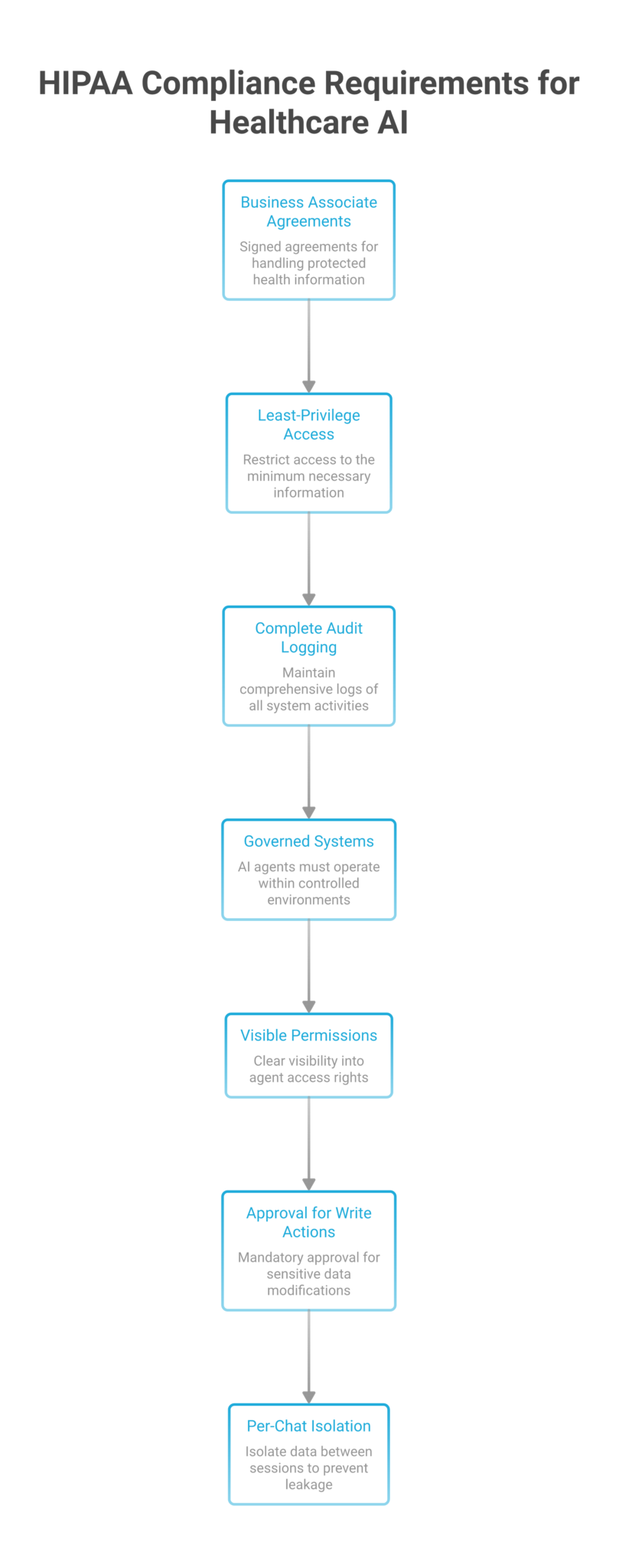
- A signed BAA, least-privilege access, and complete audit logging are the baseline controls for AI workflows that touch PHI.
- Topic-scoped memory and per-chat isolation reduce cross-case leakage when AI agents work inside connected chat-based workflows.
- Sensitive write actions should require approval, while read actions can run automatically if access is scoped and logged.
- Healthcare teams can use AI agents for patient call summaries, claim routing, staff coordination, and compliance documentation without losing control of PHI.
HIPAA Pressure on Connected AI Workflows
HIPAA and AI work agents meet at the same point: protected health information moves through a governed system, and every system in that path needs to be controlled. If a clinic, home care agency, or medical group sends PHI through connected tools without a BAA, audit trail, or access limits, the risk sits in the workflow, not just in the model.
That pressure has grown as healthcare teams use AI for patient communication, clinical notes, scheduling, and back-office coordination. Medcurity’s 2026 guidance on HIPAA compliance for AI in healthcare says there is no special AI exemption, and the same Privacy Rule and Security Rule obligations still apply. For operations leaders, that means AI agents need to be set up as governed workers inside the process, with visible permissions and proof of access.
The practical test is simple. If an AI agent can see, move, summarize, or route PHI, you need to know what data it can reach, who approved that reach, and what happened next. Zenzap gives teams a way to build those AI agents inside secure chat while keeping control of the tools, the context, and the record.
What HIPAA Requires From AI Agents
HIPAA treats AI agents as part of the covered workflow when they create, receive, maintain, or transmit PHI. The result is an operational standard, not a software label: the organization must prove that access is limited, vendor relationships are covered, and activity is recorded.
Activepieces’ 2026 requirements guide for HIPAA compliant AI agents notes that no agent is HIPAA compliant by itself, and that each new connection touching patient data becomes a liability line until it is covered by agreement and safeguards. Atlan’s HIPAA compliance guide for AI agents adds that the agent follows the same minimum necessary standard, audit controls, and breach notification obligations as human workforce members.
For a director or manager, that changes how AI rollout gets handled. You need a BAA with each vendor that touches PHI, role-based access controls, audit logging that shows who accessed what and when, and a memory model that does not leak patient context across unrelated work. You also need to know which actions can run automatically and which ones stop for approval.
A Compliance Map for Healthcare Teams
The frameworks below define the rules that shape secure AI workflows in connected tools. Each one creates a different obligation, but the same operational pattern runs through all of them: limit access, govern vendors, and retain proof.
- HIPAA requires covered entities and business associates to protect PHI under the Privacy Rule, Security Rule, and Breach Notification Rule, which means AI agents handling patient data must obey minimum necessary access, maintain audit controls under 45 CFR §164.312(b), and support breach response timelines. For a healthcare team, that means the agent cannot roam across patient records or act outside approved scope.
- SOC 2 requires controls that prove security, availability, confidentiality, and processing integrity, so AI workflows need access restrictions, traceable actions, and a record of approvals. The operational implication is that a team cannot rely on informal usage or private prompts when the workflow affects patient data.
- ISO/IEC 27001:2022 requires an information security management system with risk treatment, access control, logging, and supplier oversight, which means every connected tool and every AI workflow needs documented control ownership. For a medical group, that turns each integration into a managed security asset.
- GDPR applies when healthcare organizations process personal data of people in the UK, EU, or related markets, and it demands lawful processing, data minimization, purpose limitation, and security by design. AI agents that summarize patient contact or move records across tools must keep the data set narrow and the purpose explicit.
The Controls That Cover More Than One Rule
Some controls do more than satisfy one requirement. They become the shared layer that keeps HIPAA, SOC 2, ISO/IEC 27001:2022, and GDPR on the same operational footing.
- Least-privilege access satisfies HIPAA’s minimum necessary standard, supports SOC 2 access controls, and fits ISO/IEC 27001:2022 access management requirements. When an AI agent can only see the fields required for one task, the team lowers exposure and keeps the workflow auditable.
- Audit logging satisfies HIPAA audit controls, supports SOC 2 evidence requirements, and helps demonstrate accountability under ISO/IEC 27001:2022. If every prompt, retrieval, and action is recorded, reviewers can trace the path of PHI through the workflow.
- Topic-scoped memory supports HIPAA privacy expectations, reduces GDPR data minimization risk, and helps contain security issues under ISO/IEC 27001:2022. When memory stays inside the relevant chat or case, patient context does not spill into unrelated work.
- Vendor governance through BAAs and approved connections satisfies HIPAA business associate obligations, supports ISO/IEC 27001:2022 supplier controls, and helps with SOC 2 third-party risk evidence. Each integration stays inside a controlled set of relationships instead of a loose chain of tools.
| Capability or control | HIPAA | SOC 2 | ISO/IEC 27001:2022 | GDPR |
|---|---|---|---|---|
| Role-based access control | Satisfies minimum necessary access when scoped to PHI tasks. | Supports access control evidence and user restriction testing. | Supports access management and least-privilege control ownership. | Partially satisfies data minimization by reducing exposed data fields. |
| BAA-covered vendor connections | Satisfies business associate requirements when PHI moves to vendors. | Supports third-party risk and supplier control evidence. | Supports supplier relationship controls and documented oversight. | Partially satisfies processor governance when personal data is handled. |
| Audit logging of prompts and actions | Satisfies audit controls and supports breach investigation. | Satisfies evidence collection for security and processing integrity. | Satisfies logging and monitoring expectations for security events. | Supports accountability and incident traceability. |
| Topic-scoped memory | Satisfies privacy containment for PHI within the relevant workflow. | Supports confidentiality and change control evidence. | Supports information segregation and risk treatment controls. | Satisfies data minimization and purpose limitation more directly. |
| Approval controls for write actions | Satisfies authorization expectations for sensitive PHI changes. | Supports change approval and integrity controls. | Supports change management and control of operational risk. | Partially satisfies human review expectations for high-risk processing. |
| Whitelisted endpoint access | Satisfies network restriction and data egress control needs. | Supports secure system boundaries and monitored integrations. | Supports secure communication and technical boundary controls. | Supports transfer limitation and controlled disclosure. |
| Managed infrastructure | Satisfies administrative safeguard support for hosted operations. | Supports infrastructure availability and security evidence. | Supports operational resilience and asset management controls. | Supports security by design and operational protection. |
| Fast, topic-local agent responses | Partially satisfies workflow efficiency without changing the legal requirement. | Does not address the control directly, but improves usable security. | Does not address the control directly, but supports operational adoption. | Does not address the control directly, but reduces friction in approved workflows. |
The mapping shows that HIPAA readiness comes from the control plane around the AI agent, not from the AI agent alone.
Audit Evidence You Can Hand to Reviewers
A strong HIPAA audit packet is made of records, not promises. Teams should be able to show who had access, what data the AI agent touched, what it did, and where approval was required.
- Access logs show who entered the chat, what role they held, and which PHI-scoped topic they used. That evidence supports HIPAA audit controls and SOC 2 access testing because it ties activity to an accountable user.
- Prompt and action logs show every request, retrieval, and write action the AI agent performed. Activepieces’ HIPAA requirements guide specifically calls for logging every prompt, retrieval, and action, which gives auditors a direct trace of what happened.
- Approval records show when a sensitive write action paused for human sign-off and who approved it. That evidence supports HIPAA authorization expectations, SOC 2 change integrity, and ISO/IEC 27001:2022 change control.
- Vendor and BAA inventory shows which connected tools can touch PHI and which agreement covers each one. Atlan’s guide on HIPAA compliance for AI agents says each vendor touching PHI must be covered, so this export gives compliance teams a clean answer during review.
- Topic memory exports show what the AI agent retained inside one case and what stayed out of unrelated work. That evidence supports HIPAA minimum necessary practice and helps demonstrate GDPR data minimization.
What Deployment Changes For Compliance Teams
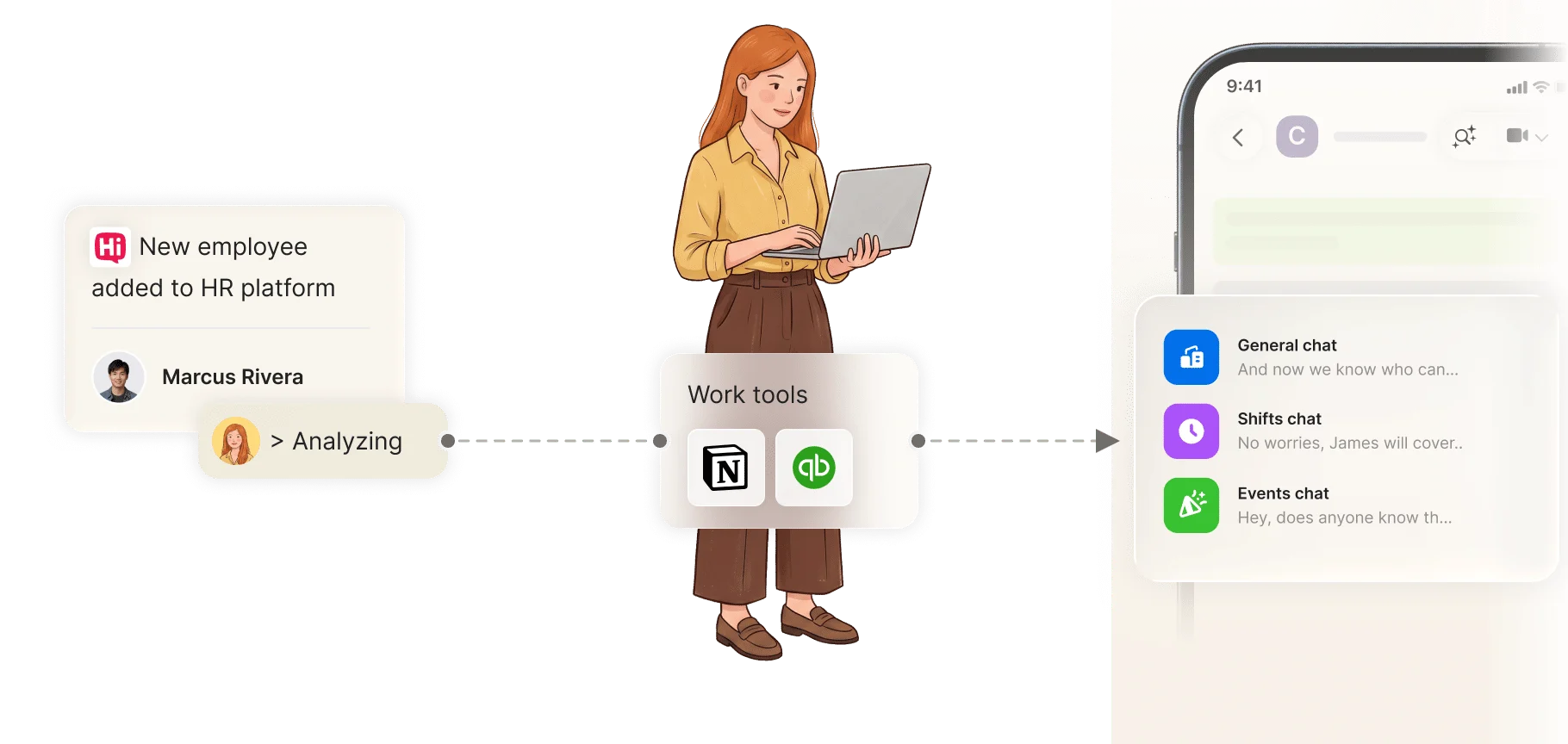
After AI agents sit inside governed chat workflows, compliance stops depending on scattered manual checks. The organization can show that each PHI touchpoint is scoped, logged, approved when needed, and tied to a named vendor relationship.
That changes the audit posture. Instead of explaining how staff used a private tool informally, the team can show how work moved through an approved process with records attached at each step. For healthcare leaders, that lowers legal exposure, shortens evidence collection, and reduces the chance that a workflow breaks privacy controls during routine work.
For a clinic director or operations manager, the practical result is a cleaner review cycle and less back-and-forth with auditors. A patient call summary, an insurance claim route, and a care-team handoff can all run inside one governed workflow, with the PHI scope limited to the task and the output stored with a clear trail.
- The board can see that PHI access is limited by role and topic, which shows the organization has moved from broad tool access to controlled workflow access.
- An auditor can review prompt logs, action logs, and approval records in one place, which shortens evidence requests and makes the control story easier to verify.
- A regulator can see that vendor relationships are covered by BAAs and that the organization can name every system that touches PHI, which reduces ambiguity during review.
- Compliance leaders can show that AI agents only see the minimum necessary data for the task, which supports privacy, security, and breach response expectations at the same time.
Compliance gets easier when the security architecture is built around the workflow from the start, because then the evidence comes out of normal work instead of being assembled after the fact.
FAQ
Q: Does HIPAA care whether a person or an AI agent handles PHI?
A: No. HIPAA cares about what happens to PHI and whether the surrounding workflow is governed. If an AI agent creates, receives, maintains, or transmits PHI, the organization still needs a BAA, access control, and logging. The practical question is whether the AI agent is part of a controlled process with documented safeguards. If it is not, the compliance gap sits with the workflow.
Q: What is the first control healthcare teams should add?
A: Start with role-based access and a signed BAA for every vendor that touches PHI. Those two controls answer the first questions auditors ask: who can see the data, and who is contractually bound to protect it. After that, add audit logging and approval controls so the team can prove what happened inside the workflow. Without those records, compliance becomes hard to defend.
Q: Why does minimum necessary matter so much for AI agents?
A: Minimum necessary limits the data an AI agent can see to what the task actually needs. That matters when an agent is summarizing a patient call, routing an insurance issue, or drafting a care note, because broad access increases the chance of exposure. Atlan’s HIPAA compliance guide for AI agents calls out broad FHIR scopes and persistent memory as common failure modes. Tight scoping keeps the workflow usable and safer.
Q: What audit evidence should a healthcare team keep?
A: Keep access logs, prompt and action logs, approval records, vendor inventories, and BAA documentation. Each one answers a different part of the HIPAA review: who accessed the data, what the AI agent did, who approved sensitive changes, and which outside systems were involved. If the evidence is complete, auditors can trace the workflow without chasing side documents. That lowers the friction of the review.
Q: Can AI agents be used for patient-facing tasks safely?
A: Yes, if the workflow is limited, logged, and approved where needed. Common uses include call summaries, routing patient requests, drafting internal notes, and triaging administrative work. The safer pattern is to keep the AI agent inside a secure chat with topic-scoped memory and approved tool access. That keeps the workflow inside the compliance boundary.
About Zenzap
Zenzap gives you AI agents that do work for you, connected to your tools and your team through a secure chat. Setup takes one click: no code, no developer. Unlike Claude or ChatGPT, the agents come already built and connected. You talk to them like a coworker: tag them into chats, correct them once and they remember. They act across your tools, automate workflows, build reports and graphs, summarize chats, flag what needs attention and coordinate people and tasks. One person gets value alone. Add your team, and every correction makes the agent sharper. Agents start in about 300 ms and run on managed infrastructure. Memory stays isolated by topic, and agents never hold credentials. They reach only approved domains, and sensitive actions need your approval.
If your team needs HIPAA-aware AI agents that work inside connected tools with governed access, what workflow would you automate first?