


Key Takeaways
- New security rules make governed AI agents in team chat a requirement, because permissions, audit logs, and identity controls are now part of the buying decision.
- Enterprise adoption is already far ahead of governance. MiniOrange cites Deloitte data showing 96% of organizations run AI agents in production, while only 21% have mature governance.
- The riskiest failures are practical, not theoretical. Reported figures include 53% of organizations seeing AI agents exceed intended permissions and 47% facing an AI agent security incident in the past 12 months.
- Topic-scoped memory, approval controls, whitelisted access, and no-credentials architecture reduce the chance that an AI agent in chat becomes a security gap.
- Teams that add AI agents inside the same place they discuss work can move faster without scattering context across private prompts and disconnected tools.
Introduction
Security rules around AI agents have tightened enough that work teams can no longer treat them as side experiments. The pressure is coming from production use, compliance demands, and rising proof requirements around access, auditability, and control. That is why AI agents in work chat are becoming non-negotiable for managers who need speed without losing oversight.
The shift is simple to describe and hard to ignore. If an AI agent can read a message thread, touch a CRM record, draft a report, or route an approval, it now sits inside the same risk surface as the rest of the business. The question is no longer whether teams will use AI agents. The question is whether those AI agents live inside a governed chat environment where people can see what happened, approve sensitive actions, and keep work in one place.
The change is not limited to one industry or one country. In the United States, Canada, and the United Kingdom, regulated teams are already facing stronger expectations around GDPR, HIPAA, SOC 2, and internal controls. That is why the convergence below matters: it explains why secure, shared AI agents are moving from optional to required.
Table of Contents
- Production Use Is Already Ahead of Governance
- Regulated Data Is Raising the Cost of Mistakes
- Identity, Audit, and Access Gaps Are Now the Bottleneck
- Work Still Happens in Chat, So Control Has To Live There
- Buyers Want Fast Setup Without Adding Risk
- A Secure Chat Layer Makes AI Agents Usable Across Teams
Production Use Is Already Ahead of Governance
AI agents are already in production at a rate that governance programs have not caught up with. MiniOrange cites Deloitte data showing 96% of organizations are running AI agents in production, but only 21% have a mature governance model, and that gap is exactly why security teams are moving from review to enforcement. The result is a market where use is normal, but control is still uneven.
That gap produces a direct decision problem for managers and directors. If an AI agent is already touching business tools, then the company needs a place to set permissions, keep a record of actions, and limit who can reach sensitive data. The miniOrange summary of AI agent compliance challenges shows how quickly these issues spread across GDPR, HIPAA, SOC 2, and the EU AI Act.
The practical effect is clear in day-to-day work. A sales director may want an AI agent to draft follow-ups in a CRM, while an operations manager wants one to update a task list after a client call. Those are useful tasks, but they also require visibility into who allowed the action, what data the AI agent used, and whether the action was approved.
Regulated Data Is Raising the Cost of Mistakes
Healthcare, legal, retail, and franchise teams are now operating in a much higher-cost environment for data mistakes. IBM and Ponemon found that the average healthcare data breach cost reached $9.77 million in 2024, the highest of any industry for the 14th consecutive year, which makes weak controls around AI agents especially expensive in medical and home care workflows. For teams in regulated sectors, an AI agent that can summarize a call or move a record also needs strict guardrails.
European enforcement pressure is adding more weight. DLA Piper reported €5.88 billion in cumulative GDPR fines since May 2018, and personal data breach notifications in Europe reached 443 per day in 2025, up 22% year over year. Those figures show why teams cannot treat access controls as a nice-to-have when AI agents handle customer, patient, or employee data.
The compliance message is the same across tools and industries. The HIPAA and GDPR guide for compliant AI agents and enterprise SOC 2, HIPAA, TCPA, and GDPR guidance both point to the same requirements: least-privilege access, traceable actions, and approved data paths. In practice, that means an AI agent in chat should only reach approved systems and should never hold credentials directly.
Identity, Audit, and Access Gaps Are Now the Bottleneck
Identity is becoming the hardest part of AI agent governance. MiniOrange reports that only 21% of organizations maintain a real-time agent registry, only 18% of security leaders believe their IAM stack can handle AI agent identities, and only 23% have a formal strategy for managing non-human identities at scale. Those numbers explain why many deployments stall after the pilot phase.
Audit depth is weak in many companies as well. The same research says only 38% track AI activity end to end, and just 17% monitor agent-to-agent interactions. EY and the AIUC-1 Consortium also found that 64% of companies with revenue above $1 billion reported AI-related losses above $1 million in 2025, which gives finance leaders a concrete reason to ask for better logs before approving wider use.
The result is a clear demand for controlled AI agents inside a shared chat environment. Security teams need topic-level memory, approval rules for sensitive actions, and logs that show the chain of events. Zenzap’s design, including per-topic isolation, whitelisted domains, and approval controls, fits that requirement better than a private chatbot thread or a loose collection of prompts.
Work Still Happens In Chat, So Control Has To Live There
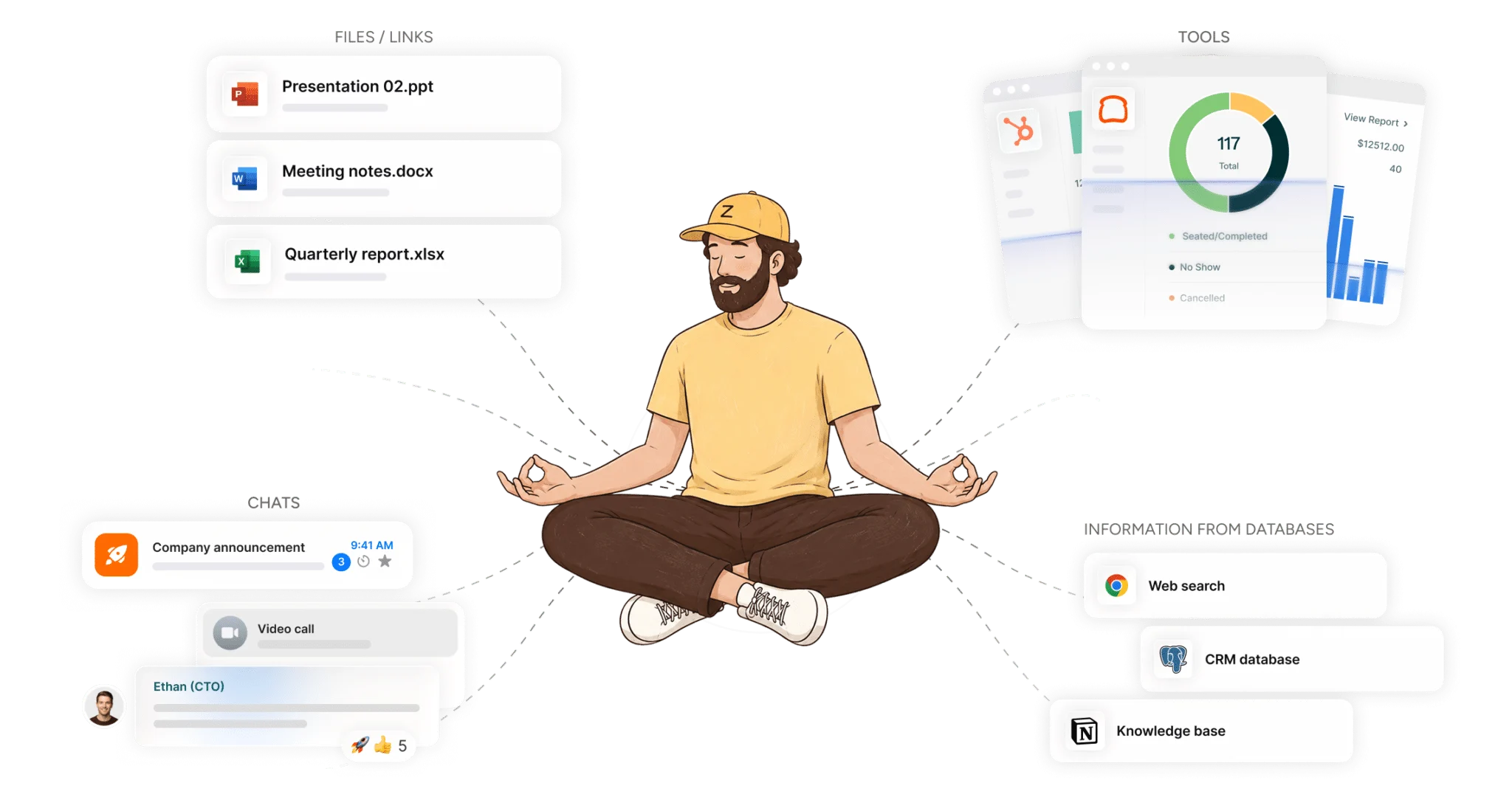
Business decisions already move through chat, calls, and quick message threads, not just through formal systems. That is why AI agents need to be present where the work is discussed, not bolted on after the fact. If a project manager approves a task in a group chat, the AI agent that updates the tracker should sit in that same thread so the reason, the approval, and the action stay together.
That setup matters because chat gives the AI agent context that a standalone prompt cannot. A legal team can keep intake, redlines, and follow-up tasks in one thread. A retail district manager can use one shared chat to track store issues, vendor responses, and local approvals. A home services team can route a job update, confirm the dispatch, and record the action in one place.
For teams comparing setup styles, the operational difference is obvious in secure team chat with enterprise-grade security for task tracking and work chat apps with admin controls and privacy. The value is not the message itself. The value is that the message, the decision, and the AI agent action can be governed in the same place.

Buyers Want Fast Setup Without Adding Risk
Adoption fails when the control layer feels like a project. Teams want AI agents that are easy to build, easy to add to chats, and ready to use without a developer on standby. That pressure is especially strong in SMBs, where the buyer wants value in days, not months.
Speed is part of the business case, but only if it is paired with control. The market is already full of experimentation, and Gartner’s cited prediction that more than 40% of agentic AI projects will be canceled by 2027 because of poor governance shows what happens when organizations move fast without guardrails. At the same time, Cisco’s 2026 Data and Privacy Benchmark Study found that 87% of organizations say strong privacy laws make customers more comfortable using AI applications, which means trust is now a commercial issue as well as a legal one.
That is where secure work software changes the buying math. A manager can simplify the workday with chat, tasks, and file sharing while keeping AI agents in the same controlled environment. The payoff is not abstract. It is fewer lost approvals, fewer manual handoffs, and fewer questions about who did what.
A Secure Chat Layer Makes AI Agents Usable Across Teams
The final force is the one that turns all the others into an operating model. When AI agents sit inside a secure chat layer, the company gets shared context, controlled access, and a visible record of action in one place. That is what makes AI agents usable for directors, managers, and team members who need more than a private assistant.
This setup also solves a practical spread problem. One person can start alone, add an AI agent, connect a tool, and save time immediately. Then the same AI agent can be added into the team thread so other people can correct it, ask for a follow-up, or see why a step was taken. That is the difference between a personal experiment and a repeatable workflow.
The best indicator that the market is moving this way is simple. Companies now want AI agents that can summarize a chat, flag what needs attention, move data across tools, and do it with approval, logs, and topic-level isolation. That is the control profile security teams can sign off on and business teams can actually use.
The convergence that makes secure AI agents non-negotiable
When all of these forces hit at once, they create a narrow window where speed, compliance, and shared context have to exist together.
The combination produces a new standard for work software, because companies now need AI agents that can act inside the same chat where decisions happen, while still respecting identity, approval, and audit rules. It also opens a buying window for teams that want to move from private experiments to governed collaboration without adding a separate system for every task. Zenzap is positioned for this moment because it gives teams AI agents already connected to the tools they use, inside a secure chat interface, with no-code setup and controls that fit real business use.
- The most important action now is to add AI agents into the same chat where work decisions already happen, so context and approval stay together.
- The most valuable capability at this point is per-topic isolation with approval controls, since it keeps sensitive actions contained.
- Teams that act now get faster coordination, cleaner audit trails, and fewer manual handoffs across tools.
- Teams that wait keep paying for disconnected prompts, hidden actions, and slower compliance reviews.
- The clearest sign the window is closing is when security, legal, and operations all start asking for registry records, approval logs, and proof of access control before any new AI agent can be used.
| Force | Individual effect | Convergence contribution | Action for managers |
|---|---|---|---|
| Production use ahead of governance | AI agents are already running in live environments. | Creates urgency to set controls before usage spreads further. | Set approval rules and approved use cases now. |
| Regulated data pressure | Breach and fine exposure is high in healthcare and other regulated sectors. | Raises the cost of every permission mistake. | Restrict access to approved domains and systems only. |
| Identity and audit gaps | Many companies lack registries and end-to-end tracking. | Makes AI agent actions hard to trust or explain. | Use a system with logs, topic memory, and clear ownership. |
| Work still happens in chat | Approvals and coordination already happen in message threads. | Puts AI agents where context already lives. | Add AI agents to the team thread, not a side tool. |
| Low-friction setup demand | Teams want fast value without developer work. | Rewards systems that are ready in one click. | Choose a no-code model with controls built in. |
FAQ
Q: Why are security rules changing how teams use AI agents?
A: Security rules are forcing companies to prove who can access data, what the AI agent can do, and where every action is recorded. That pushes AI agents out of informal use and into governed systems. Teams now need approval controls, audit logs, and identity management before broad rollout. In regulated sectors, those controls are no longer optional because the cost of mistakes is measurable.
Q: What makes AI agents in chat more secure than private prompts?
A: A chat-based setup can keep context, approvals, and actions in one place. That makes it easier to see who asked for what and whether a sensitive step was approved. It also helps teams keep memory scoped to the right topic, which reduces cross-project leakage. A private prompt leaves too much of the process outside the team record.
Q: Which industries need controlled AI agents most right now?
A: Healthcare, legal, finance, retail, hospitality, construction, and home services face the strongest pressure because they touch customer, patient, employee, or operational data. Those teams also tend to run recurring workflows, so one AI agent can affect many decisions over time. The more regulated the data, the more important it becomes to control access and log actions. Even smaller companies in those sectors now need the same discipline.
Q: What should a manager ask before adding an AI agent to a team thread?
A: Start with access, auditability, and approval. Ask whether the AI agent can touch credentials, whether its actions are logged, and whether sensitive writes require human approval. Then check whether the AI agent is limited to approved tools and approved domains. If the answer is unclear, the setup is not ready for business use.
Q: How do AI agents help without creating more risk?
A: They save time when they take on recurring work like summaries, task routing, reporting, and follow-up reminders. The risk drops when those actions happen in a controlled chat environment with topic-scoped memory and human approval for writes. That lets teams keep speed without handing over unrestricted access. The business gets the benefit only if the AI agent is built with clear boundaries.
About Zenzap
Zenzap gives you AI agents that do real work, connected to your tools and your team through a secure chat. Setup takes one click: no code, no developer. Unlike Claude or ChatGPT, the AI agents come already built and connected. You talk to them like a coworker: tag them into chats, correct them once and they remember. They act across your tools, automate workflows, build reports and graphs, summarize chats, flag what needs attention and coordinate people and tasks. One person gets value alone. Add your team, and every correction makes the AI agent sharper. AI agents start in about 300 ms and run on managed infrastructure. Memory stays isolated by topic, and AI agents never hold credentials. They reach only approved domains, and sensitive actions need your approval.
Secure AI Agents Are Now A Business Requirement
These forces will not stay aligned for long. Governance pressure is rising, regulated data exposure is getting more expensive, and companies are asking for proof before they approve more AI agents. The window is open now, and the teams that move inside it can keep work fast while bringing control into the same place.
That is why the best path is not another private assistant. It is AI agents that sit inside the team conversation, connect to the tools people already use, and keep permissions, logs, and memory under control. The teams that act now will have faster workflows and cleaner oversight while their competitors are still sorting out how to govern the next request.