


AI work agents without code are becoming the fastest way to turn AI interest into measurable work output. Enterprises are increasing AI budgets, but most teams still lose time to setup, integration, and pilot projects that never reach everyday use. When business users can build AI agents in one click, connect them to their tools, and run repeatable workflows, the result is not another experiment. It is hours saved, errors reduced, and work moved forward.
That is why the no-code approach matters now. Research keeps pointing to the same bottleneck: the demand is real, the ROI is real, but the technical lift still blocks adoption. The shift happens when the AI lives where the work already happens, instead of sitting in a private chatbot that nobody else can see.
For people searching for terms like zen app, zen chat, zenz app, or work chat, the key distinction is this: the value is not in a standalone app or a generic chatbot. It is in a shared work chat where AI agents can be tagged into real conversations, keep context, and help teams finish work together.
Table of Contents
- Why No-Code Is the First Real Constraint To Remove
- Why Fast Setup Turns Interest Into Workflow Adoption
- Why Measurable Workflows Create ROI That Teams Trust
- Why Team Chat Context Makes AI Agents Stick
- Why Security And Control Decide Whether The Rollout Scales
- What Zenzap Is and How It Compares To Other Work Chat Tools
- Key Takeaways
- FAQ
- About Zenzap
Why No-Code Is The First Real Constraint To Remove
No-code is the first bottleneck because business teams already know where the waste is. They do not need another strategy deck; they need a way to build AI agents around reporting, lead routing, ticket triage, approvals, summaries, and task coordination without waiting on engineering.
That matters even more when the market is moving this fast. Capgemini says 92% of enterprises intend to expand their AI investments, and the no-code AI platform market is projected by Zylos Research to grow from $3.68 billion in 2024 to $37.96 billion by 2033. When demand and market growth are both this strong, developer dependency becomes the real drag on outcomes.
You can see the same pattern in broader adoption data. Another market summary citing Grand View Research reports that 84% of enterprises are already adopting low-code or no-code platforms. That tells you the question is no longer whether teams want this model, but whether they can get to the work surface fast enough to use it.
Why Fast Setup Turns Interest Into Workflow Adoption
Once no-code removes the build bottleneck, speed becomes the next deciding factor. If an AI agent takes days of setup or needs a technical handoff, it stays in pilot mode and never becomes part of the daily process.
That is exactly where a one-click approach changes the economics. Zenzap gives teams a way to add AI agents in one click, connect them to work tools, and start using them right away. That matters because Anthropic’s The 2026 State of AI Agents Report found that 57% of organizations already use AI agents for multi-stage workflows, yet 46% still struggle with integration challenges. Speed alone does not solve that, but it shortens the path from idea to working process.
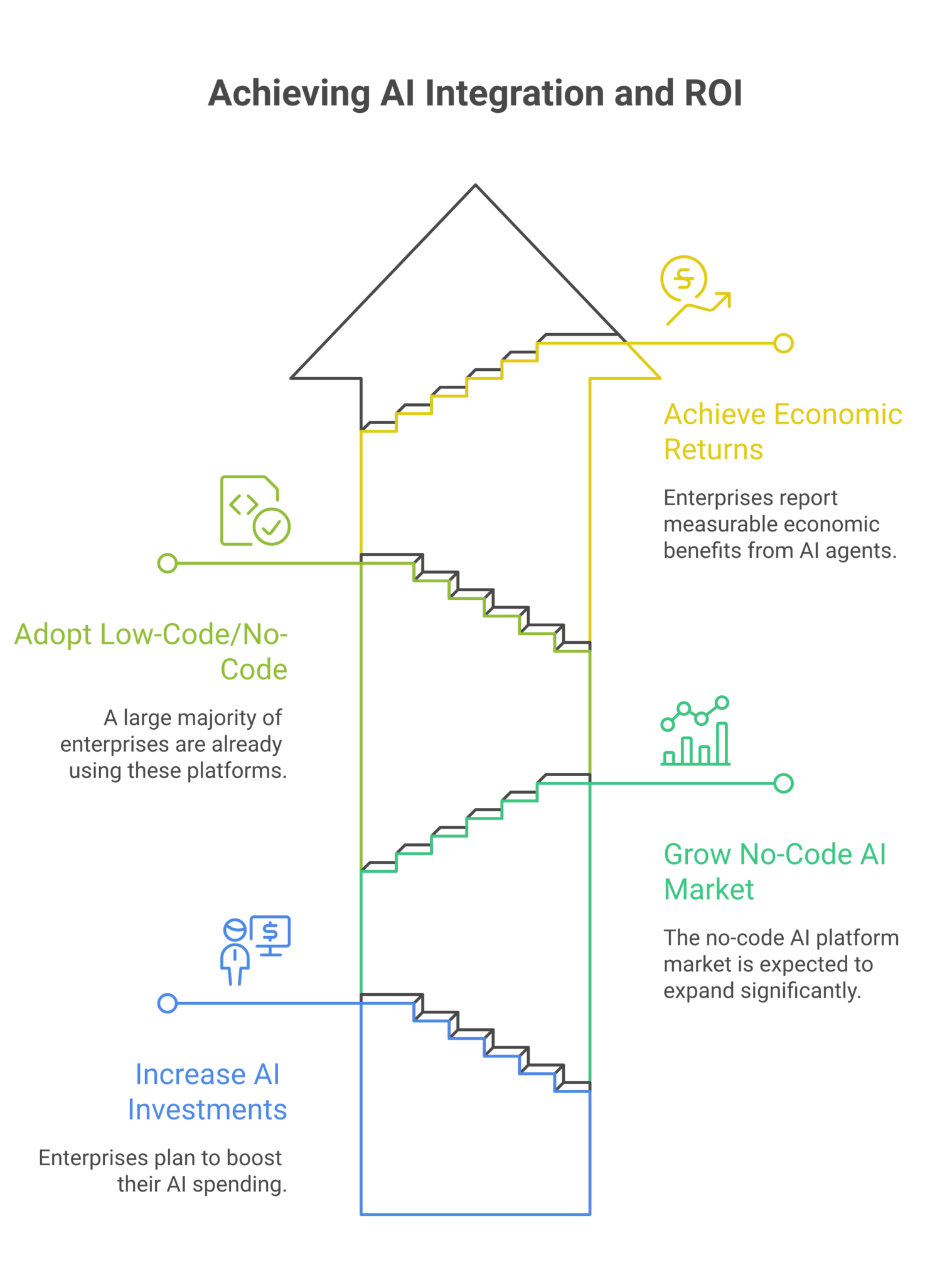
The same report says 80% of organizations already report measurable economic returns from AI agents. That is the point where adoption stops being speculative. If a team can add an AI agent quickly, prove value in one workflow, and expand from there, the rollout starts to spread on its own.
Why Measurable Workflows Create ROI That Teams Trust
Once setup gets fast, the next test is whether the AI agent is doing work that shows up in the numbers. Teams do not buy vague productivity; they buy hours saved, revenue moved, mistakes caught, and risk reduced.
That is why repeatable workflows matter more than generic chat. Lead routing, invoice follow-up, support triage, compliance checks, and daily status reporting all create measurable outputs. Panto’s statistics roundup says 80% of executives report measurable ROI from AI agents, while 95% of AI pilot programs still fail. That gap is the story. Pilot projects fail when they never attach to a real workflow with a real metric.
The best no-code AI agents close that gap because they can run the same task over and over. A weekly client update, a deal desk approval, or a service ticket summary is easier to trust when it is tied to a KPI. The more often the workflow runs, the more clearly the value appears.
Why Team Chat Context Makes AI Agents Stick
Once the workflow is measurable, it still has to live where people actually coordinate work. Private tools create private knowledge, and private knowledge does not scale across teams.
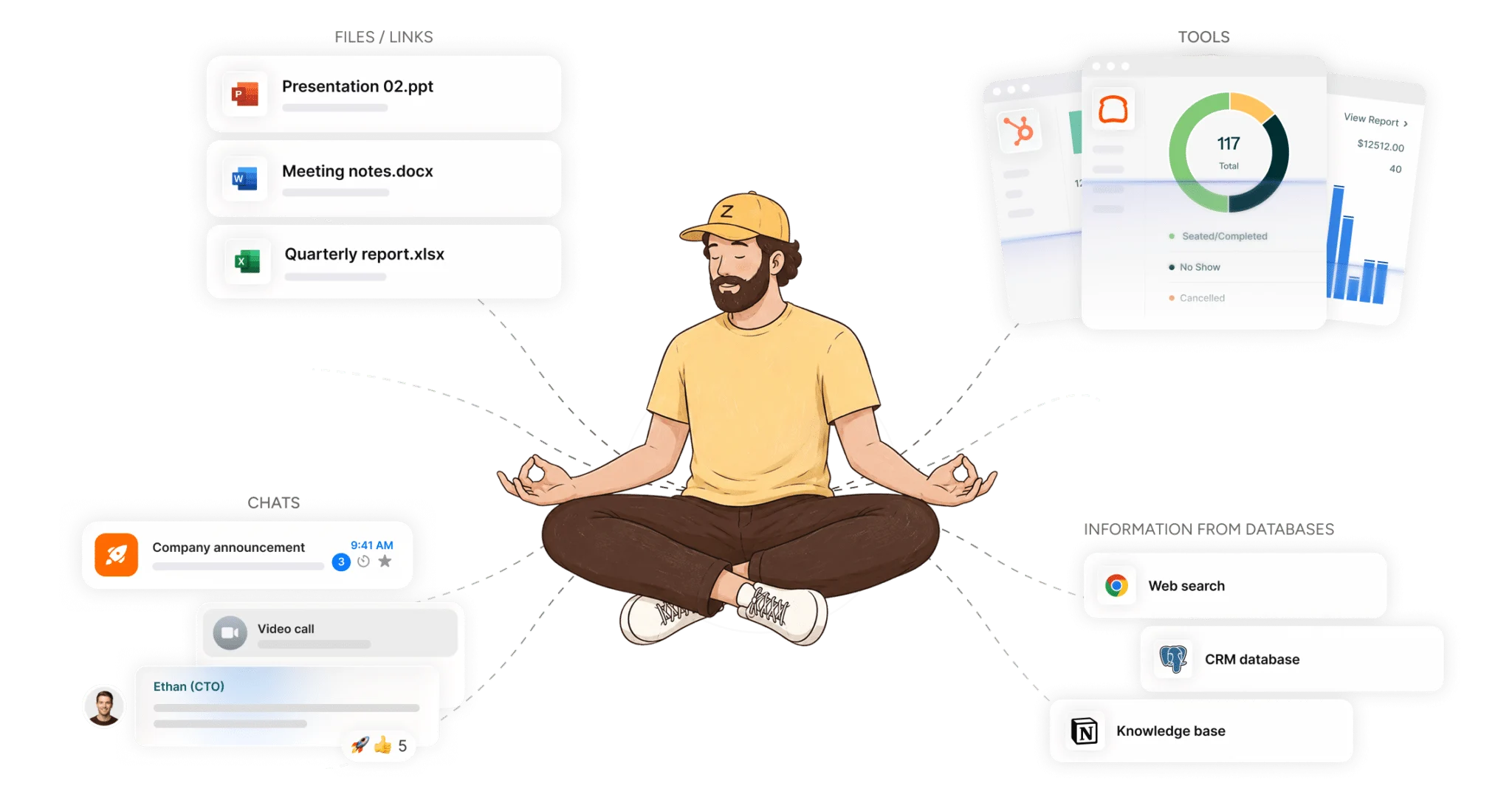
That is why multiplayer context is the next step after no-code and speed. When an AI agent sits inside team chat, the whole group can correct it, add context, and reuse the same working memory. Zenzap is built around this model, and it is also why an internal guide on how managers are switching from a popular team messaging platform to Zenzap for streamlined workflows matters for operations leaders. Work stays in the same place where the decisions are being made.
This is also the gap that matters for searches like zen chat and work chat. Those terms usually point to a simple question: can I use chat itself as the place where work gets done? The answer here is yes, but only if the chat is designed for business context, shared correction, and action inside the thread.
You can see the practical difference in the way teams use AI agents inside a shared conversation. One person can summarize a client thread, another can tag the AI agent into the same discussion, and the output becomes shared context instead of a private note. That is also why the AI agents product page is centered on doing real work across tools, not just answering questions.
Why Security And Control Decide Whether The Rollout Scales
Once the AI agent is in the workflow and in the team conversation, security becomes the final gate. If the AI agent can reach the wrong data, write to the wrong system, or hold credentials directly, the process will not survive legal, compliance, or IT review.
That is why control is not optional. Zenzap keeps memory isolated by topic, uses managed infrastructure, and never lets AI agents hold credentials directly. Sensitive actions can require approval, and access is limited to approved domains and connected tools. For teams in legal, healthcare, retail, home services, or franchise operations, those controls are what make adoption sustainable rather than risky.
A second internal resource, 7 essential features that make Zenzap the ultimate team communication tool, reinforces the same point from a product standpoint. If the platform cannot support admin controls, secure access, and shared context, the rollout stalls before the AI agent ever reaches the people who need it most. Security is the reason the workflow can spread across departments instead of staying locked in one test case.
What Zenzap Is and How It Compares To Other Work Chat Tools
If you are searching for zen app, zenz app, or oak engage vs zenzap, the comparison is usually less about consumer-style apps and more about whether the platform can actually support work. Zenzap is a secure work chat built for team communication, AI agents, and workflow execution in the same place. It is not just a messaging app, and it is not just a chatbot.
That difference matters because many tools can chat, but fewer can do all three of these things well:
– keep the conversation tied to the work
– let teams add AI agents without code
– preserve shared context as the work continues
That is the practical answer behind oak engage vs zenzap as well: the better choice is the one that lets teams communicate, coordinate, and act without stitching together separate tools for chat, task handoff, and AI assistance.
Key Takeaways
- Add no-code AI agents first where a workflow already repeats every week.
- Tie each AI agent to a KPI such as hours saved, leads moved, errors prevented, or cases resolved.
- Put AI agents inside team chat so context, correction, and follow-up stay visible.
- Use approval controls and approved tool access before expanding to sensitive workflows.
- Start with one workflow, then scale after the result is measured.
FAQ
Q: Why are no-code AI agents better for business teams than custom builds?
A: No-code AI agents remove the developer bottleneck, which is usually the slowest part of adoption. Business teams can focus on the workflow instead of writing code or waiting for engineering time. That makes it easier to move from idea to measurable output. It also reduces the chance that the AI agent stays trapped in a pilot.
Q: What kind of workflows should you build first?
A: Start with repeatable work that already happens on a schedule. Common examples include lead routing, ticket triage, report generation, approval routing, and chat summaries. These workflows are easier to measure because the input and output are already known. They also make it easier to prove value fast.
Q: Why does team chat context matter for AI agents?
A: Team chat context gives the AI agent access to the conversation where work decisions are made. That means it can learn from corrections, understand who asked for what, and keep the workflow visible to everyone involved. It also reduces the problem of one person holding all the context in a private tool. Shared context makes the AI agent more useful over time.
Q: How do you know if an AI agent is actually delivering ROI?
A: Measure the outcome tied to the workflow, not the novelty of the tool. Track hours saved, deals moved forward, tickets resolved faster, or errors prevented. If the AI agent is not connected to a measurable process, it will be hard to justify expansion. The clearest ROI comes from repeat work that happens every week.
Q: What blocks AI agent adoption most often?
A: Integration, data quality, and change management are the most common blockers. Anthropic’s 2026 report found 46% of organizations cite integration challenges, 42% cite data quality requirements, and 39% cite change management. Those issues get worse when a tool is hard to set up or isolated from the rest of the workflow. No-code setup and shared chat context reduce that friction.
Q: Can one person get value before the whole team adopts it?
A: Yes. One person can add an AI agent, connect a tool, and automate a workflow for personal use first. That is often the easiest way to prove the result and build trust. After that, the team can add the same AI agent into group chats and use the shared context together. The single-user win is the entry point, not the ceiling.
Q: Is Zenzap the same as a consumer app for meditation or personal productivity?
A: No. Zenzap is a work chat and AI agent platform built for team workflows, not a consumer mindfulness app. If you searched for zen app or zen chat, the relevant use case here is business communication, shared context, and automated work.
About Zenzap
Zenzap gives you AI agents that do real work, connected to your tools and your team through a secure chat. Setup takes one click: no code, no developer. Unlike Claude or ChatGPT, the agents come already built and connected. You talk to them like a coworker: tag them into chats, correct them once and they remember. They act across your tools, automate workflows, build reports and graphs, summarize chats, flag what needs attention and coordinate people and tasks. One person gets value alone. Add your team, and every correction makes the agent sharper. Agents start in about 300 ms and run on managed infrastructure. Memory stays isolated by topic, and agents never hold credentials. They reach only approved domains, and sensitive actions need your approval.
That is the reason no-code AI work agents matter now. They turn AI from a private test into a repeatable business workflow that a team can trust, measure, and scale. Once the setup barrier drops, the workflow becomes the product, not the experiment. And now you can see why adding AI work agents without code is the shortest path to real results.