


Key Takeaways
- AI agents moved from task support to multi-stage business work in 2026, so teams now need shared context, clear permissions, and measurable outcomes.
- Adoption is already broad. Gartner data cited by Metacto says 80% of enterprise applications shipped or updated in Q1 2026 embed at least one AI agent, up from 33% in 2024.
- The biggest bottlenecks are integration, data quality, and change management. Anthropic’s 2026 State of AI Agents Report says 46% of organizations cite integration challenges, 42% cite data quality requirements, and 39% cite change management needs.
- Shared correction matters. AI agents that live in group chats can learn from the whole team, not just one private user, which reduces handoff friction and keeps decisions visible.
- ROI is now a board-level topic. Anthropic reports 8 in 10 organizations already see measurable economic returns from AI agents, while Deloitte data cited in Digital Applied shows vendor agents reach first value in 38 days versus 94 days for custom builds.
Introduction
AI agents for companies in 2026 are moving from side projects into daily operations. The shift is visible in enterprise software, where Gartner data cited by Metacto shows 80% of applications shipped or updated in Q1 2026 embedded at least one AI agent, compared with 33% in 2024. That pace mirrors the cloud adoption wave from 2010 to 2012, but the work being automated is more specific, more measured, and more tied to internal workflows.
The practical question for managers, directors, and team members is simple: how do you build AI agents that people actually use, trust, and correct over time? The strongest answer in 2026 is shared context. When AI agents sit inside the same chat where the team already talks, they can summarize messages, flag blockers, update tools, and keep learning from corrections in real time. Zenzap’s AI agents for work fit that model by putting AI agents into the conversation instead of forcing teams to split work across separate tools.
The market data points in the same direction. Anthropic’s The 2026 State of AI Agents Report says 57% of organizations already use AI agents for multi-stage workflows, 16% have crossed into cross-functional processes, and 81% plan to take on more complex use cases in 2026. The transition is not about replacing people. It is about moving routine work into systems that can act, report, and ask for approval in the right places.
Table of Contents
- 2023 To 2024: The first wave of private AI assistants
- 2025: AI agents move into operational workflows
- Early 2026: Enterprise use shifts from experiments to workflows
- Mid-2026: Shared context becomes the real differentiator
- Late 2026: Building AI agents inside team chat becomes the default
- What leaders should build next
- A closer look at Zenzap’s model
- FAQ
- About Zenzap
2023 to 2024: The First Wave Of Private AI Assistants
The first stage was private experimentation. Individual workers tested AI tools for drafting, summarizing, and searching, then copied the output into their actual systems. That pattern created value, but it also created a second layer of manual work because the result still had to be reviewed, shared, and turned into action.
By 2024, the software market had started to change. Gartner data cited by Metacto shows enterprise applications with embedded AI agents rose from 33% in 2024 to 80% in Q1 2026. That jump tells you where the market went first: into products that already had a workflow, a user base, and a reason to act on data instead of just answer questions.
The same period also exposed the limits of private use. SALT Lab at Stanford says it analyzed data from 1,500 workers across 104 occupations and found that 70 million U.S. Workers are facing a major workplace transition due to AI agents. That is a broad signal, but it points to a narrow need inside companies, which is shared execution. If one person can draft faster but the team still has to hand off work in another system, the gain stays small.
2025: AI Agents Move Into Operational Workflows
In 2025, AI agents started moving from single tasks into repeatable operations. Anthropic’s report says nearly 90% of organizations surveyed already use AI to assist with coding, and AI agents now free up time across planning and ideation for 58% of teams and across code generation, documentation, testing, and review for 59%. That is a shift from simple assistance to actual workflow coverage.
The research also shows where the strongest returns are landing outside engineering. Anthropic says the top non-engineering use cases are data analysis and report generation at 60%, followed by internal process automation at 48%. It also reports that 56% plan to implement AI agents for research and reporting over the next year. In practice, that means companies are no longer testing AI agents only on small one-off tasks. They are asking them to produce reports, update systems, and coordinate work across departments.
SALT Lab adds another important layer. It reports that 41.0% of Y Combinator company-task mappings sit in the Low Priority Zone and Automation “Red Light” Zone, which suggests a mismatch between where startups are building and where workers actually spend time. The same lab also cites studies estimating around 80% of U.S. Workers may see LLMs affect at least 10% of their tasks, with 19% seeing disruption to more than half of their responsibilities. If that level of exposure is real, the design choice is no longer whether to use AI agents. It is how to organize them so people can see, correct, and trust what they do.
Early 2026: Enterprise Use Shifts From Experiments To Workflows
By early 2026, the market had moved into measurable operational use. Anthropic’s report, based on over 500 technical leaders in the United States, says 57% of organizations now deploy AI agents for multi-stage workflows, and 16% have moved into cross-functional processes spanning multiple teams. It also says 81% plan to take on more complex use cases in 2026, including 39% developing AI agents for multi-step processes and 29% for cross-functional projects.
That is the strongest signal yet that AI agents are becoming part of company operating systems. The point is not whether a model can answer a question. The point is whether it can move a task forward, update the right record, and surface the next step without creating extra admin work. Anthropic also says 80% of organizations report these investments are already delivering measurable economic returns, and 8 in 10 believe AI agents have already delivered measurable ROI.
The money side is getting clearer too. Digital Applied’s 2026 productivity statistics article says the median 6.4 hours saved weekly per knowledge worker comes from McKinsey Global AI Survey 2026 and the Workforce Index Q1 2026. It also cites a routine code-review task at $0.72 with AI agents versus $48 in senior-engineer time, a 66x difference. Those numbers matter because they shift the conversation from “can this be automated?” to “which recurring workflow should be moved first?”
Mid-2026: Shared Context Becomes The Real Differentiator
Once AI agents enter real workflows, the biggest gap is not model quality. It is context. Anthropic reports that integration challenges affect 46% of organizations, data quality requirements affect 42%, and change management affects 39%. Those three barriers explain why so many pilots stall before they reach production.
Shared context solves part of that problem. When an AI agent sits in a group chat with the team, it sees the thread, the correction, the follow-up, and the approval request in one place. That reduces back-and-forth across inboxes and separate dashboards. It also makes the agent easier to govern because the work is visible to the people responsible for it.

This is where Zenzap’s multiplayer AI agents model becomes useful. One person can add an AI agent, connect a tool, and get value alone. A team can then use the same AI agent in a shared chat, where each correction becomes part of the working context. The result is not just faster completion. It is better memory around who approved what, which task is blocked, and what normal looks like in that team.
Late 2026: Building AI Agents Inside Team Chat Becomes The Default
Late 2026 is shaping up around two trends at once, wider adoption and tougher scrutiny. FwdSlash says the global AI agents market is worth roughly $10 to $12 billion in 2026 and could reach $50 to $53 billion by 2030. The same source says 62% of organizations are experimenting with AI agents, but only 23% have scaled them, leaving a 39-point pilot-to-production gap.
That gap is where team-based design starts to matter more than standalone automation. FwdSlash also reports that 66% of customer service organizations now use agentic AI, up from 39% a year earlier, while 79% of executives say AI agents are in use. Consumer comfort is still low, with only 24% of U.S. Consumers comfortable letting AI make a purchase and 14% accepting AI placing orders. In company settings, that means write access, approvals, and audit trails need to be explicit.
Security data makes the case even more clearly. FwdSlash reports that 88% of organizations experienced confirmed or suspected AI agent security incidents, and 97% of AI-related breaches lacked proper access controls. For companies building AI agents in 2026, that is a warning to keep credentials out of the model, narrow internet access to approved domains, and require approval for sensitive writes. Zenzap’s secure AI agents for business follow that pattern with topic-scoped memory, approval controls, and managed infrastructure.
What Leaders Should Build Next
Leaders should start with one repeatable workflow, not a broad AI policy deck. The best first build is usually something that already happens every week, such as a customer update, a lead handoff, a finance approval, a site report, or a support summary. That keeps the scope tight and gives you a clear KPI, such as hours saved, deals moved forward, or mistakes caught.
The payback data supports that approach. Digital Applied cites Bain Agentic AI Benchmark 2026 with median payback periods of 4.1 months for customer service, 6.7 months for marketing operations, and 9.3 months for engineering. It also says vendor-deployed AI agents reach positive ROI 2.4x faster than custom builds, with time-to-first-value at 38 days for vendor agents versus 94 days for in-house custom builds, citing Deloitte’s State of Generative AI in the Enterprise Q1 2026. For most teams, the fastest path is to add an AI agent to a real workflow, connect the tools it needs, and let the team correct it in the same place work already happens.
That same approach helps with adoption. SALT Lab’s research shows 70 million U.S. Workers are in the middle of a workplace transition, and its audit of 1,500 workers across 104 occupations suggests workers need support, not just automation. Teams are more likely to adopt AI agents when they can see the logic, adjust the behavior, and keep the work in one shared place. A chat-based workflow with shared correction lowers the learning curve because people already know how to talk to a coworker.
A Closer Look At Zenzap’s Model
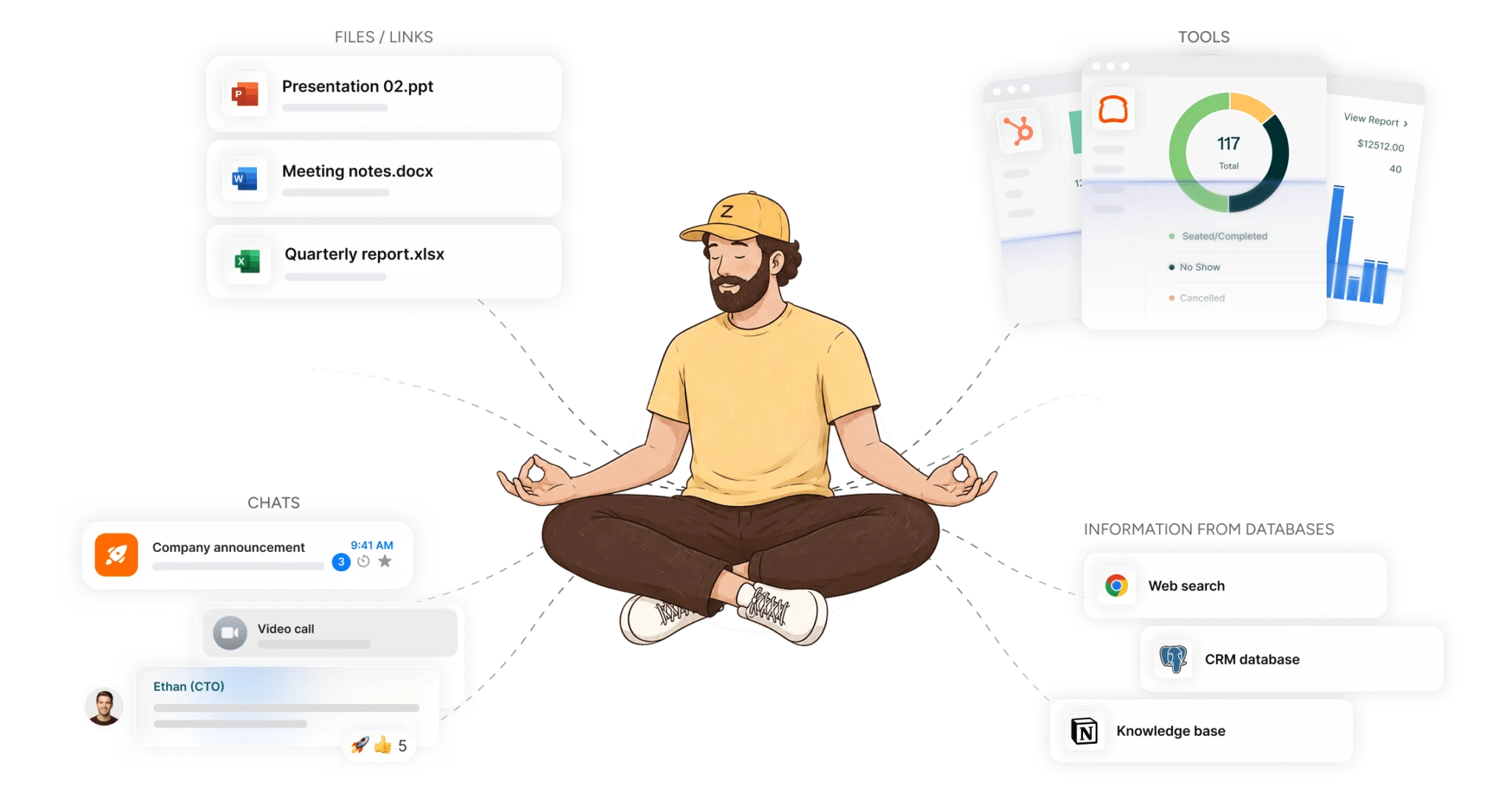
Zenzap gives companies AI agents that do real work in connected tools through secure chat. Setup takes one click, with no code and no developer. The value shows up fast because the AI agent can summarize a chat, flag what needs attention, coordinate between people and tasks, and update records across the tools your team already uses.
The design choice behind that model is straightforward. AI agents become more useful when they have context from the chat, the task, and the tool they are acting in. Zenzap keeps memory isolated by topic, starts AI agents in about 300 ms, and uses approval controls for sensitive actions. That setup fits companies that want measurable output without handing over broad access or forcing every user through a technical setup process.
For teams comparing options, the practical question is whether the AI agent works alone in a private prompt or inside the group where work is already moving. Zenzap’s AI work agents are built for the second path. A manager can add one to a project thread, a director can monitor the output, and the team can correct it together so the next action is better than the last one.
The Next Questions For Your Team
The next decision is not whether AI agents belong in your company. They already do. The real question is which workflow should get the first AI agent, who should control it, and what signal will tell you it earned its place.
If you are starting in 2026, ask whether the work is recurring, visible, and tied to a metric you can measure in hours, revenue, or risk. Then ask whether the AI agent should live in a private interface or inside the same chat where the team discusses the work. Finally, decide who can approve write actions, who can edit the workflow, and how you will review the output after the first 30 days.
FAQ
Q: What changed in 2026 for companies building AI agents?
A: AI agents moved from isolated assistants to workflow tools used across departments. Anthropic’s report says 57% of organizations now use AI agents for multi-stage workflows, and 16% use them across teams. That shift matters because it changes the design problem from “can this answer?” to “can this move work forward safely?” Companies now need shared context, approval rules, and clear metrics.
Q: Why does shared chat matter for AI agents?
A: Shared chat gives the AI agent the same context the team has. It can see corrections, follow-up questions, and approvals in one thread, which reduces confusion across tools. That also makes the work easier to audit because the decisions stay visible where the team already talks. For managers, that means less guesswork and fewer private side conversations.
Q: What is the biggest barrier to scaling AI agents?
A: Anthropic says integration challenges affect 46% of organizations, data quality requirements affect 42%, and change management affects 39%. Those are the main reasons pilots stop before production. The fix is usually not a larger model. It is a narrower workflow, cleaner inputs, and a better place for people to correct the output.
Q: How fast can AI agents pay back their cost?
A: The answer depends on the workflow, but the numbers are encouraging. Digital Applied cites median payback periods of 4.1 months for customer service, 6.7 months for marketing operations, and 9.3 months for engineering. It also reports that vendor-deployed AI agents reach positive ROI 2.4x faster than custom builds. That is why many teams start with one high-volume recurring task.
Q: What should a team build first?
A: Start with a workflow that already repeats every week. Good examples include lead routing, support summaries, site reports, approval routing, or research briefs. Pick one with a measurable outcome, such as hours saved, tickets closed, or errors reduced. Then add the AI agent to the place where the team already works so the correction loop is short.
Q: How does Zenzap fit into this shift?
A: Zenzap gives teams AI agents that work inside secure chat and connect to tools without code. That makes it easier to add AI agents to a live workflow, keep context in one place, and let multiple people correct the same AI agent. The platform also uses topic-scoped memory, approval controls, and managed infrastructure, which helps teams keep access and risk under control.
About Zenzap
Zenzap gives you AI agents that do real work, connected to your tools and your team through a secure chat. Setup takes one click: no code, no developer. Unlike Claude or ChatGPT, the AI agents come already built and connected. You talk to them like a coworker: tag them into chats, correct them once and they remember. They act across your tools, automate workflows, build reports and graphs, summarize chats, flag what needs attention and coordinate people and tasks. One person gets value alone. Add your team, and every correction makes the AI agent sharper. AI agents start in about 300 ms and run on managed infrastructure. Memory stays isolated by topic, and AI agents never hold credentials. They reach only approved domains, and sensitive actions need your approval.