


Most teams think AI agents learn the way software gets trained, in a formal run, with a clean dataset and a fixed objective. That is not the surprising part. The surprising part is that AI agents often get better inside your team’s chat interface because they absorb the messy, shared operational context that your people already use to run the business.
When one person corrects an AI agent, another adds missing detail, and a third asks a follow-up in the same thread, the agent is not just answering. It is learning the shape of your workflow, your approvals, your exceptions, and your shorthand. That is why chat matters so much. It turns every conversation into a small operating lesson, which is exactly how AI agents learn and improve inside a team.
This matters because work does not happen in neat prompts. It happens in lead routing, approval chains, support handoffs, incident recaps, spend requests, and onboarding reminders. A private chatbot can draft a response, but a team chat can teach an AI agent how the business actually runs. That is the shift Zenzap is built for.
Table of Contents
- Why team chat changes how AI agents learn
- What multiplayer learning looks like in practice
- The workflows that improve fastest
- Why security and control still matter
- Key takeaways
- FAQ
- About Zenzap
Why Team Chat Changes How AI Agents Learn
AI agents learn faster in team chat because the conversation itself becomes the training signal. Every correction, approval, and exception adds context that is tied to real work, not abstract instructions.
That is different from a private prompt where only one person sees the answer. In a shared chat, the entire team can correct the same AI agent, and those corrections build a clearer model of how your business operates. The result is not just better replies. It is better decisions, better handoffs, and fewer repeated mistakes.
The scale of this shift is already visible. The 2026 State of AI Agents Report says 57% of organizations use AI agents for multi-stage workflows, while 16% use them for cross-functional processes. It also reports that 80% see measurable economic returns, which is a strong signal that learning only matters when it changes operational outcomes.
That is why a chat interface is more than a place to talk. It is the system where context accumulates. When you add AI agents to a group chat, you are not just giving them a place to respond. You are giving them a place to learn how your team works.
The Work Brain Lives In The Thread
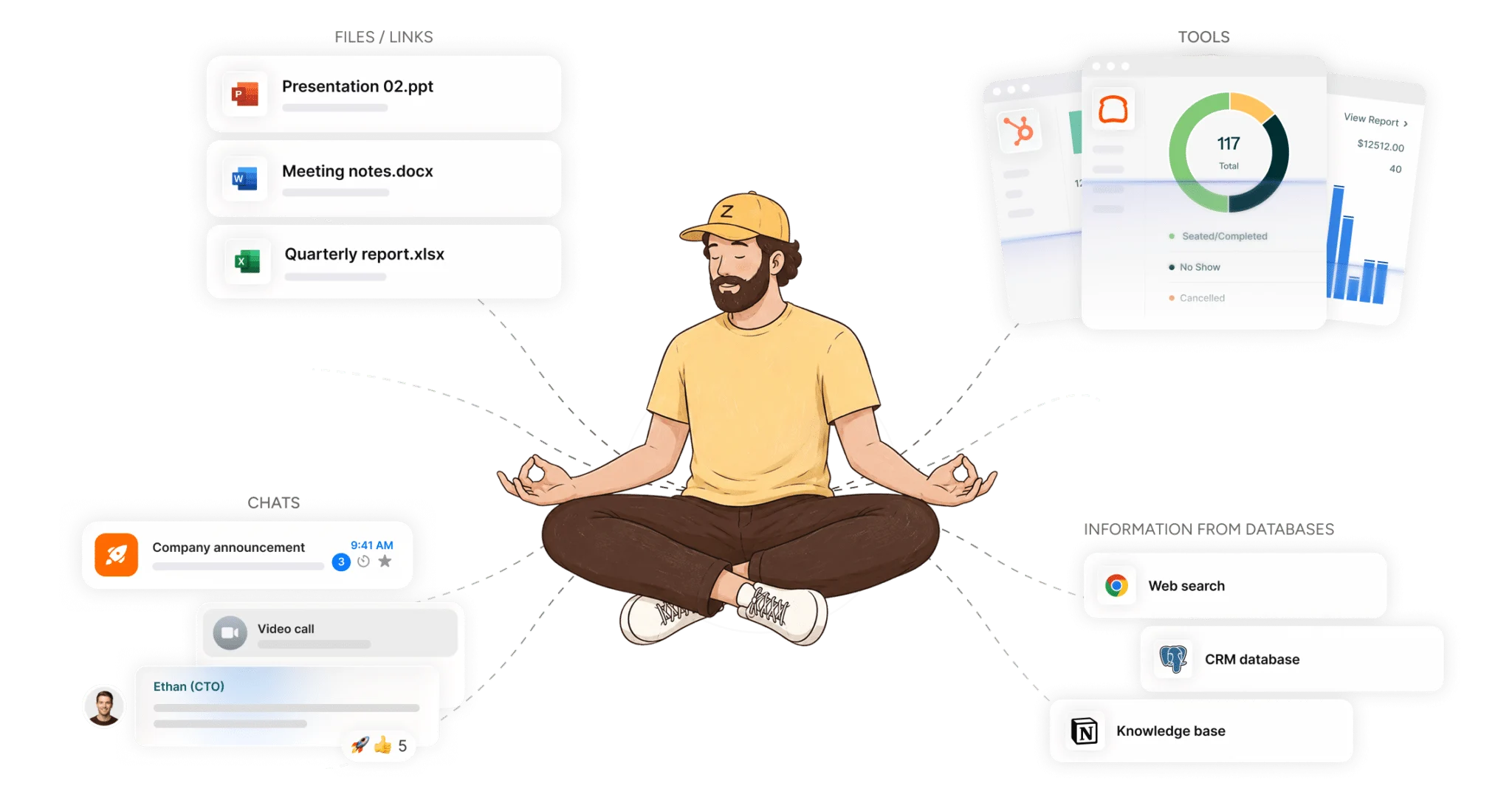
An AI agent gets sharper when it can see who approved what, where the bottleneck was, and which exception was normal. That is the work brain in action. The more chats and tools the AI agent has context on, the more accurately it understands the business.
Zenzap is built around that idea. You can add AI agents to the same chat where the team is already making decisions, and the agent can learn from the full operational trail. If someone corrects it once, it remembers. If a teammate adds missing context, it adjusts. That is what makes it useful in practice.
You can see the same pattern in how teams use connected workflows. If you want a deeper look at how chat-based work changes task flow, the post on task management inside a team chat app shows why work improves when the conversation and the task live in the same place. The same logic applies to AI agents.
Shared Corrections Beat Private Prompts
Private prompts create private memory. Shared chat creates shared operational memory. That difference is why multiplayer learning is the surprise.
In practice, one manager might ask an AI agent to summarize a customer thread, then a support lead corrects the tone, and then sales adds a note about the account history. The AI agent now understands the pattern behind the request, not just the request itself. It learns from the whole team’s version of the truth.

That is especially useful in companies where handoffs matter. The article on team-based communication and service delivery explains why service quality rises when the handoff is visible. AI agents follow the same rule. They improve when the people around them can see, edit, and refine the same thread.
What Multiplayer Learning Looks Like In Practice
Multiplayer learning is what happens when one AI agent works across the same chat where people already coordinate the work. The agent does not just answer questions. It gets shaped by the team’s habits, corrections, and follow-ups.
That is why Zenzap’s model is different from a private assistant. You can talk to the AI agent like a coworker, tag it into a chat, and let the whole team steer it. The first person may set the direction, but the second and third people sharpen the outcome.
A Lead Routing Example
A sales manager asks an AI agent to flag incoming leads that match enterprise criteria. The agent routes the right accounts and posts a summary in the team chat. Then someone from operations notices that a certain lead source should be treated differently, and they correct the logic in-thread.
The agent learns that rule because the correction happened where the work happened. Next time, it routes better. That is not formal training. That is operational memory built from shared context. Over time, this can reduce dropped leads and move deals forward faster.
For market context, the article AI Chatbots: 12 Best Options for Work Teams in 2026 makes the same distinction between answering and executing. Drafting a response is useful, but moving work forward is what turns chat into an operational system.
A Support Triage Example
A support lead adds an AI agent to a customer issue thread. The agent summarizes the case, suggests the right queue, and drafts a response. Then a teammate adds one line of context about a billing exception that was not in the original message.
That update changes the outcome. The AI agent learns which exceptions matter and which responses are safe to reuse. Over time, the team spends less time repeating the same clarifications. That is how a chat interface becomes a better learning environment than a solo prompt.
This is also where measurable impact shows up. In the Clerk AI announcement covered by Yahoo Finance, conversational AI agents remembered past interactions and adapted to how customers communicate, helping one enterprise deployment double qualified leads and reach a 3x higher conversion rate than traditional campaigns. The lesson is simple. Memory matters when it is tied to outcomes.
A Finance And Approvals Example
In finance, the learning loop is often about policy. An AI agent can flag a spend request, route it to the right approver, and pull the supporting context into the thread. If the approver explains why a request needs a second review, the AI agent learns that rule for next time.
That is a small example with a large effect. It cuts down on rework, gives you a better audit trail, and reduces risky writes. The team is not training a model in the traditional sense. The team is shaping a workflow that improves each time the same type of work comes up.
The Workflows That Improve Fastest
The fastest gains come from repetitive, high-friction work where context keeps getting lost. If a task happens every week, every day, or every time a handoff crosses teams, an AI agent in chat can usually learn it faster than a standalone tool.
The reason is simple. Repetition creates patterns, and shared chat makes those patterns visible. Once the agent sees enough examples, it starts to anticipate the right next step instead of waiting for perfect instructions.
Here is a simple way to think about where AI agents learn best inside team chat.
| workflow | how the team teaches the AI agent | what improves over time |
|---|---|---|
| Lead routing | Reps correct priority, source, and ownership in the thread | Better handoff speed and fewer dropped leads |
| Support triage | Agents learn which issues need escalation and which need a standard reply | Faster resolution and fewer repeat questions |
| Spend approvals | Managers mark the exact approval rule inside the chat | Cleaner routing and fewer policy mistakes |
| Weekly digests | Teammates refine what belongs in the report and what should be excluded | Sharper summaries and less manual cleanup |
This kind of workflow is why task and workflow management in chat matters so much for managers. When the task lives in the same place as the discussion, the AI agent can learn from the conversation that produced the task, not just the task itself.
Why Security And Control Still Matter
AI agents only become useful at scale when the team trusts them. That means secure tool access, approval controls, and topic-level memory are not extras. They are what make shared learning safe enough to use.
Zenzap keeps memory isolated by topic, which matters because one workflow should not bleed into another. A support thread should not affect a finance approval. A retail site report should not rewrite a hiring workflow. The context stays where it belongs.
This is also where the architecture matters. AI agents in Zenzap start in about 300 ms after warm-up, run on managed infrastructure, and never hold credentials directly. Read actions can run automatically, while sensitive write actions can require explicit approval. That gives teams speed without giving up control.
It also lines up with how the market is changing. The same 2026 State of AI Agents Report says 81% of organizations plan to tackle more complex use cases in 2026, including multi-step and cross-functional work. That means AI agents are no longer novelty tools. They are becoming part of the operational stack.
What Zenzap Changes In Practice
Zenzap gives you AI agents that do real work in your tools, and the team chat is where they improve. One person can get value alone by connecting a tool, automating a process, or generating a report. Then the multiplayer effect starts when the team joins the same thread.
That is the important part. The AI agent is not learning from a hidden training run. It is learning from the team’s lived workflow. Each correction, each follow-up, and each approval makes it better at understanding how your business runs.
Key Takeaways
- Add AI agents to the same chat where work decisions happen, so corrections become shared operational memory.
- Use repetitive workflows like lead routing, support triage, spend approvals, and weekly digests to teach the AI agent faster.
- Keep memory topic-scoped and approval-based so learning stays useful without creating risk.
- Measure impact in hours saved, mistakes caught, deals moved, and handoffs completed.
- Start with one person, then let the team sharpen the AI agent through real conversations.
FAQ
Q: How do AI agents learn inside a team chat interface?
A: They learn from repeated operational context, not from a formal training cycle. When people correct them, add missing details, or approve a step in the same thread, those signals shape future behavior. The chat becomes a record of how your team actually works. Over time, the AI agent becomes better at repeating the right action in the right situation.
Q: Why is shared chat better than a private prompt?
A: A private prompt only captures one person’s version of the task. Shared chat captures the team’s version, including exceptions, approvals, and follow-up details. That means the AI agent learns from more than one viewpoint. It also reduces the risk that important context stays locked in one person’s head.
Q: What kinds of workflows improve fastest?
A: Repetitive workflows with clear handoffs improve fastest. Lead routing, support triage, spend approvals, weekly reporting, and onboarding reminders are good examples. These tasks happen often enough for patterns to emerge. They also create enough correction points for the AI agent to improve quickly.
Q: How do you keep AI agents from making risky changes?
A: Use approval controls for sensitive or destructive actions. Keep memory isolated by topic so one workflow does not affect another. Limit access to approved domains and connected tools only. That way the AI agent can act quickly on low-risk work and pause when a human review is needed.
Q: Can one person get value before the whole team uses it?
A: Yes. One person can connect a tool, add an AI agent, and automate a useful workflow right away. That is often the fastest way to prove value. Once the team joins the same chat, the AI agent learns faster because everyone can correct and refine it.
About Zenzap
Zenzap gives you AI agents that do real work, connected to your tools and your team through a secure chat. Setup takes one click: no code, no developer. Unlike Claude or ChatGPT, the agents come already built and connected. You talk to them like a coworker: tag them into chats, correct them once and they remember. They act across your tools, automate workflows, build reports and graphs, summarize chats, flag what needs attention and coordinate people and tasks. One person gets value alone. Add your team, and every correction makes the agent sharper. Agents start in about 300 ms and run on managed infrastructure. Memory stays isolated by topic, and agents never hold credentials. They reach only approved domains, and sensitive actions need your approval.
What would your team automate first if the AI agent could learn from every correction in the chat itself?