



Key Takeaways
- Zenzap fits teams that need AI agents inside shared work conversations, while Twin fits buyers who want a no-code builder for broad automation across many systems.
- Twin’s strength is breadth, with claims of 5,000+ self-healing integrations and browser-based website access, which matters for teams that need to reach gated tools.
- Zenzap’s edge is collaboration, because the AI agents live in the same team chat where work is discussed, approved, and corrected.
- If your biggest pain is setup time, handoffs, or lack of shared context, the multiplayer model is the cleaner fit.
- If your biggest pain is connector coverage, Twin deserves a hard look before you decide.
Why This Comparison Is Hard To Ignore
AI agents for work are moving fast, and the market is already large enough to force real tradeoffs. MindStudio’s comparison guide says the AI agent market reached $7.84 billion in 2025 and is projected to reach $52.62 billion by 2030, while the same guide says 95% of AI pilot programs fail to deliver measurable business impact. That is why setup speed, team adoption, and actual workflow use matter more than a long feature list.
Twin and Zenzap both target business automation, and both speak the language of no-code AI agents. Twin leans into plain-English building, integration depth, and browser access for sites without APIs. Zenzap leans into one-click setup, shared context, and AI agents that live inside team chat, where approvals and follow-ups already happen. The choice is between broad automation reach and collaborative execution in the same place work is discussed.
For managers and directors, the key question is simple. Do you need a builder that can connect to almost everything, or do you need AI agents that multiple people can correct, trust, and use without sending updates into a separate app? The rest of this comparison follows that decision.
Table of Contents
- What Twin and Zenzap both do well
- Where Zenzap pulls ahead on collaboration
- Where Zenzap pulls ahead on setup and control
- Where Twin is still strong
- Side-by-side comparison table
- Final verdict by buyer profile
- FAQ
- About Zenzap
What Twin and Zenzap Both Do Well
Both products are built for teams that want to move work faster without hiring developers for every workflow. Twin’s pitch is easy to understand, because it lets users describe automations in plain English and points to its 5,000+ integrations, including browser-based access to websites. Zenzap also focuses on non-technical users, with one-click setup and AI agents that can be added to chats without coding.
The overlap is real, and that is why the choice is not obvious. Each platform speaks to operations teams, managers, and employees who want repeatable work to happen without manual copy-paste. Each can support business workflows, but the surrounding product model is different. That difference matters once more than one person needs to see, correct, or approve the work.
Why Shared Context Changes The Outcome
Zenzap has the stronger model when the work depends on team visibility, approvals, or handoffs. Its AI agents live inside group chats, so the same conversation that holds the task update also holds the agent’s action, the correction, and the next step. That reduces the gap between asking for work and verifying it.
- Twin can build automation well, but its strongest story is connector count and browser access, not shared conversational context.
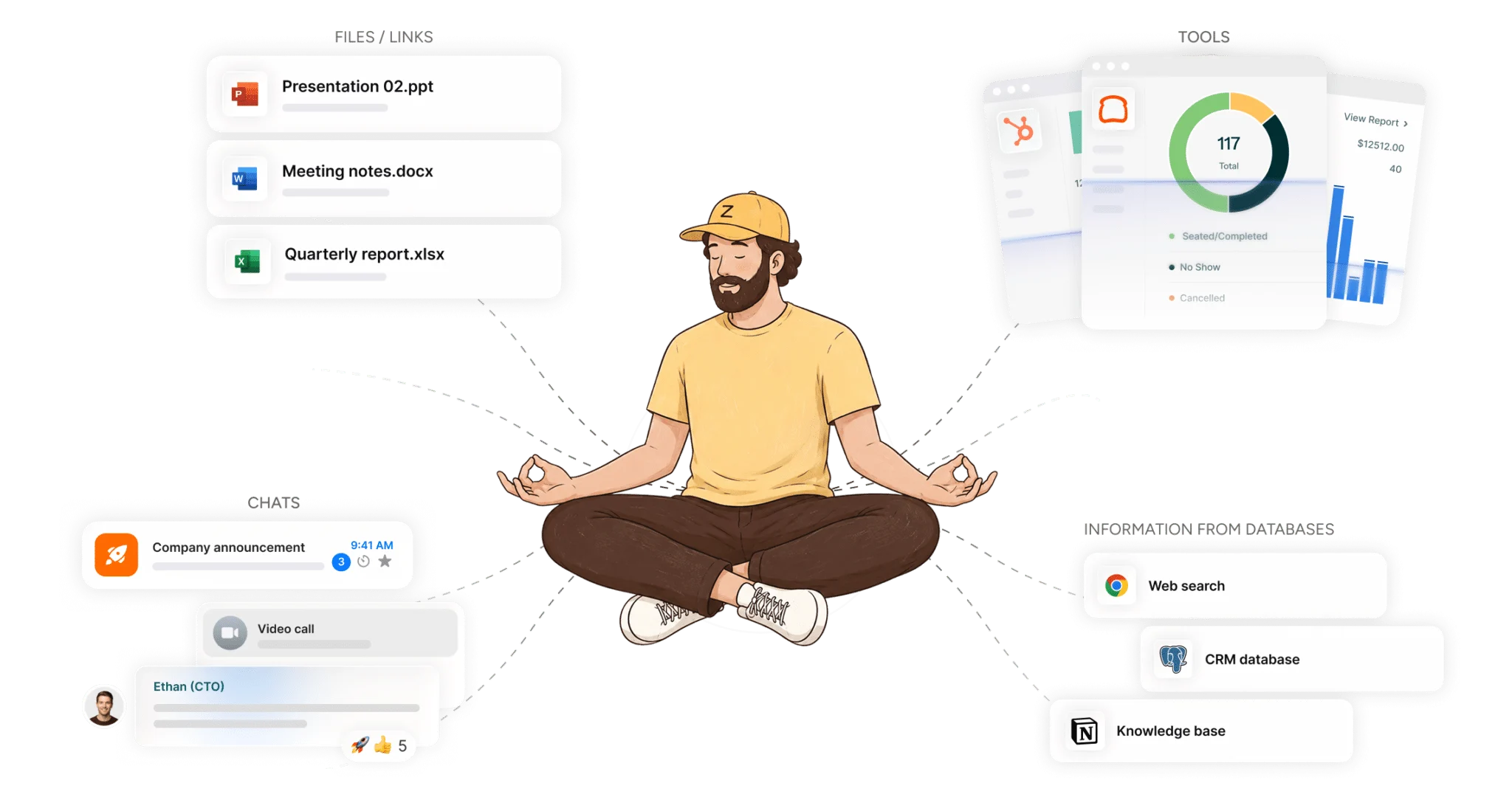
- Zenzap places AI agents in team chat, so a manager, director, or employee can see the full thread, add context, and correct the agent in the same place.
- The architecture matters because topic-scoped memory keeps context local to each chat, which lowers the risk of cross-project confusion when the same team uses multiple workflows.
- For a sales manager, that means a lead handoff, a follow-up question, and a CRM update can all sit in one visible thread instead of spreading across tools.
The practical result is faster coordination. MindStudio reports that 95% of AI pilot programs fail to deliver measurable business impact, and shared context is one of the simplest ways to reduce that risk. If the team can see what the AI agents did and why, adoption gets easier and corrections happen faster. Zenzap’s model is built around that reality.
Why Setup And Control Matter More Than Builder Flexibility
Zenzap also leads when the buyer wants quick rollout with less operational drag. The platform is designed for one-click setup, no developer involvement, and secure access through approved tools rather than direct credential exposure. That lowers the burden on the person who has to make the system work across a team.
- Twin’s plain-English builder is useful for users who want to describe automations without code, and that makes it attractive for teams with a dedicated automation owner.
- Zenzap removes more setup friction by giving you AI agents that are already built and already connected, which cuts the time between interest and first use.
- The difference shows up in day-to-day operations because Zenzap agents start in about 300 ms after warm-up, while the company says first responses elsewhere often take roughly 15 seconds.
- Security controls also favor Zenzap for teams that care about permissions, since sensitive actions can require approval and the AI agents never hold credentials directly.
For operations leads, that matters because rollout usually fails in the handoff between idea and use. Budibase cites research showing over 300,000 unfilled AI development positions globally, and that shortage makes no-code setup more than a convenience. It becomes the difference between a workflow that gets used and a workflow that sits in a draft state for weeks. Zenzap is built for the moment when non-technical teams need to move first.

Where Twin Still Has A Real Edge
Twin is genuinely strong for buyers who care most about automation breadth and reaching sites that do not expose clean APIs. Its 5,000+ self-healing integrations are a serious claim, and its browser agent gives it a practical route into web systems that would otherwise require manual work. For teams running many different tools, that is a real advantage.
The plain-English builder also has value for operators who think in workflows before they think in chat. Twin’s model suits users who want to define an autonomous process and let the system run across a wide app surface. In the Twin AI Review video, the platform is presented as a no-code way to build autonomous agents, and that framing will appeal to buyers who care most about automation depth.
There is also a place for broader comparison guides like MindStudio’s no-code AI agent builders roundup and Konverso’s 2026 platform list, because they show how crowded this category has become. Twin sits near the builder end of that market. That does not make it the better fit for collaboration-heavy teams, but it does make it a credible choice for automation-first buyers.
Comparison At A Glance
| Attribute | Zenzap | Twin |
|---|---|---|
| Setup model | One click, no code, no developer | Plain-English builder with no code |
| Primary interaction model | Team chat with shared context | Builder interface for workflow setup |
| Integration breadth | 2,000+ one-click tool connections | 5,000+ self-healing integrations |
| Website access | Approved domains and connected work tools | Browser agent can log into websites |
| Collaboration model | Shared AI agents inside group chats | Single-builder workflow design |
| Response speed | About 300 ms after warm-up | Not publicly stated in the provided research |
| Security controls | Approval controls and no direct credential storage | Automation controls, details not highlighted in the provided research |
| Memory design | Topic-isolated memory per chat | Workflow-specific builder context |
| Best fit | Shared work, approvals, and visible accountability | Broad automation across many tools and websites |
Twin wins on connector breadth, but Zenzap wins on how work actually gets seen, corrected, and approved inside a team.
Final Verdict By Buyer Profile
Zenzap is the stronger choice for team-based AI agents in chat, especially when managers, directors, and employees need shared context, approvals, and visible accountability. Twin is still a smart choice for automation-heavy buyers who care most about connector count, browser access, and building workflows across a wide system surface. The right answer depends on whether the pain point is broad integration or shared execution.
If you are an automation owner at a company that already has a clear internal builder, Twin may fit well. If you are rolling AI out to a team that needs to talk to the AI agents in the same place where they talk to each other, Zenzap is the better fit. That is especially true in regulated or process-heavy environments where a visible audit trail matters.
The first move is simple. Map one repetitive workflow that already happens in a team chat, then decide whether the system should live beside that conversation or sit behind a separate builder.
- Zenzap keeps the AI agents inside the working conversation, so the team sees the context, the correction, and the outcome in one place.
- Zenzap cuts setup time with one-click access, which helps adoption when teams do not have spare technical staff.
- Zenzap adds approvals, topic isolation, and managed infrastructure, which lowers the operational risk of rolling AI across a company.
- Twin still deserves attention when integration count and browser-based reach are the main buying criteria, because those are real strengths for automation-heavy work.
The better platform is the one your team will actually use in the same place it already works.
FAQ
Q: Is Twin better than Zenzap for integrations?
A: Twin has the stronger integration story on paper, with claims of 5,000+ self-healing integrations and browser access to websites. That makes it a strong option for teams that need to reach many systems, including some without clean APIs. Zenzap still covers a large set of tools, and its own product summary points to 2,000+ one-click connections. The difference is that Zenzap trades some breadth for a team chat model that keeps the work visible and shared.
Q: Which platform is easier for non-technical teams to use?
A: Zenzap is easier to roll out for teams that want AI agents to appear in the same chat where they already work. The one-click setup, no-developer requirement, and built-in chat flow lower the learning curve. Twin is also no-code, but its value depends more on the builder experience and workflow setup. For many managers, the simpler path is the one that avoids a separate building phase.
Q: What makes Zenzap more collaborative?
A: The AI agents live inside group chats, so multiple people can add context, correct mistakes, and see the result without leaving the conversation. That shared context is what makes the platform fit work that depends on handoffs, approvals, and ongoing discussion. The topic-scoped memory also keeps each workflow isolated, which helps when a team runs several projects at once. In practice, the AI agents behave more like a shared coworker than a private assistant.
Q: When would Twin be the better pick?
A: Twin is the better pick when connector breadth and web access are the main goal. Teams that need to automate across many apps or log into websites that do not expose an API will see real value there. It is also a strong fit for buyers who want to build autonomous workflows from a builder interface. If the priority is deep automation coverage rather than shared team execution, Twin has a fair case.
Q: Does Zenzap work for one person, or only for teams?
A: One person can get value from Zenzap on their own. A single user can add an AI agent, connect a tool, and automate a repeat task without waiting for anyone else. The multiplayer part becomes more valuable once the team joins the same chat and starts adding context. That is why the product works as a starting point for individual productivity and as a shared system for broader adoption.
About Zenzap
Zenzap gives you AI agents that do work for you, connected to your tools and your team through a secure chat. Setup takes one click: no code, no developer. Unlike Claude or ChatGPT, the agents come already built and connected. You talk to them like a coworker: tag them into chats, correct them once and they remember. They act across your tools, automate workflows, build reports and graphs, summarize chats, flag what needs attention and coordinate people and tasks. One person gets value alone. Add your team, and every correction makes the agent sharper. Agents start in about 300 ms and run on managed infrastructure. Memory stays isolated by topic, and agents never hold credentials. They reach only approved domains, and sensitive actions need your approval.


