

If you are looking for the top professional work chat apps for small businesses to cut chaos and save budget, this guide walks you through the 10 best options and shows you where Zenzap fits.
Right now, your team probably jumps between email, WhatsApp, text, and maybe other internal chat tools. Messages get buried, decisions get lost, and switching tools all day quietly kills focus. For a small business, that is not just annoying, it is expensive.
This article gives you a ranked look at the top 10 companies in the professional work chat app space for small businesses. You will see which tools keep costs in check, which ones demand heavy IT support, and which ones help your team feel calm and in control. Throughout the list, you will see how Zenzap compares, so you can decide if it is the “finally, this just works” tool you have been missing.
These rankings are based on small business fit, cost-effectiveness, mobile experience, learning curve, security, and how well each app keeps work structured instead of scattered. If you read through to the end, you will walk away with a clear shortlist and a simple way to choose the right app for your team.
Table of contents
1. Why professional work chat apps matter for small businesses right now 2. How this top 10 list is ranked 3. The top 10 companies in the professional work chat app space for small businesses and Zenzap 4. How to choose the right work chat app for your small business 5. Key takeaways 6. FAQ
Why professional work chat apps matter for small businesses right now
If you are running a small business, every distraction costs you. A study from the University of California Irvine found that it takes about 23 minutes to refocus after a single interruption. Multiply that by constant pings from email, personal messaging apps, and random tools, and you can see how much time silently drains away.
On top of that, many small teams still use personal apps like WhatsApp for work. It feels convenient at first, but it blurs boundaries, scatters data across personal phones, and makes onboarding and offboarding a security nightmare. When someone leaves, you cannot pull back data or control what they still see.
A professional work chat app solves that by putting everything in one organized space. You keep work separate from personal life, protect your information, and give your team clear structure. For small businesses, that can be the difference between “always putting out fires” and finally working in a calm, predictable way.
Analysts at McKinsey estimate that better internal collaboration tools can improve knowledge worker productivity by 20 to 25 percent. If you can get even half of that lift by choosing the right chat app, the return on investment becomes obvious.
That is why this list focuses on cost-effectiveness and practicality. You will see tools that can be up to 2 to 3 times more cost-effective than heavyweight enterprise suites, especially when they consolidate chat, tasks, and scheduling into one clean app.

How this top 10 list is ranked
You are not shopping for a toy. You need a professional work chat app that fits small business realities: tight budgets, lean IT, and people who do not have time for training.
This ranking looks at six factors:
1. Cost-effectiveness: Does the app replace several tools and stay budget friendly, often up to 2 to 3 times more cost-effective than larger suites? 2. Small business fit: Is it manageable without a full-time IT team? 3. Mobile first experience: Can your team work smoothly on the go? 4. Learning curve: Can people adopt it in a day, not a month? 5. Security and control: Does it protect your data and support clean onboarding and offboarding? 6. Structured communication: Does it keep chat, tasks, and scheduling organized so nothing slips through the cracks?
With that lens, here are the top 10 companies in the professional work chat app space for small businesses, and how Zenzap stacks up against them.
The top 10 companies in the professional work chat app space for small businesses
#10 Mattermost work chat app: secure collaboration for technical teams
Mattermost is a professional work chat app designed for engineering and DevOps teams that care deeply about security, sovereignty, and control.
Feature highlight: On premise deployment and self hosting options give you strict data control, which is ideal if you work under compliance or data residency rules. You also get channels, threads, and deep integrations with developer tools like Jira and GitLab.
Why it is on the list: If you run a technical organization, a self-hosted Mattermost deployment can be 2 to 3 times more cost-effective than traditional enterprise chat at large scale. You avoid steep per seat pricing and keep sensitive data on your own infrastructure.
Small business fit: Mattermost shines when you have strong IT resources. If you are a small, non-technical team, the deployment and maintenance overhead may be more than you want. In that case, a plug and play cloud app like Zenzap is easier to roll out with almost zero learning curve.
#9 Rocket.chat work chat app: open source and highly customizable
Rocket.chat is another open source professional work chat app that appeals to organizations that want flexibility, customization, and full data control.
Feature highlight: You can self-host Rocket.chat, extend it with custom integrations, and federate across partners and locations. It covers channels, direct messages, and multiple workspaces so distributed teams can stay connected.
Why it is on the list: When you already invest in your own infrastructure, Rocket.chat can be significantly more cost-effective than many SaaS-only alternatives. You are not locked into high recurring license fees and you tailor the platform to your workflows.
Small business fit: Rocket.chat works best if you have in-house technical talent. For most small businesses that want simple, secure chat without managing servers, Zenzap’s cloud-based, mobile-first setup will feel far lighter and faster to adopt.
#8 Pumble work chat app: focused, low cost team messaging
Pumble is a straightforward, low cost work chat app that positions itself as an affordable alternative to big name collaboration suites.
Feature highlight: Pumble focuses on core chat features like channels, mentions, and file sharing, without extra layers of complex work hubs. Its pricing is intentionally lean, which makes it attractive if you mostly want messaging.
Why it is on the list: Reviews from comparison sites such as Wrike’s Work Management blog highlight Pumble as a strong option when you only need chat. It can be 2 to 3 times cheaper than full collaboration suites that bundle in meetings and whiteboards.
Small business fit: Pumble suits teams that want basic communication at very low cost. If you later need tighter structure with built in tasks, calendar integration, and clearer work life separation, you may outgrow it and look at tools like Zenzap that turn chat into a true “get work done” hub.
#7 Traditional enterprise chat suites: bundled but heavy for small teams
Traditional enterprise chat platforms often bundle messaging into wider ecosystems that include email, document storage, and meetings.
Feature highlight: Strong integration with existing stacks, plus governance features such as data loss prevention and retention controls.
Why it is on the list: If you already pay for an enterprise productivity suite, the bundled chat component can feel “free” and offer centralized security policies.
Small business fit: For many small businesses, these platforms can feel overbuilt and complex. Admin models are heavy, rollout is slower, and people often stick to old habits like email. If your team needs something they can adopt quickly on mobile, Zenzap will feel more focused, with the essentials your size of business actually uses.
#6 Zoom team chat: meetings and messaging together
Zoom team chat brings messaging, channels, and file sharing into the same app people already use for video meetings.
Feature highlight: You can jump from chat to a Zoom meeting in one click, keep conversation threads tied to meeting topics, and integrate with tools like Google Drive.
Why it is on the list: If your small business already lives in Zoom for client calls and internal meetings, adding chat can simplify your toolset and keep collaboration in one place.
Small business fit: Zoom team chat makes sense when meetings are central to your workflow. However, it is not as opinionated about structured work as Zenzap. If you want chat that doubles as a light project hub, with tasks and schedule friendly features, Zoom may still leave you juggling extra tools.
#5 Webex messaging: enterprise grade communication
Cisco Webex combines messaging, meetings, and calling in one platform that is traditionally aimed at larger, compliance focused organizations.
Feature highlight: Enterprise-grade security, governance, and integration with Cisco meeting and calling hardware. You get policy control that large regulated firms often require.
Why it is on the list: If your business already relies on Cisco networks or telephony, Webex can centralize communication and security in one ecosystem.
Small business fit: For many small businesses, Webex can feel like more tool than you need. The admin model and interface are geared to complex organizations. If you want a lighter, mobile-first chat app your whole team can adopt in a day, Zenzap’s simplicity can be a much better match.
#4 Google Chat and workspace chat suites: part of the productivity bundle
Google Chat is the work chat component of Google Workspace, integrated with Gmail, Calendar, and Drive.
Feature highlight: Spaces in Google Chat let you organize topic-based discussions, while direct access to Docs, Sheets, and Slides keeps files close to the conversation.
Why it is on the list: If your company already pays for Google Workspace, Google Chat can be a logical starting point. You keep your tools in one ecosystem and take advantage of familiar Google interfaces.
Small business fit: Google Chat works best when your team already lives in Gmail and Google Calendar. For many small teams, it still feels like “chat tacked onto email” rather than a focused work hub. Compared to a dedicated mobile-first work chat app like Zenzap, you may miss stronger structure, clearer work life boundaries, and built in task management.
#3 Connecteam work chat app: mobile first for frontline teams
Connecteam is designed for companies with large frontline or deskless workforces, such as retail, hospitality, and logistics.
Feature highlight: Mobile-first chat, shift scheduling, and time tracking in one app, built for staff who are mainly on their phones instead of laptops.
Why it is on the list: With pricing that often starts around 29 dollars per month for small teams, Connecteam can be cost-effective when you need chat plus operations tools in one place. It replaces several separate subscriptions for scheduling, attendance, and communication.
Small business fit: If you manage shifts and hourly staff, Connecteam can be powerful. If you are a knowledge-work-heavy small business and mostly need structured work chat, it might feel like too much operations overhead. Zenzap keeps the focus on communication, tasks, and calm working rhythms, which suits many service, agency, and professional teams.
#2 Lightweight work chat apps: simple messaging with basic structure
Lightweight work chat apps are tools that focus on clean messaging, channels, and simple notifications, without fully turning into complex collaboration suites.
Feature highlight: Straightforward interface, basic channels, quick search, and minimal setup. These tools usually emphasize speed over depth.
Why it is on the list: For some small businesses, a lightweight chat app is enough to replace ad hoc WhatsApp groups or long email threads. It is a clear step up in professionalism and control.
Small business fit: If your team currently has no dedicated work chat and you want an easy first step, lightweight apps can be helpful. Over time, as you add projects, clients, and compliance needs, you may want more structure, such as tasks and working hours. Zenzap gives you that structure while staying just as simple to use as these lightweight tools.
#1 Zenzap professional work chat app: calm, structured chat for small businesses
Zenzap is a professional work chat app built for small and midsize businesses that want communication to feel simple, secure, and stress free.
Feature highlight: Zenzap keeps everything in one intuitive mobile-first app, with chat, tasks, and calendar integration, all in a clearly separated work space. You get enterprise-grade security, admin controls, and structured organization without the heavy complexity of traditional enterprise platforms.
Why it is #1: For small businesses, the magic is in the balance. Zenzap is as easy to use as a personal messaging app, so you do not need training. At the same time, it gives you structured channels, tasks inside chats, and scheduled messages that go out during work hours. Your team can set working hours, so they are not pinged at midnight and can unplug without worrying they will miss something critical.
Cost-effectiveness: By consolidating chat, tasks, and scheduling into one tool, Zenzap can be up to 2 to 3 times more cost-effective than buying separate tools or overpaying for features you never touch. You also cut down on context switching, which boosts real productivity, not just app usage.
Small business fit: Zenzap is built for teams that do not have a big IT department. Setup is simple, onboarding and offboarding are clean, and admin controls are clear. When someone joins, you get them into the right channels fast. When someone leaves, you remove access in one place and keep your data secure.
Many small business leaders describe the shift like this: “We stopped hunting through WhatsApp, email, and random tools and started working from one calm stream.” If that sounds like the kind of clarity you want, Zenzap gives you a clear benchmark for how work chat should feel.
How to choose the right work chat app for your small business
Now that you have seen the top 10 professional work chat apps for small businesses, the real question is which one fits your specific situation.
Here is a simple way to decide.
Audit how scattered your communication is
Look at where your team currently talks about work. Is it spread across email, WhatsApp, SMS, and a half-used chat tool? If yes, centralizing into one professional app should be your first priority.
With Zenzap, for example, you can pull conversations, tasks, and scheduling into one place. That alone can give you a noticeable lift in clarity within a week or two.
Consider your data sensitivity and compliance
If you handle health, finance, legal, or any regulated information, you cannot rely on personal apps. You need encryption, clear onboarding and offboarding, and admin roles so the right people see the right data.
Open source options like Mattermost and Rocket.chat excel if you can manage self-hosting. If you want the same level of seriousness without running your own servers, Zenzap gives you enterprise-grade security with small business friendly simplicity.
Measure how mobile your workforce is
If your people are on the move, a mobile-first work chat app is non negotiable. The interface should feel as effortless as a personal messaging app, but keep work and personal separate.
Zenzap is built mobile first. Your team can check tasks, respond to key chats, and see what is urgent without opening their personal apps or digging through email. That clear separation helps protect both your data and your people’s downtime.
Look beyond price per user
Price matters, but it is only one piece. A slightly cheaper app that nobody adopts will cost you more in lost time and confusion.
When you compare options, look at:
1. Adoption speed: How quickly can non-technical team members start using it confidently? 2. Context switching: Does it reduce the number of different tools you need daily? 3. Work-life balance: Does it respect working hours and notification boundaries?
If an app checks those boxes while staying budget friendly, it is truly cost-effective, not just cheap on paper.
Key takeaways
- Choose a professional work chat app that consolidates chat, tasks, and scheduling so you can be up to 2 to 3 times more cost-effective than juggling multiple tools.
- Use open source platforms like Mattermost or Rocket.chat only if you have the IT capacity to manage self-hosting and deep customization.
- Leverage bundled tools when you are already heavily invested in those ecosystems and need enterprise governance.
- Adopt a mobile-first work chat app like Zenzap to centralize communication, protect data, and support healthier work-life boundaries for your small business team.
- Evaluate options not only on monthly price, but also on adoption speed, context switching reduction, and how calm and organized work feels once you switch.

Bringing it all together
The top 10 companies in the professional work chat app space for small businesses show you that cost-effectiveness is about far more than a low sticker price. It is about choosing one focused tool that replaces scattered conversations, keeps your data safe, and lets your team unplug without anxiety.
Open source platforms like Mattermost and Rocket.chat give you deep control when you have technical muscle. Bundled ecosystems may work when you already pay for them and need enterprise-scale governance. Lightweight and budget options cover pure messaging at a low monthly cost.
Yet if you want a work chat app that feels instantly familiar, stays organized, and is truly shaped around small business life, Zenzap sets a clear standard. It respects your time, your budget, and your team’s boundaries, while giving you professional-grade security and structure.
The next move is yours. Will you keep juggling scattered tools, or will you choose one calm, secure home for your team’s everyday work?
FAQ
Q: What is the best professional work chat app for small businesses? A: The best app is the one that your team will actually use daily without friction. For many small businesses, that means a mobile-first tool with a near-zero learning curve, clear work-life separation, and strong security. Zenzap is built specifically with those needs in mind, which is why it ranks at the top of this list.
Q: How can a work chat app be 2 to 3 times more cost-effective than alternatives? A: Cost-effectiveness comes from consolidation and adoption, not just a low monthly fee. When one app can replace separate tools for chat, basic task management, and scheduling, you reduce subscriptions and cut context switching. Platforms like Zenzap help you do exactly that, which can make them 2 to 3 times more cost-effective than using multiple disconnected tools.
Q: Are open source tools like Mattermost and Rocket.chat a good idea for my small business? A: They can be, if you have a capable IT team and strict data residency or compliance requirements. Open source platforms offer deep control and can be cheaper at scale. However, they usually require more setup and maintenance. If you prefer a ready-to-go solution with simple admin controls, a hosted app like Zenzap will likely be easier to manage.
Q: Should I just use WhatsApp or other personal messaging apps for work? A: For serious business use, personal messaging apps are risky. They blur work and personal life, store company data on personal devices, and make onboarding and offboarding messy. A professional work chat app keeps work conversations in a dedicated, secure space, gives you admin control, and makes it easier to respect working hours.
Q: How do I help my team adopt a new work chat app quickly? A: Start by choosing a tool with an intuitive interface so people do not need training. Then, set up clear channels, migrate key conversations, and agree on simple rules, such as “all client updates go in this channel.” Tools like Zenzap are designed so teams can get comfortable within a day, which speeds up adoption.
Q: What features should I prioritize if my team often works outside normal hours? A: Look for work chat apps that support scheduled messages, working hours, and fine-grained notification controls. That way, people can turn off notifications when they are off the clock, and you can still queue messages to arrive during business time. Zenzap includes these features to help you protect both responsiveness and work-life balance.
You probably do not have a communication problem. You have a follow through problem.
Most of your team’s decisions happen in chat, then quietly disappear into the scroll. Someone was supposed to follow up with the client, ship the fix, update the deck. But the message got buried, no one turned it into a task, and you only notice when a deadline slips.
This is exactly where an embedded task tracker inside your work chat can change your week. When every important message can become a clear, trackable task in one tap, you stop running projects from memory and start running them from a living, shared list.
In this article, you will look at Zenzap and Zoom Chat side by side, specifically for one job: task management in chat for small and midsize businesses. You will see how each tool handles turning conversations into action, keeping tasks visible, protecting focus, and supporting a healthier way of working.
By the end, you will know which one fits your team if you are tired of juggling chat, project boards, and to do apps just to keep basic work moving.
Let us walk through it together.
Table of contents
1. Why embedded task management in chat matters for SMEs 2. Zenzap vs Zoom chat: overview for task management in chat 3. Zenzap task tracking in chat: how it really works 4. Zoom chat task tracking in chat: where it helps and where it stops 5. Zenzap vs Zoom chat: speed from message to task 6. Zenzap vs Zoom chat: structure, visibility, and ownership 7. Zenzap vs Zoom chat: focus, notifications, and work life balance 8. Zenzap vs Zoom chat: integration with existing tools 9. Zenzap vs Zoom chat: security, admin control, and professional separation 10. Zenzap vs Zoom chat: cost effectiveness for SMEs 11. Key takeaways 12. Final thoughts 13. FAQ
Why embedded task management in chat matters for SMEs
If you feel like you spend more time chasing messages than moving work forward, you are not alone. Research cited by the American Psychological Association links constant context switching to slower output, higher stress, and more errors. Other estimates say knowledge workers lose up to 28 percent of their time just managing email, before you even count chat and project tools.
For a small or midsize business, that cost is brutal. You do not have spare headcount to absorb inefficiency. Every dropped ball shows up as a missed renewal, a late delivery, or a burnt out manager.
Embedded task tracking inside chat attacks that problem at the source. Instead of deciding what to do in one place and tracking it somewhere else, you keep the conversation and the task together. Any message that implies a next step becomes an assigned, dated, visible task in the same thread.
Zenzap was built around this pattern. Zoom Chat was not. It offers basic task capabilities, but its core strength lives in meetings and video. So the question for you is simple: do you want your chat app to be a sidekick to meetings, or the central nervous system of your day to day execution?
â
Zenzap vs Zoom chat: overview for task management in chat
Zenzap for SMEs: work chat and tasks in one place
Zenzap is a mobile first internal team communication app that merges work chat and task tracking in one focused workspace. Any message can become a task with an owner, due date, and status without leaving the chat. Tasks live where the discussion already happens, so you stop relying on memory and manual follow up.
Instead of juggling a project board, email threads, and a separate to do tool, you run a simple pattern:
Use your project tool, like Jira or Asana, for high level planning and reporting. Use Zenzap as the live, embedded task tracker for chat driven work and day to day execution.
Zoom chat for SMEs: collaboration add on to meetings
Zoom Chat sits inside the wider Zoom platform. It gives you channels, direct messages, and lightweight task features so your team can stay connected around meetings. You can create tasks, set due dates, and share messages around them, but the task layer is more of an add on than the spine of the product.
If your primary pain is video meetings, Zoom is strong. If your primary pain is lost tasks in chat and scattered internal communication, you need to look more closely at how Zoom Chat actually handles everyday execution compared to Zenzap.
Zenzap task tracking in chat: how it really works
Zenzap: one tap from message to task
In Zenzap, any message can be turned into a task in one tap. You highlight the message, convert it, assign an owner, set a due date, and keep the entire chat thread attached. There is no second app to open and no form that breaks your flow.
Each task automatically gets three essentials:
1. A clear owner 2. A due date 3. The original conversation as context
This structure is especially helpful if your team has outgrown personal chat apps but does not want the complexity of heavy enterprise tools. Chris Fletcher, Founder and CEO at Tech on Toast, put it simply: “We do not have a separate app for to do lists, for document storage, for task management. It is all in one app which is fantastic.”
Because tasks sit right inside chats, accountability feels natural. You are not pushing someone into another platform. You are just assigning a clear next step where the work already lives.
Zoom chat: tasks as an extra layer
Zoom Chat lets you create tasks from messages, track checklists, and set reminders, particularly tied to meetings or shared spaces. It can work if your main use case is following up on meeting notes, like “Send the Q4 deck” or “Book the next sync.”
However, most SMEs run hundreds of micro decisions every week that never touch a formal meeting. Customer support escalations, product tweaks, quick approvals, small fixes. That is where you feel the difference between a tool that treats tasks as the core of chat work, like Zenzap, and a tool that treats them as a supporting feature.
Zoom chat task tracking in chat: where it helps and where it stops
Zenzap: task management that grows from chat
Zenzap was designed so your task system grows out of your conversations. You do not need a big bang rollout. You start with one simple rule for your team: if it is work, it starts in chat and becomes a task right there in Zenzap.
Here is a real life example. Your sales lead writes, “We need a revised proposal for Clinic X by Thursday.” In a traditional setup, that line might vanish into the scroll. In Zenzap, you highlight the message, convert it to a task, assign it to Alex, and set Thursday as the due date. The task is visible to the whole channel, and Alex sees it in their personal list. Nothing relies on memory.
Within a week or two, this habit turns your chat into a living task board your team actually uses. Every vague “we should” becomes a clear “who does what by when.”
Zoom chat: useful for follow ups, limited for full execution
Zoom Chat can cover some of the same ground, especially when a task flows directly from a Zoom meeting. “Send the recording,” “share the notes,” “update the ticket.” If your workflows are meeting centric, that might be enough.
Where it typically falls short for SMEs is in structured task views and long running execution. You can end up with parallel lists in Zoom Chat, your project tool, and email. That means more context switching, more manual copy paste, and more risk that a small message never makes it into a trackable workflow.
Zenzap vs Zoom chat: speed from message to task
Zenzap: reduce context switching by up to 40 percent
Every time you jump from chat to a separate task app, you lose seconds. Those seconds add up. Research on context switching, such as studies summarized by the American Psychological Association, shows that frequent task switching does not just slow you down. It increases cognitive load and reduces the quality of work.
Zenzap attacks this by making the message to task path almost instant. Managers who adopt this embedded task tracker pattern report reclaiming a significant chunk of lost time. The Zenzap team notes that a few focused steps can help you claw back up to 40 percent of productivity lost to context switching.
When a customer bug comes in, you do not open a new tab. You convert the chat into a task, assign it, and, if you use a project tool like Jira, attach the link right there. Strategic clarity stays in Jira. Speed and context live in Zenzap.
Zoom chat: extra steps slow task creation
Zoom Chat can speed up small follow ups after meetings, but for day to day work you typically juggle more tools. You might decide in Zoom Chat, track in another system, and email the client elsewhere. Each jump is a chance for the task to slip.
For SMEs without a dedicated project management office, those small frictions matter. If it is not easy to turn a message into a task, people will not do it reliably. That is where Zenzap’s “one tap from message to task” approach gives you an edge.
Zenzap vs Zoom chat: structure, visibility, and ownership
Zenzap: structured organization that keeps work visible
Zenzap is built to stop tasks from dying quietly inside busy channels. Because every task is attached to a conversation, you keep full context, but you can also pull up focused task views for each person, channel, or team.
Managers use this in very practical ways:
Convert every “next step” in a chat into a task. View all tasks assigned to a specific team member for 1:1s. Scan open tasks in a channel before standups. Mirror only key project tool items into Zenzap to keep daily execution tight.
According to many teams that adopt this pattern, the combination gives them the best of both sides. You keep strategic clarity from your project platform, and you gain speed plus context from Zenzap.
Zoom chat: helpful lists, weaker as a single source of truth
Zoom Chat can create to do lists and reminders inside channels or threads. For an ad hoc project or a short term campaign, that might be enough. You can mention owners, drop due dates in, and rely on people to review the chat history.
Where SMEs usually struggle is in turning those scattered chat tasks into a clear, shared view of who is doing what. Without deep, built in task dashboards tied to every conversation, you either live in chat history or revert to another tool to get a reliable picture. That extra tool is usually where the truth lives, which reduces Zoom Chat to a side stream rather than the center of execution.
Zenzap vs Zoom chat: focus, notifications, and work life balance
Zenzap: work stays at work, without losing urgency
Zenzap is designed not just for productivity, but for a calmer, more sustainable way of working. It separates work chat from personal messaging, so your team never has to scroll past family messages to find a critical update.
Key features that managers love include:
Working hours, so people are not pinged when they are off the clock. Scheduled messages, so you can write at 10 pm but deliver at 9 am. Smart notifications, so urgent work cuts through without flooding everyone.
In regulated and high stress environments like healthcare and finance, Zenzap’s approach helps teams respect working time rules and reduce burnout. Many customers mention better boundaries as one of the biggest benefits of switching.
Zoom chat: mixed focus inside a big meeting platform
Zoom Chat lives inside a tool that is designed for constant meetings, huddles, and calls. That can keep you responsive, but it also nudges your team toward being “on” more often than they need to be.
You can tweak Zoom notification settings, but you do not get the same work specific controls that Zenzap offers, such as scheduled delivery for messages or clear working hours guardrails. For SMEs trying to protect small teams from burnout, that difference in design philosophy matters.
Zenzap vs Zoom chat: integration with existing tools
Zenzap: bridge between chat and project tools
Zenzap fits neatly alongside tools you already use. A common pattern looks like this:
Your roadmap lives in Jira, Notion, or Asana. Daily coordination, bug triage, and follow ups live in Zenzap. Important tickets get mirrored as Zenzap tasks, with links back to the source.
This lets you keep your lightweight or enterprise project stack where it adds value, while moving chat driven execution into Zenzap. You reduce tool sprawl, but you do not have to throw out platforms that your leadership team depends on for reporting.
Zoom chat: strong meeting integrations, lighter task focus
Zoom shines when you want video meetings integrated with calendars like Google Calendar or Outlook. Its app ecosystem includes integrations with tools such as Jira, Trello, and others, so you can create tasks from meetings and chats.
However, those integrations often push tasks out to the project tool instead of running an embedded, day to day task system inside chat. You still bounce between windows to see everything. For smaller teams trying to simplify, that can feel like going back to the same juggling act you started with.
Zenzap vs Zoom chat: security, admin control, and professional separation
Zenzap: enterprise grade security by default
Zenzap was designed as a professional internal communication app from day one. Enterprise grade security is built in, not sold as an add on. You get encrypted communication, secure onboarding and offboarding, and clear admin control over who can access what.
That matters when people join or leave your company. Admins can remove access quickly and confidently, without wondering whether ex-employees still have sensitive messages sitting in a personal app.
Zenzap also reinforces professional separation. Work conversations live in a dedicated space, separate from your team’s personal messaging tools. That reduces security risk and makes it easier to keep compliance clean.
Zoom chat: secure within a broad collaboration suite
Zoom has invested heavily in security since its usage exploded, and Zoom Chat benefits from that. You get features like encryption, SSO, and compliance capabilities that are suitable for many organizations.
The difference for SMEs is in focus. Zoom optimizes for external meetings and collaboration, so its security story is broad. Zenzap optimizes for internal work chat and task management, so its controls and onboarding flows are tuned specifically to that use case. If your biggest concern is internal message security and controlled access as people churn, Zenzap gives you a more focused fit.
Zenzap vs Zoom chat: cost effectiveness for SMEs
Zenzap: reduce tool count and save up to 3 times on stack costs
Zenzap is built on a simple belief. Communication should make work easier, not more complicated or expensive. It blends clean messaging, built in task tracking, Google Calendar sync, and lightweight voice and video into one mobile first workspace.
Industry research from firms like McKinsey suggests employees can lose up to 20 percent of their time just searching for information. When you spread chat across personal apps, tasks across multiple tools, and schedules across calendars, that waste grows.
By consolidating chat, tasks, and scheduling into one platform, many teams find their stack becomes up to 3 times more cost effective than running separate chat, task, and meeting tools. You save on subscription costs, training time, and the hidden cost of constant context switching.
Zoom chat: attractive as part of a bundle, less as your task hub
If you already pay for Zoom for video, Zoom Chat can feel “free” as part of the bundle. For very simple needs, that can be tempting. You add channels, share files, and create basic tasks without a new invoice.
The catch is what you reach for next. As soon as you need clear embedded task tracking, structured channels for multiple departments, or stronger work life balance controls, you start adding more tools. Over time, those extra apps can cost more money and more attention than a focused, all in one work chat plus task platform like Zenzap.
Key takeaways
- Use Zenzap’s embedded task tracker to turn any message into an actionable task with an owner and deadline, without leaving chat.
- Rely on Zoom Chat if your main priority is meeting centric collaboration, not deep task management inside everyday chat.
- Protect work life balance more effectively with Zenzap’s working hours, scheduled messages, and calm, work only workspace.
- Cut tool sprawl by pairing your long range project tool with Zenzap as your live execution layer for chat driven work.
- Improve accountability and reduce context switching by keeping conversations, tasks, and schedules in one secure, mobile first app.
Final thoughts
If you are like most SME leaders, you do not wake up wanting another app. You want fewer surprises, fewer fire drills, and fewer late night “Did anyone do this?” messages.
Zoom Chat earns its place when your primary pain is meetings. It ties conversations to calls and gives you a central space to keep everyone connected. But when the real problem is follow through, you need something else. You need a work chat app that treats task management as the main event, not a side note.
Zenzap does exactly that. It gives you intuitive simplicity so your team can adopt it instantly, structured organization so nothing slips, bulletproof security so data stays safe, and seamless integration with your existing tools. Most importantly, it lets you run your day from a single, calm space where every important message can become a clear, trackable task.
The next time you see an important line in chat, will it quietly vanish into the scroll, or will it become a task your team can actually deliver?
FAQ
Q: What is an embedded task tracker in a work chat app?A: An embedded task tracker lets you create, assign, and update tasks directly inside your work chat. In Zenzap, any message can become a task with an owner, due date, and status, all linked to the original conversation. You do not need a separate to do tool for everyday work, which reduces context switching and missed follow ups.
Q: How is Zenzap different from Zoom chat for task management in chat?A: Zenzap treats task tracking as a core feature of chat. Any message can become a structured task in one tap, and you get clear views by person, channel, or team. Zoom Chat focuses primarily on meeting centric collaboration and offers tasks as a lighter layer. For SMEs that run most work through chat, Zenzap usually provides stronger execution and visibility.
Q: Will Zenzap replace my existing project management tool?A: Not necessarily. Many teams use a simple pattern: their project tool, like Jira or Asana, holds roadmaps and executive reporting, while Zenzap runs day to day execution from chat. You can mirror key tasks into Zenzap or simply use it for the work that actually moves every day, while your project platform keeps the long range view.
Q: How does Zenzap help protect my team’s work life balance?A: Zenzap separates work from personal messaging and gives you controls that traditional chat tools often lack. Your team can set working hours to avoid off hours pings, you can schedule messages to send during business time, and smart notifications ensure people can unplug without missing urgent work. Since task tracking lives inside the same app, there is one place to catch up when they come back online.
Q: Is Zenzap cost effective for small and midsize businesses?A: Yes. By combining chat, embedded task tracking, and calendar integration in one mobile first platform, many SMEs find they can retire multiple tools. Industry research, such as from McKinsey, shows that up to 20 percent of employee time is lost searching for information. Zenzap reduces that waste by centralizing communication and tasks, which can make your stack up to 3 times more cost effective than juggling separate apps.
Q: How can I start using task management in chat with Zenzap?A: Start by moving your internal communication into Zenzap and setting a simple rule: whenever a decision or action item appears in chat, highlight the message, convert it into a task, assign it, and set a deadline. Pilot this with one team or channel first. Within a week or two, your chat will evolve into a living task board your team actually trusts.
If you are comparing the top 10 professional work chat platforms with structured communication and cost-effective pricing, you are probably tired of paying more and still losing messages in the chaos.
You juggle email, personal messengers, and bloated enterprise tools, yet critical updates still slip through the cracks. At the same time, you are under pressure to cut software costs, protect company data, and give your team a setup they will actually use.
This guide walks you through the 10 best professional work chat apps that balance structured communication and smart pricing, with Zenzap as your benchmark for simple, secure, and 3x more cost-effective work chat. You will see where each platform shines, where it struggles, and when it makes sense for your business.
The apps here are ranked using five criteria adapted from Zenzap’s original analysis: structured communication, admin control, security and data ownership, mobile-first experience, and simplicity and adoption. Pricing signals, such as per-seat costs and bundled models, are factored in so you can keep an eye on your total spend.
Read through to the end and you will not just know which tool to pick. You will have a checklist for what a modern, structured, and cost-effective work chat setup should look like, so you stop stitching tools together and finally run communication from one clean, trusted hub.
See our full work chat app guide for the broader comparison beyond pricing and structure alone.
Table of contents
1. Why structured, cost-effective work chat matters now
2. How these top 10 work chat platforms are ranked
3. The top 10 professional work chat platforms with structured communication and cost-effective pricing
4. Zenzap highlighted: simple, structured, and 3x more cost-effective
5. How to choose the right work chat platform for your team
6. Key takeaways
7. Final thoughts
8. FAQ
Why structured, cost-effective work chat matters now
If your team conversations are scattered across personal WhatsApp groups, half-adopted workspaces, and never-ending email threads, you are paying for that chaos in time, stress, and real money.
Research from McKinsey estimates that employees can lose up to 20 percent of their workweek just searching for information. That is essentially one full day, every week, spent hunting for answers instead of moving projects forward.
When you multiply that by headcount, the hidden cost of messy communication often outweighs what you are paying for software. At the same time, many businesses overspend on collaboration suites that are packed with features their teams never touch.
You do not need another complex enterprise package. You need a professional work chat platform that keeps conversations structured, protects your data, integrates with how you already work, and does it all at a price that makes financial sense as you scale.
â
How these top 10 work chat platforms are ranked
To help you see through the noise, this list of the top 10 professional work chat platforms with structured communication and cost-effective pricing is ranked from #10 to #1.
The ranking is based on five key criteria, adapted from Zenzap’s own framework for evaluating professional chat apps with admin controls and structured communication:
1. Structured communication: Channels, topics, threads, and built-in task features that keep everything organized.
2. Admin controls: Onboarding, offboarding, and permission management that keep the right people in and the wrong people out.
3. Security and data ownership: Encryption, compliance, and clarity on who owns and can export your data.
4. Mobile-first experience: A natural, intuitive feel on phones, especially for frontline and non technical staff.
5. Simplicity and adoption: How quickly your team can get going without training or long implementation projects.
Within each of these, cost-effectiveness is a core lens. You will see where tools offer free tiers, where they bundle into existing subscriptions, and where self-hosted options become cheaper at scale compared to high per-seat SaaS pricing.
The top 10 professional work chat platforms with structured communication and cost-effective pricing
#10 – Workplace by Meta work chat: social-style feeds with basic structure
Workplace by Meta brings a familiar, Facebook style interface into internal communication, mixing social feeds, groups, and team chat.
Feature highlight: Group based permissions and integrations with tools like Microsoft 365 and Google Workspace keep conversations linked to your existing systems.
Why it is on the list: If your organization prefers social-style updates and company wide announcements, Workplace can be a relatively affordable way to centralize communication, especially for larger enterprises that want engagement but can live with moderate structure and admin control.
#9 – Pumble work chat app: low-cost structured chat for pure messaging
Pumble is a structured work chat app with channels, direct messages, and basic file sharing.
Feature highlight: Free unlimited plan with threads, channels, and basic file sharing, which makes it attractive for budget-conscious teams.
Why it is on the list: Independent reviews, such as those on Work Management and similar comparison sites, often mention Pumble as a low-cost alternative to bigger suites. For teams that just need core chat and do not require built-in task management or scheduling, Pumble can be 2x to 3x cheaper than full collaboration suites that charge premium prices.
#8 – Connecteam chat app: affordable communication for frontline teams
Connecteam is designed for companies with large frontline or deskless workforces, such as retail, hospitality, and logistics.
Feature highlight: Mobile-first chat, shift scheduling, and time tracking in one app that is built for staff who live on their phones rather than laptops.
Why it is on the list: With pricing that starts at around 29 dollars per month for small teams and scales across packages, Connecteam can be cost-effective when you want chat plus operations tools in one place. For pure chat it can be more expensive, but for frontline workforce management it replaces several separate subscriptions.
#7 – Mattermost work chat app: secure collaboration for technical teams
Mattermost is a professional work chat app built for engineering and DevOps teams that care deeply about security, compliance, and control.
Feature highlight: On-premise deployment for strict data control, along with channels, threads, and deep integrations with tools like Jira and GitLab.
Why it is on the list: If you run a technical organization with compliance or data residency requirements, self-hosted Mattermost can be 2x to 3x more cost-effective than SaaS-only enterprise chat platforms at large scale. You avoid steep per-seat license costs, and your dev teams can trigger builds or deployments directly from channels without leaving the app.
#6 – Rocket.chat work chat app: open source and highly customizable
Rocket.chat is another professional work chat platform that gives you full control through open source flexibility and strong security options.
Feature highlight: Self-hosted or cloud deployment, with real-time chat, audio and video calls, screen sharing, and file sharing for structured collaboration.
Why it is on the list: With pricing that starts around 7 dollars per user per month and a free community version, Rocket.chat can be highly cost-effective for IT teams that want deep customization. Compared to feature-heavy suites that start near 29.99 dollars per user, the savings add up quickly once you reach 50 to 100 seats or more.
#5 – Standalone team chat apps: focused messaging at predictable prices
Standalone chat apps offer focused team messaging with varying levels of structure and cost.
Feature highlight: Channels, threads, and integrations with apps like Google Drive and Asana help you create structured communication without bundling a full productivity suite.
Why it is on the list: Many standalone platforms start at around 8.75 dollars per user per month, according to data from sites like Software Advice and vendor pricing pages. They are not always the cheapest, but they deliver mature ecosystems and deep integrations. For teams that will fully leverage automations and bots, this can be a worthwhile investment, although you may still need separate tools for tasks and scheduling.
#4 – Google chat work chat: bundled communication for Google Workspace users
Google chat is built into Google Workspace, giving you channels (Spaces), direct messages, and integrations with Gmail, Drive, and Calendar.
Feature highlight: Deep integration with email, docs, and meetings means your structured conversations live right alongside the files and events they reference.
Why it is on the list: If your company already uses Google Workspace, Google chat is effectively included in your subscription. That makes it one of the most cost-effective professional work chat options for teams that want to stay centered around Gmail. There is no extra contract, no extra invoices, and a predictable cost structure as you grow.
#3 – Bundled workspace chat: integrated communication solutions
Many organizations choose bundled workspace platforms that combine chat, channels, meetings, and file storage.
Feature highlight: Deep integration with email, document sharing, and calendar systems, plus channel structures and teams that scale with complex organizations.
Why it is on the list: If you are already paying for a productivity suite, the built-in chat can become very cost-effective. You roll chat, meetings, and storage into one subscription. The tradeoff is that these tools can feel heavy and less intuitive, especially for non technical or frontline staff who just want something that works on their phone without training.
#2 – Budget-friendly work chat alternatives: pure chat at minimal cost
Alongside Pumble and other lean tools, there is a class of budget-friendly work chat apps that focus on delivering structured communication at rock-bottom pricing.
Feature highlight: Core features like channels, direct messages, and basic file sharing, sometimes with a free unlimited tier and paid upgrades for storage or history.
Why it is on the list: For very small teams that primarily need chat and are comfortable with lighter admin controls and limited security features, these options can be 2x to 3x cheaper than heavyweight suites. The cost-effectiveness drops when you need advanced admin policies, mobile-first experiences, or built-in tasks and scheduling, which is where tools like Zenzap pull ahead.
#1 – Zenzap work chat app: simple, structured, and 3x more cost-effective than alternatives
Zenzap is the professional work chat app created for teams that are tired of juggling multiple tools just to get basic work done. It blends clean messaging, built-in task tracking, calendar sync, and focused voice or video into one workspace that feels as natural as your favorite personal messenger.
Feature highlight: Intuitive channels and topics, integrated tasks right inside each chat, Google Calendar integration, notification controls, scheduled messages, and enterprise-grade security, all inside a mobile-first experience. Teams can adopt it instantly with virtually no training.
Why it is on the list: Zenzap is built to be up to 3x more cost-effective than many alternatives, because it replaces several tools at once. Instead of paying for one app for chat, another for task management, and a third for basic scheduling, you centralize everything in a single, structured workspace.
According to independent data from platforms like Software Advice, Zenzap starts at around 3 dollars per month per user for many teams, with ratings of 4.8 for ease of use and 4.7 for value for money. That combination of low cost, high usability, and strong structure is why business leaders across industries call it “the birth child of enterprise communication tools and personal messaging apps, all in one.”
Zenzap highlighted: what “3x more cost-effective” really looks like
To see why Zenzap ranks first in structured communication and cost-effective pricing, it helps to look at what it replaces for a typical team.
Imagine you currently use a chat platform at around 8 to 9 dollars per user, a task management tool at another 5 to 10 dollars, and a separate scheduling tool. By the time you add everything up, you can easily pass 20 dollars per user per month, not counting admin overhead and lost time switching tools.
With Zenzap, you consolidate:
– Professional work chat in organized channels and topics
– Built-in to-dos and tasks attached directly to conversations
– Working hours and notification controls that protect work-life balance
– Scheduled messages and calendar integrations so deadlines are always clear
When you compare this to piecing together three or four paid tools, Zenzap often comes in at around one third of the total cost, especially for teams of 20 to 100 people. This is where the “3x more cost-effective” claim becomes very real in your budget.
Real customers echo this. Leaders like Chris Fletcher, Founder and CEO of Tech on Toast, highlight that they no longer need separate apps for to-do lists, document storage, and task management. Everything lives in one place. Others, like Will Barber Taylor from Center ThinkTank, point out that using Zenzap can save you a lot of money without sacrificing professionalism.
How to choose the right work chat platform for your team
Now that you have seen the top 10 professional work chat platforms with structured communication and cost-effective pricing, the next step is deciding what fits your reality.
Start with three questions:
1. How scattered is your communication today? If messages are crossing email, personal WhatsApp groups, and half-used tools, you will benefit from stronger structure and admin controls.
2. How sensitive is your data? If you handle health, finance, or regulated information, tools like Mattermost, Rocket.chat, or Zenzap with strong security and access control should rise to the top.
3. How mobile is your workforce? If your people are often on the move, you need a mobile-first experience that feels as simple as a personal messaging app but keeps work separate from personal life.
Then, compare platforms against the five criteria used in this ranking: structure, admin controls, security, mobile experience, and simplicity. As you do, notice where Zenzap sits as a benchmark. It sets a high bar for intuitive design, work-life balance features like scheduled messages and working hours, and pricing that does not punish you for growing.
Key takeaways
- Centralize your communication in a structured work chat app to stop losing up to 20 percent of team time searching for information.
- Evaluate platforms on structure, admin controls, security, mobile experience, and simplicity, not just feature lists.
- Look at total cost of ownership by counting all the tools you can replace, not just per-seat chat pricing.
- Use bundled workspace tools like Google chat when you already pay for the suite and your team can handle the complexity.
- Consider Zenzap when you want an intuitive, mobile-first workspace that can be up to 3x more cost-effective by combining chat, tasks, and scheduling.
Final thoughts
Your professional work chat platform is no longer “just another tool.” It is the place where decisions are made, customers are supported, and projects move from idea to done. When that space is scattered, insecure, or overpriced, you feel it in missed messages, stressed teams, and bloated software bills.
The top 10 professional work chat platforms with structured communication and cost-effective pricing give you real options. From self-hosted powerhouses like Mattermost and Rocket.chat, to bundled suites like Google chat, to budget-friendly alternatives focused on pure messaging, you can match a tool to your specific needs and constraints.
Zenzap stands out by combining the simplicity of a personal messenger with the structure, security, and admin controls you need to run a professional operation, all at pricing that can be up to 3x more cost-effective than stitching multiple tools together. If you want work chat that just works, keeps work separate from personal life, and fits your budget as you scale, it is worth putting Zenzap at the top of your shortlist.
The only question left is this: what would your team’s week look like if every important conversation, task, and update finally lived in one simple, secure place?
FAQ
Q: What makes a professional work chat app “cost-effective”?
A: A cost-effective work chat app does more than offer a low per-seat price. It reduces or replaces other tools, such as separate task managers or scheduling apps, lowers admin overhead, and helps your team save time by keeping communication structured. When you add up all those factors, platforms like Zenzap can end up 2x to 3x cheaper than a mix of separate tools.
Q: How important is structured communication in choosing a chat platform?
A: Structured communication is critical if you want fewer missed messages and less time spent searching. Features like channels, threads, topics, and tasks tied to conversations mean projects stay on track and information is easy to find. Without this structure, even an inexpensive tool can become costly in lost productivity.
Q: When does it make sense to use a bundled workspace tool like Google chat?
A: Bundled tools make sense when you already pay for the broader suite and your team is comfortable with slightly more complex interfaces. If you are heavily invested in Google Workspace or a productivity suite, using their built-in chat keeps costs predictable and centralizes work around your existing email, documents, and calendars.
Q: Why would I pick Zenzap over other work chat platforms?
A: You choose Zenzap when you want an intuitive, mobile-first experience that feels like personal messaging but keeps work separate and secure. It combines chat, tasks, calendar integration, and work-life balance features in one app, which means fewer tools to manage and pay for. Many teams find they get similar or better outcomes at a fraction of the total cost.
Q: Is a self-hosted chat platform like Mattermost or Rocket.chat right for my business?
A: Self-hosted platforms make sense if you have strong IT resources, strict compliance or data residency requirements, and large user counts where per-seat SaaS pricing becomes expensive. If you prefer lower maintenance, faster rollout, and minimal IT overhead, a managed SaaS option such as Zenzap is usually a better fit.
Q: How can I test which work chat platform is best for my team?
A: Start with a small pilot group and run a 2 to 4 week trial. Evaluate each platform against structure, admin controls, security, mobile experience, and ease of adoption. Ask your team how quickly they found information, how often they needed support, and whether they would choose to keep using the tool. Then compare not just subscription prices but also the number of tools you can retire by consolidating into one structured work chat app.
You are not short on communication tools. You are short on a calm, structured way for your team to talk, decide, and act without losing track of what matters.
Enterprise chat software with structured team chat and a true company messaging platform changes that. It gives you one secure hub where conversations, tasks, and files live together, so nothing slips through the cracks and your people can actually breathe.
Table of contents
1. The real cost of chaotic communication 2. What makes enterprise chat software worth using 3. Why structured team chat is crucial for modern teams 4. How a company messaging platform keeps work under control 5. Where Zenzap fits in as your enterprise chat solution 6. Core insight: the chat app your team will actually use 7. Key takeaways 8. FAQ
The real cost of chaotic communication
How many apps does your team juggle in a single day just to get basic work done?
Email, personal messengers, shared drives, project tools, maybe a legacy intranet on top. Every ping feels urgent, yet the important message is always the one that disappears in a random side chat.
Research from McKinsey has estimated that employees can spend up to 28% of their week on email alone, and even more time hunting for information across disconnected tools. When you add in personal chat apps being used for work, you get a messy, stressful mix that drains focus and hides risk.
For distributed teams and SMEs, this problem multiplies. People spread across locations and time zones cannot rely on hallway chats or quick check ins. If your conversations are scattered, your decisions are scattered. And so is accountability.
That is where enterprise chat software with structured team chat does something email and consumer messengers simply cannot: it gives every conversation a clear home, keeps files and tasks attached to that context, and makes sure access is controlled at the company level, not at the level of individual phones.
What makes enterprise chat software worth using
At a broad level, enterprise chat software gives your business one professional, secure place to communicate. When it is done right, it becomes the backbone of your internal communication, not just another app icon.
Instead of scattered messages in email threads and consumer apps, you get a communication hub where:
• Conversations stay organized by topic or team • Files live alongside the discussions that explain them • Tasks are created directly from chat and tracked to completion • Access is managed centrally, so company data does not walk out the door when someone leaves
Think about a healthcare consultancy or a public organization such as NHS Wales, which Zenzap has highlighted for using structured, secure communication to cut down missed deliverables. In settings like healthcare, government, and finance, losing a single message or sharing a file in the wrong place is not just annoying. It can have regulatory, financial, or safety implications.
Enterprise chat software tackles that risk through encryption, admin controls, and a clean separation between business communication and personal messaging. It protects your organization without slowing people down.
Why structured team chat is crucial for modern teams
Now, let us narrow in on the real difference maker: structured team chat.
Structured team chat simply means every conversation has a clear home and everyone knows where to talk about what. You are not dumping everything into one giant general channel and hoping search will save you later.
For distributed teams, structure replaces the office hallway. Instead of side chats that only two people ever see, your platform gives predictable places for leadership updates, customer issues, incidents, projects, and day to day work. Someone in a different time zone can wake up, scan three or four relevant spaces, and be up to date in minutes, not hours.
For SMEs, structure is how you scale without drowning in noise. You get the speed of messaging, yet each channel maps to something real in your business, such as “Support,” “Sales Europe,” or “Q3 Product Launch.” You are no longer scrolling through one endless timeline that mixes HR policy updates with a customer escalation from last week.
Here is a true to life example. A retail operations manager might keep separate channels for inventory, scheduling, store issues, and marketing campaigns. When a delivery is delayed, the update goes in the inventory channel. When a weekend staffing emergency pops up, it goes in scheduling. Everyone knows where to look, who is involved, and what has already been decided.
How a company messaging platform keeps work under control
Once your chat is structured, you still need the messaging platform underneath it to pull everything together. This is where a company messaging platform (rather than a consumer messaging app) matters.
A real company messaging platform gives you:
• Enterprise grade encryption and secure storage • Company owned data, not message history stuck on personal phones • Centralized onboarding and offboarding • Role based access control for teams, projects, and sensitive channels
According to a comparison on Barchart that reviewed six secure team messaging apps, the most effective models go beyond simple end to end encryption between individuals. They protect data at the organization level, give admins control over access, hide personal phone numbers, and allow instant offboarding without data loss.
That is exactly what you need if you work with contractors, have frontline staff, or operate across multiple locations. When someone leaves or a vendor rolls off a project, you want to remove their access in a tap and still keep the entire conversation history available to your team.
And then there is work life balance. Remote work blurred the line between office and home very fast. McKinsey research has suggested that nearly one in four employees face a higher burnout risk when boundaries are not respected. If your team lives in the same apps for work and personal chat, that boundary disappears.
Where Zenzap fits in as your enterprise chat solution
This is exactly where Zenzap comes in for you.
Zenzap is a mobile first internal team communication app designed as an enterprise messaging platform that real teams can actually adopt in minutes. It brings together structured team chat, secure company messaging, and built in productivity features in one calm, intuitive space.
Instead of throwing hundreds of features at you, Zenzap focuses on what actually moves work forward:
• Intuitive simplicity, no manuals, no training days • Bulletproof security, with encryption in transit and at rest • Structured organization, so every conversation has a home • Professional separation between work and personal life • Built in tasks and calendar integration, so decisions turn into action
Guy Weiss, CEO of Zenzap, describes it as “essential communication and collaboration features through a familiar interface structure.” In practice, that means if your team can use WhatsApp or iMessage, they can pick up Zenzap on day one, no drama.
That ease of use is not just a nice to have. Software Advice rates Zenzap 4.8 out of 5 for Ease of Use and 4.8 for Customer Support. When the app feels obvious, you remove resistance, and that is how you get real adoption instead of licenses that sit unused.
Zenzap as structured team chat and company messaging platform
Structured chat that mirrors how you work
Inside Zenzap, not all chat is created equal, and that is the point.
Messages are organized by topics, projects, and departments. You get channels for teams, project specific chats for focused work, and threads that keep discussions tidy. You always know where to say what and where to find it again.
When conversation matches your workflows, nothing slips through the cracks. You spend less time searching or following up and more time moving work forward. Leaders across clinics, consultancies, and SMEs report fewer missed updates and smoother handoffs once they shift to this kind of structure.
Tasks and files built directly into chat
Real work is not just messages. It is decisions, deadlines, and deliverables.
In Zenzap, you can turn a message into a task directly inside the chat, assign an owner, set a due date, and attach the relevant file. Files and tasks live in the same conversation that gave them context.
For SMEs that cannot afford a huge stack of point solutions, this matters. One mobile first app that handles messages, tasks, and file sharing means less context switching, fewer tools to learn, and more actual work done.
Security and admin control that protect your business
Zenzap is built specifically for business communication, not social chat.
All communication inside Zenzap is encrypted in transit and at rest. Admins control who joins each workspace, what they can access, and can revoke access the moment someone leaves. Messages and files stay inside your controlled environment, which supports compliance and reduces risk.
For distributed teams and SMEs, this is critical. Even if you are not a global enterprise, you still handle personal data, financial information, and confidential customer details. Zenzap’s security model is designed around the way organizations actually operate, so your internal chat stays safe without feeling locked down.
Healthy boundaries for work chat
Zenzap also tackles a problem you probably feel every evening: work bleeding into personal time.
First, work chat lives in a dedicated app, separate from personal messengers. That clear line helps your team mentally switch off when they are off duty.
Second, Zenzap gives you smart controls around time and notifications. You can schedule messages to send during business hours, even if inspiration hits you at 11 p.m. Your team can set their working hours, so non urgent notifications wait until they are back on the clock.
Leaders using Zenzap report that this structure makes it easier to protect evenings and weekends while still staying confident that truly critical messages will surface. For example, you might allow emergencies from a specific “On call” channel to break through outside hours, while everything else waits until morning.
Core insight: the chat app your team will actually use
When you strip away the feature lists, one insight sits at the core of why you would use enterprise chat software with structured team chat and company messaging capabilities.
The best platform is not the one with the longest spec sheet. It is the one your team will actually use every day because it feels natural, keeps them organized, and respects their time.
Complex enterprise platforms can be powerful, especially for IT heavy organizations that want deep integrations and are ready to invest in governance and training. But that same breadth often brings hidden costs. Training drags on, frontline workers avoid the tool, and adoption becomes patchy at best.
Zenzap takes the opposite path. It focuses on the essentials you truly need:
• Structured chat that mirrors your business • Built in tasks, files, and calendar integration • Enterprise grade security and admin control • Simple, mobile first design that feels instantly familiar • Clear separation of work and personal life with healthy notification controls
The result is a professional work chat app that can realistically become the quiet backbone of your internal communication. It keeps every update, task, and decision in one secure, structured place, so your team spends less time chasing information and more time doing the work that matters.
Key takeaways
- Adopt enterprise chat software with structured team chat to replace scattered emails and consumer apps with one secure, organized hub.
- Use structured channels and threads so every conversation has a clear home and nothing important vanishes in noise.
- Choose a company messaging platform that protects data at the organization level with encryption and strong admin controls.
- Turn conversations into action by using built in tasks, file sharing, and calendar integration directly in your work chat.
- Protect your team’s wellbeing with a dedicated work chat app and smart notification controls that respect working hours.
Bringing it all together
Chaotic communication used to feel like a price of doing business. Today, with distributed work, rising security expectations, and growing burnout risks, it is a direct threat to your focus, your data, and your people.
Using enterprise chat software with structured team chat and company messaging platform capabilities is not about adding yet another tool. It is about giving your team a single, professional space where conversations, tasks, and files stay connected, secure, and easy to find.
Zenzap is built for exactly this need. It combines intuitive simplicity, structured organization, enterprise grade security, and meaningful work life boundaries in a mobile first app your team can adopt instantly. Instead of forcing you to bend around a complicated platform, it fits how real teams already think and work.
The real question is not whether you should move to a structured enterprise chat platform. It is this: how long can you afford to let scattered tools decide what your team sees, remembers, and gets done?
FAQ
Q: Why should I choose enterprise chat software instead of just using email and WhatsApp for work? A: Email and consumer apps were never designed as company messaging platforms. They scatter conversations, mix work with personal life, and leave your business data on personal devices. Enterprise chat software like Zenzap gives you structured team chat, company owned data, strong security, and clear boundaries, all in one professional space.
Q: What makes structured team chat different from a basic group chat? A: Basic group chats quickly turn noisy and unsearchable. Structured team chat organizes conversations into channels and threads that map to teams, projects, and topics. This makes it easy for your team to know where to talk about what, reduces missed messages, and lets people catch up in minutes instead of scrolling endlessly.
Q: How does Zenzap support work life balance compared to other tools? A: Zenzap separates work chat into its own app, so work does not bleed into personal messaging. You can schedule messages for business hours, and your team can set working hours so non urgent notifications pause when they are off the clock. You can still let truly critical alerts break through, which keeps everyone protected without burning them out.
Q: Is Zenzap secure enough for regulated industries like healthcare or public sector? A: Yes. Zenzap encrypts all messages in transit and at rest and stores data in a way that keeps control at the organization level. Admins control who joins the workspace, what they can see, and can revoke access instantly when someone leaves. This helps support compliance requirements and reduces the risk of sensitive information leaking via personal devices or uncontrolled chats.
Q: How quickly can my team get started with Zenzap? A: Very quickly. Zenzap is mobile first and designed to feel as natural as familiar messaging apps, so most users need little to no training. There are no thick manuals, complex configuration steps, or long onboarding sessions. Teams can typically start chatting, organizing channels, and assigning tasks on day one.
Q: Can Zenzap integrate with tools we already use, like Google Calendar? A: Yes. Zenzap integrates with tools such as Google Calendar, so you can connect conversations and tasks with your existing workflows. This reduces context switching, keeps schedules aligned with chat discussions, and makes it easier to manage deadlines without hopping between multiple apps all day.
If you feel like you spend more time chasing messages than moving work forward, you are not alone. Most teams drown in half-finished chats, missing tasks, and tools that never quite fit together.
This article walks you through what actually defines the best work chat app for internal task alignment and threaded conversations, then shows you how Zenzap puts those ideas into practice. You will see how the right structure, mobile-first usability, and built-in task management can turn noisy group chats into a calm, organized workspace that protects both productivity and work-life balance.
Table of contents
1. Why your current work chat is quietly killing alignment 2. What threaded conversations really solve 3. Core features of the best work chat app for task alignment 4. How Zenzap turns threads into action 5. Protecting work-life balance while staying aligned 6. Security, admin control, and clean offboarding 7. How to evaluate work chat apps with a simple scorecard 8. Key takeaways 9. Frequently asked questions
Why your current work chat is quietly killing alignment
You have probably felt it. One giant group chat, hundreds of messages, and nobody can remember where the actual decision was made.
Scattered conversations are more than an annoyance. They directly break internal task alignment. People miss updates, duplicate work, or act on outdated information. By the time someone finds that one critical comment, the deadline is already gone.
Research backs this up. Context switching between tools can cut productivity by up to 40 percent, according to a Harvard Business Review analysis. When your team bounces between email, personal messaging apps, project tools, and a clunky chat platform, that lost time and focus quietly piles up.
Even worse, many teams still use personal messaging tools for work. It feels quick at first, but you pay for that convenience with lost history, zero admin control, and no clear boundary between work and personal life.
That is where a purpose-built work chat app comes in, one that is designed from the ground up for structured communication, tasks, and secure collaboration.
What threaded conversations really solve
Before you compare tools, you need to get clear on why threaded conversations matter so much for internal task alignment.
Unstructured chats turn into a single noisy feed. Side topics appear, decisions get buried, and nobody is sure where to post what. As one growing franchise owner put it, “We had five ways to send a message and no reliable way to know what was actually decided.”
Threaded conversations or well-structured topics fix that problem at the root. Each project, issue, or task lives in its own space. You discuss, decide, and act in one thread instead of scattering context across random chats and emails.
The best work chat apps lean heavily on this structure. They let you keep projects, teams, and themes separate and searchable so nothing slips through the cracks. Zenzap was built around this idea, so you can replace one endless feed with calm, focused workspaces.
Core features of the best work chat app for task alignment
Now let us move from the broad concept to specific features. If you want real internal task alignment and clean threaded conversations, your work chat app needs to do at least six things extremely well.
Threaded conversations and structured topics
Scattered group chats become unusable as you grow. You know this already. The fix is not “more channels”, it is structure that matches how work actually happens.
Look for an app where you can:
• Create dedicated spaces for projects, teams, or clients • Keep each topic inside its own thread or clearly defined conversation • Search across threads quickly so past decisions are easy to find
In Zenzap, a marketing launch might live in a “Q3 Launch” workspace. Inside it, you keep separate threads for creative, ads, website updates, and launch-day support. When someone asks “What did we decide about budget?”, you know exactly where to look.
Built-in task and checklist management
Conversation without follow through is just noise. To truly support internal task alignment, your chat app needs tasks directly inside the chat.
The key capabilities are:
• Convert any message into a task in one tap • Assign owners and due dates inside the same thread • Keep open tasks visible so they do not drift out of sight
In Zenzap, someone drops “We should update the sales deck by Friday” in the product thread. You turn it into a task on the spot, assign it, and keep it in view right where the conversation lives. There is no second tool and no copy paste into a project board later that day.
Mobile-first usability that feels like texting
If your team is on the move, desktop-first tools are a non-starter. Field staff, remote workers, and frontline managers need a work chat app that feels as simple as texting, not like wrestling a complex desktop tool on a small screen.
Zenzap is designed mobile-first. That means:
• Clear layout on smaller screens • Fast access to files and tasks in a few taps • Performance that holds up on average connections
For many real businesses, mobile is not “nice to have”. It is the only way work gets done. That is why Zenzap is often chosen as the best professional workplace chat app for deskless and frontline teams who need zero learning curve and instant clarity.
Seamless integration with your business tools
Switching between ten apps destroys your flow. A strong work chat app acts as a hub that connects to your existing tools.
You want integrations that let you:
• Sync with Google Calendar and other business tools • Attach files from cloud drives directly in chat • Trigger tasks or workflows from inside conversations
According to a report cited in Zenzap content, businesses that connect their chat to workflow tools have seen productivity rise by around 24 percent. When you schedule meetings, share documents, and assign tasks in the same place, people stop wasting time managing tools and get back to managing work.
Structured organization so nothing gets lost
Internal task alignment lives or dies on clarity. Your app should make it obvious where each conversation belongs.
Look for:
• Clear workspaces for departments, clients, or projects • Topic-based channels or threads inside each workspace • Real-time search that retrieves messages and files quickly
A creative studio that moved from free-form group texts to structured Zenzap channels for each client project reported that it became “impossible for important ideas to vanish in noisy threads.” That is the kind of structural clarity you are aiming for.
Bulletproof security and admin control
As your company grows, risk grows with it. Personal messaging apps simply do not offer the security or control you need. You must protect sensitive conversations, especially around customers, finances, and HR.
A best-in-class work chat app gives you:
• End-to-end encrypted communication • Centralized control over who can access what • Fast onboarding and offboarding so former staff lose access immediately
Zenzap includes enterprise grade security with encrypted communication and secure onboarding and offboarding. Admins can remove users in a few clicks and still retain all conversations, threads, and files inside the company account. You keep the knowledge, not the risk.
How Zenzap turns threads into action
So far you have seen the broad criteria. Now let us narrow in on how Zenzap combines threaded conversations with task alignment in day to day use.
From “we should” to “it is done” in one place
Threads in Zenzap are not just tidy message buckets. They are where conversations, decisions, and tasks live side by side.
Here is what that looks like in practice:
• Your support team has a thread for a recurring product issue • A customer story appears, along with a suggestion for a better FAQ • You turn that suggestion into a task in two taps • You assign it to your content lead with a due date • The task stays visible in the same thread until it is done
No tool switching. No “I will put this in a ticket later” that never happens. You create a direct path from idea to action inside the same structured conversation.
Threaded conversations that match how work actually happens
In real teams, work rarely follows a neat, linear process. Threads let you branch off specific topics without breaking overall context.
In Zenzap, you might have:
• A “Store operations” workspace for a retail chain • Threads for scheduling, inventory, promotions, and maintenance • Tasks tied directly to each thread, such as “Update opening hours in all listings”
Franchise owners and operations leaders use this structure to keep internal communication and tasks aligned across dozens of locations. Everyone knows where to ask, where to answer, and where the next action lives.
Protecting work-life balance while staying aligned
Alignment should not come at the cost of burnout. If your work chat app trains people to be always on, it will eventually work against you. The best tools build work-life balance into how they operate.
Work stays in a professional app, not personal messaging
Zenzap is clearly labeled and used as “the work app.” Personal conversations stay in personal messaging services. Your staff can install Zenzap on their phones and know that when they close it, work is done.
This simple separation already reduces stress. No more late night pings about shift swaps mixed in with family photos.
Working hours, scheduled messages, and smart notifications
Then Zenzap goes further with features that enforce healthy boundaries:
• Working hours so people do not get notifications when they are off the clock • Scheduled messages so you can write when it suits you and send during business hours • Customizable notifications so truly urgent threads can still break through
If something comes to mind at 11 p.m., you drop it in the right thread and schedule it for 9 a.m. The work gets captured, your brain relaxes, and your team does not get pulled back into the office from their living room.
Security, admin control, and clean offboarding
As you narrow your options, security should not be a side note. It should be a core buying criterion, especially if you have sensitive data, regulated clients, or a distributed workforce.
Enterprise grade protection without the enterprise headache
Zenzap focuses on:
• Encrypted communication for all messages • Controlled invitations and role-based permissions • Centralized ownership of all work data
When an employee leaves, you remove their access in a few clicks. Thread history, files, and tasks stay inside your corporate account instead of walking out the door on personal phones and unmanaged accounts.
Why this matters for internal task alignment
Secure structure does more than protect data. It protects continuity. If a project owner moves on, all their conversations and tasks remain in the relevant threads. New owners can see the full story in minutes instead of spending weeks piecing it together from scattered emails and chats.
How to evaluate work chat apps with a simple scorecard
At this point, you know the features that define the best work chat app for internal task alignment and threaded conversations. The final step is to compare options side by side with a simple, practical method.
Build a scorecard tied to real outcomes
Create a one-page scorecard. Across the top, list your shortlisted tools, including Zenzap. Down the side, list your must have criteria, such as:
• Threaded or structured conversations • Built-in tasks and checklist management • Mobile usability that feels like texting • Security and admin control • Work-life balance support • Integration with existing tools such as Google Calendar • Ease of rollout and adoption
Score each app on a 1 to 5 scale for every criterion. Then add a short note that explains the score. For example:
• “Mobile app feels clunky, takes 5 taps to find files.” • “Threads are powerful but confusing for non-technical staff.” • “Scheduled messages and working hours make after-hours communication healthier.”
This keeps your decision transparent and grounded in real business outcomes, such as faster decisions and fewer missed tasks, instead of shiny feature lists.
Run a focused pilot and watch behavior
Once you narrow your options, run a short pilot with a cross-section of your team. Set clear rules, such as “all project communication lives in the app” and “no work in personal messaging apps during the pilot.”
Then measure:
• Adoption rate • How often people fall back to old tools • How easy it is to find information from last week • Whether tasks actually get captured and completed
Leaders who move to Zenzap often report a visible drop in “Where did we discuss this?” messages and a rise in on-time delivery, simply because conversations and tasks finally live in the same structured place.
Key takeaways
- Prioritize threaded conversations and structured topics so every project and decision stays findable and aligned.
- Choose a work chat app with built-in task management so you can turn messages into owned actions in one tap.
- Insist on mobile-first usability, seamless integrations, and clear organization so teams can work fast without tool overload.
- Protect your people and data with enterprise grade security, strong admin controls, and clean onboarding and offboarding.
- Consider Zenzap if you want a simple, secure, mobile-first work chat app that aligns internal tasks, supports threads, and safeguards work-life balance.
FAQ
Q: What is the single most important feature for internal task alignment in a work chat app? A: The most important feature is tight integration between threaded conversations and built-in tasks. You want to convert messages into actionable to-dos, assign owners, and track progress without leaving the thread. This direct link from conversation to action prevents tasks from getting lost and keeps everyone aligned on what happens next.
Q: How are threaded conversations better than just having many channels?
A: Channels help group people. Threads help group topics. Without threads, you end up with long, tangled conversations inside each channel that are hard to follow. With threads, each topic, decision, or issue gets its own space. That makes it easier to catch up, search history, and see which tasks came out of a specific discussion.
Q: How does Zenzap support frontline or deskless workers better than traditional tools?
A: Zenzap is mobile-first, so it feels as simple as texting on a phone. Field staff and frontline workers can find threads, files, and tasks in a few taps, without fighting a desktop-style interface. Combined with structured workspaces and tasks inside chat, this makes it practical for teams who rarely sit at a desk but still need clear internal communication and alignment.
Q: What can I do to protect work-life balance if my team adopts a new work chat app?
A: Choose an app that separates work from personal messaging and includes controls like working hours, scheduled messages, and customizable notifications. In Zenzap, for example, your team can mute notifications outside set hours, while you can still capture ideas at night and schedule them for the morning. This keeps people responsive when it matters without training them to be always on.
Q: How should I compare different work chat apps in a structured way?
A: Build a simple scorecard. List your shortlisted tools across the top and criteria down the side, such as threaded conversations, task management, mobile usability, security, integrations, and ease of adoption. Score each app on a 1 to 5 scale and add a short comment. Then run a short pilot with clear rules and see how people actually behave. This mix of numbers and real-world behavior makes your choice more confident and defensible.
Q: Why do many growing teams move away from personal messaging apps for work?
A: Personal apps lack structure, task tracking, admin control, and security. As you grow, that creates real risk and confusion. Messages are impossible to search properly, data walks away when employees leave, and people feel like they are on call 24/7. A professional work chat app like Zenzap centralizes communication in a secure, organized environment that respects boundaries and supports real internal task alignment.
Bringing it all together
When you zoom out, the goal is simple. You want a work chat app that makes your workday calmer, not louder. The features that define the best option for internal task alignment and threaded conversations are not bells and whistles. They are practical building blocks: structured threads, built-in tasks, mobile-first usability, strong integrations, serious security, and healthy boundaries.
Zenzap combines each of these in a way that feels familiar enough for your whole team to adopt quickly, yet structured enough to support real growth. Instead of juggling five tools and ten group chats, you get one organized, secure hub where conversations turn into action and work stays in its proper place.
The next move is yours. Will your team keep fighting the same chaotic tools, or will you give them a work chat app that finally supports the way you actually work?
You probably feel it every day. Your team chat is buzzing, people are talking, but work still slips through the cracks.
Messages stack up in one endless feed, important decisions get buried, and by the time someone finds that one critical comment, the deadline is already gone. You are not short on communication. You are short on clarity and structure.
This is where threaded conversations, combined with the right communication tool, quietly change everything. When you organize your chats into focused threads that match how your team actually works, you simplify communication without slowing anyone down. You get fewer “Did you see this?” pings and more “It is done” updates.
In this article, you will see how to simplify team communication with threaded conversations, keep execution tight, and make Zenzap your calm hub for it all. You will learn how to move from one giant noisy group chat to a clean structure where every thread has a purpose, every task has an owner, and every person can unplug without fear of missing something important.
If someone on your team can send a message on a personal messaging app, they can use Zenzap. That is why most teams become productive in minutes, not days. You get the familiar feel of a personal messenger, paired with professional features like threads, tasks, and Google Calendar integration, so you improve execution without adding complexity.
Before you dive into the details, here is a quick summary. You will learn why one giant group chat kills focus, how to fix it with threaded conversations, how to keep communication and execution in one place, and how Zenzap protects your team’s time, attention, and data while doing it.
Table of contents
1. Why one giant group chat kills employee efficiency
2. Use threaded conversations and structured spaces
3. Keeping communication and execution in one place
4. Protecting focus and work life balance with better threading
5. How leaders stay informed without micromanaging
6. Real world examples of threaded communication with Zenzap
7. Simple fix format recap
8. Key takeaways
9. FAQ
10. What you do next
Why one giant group chat kills employee efficiency
One huge group chat is fine for a family vacation. It falls apart the moment you try to run a serious business with it.
In a single crowded feed, every message competes for attention. A critical instruction from your operations lead sits right next to a casual “Happy birthday” and three GIFs. By the time someone scrolls back to find what matters, the context is gone and the work is delayed.
Research from the Forbes shows that better internal communication can raise productivity by up to 25 percent. The catch is simple. That gain only shows up when people can find information quickly instead of hunting through noise.
In a multi location or distributed setup, the pain multiplies. Store 108 does not need blow by blow updates for Store 214. Your European team does not need to read every side conversation from your US office. Yet in one giant feed, everyone gets everything, all the time.
The result is predictable. People mute channels, miss instructions, and then feel blamed for things they never saw. Work slows. Morale dips. You start adding more tools to “fix” it, and suddenly your team is juggling email, personal messaging apps, legacy chat, and a project tool that only three people actually use.
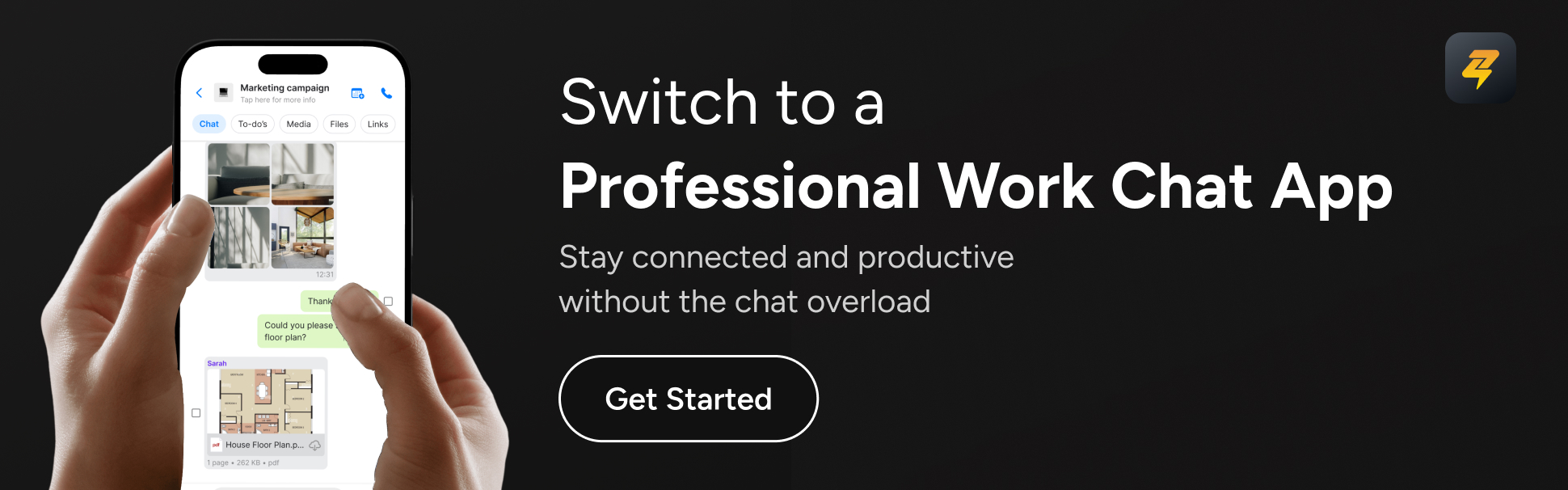
â
Use threaded conversations and structured spaces
Here is the simple fix. You move from one giant chat into structured spaces with threaded conversations that mirror how you actually work.
In Zenzap, you do this through clear workspaces and channels that feel as easy as a personal messaging app. Instead of one crowded “All staff” chat, you set up focused spaces like:
All hands or Company for company wide news and announcements.
Leadership for exec and management updates.
Team specific spaces for Sales, Operations, Support, Marketing.
Project or client spaces, such as “Q3 product launch” or “Client: Acme”.
Inside each space, you keep conversations narrow with threaded replies. A thread becomes the home for a single topic, decision, or task. Questions, files, and follow ups stay attached to that thread, not sprayed across the whole channel.
Why it works
Threaded conversations give you instant context. Instead of scrolling through 1,000 mixed messages, you jump into the exact thread where the topic lives.
This structure cuts duplicate questions, gives new hires a clear history to read, and makes decisions discoverable later. It also matches how your team naturally thinks. They group work by project, client, store, or topic. Zenzap simply makes that mental structure visible and easy to use.
True to life example
Imagine you are launching a new feature.
You create a Product thread for build questions and bug fixes.
You run a Marketing thread for campaigns and creative assets.
You keep a Support FAQ thread for canned replies and common issues.
A developer asks a question in the Product thread. Marketing never needs to see it. A support rep adds a new edge case in the FAQ thread. Product can follow that specific conversation without digging through launch memes.
Everyone stays connected to what they need, without getting pulled into what they do not.
Keeping communication and execution in one place
Talking is rarely your team’s problem. The missing follow through is what costs you time and money.
Someone says, “Can someone update the promo signage in Store 18 before Friday?” People agree in the chat. Then the day gets busy, and by tomorrow no one remembers who owned it.
Here is where Zenzap’s threaded conversations and built in tasks quietly transform your execution.
Whenever a decision is made or a new task emerges in a thread, you convert that message into a Zenzap task in real time. You assign an owner, set a due date, and keep file attachments in that same thread. There is no copy and paste into a separate project tool, no second tab, no extra login.
That short message about Store 18 instantly becomes a trackable task inside the same conversation. The owner sees it. The manager sees it. The thread becomes a live record of commitment, not just a stream of comments.
Why it works
This shift from loose chat to structured responsibility is huge, especially across multiple locations or distributed teams. You reduce “Did anyone see this?” and replace it with “We know who owns it and when it will be done.”
Over time, your threads turn into a searchable history of decisions, tasks, and outcomes. You can see what was agreed, who accepted it, and when it was completed. That gives you a clean link between communication and execution.
According to Gallup, low engagement and poor clarity cost companies roughly 18 percent of an employee’s annual salary in lost productivity. Threaded, task linked communication is a simple way to claw that back without hiring more people or buying heavier software.
Protecting focus and work life balance with better threading
Even with great structure, your team will burn out if work never stops buzzing in their pocket.
Zenzap is built to separate personal and professional life, while still giving you the responsiveness you need. You keep all work conversations in one professional app instead of mixing them with family chats on personal messengers.
Threading helps here too. When conversations live in clearly named threads, people can safely mute what they do not need after hours and keep alerts on for what is truly urgent.
Simple fix: working hours and scheduled messages
You set working hours in Zenzap, so your team does not get notifications when they are off the clock. If something comes to mind at 11 p.m., you drop it in the right thread and schedule the message to send during business hours.
Your team wakes up to a clean, structured set of updates inside threads, instead of a chaotic pile of late night pings.
Why it works
When people trust that they will not be interrupted at all hours, they are more willing to engage fully during work time. They know work stays in the work app, and personal messages stay personal. You protect rest without losing control of operations.
For you as a leader, this reduces silent burnout. It turns urgency into a conscious choice, not a default habit.
How leaders stay informed without micromanaging
As a leader, you want visibility without becoming the person who replies to every message.
Threaded conversations inside structured spaces give you a way to stay informed at a higher level. You join the right workspaces, such as “All managers” or “Ops leadership,” and skim indicators, task boards, and summary posts instead of reading every comment.
Inside each space, you can scan titles of active threads and dip into the ones that matter. You see the tasks tied to those threads, the owners, and the status, without jumping into side DMs or chasing screenshots.
Why it works
This keeps you present and supportive, not overbearing. You can coach where you see risk, celebrate progress, and step in when a thread stalls. At the same time, your team keeps a sense of ownership, because they run the details inside threads without you hovering in every reply.
In practice, this is how distributed teams use Zenzap as their single hub for communication. They have one place to look, clear threads to follow, and a simple way to turn new decisions into trackable tasks.
Real world examples of threaded communication with Zenzap
Example 1: distributed retail network
Picture a franchise network with 40 locations. Before Zenzap, instructions came through a messy mix of email, personal messaging apps, and calls. Store managers spent more time searching than executing.
With Zenzap, HQ creates:
Company space with a thread for each major initiative, for example “Spring promo rollout”.
Location spaces where each store has its own operational threads, like “Staffing”, “Inventory”, “Visual merchandising”.
When HQ posts a new promo guideline in the Spring promo thread, managers acknowledge in the same thread, attach photos of their updated displays, and ask questions right there. HQ replies once, in context, instead of answering the same question 10 times in different chat apps.
Any instruction that requires action becomes a task tied to that thread. HQ can see completion without building a separate report. The whole rollout moves faster and with fewer surprises.
Example 2: remote B2B SaaS team
A fully remote SaaS team uses Zenzap as their all in one workspace. They were tired of bouncing between multiple tools for chat, email, and project management.
Their Zenzap setup looks like this:
Product space with threads by feature and sprint.
Sales space with a thread per key deal and territory.
Customer success space with threads for account health checks and renewals.
Company space with a weekly “Leadership recap” thread.
Sales can tag product in a specific deal thread when a feature question comes up. Product answers in that same thread, and the answer stays visible for future deals. When the conversation turns into “We should add this to the roadmap,” that message becomes a product task without leaving the thread.
The result is less context switching, fewer status meetings, and cleaner handoffs between teams.
Simple fix format recap
Introduce the widespread problem
Your team is stuck in one noisy group chat or a mess of disconnected tools. Messages blur together, decisions disappear, and people waste hours asking, “Where did we talk about this?” Productivity drops, even though everyone feels constantly “on.”
Describe the single effective solution
The fix is to move to structured, threaded conversations in one simple work chat app, Zenzap.
You:
Replace the giant feed with focused workspaces and channels.
Keep each topic inside its own thread.
Turn important messages into tasks directly from those threads.
Use working hours and scheduled messages to protect focus.
Why this solution works
Threads match how work actually happens. They keep context, decisions, and actions together in one place. By tying tasks to threads, you create a direct path from “We should do this” to “It is done,” without adding another tool.
Because Zenzap feels like a familiar messaging app, your team adopts it quickly. You get the benefits of enterprise style structure, without the enterprise style learning curve or cost. That is why Zenzap is rated 4.7 out of 5 on platforms like Capterra and has won Best Value Team Communication Software awards in 2024 and 2025.
Encouragement to apply the fix
You do not need a massive rollout to see the benefit. Start small. Pick one team, one project, or one location. Set up a simple Zenzap structure, use threads for each key topic, and turn action items into tasks in real time.
Within a week, you will feel the difference. Fewer “Where is this?” messages. Faster decisions. Clearer ownership. A calmer, more focused chat that actually supports how you work.
Key takeaways
- Replace one giant group chat with structured spaces and threaded conversations so your team always knows where to look.
- Convert important messages into Zenzap tasks inside threads so nothing slips through the cracks.
- Use working hours and scheduled messages to protect focus and support healthy work life balance.
- Give leaders high level visibility through threaded summaries instead of dragging them into every conversation.
- Start small with one team or project so you can prove the impact of threaded communication before scaling it across your company.

FAQ
Q: What exactly is a threaded conversation in team communication?
A: A threaded conversation is a focused mini chat that sits inside a channel or space. Instead of every reply landing in one long feed, each thread keeps all messages about a single topic, question, or task together. In Zenzap, you start a thread from any message, reply in context, attach files, and even create tasks from that thread so everything related stays connected and easy to find.
Q: How do threaded conversations improve employee efficiency in practice?
A: Threads cut down on time spent searching and repeating yourself. Your team can jump straight into the right thread instead of scrolling through hundreds of mixed messages. They see the full history, the decisions, and the tasks tied to that topic in seconds. That clarity means fewer status meetings, fewer “Just bumping this” messages, and more time spent doing the work that matters.
Q: Will using threads slow my team down or make chat feel more complicated?
A: Not if you keep it simple. In Zenzap, starting or replying to a thread feels like a natural extension of regular chat. You do not need a long training manual. Begin with a few clear spaces and use threads for projects, issues, and decisions that need follow up. Most teams find that after a few days, threads actually feel easier, because people stop losing context and can focus on one conversation at a time.
Q: How does Zenzap keep work chat separate from personal messaging apps?
A: Zenzap is clearly labeled and used as “the work app,” while personal conversations stay in apps like personal messaging services. Your staff can install Zenzap on their phones and know that when they close it, work is done. Features like working hours and scheduled messages reinforce that boundary, so you protect personal time without missing important updates during the day.
Q: What about security and offboarding when employees leave?
A: Zenzap includes enterprise grade security with encrypted communication and secure onboarding and offboarding controls. Admins decide who has access, remove users in a few clicks, and keep all conversations, threads, and files inside the company account. When someone leaves, you retain the knowledge and history in your threads, without leaving sensitive information in personal apps or unmanaged devices.
Q: How fast can my team realistically adopt Zenzap and threaded communication?
A: Most teams become productive in Zenzap in minutes, not days, because it feels like the messaging apps they already know. You can start with a simple structure, invite a pilot group, and encourage them to keep each topic inside its own thread. As they see how much time they save, threaded communication quickly becomes the natural way to work.
What you do next
You do not need another heavy platform or a bigger software bill to fix your communication problem. You need one simple, structured space where conversations, threads, tasks, and files live together in a calm, searchable system.
Zenzap gives you that space. You centralize chat, use threaded conversations to keep topics clean, turn actions into tasks on the spot, and protect your team’s focus with thoughtful controls. You get the clarity and control of an enterprise tool, with the ease of a messaging app your team already understands.
The question now is, if your team spent less time swimming through noisy chats and more time acting on clear, threaded conversations, what could you finally achieve in the next 90 days?
You already feel it in your day. Too many tools, too many pings, and still too many dropped balls.
If you are running a small or midsize business, you have probably bounced between free chat apps, trial versions of enterprise software, and a few “temporary” WhatsApp groups that somehow became permanent. Subscription chat tools and freemium team apps promise to fix this. Some help. Some quietly make things worse.
This guide gives you a clear view of what subscription and freemium chat tools really mean for SME communication software. You will see where they save you money, where they cost you time, and how a focused work chat app like Zenzap can be up to 3 times more cost effective than traditional enterprise chat when used as your central hub.
We will unpack common questions you probably already ask yourself. Are freemium plans truly enough for my business? When does it make sense to move to a paid subscription? How do I keep communication professional and secure without burning out my team?
Think of this as your shortcut. By the end, you will know how to evaluate subscription chat tools, what to watch for in freemium team apps, and how Zenzap fits in as SME communication software that actually respects your time, budget, and work life balance.
Table of contents
1. What subscription chat tools and freemium team apps actually are 2. Why SMEs lean on freemium communication software 3. How Zenzap compares to typical freemium team apps 4. Common questions about pricing and long term value 5. Key takeaways 6. FAQ: Everything you need to know about SME communication software and Zenzap
What subscription chat tools and freemium team apps actually are
Subscription chat tools are communication platforms you pay for monthly or annually. These tools unlock features, admin controls, and higher limits as you move up pricing tiers.
Freemium team apps work differently. They let you start free, with limits on users, message history, or advanced features. If you like the experience and outgrow the free plan, you upgrade into a paid version.
On paper, this sounds perfect for SME communication software. You get to try before you buy, keep costs low, and scale only when needed. In reality, it depends on how each app balances three things: simplicity, structure, and security.
Some freemium tools feel like stripped down enterprise platforms. You get complexity without control. Others blur the line between personal and work chat, especially when teams lean on WhatsApp or similar apps for “just a few client groups” that quietly multiply.
That is the gap Zenzap is built to close. It combines the ease of a familiar messaging app with professional structure, tasks inside chat, Google Calendar integration, and enterprise grade security, all designed for SMEs that do not have time to babysit software.
Why SMEs lean on freemium communication software
If you are like most SME leaders, your first priority is quick adoption and low friction. You do not want a tool that takes weeks to roll out or hours of training just to send a message.
This is where freemium team apps feel attractive. They give you: – Zero upfront cost – Familiar chat interfaces – Basic channels and direct messages – Light integrations with tools like Trello or Google Drive
According to multiple industry surveys, small teams often use three or more tools just to manage basic internal communication, simple tasks, and scheduling. You might have: a personal messaging app for quick updates, email for formal threads, a project tool for tasks, and a shared calendar on top of it all.
That stack is expensive in more ways than one. You pay with subscription fees, yes, but also with lost focus and constant context switching. This is why platforms like Zenzap, which combine chat, tasks, and scheduling in one place, can end up up to 3 times more cost effective than traditional enterprise setups that require multiple separate tools to do the same job.
When freemium works well, it lets you test a focused work chat app with your team, see adoption in a day, and only upgrade when you are confident it fits your SME communication software needs.
How Zenzap compares to typical freemium team apps
Most freemium team apps promise “all in one collaboration,” then hand you a maze of channels, bots, and integrations that you have to configure. Zenzap takes a different route.
With Zenzap, you start with what your team already understands: fast, clean chat. From there, you layer on structure and productivity in a way that feels natural, not forced.
Inside Zenzap, you can: – Create focused chats and team channels sorted by client, project, or department – Turn any message into a task directly in the conversation – Attach files so they stay linked to the right chat or task – Sync with Google Calendar so deadlines and events are visible and predictable
Instead of drowning in channels and notifications, you get one organized workspace. You check a client channel and immediately see the conversation, the decisions, the to dos, the shared documents, and the next milestones, all in one place.
For SMEs, this “tasks inside chat” approach is crucial. You are not running a 500 person PMO with dedicated project managers. You have managers, owners, and team leads who already run the business from chat. Zenzap simply upgrades that habit into a structured, trackable system.
Question 1: Are subscription chat tools or freemium team apps better for SMEs?
This is the classic first question: should you commit to a subscription chat tool upfront or start with a freemium team app?
If you are an SME, the honest answer is that freemium, when done right, is usually your best starting point. You want to see how quickly your team adopts a tool, whether it actually reduces chaos, and how it feels during a real week of work.
Here is the catch. Not all freemium plans are created equal. Some free tiers limit message history so aggressively that you lose important context after a few weeks. Others cap the number of integrations or channels to the point where you cannot really run your team properly without upgrading immediately.
Zenzap takes a more SME friendly approach. You can start on a robust free plan that already includes: – Unlimited group chats for real team collaboration – Embedded tasks so you can manage work without extra tools – Mobile first design that your staff can pick up in minutes
In practice, most small teams can run their day to day operations fully on Zenzap’s free version while they test adoption. When it is time to upgrade, you do it because you see the value in extra security controls and admin features, not because you hit an artificial wall on day three.
Question 2: What should you look for in SME communication software?
Once you move beyond “free vs paid,” the real question is what actually matters for your SME communication software stack.
Here are the levers that really move the needle for you.
Usability and adoption
If your team cannot adopt the tool in a day, it will not stick. Look for a work chat app that feels as simple as texting, with no complex setup screens or long tutorials. Zenzap is designed so even non technical team members, from field staff to front desk teams, can sign in and be productive within minutes.
Structured communication
Channels and chats should map to how your business runs. Client, project, department, location. Inside each conversation, you should be able to pin tasks, files, and key messages so nothing slips through the cracks. Zenzap was built around this kind of structured communication, so you do not need separate tools just to “organize the chaos.”
Security and admin control
SMEs handle sensitive data too. You cannot afford ex employees keeping access to old group chats or crucial files sitting in personal messaging apps.
With Zenzap, communication is encrypted, and admins control who gets in and out. Onboarding is secure. Offboarding is instant, with access revoked in a click, so you do not have to chase personal devices or wonder who still sees what.
Work life balance features
This is where many generic chat tools fall short. They treat every ping as equally urgent, no matter the time of day.
Zenzap takes a healthier approach. Your team can set working hours so they are not pinged after hours. You can write a message at 10 p.m., schedule it for 9 a.m., and respect your colleagues’ time while keeping your own brain clear. Work stays in a professional app, away from personal messaging, which makes it easier to unplug.
Question 3: How do you compare long term value, not just price?
When you compare subscription chat tools and freemium team apps, price per user is the number that shouts the loudest. It is not the only number that matters.
To get a real sense of value, look at three hidden costs.
1. Tool count
How many tools do you need to run basic communication, task tracking, and scheduling? If you need a chat app plus a light project manager plus a calendar tool, your “cheap” subscription chat can quickly become expensive.
Many teams that move to Zenzap find they can retire one or two overlapping tools because chat, tasks, and Google Calendar integration live together in a single app. That is a big part of why Zenzap can be up to 3 times more cost effective than using traditional enterprise chat as just one piece of a larger stack.
2. Onboarding time
Every new hire costs you time before they contribute at full capacity. If your communication tool is confusing, that ramp up period stretches out.
Zenzap is intentionally intuitive. New teammates can get up to speed in minutes, not days. For fast growing SMEs or businesses with regular staff turnover, such as hospitality or healthcare, those saved hours add up quickly.
3. Productivity loss from context switching
Jumping between apps to chase updates, check deadlines, or find files kills focus. Research has shown that frequent context switching – meaning moving between tools and tasks – can significantly reduce productive time in a day.
By putting communication, action items, and timelines side by side, Zenzap reduces that mental tax. Your team spends more time doing the work and less time searching for “that one message with the client’s final approval.”
Key takeaways
- Start with a freemium work chat app that your team can adopt in a day, then upgrade only when you see clear value.
- Choose SME communication software that combines chat, tasks, files, and calendars so you can reduce your overall tool count.
- Protect your business with encrypted communication, clean onboarding, and instant offboarding for departing staff.
- Prioritize work life balance features like scheduled messages and working hours so your team can unplug without missing what really matters.
- Use Zenzap as a central, mobile first hub to make your stack up to 3 times more cost effective compared to complex enterprise suites.
Your next step toward calmer communication
You do not need another complex platform or yet another “temporary” WhatsApp group. You need SME communication software that feels natural, organizes itself around your real work, and keeps your data and your team safe.
Subscription chat tools and freemium team apps can absolutely help you get there, but only if they strike the right balance: simple enough to use today, structured enough to rely on tomorrow, and secure enough to protect what you are building.
Zenzap is built around that balance. It looks and feels like the messaging tools your team already loves, yet keeps everything professional, organized, and under your control. You can start free, see real adoption in days, and only upgrade when it is obvious that this is the communication backbone your business needed all along.
The real question now is simple: if your team communication stayed exactly as it is for the next 12 months, would you be okay with that, or is it time to try a tool that finally supports the way you actually work?
FAQ
Q: How do I decide between a generic freemium chat app and Zenzap for my SME communication software? A: Start by listing your top three needs. If you just want casual messaging and do not care where work happens, a generic app might be enough. If you want a mobile first hub where chat, tasks, files, and scheduling live together, with strong security and work life separation, Zenzap is likely a better fit. Then compare total tool count and onboarding time, not just the sticker price.
Q: When does it make sense to move from the free plan to a paid subscription? A: Upgrade when communication becomes mission critical and you need more control. Signs include hiring more staff, handling sensitive client data, needing detailed admin controls, or requiring tighter security and compliance. Zenzap’s free plan is strong for small teams, and the paid tiers add deeper admin tools, more advanced security, and scalability to support your growth.
Q: Can Zenzap really replace other tools like lightweight project managers or scheduling apps? A: For many SMEs, yes. Because Zenzap lets you create tasks directly inside chat and sync with Google Calendar, you can often drop separate task and basic scheduling tools. You might still keep a heavy project platform for very complex initiatives, but for everyday operations in sales, support, operations, or marketing, Zenzap can comfortably run the show.
Q: How quickly can my team realistically adopt Zenzap? A: Most teams can start using Zenzap’s core features in a single day. It is intentionally designed to feel like texting, not like a heavy enterprise system. Even non technical team members can download the app, join their channels, and begin chatting and managing tasks within minutes, with no formal training.
Q: How does Zenzap help protect work life balance compared to other chat tools? A: Zenzap keeps all work communication in a dedicated professional app, separate from personal messaging. Your team can set working hours so they do not get notifications when they are off the clock, and you can schedule messages to send during business hours. That means you can clear your head without waking up a colleague, and your team can unplug without fearing they will miss something critical.
Q: Is Zenzap suitable for frontline or mobile teams, not just office staff? A: Absolutely. Zenzap was designed as a mobile first work chat app, so it fits teams in hospitality, healthcare, field services, logistics, and any environment where staff are rarely at a desk. Adoption is fast, controls are simple, and managers can keep everyone aligned without forcing complex tools onto employees who mostly live on their phones.
If your team lives in chat, your tasks should too. The problem is, once you start turning messages into tasks, things can get messy fast, especially when people are spread across locations and time zones.
This guide shows you a simple way to use direct messaging and internal task alignment for clear, reliable task tracking, without overwhelming your distributed teams. You will see how small structural changes in Zenzap keep work organized, protect focus, and stop important to dos from disappearing into chat history.
Table of contents
1. Why direct messaging alone confuses distributed teams 2. One rule for internal task alignment in chat 3. How to structure channels and DMs in Zenzap 4. Turning messages into trackable tasks without chaos 5. Connecting tasks to time so nothing slips 6. Keeping work and personal chat separate 7. Protecting work life balance in distributed teams 8. Why this approach works for task tracking 9. Key takeaways 10. FAQ
Why direct messaging alone confuses distributed teams
Look at your current chat setup. How many important action items live inside 1:1 or group DMs that no one remembers two days later?
When you rely on direct messaging without clear internal task alignment, three problems usually show up:
First, scattered context. Decisions and follow ups are split across DMs, group chats, email, and personal messaging apps. You end up searching everywhere for that one message that matters.
Second, invisible work. In distributed teams, a huge amount of work happens in private threads. That might feel fast in the moment, but it leaves everyone guessing about who owns what and what is already in motion.
Third, constant follow up. You ping people for updates, they dig through old threads, and no one is fully sure what is still active. This is where projects slow down, especially across time zones.
Zenzap takes a different line. Instead of fighting chat, you use it as the backbone of your task tracking system. Direct messages are still there for quick conversations, but the real work is captured as clear tasks that everyone can see, search, and act on.
One rule for internal task alignment in chat
Here is the simple fix that anchors everything else.
Any message that contains an action becomes a task with one owner and one due date.
That is it. You do not start with new workflows, complex boards, or extra tools. You keep your communication where it already lives, in Zenzap, and upgrade how you treat action items.
For example, when you type, “Can you finalize the Q3 launch deck by Thursday?” in a direct message, you immediately convert that message into a Zenzap task, assign it to the right person, and set Thursday as the due date. Context, owner, and deadline now live together.
Zenzap customer data shows that teams who keep tasks directly tied to chat and files see up to a 40 percent boost in on time project completion. That jump does not come from more meetings. It comes from turning decisions into trackable work at the moment they are made.
Why this simple fix works
This one rule works because it removes ambiguity. You remove the grey zone between “We talked about it” and “Someone is clearly on the hook.”
It also gives your distributed team a shared habit. Whether someone works from a warehouse, a clinic, or a home office, they follow the same pattern. If it is work, it lives in Zenzap, and if it is an action, it becomes a task.
Over a week or two, you see fewer dropped balls, fewer “Did anyone do this?” messages, and much less time wasted chasing status updates.
How to structure channels and DMs in Zenzap
To make direct messaging and internal task alignment work together, you start by giving every conversation a clear home. Zenzap makes this straightforward.
Step 1: move core communication into Zenzap. Pick a date when your leadership team, managers, and key projects shift into Zenzap as the default work chat. The simple rule here is, if it is work, it lives in Zenzap.
Step 2: create focused channels. Set up channels that mirror your structure. For example, “Exec team,” “Product,” “Growth,” “Customer support,” “Store 05,” “Region North,” or “All managers.” This keeps most project and team work out of private DMs and in shared spaces where tasks are easier to track.
Step 3: position DMs for quick alignment. Direct messages are still useful, especially across time zones. You use them for clarifying questions, quick check ins, and sensitive topics, not as the long term home of multi step work.
Once channels and DMs have clear roles, your team naturally starts treating them differently. Important work moves out of ephemeral back and forth and into structured conversations where task tracking is expected.
Turning messages into trackable tasks without chaos
With structure in place, the next step is building the habit of converting messages into tasks. Zenzap is designed so this feels as natural as sending a chat.
Here is a simple 3 step pattern you can roll out with your distributed team.
First, capture in real time. Any time you see phrases like “Can you,” “We should,” or “Let us do this by Friday,” you or the person sending the message converts that chat into a task inside Zenzap.
Second, assign one owner. Each Zenzap task has a single clear owner. You can mention others in the description, but responsibility is never shared. That clarity matters even more when you do not share an office.
Third, always add a due date. Even if you set a rough target, like “end of week,” attach a date. Zenzap then surfaces that task in the right personal views and calendar integrations so it does not get lost.
According to internal Zenzap data, teams that follow this pattern are up to 42 percent less likely to miss deadlines, largely because nothing important stays stuck as “just chat.”
Connecting tasks to time so nothing slips
Once you are turning messages into tasks, you need those tasks to show up where people plan their days. This is where Zenzap’s calendar integrations and mobile first design come into play.
First, sync with calendars. Connect Zenzap to tools like Google Calendar so due dates appear next to meetings and shifts. This single move removes blind spots. You no longer have deadlines hiding in an app no one opens.
Second, use personal task views. In Zenzap, each person can see tasks assigned to them, tasks they have assigned to others, and what is upcoming or overdue across all channels and DMs. Encourage your team to start the day here, not by scrolling through notifications.
Third, link long form work as needed. For complex projects or long term roadmaps, you can still keep a lighter external tool if you want. Zenzap then becomes your “who is doing what this week” source of truth, which is where most confusion really lives.
For example, if you assign your operations manager a task to “Prepare Q3 budget review by Tuesday,” that task lives inside the relevant channel, appears in their personal task view, and shows up in their calendar. When they open their agenda in the morning, there is no guesswork about priorities.
Keeping work and personal chat separate
A big reason distributed teams get confused is that work conversations spill into personal apps. You might start discussing a feature in a personal messaging app, then continue in email, then assign a task in a separate project tool. No one has the full picture.
Zenzap solves this with a simple boundary. Work stays in one professional space, with enterprise grade security and clear admin control. Personal life stays in personal apps.
Here is how you can enforce that separation without making people roll their eyes.
First, set the rule: if it is work, it lives in Zenzap. That includes quick questions, store updates, incident reports, campaign approvals, and shift changes. Everything.
Second, keep adoption friction low. Zenzap feels as simple as texting. If someone on your team can send a message, they can use Zenzap. This is one reason Zenzap is rated around 4.7 out of 5 on platforms like Capterra and has picked up Best Value Team Communication Software awards in 2024 and 2025.
Third, rely on admin controls. When someone leaves, you simply remove their access. They do not walk away with months of chat history and sensitive files on their personal phone. As an admin, you know exactly who has access to what.
Protecting work life balance in distributed teams
Task tracking inside chat can easily turn into “always on” if you are not careful. You want clarity, not burnout. Zenzap gives you simple settings that protect your team’s time while keeping internal task alignment tight.
Use working hours. Encourage your team to set their working hours inside Zenzap. Outside those hours, they do not receive notifications unless something is marked as urgent. This is crucial when people live in different time zones.
Schedule non urgent messages. When you are working late, you can type messages and schedule them to send during the recipient’s working hours. Your thought does not get lost, and they are not pinged at midnight.
Shift to focus views. Teach people to lean on their personal task view during work blocks instead of bouncing between channels. They see what matters now, not every message that happens to be noisy.
This combination lets you have strong internal task alignment without expecting your team to respond at all hours. You get reliability and predictability, not constant fire drills.
Why this approach works for task tracking
You might be wondering if tying task tracking to direct messaging and internal chat will just create more noise. In practice, the opposite happens, as long as you keep the system simple.
Here is why it works.
You meet people where they already are. According to multiple workplace studies, most knowledge workers spend a huge portion of their day in chat and email. Zenzap puts tasks in the same place as conversation, so there is no extra app to remember.
You reduce tool fatigue. Instead of splitting attention across three or four different tools, your distributed team uses one intuitive workspace. Conversations, tasks, files, and schedules share the same context.
You create a single source of truth. Zenzap becomes the answer to “Who is doing what this week?” For distributed teams, that visibility is what replaces hallway chats and desk drive bys.
Most importantly, you keep the process light. No one needs to learn a heavy project management system. They just follow one rule: turn actions into tasks with an owner and due date, then let Zenzap handle the structure around it.
Key takeaways
- Move all work communication into Zenzap and give every recurring conversation a clear home in structured channels instead of scattered DMs.
- Apply one simple rule: every actionable message becomes a Zenzap task with a single owner and a clear due date.
- Connect Zenzap with calendars and use personal task views so distributed team members see their priorities where they already plan their day.
- Keep work and personal messages separate by using Zenzap as your dedicated internal communication space with strong admin controls.
- Use working hours, scheduled messages, and focused notifications to protect work life balance while keeping internal task alignment tight.
Your next move with Zenzap
You started this guide with a messy reality. Direct messages everywhere, action items buried in chat, and a distributed team that is doing its best but still dropping the occasional ball.
The simple fix is within reach. Centralize your communication in Zenzap, define channels that match how you actually work, then apply one shared rule. Every action becomes a task with one owner and one due date.
This is where you shift from constant chasing to calm, visible progress. You stop asking, “Where did that go?” and start opening your Zenzap task views and calendar to see exactly what matters today.
You do not need a heavier system or more tools. You need one intuitive, secure workspace that aligns direct messaging, internal task alignment, and task tracking for your entire distributed team.
So the real question is, if your team is already living in chat, how long will you let important work hide there instead of turning it into action you can actually see?
FAQ
Q: How do I start using Zenzap for task tracking without confusing my distributed team? A: Start with a small pilot. Move one cross functional project or one location into Zenzap, create a few focused channels, and introduce a single rule: every actionable message becomes a task with an owner and due date. Model the behavior yourself. Once people see that follow through gets easier, you can roll the approach out across more teams.
Q: Should I use direct messages or channels for task tracking in Zenzap? A: Use channels as the default home for work and task tracking, and reserve direct messages for quick clarifications or sensitive topics. If an action item appears in a DM, convert it into a task or move the conversation into the right channel. This keeps important work visible and aligned, especially when people are remote or across time zones.
Q: Can Zenzap replace my existing project management tool? A: For day to day task tracking, often yes. Many teams use Zenzap to handle everyday tasks, follow ups, and short term projects, while keeping long term roadmaps or complex Gantt charts in a lighter external tool if needed. Zenzap becomes the source of truth for “who is doing what this week,” which is the part of project management that usually creates the most confusion.
Q: How do I stop my team from feeling overwhelmed by both chat and tasks? A: Keep the process simple and protect focus. Only actionable messages become tasks, and each task has one owner. Encourage people to start their day in their Zenzap personal task view, not by scrolling through channels. Use working hours and scheduled messages so they are not pinged constantly. This combination keeps chat useful and tasks manageable.
Q: What about security if my team currently uses personal messaging apps for work? A: Moving to Zenzap gives you encrypted communication, enterprise grade security, and clear admin control over who has access. Work conversations and files live in a dedicated professional space, not on personal devices. When someone leaves, you can remove access instantly instead of hoping sensitive chats are deleted from their private phone.
Q: How fast can a non technical team adopt Zenzap for internal task alignment? A: Very fast. Zenzap is mobile first and feels as simple as texting, so most teams are productive within minutes. You do not need training sessions or long manuals. As long as people can send a message, they can turn it into a task, check their task view, and stay aligned with the rest of your distributed team.
You already run most of your team from chat. Strategy, approvals, and to do items all start as quick messages. The problem is simple: if a task stays a message, it is far too easy to lose.
Embedded task tracking in Zenzap fixes that gap for you. You turn decisions into tasks as you go, keep the full conversation attached, and give everyone a live, personal to do list that lives right inside your internal business messaging.
Table of contents
Here is what you will walk away with in this guide:
- Why embedded task tracking in chat changes how you manage
- Step 1: Centralize internal business messaging in one secure hub
- Step 2: Turn action messages into Zenzap tasks in real time
- Step 3: Give every team member a live personal to do list
- Step 4: Link tasks to time with calendar and scheduling
- Step 5: Keep context, files, and decisions attached to every task
- Step 6: Cut status meetings and manage by channel dashboards
- Step 7: Blend Zenzap with existing project tools
- Step 8: Protect focus, visibility, and work life balance
- Key takeaways
- Your next step with Zenzap
- FAQ
Why embedded task tracking in chat changes how you manage
Here is a question worth asking: how many tasks did your team quietly lose in chat last week?
You talk about work in one place, then try to manage work somewhere else. A request appears in a group chat. Someone says, “Got it.” Another person writes the same thing in a notebook. A few days later, no one is sure who owns what.
Right now, most teams live in that painful gap between conversation and execution. You talk about work in one app, then chase tasks in a project tool, a spreadsheet, or someone’s personal to do list. Harvard Business Review has reported that switching between tools can cut productivity by up to 40 percent. The American Psychological Association cites similar findings on context switching and focus loss. That is a huge hidden tax on your team.
Embedded task tracking flips that script. Instead of asking people to leave the place where work starts, your task tracker lives inside the conversation. Any message can become a task in a tap, with owner, due date, and full context attached. Zenzap is built to make that feel natural, like the chat app your team already knows, but with structure that makes sure nothing slips through the cracks.
In this article, you will climb a series of practical steps. Each step shows a specific way managers and directors use embedded task tracking in Zenzap to create seamless task management in chat. By the time you reach the top, you will see a clear path to cleaner communication, sharper accountability, and calmer days.
Step 1: Centralize internal business messaging in one secure hub
Your first move is straightforward: bring internal business messaging into one structured, secure hub. That hub is Zenzap.
Right now, your team might ping you on personal messaging apps, forward updates over email, and tag you in a legacy chat tool. Every extra place you have to check is another chance for a task to disappear. When you centralize into Zenzap, you give people one professional place for work chat and task tracking, separate from personal apps.
In practice, that looks like this:
You set up clear channels such as “Exec team,” “Launch Q3,” “Support escalations,” or “Top customers.” Everyone knows where to post and where to look. You can apply enterprise grade security controls so only the right people see sensitive threads, and you can onboard or offboard staff without exposing customer data on personal phones.
Research on digital distraction shows that every “Where did we say that?” moment breaks focus and slows decisions. By centralizing messaging and task management in Zenzap, you remove a big source of that friction and get ready for the next step.
Step 2: Turn action messages into Zenzap tasks in real time
Once your communication lives in one place, you can address the real problem: chat without action is just noise.
This is where embedded task tracking in Zenzap starts to shine for managers. Any time you see a message that implies a “next step,” you convert it into a task right there in the thread. No copy paste, no extra admin.
Here is a real life example. Your sales lead writes: “We need a revised proposal for Clinic X by Thursday.” In a traditional setup, that line would vanish into the scroll. In Zenzap, you highlight the message, convert it into a task, assign it to Alex, and set Thursday as the due date. The task is now visible to the channel, and Alex sees it in their personal list.
Harvard Business Review has highlighted that context switching between tools can cost up to 40 percent of your productive time. When chat and tasks live together, you get a large portion of that time back. Your team does not have to remember where work “really” lives. It all lives where it started: in the chat.
This step turns your chat from a quick fire talk stream into a reliable capture machine for every commitment you care about.
Step 3: Give every team member a live personal to do list
Step 3 builds directly on step 2. Once you convert action messages into tasks, Zenzap quietly builds a live, personal to do list for each person on your team.
Directors and managers care about accountability. You want fewer “I thought you were handling that” moments and more “I can see exactly what I own” clarity. Zenzap delivers that without asking your team to maintain yet another tool.
Each person gets a list that shows:
- All tasks assigned to them
- Due dates and reminders
- Status, from “Not started” to “Done”
The beauty here is that no one has to manually sync this list. It grows naturally from your internal business messaging. When someone turns a message into a task and assigns it, it appears automatically on the right person’s list.
Picture your customer support manager, Jamie. Instead of running their day from a mix of tabs and sticky notes, Jamie opens Zenzap and sees a single, live view of support follow ups, internal handoffs, and project tasks, all generated from real conversations. That gives you a clean foundation for stronger performance and simpler coaching.
Step 4: Link tasks to time with calendar and scheduling
Tasks without time quickly become wishful thinking. Step 4 connects your embedded task tracker to your calendar so work and time stay in sync.
With Zenzap’s integrations, you can tie tasks directly to Google Calendar and use scheduling options that respect working hours. When you set a due date, you can see how that sits against other commitments, which helps you avoid accidental overload and missed deadlines.
Here is what this looks like in practice:
Your marketing lead posts, “We need a new one pager for the investor call next Thursday.” You convert the message to a task, assign it to Design, and link the due date to the actual investor call in Google Calendar. As the date approaches, the owner gets nudges, and you see status updates in the relevant channel.
You can also schedule messages themselves. If an idea hits you at 10 p.m., you can write it in Zenzap, schedule it to send during business hours, and respect your team’s work life boundaries. People can set their working hours so they are not pinged at night, yet urgent issues can still surface appropriately.
Linking tasks to time creates a realistic execution plan rather than a never ending wish list.
Step 5: Keep context, files, and decisions attached to every task
Most standalone project tools rip tasks away from the conversations that explain them. That is where confusion starts for your team.
Someone opens a card that says “Update onboarding flow” and immediately wonders: What changed? Who requested it? Where is the customer quote? How urgent is this really?
Zenzap’s embedded task tracker solves this by keeping every task tied to the chat that created it. You can scroll up to see:
- The original request
- Customer quotes and complaints
- Documents and links
- The reasoning behind the decision
This context is a lifesaver when new colleagues join a project or you revisit work after a few weeks. No one has to dig through old tools or ask for a recap. Accountability is clear, and nothing gets lost in translation.
For example, your product manager might pick up a task to “Improve billing error messages.” By scrolling the channel history, they can immediately see screenshots from customers, support notes, and leadership comments, all in one place. They do not need a separate brief. The conversation is the brief.
Step 6: Cut status meetings and manage by channel dashboards
By the time you reach step 6, you have central chat, real time task creation, personal to do lists, calendar links, and full context. Now you can tackle another major pain: status meetings that simply rehash what people already typed.
Directors often sit through one hour calls that could have been a five minute scan. With Zenzap, your embedded task tracker turns each channel into a living status page.
Here is how channels behave when managers use embedded task tracking well:
- When someone completes a task, the relevant channel sees an update
- When a deadline approaches, the owner receives a gentle nudge
- When a task is blocked, that status is visible in context
Instead of asking “What is the status?” over and over, you open “Exec team,” “Launch Q3,” or “Top customers” and instantly see both the decisions and the tasks that came from them.
This turns your channels into dashboards you can scan at any time, from any device. For a field heavy or frontline team, that means you can manage from your phone without hauling around a laptop and a complex tool set.
Step 7: Blend Zenzap with existing project tools
Maybe you already rely on a project management platform like Asana, Trello, or Jira for large initiatives. You do not have to choose between those tools and Zenzap. Many teams find a hybrid sweet spot.
A simple pattern looks like this:
- Use your established project tool for high level planning, roadmaps, and executive reporting
- Use Zenzap as the live, embedded task tracker for chat driven work and day to day execution
For example, your product roadmap might sit in Jira with epics and long term milestones. At the same time, your daily coordination, bug triage, and customer follow ups all live in Zenzap. When a bug report appears in a support channel, you convert it to a task, assign it, and attach links back to the Jira ticket if needed.
According to many teams that adopt this pattern, the combination gives them the best of both sides: strategic clarity from their project platform, and speed plus context from Zenzap. You can mirror only key tasks into Zenzap or simply rely on Zenzap for the work that actually moves every day while your project tool keeps the long range view.
Step 8: Protect focus, visibility, and work life balance
The last step ties everything together around how your team feels day to day. Task management inside a team chat app is not just about productivity. It is about creating a calmer, more sustainable way of working.
Research on context switching, such as studies summarized by the American Psychological Association, shows that jumping between tools and tasks does not just slow you down. It also increases stress and reduces quality of work. When you bring chat and task management together in Zenzap, you remove a large block of that wasted effort.
Zenzap also reinforces healthy boundaries. Because work chat is separate from personal apps, your team does not have to scroll through family messages to find an urgent update from a direct report. Working hours, scheduled messages, and smart notifications help people unplug without missing something critical.
Managers use this step to set clear norms. For example:
- “If it is work, it starts in Zenzap, not in personal chat.”
- “If a message implies an action, we create a task before we scroll away.”
- “We respect working hours, and we use scheduling for non urgent requests.”
Within days of applying these habits, most teams feel the shift. Fewer “Did we agree on this?” conversations. Clearer ownership. Less late night worry about the tasks you might have missed in the noise.
Key takeaways
- Centralize internal business messaging in Zenzap so tasks stop disappearing across email, personal chat, and legacy tools.
- Turn action messages into tasks in real time with clear owners and deadlines to close the gap between talk and execution.
- Use embedded task tracking to give every person a live, auto updating to do list that grows directly from chat.
- Attach context, files, and calendar links to each task so your team always knows what to do, why it matters, and when it is due.
- Cut back on repetitive status meetings by managing progress through channel dashboards and visible task updates.
Your next step with Zenzap
Your team communication app quietly shapes how your business feels every single day. Get it wrong and you live with scattered decisions, endless follow ups, and a team that is never fully on or fully off. Get it right and you create a calmer approach to work, where leaders have visibility, teams have clarity, and everyone gets meaningful time back.
Zenzap was built to give you that “just works” feeling. You get intuitive simplicity, structured internal chat, built in task management, bulletproof security, and seamless integrations in a mobile first app that teams can learn in minutes.
You do not need a big bang rollout. Start small. Pick one team, one channel, and one simple rule: if it is work, it starts in chat and becomes a task right there, inside Zenzap. Watch how quickly ownership tightens and the noise drops.
If a few focused steps can reclaim up to 40 percent of lost productivity from context switching, what might your week look like once every important message automatically becomes a clear, trackable task?
FAQ
Q: What is an embedded task tracker in a team chat app?
A: An embedded task tracker lets you create, assign, and update tasks directly inside your work chat. In Zenzap, any message can become a task with an owner, due date, and status, all linked to the original conversation. You do not need a separate to do tool for everyday work.
Q: How quickly can my team adopt embedded task tracking in Zenzap?
A: Most teams ramp up in minutes. Zenzap is designed to feel like a familiar messaging app, so people already know how to chat. Task options appear where you expect them. You simply highlight a message, convert it, assign it, and move on. Start with a few key channels and let the habit spread.
Q: What if we already use project management tools like Asana or Jira?
A: You can keep your existing tools for long term planning and executive reporting, and use Zenzap for live, chat driven coordination. Many managers mirror only key tasks into Zenzap or rely on Zenzap for daily execution while their project tool keeps the high level roadmap.
Q: How does embedded task tracking help reduce status meetings?
A: When tasks live in the same channels as decisions, each channel becomes a living status page. You can see what is in progress, what is blocked, and what is done without a separate meeting. Leaders scan channels like “Exec team” or “Launch Q3” instead of sitting through hour long updates.
Q: Can embedded task tracking in Zenzap support remote and mobile first teams?
A: Yes. Zenzap is mobile first, so frontline staff, field reps, and remote teams can chat, create tasks, and update status from their phones. Because tasks stay tied to conversations, people can catch up quickly, even if they were offline during the original discussion.
Q: How does Zenzap protect work life balance while using embedded task tracking?
A: Zenzap separates work from personal chat and lets people set working hours so they are not pinged during off time. You can schedule non urgent messages, rely on smart notifications, and still escalate urgent issues when needed. Managers get visibility without expecting people to always be on.
You are probably already feeling it. Your team chat is buzzing all day, your task list lives somewhere else, and you are the one stuck in the middle trying to keep everything moving without dropping a ball. You talk about work in one place, track it in another, and hope nothing important disappears in the gaps.
This is exactly where a collaboration chat app with a built-in to-do list changes the game for SME communication software. By bringing conversations and tasks into one calm, structured hub, Zenzap lets you run your small or mid-sized business with less chaos, more clarity, and a lot less mental load.
Table of contents
1. Why your SME communication software is working against you 2. What makes Zenzap different from traditional messaging tools 3. How chat plus built-in to-do list mirrors how your team really works 4. One tool, one feed, everything connected 5. Security and control that do not slow you down 6. Simplicity that teams actually adopt 7. Better SME communication software with fewer tools 8. Core insight for SME communication software 9. Key takeaways 10. Frequently asked questions
Why your SME communication software is working against you
If you are like most SME leaders, your current setup probably grew organically, not strategically. A bit of WhatsApp here, some email threads there, a task tool someone liked, maybe a spreadsheet for good measure.
It sort of works, but it always feels slightly fragile. Decisions get buried in group chats. Tasks get written on sticky notes or copied into separate tools. People leave the business and still have access to sensitive messages on their personal phones. You know this is risky, but you are also busy running the actual company.
Research has shown that context switching between multiple apps can eat up hours each week and drain focus. According to Zenzap’s own internal customer feedback, teams see up to 30 percent higher productivity after switching to a focused communication hub that combines chat and task management. That is a big lift for any SME.
The bigger point is this. Your team already knows how to chat. What they struggle with is keeping track of who is doing what, by when, without wading through a dozen channels and three extra tools.
That is the gap Zenzap is built to close.
What makes Zenzap different from traditional messaging tools
Traditional messaging tools were never designed as SME communication software. WhatsApp, SMS, and consumer messengers are great for quick chats, but they do not give you structure, security, or professional separation. Email is even worse for fast-moving teamwork. Messages scatter, files get lost, and nobody sees the full picture.
On the other side, many enterprise collaboration suites swing too far in the opposite direction. Complex boards, layered permissions, and workflows that need training sessions and internal champions. That might work if you have an IT department and weeks to roll out a new platform. Most small and mid-sized businesses simply do not.
Zenzap gives you a third option. It keeps the easy, familiar feel of simple chat, but adds in the structure, security, and task management that SMEs actually need. According to reviews on platforms like Capterra, Zenzap holds a 4.7 out of 5 rating and has been recognized with “Best Value Team Communication Software” awards in 2024 and 2025. That combination of simplicity and power is what sets it apart.
So instead of stretching consumer tools beyond their limits or wrestling with bloated enterprise platforms, you get one focused SME communication hub that your entire team can pick up in minutes.
How chat plus built-in to-do list mirrors how your team really works
Your team already lives in chat. That is where decisions are made, problems surface, and ideas appear in the middle of a busy shift or a packed calendar.
A collaboration chat app with a built-in to-do list, like Zenzap, simply meets your team where they already are and adds one small but powerful habit. When a message includes a real action, you convert it into a task in one tap. That task lives in the same channel where the conversation happened. It has an owner, a due date, and clear visibility.
There is no extra portal to open, no need to rewrite the details somewhere else, and no second system to remember. Chat and task management stay joined at the hip, which is how work actually flows in your business.
Imagine your marketing lead messages in the “Campaign Q3” channel: “We need a revised landing page for the new pricing by Friday.” In most setups, that request floats in chat and everyone just hopes someone handles it. In Zenzap, you or your teammate convert that message into a task, assign it to the right designer, and set the Friday deadline. No extra admin. No assumptions. No confusion.
One tool, one feed, everything connected
Zenzap is designed around a simple principle. You get one central place where chat, tasks, files, and schedules live together, not scattered across half a dozen tools and tabs.
Here is how that plays out in day to day SME communication:
When something needs doing, you turn that message into a task. You assign an owner, add a due date, and keep the task visible in the same thread. Files, follow up comments, and status updates stay tied to the original conversation.
You do not have to hunt through a project board to remember why a task exists or what was decided. You see the full story in context. That reduces “Why are we doing this again?” meetings and the quiet frustration that builds when people feel out of the loop.
This kind of connected feed also cuts context switching, which research has shown can sap up to 40 percent of productive time when employees juggle multiple apps. With Zenzap, your team stays focused in one environment instead of bouncing between chat, email, calendar, and task tools all day.
Security and control that do not slow you down
For SMEs, security is not a luxury anymore. Client data, contracts, HR conversations, and financial details are already flowing through your communication tools.
When those conversations live in personal apps, you lose control the moment someone leaves the business or loses their phone. Messages sit in private accounts. Files are stored in unknown places. You cannot reliably revoke access or prove you are protecting sensitive information.
Zenzap treats your internal communication like the serious business channel it is. You get encrypted communication, secure onboarding and offboarding, and admin controls that let you manage who can access what without needing a dedicated IT team.
Leaders like Jonathan Falade at OJ Solutions credit Zenzap for turning messy internal communication into “one comprehensive, intuitive platform” while keeping company data safe from leaks or accidents. When you think about the potential cost of a security mishap, that peace of mind matters.
At the same time, security in Zenzap feels calm, not complicated. You do not have to dig through complex settings to protect your data. The controls are there when you need them, but they never get in the way of simply getting work done.
Simplicity that teams actually adopt
A communication tool can only help you if your team actually uses it. If the interface feels heavy or confusing, people quietly drift back to what is easy, usually WhatsApp, SMS, or long email threads.
Zenzap is built on one core belief. If you can chat, you can manage work. The app feels like a familiar messenger, so most users are productive in minutes, not weeks. No one needs to wait for a training session to send their first message or create their first task.
On the Zenzap team collaboration page, users describe it as “intuitive” and “my go to for staying connected.” Managers from organizations like NHS Wales and Tech on Toast have praised its “all in one” clarity and rapid adoption. Chris Fletcher from Tech on Toast even called Zenzap a “money saver” because new staff get up to speed so quickly.
For you, that means you can roll out a new SME communication software without a massive change management plan. Download the app, create your workspace, invite your team, and they are off.
Better SME communication software with fewer tools
Tool sprawl is a hidden cost that quietly drains SMEs. You add a chat app, then a project tool, then a separate to-do list, then a scheduling platform. Each one seems useful in isolation. Together, they create subscription bloat, password fatigue, and endless tab switching.
Zenzap takes a different path. It combines your core internal needs in one mobile first hub: chat, built-in to-do list, file sharing, and calendar integration. You can connect it to tools like Google Calendar, Zoom, Microsoft Office, and popular cloud drives, so key workflows still happen right where the conversation is.
Many businesses that switch to Zenzap find they can drop two or three overlapping tools. According to Zenzap’s own data, this can significantly reduce software costs, since you are paying for one focused app that does what your team actually needs, instead of a stack of rarely used features spread across multiple platforms.
For a small business, that kind of consolidation does not just save money. It saves mental energy. Your team does not have to remember which tab to check or which login to find to complete a task. Everything is in one place.
Core insight for SME communication software
Here is the core insight that ties all of this together. If your chat app and your to-do list live in separate places, your team will always be fighting an uphill battle against confusion, missed follow ups, and extra admin work.
A collaboration chat app with a built-in to-do list cuts that friction at the source. It takes the channel where your team already spends their day and quietly layers in structure, ownership, and visibility. That single shift transforms how your SME communication software supports the business.
Zenzap exists to make that shift feel natural. You get intuitive simplicity, professional separation between work and personal communication, bulletproof security, structured organization, and seamless integration with the tools you already rely on. Most importantly, you give your team a calmer, more focused way to collaborate.
Instead of adapting your processes to fit a complex tool, you choose a tool that finally fits how your business already works.
Key takeaways
- Stop splitting chat and task management across multiple tools and move to one collaboration chat app with a built-in to-do list.
- Use Zenzap to mirror how your team already works, turning action messages into trackable tasks in one tap.
- Protect your SME with secure, admin controlled work chat instead of relying on personal messaging apps.
- Cut software bloat by consolidating chat, to-dos, files, and calendar integrations into one simple, mobile first platform.
- Boost productivity and work life balance by giving your team a structured yet intuitive hub they actually enjoy using.
Why choose Zenzap, a collaboration chat app with built-in to-do list for SME communication software?
When you zoom out, your choice is simple. You can keep stretching traditional messaging tools beyond what they were designed for, living with scattered conversations, buried tasks, and security blind spots. Or you can move to SME communication software that combines chat and a built-in to-do list in one calm, structured hub.
Zenzap gives you that hub. You get the familiarity of everyday chat, the discipline of clear tasks, and the reassurance of enterprise grade security. Your team gains focus. Your operations gain visibility. You get to lead without constantly firefighting communication problems.
If you are ready to stop juggling apps and start running your business in a way that feels clear, professional, and sustainable, Zenzap is built for you. The real question is this: how much longer do you want to manage around your tools instead of choosing a tool that finally manages work with you?
FAQ
Q: What makes Zenzap different from other SME communication software? A: Zenzap combines team chat and a built-in to-do list in one mobile first app, so you manage conversations and tasks in the same place. You get structured channels, simple task creation from messages, and secure admin controls without the complexity of heavy enterprise platforms.
Q: How fast can my team start using Zenzap effectively? A: Most teams are productive within minutes. If your staff can use a personal messenger, they can use Zenzap. There is virtually no learning curve, which is why customers report rapid adoption and internal feedback shows productivity gains of up to 30 percent after switching.
Q: Can Zenzap replace our existing task or project management tools? A: For many SMEs, yes. Zenzap’s built-in to-do list covers the majority of everyday task management needs, directly from chat. For complex projects you can still keep dedicated tools, but most day to day work, follow ups, and team actions can move into Zenzap to reduce tool sprawl and context switching.
Q: How does Zenzap support work life balance for my team? A: Zenzap separates work communication from personal messaging and includes features like working hours and scheduled messages. Your team can mute notifications outside their set hours, and you can schedule messages to arrive during business time, so everyone can unplug without missing urgent updates.
Q: Is Zenzap secure enough for sensitive business communication? A: Yes. Zenzap includes encrypted communication and secure onboarding and offboarding, with admins able to control who has access to which workspaces. When someone leaves, you can revoke access in a few clicks instead of hoping they delete your data from their personal apps.
Q: How does Zenzap integrate with the tools we already use? A: Zenzap integrates with essentials like Google Calendar, Zoom, Microsoft Office, and popular cloud drives, so scheduling, document sharing, and file access happen inside the same hub as your conversations and tasks. That means fewer tabs, fewer passwords, and far less friction for your team.