


Key Takeaways
- AI agents in 2032 will sit inside the systems your team already uses, not in a separate side channel. The biggest gains will come from shared context, approval controls, and tool connections that let one action move work forward across departments.
- The strongest adoption path starts with one person. A manager or employee can build an AI agent for a single workflow, prove the time saved, then add it to team conversations so the benefit spreads.
- The 2026 market signals already point in the same direction. Google Cloud research surfaced by Datwave’s 2026 AI agent trends report says 52% of executives in organizations using generative AI already have AI agents in production, and 88% of early adopters see positive ROI on at least one use case.
- The next operating model is collaborative, not private. Microsoft’s 2026 Work Trend Index report describes work being organized across people, AI agents, and the systems that connect them, which is the exact pattern behind team-chat-based AI agents.
- The winners will measure outcomes, not novelty. If you can show fewer handoffs, faster response times, fewer mistakes, and better throughput, AI agents stop being a pilot and become part of daily operations.
Introduction
The year is 2032, and AI agents connected to your tools and team chat have become a normal part of how work gets done. The shift is simple to describe and hard to ignore: teams now expect AI agents to move tasks across systems, summarize decisions in real time, and stay in the same conversation where work is planned and corrected.
For SMBs and companies with 10 to 5,000 employees, the advantage is practical. You do not need to predict a perfect future, you need to see the shape of the next workflow, because the teams that understand it first will make faster decisions, cut waste, and hold a cleaner audit trail. That is why the clearest signal from the market is not just higher adoption, but a move from isolated AI pilots to shared, workflow-level AI agents.
A useful way to read the market is to watch where AI agents already produce measurable results. Google Cloud’s findings, surfaced in Datwave’s report, show 88% positive ROI among early adopters and a 95% reduction in time required for data queries in some organizations, while Gallup data summarized by Use Carly shows 52% of U.S. Employees now use AI at work at least a few times a year. Those numbers point to a future where the question is no longer whether to add AI agents, but how to place them where your team already works.
Table of Contents
- 2032 Market Structure for AI Agents
- Where Adoption Is Coming From
- What Collaborative AI Agents Change Inside Teams
- The Workflows Delivering Measurable Value
- What to Watch Next
2032 Market Structure For AI Agents
By 2032, the market has settled around a clear operating pattern. AI agents are built into daily workflows, tied to tools, and visible to the whole team, which means the unit of value is no longer a chat response but a completed task, a cleared approval, or a report sent on time.
The most important change is that the system is now collaborative. Work no longer depends on a private prompt, because team chat, task history, and tool context give AI agents the information they need to act with fewer mistakes and less back-and-forth.
- The biggest shift is operational, not cosmetic, because AI agents now move work across systems instead of only answering questions.
- For AI work agents and productivity tools, the winning design is the one that connects to approvals, task lists, calendars, and reporting systems.
- Compared with 2026, 2032 shows a larger share of AI agents in production, with adoption moving from pilot programs to standard operating workflows.
- Zenzap’s secure chat-based model fits this shift because the AI agents live where the team already talks, reviews, and corrects work.
- You can act on this now by mapping one repeated workflow, then adding an AI agent that touches the tools involved and reports back in the same chat.
A useful comparison comes from Microsoft’s 2026 Work Trend Index, which frames work as a system of people, AI agents, and the tools that connect them. That model explains why isolated automation stalls, while shared context keeps improving outcomes as the team adds corrections and clarifies edge cases.
The best 2032 implementations are also faster in practice. Zenzap says warm-started AI agents begin in about 300 ms, which matters because response lag kills adoption when people are trying to resolve live issues in chat rather than wait for a separate workflow to catch up.
Where Adoption Is Coming From
Adoption is now broad enough that it no longer belongs to one job title or one department. Gallup data summarized by Use Carly shows that 52% of U.S. Employees use AI in their job at least a few times a year, while 15% use it every day, based on a survey of 22,573 employed adults in May 2026.
The adoption pattern is uneven across roles, which is exactly why company-level rollout matters. Leaders report higher use than managers and individual contributors, and the technology sector is further ahead than retail, which means the next five years will reward companies that design AI agents for the realities of frontline and office work at the same time.
- The clearest number is 52% employee usage, which shows AI has already moved past the experimentation stage in ordinary workplaces.
- For AI work agents, the implication is that adoption depends on visible, repeated work, not abstract demos or isolated test accounts.
- The 2026 baseline is still role-skewed, with leaders ahead of managers and managers ahead of individual contributors, while 2032 shows wider distribution across the org chart.
- Zenzap’s multiplayer model is well placed here because team chat lets a manager, director, and employee work from the same context instead of starting over in private.
- A practical next step is to add one AI agent to a high-frequency process, such as lead handoff, customer support triage, or invoice follow-up, then track the time saved each week.
Industry variation is also a major clue. Use Carly reports 77% of U.S. Technology employees use AI at work and 31% do so daily, while retail sits at 33%, which shows that sector-specific workflows still shape adoption more than generic enthusiasm. That gap matters for companies in healthcare, hospitality, retail, food service, and home services, where the value comes from operational consistency rather than long experimentation cycles.
The most useful lesson is that adoption follows pain. If a team spends time copying data between systems, chasing approvals, or asking for status updates, an AI agent connected to the right tools will get used because it removes a recurring bottleneck.
What Collaborative AI Agents Change Inside Teams
Collaborative AI agents change the social structure of work. When the AI agent sits in team chat, the whole group can see the same context, fix mistakes faster, and avoid the gap where one person privately learns something and everyone else hears it later.
That change has a measurable impact. Google Cloud research surfaced by Datwave says 52% of executives in organizations using generative AI already have AI agents in production, 88% of early adopters report positive ROI on at least one use case, and some organizations cut average customer response times from 42 hours to near real-time.
The chat layer changes the economics.
The value comes from visibility, correction, and shared memory, because those three things keep AI agents useful after the first use case.

- The strongest finding is that AI agents get better when more of the team can correct them in the same place work is discussed, which reduces repeated explanation and duplicate effort.
- For AI work agents and productivity tools, this means the collaboration layer is part of the product, not a nice extra.
- Compared with 2026, when many AI efforts remained private or team-by-team, 2032 brings a model where one AI agent can serve a group chat, carry context, and keep moving across tasks.
- The article on chat context and agent learning shows why context inside the conversation improves performance over time.
- You can use this today by adding an AI agent to one cross-functional chat, then letting the team correct it once so it learns the preferred format, timing, and approval flow.
The most persuasive team examples are the boring ones. A sales manager wants a handoff note written into the CRM and then posted back into chat. A finance lead wants a vendor bill checked against policy before approval. A support director wants one AI agent to summarize customer issues and flag the urgent ones before the queue grows.
Those are not abstract productivity claims. They are measurable business outcomes, and they are easier to trust when the AI agent lives in the same conversation as the people responsible for the result.
The Workflows Delivering Measurable Value
The biggest gains in 2032 come from repeatable workflows, not one-off prompts. Retell AI reports that 64% of AI agent adoption is centered around business process automation, which matches what teams already experience when AI agents reduce manual routing, reporting, and follow-up work.
The business case is strongest where time, risk, or revenue moves every day. Google Cloud findings surfaced by Datwave show a 95% reduction in time required for data queries among thousands of employees, while Gallup’s workplace AI data shows adoption is already widespread enough to support company-wide rollout rather than one-user pilots.
- Customer support teams use AI agents to triage tickets, summarize the thread, and route high-priority cases to the right person before a response breach happens.
- Sales teams use AI agents to turn a meeting recap into next steps, update the CRM, and notify the account owner in the same chat.
- Finance and operations teams use AI agents to check approval thresholds, compare records across systems, and flag exceptions before a payment or purchase order moves forward.
- The secure mobile-first chat platform shows how this kind of workflow works when the conversation, task, and tool access stay together.
- The next move is to pick one workflow with a clear KPI, then measure hours saved, response time reduced, or errors prevented after the AI agent handles it.
The more advanced use cases are not far away. In healthcare, an AI agent can summarize intake notes and flag missing fields. In retail, it can route stock issues and send the update to the store team. In construction, it can collect daily site notes and produce a report for the project lead before the day ends.
A good rule is to start with a workflow that already repeats every week. If a process happens often enough for someone to remember it by muscle memory, it is a strong candidate for an AI agent.
What To Watch Next
The next phase of the market will be defined by control, speed, and context depth. The organizations that do best will not simply add more AI agents, they will place them where the team already works, connect them to the right tools, and keep sensitive actions behind approvals.
The clearest 2032 lesson is that AI agents are now a work system, not a side experiment. Microsoft’s 2026 framing of people, AI agents, and connected systems, along with the production data from Google Cloud and the broad usage seen in Gallup’s workplace survey, all point to the same outcome: companies that treat AI agents as part of operating rhythm will move faster and waste less.
- The most important signal is that context now matters as much as model quality, because the best AI agents learn from the team’s actual work instead of a generic prompt.
- For AI work agents, the practical effect is that approvals, security, and topic-specific memory become standard requirements, not optional extras.
- The 2026 baseline still had many teams using separate tools and disconnected chats, while 2032 shows AI agents embedded in the same thread where decisions are made.
- Zenzap’s approach fits the 2032 pattern because it combines multiplayer AI, one-click setup, and a secure chat interface that keeps the work visible to the team.
- You should start by auditing one repeated process, then add an AI agent into the chat where that process already gets discussed and approved.
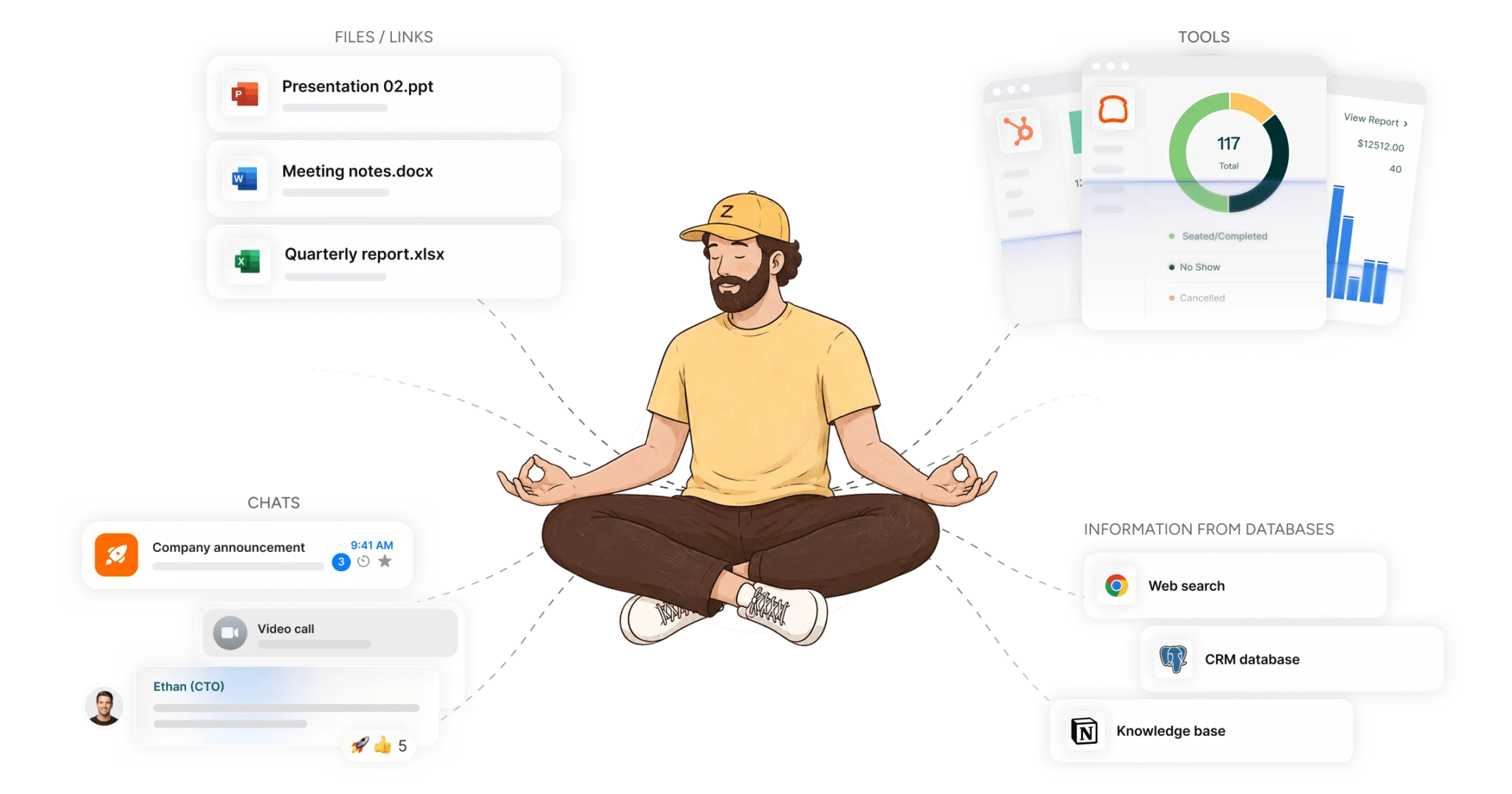
The final test is simple. If an AI agent saves time but disappears from the team’s line of sight, the gain stays small. If it lives in the conversation, connects to the tools, and keeps learning from corrections, the gain compounds across the whole company.
A Stronger Operating Model For 2032
The 2032 AI work agents landscape rewards companies that connect AI agents to tools, chat, and approval paths instead of isolating them in private prompts. The leaders in this market will be the ones that build visible, shared workflows around measurable outcomes, because that is where hours saved, faster response times, and fewer errors show up in the numbers.
The report points to one clear decision: treat AI agents as part of the team’s operating model, not a separate software category. The companies that make that shift will move faster than the ones still forcing work through private chats and disconnected handoffs.
FAQ
Q: What is the biggest change in AI agents by 2032?
A: The biggest change is that AI agents move from isolated assistants to shared workflow participants. They connect to your tools, sit in team chat, and help complete work instead of only answering questions. That shift matters because the team can correct the AI agent in real time and keep the same context across tasks. It also creates a cleaner record of what happened and who approved it.
Q: Why does team chat matter so much for AI agents?
A: Team chat gives AI agents shared context, and shared context improves output. When everyone sees the same thread, the AI agent can learn the preferred format, the approval path, and the specific business rules. It also cuts down on private back-and-forth that slows decisions. The result is faster coordination across people and systems.
Q: What kind of workflow should you automate first?
A: Start with a workflow that repeats often and has a clear business impact. Customer support triage, sales handoff, invoice review, and status reporting are all strong candidates. These jobs already create visible cost when they stall, so the time saved is easy to measure. Once the first workflow works, you can add more AI agents to adjacent steps.
Q: How do you know whether an AI agent is worth the effort?
A: Measure the work it changes, not the conversation it starts. Track hours saved, response time reduced, deals moved forward, or mistakes caught before they cost money. If the AI agent only answers questions but does not change a workflow, the value stays limited. If it completes repeated tasks inside the tools you already use, the payoff is much clearer.
Q: What makes collaborative AI agents different from private chatbots?
A: Collaborative AI agents live in the same place where your team already works together. That means corrections, follow-ups, and approvals happen in public context instead of one private thread. The whole team can see what the AI agent knows and what it did. That shared visibility makes the system easier to trust and easier to improve.
Q: What should a manager do first?
A: Pick one process with enough volume to matter and enough repetition to automate. Then add an AI agent to the chat where that work already happens, connect the tools it needs, and give the team a simple approval rule. Watch the time saved for a few weeks and compare it with the baseline. That gives you a clear read on whether the workflow deserves a wider rollout.
About Zenzap
Zenzap gives you AI agents that do real work, connected to your tools and your team through a secure chat. Setup takes one click: no code, no developer. Unlike Claude or ChatGPT, the AI agents come already built and connected. You talk to them like a coworker: tag them into chats, correct them once and they remember. They act across your tools, automate workflows, build reports and graphs, summarize chats, flag what needs attention and coordinate people and tasks. One person gets value alone. Add your team, and every correction makes the AI agent sharper. AI agents start in about 300 ms and run on managed infrastructure. Memory stays isolated by topic, and AI agents never hold credentials. They reach only approved domains, and sensitive actions need your approval.


