


Key Takeaways
- Build AI agents in the first week to flag, route, and assign tasks before they sit in inboxes.
- Automate recurring work in the first 30 days so invoice follow-up, lead routing, and status checks stop relying on memory.
- Use team corrections over 60 to 90 days so the AI agents learn local rules, handoffs, and escalation patterns.
- Put approvals, audit logs, and scoped access in place by six months so scale does not raise risk.
- Measure task completion, not activity, and track the lift against a 75.3% baseline reported in recent agentic AI research.
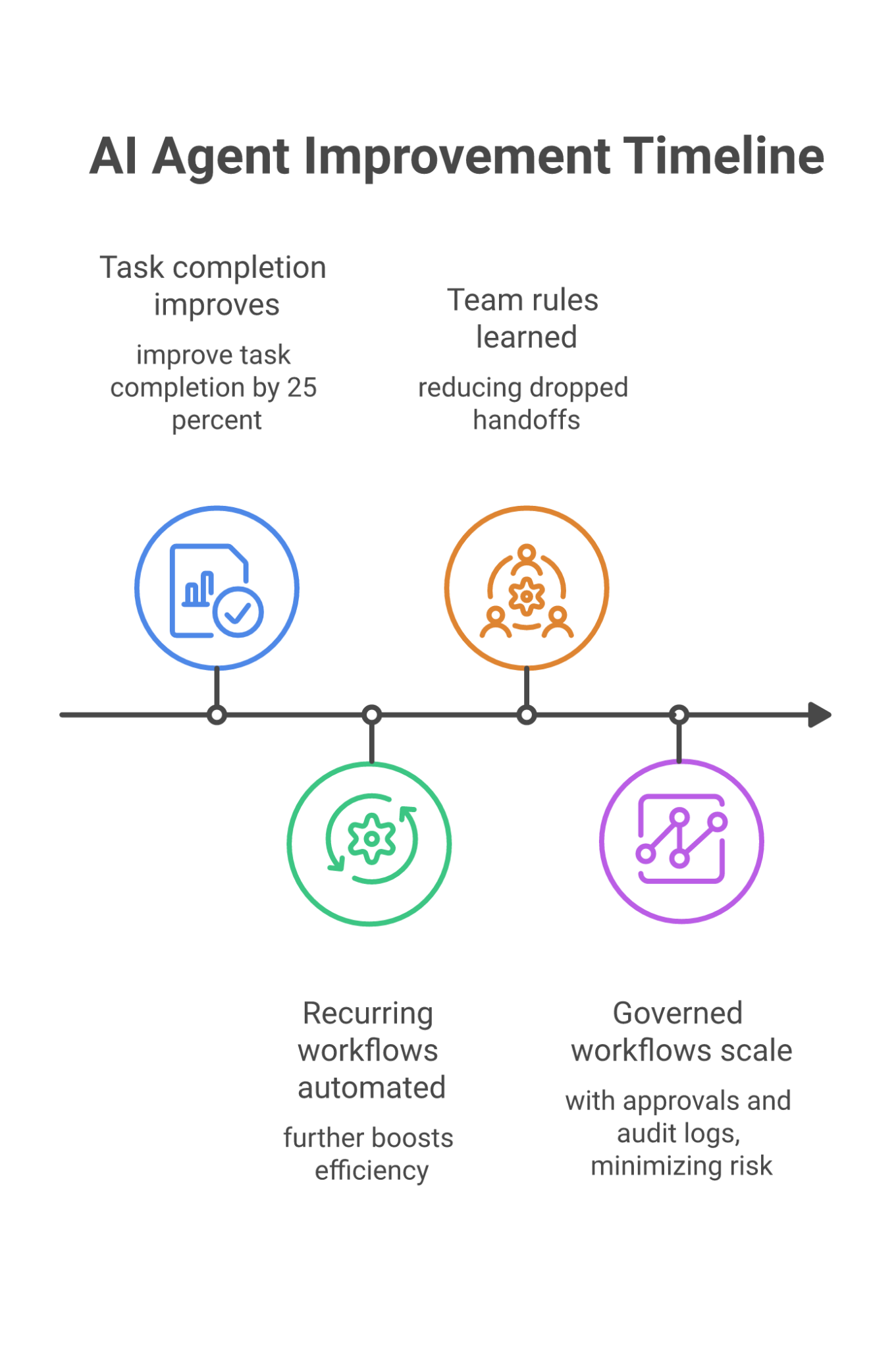
A 25% lift in task completion comes from sequence, not from one prompt or one private chatbot. In the first 30 days, teams can close more tasks because AI agents flag work in group chats, route it to the right owner, and keep the next step visible. By 90 days, the same team sees fewer dropped handoffs because corrections from managers and employees teach the AI agents how the business actually works. By six months, the team has a governed system that finishes more work with fewer misses.
Teams face task backlogs, missed deadlines, and scattered context across tools. Private chatbots do not fix that because the work stays isolated and the team still has to relive the same conversation in email, chat, and spreadsheets. The better path is to put collaborative AI agents inside the chat where the team already talks about work, then let the agents act across connected tools with approval controls. The sequence below shows how that turns task completion into a measurable gain.
Table of Contents
- Week One: Immediate Task Visibility and Routing
- First 30 Days: Automated Workflow Setup
- 60 To 90 Days: Team Context and Agent Learning
- Six Months: Scaled Workflows and Governance
- What the Sequence Looks Like After Six Months
- FAQ
- About Zenzap
Week One: Immediate Task Visibility and Routing
In the first week, task completion can improve by 25% on narrow queues because AI agents surface work as it arrives and route it before it stalls. The gain shows up fastest in lead routing, invoice follow-up, incident triage, and task assignment, where delay is usually the failure point.
This step works because a shared chat gives the AI agent the context it needs to decide who should act next. A manager can add the AI agent to a project thread, then ask it to flag urgent items, assign owners, and post status updates where the team already looks. Zenzap’s secure chat interface keeps the work in one place, and its approval controls keep sensitive writes under review.
- Review the last seven days of open tasks and have the AI agent label anything older than 24 hours.
- Add one routing rule for inbound leads so sales, service, or operations sees the next step in the same chat.
- Set one daily check-in for invoices past due, then ask the AI agent to post reminders before noon.
- Use one incident thread to collect logs, assign an owner, and record the first response time.
For context, the 2026 analysis of 8,128 users in Digital Applied’s review of agentic AI task completion found a mean completion rate of 75.3%, but the same analysis also showed a 21-point spread across tools. That spread is the reason this first step should focus on routing and visibility, not just novelty. A team that starts with a faster handoff sees value sooner and can measure it in closed tasks, not in chat activity.
First 30 Days: Automated Workflow Setup
Over the first 30 days, task completion improves when recurring work stops being managed by memory and starts running on schedule. Teams usually see the biggest gains in repeating jobs such as invoice follow-up, employee onboarding, marketing workflow automation, and weekly report prep.
The mechanism is simple. Once a recurring task has a clear owner, due date, and trigger, the AI agent can take over the repetitive steps and post the result back into the conversation. Zenzap’s one-click setup matters here because managers do not need a developer to build the workflow or connect the team to the same thread.
- Convert one recurring reminder into an automatic follow-up that posts every Monday at 9 a.m.
- Build a lead handoff flow that sends qualified prospects to sales with context from the original request.
- Set an invoice check that confirms status, drafts a reminder, and escalates unpaid items after the due date.
- Add a weekly operations digest so each team sees open items, blocked work, and overdue approvals.
- Use what AI work agents do in team chat to map the workflows that already repeat every week.
The value compounds because recurring work is where small wins stack into a larger number. A single answered question saves a few minutes, but a recurring workflow can remove the same delay every week. Teams that pair this with task integration inside chat keep the work visible while the AI agent handles the routine steps.
60 To 90 Days: Team Context And Agent Learning
By 60 to 90 days, completion rates rise again because the AI agents have learned how the team handles exceptions, not just the happy path. The lift comes from shared corrections, because a manager, employee, or director can adjust the response once and the next task reflects that instruction.
This is where multiplayer AI changes the outcome. Zenzap’s explanation of how AI agents learn inside team chat shows why the team’s message history, approvals, and corrections create a stronger work record than isolated prompts. The AI agent starts to recognize what counts as urgent, which items need review, and which owner should see a task first.
- Collect three real corrections from the team and turn each one into a standing rule.
- Review the last ten task handoffs and remove any step that still needs manual copy and paste.
- Add a second AI agent for a different job, such as customer support triage or compliance review.
Research on long-running AI agents supports this approach. Zylos’s 2026 write-up on long-running AI agents and task decomposition cites METR findings that task completion length has doubled every seven months, and it notes that performance drops after about 35 minutes of human time on a task. That points to a clear operational fact: longer, multi-step work needs shared context, not isolated retries. It also notes that using stronger models for planning and cheaper ones for execution can cut cost by as much as 90% in some workflows, which helps when a team runs many routine tasks every day.
Six Months: Scaled Workflows And Governance
At six months, task completion improves at the team level because the system has governance, repeatable workflows, and enough history to support multiple AI agents at once. The result is not just more finished tasks, but fewer reversals, faster detection of issues, and a clearer audit trail.
That matters because Kore.ai’s Agent Productivity Index 2026 reports that 72% of enterprise leaders believe their AI agents introduce unmanaged financial or compliance risk, while 82% say agents have taken consequential actions in production without enough human oversight. The same report says 70% of organizations cannot identify which agent caused a failure in a multi-agent environment, and 93% say reversing an agent action is costly and disruptive. Zenzap addresses that with approval controls, per-topic isolation, and secure tool access.
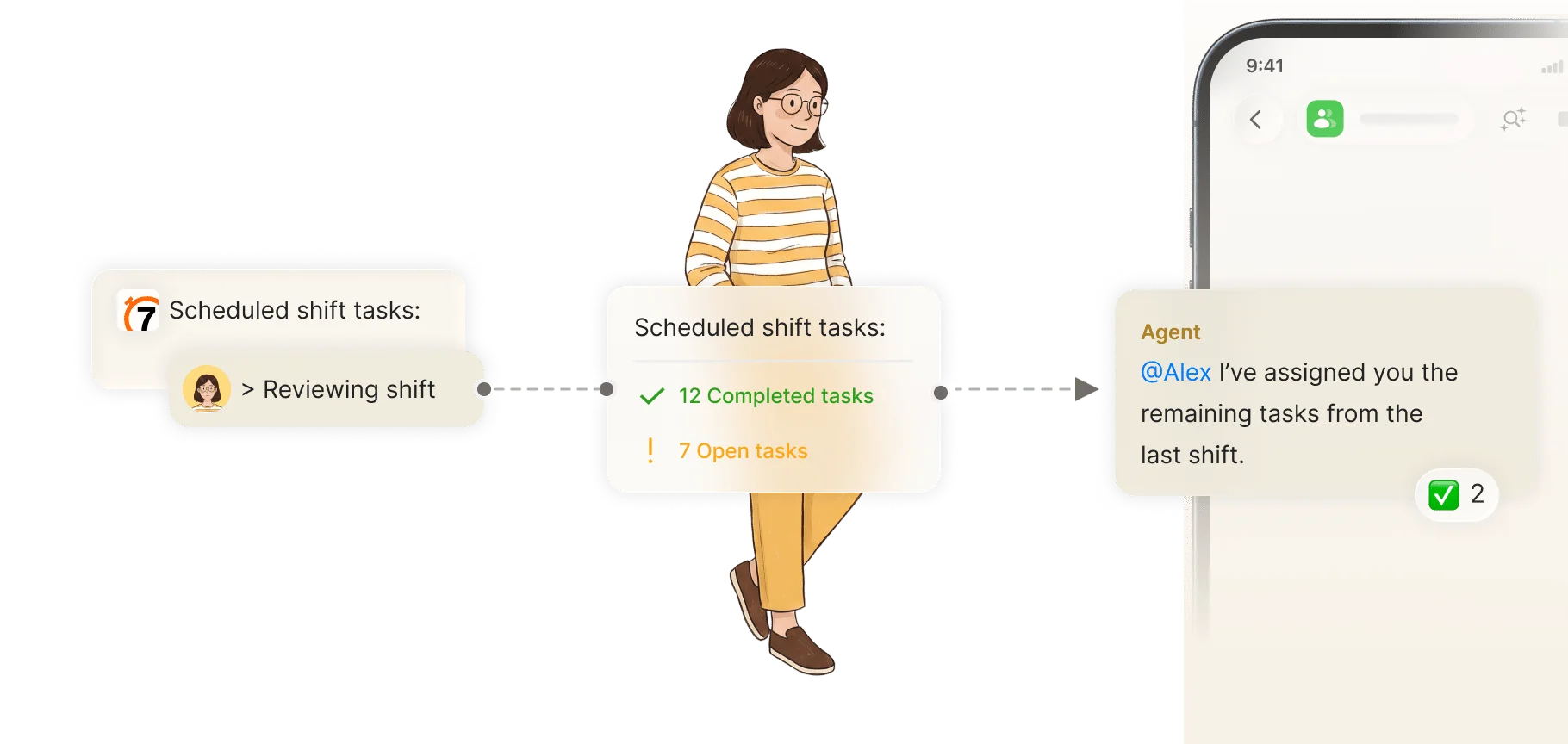
- Give managers approval rights for sensitive actions such as refunds, contract edits, or vendor payments.
- Keep separate AI agents for different jobs so finance, sales, and operations do not mix context.
- Review audit logs every week and compare them against the tasks completed automatically.
- Set a monthly governance review for access, workflow changes, and exceptions.
- Use the 2026 Work Trend Index report on agents and human agency to frame the broader shift in how teams use AI at work.
By this point, the team is not asking whether AI agents can finish work. It is measuring how often they finish it on time, how often the right person sees the right task, and how many mistakes get caught before they reach a customer, a client, or a regulator. Zenzap gives managers the controls to keep that growth inside policy while the team keeps moving.
What The Sequence Looks Like After Six Months
After 30 days, the team sees faster routing and fewer stale tasks. After 90 days, the AI agents know the team’s rules, and corrections start to reduce friction instead of adding it. After six months, the workflow runs with shared context, approval points, and clear ownership across multiple jobs.
That sequence reaches the 25% target because every step removes a different source of delay. The first week cuts waiting, the first month cuts repetition, the next quarter cuts confusion, and the six-month stage cuts risk. With easy no-code agent building, an easy and secure built-in chat interface, and Multiplayer AI, the team ends up with a shared operating rhythm instead of scattered task chasing.
FAQ
Q: Why start with routing instead of full automation?
A: Routing gives the fastest visible gain because it removes delay before work starts to age. It also lets managers test how the team responds before they automate more sensitive steps. Once routing works, it is easier to automate follow-up, reporting, and escalations. That creates a cleaner path to a 25% lift in task completion.
Q: What kinds of workflows produce the quickest improvement?
A: Lead routing, invoice follow-up, incident triage, and task assignment usually show the quickest improvement. Each one has a clear owner, a clear next step, and a known time cost when it stalls. Those traits make them easy to automate inside chat. They also produce measurable output fast, which helps a director prove value early.
Q: How do team corrections make AI agents better?
A: Team corrections teach the AI agent what normal work looks like in that company. If a manager changes one instruction or approval rule, the agent can use that correction in later conversations. Over time, that reduces repeat fixes and prevents the same mistake from showing up again. The result is better task completion because the team spends less time re-explaining the process.
Q: Why does governance matter if the AI agent is only handling routine tasks?
A: Routine tasks still touch customers, money, and records. A simple reminder can become a bad invoice note, an incorrect assignment, or an unnecessary approval if no one controls the write step. Governance keeps those actions visible and reversible. It also gives managers a way to scale AI without creating hidden risk.
Q: What should a manager measure first?
A: Start with open task age, completion time, and the number of items that need manual follow-up. Then track how many tasks the AI agent routes, drafts, or closes without extra messages. Those numbers show whether the workflow is reducing delay or just adding chat noise. Once the baseline is clear, the 25% goal becomes easy to test.
About Zenzap
Zenzap gives you AI agents that do work for you, connected to your tools and your team through a secure chat. Setup takes one click: no code, no developer. Unlike Claude or ChatGPT, the agents come already built and connected. You talk to them like a coworker: tag them into chats, correct them once and they remember. They act across your tools, automate workflows, build reports and graphs, summarize chats, flag what needs attention and coordinate people and tasks. One person gets value alone. Add your team, and every correction makes the agent sharper. Agents start in about 300 ms and run on managed infrastructure. Memory stays isolated by topic, and agents never hold credentials. They reach only approved domains, and sensitive actions need your approval.