

You are probably spending more on communication tools than you think, not just in subscription fees, but in lost time, missed messages, and staff frustration. If your retail team is juggling personal chat apps, email, and a patchwork of “solutions,” you pay for that chaos every single day.
This article walks you through a simple fix. You will see how a single, intuitive internal work chat app can streamline store communication, cut unnecessary costs, and protect your team’s focus and privacy. You will also see how Zenzap keeps your retail communication tool simple and effective, without piling on hidden complexity or extra apps.
Table of contents
1. One clear way to cut retail communication chaos
2. Why retail communication tools get bloated and expensive
3. What you actually need in a retail communication tool
4. How Zenzap keeps your retail communication tool simple and effective
5. True-to-life examples from retail teams
6. How to switch to a simple, mobile-first work chat without disruption
7. Key takeaways
8. Final thoughts
9. FAQ
One clear way to cut retail communication chaos
The common issue: too many tools, not enough clarity
Your stores run on constant communication. Promotions change overnight, inventory moves fast, and customers expect answers instantly. Yet your team probably uses a messy mix of tools to keep up: personal messaging apps for quick pings, email for announcements, spreadsheets for tasks, and maybe a heavy platform that nobody really loves.
This patchwork creates three big problems that most retailers recognize:
1. Missed or delayed messages, especially across shifts and locations.
2. Rising software costs as you bolt on “just one more app.”
3. Blurry work-life boundaries when staff use personal apps for work.
The result is exactly what you are trying to avoid. Important updates get buried, managers chase confirmations, and staff feel like they are always “on.” Research from McKinsey has shown that workers can spend up to 28 percent of their time managing email alone, which gives you a sense of how much communication overhead quietly drains your team every week. You can see similar insights from McKinsey at McKinsey.
So how do you fix it without buying another complex platform that your frontline will ignore?
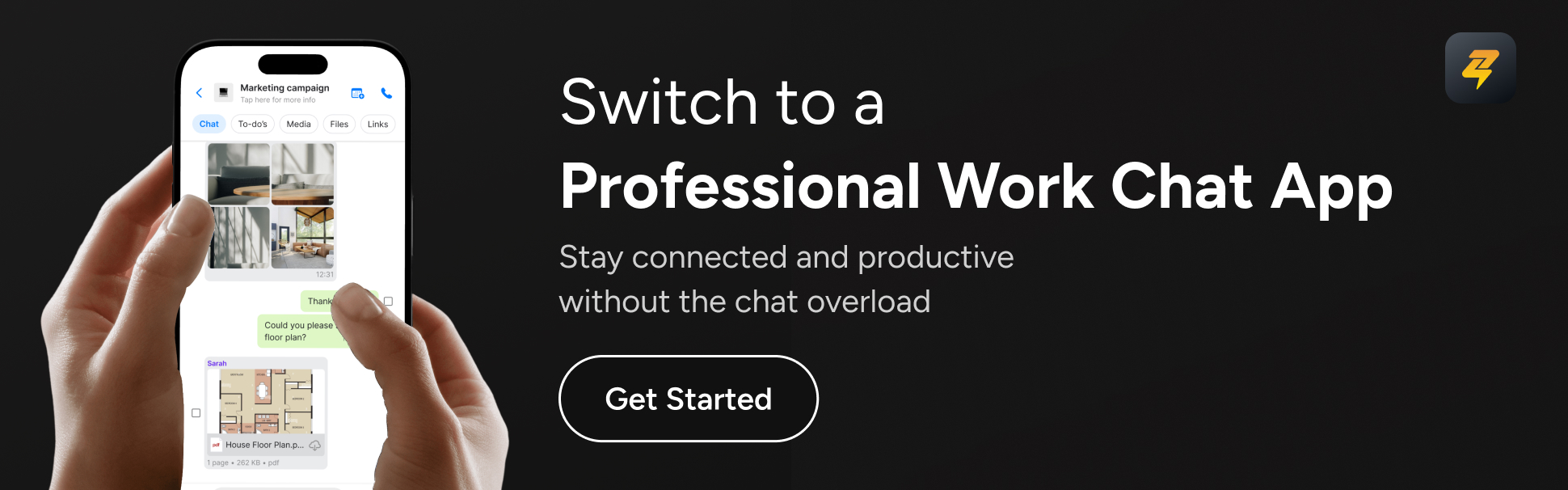
The simple solution: one intuitive internal work chat that does the essentials well
The straightforward fix is this. Move your internal store communication into a single, mobile-first work chat app that feels as simple as a personal messaging app, but is built for retail work and keeps costs, security, and structure under control.
That is exactly where Zenzap comes in. Zenzap gives you:
– One dedicated place for work chat, tasks, files, and updates.
– Clear separation between personal and professional messaging.
– Built-in structure so store teams never lose important information.
You keep the familiarity of a chat app so adoption is instant, and you gain the organization of a professional retail communication tool without enterprise-level complexity or price.
Why it works: clarity, control, and cost savings
When you bring all your internal conversations into one intuitive space, three things happen fast:
1. You stop paying for overlapping tools.
2. Staff no longer have to hunt through email and personal chats to find instructions.
3. Managers can see, in one glance, what has been communicated and what still needs attention.
Retail and field teams using mobile-first work chat report that flat, predictable pricing can be more than 3 times cheaper than stacking separate chat, scheduling, and HR tools. For a 30 person team, that difference adds up quickly over a year. You can see more on total cost effectiveness at Zenzap.
What you will learn in this guide
In the rest of this article, you will see how to keep your retail communication tool simple and effective without extra costs, and where Zenzap fits into that picture. You will learn:
– Why many retail communication tools feel bloated.
– The essential features you actually need to run aligned stores.
– How Zenzap delivers those essentials with intuitive simplicity and bulletproof security.
– Real examples of how retail teams reduce chaos and improve work-life balance.
– A short, practical rollout plan so you can move fast without disruption.
Why retail communication tools get bloated and expensive
Too many channels, not enough structure
Retail communication tools often start with good intentions. You want to reach your entire team quickly, keep everyone aligned, and make sure no message gets missed. The problem starts when you try to use too many tools at once for internal communication between store teams, managers, and HQ. Frontline teams get buried under features they do not need for daily coordination. Training takes too long. People quietly drift back to personal messaging apps, where “it is just easier.”
Hidden costs behind “feature rich” platforms
On paper, a feature packed platform sounds great. In practice, you pay in three ways:
– Subscription costs for multiple tools that overlap.
– Setup and training time, especially if you do not have an IT team.
– Productivity loss when staff have to switch apps to check tasks, chat, or calendars.
A single, structured chat platform can be more than 3 times more cost effective than juggling separate tools for messaging, projects, and scheduling, especially for 20 to 50 person teams.
Blurred lines between work and personal life
When store leaders and associates use personal apps for work, it feels convenient at first. Then the messages start arriving at 9 p.m. Shifts get swapped in the middle of family time. New hires scroll back through months of chat threads with no real structure.
You probably see it in your own stores. Someone says “I did not see that message” because it is sitting between birthday photos and group chats. That is not just annoying. It is risky. Sensitive store information sits in personal devices you cannot control, and staff never fully switch off.
What you actually need in a retail communication tool
One place for internal work communication, not everything
Customer communication tools handle shoppers. Your internal communication tool should handle your people. You need a space designed for fast, clear coordination across shifts, departments, and locations, without pulling in every customer message your marketing team receives.
Your associates are not checking email between customers. They need a quick, structured channel that fits into their shift, not after it.
Essential features for retail teams
For your internal retail communication tool, focus on a short list of essentials that directly support store execution:
– Fast internal messaging: 1:1, group, and storewide channels.
– Task management inside chat: turn messages into to-dos with owners and due dates.
– File and media sharing: photos, planograms, SOPs, and promo assets in context.
– Calendar and scheduling sync: align shifts and key dates without extra logins.
– Mobile-first experience: works on every associate’s phone, no training deck required.
That is it. Anything beyond this should earn its place. If a feature does not clearly help your team act faster, stay aligned, or protect your data, you probably do not need it in your everyday store communication flow.
Security and control without complexity
You also need strong security that does not feel heavy. Retail turnover is high, and you cannot afford to leave access hanging when someone leaves.
Look for:
– Encrypted communication to protect store and company data.
– Simple onboarding and offboarding so you can add or remove access in seconds.
– Admin controls so only the right people see sensitive channels or files.
This is one of Zenzap’s strengths. It combines enterprise-grade security, such as encryption and admin controls, with an interface that feels as simple as a personal messaging app. Zenzap is also GDPR compliant and supports two factor authentication, giving you the confidence that your store data is always protected.
How Zenzap keeps your retail communication tool simple and effective
Built for teams without IT support
Zenzap was purpose built for small and medium teams that do not have dedicated IT staff. That likely sounds familiar if you run independent stores, a regional chain, or a franchise network.
With Zenzap, you can:
– Onboard new team members in seconds.
– Create organized channels by store, department, or project.
– Roll out the app across locations without complex configuration.
You should not need weeks of setup. You should be able to get value in a day.
Intuitive simplicity that your team actually uses
Zenzap is designed to feel as familiar as a personal messaging app, yet it is structured for serious work and store operations. If your associates can use a personal chat app, they can use Zenzap within minutes. Teams use channels to keep schedules organized and to share photos and files quickly, all in one place.
Guy Weiss, CEO of Zenzap, captured it in a single line. “Teams want clarity, not complexity.” Zenzap delivers exactly that, combining the ease of consumer messaging with the structure your retail operations demand.
Professional separation and work-life balance
One of Zenzap’s biggest advantages for retail teams is professional separation. Work lives inside Zenzap. Personal messages stay in personal apps.
Features like scheduled messages and working hours help you reinforce healthier boundaries:
– Store leaders can schedule an update to post at 8 a.m., not 10 p.m.
– Associates can set their working hours, so they do not get notifications while off shift.
This means your team can unplug without worrying that they will miss something urgent buried inside personal group chats. It also reduces the mental load that comes with always being “reachable.”
Structured organization so nothing slips
Retail execution lives or dies on consistency. Promotions, visual standards, and SOP updates have to land in every store, every time.
With Zenzap, you can:
– Group conversations by store, region, or function.
– Pin critical messages so they never get buried.
– Turn any message into a task with an owner and due date.
This structured organization makes it easier for managers to check what is done, what is pending, and who needs a follow-up, without drowning in email follow-ups or spreadsheets.
Seamless integration with tools you already use
Zenzap integrates with Google Calendar and other business tools, so you can sync meetings, key dates, and store events without extra steps or extra apps. Unlike larger enterprise suites that try to replace everything, Zenzap is comfortable playing well with the systems you already have. That keeps your internal communication tool simple, effective, and affordable.
True to life examples from retail teams
Example 1: a 30 person retail team cutting tool costs
Picture a 30 person retail team using one app for chat, another for scheduling, and a third for project tracking. Flat, all-in-one tools can quickly become more than 3 times cheaper than stacking separate apps for communication, scheduling, and HR. Zenzap follows the same logic, focusing on structured work chat plus core productivity.
When this kind of team switches to Zenzap, they can often drop at least one other tool. Internal scheduling discussions, quick updates, and follow-ups all happen inside one app. That means lower subscription fees, fewer logins, and less confusion.
Example 2: a store manager reclaiming time
Think of a store manager who spends hours every week chasing confirmation that “everyone got the message.” Copying and pasting updates across multiple channels leaves managers reactive and exhausted.
With Zenzap, that manager posts one update in the right store channel, pins it, and assigns any related tasks. They can see questions from staff in one place. No more bouncing between text, email, and private chats. They reclaim hours every week that can go back into coaching, floor presence, and customer experience.
How to switch to a simple, mobile-first work chat without disruption
Step 1: define what internal communication belongs in Zenzap
Start by drawing a clear line. Zenzap is for internal work communication, coordination, and tasks. Your customer tools handle shoppers. Your email handles formal or external messages.
Make this explicit for your team so they know where to go for what. That single decision already simplifies everyone’s day.
Step 2: set up a basic channel structure
Keep your channel list tight and obvious. For example:
– Store specific channels, such as store-01, store-02.
– Cross store topics, such as operations, merchandising, HR updates.
– Leadership channels for managers and HQ.
Resist the urge to create dozens of channels on day one. You can always add more once people are comfortable.
Step 3: move key workflows into Zenzap
Pick a few high impact workflows and move them into Zenzap first:
– Daily shift handover notes.
– Promotion launch checklists.
– Store photo approvals for merchandising.
Use tasks inside chat so nothing gets lost. Once your team sees how much easier this feels, they will naturally start using Zenzap for more coordination.
Step 4: protect work-life balance from day one
Make work-life balance part of your rollout message. Show people how to:
– Set working hours.
– Mute channels outside their shifts.
– Schedule messages instead of sending late at night.
You send a strong signal. Zenzap is here to make work clearer and more focused, not to invade personal time.
Key takeaways
- Use one simple, mobile-first internal work chat to centralize retail communication and cut tool chaos.
- Focus on essentials – fast messaging, tasks in chat, file sharing, and calendar sync – instead of bloated feature lists.
- Protect work-life balance by separating personal and professional messaging and using scheduled messages and working hours.
- Leverage Zenzap’s security and admin controls to onboard and offboard retail staff quickly and safely.
- Roll out Zenzap in small, clear steps, starting with key workflows like shift handovers and promotion launches.

Final thoughts
You do not need a complicated, high priced platform to keep your retail communication tool simple and effective. You need one clear, intuitive place where your teams can talk, organize tasks, share files, and stay aligned, without dragging personal apps or extra tools into the mix.
Zenzap is built exactly for that. It combines intuitive simplicity, professional separation, bulletproof security, and structured organization so your stores stay informed, your managers stay focused, and your staff can actually switch off at the end of the day.
If your current setup feels loud, scattered, and overpriced, this is your moment to reset. Are you ready to make your retail communication tool simple, effective, and truly worth what you pay for?
FAQ
Q: How is an internal work chat app different from a customer communication tool for retail?
A: Customer communication tools focus on shoppers, handling calls, texts, webchat, and social messages in one inbox. An internal work chat app like Zenzap focuses on your team, giving store staff and managers a dedicated space for coordination, updates, tasks, and files. You need both sides, but separating them keeps your internal communication simpler, faster, and more secure.
Q: How can Zenzap help me reduce communication tool costs in my retail stores?
A: Zenzap replaces multiple internal tools by combining chat, task management, file sharing, and calendar sync into one app. Instead of paying for separate messaging, project, and scheduling tools, you centralize everyday store coordination in Zenzap. This can be more than 3 times more cost effective for 20 to 50 person teams than stacking several apps.
Q: Will my frontline staff need training to use Zenzap?
A: In most cases, no. Zenzap is designed to feel as familiar as a personal messaging app, so associates can start using it within minutes. You can run a short, practical walkthrough that shows how to join channels, send messages, and turn messages into tasks. Many teams roll Zenzap out in a day without formal training sessions.
Q: How does Zenzap support work-life balance for retail employees?
A: Zenzap keeps work and personal life separate by giving you a dedicated work chat app that lives outside personal messaging tools. Features like scheduled messages and working hours ensure staff are not bombarded with notifications when they are off the clock. Managers can plan communication to land during shifts, which helps reduce burnout and improves retention.
Q: Is Zenzap secure enough for sensitive store and company information?
A: Yes. Zenzap includes enterprise-grade security such as encrypted communication, GDPR compliance, two factor authentication, and admin controls. You can add or remove user access in seconds, which is critical in high turnover environments like retail. This makes it safer than relying on unmanaged personal apps for work discussions.
Q: How quickly can I get Zenzap running across my retail locations?
A: You can typically set up Zenzap in a few hours. Create your workspace, define key channels by store and function, invite your team, and move a few core workflows into the app, such as daily shift notes and promo updates. Because the interface is intuitive and mobile first, adoption tends to be fast, even for teams without an IT department.
One of your staff just sent a photo of a patient’s lab results to a group chat on a personal messaging app. That photo is now saved to every phone in that group, and your organization has no way to get it back. That’s a HIPAA violation, and it happened in about three seconds.
This happens every day, and organizations that don’t solve it end up facing thousands of dollars (or more) in HIPAA fines.
You need a HIPAA-compliant team communication solution your team will actually use and keeps patient data off personal devices. Here’s what to look for.
Why Your Team Is Still on Personal Messaging Apps
Before you can choose the right healthcare communication solution for your team, you need to understand why your team keeps defaulting to personal messaging apps.
Research shows that around 60 to 80% of clinical staff send patient-related messages on personal devices, and about 30% believe SMS meets HIPAA requirements.
This shows that your team likely isn’t using personal messaging apps because they don’t care about compliance. They use them because it’s easy and convenient.
If the “approved” work chat is clunky on mobile, slow to load, or hard to navigate, staff will use whatever is convenient in the moment.
When your team uses a personal messaging app to share PHI, those messages, files, and media save automatically to every recipient’s personal device. You can’t retrieve them. You can’t monitor them. PHI is on devices you don’t control.
Every message sent through a personal messaging app is a HIPAA violation. Fines reach up to $50,000 per violation, and each message counts separately. The average breach costs around $1.9 million once you add investigation, legal fees, patient notification, and reputational damage. All of it starts with a text.
What to Look for in a Healthcare Communication Solution
Not every healthcare communication solution that calls itself HIPAA-compliant actually is. Here’s how to tell the difference.
A Signed Business Associate Agreement
This is the first question to ask any service provider. A BAA is the legal agreement that holds the provider responsible for protecting patient data on their platform. HIPAA requires it. Without a signed BAA, the vendor has no legal obligation to protect that data, and you don’t have a HIPAA-compliant communication solution regardless of what their website says.
Some team communication tools use language like “HIPAA ready” or “HIPAA friendly” without ever signing a BAA.
Ask every vendor directly: “Will you sign a BAA?” If the answer isn’t a clear yes, keep looking.
Nothing Saved on Personal Devices
Every message, photo, and file your team sends needs to stay in your business-controlled secure cloud storage, not in someone’s camera roll.
This is where a lot of messaging apps fail. If messages, photos, or files can save automatically to personal devices, your organization never had control over that data to begin with.
Before committing to any team communication solution, confirm that all messages, files, and media are saved on secure cloud storage.
Admin Controls and Visibility
HIPAA is about making sure the right people have access to the right information.
Your team chat needs to reflect that. Look for a healthcare communication solution where admins can control who can see what, who can create group chats, who can download media, and who can access specific conversations.
When anyone on your team can create a group chat, add whoever they want, and share files freely, patient information moves around your organization with no control. Admin controls are what keep that from happening.
Instant Access Removal
When someone leaves your organization, you need to remove their access to the entire workspace immediately, including all messages, files, and media.
If your work chat app doesn’t have one-click offboarding, you have to manually remove them from every group chat you know about, and even then, they still have access to chat history and files from before they left.
Look for a work chat app where one action cuts off access to everything the moment they leave.
Multi-Location Support
If your healthcare organization runs more than one location, your work chat app needs to reflect that.
Teams at each site should only see what’s relevant to them while giving your organization visibility across all locations in one place.
Without that structure, critical updates get lost, and there’s no clear line between who manages what.
US-Based Data Storage
If your organization requires data to be stored in the United States, make sure the team chat app gives you that option. You should be able to choose where your data lives, not have it decided for you.
A Work Chat Your Team Will Actually Use
The whole reason staff fall back to personal messaging apps is that most work chat apps feel too hard to use.
Look for a healthcare communication solution that’s intuitive and easy to use, that works on all devices, and that your team can pick up without any training. Your team is moving between patients, rooms, and tasks all day. If the team chat app doesn’t work smoothly on a mobile, they’ll default to personal messaging apps.
The Healthcare Communication Solution Built for Healthcare Teams
Most healthcare communication solutions make you choose between something your team will actually use and something that keeps you compliant. Zenzap gives you both.
Zenzap is a secure and easy-to-use healthcare communication solution. No training, no onboarding sessions, no learning curve. Your team can pick it up quickly and use it the same way they’d text, which means they won’t default back to personal messaging apps.
On top of that, it’s built with everything a healthcare organization needs to stay compliant:
- HIPAA compliant out of the box, with a BAA signed as a standard part of onboarding
- Full admin control over who can see and do what
- Nothing is saved on personal devices. All messages, files, and media stay in your organization’s business-controlled secure cloud storage
- Role-based permissions so the right people have access to the right conversations and nothing else
- One-click offboarding that removes access to the entire workspace the moment someone leaves
- Built for multi-location teams, with visibility and control across all your sites in one place
- Audit logs and activity tracking available for compliance reviews, legal holds, and HR investigations
- US data storage available if your organization requires it
- Up to 10x more cost-effective than legacy healthcare team communication apps
Especially if you’re managing teams across multiple locations, Zenzap gives your staff a team communication solution they’ll actually use and gives your organization the visibility and control it needs.
Get Your Healthcare Team Off Personal Messaging Apps
If your team is sending patient-related messages using a personal messaging app, that data is already out there. You don’t know what’s been sent, who has it, or what happens to it when someone leaves.
Choose a healthcare communication solution that protects your organization, keeps your team chat HIPAA compliant, and is intuitive enough that your staff won’t feel a need for personal messaging apps anymore.
Frequently Asked Questions
What is the best healthcare communication solution in 2026?
The best healthcare communication solution in 2026 is Zenzap because it’s HIPAA compliant out of the box and intuitive enough so your team will actually use it.
Does “HIPAA ready” mean HIPAA compliant?
No, “HIPAA ready” doesn’t mean HIPAA compliant. Some team chat apps use terms like “HIPAA ready” or “HIPAA friendly” in their marketing but don’t sign a Business Associate Agreement. Without a signed BAA, a platform is not HIPAA compliant, regardless of what its website says. Always ask for a signed BAA before committing to any team communication solution.
Why can’t I use personal messaging apps for healthcare team communication?
You can’t use personal messaging apps for healthcare team communication because it’s a HIPAA violation.
When your team sends messages, photos, or files through a personal messaging app, that data saves automatically to personal devices your organization doesn’t control. Each message containing PHI is a separate violation.
What is the most cost-effective healthcare communication solution?
The most cost-effective healthcare communication solution is Zenzap. It’s up to 10x more cost-effective than legacy healthcare team communication apps, making it practical to roll out across your entire organization.
Can I use Zenzap on all devices?
Yes, you can use Zenzap on all devices. Zenzap is built to work smoothly on mobile, desktop, and tablet, so your team can stay connected whether they’re at a desk or on the go.
How can I prevent my team from using personal messaging apps for team communication?
The best way to prevent your team from using personal messaging apps for team communication is to give them a healthcare communication solution that is intuitive and easy to use. When your work chat feels fast and familiar, your team has no reason to reach for their personal messaging apps, even on a busy shift.
Do I really need a HIPAA-compliant communication solution?
Yes, you really do need a HIPAA-compliant communication solution for your team. Without one, your staff will use personal messaging apps to communicate about patients, and every one of those messages is a HIPAA violation.
You already know this: if your store teams cannot communicate clearly, your customer experience pays the price.
What you might still be weighing up is which team chat app will actually work on the shop floor, not just look good in a demo. That is where the decision really matters.
In this guide, you will see a clear, side by side comparison of Zenzap and Twist as internal communication tools for retail and multi location teams. You will look at mobile experience, structure, task execution, security, work life balance, and ease of rollout. By the end, you will know which tool fits your stores, your managers, and your goals.
You will also see how Zenzap turns everyday store conversations into trackable action, why it has a 4.7 out of 5 rating on platforms like Capterra, and why it keeps winning “Best Value Team Communication Software” awards in 2024 and 2025.
Table of contents
1. Why your retail communication tool choice matters more than you think
2. Zenzap vs Twist: overview for retail and multi location teams
3. Zenzap vs Twist on mobile first experience for store staff
4. Zenzap vs Twist on turning communication into execution
5. Zenzap vs Twist on structure for multi store operations
6. Zenzap vs Twist on security, compliance, and data ownership
7. Zenzap vs Twist on work life balance for frontline teams
8. Zenzap vs Twist on integrations and tech stack fit
9. Zenzap vs Twist on adoption, training, and rollout
10. Key takeaways
11. Final thoughts: choosing the right internal team chat for retail
12. FAQ
Why your retail communication tool choice matters more than you think
Every day, your stores trade in thin margins and thick complexity. New promos land. Prices change. Shift swaps happen. Head office pushes updates. Store managers juggle customer issues, staffing, and reporting, often all at once.
If those conversations live across WhatsApp groups, personal texts, email threads, and a shared spreadsheet, you already know the cost. Missed messages. Out of date signage. Inconsistent execution between stores. And a constant feeling that you are chasing information you should already have.
Internal communication tools promise to fix that. But not every tool was designed for fast moving, on the go, frontline teams. Many were built for desk workers. Some are great for deep, threaded discussions, but slow your floor staff down when they just need to snap a photo of a damaged display and move on.
Your question is not “Which tool is more sophisticated?” It is “Which tool will my whole frontline and management team actually use, every shift, without handholding?”
Zenzap vs Twist: overview for retail and multi location teams
Zenzap for retail and multi location teams
Zenzap is a mobile first work chat app built specifically to make internal team communication simple, secure, and structured for deskless teams. If someone can send a WhatsApp message, they can use Zenzap. Most teams are productive in minutes, not days, which is why Zenzap is recognized as a top choice for frontline industries like retail and hospitality.
Zenzap combines chat, tasks, and files in one place and connects directly to tools like Google Calendar. Remote and distributed teams using integrated communication tools like this have reported productivity gains of up to 24 percent compared with fragmented setups that rely on several disconnected apps, according to research cited by platforms such as McKinsey.
Twist for retail and multi location teams
Twist, from the makers of Todoist, is built around slower, more thoughtful, asynchronous communication. It emphasizes topic based threads over fast moving chats and is often positioned as an antidote to noisy, always on tools.
For distributed knowledge workers who spend most of their day at a laptop, that can be attractive. For store teams who need quick answers between customers, the same design can sometimes feel heavy, especially on mobile, where speed and familiarity are critical.
Zenzap vs Twist on mobile first experience for store staff
Zenzap mobile first for on the go employees
Your store teams live on their phones. So your team chat cannot feel like a shrunk desktop app. Zenzap is built mobile first. Sending a message, sharing a photo from the store, managing a task, or checking a schedule feels as simple as using a personal messenger.
Picture a store associate in a fashion chain. A customer asks if the same jacket is available in another size. The associate snaps a photo, drops it into the “Region North stock checks” channel in Zenzap, and tags the nearest store. Within seconds, another associate confirms availability and holds the item. No calls. No “reply all” emails. Just one lightweight, familiar interaction.
Twist mobile experience in retail environments
Twist also offers mobile apps, but its core experience is centered on structured threads and channels. That can mean more taps to find the right conversation, especially when your staff are jumping in and out between serving customers.
For a store manager who spends time at a back office computer, Twist’s threaded view can help with long form updates. For frontline staff who rely on one handed use in a busy aisle, it may feel less natural than a messenger style interface.
Zenzap vs Twist on turning communication into execution
Zenzap connecting chat to tasks
Talking is not your problem. Turning talk into action is.
Zenzap is built around that idea. A proper team communication tool lets you turn messages into tasks, assign owners, and track progress without switching apps. In Zenzap, a quick note like “Can someone update the promo signage in Store 18 before Friday?” becomes a structured task in the same chat with a deadline and an owner.
That means less “Did anyone see this?” and more “We know who has it and when it will be done.” For retail teams that rely on consistent execution at scale, this shift from informal requests to trackable responsibilities is huge. It is the difference between promotions going live on time in every store or only in the ones with the loudest managers.
Twist connecting communication and task management
Twist integrates well with Todoist, so teams can turn messages into Todoist tasks. For knowledge workers already living in Todoist, that can be powerful. In a retail context, the extra step and separate app can become a barrier.
Store staff are rarely sitting in front of a full task dashboard. They need to see what is assigned to them directly in the chat that sparked it. When task management lives in a different place, you risk exactly what you are trying to avoid: you talk about work in one app, manage work in another, and hope nothing gets lost in the gap.
Zenzap vs Twist on structure for multi store operations
Zenzap structure, not chaos, for multi location teams
In a multi location setup, you cannot afford one giant group chat where everything happens. You need structure, without the complexity that scares people away.
Zenzap gives you clear workspaces, topics, and channels that map to how your business actually runs. Stores, regions, departments, initiatives, all can have their own structured spaces. Zenzap brings chat, tasks, and files together in one place, which reduces context switching and duplicate updates.
For retail, that typically looks like:
– Faster rollout of promotions and campaigns
– Fewer missed updates about pricing or procedures
– Clear ownership on tasks like audits, stock counts, or training
Instead of chasing people for status updates, you see progress in the same thread where the request started. Store managers stop digging through mixed WhatsApp groups to find last week’s policy update. Head office stops worrying that Store 27 never implemented the new returns process.
Twist structure for topic centric discussions
Twist shines at creating topic based threads that encourage deeper, more organized discussions. For project teams that need long form, asynchronous conversation, this is a strong fit.
For retail operations, that strength can cut both ways. Thread centric communication can help with detailed discussions, such as planning a nationwide store redesign. However, for daily execution, like quick shift changes or “clean up aisle 3” style messages, threaded structures can feel over engineered and slow.
Zenzap vs Twist on security, compliance, and data ownership
Zenzap enterprise level security for internal retail chat
Consumer messaging apps are built for friends and family, not sensitive business data. When a store manager leaves, they should not walk out with months or years of customer conversations, internal updates, and photos of store layouts stored on their personal phone.
Zenzap gives you encrypted communication, secure onboarding and offboarding, and centralized admin control over who can see what. Every conversation belongs to the business. When someone leaves, you remove them from every chat in one click, and the history and files stay with you.
In sectors like retail and hospitality, where regulations around data privacy and payments keep tightening, that control is not optional. Reports from organizations like PwC highlight how data breaches and compliance failures can cost far more than investing in secure communication tools from day one.
Twist security and compliance posture
Twist offers standard security practices for SaaS collaboration tools, including encrypted data and account level controls. For many small teams of knowledge workers, that is enough.
However, Twist is not purpose built for deskless, high turnover environments where you might onboard and offboard dozens of store employees in a quarter. Admin workflows such as one click access removal across locations, or strict separation between personal and work communication, are not as central to its design.
Zenzap vs Twist on work life balance for frontline teams
Zenzap protecting work life balance for store and field staff
When you mix work chat into personal apps, boundaries disappear. A casual WhatsApp message at 10 pm about tomorrow’s shift quickly becomes the norm. Your team never fully switches off, and over time, that kind of always on culture drives burnout and turnover.
Zenzap fixes that by giving you a dedicated professional space. Work stays at work. Personal stays personal.
For store and field staff, Zenzap supports work life balance in three key ways:
– Working hours: your team sets their working hours so they do not get notifications when they are off the clock.
– Scheduled send: you can schedule messages to land during business hours instead of pinging someone at night.
– Clear separation: staff use Zenzap for work and keep personal apps for friends and family.
The result is a culture where people can unplug confidently without missing anything urgent. That is not just a nice to have. In high turnover industries like retail, better balance can directly impact retention and performance, something human capital studies from sources such as Gallup tie to profitability and customer satisfaction.
Twist approach to work life balance
Twist is designed for asynchronous communication, which in theory supports calmer work and fewer interruptions. It encourages teams to avoid constant pings and rely more on written, thread based updates.
For knowledge workers, that can be helpful. For frontline staff whose shifts are inherently synchronous and time bound, the benefits are less direct. Twist does not focus as explicitly on features like shift based working hours or scheduled sends tuned to retail schedules, so you may still lean on informal norms to protect people’s time.
Zenzap vs Twist on integrations and tech stack fit
Zenzap focused integrations that keep things calm
There is a temptation to turn your team chat into a firehose of bots and notifications. Zenzap takes a different approach. It focuses on a small set of powerful integrations that help people act faster without flooding the workspace.
With Zenzap you can:
– Plug directly into Google Calendar
– Share files from leading cloud drives
– Create and share meeting links from inside chat
– Keep key events and deadlines visible without opening extra tabs
Every automated message has to earn its place. If it does not help your team move, it does not belong in the main workspace. That restraint keeps Zenzap calm instead of chaotic, so your staff are not drowning in automated noise between real conversations.
Twist integrations for knowledge centric work
Twist integrates tightly with Todoist and offers other app connections via tools like Zapier. For product development teams or agencies, this fits well with project management heavy workflows.
In a retail context, where you may rely more on POS systems, staff scheduling tools, or retail specific platforms, you will likely still need other systems for operations. Twist can participate in that ecosystem, but it is not optimized around retail tools and shift based usage in the way Zenzap is for industries with deskless teams.
Zenzap vs Twist on adoption, training, and rollout
Zenzap adoption in minutes, not days
Your best team communication app is not the one with the longest feature list. It is the one your team will actually use, consistently, across stores and shifts, without constant reminders.
Zenzap is built to pass that test. If someone can send a WhatsApp message, they can use Zenzap. There is effectively zero training required. That is one reason it has a 4.7 out of 5 rating on review platforms like Capterra and has been recognized for “Best Value Team Communication Software” twice in a row.
In practice, this means you can:
– Roll out Zenzap to dozens of stores in days, not months
– Avoid long onboarding decks and training sessions
– See real adoption from part time staff, not just managers
For multi property hospitality teams, industry analyses have already picked Zenzap as a top choice because it is “as easy as texting, with the security and control a growing business requires,” as highlighted in coverage from Hospitality Net. The same pattern applies in retail environments.
Twist adoption and learning curve
Twist introduces a different mental model of communication. Instead of fast group chats, it leans on threads and topics. For some teams, that deliberate change is the point.
However, for frontline and hourly staff, every extra concept is friction. Training people on threads, channels, and best practices may be realistic for corporate teams, but it is harder for seasonal hires, temporary staff, or locations with high turnover. If adoption stalls, conversations drift back to personal apps, and your investment turns into shelfware.
Key takeaways
- Choose an internal team chat that your frontline staff can pick up in minutes, not days, or adoption will stall and conversations will slip back to personal apps.
- Prioritize tools that connect communication to execution, so messages can become trackable tasks without leaving the chat.
- Protect your business by using secure, admin controlled communication instead of consumer apps that leak data when people leave.
- Support work life balance with features like working hours and scheduled send, so retail staff can switch off without missing urgent updates.
- Focus on mobile first, structured communication that matches how your stores operate, not just what looks good for desk based teams.
Final thoughts: choosing the right internal team chat for retail
When you compare Zenzap and Twist point by point for retail internal communication, a pattern appears.
Twist is strong if you are a primarily desk based, knowledge heavy team that wants slower, more deliberate, asynchronous discussion. It fits teams that will invest time in learning a new way to communicate and already rely on tools like Todoist.
Zenzap is built for you if your reality is different – if you run busy stores, rotating staff, and managers who live on the move. It gives you a mobile first app, embedded tasks, structured channels that match your locations, strong security, and very low training overhead.
Instead of juggling WhatsApp groups, phone calls, and email, you get one calm, professional space where conversations turn into action, and where your staff can log out and truly be off the clock.
The real question is simple: which tool will your entire retail team, from head office to weekend staff, still be happily using six months from now?
FAQ
Q: Why is a mobile first team chat so important for retail staff?
A: Your frontline employees are rarely at a desk. They are walking the floor, in the stock room, or serving customers. A mobile first team chat means they can send photos, ask questions, and see tasks in seconds, without awkward workarounds. When the app feels as natural as texting, adoption goes up and you avoid the chaos of mixing work into personal messaging apps.
Q: How does Zenzap reduce the risk of missed updates across multiple stores?
A: Zenzap lets you create structured channels by store, region, and topic, so important updates do not get buried in one giant group chat. You can tag specific locations, assign tasks directly from messages, and keep files in context. Store managers see what applies to them, and head office can quickly check which stores have acted on a change, like a new promo or pricing update.
Q: Can Zenzap replace WhatsApp or other personal messaging apps for work?
A: Yes, that is exactly what Zenzap is designed to do. It gives your team a professional, secure place for all internal communication, with topic based channels, task tracking, and admin controls. You keep work separate from personal chats, which improves security and helps staff switch off outside working hours. Many teams phase out WhatsApp for work entirely once Zenzap is live.
Q: How does Twist compare to Zenzap on speed for quick, urgent messages?
A: Twist is optimized for threaded, asynchronous communication. That is great for thoughtful discussions, but can feel slower for quick, back and forth exchanges common on the shop floor. Zenzap is designed to feel like a fast, familiar messenger while still giving you structure and task tracking. For urgent retail scenarios, that speed and familiarity often matter more than deep threading.
Q: What happens to conversations and data when an employee leaves the company?
A: In Zenzap, every conversation belongs to your business. When someone leaves, you remove their access in one click. Their chats and files remain available to authorized team members, so knowledge does not walk out the door. With personal messaging apps, that history usually stays on the person’s private phone, which creates compliance and data ownership risks.
Q: How quickly can a multi location retail business realistically roll out Zenzap?
A: Because Zenzap feels as simple as a personal messenger, most teams roll it out in days rather than months. You can onboard a pilot group, refine your channel structure, then expand across locations with minimal formal training. Many managers introduce it during a single shift briefing, and staff are sending useful messages within minutes. The bigger question is not “Can we deploy this?” but “Are we ready to bring all our work communication into one organized place?”
If your franchise team chat feels noisy, scattered, and a little out of control, you are not imagining it. The tools you use either calm that chaos or quietly add to it.
In this guide, you look at Zenzap, a mobile first internal team communication app built for structured franchise communication. You will see where it shines on threads, direct messages, mobile use, and security, and what that means for a franchise network that lives and dies on consistent execution across locations.
Table of contents
1. Why your franchise team chat tool matters more than you think 2. Zenzap vs Chanty for threaded conversations and DMs 3. Zenzap vs Chanty for franchise structure and organization 4. Zenzap vs Chanty for mobile first work and frontline teams 5. Zenzap vs Chanty for security, admin control, and staff turnover 6. Zenzap vs Chanty for work life balance and notification control 7. How to choose the right business chat software for your franchise 8. Key takeaways 9. Bringing it all together 10. FAQ
Why your franchise team chat tool matters more than you think
Every missed update, every “Did anyone see this?” message, and every instruction that never makes it to the shop floor has a root cause. Often, it is not your people. It is the chat tool you gave them.
Threaded conversations and direct messages are the backbone of your internal communication system. Threads decide whether your discussions stay findable and on topic. Direct messages decide whether sensitive or urgent conversations are quick and focused, or just another source of confusion and side agreements that never reach the right channel.
For franchise owners and operations leaders, this is not abstract. It shows up as stores running outdated promotions, seasonal hires who miss shift changes, and managers juggling personal messaging apps, email, and one more “official” app just to keep up. When communication breaks down, brand consistency takes the hit.
That is where the right business chat software for franchises pays off. You want something that feels as easy as texting for staff, yet gives you structured channels, clear ownership of tasks, and reliable separation between work and personal life. Zenzap was built for exactly that.
Teams that switch to structured tools like Zenzap often report productivity gains of up to 30 percent, simply because they stop context switching between apps and hunting for missing information. In a franchise setting, that can mean faster rollouts, fewer mistakes, and less time putting out fires.
Zenzap vs Chanty for threaded conversations and DMs
Zenzap: Structured threads as a franchise execution engine
Zenzap is a mobile first internal team communication app that combines chat, tasks, and calendar in one place. Threads in Zenzap live inside structured workspaces and folders, not just loose channels. That means every discussion has a clear “home” that mirrors how your franchise runs.
For example, you might have a workspace for “Region West,” with folders for “Store 101,” “Store 102,” and so on. Inside each, you keep threads for opening checklists, weekly promos, and maintenance issues. When a message turns into action, you convert it into a task directly in the thread, assign an owner, add a due date, and keep files attached.
Nothing slips through the cracks because the conversation, the decision, and the task all live together. For franchise operations, that is the difference between “We said this in chat somewhere” and “Here is the exact thread and task that show what we agreed and who owns it.”
Chanty: simple channel threads for smaller teams
Chanty gives you threaded conversations inside a familiar channel based layout. For small or early stage teams that are moving off personal apps, this is already a big step up. Your staff can spin up a channel, start a thread, and keep quick conversations from drowning the main stream.
The tradeoff shows up as you scale. Threads in Chanty live primarily at the channel level, without multi level workspaces or deep folder structure. You can create channels by store, region, or function, but older conversations turn into islands in a busy sea. Someone often needs to know the exact channel and remember roughly when something happened to find it again.
For a five person remote team, that might be fine. For a 50 store franchise network, it can turn into a search project, especially when turnover is high and new managers inherit messy histories.
Zenzap vs Chanty for franchise structure and organization
Zenzap: Mirroring your franchise model inside chat
Zenzap is built around structured organization. You can mirror your franchise structure directly in the app with store chats, regional groups, and department spaces. That clarity keeps everyone aligned on where to talk, where to look, and where decisions live.
A typical franchise setup in Zenzap might include:
– One workspace for the entire brand – Sub workspaces or folders by region or country – Store level chats for each location – Functional spaces for operations, HR, marketing, and training – Temporary project chats for openings or campaigns
Because Zenzap is designed as an enterprise messaging platform, this structure stays manageable as you grow into new territories or add new brands. You can standardize templates for new stores, keep naming consistent, and make sure that every manager instantly knows where they belong when they join.
This is exactly what franchise owners need when communication tends to drift into personal apps. Zenzap becomes “the place work lives,” so you can gently redirect every off platform conversation back into a structured channel.
Chanty: straightforward channels with lighter structure
Chanty keeps things simple with a clean channel based layout. You can name channels by store, project, or function and add threads inside them. For very small or less complex operations, that clarity is enough to keep everyday communication on track.
Where it becomes harder is long term organization. Chanty offers fewer layers of hierarchy around channels and DMs. As your franchise expands into multiple regions or ownership models, you rely more on manual rules and naming conventions to prevent channel sprawl.
That might mean long lists of channels like “Store-101-ops,” “Store-101-hr,” “Store-102-ops,” and so on. It is workable, but it demands discipline from every manager. If someone ignores the pattern or creates a “quick” channel for a side conversation, you lose consistency and make it harder for new leaders to find what they need.
Zenzap vs Chanty for mobile first work and frontline teams
Zenzap: Built from day one for mobile work
Zenzap was designed for teams that are not tied to desks. If someone on your staff can send a text message, they can use Zenzap. That matters when you have part time, seasonal, and frontline employees moving between shifts and locations.
The app feels as easy as personal messaging, yet it includes:
– Clear, large buttons and simple navigation – Mobile friendly views of tasks and Google Calendar events – Fast access to store level chats and regional announcements – Message scheduling so HQ can line up updates during local business hours
Many teams report being fully up and running in a day without formal training. In franchise operations, that kind of fast adoption is critical. You cannot afford a tool that only managers actually understand while everyone else leans back on personal messaging apps or SMS.
Chanty: mobile support on top of a simple layout
Chanty also offers mobile apps and keeps its interface relatively clean. For distributed teams that need a basic channel based chat with threads, it feels less intimidating than heavy enterprise tools.
However, its core focus is still general team chat, not franchise or frontline work specifically. You get mobile access to conversations, but fewer embedded productivity tools tuned for shift based operations, such as tightly integrated tasks inside every DM or store chat.
If you just need a straightforward chat app to keep a small distributed team in sync, Chanty covers the basics. If you are coordinating dozens of stores with constant staff rotation, you will feel the difference between “has a mobile app” and “was built mobile first for non desk teams.”
Zenzap vs Chanty for security, admin control, and staff turnover
Zenzap: Enterprise grade control for high turnover teams
Franchise businesses deal with constant onboarding and offboarding. That is exactly where work chat can become a silent risk. Personal messaging apps leave ex employees with ongoing access to sensitive conversations. Even some general purpose chat tools make it painful to remove access quickly.
Zenzap is built for this reality. You get:
– Enterprise grade security with encryption in transit and at rest – Centralized admin controls for user access and roles – Secure onboarding and instant offboarding in a few taps – Workspace level access control, so you can limit what store staff see – Clear separation between personal and work accounts
When someone leaves, you remove their access to all work chats, threads, and DMs in one controlled step. All past conversations, tasks, and files stay inside your managed workspace, not on personal phones. That protects your brand and reduces the risk of sensitive info walking out the door.
This is particularly valuable in regulated sectors such as healthcare or finance, where strong admin control supports GDPR and HIPAA aligned practices and helps prevent data leakage that could carry financial or legal consequences. You can read more about GDPR at gdpr.eu and HIPAA basics at hhs.gov.
Chanty: core security without deep franchise specific controls
Chanty covers the basics. You get encrypted data and standard member management controls. For many small teams, that coverage is enough to feel safe moving off personal messaging apps.
The difference shows up when you need franchise grade control. Chanty does not offer the same depth of workspace level access or the kind of structured onboarding and offboarding workflows that Zenzap focuses on. Removing a user is possible, but you will not get the same level of centralization and separation between different regions, brands, or ownership models.
If your network is small, stable, and low risk, that may be acceptable. If you are handling sensitive operational data, rotating seasonal staff, or working in industries with higher regulatory expectations, you will likely prefer the extra guardrails that Zenzap provides.
Zenzap vs Chanty for work life balance and notification control
Zenzap: Keeping work out of personal apps
Many franchise leaders start with personal messaging apps because they feel quick and familiar. Over time, that convenience hurts. Staff feel pressured to respond at all hours. Personal numbers mix with customer or vendor contacts. Ex employees keep access to conversations that really should be closed.
Research from firms such as McKinsey suggests that nearly one in four employees faces higher burnout risk when boundaries between work and personal life are not respected. If your team lives in the same apps for friends, family, and work, that boundary disappears. You can read more on burnout statistics at mckinsey.com.
Zenzap helps you fix that, without losing control of operations. It does this in two ways:
1. Work chat lives in its own dedicated app. This clear line makes it easier for your team to mentally clock out when they are off duty. 2. Smart time and notification controls. You can schedule messages to send during business hours, even if you write them at 11 p.m. Your staff can set working hours so non urgent notifications pause until they are back on the clock.
For example, you might let urgent messages from an “On call” channel break through outside hours, while all other communication waits until morning. Leaders using Zenzap report that this structure helps them protect evenings and weekends, while staying confident that critical issues still surface.
Chanty: basic notifications without deep boundary tools
Chanty offers standard notification settings: mute channels, turn off alerts for certain periods, and so on. That helps reduce noise, but it is not the same as a full approach to work life balance tailored to franchise operations.
Because Chanty is not specifically designed around separating work and personal life, it lacks built in features like message scheduling tied to business hours or explicit work hour settings for staff. You can still encourage people to mute notifications, but you have fewer shared rules baked into the tool itself.
In a small, tight knit remote team, a culture of respect may be enough. In a franchise network with high turnover and mixed tech comfort levels, relying on that kind of informal agreement is risky. A tool that automates some of these boundaries, like Zenzap, often delivers better results with less training.
How to choose the right business chat software for your franchise
When you evaluate business chat software and company messaging tools for franchise team chat success, you are really answering two questions:
– Will my staff actually use this every day? – Will this keep us organized, secure, and sane as we grow?
Here is how Zenzap and Chanty compare across the axes that matter most for franchises.
Zenzap: for growing, multi location, and mixed ownership networks
Choose Zenzap if you want:
– Intuitive simplicity so staff can adopt it in minutes – Structured organization that mirrors your franchise model – Built in tasks and Google Calendar integration inside chat – Enterprise grade security and admin control for high turnover teams – Clear separation between work and personal life with work hour settings – A mobile first experience tailored to frontline and non desk workers
Zenzap is rated 4.7 out of 5 on platforms like Capterra and has won Best Value Team Communication Software awards in 2024 and 2025. That recognition reflects what franchise leaders care about most: a tool people actually use and that quietly holds the brand together behind the scenes.
Chanty: for small, low complexity teams leaving personal apps
Choose Chanty if you:
• Run a small remote team with straightforward communication needs<br>
• Mainly need a friendly, thread capable alternative to personal messaging apps<br>
• Are not yet dealing with complex franchise structures or heavy regulatory pressure<br>
• Prefer a very lightweight interface and are comfortable with manual organization rules
In this scenario, Chanty offers an approachable entry point into structured chat. As your business grows more complex, however, you may find yourself layering on extra tools for tasks, calendars, and admin control, or eventually migrating to something like Zenzap that brings those capabilities into one place.
Key takeaways
- Map your franchise structure directly into your chat tool so every store knows exactly where to talk and where to look.
- Prioritize mobile first design and simplicity so part time and frontline staff can adopt the app without training.
- Use a work dedicated chat tool such as Zenzap to keep work separate from personal apps and protect work life balance.
- Choose enterprise grade security and fast offboarding to reduce brand and privacy risks from staff turnover.
- Connect conversations to tasks and calendars so decisions in chat reliably turn into action on the shop floor.
Bringing it all together
Franchise success does not live in your playbooks alone. It lives in the everyday conversations, handoffs, and follow through that happen across your locations. Your business chat software either supports that flow or quietly gets in the way.
Zenzap gives you a mobile first, structured communication hub where chats, tasks, and calendar events stay together. You mirror your franchise model inside the app, protect your data with enterprise grade controls, and help your staff keep work out of personal apps so they can actually switch off.
In a landscape where attention is your scarcest resource, you do not need ten different tools. You need one calm, intuitive workspace that your teams can adopt in minutes and that grows with you as you add stores, regions, and brands.
The real question is simple: do you want a chat app that just lets people talk, or a business messaging platform that helps every location execute better every day?
FAQ
Q: Is Zenzap a good fit for a fast growing franchise network? A: Yes. Zenzap’s workspace and folder structure lets you mirror regions, stores, and departments, while enterprise grade security and quick offboarding protect your brand as staff rotates. Its mobile first design and instant adoption mean even high turnover teams get up to speed in a day.
Q: Can Zenzap replace our separate task management tool for store operations? A: In many cases, yes. Zenzap lets you turn messages into tasks directly inside chats, assign owners, set due dates, and keep files attached. For day to day store execution, that often removes the need for a standalone task tool. You might still keep a specialized project system for complex, long term initiatives, but Zenzap can handle most operational work.
Q: How difficult is it to move staff off personal messaging apps? A: The shift is easier than you might expect if you take a simple, three step approach. First, explain what is in it for staff, such as fewer off hour pings and clearer information during shifts. Second, set up clear workspaces that mirror your real stores and regions. Third, gently redirect work conversations from personal apps into Zenzap by replying there with a short recap and decision.
Q: How does Zenzap handle security for teams with high staff turnover? A: Zenzap provides enterprise grade security with encrypted communication, workspace level access control, and structured onboarding and offboarding. When someone leaves, you remove their access to all work chats, threads, and DMs in one controlled step, ensuring no sensitive information walks out the door.
Q: How quickly can new hires get productive in Zenzap? A: Zenzap is designed to feel like texting, with clear layouts and large buttons, and most teams report that staff become productive within a day. New hires also see a clear structure of stores, regions, and tasks from the moment they join, so they know exactly where to go from day one.
Q: How does Zenzap protect work life balance for franchise teams? A: Zenzap keeps work in a dedicated app, supports message scheduling tied to business hours, and lets staff set working hours so non urgent notifications wait until they are back on the clock. This structure helps protect evenings and weekends while ensuring critical issues still surface when needed.
You already feel it every shift. Your team talks across five different apps, decisions hide in random threads, and you still worry that one leaked screenshot could cost you a client, an audit, or your reputation.
At the same time, most of your people are not sitting behind a laptop. They are on the shop floor, in the clinic hallway, loading a van, walking a site, or checking a patient. Desk based tools with clunky mobile add ons simply do not fit how they actually work.
This is the tension that is shaping 2026. You need communication that is as fast and familiar as texting, but as secure and structured as an enterprise platform. You cannot afford chaos, and you cannot afford complexity that your frontline will never adopt.
That is exactly where secure workplace messaging comes in, especially for deskless team messaging. Encrypted, mobile first work chat is shifting from “nice to have” to “if you do not have this, you are behind.”
In this article, you will see why. You will connect the dots between market trends, real deskless use cases, rising security expectations, and how Zenzap gives you a secure, intuitive work chat app your team can actually use in minutes.
Table of contents
1. The everyday story: one shift, too many apps 2. Why 2026 makes secure workplace messaging non negotiable 3. Mobile first communication as the new standard for deskless teams 4. How secure chat is replacing internal email 5. One internal hub instead of a patchwork of tools 6. Why deskless and shift based teams are leading the change 7. How Zenzap turns secure workplace messaging into an everyday habit 8. Practical next steps you can take this quarter 9. Key takeaways 10. FAQ: secure workplace messaging for deskless team messaging
The everyday story: one shift, too many apps
Picture a normal morning for you.
Store managers are checking a WhatsApp group for rotas. Nurses are scrolling through personal texts for on call updates. A supervisor is forwarding a critical email from her phone because “no one checks their inbox.” One technician missed the latest safety note because it was posted in a private chat he was never added to.
Nothing about this is malicious. It is just what happens when the tools your people have, and the tools your IT team trusts, do not line up.
By lunchtime, you have multiple versions of the same message in different places. HR is nervous about sensitive information sitting on personal phones. You are nervous that someone will miss an urgent update during a night shift because it got buried in a noisy group chat.
Now zoom out. Multiply that across every location, every team, every shift. You can see why so many leaders say secure workplace messaging is no longer optional, especially for deskless team messaging.
â
Why 2026 makes secure workplace messaging non negotiable
Three things are colliding in 2026.
First, mobile messaging has become the default for real time communication. Infobip’s Messaging Trends 2026 report analyzed 628 billion interactions in 2025 and more than 3.8 trillion messages over 20 years. Their conclusion is clear. People reach for messaging first, not email, when they need a quick answer.
Second, security expectations have risen everywhere. You live in a time where a single leaked screenshot or misdirected email can trigger an investigation, a fine, or a lost contract. Regulators, clients, and partners expect you to prove that work communication is protected.
Third, your workforce is more deskless and distributed than ever. Retail staff, clinicians, hospitality teams, drivers, field technicians, franchise locations. These people keep your business moving, but they rarely sit in front of an inbox.
Put that together and you get a simple prediction for 2026. Secure workplace messaging will be a must have for any business that relies on deskless teams. Not a side project, not an “IT initiative,” but the backbone of how you coordinate work.
Mobile first communication is the norm
Most of your people do not sit at a desk all day. They are in stores, clinics, classrooms, warehouses, kitchens, vans, or on client sites. Tools that were built for desktop, then squeezed onto a phone, slow them down and quietly push them back into personal messaging apps.
In 2026, the strongest internal communication tools flip that logic. They are mobile first. They are designed for phones from day one, then adapted for desktop later. If your team can use a standard messaging app, they should be able to use your work chat app in minutes, without training.
That is why secure workplace messaging for deskless team messaging has to feel as simple as texting. If your app needs a tutorial, your rollout will stall. If it feels familiar, adoption takes care of itself.
Zenzap follows this pattern. It is built so your frontline staff, managers, and leadership all feel at home from the first login. You get a clean, intuitive mobile interface and a desktop experience that fits in naturally for planning or longer typing sessions.
How secure workplace messaging actually protects you
When you hear “secure workplace messaging,” it can sound abstract. In practice, encrypted workplace messaging does three specific things for you.
First, it protects content in transit. Every message, file, and notification in your work chat is scrambled as it travels between devices and servers. If someone intercepts the traffic, they see noise, not readable text.
Second, it protects content at rest. Messages stay encrypted while stored. Without the right keys, the raw content is unreadable. Modern platforms that align with SOC 2 style expectations aim for 100 percent of messages and files encrypted at all times.
Zenzap is built to meet that standard so you are not relying on partial coverage or “only in certain cases” protection.
Third, it gives admins precise control. When someone joins or leaves, you can grant or revoke access in one action. You are not chasing old chats on personal phones or guessing who still sees what.
For deskless teams, this matters more than you might think. Your people change shifts, change roles, move sites, and sometimes leave with little notice. Clean onboarding and offboarding is part of real security, not an afterthought.
Secure chat is replacing internal email
Look at your own day for a moment. How many minutes do you waste digging through email threads, WhatsApp groups, and random SMS messages just to find one decision or file?
Across Zenzap customers and industry peers, one pattern keeps showing up. Once a company adopts a dedicated encrypted team messenger, internal email volume drops sharply. Secure chat becomes the everyday channel. Email falls back to formal notices and external communication.
You can see this echoed in external research. The Infobip report mentioned earlier points to the same pattern. Mobile messaging has become the default for real time communication. Email is quietly losing ground as the backbone of day to day operations because it is too slow for real time coordination and too fragmented for clean handovers.
Secure chat changes that equation. Instead of long email threads, you get focused workspaces and channels. Instead of attachments scattered across inboxes, you centralize files inside your team messenger. Instead of everyone “replying all,” you keep conversations where they belong.
For deskless team messaging, the difference is stark. A nurse on a late shift can quickly scroll back through a dedicated “Ward A handover” channel. A field technician can see every update for today’s jobs in one place, instead of juggling half a dozen messages from different tools.
One internal hub beats a patchwork of tools
If you feel like half your job is jumping between chat, email, project tools, and WhatsApp, you are not imagining it. Research highlighted across Zenzap customers shows that once teams centralize work communication into one encrypted hub, internal email becomes the backup plan, not the main stage.
Real work moves into chat, where it is faster, easier to structure, and simpler to secure.
That central hub approach matters even more for deskless team messaging. Deskless employees do not have the luxury of multiple screens and constant Wi Fi. They need one app they can trust for:
– Team chat and direct messaging – Clear channels for locations, roles, and projects – Tasks linked directly to conversations – Shift and working hours visibility – Quick file and photo sharing
When you get this right, communication feels lighter, not heavier. The rule becomes simple. If it is work, it lives in your secure workplace messaging app.
Zenzap leans into that philosophy. You get chat, tasks, structured channels, and calendar integration with tools like Google Calendar all in one place. Your people do not have to think “which app is this in?” They just open Zenzap.
Why deskless and shift based teams are leading the change
The number one pattern driving the switch to encrypted messaging in 2026 is not limited to a single sector. It spans many of them. Frontline and shift based teams that need secure, simple, mobile first communication are leading the way.
Whether you run clinics, care homes, restaurants, retail stores, warehouses, or small offices, your people are on the move. They need something that feels like texting but gives you enterprise grade protection and structure.
That is why you see hospitality brands moving off personal apps to protect guest data. Franchise networks consolidating dozens of location chats into one structured, role based system. Clinics replacing messy personal app threads with secure workplace messaging that fits clinical workflows.
In these environments, a missed message is not just an annoyance. It can mean a patient left waiting, a guest room not turned, a delivery delayed, or a safety step skipped.
Zenzap is built precisely for these teams. Customers report that new hires become productive on day one because they can see past context instantly, including messages and files, inside secure, organized chats.
How Zenzap turns secure messaging into an everyday habit
Zero learning curve for deskless team messaging
If your people can use a personal messaging app, they can use Zenzap. The interface feels familiar, with clear conversations, simple reactions, and straightforward file sharing. There is no “enterprise portal” feeling that sends everyone back to their phones.
For you, that means you can roll Zenzap out to a clinic, store cluster, or depot with almost no training. A short kickoff, a few simple rules, and the tool starts earning trust immediately.
Work stays at work, personal stays personal
One of the biggest hidden risks of using personal apps for work is that boundaries disappear. People feel pressure to be always on. Sensitive information lives on devices you do not control.
Zenzap fixes that in two ways.
First, it gives you a distinct professional space where all work chat lives. You can confidently say “if it is work, it lives in Zenzap” and phase out personal tools for internal communication.
Second, it bakes in work life balance. Your team can set their working hours so notifications pause when they are off the clock. You can schedule messages to send during business hours instead of late at night. For shift based teams, that is a powerful signal that rest is respected.
Structured organization so nothing slips through the cracks
Most teams decide what to do in chat, then quietly hope someone remembers to turn those decisions into tasks. Often, they do not. Work gets lost in long threads, especially when shifts change.
Zenzap solves this by putting lightweight task management directly inside the chat. You can turn a message into a task, assign it, and see progress without leaving the conversation. That is a big win for deskless team messaging, where no one has time to switch between multiple tools on a small screen.
On top of that, you can design channels around locations, roles, or services. For example, “Clinic A Nurses,” “Store 14 Managers,” “Night Shift Logistics,” or “Franchise Announcements.” Each message lands where it should, and handovers are easier to track.
Practical steps you can take this quarter
Knowing that secure workplace messaging is a must have is one thing. Rolling it out calmly and confidently is another. Here is a simple path you can follow.
1. Map your current communication mess
Spend one week documenting where work conversations actually happen. Email, SMS, WhatsApp, old intranet tools, voice notes, paper notes. Notice which teams are most at risk, especially deskless staff who rely on personal phones.
2. Define your non negotiables
Based on that map, write a short list of requirements. For most leaders, that includes:
– Encryption in transit and at rest – Clean admin controls for onboarding and offboarding – Mobile first experience that needs no formal training – Clear separation between work and personal messaging – Lightweight task management so decisions turn into action
If you want an external checklist, you can cross reference with guidance from security focused resources and regulators such as the National Cyber Security Centre at NCSC or, for data protection, the guidance from ICO in the UK or similar local bodies.
3. Run a focused pilot with one deskless group
Pick one department, one clinic, or one cluster of locations that feels the pain daily. Bring them into Zenzap as their single internal communication hub for four to six weeks.
During the pilot, track:
– Drop in internal email volume – Reduction of WhatsApp or SMS use for work – Time saved looking for information – Onboarding speed for new staff
Real numbers build confidence and help you win support from leadership, IT, and frontline managers.
4. Codify simple rules everyone can follow
Before you scale, write a short “how we use Zenzap” playbook. Keep it simple. For example:
– All shift handovers happen in the “Handover” channel – Safety issues are logged as tasks from within chat – No work conversations in personal apps, even for quick questions – Managers schedule non urgent messages for working hours
Share this inside Zenzap itself so everyone can see it in the place they work.
5. Scale gradually, support lightly
Once your pilot proves adoption and impact, expand to more teams. Use champions from the first group to support new locations. Keep training light, focused on real scenarios instead of feature tours.
The goal is not to become a messaging expert. The goal is for secure workplace messaging to become the quiet backbone of how your deskless teams communicate every day.
Key takeaways
- Move deskless team messaging out of scattered personal apps into one secure workplace messaging hub.
- Choose encrypted team chat that is truly mobile first so frontline staff can adopt it in minutes.
- Use structured channels and built in tasks in Zenzap so nothing is lost between shifts and locations.
- Protect work life balance with working hours, scheduled messages, and clear separation from personal chat.
- Start with a focused pilot, prove the benefits, then scale Zenzap across your business with simple, clear rules.
Where this leaves you in 2026
The teams moving to encrypted messaging in 2026 are already showing you what comes next. Internal email is shrinking. Personal apps are being phased out for work. Secure, structured chat is taking center stage, especially for deskless team messaging.
If you guide that shift intentionally, you get faster decisions, stronger security, and a calmer, more focused team. You move from chasing updates across channels to a simple rule everyone understands. If it is work, it lives in Zenzap.
Your next move does not have to be big. It just has to be deliberate. Start small, learn quickly, then build a communication setup your team actually trusts.
In a year or two, when secure workplace messaging is simply “how we work,” you might look back at today’s patchwork and wonder how you ever managed. The real question is, how long do you want to keep asking your frontline to piece together tomorrow’s work with yesterday’s tools?
FAQ: secure workplace messaging for deskless team messaging
Q: Why is secure workplace messaging now a must have for deskless teams? A: Because your deskless staff live on their phones and handle sensitive information every day. Using personal apps or unsecured tools exposes you to data leaks, compliance issues, and missed messages. Secure workplace messaging combines encryption, admin controls, and a mobile first experience so your people can communicate quickly without putting your organization at risk.
Q: How is secure work chat different from WhatsApp or other personal apps? A: Personal apps are built for friends and family, not regulated business communication. They mix work and personal life, give you little control when someone leaves, and make audits or investigations difficult. A secure workplace messaging app like Zenzap gives you centralized admin control, structured channels, clean offboarding, and encryption that is designed for professional use.
Q: Will my least tech confident employees be able to use Zenzap? A: Yes. Zenzap is designed to feel as simple as everyday texting. If someone can open a messaging app, they can use Zenzap. Most teams see frontline staff sending messages, sharing photos, and checking tasks within minutes of first login, without formal training sessions.
Q: How does Zenzap help with work life balance for shift based staff? A: Zenzap lets each person set working hours so notifications pause when they are off the clock. Managers can schedule messages to send during business hours instead of late at night. Because all work chat lives in a separate app, people are not constantly pulled back into work when they open personal messaging tools.
Q: What security features should I look for in secure workplace messaging? A: At minimum, you should look for encryption in transit and at rest, strong admin controls for onboarding and offboarding, role based access, and clear audit trails. Zenzap pairs enterprise grade protection with an interface that feels like simple chat, so your security standards go up without adding friction for your deskless teams.
Q: How do I start moving my organization into secure workplace messaging without overwhelming everyone? A: Begin with one group that feels the pain most, such as a clinic, store cluster, or depot. Move all their work conversations into Zenzap for a short pilot, use simple rules, and track results like reduced email and personal app use. Once you see the benefits and feedback is positive, you can expand gradually to other teams.
You have stores to run, numbers to hit, and a frontline team that never sits still. The last thing you need is one more noisy app that your people ignore after a week. What you actually need is simple: one franchise team chat that finally fits how retail, deskless, and multi-location teams really work.
This article walks you through exactly where franchise team chat overlaps with retail communication tools and deskless team messaging, and where it usually falls short. Then you will see how Zenzap closes that gap, so you get one calm, mobile-first workspace instead of a patchwork of email and clunky intranets.
Table of contents
1. Why traditional tools fail retail and franchise teams 2. The intersection of franchise team chat, retail communication tools, and deskless messaging 3. Core 2026 trends that reshape franchise communication 4. How Zenzap meets the needs of deskless, multi-location teams 5. Real franchise use cases you can recognize instantly 6. Turning everyday chat into structured execution 7. Key takeaways 8. Bringing it all together 9. FAQ
Why traditional tools fail retail and franchise teams
Look at a typical day across your franchise network. Store leaders are in personal group chats, supervisors are buried in email, and head office is still posting updates on an intranet that nobody opens on their phone.
On paper, you already have “communication tools”. In practice, your teams spend more time asking “Where did we talk about that?” than actually acting on decisions.
Here is the core problem. Most tools were built for people sitting at desks, not for teams on shop floors, in stockrooms, and in back offices. Desktop-first platforms slow your frontline down, so they fall back to whatever is fastest on their phone, usually personal messaging apps you cannot control.
That creates three painful gaps for you:
1. No real separation between work and personal life, so burnout creeps in. 2. No structure, so important updates get buried under memes and shift swaps. 3. No security or ownership of data, so your business lives in private chats you do not control.
This is exactly the space where modern franchise team chat, retail communication tools, and deskless team messaging need to meet. Not as three separate systems, but as one simple, mobile-first workspace.

The intersection of franchise team chat, retail communication tools, and deskless messaging
At a high level, all three concepts sound similar.
Franchise team chat is your internal messaging layer across corporate, franchisees, and stores. Retail communication tools usually add workflows such as promotions, audits, and merchandising. Deskless team messaging focuses on frontline usability, especially on mobile.
Where they need to meet is in one place.
You want a tool that:
• Feels as easy as personal messaging for your store teams. • Mirrors your franchise and retail structure, so Store 27 does not get flooded with updates for Store 5. • Keeps work separate from personal life, so your people can finally unplug. • Gives you the security, compliance, and control you expect from an enterprise platform.
Most “all-in-one” systems hit only one side of that triangle. Generic chat tools ignore retail workflows. Heavy retail platforms overwhelm deskless staff. Personal apps keep everyone chatting, but give you zero control.
That is why Zenzap was built specifically where these three needs overlap. It is franchise team chat that behaves like a retail communication tool, designed first for deskless teams.
Core 2026 trends that reshape franchise communication
By 2026, one pattern is already clear across retail, hospitality, healthcare, and other frontline sectors. The organizations that pull ahead are not always the ones with the biggest tech stack. They are the ones that turn a simple idea into a daily habit.
One calm, structured, mobile-first team chat app becomes the backbone of operations.
If you run a franchise network, five trends are driving your next decision on communication tools.
Mobile-first for deskless staff
Your frontline people do not sit at desks. They are on the move, serving customers, managing stock, and fixing issues in real time. Any tool that expects them to live in a browser tab is already losing.
By 2026, leading platforms are genuinely mobile-first. The complete experience, from joining channels to creating tasks and checking calendars, has to feel natural on a phone.
Zenzap was designed mobile-first from day one. If your team can use personal messaging apps, they can use Zenzap in minutes, including part-time, seasonal, and less tech-confident staff. Many franchise networks get fully up and running in a single day, without formal training.
Professional separation and work-life balance
Using personal messaging apps for work solves one problem, speed, but creates several bigger ones.
Your people never switch off, because work lives next to family chats. Sensitive photos, customer data, and HR conversations end up on personal devices. When someone leaves, you lose history, context, and control.
Modern retail communication tools must bake in separation. In Zenzap, work has its own dedicated space. Your team can schedule messages during business hours, set working hours, and mute notifications when they are off the clock without fearing they will miss something critical.
From scattered tools to one structured workspace
Right now, your communication is probably scattered across:
• Email threads between regional managers and head office. • Personal messaging apps between store leaders and staff. • Legacy intranets that nobody checks. • Task tools that only a few power users understand.
This patchwork is not just annoying. It is expensive. People duplicate work, repeat instructions, and miss rollouts. Talking is not your problem. Turning talk into action is.
Zenzap brings chat, basic task management, files, and schedule visibility together in one place. It gives you just enough structure without drowning frontline teams in project management complexity.
How Zenzap meets the needs of deskless, multi-location teams
Now let us narrow the focus. Where exactly does Zenzap fit as a franchise team chat and retail communication tool for deskless staff?
Mirror your franchise structure in one workspace
Zenzap lets you organize communication by store, region, and function, so your digital structure matches your real-world setup. For a typical franchise network, that might look like:
• Store chats for each location, for example, Store 101 London, Store 102 Manchester. • Regional groups for area managers, for example, UK North, UK South. • Department spaces for operations, HR, training, finance, marketing. • Project chats for openings, campaigns, audits, or menu changes.
This mirrors what you already understand as a leader. It also keeps communication intuitive for staff. Store teams see only what they need to run their location. Area managers get cross-store visibility without drowning in detail. Head office can broadcast updates then answer questions in context.
Structured organization without complexity
One giant group chat across your franchise is chaos. Fifteen different tools are just as bad. You need structure that your people actually follow.
Zenzap gives you structured organization in a way that feels natural. Channels organize topics, tasks sit inside those channels, and everyone can see who is responsible for what.
You get structure without asking people to learn spreadsheet-like project software they will never open on a shop floor.
Tasks, schedules, and files in the same place
Retail and franchise work is action-heavy. Promotions, audits, training, safety checks, and staffing all rely on consistent follow-through. If tasks live in a different tool from the conversation, things get dropped.
In Zenzap, tasks live where the conversation happens.
A quick message like “Can someone update the promo signage in Store 18 before Friday?” becomes a structured task in the same thread, with an owner and a due date. Everyone who needs to see it sees it, and you can check progress without leaving the app.
Files and schedules live there too. You can attach SOPs, training guides, visual merchandising photos, and safety checklists directly to the right chat or task. Integrations with tools such as Google Calendar mean store audits or marketing launches can show up as shared events that everyone can see on their phone.
Real franchise use cases you can recognize immediately
To see where franchise team chat truly meets retail communication and deskless messaging, it helps to imagine familiar scenarios.
Promo rollout across 20 or 200 stores
A regional manager sets up a “Promo Launch Q3” group in Zenzap with store managers from 24 locations. They upload campaign assets, assign tasks inside the chat, and pin the rollout checklist.
Instead of 24 different email chains, everyone sees the same information, can ask questions in one place, and track what is done. Head office gets live visibility into which stores are ready, which are delayed, and where support is needed.
Health and safety alerts to frontline teams
A safety update from HQ needs to reach every store within hours, not days. With Zenzap, head office posts the update in a dedicated Health & Safety channel, tags store leaders, and attaches the checklist.
Store leaders confirm completion by marking tasks as done in the same chat. You end up with a clear, auditable trail of who has seen what and which sites are compliant.
Staff turnover and fast onboarding
Retail and franchise operations live with high turnover. That should not mean losing knowledge every time someone leaves.
With Zenzap, admins can revoke access instantly when an employee leaves. All past messages, tasks, and files stay in your controlled workspace instead of on personal phones. New hires can be added quickly and plugged into existing store or team chats. They scroll back, see context, and get up to speed in days instead of weeks.
Turning everyday chat into structured execution
The real convergence between franchise team chat and retail communication tools shows up when you look at execution. Chat is only valuable if it pushes work forward.
Group messaging that matches real workflows
In retail, “groups” are not just social spaces. They are how work gets done.
In Zenzap, you create purpose-driven groups that reflect your operation, for example:
• Store-based groups, such as Store 018 Team or Downtown Flagship, for daily coordination. • Role-based groups, such as Store Managers or Regional Leads, for leadership updates and decisions. • Topic-based groups, such as Visual Merchandising, Health & Safety, Inventory Issues, or Late Shift.
This keeps noise under control. People can follow what matters, mute what does not, and trust that key updates live in one place when they are ready to catch up.
From “Did anyone see this?” to “We know who owns it”
Talking is not your problem. Turning talk into accountability is.
In many personal or generic chat apps, messages are just messages. “Can someone check the freezer temperature logs?” or “Who is covering the closing shift on Friday?” scroll away in minutes.
With Zenzap, those requests can become tasks with owners and deadlines in a few taps. Regional leaders and head office can quickly see which tasks are on track, which stores are live with a promo, and where help is needed.
That shift from informal requests to trackable responsibilities is what makes franchise team chat a genuine retail communication tool, not just digital noise.
Security, compliance, and control as standard
As your network grows, the risk of sensitive information drifting into personal apps grows with it. Franchise performance numbers, HR incidents, and customer data do not belong in personal messaging apps.
Zenzap is designed with enterprise-grade security in mind, while still feeling light and familiar for your frontline.
You get:
• Encrypted communication and military-grade data protection. • One-click offboarding to instantly cut access to all chat history and media files. • Full ownership of your data, so nothing walks out the door when someone leaves. • Compliance support for frameworks such as GDPR and SOC 2, which is especially important if you operate across regions.
In other words, you get the control of a serious internal communication platform without sacrificing the simplicity that your teams actually need.
Key takeaways
- Choose a mobile-first franchise team chat that your deskless staff can use in minutes, without training.
- Mirror your real-world structure inside your retail communication tools, with chats by store, region, and function.
- Turn everyday messages into tasks, files, and calendar events in the same workspace to avoid dropped balls.
- Protect your business by moving work conversations out of personal apps into a secure, centrally owned system.
- Make one calm, structured team chat app the communication backbone of your franchise operations.

Bringing it all together
Franchise team chat, retail communication tools, and deskless team messaging are no longer three separate categories. For you, they now converge into a single question.
Can you give every person in your network, from HQ to weekend staff, one simple app where work conversations, tasks, files, and schedules live together, stay secure, and respect work-life boundaries?
Zenzap is built for exactly that shift. It feels like the messaging apps your teams already know, yet it gives you the separation, structure, and security that have been missing from your current setup. It is work chat that finally fits how retail franchises actually operate.
The franchise brands that pull ahead in 2026 will be the ones that choose one calm, structured, mobile-first workspace, then turn it into a daily habit across every site. They will stop running their business in private chats and start running it in a secure, organized system that everyone can use in seconds.
The next move is yours. Will your communication stack stay as a patchwork of tools, or will you bring everything together in one place where your deskless teams can truly thrive?
FAQ
Q: How is Zenzap different from using personal messaging apps for my franchise team chat? A: Personal apps feel quick, but they blur work and personal life, offer no real structure, and give you no control over data when staff leave. Zenzap gives you the same “as easy as texting” experience, but in a professional, secure workspace. You can mirror your franchise structure, separate work from personal life, and keep full ownership of messages, tasks, and files.
Q: Can Zenzap replace some of my existing retail communication tools? A: In many cases, yes. By combining team chat, basic task management, file sharing, and Google Calendar integration, Zenzap can reduce the need for separate messaging apps, light project tools, and informal file-sharing setups. It is designed to sit at the center of your communication stack, not just on the edge of it.
Q: Is Zenzap suitable for franchise networks with mixed ownership models? A: Absolutely. You can structure workspaces to reflect ownership or brand layers, set different access levels for franchisees and corporate teams, and keep sensitive information restricted to the right people. That helps you maintain brand standards while still giving each location the communication space it needs.
Q: How quickly can my deskless staff adopt Zenzap? A: Most teams are fully up and running in a day. If your staff can send a text, they can use Zenzap. The interface is mobile-first, with clear layouts and large buttons, which makes it ideal for frontline, part-time, and seasonal staff who may not be tech-savvy.
Q: How does Zenzap help reduce notification overload for store teams? A: Zenzap uses clear group structures and granular notification controls. Staff can join only the chats they need, mute what is not relevant, and catch up in one place when they have time. Because updates, tasks, and files are organized by store, region, and topic, people are less likely to be flooded by noise and more likely to see what really matters.
Q: What happens to my data if someone leaves the business? A: When an employee leaves, admins can revoke their access with one click. All past messages, tasks, and files remain in your controlled workspace. That means you keep the full history of conversations, decisions, and documentation, even as people move on. Knowledge stays with the business instead of disappearing in personal group chats.
You are probably juggling a chat app, a task tool, email, and a calendar before your first coffee. Messages live one place, files in another, and nobody is quite sure where the latest update went. Collaboration chat apps and startup collaboration tools promise to fix this, but if you pick the wrong stack you simply move the chaos into a prettier interface.
This guide shows you a better path. You will see what to look for in a collaboration chat app, how startup collaboration tools can actually simplify work for retail communication tool managers, and where Zenzap fits as a mobile first hub that keeps chat, tasks, files, and schedules together. You will walk away knowing exactly what matters, what to ignore, and how to evaluate if your current tools are quietly slowing you down.
Table of contents
1. Why collaboration chat apps matter for retail and startups 2. What makes a good collaboration chat app for retail communication tool managers 3. How startup collaboration tools fit into your retail tech stack 4. Zenzap at a glance for retail and startup teams 5. Everything you need to know about: the FAQ format for collaboration tools 6. Key takeaways 7. FAQ
Why collaboration chat apps matter for retail and startups
Here is a simple question. When something goes wrong in a store or a fast moving startup project, how long does it take before the right people see it and act on it?
If your answer involves digging through personal messaging groups, email threads, and random project boards, you are not alone. Industry surveys regularly show that small teams and SMEs often use three or more tools just to manage basic internal communication, simple tasks, and scheduling. That might look like a personal messaging app for quick updates, email for formal threads, a project tool for tasks, and a shared calendar on top of it all.
For retail communication tool managers, that fragmentation is not just annoying. It costs real money. Messages get lost. Tasks slip through the cracks. Store teams miss promotions or compliance updates. Startup teams, which should move fast, instead spend time asking, “Where did we talk about this?”
Collaboration chat apps and startup collaboration tools, when they are done right, solve exactly that problem. They give you one organized workspace where chat, decisions, files, and next steps live together. Tools like Zenzap take the familiarity of personal messaging and wrap it in the structure, security, and control your business needs.
The key word here is “right.” Not every chat tool is built for multi location retail teams or scrappy startups. Some are bloated. Some are too basic. Your job is to find the tool that your people will actually use, that your security team will trust, and that you can afford to roll out across stores, regions, and fast growing squads.
What makes a good collaboration chat app for retail communication tool managers
Instant adoption with intuitive simplicity
A collaboration chat app only works if your team actually uses it. That means no complicated onboarding, no thick manuals, and no training days every time you open a new store or hire seasonal staff.
Zenzap keeps the speed and familiarity you like from personal chat apps, and wraps them in the structure your business needs. The interface feels like a modern messenger, not an IT project. If someone can send a message on their phone, they can use Zenzap.
Your team can start chatting instantly. Most users are productive in minutes instead of days. That is one reason Zenzap has been rated 4.7 out of 5 on platforms like Capterra and recognized with “Best Value Team Communication Software” awards in 2024 and 2025. When tools feel natural, people stick with them.
Chris Green, National Sales Manager at Fruhauf Uniforms, shared that having something that works cross platform made communication “a whole lot easier” and called Zenzap “essential, 100 percent.” That is what you want in a collaboration chat app: something so obvious to use that adoption is basically automatic.
Professional separation and work life balance
For many retail and startup teams, the first “collaboration tool” was a personal messaging app. It was free, familiar, and already on everyone’s phone. Then it quietly blurred every boundary between work and home.
Staff cannot switch off, because work pings are mixed in with family chats. Managers feel guilty sending a late message, but they also do not want to forget it. You might have already seen people mute whole groups just to reclaim some peace, which defeats the purpose of quick communication.
A proper collaboration chat app gives you professional separation. With Zenzap, work stays in one secure, business grade app, and personal life stays in personal apps. Work life balance features support that separation. You can schedule messages to send during working hours instead of waking someone up. Team members can set working hours so they will not get notifications when they are off the clock, yet truly urgent alerts can still break through.
That balance is not just nice to have. Multiple studies, such as research published by Harvard Business Review, link constant digital interruption to burnout and higher turnover. A communication tool that respects off time helps you retain good people and keep them fresh on the floor or in the next sprint.
It should connect communication to execution
Talking is not your problem. Turning talk into action is. In many tools, the most important part of a conversation, the “who does what by when,” quietly disappears in a flood of messages.
A good collaboration chat app lets you turn chat into tasks in one click. In Zenzap, any message can become a trackable task instantly. You can assign an owner, add a due date, and keep the task tied to the original conversation.
Imagine a regional manager drops a note in a channel: “Can someone update the promo signage in Store 18 before Friday?” In a generic chat tool, that is just another message to scroll past. In Zenzap, that line becomes a structured task in the same chat, with a deadline and a clear owner. The manager can see when it is completed without chasing screenshots or sending follow ups.
That shift from vague requests to visible responsibilities is huge for retail execution and startup delivery. It turns your collaboration chat app into a real work hub instead of a talking space that needs another project tool beside it.
Structured organization by store, region, and function
In a multi location setup, you cannot afford one giant group chat where everything happens. You need structure, but not the kind of complexity that scares people away from using the tool.
With Zenzap, you mirror your retail or startup structure inside the app in a way that feels natural. For example, you might have:
- Store specific chats for each location
- Regional groups for area managers and supervisors
- Department spaces for operations, merchandising, HR, finance, or product teams
- Project chats for store openings, seasonal campaigns, feature launches, or audits
This lets information flow to the right people without overloading everyone. Store staff see what they need for their location. Area managers get cross store visibility. Head office can broadcast important updates and still answer questions in structured threads that are easy to search later.
For startups, the same structure works by client, squad, or product. You might have workspaces per client, channels for strategy, delivery, support, and internal only discussions, all within one collaboration app instead of scattered across tools.
Tasks, schedules, and files in the same place
The best collaboration chat apps give you one calm hub that connects chat to everything around it. With Zenzap, you can turn any message into a task, attach files so they stay linked to the right chat, and sync with Google Calendar so deadlines and events are visible and predictable.
Instead of drowning in channels and notifications, you get one organized workspace. You check a store channel or client space and instantly see the conversation, the decisions, the to dos, the shared documents, and the next milestones, all in one place. That reduces context switching and gives your team more time to actually serve customers or ship features.
How startup collaboration tools fit into your retail tech stack
Mobile first for frontline and hybrid teams
Retail teams and many startup teams live on their phones. They move around stores, warehouses, client sites, or co working spaces. A communication tool built for desktop first then squeezed onto a phone will never feel natural for them.
Zenzap is built mobile first. Sending a message, sharing a photo from the store, managing a task, or checking a schedule feels as simple as using a personal messenger. That is crucial if you want everyone, from part time associates to founders, to actually use your chosen collaboration chat app.
At the same time, desktop and web access are there for managers who need a bigger view. The point is that your frontline is not stuck with a clunky sidekick app. They get the full power of your startup collaboration tool in their pocket.
Tool count and cost control
When you evaluate startup collaboration tools, you cannot just look at the sticker price per user. The real cost shows up when you add all the extra tools you need to cover basic workflows.
If you need a chat app plus a light project manager plus a calendar tool, your “cheap” subscription chat can quickly become expensive. According to many SME surveys, it is common for small teams to use at least three separate apps just to handle communication, tasks, and scheduling.
Many teams that move to Zenzap find they can retire one or two overlapping tools, because chat, tasks, and Google Calendar integration live together in a single app. Internal estimates show this can make Zenzap up to three times more cost effective than using a traditional enterprise chat tool as just one part of a larger stack.
Pricing starts with a free plan for teams that need structured, professional communication. Pro plans typically run around 3 to 4 dollars per user per month, which keeps it realistic even if you have a lot of part time staff or a fast growing startup team.
Onboarding time and change fatigue
Every new hire costs you time before they contribute at full capacity. If your collaboration tool is confusing, that ramp up period stretches out. Multiply that across high turnover retail roles or a scaling startup and you are burning weeks of productivity.
Zenzap is designed for instant adoption. The dashboard is clean. Core tools such as chats, to dos, calendar, files, and admin controls sit exactly where you expect them. Non technical staff, from field teams to front desk, can sign in and be productive within minutes. There are no endless tutorials or certification paths, just a tool that works how people expect it to.
For you, that means you are not running training every time you open a new location or spin up a new squad. You invite people by email or CSV upload, structure workspaces by store and region or client and project, and have a new group up and running in a day.
Security and admin control
Retail and startups both handle sensitive data, even if you do not always think of it that way. Store performance numbers, payroll details, discount codes, unreleased features, internal roadmaps, and customer information all show up in chat.
Using personal messaging apps for this puts you at risk. Ex employees keep access to old groups. Company files sit on personal phones. You cannot see who still has what. That is a compliance and brand trust problem waiting to happen.
With Zenzap, communication is encrypted, and admins control who gets in and out. Onboarding is secure. Offboarding is instant, with access revoked in a click. You do not have to chase personal devices or worry about who still sees sensitive information.
When you are comparing collaboration chat apps, look for enterprise grade security, clear admin roles, and data controls that match standards like GDPR. Resources from organizations like the International Organization for Standardization (ISO 27001) can help you understand what to expect from a secure platform.
Work life balance features that actually work
Generic chat tools tend to treat every ping as equally urgent. Your midnight thought about a new window display or product idea hits someone’s phone just as loudly as a real emergency.
Zenzap takes a different path. Working hours, scheduled messages, and focused notification controls are built in. You can send a message when it is on your mind, but schedule it to arrive in your team’s next shift. Staff can define when they are available, so silent hours are actually quiet, without you losing the ability to reach someone in a real crisis.
That design helps your collaboration chat app support sustainable ways of working, instead of quietly encouraging an “always on” culture that burns people out.
Zenzap at a glance for retail and startup teams
One calm hub for every conversation
Zenzap gives you one collaboration chat app that replaces random personal messaging groups, scattered chat workspaces, and messy email chains. You organize conversations by topic, team, project, store, or client so people always know where to go.
Instead of “Where did we talk about this?”, your team has “It is in the Store 18 operations channel in Zenzap,” or “Check the client success Q4 channel.” Everything is easy to find, easy to search, and easy to audit later.
For a remote product launch, instead of juggling strategy notes in email, quick questions in personal chats, files in shared drives, and tasks in separate tools, you run a dedicated Zenzap workspace. Chat, decisions, tasks, files, and meeting links all live in that context. When leadership asks for status, you open Zenzap and it is all there.
Built for managers and frontline teams
Retail communication tool managers and startup leaders both need visibility without micromanaging. Store staff and individual contributors need clarity without drowning in channels and alerts.
Zenzap gives leaders a clear view of what is moving and what is stuck. You can see tasks by owner, monitor key threads, and know which stores or squads need support. At the same time, staff get focused spaces with only the information that matters for them, plus powerful search so they can pull up that one instruction or video in seconds.
Within weeks of rolling out Zenzap, many teams report shifts like these:
- All campaign or project discussions move into project specific channels.
- Ideas turn into tasks directly in chat with owners and due dates.
- Working hours protect evenings and weekends for staff.
- Leaders can finally see, in one place, what is progressing and what is stuck.
How Zenzap compares to basic chat apps
Personal messaging apps are built for personal use. Zenzap is built for business. You still get the easy, instant messaging experience, but on top of that you gain:
- Workspaces by team, store, region, client, or project, not just loose groups
- Tasks that live directly in the related conversation
- Google Calendar integration so deadlines and events show up where you work
- Admin controls for secure onboarding and instant offboarding
- Work life balance features like working hours and scheduled messages
That mix of intuitive simplicity, strong security, structured organization, and real work life separation is what turns Zenzap into a true collaboration chat app instead of just another way to send messages.
Everything you need to know about: the FAQ format for collaboration tools
Why an FAQ format helps you choose the right tool
When you are evaluating collaboration chat apps and startup collaboration tools, you are usually juggling dozens of questions at once. Is it secure enough? Will my team adopt it quickly? Does it work with Google Calendar? Can I afford it for all locations?
An FAQ format is one of the easiest ways to bring order to that thinking. You list the questions you are actually asking, then you answer them clearly and in plain language. For retail communication tool managers, this has two big advantages. First, it keeps your evaluation process honest. Second, it gives you a simple way to explain your choice to stakeholders, from store managers to finance.
Below, you will see common questions and straight answers that apply directly to collaboration chat apps in retail and startup settings, with Zenzap as the concrete example. You can reuse the same question list when you compare any other tools on your shortlist.
Question 1: Do I really need a dedicated collaboration chat app for retail and startup teams?
Q: We already have personal messaging apps and email. Do we truly need a dedicated collaboration chat app like Zenzap for our stores or startup team?
A: If you only looked at the number of apps, you might think you are covered. The problem is not the absence of chat. It is the lack of structure, security, and accountability around that chat.
Using a personal app for work means your data is scattered across private devices and ungoverned groups. Ex employees can still read old conversations. Tasks are buried in long message histories. There is no way to map communication to your actual organization chart or project structure.
A dedicated collaboration chat app solves that by giving you:
- One secure place for every work conversation
- Organization by store, region, client, or project
- Tasks, files, and schedules tied directly to conversations
- Admin controls so only the right people see sensitive info
For retail communication tool managers, that means fewer “lost” messages and faster execution in stores. For startups, it means you move quickly without losing control as headcount grows.
Question 2: How do collaboration chat apps support work life balance?
Q: Our frontline teams and startup staff already feel always on. How can another chat tool improve, instead of worsen, work life balance?
A: The right collaboration chat app does not just move your existing noise into a new space. It gives you controls to separate work and personal life in a healthy way.
In Zenzap, you can define working hours so that non urgent messages stay quiet when people are off shift. You can schedule a message to arrive during business hours even if you type it at night. You can also reserve special notification rules for truly critical alerts.
Used well, this lets you set a simple rule, for example: “All work updates live in Zenzap. If it is in Zenzap, we know where to find it. Outside working hours, only emergencies break through.” That clarity gives your team permission to switch off without fear of missing something important.
Question 3: What about security and compliance when staff use their own phones?
Q: Most of our staff use their own smartphones. How do we stay secure and compliant if we roll out a collaboration chat app?
A: Personal phones are not the problem. Uncontrolled, consumer grade tools are the problem. With a business focused app like Zenzap, you get encrypted communication, secure logins, and admin level control over who can access what.
Onboarding new staff is as simple as sending an invite to their work email and assigning them to the right workspaces and channels. Offboarding is just as fast. When someone leaves, you revoke their access in a click. They lose contact with work data, even though they keep their phone.
For compliance, this is a massive step up from unmanaged personal messaging chats. You can prove where data lives, who has access, and that access is removed when someone exits, which is vital for regulations such as GDPR in the EU.
Question 4: Can a collaboration chat app really reduce the number of tools we use?
Q: Every vendor says their tool will simplify our stack. How does a collaboration chat app realistically reduce tools for a retail or startup team?
A: The key is whether your collaboration tool is just a chat layer or a real work hub. With Zenzap, you get fast chat plus integrated tasks, file sharing in context, and Google Calendar sync in one app.
This often lets teams retire at least one separate project tool and one standalone scheduling app. Instead of paying for three or more overlapping products, you cover most of your daily operations inside Zenzap, then connect to specialist tools only where it truly adds value.
The practical test is simple. Pick a typical day, such as a promo launch or sprint cycle. Ask yourself: “If we ran this using only our collaboration chat app plus email and a shared drive, would anything important break?” If the answer is no, you are looking at real consolidation and cost savings.
Question 5: How hard is it to roll out a tool like Zenzap across multiple locations?
Q: We manage several stores or a distributed startup team. How complex is it to roll out Zenzap everywhere without losing control?
A: Deployment is straightforward. You define a simple structure first, such as workspaces by region or client, then channels by store, department, or project. You invite staff by email or bulk upload, assign them to the right spaces, and share one clear rule: “If it is not in Zenzap, we treat it as if it never happened.”
Because the app feels like a modern messenger, most people need almost no training. Within a day, most of your team will be chatting, assigning tasks, and sharing files comfortably. From there, you refine your channel structure and rules as you learn what works best in your context.
Key takeaways
- Use collaboration chat apps to centralize every work conversation, task, and file in one secure, structured place.
- Choose startup collaboration tools that your team can adopt in a day, with a mobile first design and almost no learning curve.
- Protect work life balance with features like scheduled messages, working hours, and focused notifications.
- Cut your tool count by favoring platforms, such as Zenzap, that combine chat, tasks, and calendar integration in one app.
- Give managers clear visibility and admin control so onboarding, offboarding, and compliance stay simple as you scale.
FAQ
Q: What is the difference between a collaboration chat app and a regular messaging app? A: A regular messaging app focuses on person to person chat. A collaboration chat app is built for work. It gives you structured workspaces and channels, task management tied to messages, secure admin controls, integrations with tools like Google Calendar, and features that support work life balance. With Zenzap, for example, you can mirror your org structure, turn any message into a task, and onboard or offboard staff securely, which is not possible in most consumer apps.
Q: How do I know if my retail or startup team is ready to switch tools? A: Look for pain signals. People ask “Where did we talk about this?” several times a day. Important updates still go out on personal apps. Tasks frequently get missed because they are hidden in chats or emails. New hires take more than a couple of days to understand where work happens. If any of that sounds familiar, you are ready to centralize communication into a collaboration chat app. Start with a pilot team, prove the value, then roll out gradually.
Q: What should I prioritize when comparing startup collaboration tools? A: Focus on four things: usability, structure, integration, and security. Your team should be able to use the tool within minutes. You must be able to map channels to how your business runs, such as store, region, client, or squad. The app needs solid integrations with essentials like Google Calendar or your document storage. Finally, it has to give you encryption and admin control so you can onboard and offboard safely. Zenzap was designed around these exact priorities.
Q: Will a central tool like Zenzap feel too complex for non technical staff? A: No, provided the tool is intentionally simple. Zenzap is designed to feel as easy as a regular chat app, with organization and task features layered in gently. Most teams start chatting, assigning tasks, and sharing files within a day. Short, focused onboarding clips or a quick live walkthrough are usually more than enough to get everyone comfortable.
Q: How can I roll out a collaboration chat app without overwhelming my team? A: Start small and clear. Define a “one place for work” rule so people know why you are introducing the tool. Create only a few high impact channels at first, such as a store operations channel, a region or leadership channel, and one project or campaign space. Move current conversations and to dos into those channels, then ask people to default to the new app instead of legacy tools. As adoption grows, you can add more structure where it truly adds value.
You now have a clear picture of what collaboration chat apps and startup collaboration tools can do for retail communication tool managers, from instant adoption and strong security to better work life balance and fewer fragmented tools. The next decision is in your hands. If your communication could finally feel simple, secure, and stress free, what higher value work would you free your team to focus on?
You rely on people who are rarely at a desk, but every critical update still has to reach them clearly and fast. Traditional tools like email and heavy desktop apps keep missing that mark, which leaves you juggling personal messaging, calls, and outdated systems just to keep shifts running.
At the same time, your team lives on their phones. Direct messaging already drives how they coordinate everything else in life. When you tap into that same behavior with the right work chat app, you give deskless teams a simple, secure way to stay aligned without blurring personal boundaries.
What you will get from this guide
By the end of this guide, you will know exactly how to choose and roll out a work chat app that gives your deskless teams instant, structured direct messaging without sacrificing security or work-life balance. You will also see how Zenzap turns everyday messaging into a calm, professional workspace your people actually want to use.
Table of contents
Step 1: Understand why direct messaging matters for deskless workers
Step 2: Spot the risks of personal messaging apps for work
Step 3: Define what a great deskless work chat app must include
Step 4: Use Zenzap to organize direct messages without chaos
Step 5: Protect your data with secure workplace messaging
Step 6: Support healthy work-life boundaries for frontline teams
Step 7: Connect chat, tasks, and tools to cut busywork
Step 8: Roll out Zenzap with a simple, repeatable plan
Key takeaways
Final thoughts
FAQ
Step 1: Understand why direct messaging matters for deskless workers
Here is a blunt reality: around 80 percent of the global workforce is deskless, yet most legacy communication tools were built for people sitting behind laptops. Your frontline staff, drivers, retail associates, nurses, and technicians are moving constantly, often with nothing but a smartphone in their pocket.
For them, direct messaging is not a nice-to-have. It is how they actually work. If a fridge fails in a restaurant, if a patient’s status changes, or if a store needs extra staff right now, nobody has time to dig through email threads or open a complex desktop app.
They need to send a quick message, share a photo, or record a voice note, then get back to the task in front of them. That is exactly how consumer messaging apps behave, which is why so many deskless teams secretly rely on personal messaging apps to fill the gap.
The problem is not instant messaging itself. The problem is using the wrong kind of direct messaging for work.
Used in the right way, work chat apps with direct messaging become your fast lane for:
- Shift updates and last-minute changes
- Safety alerts and incident reporting
- Quick approvals and questions
- Customer issues that need instant escalation
When direct messaging lives in a dedicated work chat app like Zenzap, you get the speed of personal chat with the structure, security, and control your business needs.
â
Step 2: Spot the risks of personal messaging apps for work
You might feel that personal apps are “good enough” for deskless team messaging. They are familiar, free, and your people already use them. The trade-offs are big, and they compound over time.
Here is what typically goes wrong when work chat lives in personal tools:
Work bleeds into every hour. Staff get pings at midnight in the same place they talk to friends and family. Studies, including those covered by Harvard Business Review, link always-on communication with higher burnout and turnover.
Information is scattered and unsearchable. Updates live in private group chats, personal SMS threads, and random images saved on individual devices. When someone leaves, so does half the history.
Onboarding and offboarding are messy. You cannot instantly revoke access to former employees’ chats or files. That leaves you exposed and makes it almost impossible to enforce proper recordkeeping, something regulators like the SEC emphasize for electronic communications.
There is no clear data ownership. When people use their own devices and accounts, where does company data really live, and who controls it?
These may sound like theoretical risks until something goes wrong. A manager leaves and takes entire customer histories with them. A sensitive photo ends up in the wrong chat. A compliance check reveals conversations you cannot retrieve or protect.
Work chat apps like Zenzap are designed to close this gap. You keep the familiar feel of direct messaging while pulling it into one secure, professional environment that you actually control.
Step 3: Define what a great deskless work chat app must include
Before you jump into a new tool, get clear about what your deskless teams really need from direct messaging. This simple checklist will keep you from choosing something that looks impressive on a spec sheet but fails on the shop floor.
Mobile-first, not mobile-optional
Your app should feel like texting on a typical smartphone. That means fast loading, clean layouts, and clear controls on smaller screens. Zenzap is built mobile-first so cleaners, field techs, and store associates can use it with one hand, often in less than ideal conditions.
Zero learning curve
If your team knows how to send a text, they should be able to use your work chat app. You should not need training sessions or thick manuals. Zenzap keeps the interface simple and familiar so most teams are up and running in minutes, not weeks.
Structured organization
Direct messaging cannot become a free-for-all. You need:
- Team chats grouped by location, role, or project
- Clear spaces for company-wide news
- Direct messages for 1:1 conversations
This structure is what stops “just ping me” from turning into chaos where nothing is findable when you actually need it.
Built-in tasks and scheduling
For deskless workers, chat without action is just noise. Look for a work chat app that lets you convert a message into a task, assign it, and give it a due date without switching tools. Zenzap brings messages, tasks, and Google Calendar together in one place so conversations naturally turn into action.
Secure access controls
Admins need to control who is in, who is out, and what they can see. When someone joins, they should get instant access to the right spaces. When they leave, their access should be revoked just as quickly. Zenzap gives you that control without drowning you in settings.
Step 4: Use Zenzap to organize direct messages without chaos
Now that you know what to look for, here is how to structure direct messaging for deskless teams using Zenzap.
Group your workspace by how work actually happens
Start by mirroring your real operations. For example, a retail company might create:
- A company-wide announcements space
- A “Store Managers” team chat
- Individual store chats, such as “Store 14” or “Downtown”
- Direct message threads between managers and team members
This way, a shift change for Store 14 happens in the store chat, a staffing guideline update goes in announcements, and a private coaching conversation uses direct messaging between the manager and employee.
Keep direct messaging focused and professional
Direct messages in Zenzap are perfect for:
- Quick clarifications, such as “Can you cover the 3 p.m. slot?”
- Sensitive HR conversations that should not live in group chats
- Real-time coordination between a field tech and a dispatcher
Because everything sits inside one professional work chat app, those messages stay searchable, structured, and easy to manage. They do not vanish into private phone histories when someone changes jobs or replaces a device.
Use real-life examples to guide behavior
Imagine a hospitality group where Bal Mahey, an operations director, relies on frontline teams across multiple venues. Instead of juggling personal messaging apps, each venue now uses Zenzap teams and direct messages. Shift swaps, last-minute event changes, and guest issues are handled in one place. Bal can see what is happening without micromanaging, and staff no longer guess which app to check.
Step 5: Protect your data with secure workplace messaging
Speed is useless if you cannot trust your communication. For many leaders, security and compliance are what finally push them away from personal messaging apps.
Enterprise-grade security without heavy overhead
Zenzap gives you encrypted communication, secure cloud storage, and admin controls that keep your data where it belongs. Files stay in the cloud instead of on personal devices. Messages travel through secure workplace messaging, not unknown personal accounts.
Strong onboarding and offboarding
When someone joins, you can:
- Add them to the right teams and channels
- Give them access only to what they need
- Keep a clear record of their communication
When they leave, you simply revoke their access. They no longer see any work chats, but your company history remains intact. That helps you meet internal policies and external requirements, including those highlighted by regulators focused on electronic recordkeeping.
Clear separation of work and personal life
Because Zenzap is a dedicated professional work chat app, staff keep work messages out of their personal chat apps. That alone reduces the risk of accidental data sharing with friends or family and keeps confidential information off personal backups.
Step 6: Support healthy work-life boundaries for frontline teams
Deskless teams are often the most at risk of burnout. Their shifts span nights, weekends, and holidays, and messages rarely respect those boundaries once work moves into personal apps.
Scheduled messages that respect shifts
With Zenzap, you can write a message when it suits you, then schedule it to send during someone’s working hours. Picture a store manager who remembers a merchandising change at 11 p.m. They can draft the message and schedule it for 9 a.m. the next day. The team gets what they need when they are on duty, and no one is jolted awake for a non urgent update.
Working hours and quiet time
Your people can set their working hours so notifications pause when they are off the clock. Important information remains available when they next log in, but you break the habit of “always on” messaging that eats away at morale.
Why this matters for retention
Research covered by outlets like Harvard Business Review links constant availability to higher turnover. When you give teams a work chat app that protects their time, you send a clear message: you respect their lives outside work. That builds loyalty and reduces the hidden cost of replacing burned-out staff.
Step 7: Connect chat, tasks, and tools to cut busywork
Deskless workers do not have time to jump between six different apps just to close one job. Every switch costs focus. The American Psychological Association notes that frequent task switching can cut productivity by up to 40 percent.
Turn conversations into tasks instantly
Inside Zenzap, you can convert any message into a task right in the same chat. You add an owner, set a due date, and keep the task visible alongside the conversation. There is no separate task manager to open, no extra logins to remember.
In a real example, a facilities company with teams across 50 sites can run everything from one simple chat interface. A cleaner spots a leak, sends a photo in the site chat, and the supervisor turns that message into a task on the spot. The job gets tracked to completion, and the whole thread stays together for future reference.
Integrate calendars and files
Zenzap connects with tools like Google Calendar and cloud storage. That means:
- Meetings scheduled in chat appear automatically on everyone’s calendar
- Files shared in chat link directly to your cloud drive
- You can jump into a video call from a message when text is not enough
Research from McKinsey shows that integrated digital tools can significantly improve how effective employees are. Other McKinsey analysis suggests workers can lose up to 20 percent of their time just searching for information. By keeping communication, tasks, and schedules together, Zenzap helps you reclaim a large chunk of that lost time.
Step 8: Roll out Zenzap with a simple, repeatable plan
Now you know why direct messaging is vital, what to avoid, and what Zenzap can do. Here is how to actually roll it out so people adopt it quickly.
Step 8.1: Start with one clear use case
Pick a high-impact scenario that frustrates people today. For example:
- Shift scheduling and swaps for one location
- Incident reporting for maintenance teams
- Daily handover notes between shifts in a clinic
Set up the relevant teams and direct messages in Zenzap, then move that single process into the app. This keeps change manageable and gives you quick wins.
Step 8.2: Show how it replaces personal apps
Be explicit. Tell people, “From now on, all shift changes live in Zenzap, not personal messaging apps.” Explain why. You are protecting their personal time, making sure nothing gets lost, and keeping sensitive information secure.
Because Zenzap feels like a familiar chat app, resistance is usually low. Your people open it, see their teams and direct messages, and start chatting.
Step 8.3: Layer in tasks and integrations
Once basic messaging feels natural, start using tasks and calendar integration:
- Turn recurring updates into scheduled messages and tasks
- Connect Google Calendar so meetings sit right alongside conversations
- Use tasks for inspections, checklists, and follow-ups
This shifts Zenzap from “just another chat app” into the place where work actually happens.
Step 8.4: Use admin controls to keep things clean
Give one or two trusted team members admin rights. Their job is to:
- Keep the workspace tidy and well structured
- Add and remove users as people join or leave
- Make sure company announcements use the right channels
That light governance is what keeps your work chat app clean, predictable, and useful over time.
Key takeaways
- Move deskless team messaging into a dedicated work chat app so direct messages stay fast, organized, and professional.
- Avoid personal messaging apps for work so you reduce data risk, confusion, and burnout from always-on chat.
- Choose a mobile-first work chat app like Zenzap that feels as simple as texting but includes structure, tasks, and admin control.
- Use features like scheduled messages, working hours, and secure access control to protect both your data and your team’s personal time.
- Connect chat, tasks, and calendar in one place to cut context switching and help deskless workers get more done in less time.
Final thoughts
Direct messaging already runs your deskless teams’ personal lives. When you harness that same behavior inside a professional work chat app, you trade scattered, insecure conversations for focused, secure workplace messaging that actually supports how your people operate.
Zenzap gives you a mobile-first, intuitive space where every deskless worker can send messages, share updates, and close tasks without training or tool fatigue. You keep work separate from personal chat, protect your company data, and give your team permission to truly switch off when their shift ends.
The result is simple: fewer missed messages, faster decisions, and calmer communication across every site you run. The next step is yours. Are you ready to move your deskless team messaging into a work chat app that your people will actually use and appreciate every day?
FAQ
Q: Why is direct messaging so important for deskless teams?
A: Deskless workers are rarely in front of a laptop, so they rely on quick, short-form communication to stay aligned. Direct messaging lets them ask questions, share updates, and respond to issues instantly from their phones. When this messaging lives inside a dedicated work chat app like Zenzap, you keep that speed while adding structure, security, and clear ownership of company data.
Q: What is the main problem with using personal messaging apps for work?
A: Personal apps blur the line between work and life, scatter information across private devices, and make it almost impossible to control access when people join or leave. You cannot reliably search past decisions, enforce recordkeeping, or protect sensitive data. A professional work chat app centralizes everything in one secure, admin-controlled environment, while still feeling as easy as texting.
Q: How does Zenzap help prevent burnout for frontline staff?
A: Zenzap separates work chat from personal messaging and gives people tools to protect their time. Staff can set working hours so notifications pause when they are off the clock, and managers can schedule messages to arrive during shifts instead of late at night. This keeps teams informed without constant pings, which research links to lower burnout and better retention.
Q: Is Zenzap difficult to roll out to non-technical workers?
A: No. Zenzap is designed for zero learning curve. If your team knows how to text, they can use it. The interface mirrors familiar messaging apps, with clearly labeled workspaces, team chats, and direct messages. Most teams are active in under a day, so you avoid long training cycles and adoption stalls.
Q: Can Zenzap integrate with the tools I already use?
A: Yes. Zenzap connects with tools like Google Calendar and cloud storage platforms. That means you can schedule meetings, share files, and jump into calls directly from chat. These integrations reduce context switching and help deskless workers manage their tasks and schedules in one place.
Q: How does Zenzap improve security compared with personal apps?
A: Zenzap uses encrypted communication, secure cloud storage, and admin-controlled access to protect your data. You decide who sees which chats, you can revoke access instantly when someone leaves, and company information stays inside one professional workspace instead of being spread across personal phones and accounts.
Healthcare communication is under pressure. You are juggling overflowing WhatsApp groups, late night texts, and scattered emails, while trying to protect patient data and keep your team sane. At the same time, regulators are getting stricter, staff burnout is rising, and patients expect faster, more coordinated care.
This shift is forcing healthcare organizations to rethink how they communicate inside their teams. Instead of patching together consumer apps and legacy tools, more clinics, hospitals, and care networks are moving to secure team communication tools that are built for healthcare. Zenzap is one of those tools, designed to give you a simple, secure, mobile-first work chat app that your team actually wants to use.
Table of contents
1. The hidden cost of broken healthcare communication 2. Why secure team communication tools are replacing personal apps 3. What healthcare teams really need from a team chat app 4. Why healthcare organizations are choosing Zenzap 5. How Zenzap supports secure, structured clinical workflows 6. Real healthcare examples: from chaos to calm coordination 7. How to make the shift to secure team communication smoothly 8. Key takeaways 9. Moving from scattered tools to one secure backbone 10. FAQ
The hidden cost of broken healthcare communication
“Healthcare communication is broken.”
You see it every day. Doctors buying second phones just to keep work off their personal devices. Nurses chasing updates across WhatsApp, SMS, and email threads. Admin staff trying to coordinate shifts with spreadsheets and group chats that never stay up to date.
It feels fast in the moment to send a quick text or start another informal group. In reality, it quietly drains focus, blurs responsibility, and leaves you exposed on compliance and patient safety.
Industry studies back up what you already sense. Research from the Joint Commission has shown that communication failures are a leading factor in serious adverse events in healthcare. At the same time, Gallup has found that highly engaged teams can see up to a 30 percent productivity lift, which often comes down to clear, consistent communication.
When updates are scattered, you pay for it in three ways: slower decisions, higher risk, and burning out the very people you rely on most.
Why secure team communication tools are replacing personal apps
If you are like many healthcare leaders, your teams are still relying on a patchwork of tools: personal messaging apps, email, rushed phone calls, maybe a legacy intranet or portal that clinicians rarely open.
It is understandable. Personal apps are familiar and quick. Email feels official. Phone calls feel direct. But for internal healthcare communication, they are no longer enough.
Here is why many organizations are moving to secure team communication tools instead:
1. Compliance pressure is only increasing. Regulators and auditors expect you to control where patient data lives, who can see it, and how access is revoked when staff leave. Messages that live on personal devices or linger in unmanaged WhatsApp groups are a compliance nightmare.
2. Staff boundaries are collapsing. When every channel is fair game for work messages, your team is never truly off. Doctors and nurses see notifications at midnight because there is no separation between personal and professional spaces.
3. Operational complexity is growing. Even smaller clinics now coordinate multi-disciplinary teams, remote consultations, and digital records. Old tools like email and SMS simply cannot keep up with the speed and structure you need.
Across sectors, from healthcare to retail and hospitality, one pattern is repeating. Organizations that treat team communication as a first class system, and give their people a single secure workspace, are pulling ahead. Healthcare is now catching up, quickly.
What healthcare teams really need from a team chat app
So, what should a secure team communication tool actually do for your healthcare organization?
Not every platform built for generic office work will fit your reality. You need something that works at the pace of a clinic floor, not just a boardroom.
Simple enough to adopt in a day
Your staff do not have time for a three week rollout plan or hours of training. A team chat app for healthcare must feel as simple as texting. Zenzap is intentionally designed this way, so most teams “just get it” within minutes.
Secure enough for patient data
At the same time, under that simple surface you need serious protection.
A true healthcare team chat app should give you:
– Encryption in transit and at rest – Strong access controls for each workspace – Clean onboarding and instant offboarding – Audit trails to support GDPR, HIPAA, and local regulations
Zenzap follows this pattern. Messages and files are stored securely in the cloud, not on personal devices. Admins can revoke access in one click when someone leaves, so you are not relying on individuals to leave group chats they should never keep.
Structured enough to keep nothing from slipping through
Healthcare communication is not just talk. It is tasks, shifts, protocols, and time critical updates.
That is why leading secure team communication tools are moving beyond basic chat and adding:
– Built in task management – Channel structures that mirror patient journeys or departments – Integrations with EMRs and calendars – Search that actually works under pressure
A clinical director quoted in the Zenzap guide to work chat apps for healthcare summed it up simply: “With Zenzap, every patient has their own secure chat, and updates from our EMR appear instantly. Our response times have dropped, and handoffs are finally seamless.”
Why healthcare organizations are choosing Zenzap
There are plenty of communication tools out there. So why are clinics, healthcare consultancies, and public organizations like NHS Wales choosing Zenzap as their secure team communication backbone?
Mobile first, for real frontline work
Most of your staff are not sitting at desks. They are on the move, from ward to ward, room to room, or even between sites. A desktop first collaboration tool that sort of works on mobile will not cut it.
Zenzap was built as a mobile first internal team communication app. Everything, from interface design to notifications, is optimized for quick use on the go. That is why frontline teams in healthcare, hospitality, and education report near instant adoption.
Calm, structured communication instead of noisy chaos
Many platforms promise collaboration, then drown you in channels, threads, and features nobody uses. Zenzap takes the opposite route.
It focuses on a few critical capabilities that matter in a healthcare setting:
– Intuitive work chat that feels familiar – Built in tasks you can attach to messages – Google Calendar integration for shifts and appointments – Optional EMR integration to pull patient updates into secure chats
Managers at organizations like NHS Wales call it an “all in one professional communication backbone” because it keeps conversations, tasks, and files together in one calm workspace.
Professional separation and healthier work life balance
One overlooked reason healthcare organizations are moving to secure team communication tools is staff wellbeing. When work lives in personal apps, work follows your people everywhere.
Zenzap draws a clear line. Work conversations stay in a professional app, separate from personal messaging. Features like scheduled messages and working hours mean your team can unplug without missing critical updates.
For example, a clinic manager can schedule a non urgent policy update to go out at 8:30 a.m. instead of pinging nurses at 11 p.m. Your ICU lead can set quiet hours, so only urgent tagged messages break through while they are off shift.
How Zenzap supports secure, structured clinical workflows
Beyond the big picture, you probably want to know how this plays out in day to day clinical work. Here is how Zenzap fits into typical healthcare workflows when used as your secure team communication tool.
Patient centered channels
Instead of chasing updates across text threads and sticky notes, you can set up secure chats that mirror your clinical reality. Many teams use one channel per patient or per ward.
With Zenzap and an EMR integration, new patient events automatically appear in the right chat. That means lab results, admission updates, or discharge plans land where the care team is already coordinating. No more wondering who saw what.
Tasks attached directly to messages
In healthcare settings, “I will take care of it” is not enough. You want clear ownership and visibility.
With Zenzap, clinicians and admin teams can turn any message into a task. For example:
– “Call patient X about follow up scan” becomes a tracked task – “Update anticoagulation protocol in shared folder” is assigned to a specific user – “Confirm locum coverage for Friday night” gets a due date and owner
This simple structure lowers the risk of missed handoffs, particularly across shift changes or multi site teams.
Shift and rota coordination
Shift management is one of the most painful parts of healthcare communication when you rely on spreadsheets and informal chats.
With Zenzap as your secure team communication hub, you can:
– Share on call rotas in a single channel – Pin key schedules so they are easy to find – Broadcast last minute changes to the right group instantly – Use calendar integration to keep everyone aligned on clinics and meetings
Instead of having three different versions of “the latest rota” in three different apps, your staff see one source of truth inside a tool they use all day.
Real healthcare examples: from chaos to calm coordination
It can be helpful to picture how this looks in real organizations like yours.
NHS Wales and structured communication
Think of a public organization like NHS Wales, which has been highlighted for using structured, secure communication to reduce missed deliverables. In contexts like this, losing a single message or sharing a file in the wrong place is more than inefficient. It is a serious risk to compliance and patient safety.
By centralizing team communication in a secure chat app like Zenzap, managers keep messages, files, and tasks inside a controlled environment. Access can be managed centrally. When staff move between teams or leave the organization, permissions change instantly.
A busy private clinic untangling WhatsApp
Imagine a mid sized clinic where consultants, nurses, and admin staff have fallen into the habit of using WhatsApp for nearly everything. Over time, dozens of groups appear: “Consultants only,” “Ward A mornings,” “Urgent imaging,” and many more.
It works, until it does not. A consultant leaves, but stays in groups for months. A phone with sensitive photos goes missing. Someone accidentally shares a patient name in the wrong chat.
When this clinic moves to Zenzap, a few things happen quickly:
– Work conversations leave personal devices – Each care team gets its own structured channels – New clinicians are added to the right spaces on day one – Departing staff are removed in a click, with no ghost access
Within a week, people stop asking “Where was that message?” and start trusting that if it is important and work related, it lives in Zenzap.
How to make the shift to secure team communication smoothly
Moving from legacy tools and personal apps to a secure team communication platform can feel daunting. You do not want to slow down patient care. You also cannot afford another platform that people ignore.
Here is a simple way to approach the transition.
Start with one or two high impact use cases
Pilot Zenzap in areas where communication pain is obvious, such as:
– On call coordination – Emergency department handoffs – A single ward or specialty team
This gives you quick wins and real examples to share across the organization.
Mirror your existing structure
Do not reinvent how your teams work. Instead, mirror your current reality inside Zenzap:
– Create channels for wards, specialties, or locations – Set up patient specific chats where needed – Connect calendars and EMRs where appropriate
The goal is for staff to recognize their daily world in the app, so adoption feels natural.
Set clear norms around work life boundaries
One of the biggest benefits of moving away from personal apps is the chance to reset boundaries.
Use Zenzap features like scheduled messages and working hours to agree team norms, for example:
– Non urgent messages are scheduled for core hours – Only tagged urgent messages notify staff outside shifts – All clinical communication moves out of WhatsApp within a set timeframe
This kind of clarity signals that you take staff wellbeing seriously while still protecting patient care.
Key takeaways
- Replace scattered personal messaging and email with one secure team communication tool that your healthcare staff can adopt in a day.
- Protect patient data by keeping messages and files in an encrypted, controlled environment with clean onboarding and offboarding.
- Use structured channels, built in tasks, and calendar or EMR integrations to reduce missed handoffs and speed up care coordination.
- Draw a clear line between work and personal life by moving clinical chat into Zenzap and using schedules and quiet hours.
- Start small with high impact use cases, then scale Zenzap as your trusted backbone for internal healthcare communication.
Moving from scattered tools to one secure backbone
As you look across your organization, you probably see the same pattern that is playing out globally. Critical updates are still running through personal messaging apps, scattered emails, and rushed phone calls. It feels fast, but it is fragile.
Secure team communication tools give you a different path. They turn daily coordination into a calm habit. They keep conversations, tasks, and files in one structured, searchable space. They help you meet compliance expectations without burying your staff in complexity.
Zenzap is built to be that backbone for healthcare teams. It gives you intuitive simplicity so clinicians adopt it without training, bulletproof security so your risk and compliance teams can breathe, structured organization so nothing slips through, and healthier boundaries so your people can finally switch off when they are off shift.
You cannot slow down the pace of healthcare, but you can choose how your teams communicate inside it. What would change for your patients and your people if every critical update finally lived in one secure, simple, and focused place?
FAQ
Q: What is a secure team communication tool for healthcare? A: It is a professional messaging app where clinicians, admin staff, and leaders coordinate work in one place. Unlike personal messaging apps, a secure tool like Zenzap keeps conversations, tasks, files, and schedules inside a controlled environment, with encryption, admin controls, and proper onboarding and offboarding.
Q: How is Zenzap different from using WhatsApp or SMS for clinical chat? A: WhatsApp and SMS are built for personal use, so you cannot control access, prevent data from living on personal devices, or cleanly remove staff who leave. Zenzap is designed for healthcare work communication. All messages are encrypted in transit and at rest, admins manage who joins each workspace, and you can revoke access instantly without relying on individuals to leave group chats.
Q: Is Zenzap secure enough for sensitive patient communication? A: Yes. Zenzap uses enterprise grade encryption to protect messages and files in transit and at rest. Messages and documents stay in your controlled environment in the cloud, not on personal phones. Admins can enforce access rules, manage roles, and generate audit friendly records to support GDPR, HIPAA, and local regulatory requirements.
Q: How quickly can our staff adopt Zenzap? A: Most healthcare teams are comfortable within a day because Zenzap feels like the messaging apps they already use. There is no steep learning curve or complex portal to navigate. You can start with a small pilot team and scale as people see how much easier it is than juggling multiple apps.
Q: Can Zenzap integrate with our EMR and calendars? A: Yes. Zenzap integrates with tools such as Google Calendar, and in many healthcare settings it can connect to EMRs so that patient updates flow directly into secure chats. This allows you to organize communication around patients, wards, or specialties, while keeping schedules and key events in sync.
Q: How does Zenzap support work life balance for clinicians? A: By separating work from personal chat and giving you control over when notifications arrive. Your team can set working hours so non urgent notifications pause while they are off shift, and you can schedule messages to send during business hours. This helps reduce burnout while still allowing truly urgent updates to get through when needed.
If you are looking for the top 10 team chat apps for franchise businesses to cut chaos, protect your brand, and keep every location aligned, this guide walks you through the best options and how they compare to Zenzap.
Right now your stores, clinics, or restaurants are probably juggling WhatsApp groups, emails, texts, and maybe a heavy enterprise suite on top. Messages get lost, policies are misread, and you are never quite sure who has seen what. For a franchise network, that is more than annoying. It is risky.
Franchise operations depend on consistency at scale. One missed update can mean a promotion launched with the wrong pricing, an out-of-date safety checklist, or a frustrated franchisee who feels unsupported. You need team chat that is fast, structured, and secure, across dozens or hundreds of locations, without turning into another IT project that stalls for months.
This is where choosing the right team chat app for franchise businesses matters. In this article you compare 10 leading players, ranked from number 10 up to your smartest choice at number 1, Zenzap. Each one has strengths, especially for distributed teams, but only a few are truly built for the daily reality of franchise managers and frontline teams.
To keep this list useful, every tool is evaluated on clear criteria that matter for you: mobile-first usability, ease of adoption, cost-effectiveness across many users, security and compliance, and how well it supports structured communication so nothing slips through the cracks. If you read through to the end, you will have a short list you can act on today, plus a clear sense of why Zenzap gives franchise systems a calmer, more controlled way to communicate.
Table of contents
1. How this top 10 list is ranked for franchise teams
2. The top 10 companies in the team chat app space for franchise businesses
3. Why Zenzap fits franchise businesses especially well
4. Key takeaways
5. FAQ
How this top 10 list is ranked for franchise teams
Before you look at specific tools, you need a lens that fits multi-location operations. A chat app that is fine for a 15 person startup can collapse under the weight of 80 stores and rotating staff.
This ranking is shaped by five criteria that matter most for franchise businesses.
1. Performance and mobile usability Is the mobile app fast, responsive, and simple enough for frontline workers who might never sit at a desk? Franchise employees often share devices or check messages in short breaks, so delays and cluttered interfaces quickly kill adoption.
2. Adoption and learning curve Can new team members, including part-time staff, be productive on day one without formal training? Tools that feel like familiar messaging apps have a huge advantage, especially when you have constant hiring and turnover.
3. Cost-effectiveness at scale Pricing that looks fine for one office can break your budget when you roll it out to 300 people. The strongest tools consolidate multiple apps and help you be up to 2 to 3 times more cost-effective compared with heavyweight suites that still force you to buy extra task and scheduling tools. For franchise systems, every extra per-seat fee is multiplied across locations.
4. Security, compliance, and control You cannot afford sensitive customer or operational data living in personal WhatsApp accounts. Enterprise-grade encryption, secure onboarding and offboarding, and clear admin controls are non-negotiable. According to Verizon’s Data Breach Investigations Report, over 80 percent of breaches involve human error or misuse of access, which makes strong admin controls essential in large networks.
5. Structured communication and work-life balance You need national announcements, location-level channels, and role-based groups that keep information organized. At the same time, you want your team to unplug after shifts. Features like scheduled messages and configurable working hours let you protect your culture while staying responsive to real issues.
â
The top 10 companies in the team chat app space for franchise businesses
#10 Nextcloud Talk team communication tool: on premises control for regulated franchises
Nextcloud Talk is a privacy-focused, self-hosted team communication tool that combines instant messaging, video calls, and file sharing.
Feature highlight: Real-time voice and video chat across web, desktop, and mobile with data stored on your own servers.
Why it is on the list: If you run franchise operations in heavily regulated sectors like healthcare, finance, or legal services, Nextcloud Talk lets your IT team control data location, retention, and access completely. That level of control can satisfy strict regional rules. The trade-off is a higher maintenance load, a steeper setup curve, and a less plug-and-play experience than cloud-first tools such as Zenzap, which matters when you are rolling out across dozens of franchise partners.
#9 Flock team chat app: collaboration with light productivity for smaller franchise groups
Flock brings channels, direct messages, and basic task tools into one workspace that suits small to mid-sized operations.
Feature highlight: Shared to-do lists and polls inside chat channels that make it easy to collect quick input from store managers.
Why it is on the list: If your franchise network is still relatively compact, Flock gives you a simple way to coordinate campaigns, collect feedback, and track light tasks. For example, you might create a channel for a limited-time offer, attach a task list for each store’s launch checklist, and run a poll to confirm completion. Compared with Zenzap, Flock is less focused on work-life separation and structured task management at scale, which can become an issue as your footprint grows.
#8 Zoom team chat app: meeting centric chat for training heavy franchises
Zoom is best known for video meetings, but Zoom Team Chat ties persistent messaging into the same ecosystem.
Feature highlight: Chat channels linked with meeting histories plus one click escalation from messages to video calls.
Why it is on the list: Many franchise brands already lean on Zoom for training, onboarding, and regional leadership calls. With Zoom Team Chat, a franchise operations lead can see an issue raised by a store, start an instant huddle with the field trainer and area manager, then drop the recording and notes straight back into the same channel. The downside is that it remains video first. If you want structured, task-driven internal communication that feels calm and clearly separated from calls, you may still pair Zoom with a focused work chat hub such as Zenzap.
#7 Mattermost team messaging software: secure open source chat for compliance driven networks
Mattermost is an open source team messaging platform that you can self-host and customize heavily.
Feature highlight: On-premise deployment on your own infrastructure for strict data residency and security policies.
Why it is on the list: Mattermost is popular with engineering-heavy and compliance-driven organizations, including government and security sectors. If your franchise network includes sensitive operations, such as healthcare clinics or financial advisory branches, this level of control can be appealing. You trade convenience for flexibility. Upgrades, performance tuning, and integrations usually require dedicated IT resources, and the mobile experience is more complex than mobile-first apps like Zenzap that prioritize instant adoption by non-technical staff.
#6 Google Chat team communication tool: chat inside the Google Workspace bundle
Google Chat sits inside Google Workspace and connects directly with Gmail, Calendar, Drive, Docs, and Sheets.
Feature highlight: Tight integration with Gmail and Docs so you can discuss store performance while looking at the same spreadsheet.
Why it is on the list: If your corporate or master franchise already runs on Google Workspace, Google Chat gives you a low-friction entry point to structured communication. A regional manager can comment on a shared P&L sheet and chat with the franchise owner in the same environment, which cuts down on app switching. Where it often falls short for large franchise networks is granular separation between locations, intuitive task flows for frontline teams, and clear work versus personal boundaries. For many, Google Chat becomes part of the stack, while a purpose-built work chat like Zenzap becomes the daily home for operations.
#5 Connecteam team chat app: workforce management with built in communication
Connecteam focuses on field and frontline teams, blending chat with scheduling, time tracking, and daily operations tools.
Feature highlight: Internal communication, real-time team chat, and scheduling, all in one mobile-first app for workers on the go.
Why it is on the list: For franchises in retail, hospitality, and logistics, Connecteam can centralize multiple operational tools. Its basic plan, often around 29 dollars per month for the first 30 users, is attractive when budgets are tight and staff numbers are high. You might use it to coordinate shift swaps, share opening checklists, and message staff about last-minute changes. Compared with Zenzap, Connecteam leans more into workforce management. Zenzap leans deeper into intuitive communication, structured organization, and a clean divide between personal and professional messaging so your teams can truly switch off.
#4 Webex messaging app: enterprise grade communication for large corporate franchises
Cisco Webex brings messaging, meetings, and calling into a single platform, designed for organizations that prioritize governance and compliance.
Feature highlight: Enterprise security controls plus integration with Cisco calling and meeting hardware in offices and training centers.
Why it is on the list: If your franchisor is already a Cisco customer and runs complex internal infrastructure, Webex can align with existing investments. Corporate teams may appreciate advanced admin features and central reporting. For everyday use by busy franchise managers and in store staff, however, the experience can feel heavy. Training can take time, and configuration is not always straightforward. Franchise systems that want a work chat app everyone can adopt with zero learning curve in under a day often find Zenzap’s mobile-first simplicity far quicker to roll out.
#3 RingCentral messaging: omnichannel communication with team chat included
RingCentral combines internal team chat, voice, SMS, and video meetings into one cloud communication suite.
Feature highlight: More than 500 integrations across CRM, helpdesk, and productivity tools so operations and support teams stay synced.
Why it is on the list: If your franchise business needs to coordinate internal chat and customer-facing communication in one platform, RingCentral can be powerful. Imagine a support center handling franchisee calls, internal escalation chats, and knowledge articles from the same dashboard. This can reduce tool sprawl and speed up responses. On the flip side, that breadth can overwhelm teams who mainly need simple, structured internal communication. For those cases, Zenzap’s focused work chat, with integrated tasks and calendar, feels lighter and easier to keep under control.
#2 Personal messaging apps for work: familiar but risky for franchise communication
Tools like WhatsApp, iMessage, and Telegram often become unofficial team chat solutions for franchise businesses because everyone already has them installed.
Feature highlight: Instant familiarity, fast onboarding, and minimal friction to get started.
Why it is on the list: If you are honest, you probably already have at least one unofficial WhatsApp group running operations in a local market. It feels easy, until it is not. You have no central admin control, no clean onboarding and offboarding, and no visibility into which messages staff see after they leave. Data lives on personal phones. Regulatory bodies in regions like the EU are increasingly vocal about the risks of unmanaged messaging for business communication, as seen in multiple high profile fines related to off-channel messaging in finance. These tools might be part of your history, but they should not be your long-term strategy.
#1 Zenzap team chat app: mobile first, structured, and built for calm franchise communication
Zenzap is the professional work chat app designed to feel as effortless as your favorite personal messaging tools, while giving you the structure, security, and admin control you need to run a serious franchise network.
Feature highlight: Company wide data protection, granular admin controls, intuitive work chat, built in tasks, Google Calendar integration, and a clear separation between work and personal life.
Why it leads for franchise businesses: Independent reviews consistently place Zenzap at the top for teams that want strong security without heavyweight complexity. Messages and media are stored securely in the cloud, not on personal devices, which protects data if a phone is lost or an employee leaves. You get enterprise grade encryption, secure onboarding and offboarding, and audit ready compliance support for standards such as GDPR and HIPAA. At the same time, new hires can start using Zenzap on day one without training.
For franchise systems, Zenzap solves three big pain points in one place:
1. Intuitive simplicity for every role Your area managers, store leaders, and frontline staff do not have time to learn a new enterprise tool. Zenzap works the way they expect it to, with a mobile first interface that feels like texting but adds structure and professional controls. You can organize channels by region, brand, or function so everyone knows exactly where to go for what.
2. Professional separation and work-life balance Zenzap gives you a dedicated professional space, separate from personal messaging apps. You can schedule messages to arrive during business hours, and your people can set working hours so they will not receive notifications when they are off the clock. For franchise brands that rely on shift work, this protects staff wellbeing and reduces burnout, without sacrificing responsiveness to urgent issues.
3. Structured organization and bulletproof security Tasks live alongside conversations, so when you announce a new promotion, you can immediately assign and track action items per location. Nothing gets lost in endless chats. Enterprise-grade encryption keeps sensitive information secure, and administrators can manage access centrally, which is critical in franchise networks with frequent staff changes. When someone leaves, access is removed in seconds, with no loose ends in personal apps.
The result is a work chat benchmark that finally feels like it fits how franchise teams actually operate: on the move, multi-location, and always balancing consistency with local nuance.
Why Zenzap fits franchise businesses especially well
Beyond ranking at number 1, Zenzap’s design decisions line up closely with the realities you deal with every day in a franchise network.
First, you get structured hierarchy without complexity. You can mirror your organization, from corporate to regions to individual locations, in a clear channel layout. That makes national campaigns, regional updates, and local store chatter easy to separate and manage.
Second, integrations let you keep your existing tools. Zenzap works smoothly with calendars such as Google Calendar and other business tools, so you do not need to rip and replace your tech stack. Instead, you centralize the conversation while your data stays in familiar systems.
Third, rollout is fast. Because Zenzap has a zero learning curve, you can realistically aim to have hundreds of users active within days, not months. For a franchise system testing a new communication standard, that speed matters.
Key takeaways
- Choose team chat apps for franchise businesses based on mobile usability, security, and cost across all locations.
- Avoid relying on personal messaging apps like WhatsApp for franchise communication due to security and compliance risks.
- Tools such as Connecteam, RingCentral, and Webex can help, but often feel complex for frontline teams.
- Zenzap combines intuitive simplicity, structured organization, and enterprise-grade security in one mobile first app.
- By standardizing on Zenzap, you give every franchise location a calm, consistent way to communicate and stay aligned.
Bringing it all together for your franchise network
You have seen how the top 10 companies in the team chat app space for franchise businesses stack up, from on premises platforms like Nextcloud Talk and Mattermost to all-in-one suites such as RingCentral and Webex, as well as workforce tools like Connecteam.
Each option has its place. Some shine in compliance heavy contexts, others in workforce scheduling or video heavy collaboration. But if you want a mobile first, structured, and secure team chat app that your entire franchise network can adopt instantly, Zenzap stands out as your benchmark.
With Zenzap, you get intuitive simplicity, professional separation from personal apps, bulletproof security, and the structured organization you need so that no task, announcement, or safety update slips through the cracks.
The next step is simple. Decide what kind of communication culture you want your franchise brand to be known for, then ask yourself: is your current chat setup helping you get there, or holding you back?
FAQ
Q: Why do franchise businesses need a dedicated team chat app instead of WhatsApp groups? A: Personal messaging apps such as WhatsApp or iMessage offer no central admin control, no secure onboarding or offboarding, and no structured channels by location or role. For franchises, this creates real risk. A dedicated team chat app for franchise businesses like Zenzap keeps data in a controlled environment, lets you manage access centrally, and organizes communication so you can prove who saw what and when.
Q: How does Zenzap help maintain brand consistency across multiple franchise locations? A: Zenzap lets you create clear channels for national announcements, regional updates, and store level conversations. You can attach tasks to each communication so franchisees not only read brand guidelines or campaign details, they confirm completion. This structured approach reduces misinterpretation and helps you roll out consistent promotions, pricing, and service standards at scale.
Q: Is Zenzap difficult to roll out across hundreds of franchise employees? A: No. Zenzap is designed with a zero learning curve and a mobile first interface that feels like familiar messaging tools. New users can sign in, join the right channels, and start contributing in minutes, which is ideal for franchise environments with high staff turnover. You avoid long training sessions and get near immediate adoption.
Q: How does Zenzap support work-life balance for shift based franchise teams? A: In Zenzap, staff can set working hours so they do not receive notifications when they are off the clock. Managers can schedule messages to be sent during business hours instead of late at night. This helps you respect local labor practices, reduce burnout, and still keep teams aligned on what matters.
Q: Can Zenzap integrate with other tools used by franchise networks? A: Yes. Zenzap integrates with tools such as Google Calendar and other business platforms, so you can connect shifts, meetings, and operational workflows directly into your chat environment. This reduces app switching and keeps communication anchored to real tasks and events.
Q: How secure is Zenzap for sensitive franchise data? A: Zenzap provides enterprise grade encryption, secure cloud storage, and robust onboarding and offboarding controls. Messages and media are not stored on personal devices, which protects your data if a phone is lost or an employee leaves. For franchises that handle customer information or regulated data, this level of protection is critical.