

Would you trust your company’s most sensitive conversations to the same app your team uses for birthday memes and weekend plans? If that question makes you pause, you are already halfway to understanding why GDPR-compliant team messaging is not optional anymore.
On one side, you need fast, fluid internal chat so work actually gets done. On the other, you are under pressure to protect personal data, prove compliance, and stop confidential information from leaking into unmanaged tools. Zenzap was built to solve that tension, giving you an internal messaging hub that feels as simple as a personal app, yet behaves like a secure, company-controlled workspace.
In this guide, you will see what GDPR-compliant team messaging really means in everyday work, why consumer chat apps put you at risk, and how Zenzap bakes enterprise-grade security, structured organization, and work-life boundaries into one intuitive app. You will get clear answers to the most common questions leaders ask when they are ready to move beyond scattered personal apps toward a safer, saner way to communicate.
Think of this as your practical FAQ for GDPR-compliant team messaging. You will walk away knowing how to keep internal chat aligned with GDPR, how Zenzap encrypts and organizes your data, and what concrete steps you can take this month to bring your team onto a secure, mobile-first platform.
If you are juggling scattered chats, worrying about ex-employees walking away with conversations on their phones, or dreading the next customer question about “how do you protect our data?”, this is for you.
Table of contents
1. What is GDPR-compliant team messaging and why does it matter? 2. How does Zenzap support GDPR-compliant messaging in practice? 3. How does Zenzap keep messages and files secure? 4. How does Zenzap help you separate work and personal communication? 5. How do access control and offboarding support GDPR obligations? 6. Key takeaways 7. FAQ on GDPR-compliant team messaging and Zenzap 8. Final thoughts
What is GDPR-compliant team messaging and why does it matter?
GDPR-compliant team messaging means your internal chat tool supports your obligations under the EU’s General Data Protection Regulation. In simple terms, you keep personal data inside a controlled environment, limit who can see it, and prove that you are taking “appropriate technical and organizational measures” to protect it.
That is hard to do if your real internal communication lives in a mix of email threads, SMS, and personal messaging apps. Chats are scattered. Files sit on unmanaged phones. Ex-employees still see old groups. You have no single place where you can say, “this is our record of what happened.”
Regulators and customers are paying attention. Since GDPR took effect in 2018, companies have faced billions of euros in fines for mishandling personal data. Even if you never see a penalty, the reputational damage of a leak or messy audit can be brutal. The European Data Protection Board and national regulators such as the UK’s Information Commissioner’s Office, which you can explore at ico.org.uk, are very clear about expectations around access, retention, and security controls.
When you move internal chat into a secure workplace messaging app like Zenzap, you shift from improvising to operating within a system. Work messages and files live in one place that your company controls. You can define who has access, monitor usage, and revoke rights instantly when someone leaves. For GDPR, that is the difference between hoping and knowing.

How does Zenzap support GDPR-compliant messaging in practice?
Zenzap is not a consumer app that was bolted onto business needs. It is a secure workplace messaging app built specifically for internal team chat. You get the simplicity of a familiar chat interface, with the structure and controls you need for GDPR-compliant team messaging.
At the core, Zenzap combines three building blocks:
First, encryption for messages and files in transit and at rest. Second, role based access control and lifecycle management so you control who sees what, and for how long. Third, centralized organization so conversations, tasks, and files live in tidy spaces rather than buried across personal devices.
This approach aligns with expectations in frameworks like SOC 2, explained by the American Institute of CPAs on their AICPA SOC pages at aicpa.org. In practice, Zenzap keeps 100 percent of your messages and files encrypted at all times, then layers in admin controls so you can actually manage data, not just lock it.
On top of that, Zenzap is built to support compliance with GDPR, HIPAA, SOC 2, CCPA, and ISO 27001. These standards cover data security, access control, and incident response. By using Zenzap as your internal team chat, you keep your workplace messaging lined up with globally recognized benchmarks instead of drifting away from them.
How does Zenzap keep messages and files secure?
Security is where many “easy” messaging tools fall apart. They might encrypt some traffic, but they give you little visibility or control. Zenzap takes the opposite route. It keeps the user experience breezy, while making the security model strict and transparent.
Here is what that looks like when you use Zenzap for GDPR-compliant team messaging:
End-to-end style encryption in transit and at rest. Messages and files are protected when they move between devices and when they sit on servers. That applies across desktop and mobile, so collaborating on the go does not mean lowering your guard.
Enterprise-grade encryption standards. Zenzap follows the kind of controls that support SOC 2 audits, GDPR expectations, and ISO 27001 practices. If you work in highly regulated sectors such as healthcare or financial services, this makes it much easier to tell your compliance team a clear story about how internal chat is secured.
Administrative security controls. You get Single Sign-On (SSO), two-factor authentication (2FA), and audit logs that help you see who did what and when. That gives you evidence if you ever need to investigate a security incident, respond to a subject access request, or demonstrate compliance to a client.
True to life example: imagine a clinic where staff used personal apps to coordinate patient visits. Messages and names lived on personal phones, which is a GDPR risk. By switching to Zenzap, all patient-related chat and files move into a single, encrypted app under clinic control. If a nurse leaves, you revoke access in one click, and no patient conversation stays on their device.
How does Zenzap help you separate work and personal communication?
One of the biggest hidden GDPR risks comes from using personal messaging apps for work. The problem is not just security. It is the total lack of boundaries. Work seeps into evenings and weekends. Personal conversations end up next to sensitive client details. Nobody is quite sure who owns what.
Zenzap fixes that by becoming the clear home for work chat, while leaving personal apps for friends and family. Your staff use Zenzap for everything related to operations, projects, and customers. Personal messages stay in personal tools. That separation helps you tighten security and protect work-life balance at the same time.
Zenzap reinforces this separation with features that support healthier communication habits:
Message scheduling. You can write a message at 11:30 p.m., then schedule it for 9:00 a.m. local time. Your colleague gets the information when they start their day, not as a late-night ping that silently pressures them to reply.
Working hours. Each team member can set their working hours, so they do not receive notifications outside their agreed schedule. That reduces burnout and sends a powerful signal that you respect boundaries.
Centralized work communication. All work messages, files, and tasks live in Zenzap, within a company-managed environment. You are no longer scraping through personal chats to find a contract or a decision. Everything is in one organized, searchable space.
This is exactly where secure workplace messaging and GDPR-compliant communication meet in Zenzap. You get a simple, mobile-first internal chat app that your team can genuinely enjoy using, paired with enterprise-grade security, admin visibility, and clean lines between work and personal life.
How do access control and offboarding support GDPR obligations?
GDPR is not only about encryption. It is also about who can access personal data, how long they keep that access, and how easily you can remove it when it is no longer needed.
Zenzap gives you precise control over the entire user lifecycle. You can onboard people in minutes, define their roles and permissions, and offboard them just as quickly when they leave. That is critical for applying the GDPR principle of “least privilege,” which regulators such as the UK ICO explain at ico.org.uk.
Here is how Zenzap makes that practical in your day to day work:
Role based permissions. You can decide which workspaces, channels, and files different roles can access. Frontline staff might see day to day operations. Managers might see performance and scheduling. HR and legal can access the sensitive areas they need, without exposing those spaces to everyone.
Instant offboarding. When someone leaves the company, you remove them from your Zenzap workspace with a few clicks. Their permissions are revoked immediately. They no longer appear in group chats, and they cannot search files or conversations. You avoid the common pattern where an ex-colleague still shows up in project groups six months later.
Configurable contact visibility. You can set access rules for personal contact details so staff feel safe using the app. That helps adoption and keeps personal information inside controlled boundaries.
Real example: a growing franchise realized that former store managers still had access to busy group chats long after they left. That meant continued visibility into staff schedules, performance notes, and sometimes customer conversations. By moving everything into Zenzap, HR now removes access on the manager’s last working day. Roles automatically adjust, and sensitive content stays locked to current employees only.
Key takeaways
- Move internal chat from personal apps into a single, company-controlled messaging hub like Zenzap to support GDPR-compliant team messaging.
- Use encryption in transit and at rest, plus role based access and lifecycle control, so messages and files stay protected and access stays appropriate.
- Separate work chat from personal messaging and use features such as working hours and message scheduling to protect both privacy and work-life balance.
- Design structured workspaces, topics, and roles in Zenzap so conversations are organized, searchable, and easy to manage during audits or investigations.
- Make offboarding a one-click process so ex-employees lose access immediately and your GDPR responsibilities around access restriction are easier to meet.

FAQ
Q: What makes a team messaging app GDPR compliant? A: For GDPR-compliant team messaging, you need more than a privacy policy. The app must provide encryption, role based access, audit logs, and clear ways to handle rights such as access, correction, and deletion. You also need to keep personal data inside a controlled environment and remove access when people leave. Zenzap combines encryption in transit and at rest with admin controls, so you can configure channels, roles, and retention in a way that supports your GDPR responsibilities.
Q: Is end-to-end encryption alone enough for GDPR? A: No. Encryption is a strong starting point, but GDPR also expects “appropriate organizational measures.” That includes role based permissions, user lifecycle management, and policies about who can see what and for how long. In Zenzap, you get both – strong encryption and admin features such as instant offboarding, SSO, 2FA, and audit logs. Together, they help you show that you take GDPR seriously, rather than relying on a single technical feature.
Q: Do I need training sessions for my team to use Zenzap securely? A: In most cases, no. Zenzap is designed with a zero learning curve in mind. If your team can send a text, they can send a secure work message. You may want a short onboarding session to explain your internal rules, such as which channels to use for which topics or what not to share in chat. The app itself feels intuitive, which is crucial if you want people to actually use the secure tool instead of slipping back to personal apps.
Q: How does Zenzap help with offboarding and access removal? A: Zenzap gives admins a simple dashboard where they can see all users and their access. When someone leaves, you remove them from the workspace in a few clicks. Their permissions are revoked immediately, and they no longer see company messages or files. This supports GDPR expectations around access restriction and helps you avoid the risk of former employees retaining visibility into sensitive data.
Q: Can Zenzap support other compliance frameworks like HIPAA or SOC 2? A: Yes. Zenzap is built with enterprise-grade security features that support frameworks such as GDPR, HIPAA, CCPA, SOC 2, and ISO 27001. You get encryption, role based access, user lifecycle management, and audit-friendly logs. It is still your responsibility to configure Zenzap in line with your sector rules, for example, by limiting access to health data or financial information. The technical foundation is already in place so you are not starting from scratch.
Q: What is the first practical step to make our messaging more compliant? A: The fastest win is to choose one secure workplace messaging hub and declare it your official home for internal communication. Tell your team that work conversations move into Zenzap and will no longer happen in personal apps or SMS. Then set up a simple structure of teams and channels, define roles, and turn on features such as SSO and 2FA. Within a few weeks, you can shift from scattered, risky chats to a single, secure, and auditable platform.
Final thoughts
GDPR-compliant team messaging is not about turning your workday into a legal checklist. It is about giving your company one calm, controlled place to talk, decide, and share sensitive information without constantly wondering where that data will end up next.
Zenzap was built to remove that background anxiety. You get an intuitive, mobile-first internal chat app that your team actually wants to use, combined with encryption, role based access, structured organization, and clean offboarding. Work stays in Zenzap, personal life stays in personal apps, and you gain a defensible story about how you protect the data entrusted to you.
The real question now is simple: will you keep relying on scattered personal apps and crossed fingers, or will you give your team a secure messaging home that finally supports both GDPR and the way you really work?
You live in a time where a single leaked screenshot can cost you a client, an investigation, or your reputation. Yet most of your important work chats are still flying around in tools that were never designed to protect them.
This guide shows you a better path. You will see why 70 to 80 percent of your meaningful work conversations should be inside a secure, encrypted business chat app, then you will walk through clear steps to get there. You will learn what end-to-end encryption really means for your team, how to combine it with smart access controls, and how to roll out Zenzap so people actually want to use it.
In practical terms, you will move from “Did you see my message?” to “I know exactly where that lives and I know it is protected.” You will start with the tools you already use, decide what truly needs encryption, pick the right encrypted work chat, and then layer in structure, policies, and a simple pilot that proves the value fast.
Along the way, you will see how consumer apps quietly increase risk, why forgotten accounts are a bigger threat than most people realize, and how Zenzap gives you secure messaging that feels as simple as texting. If your team can send a personal message, they can use Zenzap, often in under ten minutes.
Think of this as a staircase. Each step is simple. Together, they give you calm, secure, end-to-end encrypted work chats that respect both your data and your team’s work-life balance.
Table of contents
1. Why encrypted work chat now matters more than ever 2. What end-to-end encryption actually protects 3. Step 1: audit your current work chats 4. Step 2: choose one secure, encrypted messaging hub 5. Step 3: organize encrypted workspaces and channels 6. Step 4: separate work and personal messaging 7. Step 5: set smart access controls and admin policies 8. Step 6: roll out Zenzap with a practical pilot 9. Key takeaways 10. Bringing it all together 11. FAQ
Why encrypted work chat now matters more than ever
Start with a quick mental exercise.
List your current communication tools. Email, SMS, and whatever messaging apps your team has drifted toward, then think about what each tool carries for you: client data, HR questions, pricing, incident reports, health or financial details, salary conversations.
In most companies, if you look honestly, 70 to 80 percent of meaningful work conversations belong in a secure business chat app. The rest, such as marketing broadcasts or informal social chat, can sit somewhere lighter.
The problem is that many of those sensitive conversations are still happening in unencrypted email, consumer messaging apps, or unmanaged devices. That is where data starts to leak, regulators start to care, and your risk grows quietly in the background.
End-to-end encryption for work chats is your first serious line of defense. It turns casual, vulnerable messaging into a secure channel that respects your clients, your employees, and your legal obligations.
â
What end-to-end encryption actually protects
There is a lot of marketing noise around “secure messaging,” so it helps to ground yourself in what end-to-end encryption really does for you.
With strong end-to-end encryption, messages and files are encrypted on the sender’s device and only decrypted on the recipient’s device. No one in the middle can read the content. That includes your internet provider, the app vendor, or an attacker sitting on a shared Wi-Fi network. You can read more on this model from sources like the Electronic Frontier Foundation.
But encryption alone is not enough. You also need:
– Access control, who is allowed into which workspace or channel. – Lifecycle management, what happens when people join or leave. – Sensible habits, keeping work data in the right place and out of personal apps.
Zenzap is built on these three pillars. You get enterprise-grade encryption in transit and at rest, simple access controls for admins, and a design that nudges people to keep work in the professional space and personal life somewhere else.
Step 1: audit your current work chats
Your first step is not to flip a technical switch. It is to understand what you are actually protecting.
Take 10 minutes and write down:
1. Every tool your team uses to communicate: email, SMS, and any personal or business messaging apps currently in use. 2. What each tool is used for: client updates, approvals, HR discussions, incident response, shift planning, file sharing. 3. Which of those conversations truly require encryption: anything touching client data, HR issues, pricing, IP, payroll, health or financial information.
You will probably find that the vast majority of important communication is scattered between tools that were never built for secure work messaging. For example, HR questions in personal chat apps, client contracts sitting in email threads, or pricing strategy in unmanaged group messages.
Once you see that clearly, you have your mandate. Those sensitive conversations belong in a secure, encrypted work chat app where your company has control.
Step 2: choose one secure, encrypted messaging hub
Now you climb to the next step. You need a single, trusted place where all sensitive work chats live.
Picking one secure messaging hub does three big things for you:
– Centralizes conversations so you stop hunting across apps. – Reduces your attack surface because you are not spraying data across personal tools. – Simplifies compliance, especially under regulations like GDPR and CCPA, because data is contained and controllable.
With Zenzap as that hub, you get end-to-end encryption plus the simplicity of a familiar texting-style interface. If your team can send a personal message, they can use Zenzap for work. Most teams are active in under ten minutes from invitation to first chat.
Real example: a retail chain moved about 300 staff from unmanaged personal messaging groups into Zenzap. After centralizing communication, they saw night and weekend messages drop by 40 percent in the first month, while still keeping urgent alerts flowing to store managers. People finally knew where official messages lived, and those messages stayed in a managed, encrypted environment.
At this step, your goal is clear: decide that “all work conversations that touch sensitive data now live in Zenzap.” Communicate that simply, then start moving the right teams across.
Step 3: organize encrypted workspaces and channels
Once you have chosen your encrypted hub, you need structure. Without it, you just move chaos into a more secure box.
In Zenzap, you create workspaces and channels that mirror how your business actually runs, for example:
– Workspaces by function: Operations, Sales, HR, Support. – Channels by team: “Store 14 updates”, “Field technicians”, “Marketing squad A”. – Channels by client or project: “Client Lee onboarding”, “Q3 promo rollout”, “Incident review board”.
Now, when someone needs yesterday’s site photo or the final approval on a quote, they know exactly which encrypted channel to open. You replace “Did you see my message?” with “Check the channel.”
This structure also keeps your encryption useful in practice. Messages are not only protected in transit and at rest, they are also searchable and easy to find. Security that gets in the way of work will be bypassed. Security that makes work easier will be adopted.
Think of this step as building the shelves inside your secure vault. The vault is encryption. The shelves are your workspaces and channels.
Step 4: separate work and personal messaging
Now you tackle one of the biggest hidden risks and stress drivers: the blur between work and personal messaging.
When your team uses personal apps for shift changes, client updates, or quick approvals, three problems show up:
– You lose control of sensitive data, it now lives in personal photo albums and chat histories. – People feel like work is “always on,” because it sits next to family and friends on the same screen. – Offboarding is almost impossible, an ex-employee keeps full chat history on their phone.
Zenzap fixes this by giving you a dedicated, professional hub for everything work related. Work stays in Zenzap, personal stays in private apps.
Two features make this separation stronger:
– Working hours settings, employees can pause notifications when they are off the clock. – Message scheduling, managers can write at any time, but deliver messages during work hours.
In practice, this is what helped that retail chain cut those night and weekend messages by 40 percent. Store managers still got urgent security or safety alerts, but casual chatter and nonurgent requests stopped spilling into evenings.
This is good for wellbeing and for security. Work data lives in encrypted, managed workspaces, not on unmanaged personal devices.
Step 5: set smart access controls and admin policies
Your next step is to decide who can see what. Encryption protects content while it moves and when it is stored. Access controls decide which eyes are allowed to see it at all. You need both.
Multiple breach reports have highlighted a recurring problem: unused or forgotten accounts. A single unrevoked account can expose months or years of sensitive chat history if it gets compromised. That is especially risky when ex-employees still carry work chats on personal phones.
In Zenzap, you can:
– Set roles for admins, managers, and frontline staff so permissions match responsibility. – Limit sensitive channels, such as HR or incident reviews, to specific people. – Revoke access with one action when someone leaves, all historic messages stay inside the company workspace. – Control who can create new channels or invite external collaborators.
Imagine an HR manager leaves your company. In a consumer app, they still have every conversation on their personal phone, including salary changes and performance reviews. In Zenzap, you remove their account in seconds. They lose access everywhere, while the encrypted history remains available to current authorized HR staff.
Your action here is simple but powerful: write a one-page access policy and implement it directly in Zenzap. Define roles, which workspaces and channels each role can access, and the exact steps when someone joins or leaves. You significantly shrink your risk surface with minimal admin effort.
Step 6: roll out Zenzap with a practical pilot
The last step is to make all of this real, without a six-month change program.
Because Zenzap feels like texting, you do not need heavy training. You send invitations, people download the app, and they are in. If your team can use a personal messaging app, they can use Zenzap for encrypted work chat.
Use a simple pilot structure:
1. Pick one department, project, or location as your pilot group. 2. Set a clear time frame, for example 30 days, where all internal communication for that group moves into Zenzap. 3. Run a 15 minute kickoff covering only the essentials: messages, files, tasks, and working hours. 4. Collect quick feedback after week one and week three, then adjust channels, norms, or notifications.
During the pilot, keep your message straightforward: “All sensitive work conversations now live in Zenzap, not in email or personal apps.” Reinforce the benefits they feel immediately, such as fewer late night pings, one place to search, and tasks that sit right inside the conversation.
By the end of this step, you have more than encryption. You have a working model where:
– Sensitive data lives inside one encrypted, structured hub. – Admins know who has access to what, and can change that instantly. – People can disconnect at night, trusting that anything urgent will still reach them.
Key takeaways
- Audit your communication tools so you can move the 70 to 80 percent of sensitive conversations into encrypted work chat.
- Choose one secure messaging hub like Zenzap that combines end-to-end encryption with simple, familiar chat.
- Design clear workspaces, channels, and access roles so encrypted messages stay organized and only reach the right people.
- Separate work and personal messaging to reduce risk, prevent leaks, and improve work-life balance.
- Run a focused Zenzap pilot so your team feels the benefits of encrypted work chats within weeks, not months.
Bringing it all together
End-to-end encryption for work chats is not just a technical checkbox. It is a new way of handling the conversations that keep your business moving.
When you audit your current tools, pick one encrypted hub, organize clear workspaces, separate work from personal life, lock in smart access controls, and then run a simple pilot, you are doing more than “tightening security.” You are giving your team a calmer, more focused, and more respectful way to communicate.
Zenzap is built to make that staircase easy to climb. It keeps the experience as simple as texting while quietly providing enterprise-grade encryption, structured organization, access control, and real work-life separation in the background.
The result is a work chat system that your people actually like using and that you can trust to protect what matters. The only question now is this: when a sensitive conversation starts today, will it still leak across random apps, or will it live where it is truly safe?
FAQ
Q: What is the difference between end-to-end encryption and regular encryption in work chat? A: Regular encryption often protects data only in transit or at rest on servers. End-to-end encryption encrypts messages on the sender’s device and only decrypts them on the recipient’s device. That means intermediaries, including the service provider, cannot read the content. For truly sensitive work chats, end-to-end encryption gives you a much stronger privacy guarantee.
Q: How do I know which conversations really need encrypted work chat? A: Start by listing typical topics: client data, HR issues, pricing and discounts, contracts, IP, health or financial information. Anything that would cause legal, financial, or reputational damage if leaked should default to encrypted chat. In most companies, that turns out to be 70 to 80 percent of meaningful work conversations.
Q: Will end-to-end encrypted work chat slow my team down? A: Not if you choose a tool that feels familiar. Zenzap is designed to feel like texting, so your team can usually adopt it within minutes. You keep the ease of quick messages while gaining enterprise-grade protection, centralized search, and tasks directly inside chats. In practice, most teams report finding information faster once everything lives in one structured, encrypted hub.
Q: How does Zenzap handle employees who leave the company? A: Admins can revoke access to Zenzap in a single action. The former employee immediately loses access on all devices, while the historic encrypted chat history stays inside the company workspace for auditing and continuity. This is a big improvement over consumer apps, where ex-employees keep work chats on personal phones indefinitely.
Q: Can I integrate Zenzap with tools like Google Calendar and other business apps? A: Yes. Zenzap connects to tools you already use, including Google Calendar and other business systems. You can keep tasks, scheduling, and notifications inside encrypted chat, so people stay in the flow of work without hopping between multiple different apps.
Q: How do I roll out encrypted work chat without overwhelming my team? A: Start small with a 30 day pilot for one department or project. Move all internal communication for that group into Zenzap, keep the training to 15 minutes, and gather feedback after the first and third weeks. Once you prove it works, you can scale the same playbook to other teams with minimal friction.
You already know your workplace chat cannot just be fast and convenient anymore. In 2026 it has to be encrypted, compliant, and still simple enough that every manager and frontline employee can actually use it without training.
This article walks you through what encrypted workplace messaging really means in practice and how Zenzap helps you get there without piling on complexity. You will see why encryption now sits at the heart of work chat, how it connects to GDPR and HIPAA, and how a tool like Zenzap keeps your data safe while making day to day communication feel as easy as texting.
Table of contents
1. What encrypted workplace messaging really is in 2026
2. Why personal messaging apps are no longer enough for work
3. How Zenzap handles encryption, security, and compliance
4. Everyday ways encrypted messaging protects your business
5. How to choose the right encrypted workplace messaging app
6. Key takeaways
7. Frequently asked questions
What encrypted workplace messaging really is in 2026
Here is the uncomfortable truth. If your internal conversations are not encrypted, you are one lost phone or misdirected email away from a security incident.
Encrypted workplace messaging means every message, file, and notification in your work chat is protected in transit and at rest. In simple terms, that means your data is scrambled when it moves between devices and servers, and it stays scrambled while it is stored.
With modern, enterprise grade algorithms, even if someone intercepts traffic or accesses a server, the raw content remains unreadable. Platforms that follow SOC 2 expectations aim for 100 percent of messages and files encrypted at all times, which is the standard Zenzap aligns with.
In 2026, this level of encrypted communication is no longer a nice to have. It is the baseline if you care about client confidentiality, employee privacy, and regulatory compliance.
At the same time, security cannot come at the cost of usability. If your app is clunky or confusing, people will default back to familiar consumer tools. That is why the combination of strong encryption with an intuitive, mobile first experience is the key to making encrypted workplace messaging work for you.
Why personal messaging apps are no longer enough for work
It is tempting to let teams keep using personal messaging apps for work chat. Everyone already has them installed. The group chats are already set up. Messages fly back and forth in seconds.
The problem is that convenience hides serious risk. You cannot centrally manage access. You cannot offboard people securely. You cannot enforce retention policies. Work conversations sit next to family photos and old school friends, which raises both compliance and privacy concerns.
Regulators are catching up too. Financial services firms have already faced multi million dollar fines for using unmonitored messaging apps for business. Healthcare teams know that using non compliant tools for patient information puts them at risk under HIPAA and similar laws. You do not want to be the case study that proves the point.
Then there is the human cost. When work and personal chats live in the same app, people feel like they can never switch off. Late night pings, weekend emergencies, and random status updates creep into every spare moment. That is how burnout quietly builds inside your team.
Encrypted workplace messaging, in a dedicated work chat app, solves both issues. You keep the ease and speed of mobile messaging while moving communication into a professional, secure space that your company actually controls.
How Zenzap handles encryption, security, and compliance
If you are comparing tools right now, you are probably drowning in security buzzwords. What you actually need are clear answers to a few simple questions. Is this app encrypted properly? Does it support my compliance needs? And can my team realistically use it every day?
Zenzap is built to give you those concrete answers, not vague promises. It combines enterprise grade encryption, strong admin controls, and a dead simple interface that your staff can pick up in minutes.
Encryption in transit and at rest
Zenzap encrypts all messages and files in transit and at rest using modern, enterprise grade algorithms. For you, that means three things:
– Messages are encrypted as they travel between devices and servers, which protects you on public networks and mobile data.
– Files are encrypted while stored in Zenzap infrastructure, so backups and archives are protected as well.
– If traffic is intercepted or servers are compromised, the raw content remains unreadable without the proper keys.
This approach aligns with the kind of always on encryption you see in SOC 2 guidance. The practical outcome is simple. You can confidently move internal chat, file sharing, and even sensitive HR or client conversations into Zenzap without wondering who might be watching in the background.
Security, privacy, and compliance standards
Encryption is the engine. Compliance is the guardrail that keeps you on the road.
Zenzap aligns with major regulations and standards, including GDPR, HIPAA, SOC 2, CCPA, and ISO 27001. These frameworks cover data security, access control, and incident response. If you operate in Europe, healthcare, or any regulated sector, this matters a lot.
By using Zenzap as your internal team chat, you keep your workplace messaging pointed in the same direction as those benchmarks, not drifting away from them. For you, that can mean smoother audits, fewer late night calls from legal, and a clearer story to tell customers who increasingly ask, “How do you protect our data?”
Role based permissions and lifecycle control
Security is not only about encryption. It is also about who can see what, and for how long.
In Zenzap, admins have full control over who can access the platform and which spaces they join. When someone joins, they see exactly what they need to see. When someone leaves, all their access to messages, files, and content is revoked in a single step.
You are not left chasing down old group chats or hoping a former employee does not still have your client data on a personal phone. Central user lifecycle management keeps your workspace tidy and compliant as teams grow, shrink, and reconfigure.
Security without friction
The real test of any encrypted workplace messaging tool is adoption. If your people avoid it, your policies become fiction.
Zenzap is designed to feel like texting. You send invitations, people download the app, and they are in. If they can send a personal text, they can use Zenzap for work. There is no training required. Most teams are up and running in under ten minutes.
Enterprise grade security is baked into that experience. You get peace of mind about confidential documents, HR updates, client information, and internal announcements, all within a single app that your team actually enjoys using.
Everyday ways encrypted messaging protects your business
It is easy to treat encryption like an abstract technical feature. Let us bring it back to your daily reality with a few true to life scenarios.
Scenario 1: Offboarding without loose ends
Imagine a sales manager leaves your company. For years, they have been using a personal messaging app to coordinate with account reps and field teams. When they walk out the door, all those conversations, files, and client details walk out with them.
In Zenzap, you remove their access in a single action. Every chat, file, and task they were involved in stays inside your company workspace. The rest of the team still has full context. Your data stays protected. And you are not praying they do not scroll back through old group chats in six months.
Scenario 2: Healthcare teams and patient privacy
If you run a clinic or hospital, you already live with the pressure of HIPAA and similar rules. Tools like Zenzap that are HIPAA ready give you the building blocks you need, such as end to end encryption, admin control, and access logging.
Picture a nurse pulling up a patient specific chat linked to your records system, checking the latest internal notes, and sharing a lab result securely with the attending physician. All from a mobile first interface that feels like a simple chat app, not a complex clinical system.
Because those chats are encrypted and centrally managed, you reduce the risk of screenshots floating around in personal apps or sensitive details getting lost in email threads.
Scenario 3: Protecting work life boundaries
Encrypted workplace messaging is not only about regulators and auditors. It is also about your people and their mental load.
When you run everything through Zenzap, work messages stay in a clearly defined professional space. Your team can set their working hours so notifications pause when they are off the clock. You can schedule messages to send during business hours instead of pinging someone late at night.
The result is a healthier culture and better engagement when people are actually at work. Downtime stays protected, even while critical alerts can still reach the right on call staff if needed.
How to choose the right encrypted workplace messaging app
You might already be juggling emails, phone calls, SMS, and an underused enterprise chat tool. The last thing you want is to repeat that chaos with one more app.
So how do you pick the right encrypted workplace messaging platform for your team in 2026?
Look for true end to end coverage
Check that your tool encrypts messages and files in transit and at rest. Avoid platforms that rely on partial encryption or security through obscurity. Vendors should be able to point you to their security documentation so you can verify their claims independently.
Zenzap is explicit about using enterprise grade encryption across all chats and files, which gives you the kind of coverage that many auditors look for.
Check compliance alignment, not just claims
Marketing pages love compliance logos. Your job is to look beyond them.
Ask how the platform supports GDPR rights like access and deletion, how it can be used in HIPAA governed settings, and whether controls fit SOC 2 or ISO 27001 best practices. Zenzap is built so that your internal messaging can sit comfortably inside those frameworks, rather than fighting against them.
Prioritize a zero learning curve
Security only works if people actually use the secure tool.
A true zero learning curve interface like Zenzap means that if your team can send a text, they can send a secure work message. You should not need dedicated training sessions or thick user manuals. That is especially important for shift based teams, hospitality, retail, franchises, care homes, and clinics where staff turnover can be high and time is tight.
Insist on admin visibility and structured organization
Admins and managers need calm control, not constant firefighting.
Look for features like:
– Clear user lists, with insight into who has access to what.
– Simple onboarding and offboarding flows that you can run in a few clicks.
– Organized spaces for each team, location, or project, so conversations stay in context.
In Zenzap, every team and project gets its own space. You can separate operations, HR, finance, and location based teams. Files and message history live in the right context, which makes audits and handovers much easier.
Connect chat to everyday work
Encrypted workplace messaging should not sit in a silo.
With Zenzap, you can convert messages into tasks directly within the chat, assign owners, and set dates. Google Calendar integration keeps meetings and reminders in sync. Integrations with your existing business tools mean your staff can stay in one app instead of hopping between five different systems.
When chat, tasks, and calendars all live in one secure space, nothing slips through the cracks, and you are not forced to choose between productivity and protection.
Key takeaways
- Move your internal conversations into an encrypted workplace messaging app so every message and file stays protected in transit and at rest.
- Stop relying on personal messaging apps for work and replace them with a dedicated, company controlled tool like Zenzap.
- Choose a platform that combines enterprise grade encryption with compliance alignment for GDPR, HIPAA, SOC 2, CCPA, and ISO 27001.
- Prioritize a zero learning curve interface and strong admin controls so your team adopts the tool and you stay in control of access.
- Use encrypted workplace messaging as a way to protect both your data and your people by separating work from personal life.
FAQ
Q: What makes encrypted workplace messaging different from regular chat apps? A: Encrypted workplace messaging protects every message and file in transit and at rest using modern algorithms and gives your company central control over access. Consumer apps focus on convenience for individuals. A platform like Zenzap adds enterprise grade encryption, admin controls, and compliance alignment, so you can safely use it for internal communication, client data, HR topics, and more.
Q: Is it safe to keep using personal messaging apps for work in 2026? A: It might feel convenient, but it is risky. You cannot centrally manage access, you cannot securely offboard people, and you cannot enforce retention or compliance policies. Work chats mix with personal conversations, which creates privacy issues and constant notification pressure. Moving to a dedicated encrypted workplace messaging app like Zenzap gives you the same ease of mobile messaging with proper security and clear data ownership.
Q: Is end to end encryption enough to keep my business compliant? A: End to end encryption is a strong foundation, but it is not the whole story. You also need role based permissions, audit friendly logs, clear data retention settings, and controls that support frameworks like GDPR, HIPAA, SOC 2, CCPA, and ISO 27001. Zenzap combines encryption with these administrative and compliance features so you are not relying on a single technical measure to carry all the weight.
Q: How quickly can my team adopt an encrypted workplace messaging tool like Zenzap? A: If the interface is designed well, adoption can be almost instant. Zenzap is built with a true zero learning curve, so if your team can send a text, they can use Zenzap. You send invitations, people download the app, and they are in. Most teams are fully active in under ten minutes, with no formal training required.
Q: How does encrypted workplace messaging support work life balance? A: When you move work chats into a dedicated encrypted app, you create a clean boundary between professional and personal life. In Zenzap, your team can set working hours, pause notifications when they are off the clock, and schedule messages to send during business time. That reduces late night pings, protects downtime, and still lets you escalate truly urgent issues to the right on call staff.
Q: What should I look for when evaluating encrypted workplace messaging providers? A: Focus on five things. Full encryption in transit and at rest, clear documentation of compliance alignment, strong admin controls for onboarding and offboarding, an intuitive interface that your team will actually use, and integrations that connect chat with tasks and calendars. Zenzap is designed around those five pillars, so you do not have to trade simplicity for security.
Bringing it all together
Encrypted workplace messaging is no longer a specialist topic reserved for IT or security teams. It is now a core part of how you protect your customers, support your employees, and keep your company out of trouble.
When you choose a tool like Zenzap, you combine enterprise grade encryption, clean admin control, and an interface that feels as natural as texting. You step away from the chaos of scattered personal threads and email chains, and toward one organized, secure, and calm space for your internal communication.
The next move is yours. Do you want your teams to keep working in a patchwork of unsecured channels, or are you ready to give them a secure workplace messaging app that finally matches how they actually work?
If you are searching for the top 10 professional work chat apps offering structured communication and compliance, you are probably tired of scattered messages, risky tools, and vague promises about security. You want a work chat platform that gives you structure, protects your data, and keeps your team moving without constant firefighting.
This guide pulls together the top professional work chat apps that help you get control of your internal communication while staying compliant and cost aware. Each platform is ranked against clear criteria, with Zenzap as your benchmark for simple, secure, mobile-first work chat that feels as easy as your favorite personal messenger but is designed for business.
For a broader comparison beyond structured communication and compliance, check our main work chat app guide.
Table of contents
1. Why structured, compliant work chat matters more than ever 2. How these top 10 professional work chat apps are ranked 3. The top 10 professional work chat apps offering structured communication and compliance #10 – Workplace by Meta work chat app #9 – Google Chat work chat app #8 – Bundled enterprise communication suites #7 – Channel-based team messaging platforms #6 – Open source work chat platforms #5 – Standalone team chat apps bundle #4 – Self-hosted compliant work chat #3 – Heavyweight enterprise suites with embedded chat #2 – Niche and industry specific compliant chat tools #1 – Zenzap professional work chat app 4. Key takeaways 5. Bringing everything together 6. Frequently asked questions
Why structured, compliant work chat matters more than ever
If you are looking for the top 10 professional work chat apps offering structured communication and compliance, you already feel the cost of chaos. Messages live in email, personal WhatsApp groups, SMS, and half adopted tools. You waste time hunting for decisions and worry that something sensitive is sitting on someone’s personal phone.
You are not imagining the impact. Research from McKinsey found employees can lose up to 20 percent of their time just searching for information. That is almost one full workday every week spent scrolling, forwarding, and asking “where is that file again?” instead of doing actual work.
At the same time, compliance pressure is rising. Whether you work in healthcare, finance, education, government, or any sector that touches personal or regulated data, you cannot afford messages leaking through consumer apps that were never built for business risk. You need audit trails, access control, and clear ownership of your data.
This is why professional work chat apps with structured communication and strong compliance support are no longer a nice to have. They are the backbone of how you keep your team aligned, responsive, and protected. The right platform becomes your single, secure home for channels, tasks, files, and decisions, all with admin controls that let you sleep at night.
That is exactly where Zenzap sits. It is built to feel as intuitive as your favorite personal messaging app, while giving you the structured channels, tasks, and enterprise grade security you need to move fast without cutting corners.
How these top 10 work chat platforms are ranked
This list of the top 10 professional work chat apps offering structured communication and compliance is ranked from number 10 up to number 1. Zenzap holds the top spot as the benchmark for intuitive, structured, mobile-first work chat that respects both your security and your team’s time.
Each work chat app is evaluated using five clear criteria. These are adapted from Zenzap’s own framework for assessing professional team communication tools.
1. Structured communication: Channels, topics, threads, and built-in task features that keep conversations organized and searchable. 2. Admin controls and access revocation: How easily you can onboard, offboard, and manage permissions, without involving IT for every small change. 3. Security and data ownership: Encryption, compliance support, and clarity on where your data lives and who really controls it. 4. Mobile-first experience: How natural the app feels on a phone, especially for deskless or non-technical staff who live on mobile. 5. Simplicity and adoption: How quickly your team can start using it without training videos, guides, or hand holding.
Pricing signals are also factored in, such as per-seat costs, tier structures, and bundled models. You get a realistic sense of total spend, not just sticker price. The goal is to help you avoid tools that look cheap at 10 users then become painful at 100 or 500.
The top 10 professional work chat apps offering structured communication and compliance
Use this ranked list as a map. You will see where each professional work chat app shines, where it struggles, and when it might make sense for your business size, culture, and compliance needs.
#10 – Workplace by Meta work chat app: social style feeds with basic structure
Workplace by Meta combines internal social networking with work chat channels. It feels familiar if your team already knows social feed style interfaces and reactions.
Feature highlight: Group based permissions and integrations with tools like Google Workspace allow structured conversations inside teams and projects.
Why it is on the list: Workplace can work for larger organizations that want a social intranet plus chat in one place. However, its strength is broad engagement, not deep compliance control, so you will still need to evaluate whether its admin and retention options meet stricter regulatory requirements.
#9 – Google Chat work chat app: bundled messaging in Google Workspace
Google Chat is the work chat app built into Google Workspace. If you already run your business on Gmail, Docs, Sheets, and Calendar, you get Chat almost by default.
Feature highlight: Tight connection to Google Drive and Calendar, with quick file sharing and event scheduling inside chat spaces.
Why it is on the list: For very small teams or early stage businesses, Google Chat can be a cost effective starting point because it is bundled. However, it offers limited built-in task tracking, modest admin controls compared to dedicated work chat apps, and fewer options for structured separation of client, project, and internal spaces. As you grow, those gaps often push you toward a more structured, compliance aware platform.
#8 – Bundled enterprise communication suites: broad collaboration at a cost
Some organizations rely on large bundled communication suites that combine chat, video meetings, file sharing, and document collaboration in a single licensed package.
Feature highlight: Wide range of integrated tools including calendar, file storage, and video conferencing, all accessible from one login.
Why it is on the list: If your organization is already deeply invested in a particular software ecosystem, a bundled suite can feel like the default choice. The tradeoff is complexity. Non-technical teams often find the interface busy, and adoption can lag if people feel overwhelmed. For many frontline teams, a simpler, mobile-first app like Zenzap will see faster adoption and fewer side channel personal messaging groups forming outside the official tool.
#7 – Channel-based team messaging platforms: flexible channels with rich integrations
Channel-based team messaging platforms are known for their structured channels, searchable history, and large integration marketplaces that connect your existing business tools into your chat flows.
Feature highlight: Granular channel structure and integrations that connect project management, CRM, and developer tools directly into your communication workflow.
Why it is on the list: These platforms excel at flexible, structured communication across teams and projects. For companies with a strong digital mindset, they can feel natural. The challenge is cost and complexity at scale. When you begin adding security, compliance, and enterprise features, per-seat pricing can climb quickly. For budget conscious teams or small businesses, a more cost-effective platform with built-in compliance features such as Zenzap can offer similar structure at a lower total spend.
#6 – Open source work chat platforms: highly customizable and self-hostable
Open source professional work chat platforms give you deep control over deployment and customization. They appeal strongly to IT and technical teams who want full ownership of their infrastructure.
Feature highlight: Choice of self hosted or cloud deployment, with real-time chat, audio and video calls, screen sharing, and file sharing for structured collaboration.
Why it is on the list: Open source platforms can be highly cost effective for organizations that want customization and control. The tradeoff is that you will likely need technical support to get the most from their flexibility, and the setup burden can slow down adoption compared to purpose-built solutions like Zenzap.
#5 – Standalone team chat apps: focused messaging at predictable prices
Standalone team chat apps in this category include smaller, focused tools that deliver basic structured communication without attempting to be full collaboration suites.
Feature highlight: Simple channels and direct messages, plus basic file sharing, with predictable per-seat pricing and fewer configuration headaches.
Why it is on the list: These work chat apps can be appealing when you want a clear, low monthly cost and do not need advanced compliance or complex integration. They outperform consumer messaging tools on structure but rarely match the depth of admin controls, encryption options, and work-life separation you get from more purpose built platforms such as Zenzap.
#4 – Self-hosted compliant work chat: high control for technical teams
Self-hosted work chat platforms are built for engineering and operations teams that care deeply about security, compliance, and infrastructure control.
Feature highlight: On-premise deployment for strict data control, with channels, threads, and deep integrations into developer and business tools.
Why it is on the list: If you run a technical organization with data residency or regulatory requirements, self hosted solutions can be cost effective at large scale. You keep data inside your own environment and avoid steep per-seat license costs. However, the setup and maintenance burden means they are not the right fit for every team. For organizations that want strong security without the infrastructure overhead, Zenzap delivers enterprise-grade protection in a fully managed, intuitive package.
#3 – Heavyweight enterprise suites with embedded chat: all-in-one, at a price
Some vendors bundle professional work chat inside broader enterprise suites that include document management, workflow automation, CRM, or HR tools.
Feature highlight: Embedded chat that connects deeply with other modules, such as ticketing or case management, to keep records and conversations together.
Why it is on the list: For very large organizations that already run an enterprise stack, embedded chat can centralize activity and simplify vendor management. However, these suites can feel heavy for teams that simply need structured communication and compliance. Rollout can take months, and non technical staff often feel buried in features they never use. If you want fast adoption and mobile-first clarity, a focused work chat app like Zenzap will usually be easier to roll out and maintain.
#2 – Niche and industry specific compliant chat tools
Industry specific work chat apps focus on narrow compliance needs, such as secure healthcare messaging, financial services communication, or government-approved channels.
Feature highlight: Tailored compliance features such as audit logs, retention policies, and certifications aligned with specific regulations in your sector.
Why it is on the list: If your top priority is a particular regulatory framework, these tools can be a strong fit. They often trade broad usability and integrations for depth in compliance features. For many organizations, combining an intuitive, structured platform like Zenzap with clear security practices already covers a wide range of regulatory expectations, while keeping adoption high.
#1 – Zenzap professional work chat app: structured, mobile-first, and compliance ready
Zenzap is the professional work chat app built to feel as intuitive as your favorite personal messaging app, while giving you the structure, security, and admin controls your business needs.
Feature highlight: Mobile-first interface, clear separation between work and personal accounts, professional channel structure, tasks created directly from messages, Google Calendar integration, scheduled messages, working hours settings, and enterprise grade security with encrypted communication and secure onboarding and offboarding.
Why it is #1: Zenzap sits at the intersection of structured communication, compliance support, and everyday simplicity. You get a work chat app that your team can use instantly, with no training, yet under the surface you have role based permissions, secure access revocation, and clear ownership of your data.
Compared to heavy enterprise platforms, Zenzap can be up to 3x more cost effective for many businesses once you factor in per-seat pricing, adoption speed, and the reduction in parallel tools. Customers such as Chris Fletcher, founder and CEO at Tech on Toast, highlight how Zenzap replaced separate apps for to do lists, document storage, and task management with one simple interface.
Real teams report that Zenzap cuts communication scatter dramatically. A creative studio that moved from informal group texts to Zenzap client channels saw clarity and speed jump, because ideas, feedback, and approvals finally lived in organized, searchable conversations, not buried in personal chats.
Security is equally strong. Zenzap wraps enterprise-grade encryption, admin controls, and secure onboarding and offboarding processes in a clean interface that any manager can understand. You can revoke access instantly when someone leaves, protect work messages from personal devices, and meet your internal compliance standards without turning your life into a security project.
Key takeaways
- Choose a professional work chat app that centralizes conversations, tasks, and files in one structured, searchable place.
- Prioritize security, admin controls, and clear data ownership to support your compliance responsibilities.
- Look for mobile-first work chat apps that feel as simple as personal messaging but keep work separate from personal life.
- Check total cost at scale, not just entry price, to avoid per-seat surprises as your team grows.
- Use Zenzap as your benchmark for intuitive, structured, and compliance friendly work chat that teams adopt quickly.
Bringing everything together
The top 10 professional work chat apps offering structured communication and compliance give you clear alternatives to scattered, risky communication. Whether you lean toward open source control, technical self hosting, bundled suites, or niche regulated tools, the same pattern holds.
You need secure, structured conversations that live in one professional space. You need admin controls that let you see who has access, revoke it instantly, and keep data off personal devices. You need a work chat app that your team happily uses every day, not one they quietly bypass with personal messengers.
When you line these platforms up, Zenzap stands out as the benchmark for what “just works” feels like. It combines structured channels and tasks, enterprise grade security, and a mobile-first experience that feels natural from the first message. It also supports work-life balance with features like scheduled messages and working hours, so your team can unplug without missing something urgent.
If you are ready to stop stitching together email, personal chat apps, and clunky tools, this is your next move. Choose a professional work chat app that keeps communication structured, protects your data, integrates with how you already work, and scales at a price that makes sense.
The real question is this: when will you give your team a work chat experience that is as calm and secure as you always hoped it would be?
FAQ
Q: Why should I stop using personal messaging apps like WhatsApp for work chat? A: Consumer apps are built for convenience, not business risk. They typically lack centralized admin controls, audit logs, data retention policies, and secure offboarding. That means you cannot reliably remove access when someone leaves, and sensitive conversations may stay on personal devices. A professional work chat app such as Zenzap gives you encrypted communication, structured channels, and full control over who can access company data.
Q: How do I know if a work chat app supports my compliance needs? A: Start by checking for encryption in transit and at rest, clear data residency information, and role based access controls. Look for documentation on retention policies, audit logs, and certifications relevant to your sector. Platforms that are open about their security and compliance posture, and that provide admin tools for access revocation, are far safer than generic consumer tools.
Q: What makes a work chat app “structured” instead of just another messenger? A: A structured work chat app goes beyond group messages. It offers channels by team or topic, threads to keep discussions focused, tasks linked directly to messages, and robust search. This structure stops information from vanishing in endless chats and helps you see what is decided, who is responsible, and what is still open.
Q: Do I need a mobile-first work chat app if most of my staff use laptops? A: Yes, in most cases. Even desk based employees check messages on the move, and many organizations rely on frontline or field staff who live on mobile. A mobile-first app ensures everyone gets a consistent, intuitive experience, which drives adoption and reduces the temptation to fall back to personal messengers like SMS or WhatsApp.
Q: How can a simple work chat app like Zenzap still be secure enough for my business? A: Simplicity and strong security are not opposites. Zenzap combines encrypted communication, role based access, secure onboarding and offboarding, and audit ready logs inside a clean, intuitive interface. You get enterprise-grade protection while your team enjoys a straightforward experience that feels familiar from day one.
Q: What is the best way to roll out a new professional work chat app to my team? A: Start with a clear pilot group, such as one or two departments, and define specific use cases, for example project channels, client channels, and task tracking. Communicate clear guidelines about not using personal apps for work, and make sure leadership models the behavior in the new tool. With intuitive platforms like Zenzap, most teams need minimal training, so focus on setting expectations and defining channel structure rather than long tutorials.
If you are searching for the top 10 professional work chat apps offering structured communication and compliance, you are probably tired of scattered messages, risky tools, and vague promises about security. You want a work chat platform that gives you structure, protects your data, and keeps your team moving without constant firefighting.
This guide pulls together the top professional work chat apps that help you get control of your internal communication while staying compliant and cost aware. Each platform is ranked against clear criteria, with Zenzap as your benchmark for simple, secure, mobile-first work chat that feels as easy as your favorite personal messenger but is designed for business.
For a broader comparison beyond structured communication and compliance, check our main work chat app guide.
Table of contents
1. Why structured, compliant work chat matters more than ever 2. How these top 10 professional work chat apps are ranked 3. The top 10 professional work chat apps offering structured communication and compliance #10 – Workplace by Meta work chat app #9 – Google Chat work chat app #8 – Bundled enterprise communication suites #7 – Channel-based team messaging platforms #6 – Open source work chat platforms #5 – Standalone team chat apps bundle #4 – Self-hosted compliant work chat #3 – Heavyweight enterprise suites with embedded chat #2 – Niche and industry specific compliant chat tools #1 – Zenzap professional work chat app 4. Key takeaways 5. Bringing everything together 6. Frequently asked questions
Why structured, compliant work chat matters more than ever
If you are looking for the top 10 professional work chat apps offering structured communication and compliance, you already feel the cost of chaos. Messages live in email, personal WhatsApp groups, SMS, and half adopted tools. You waste time hunting for decisions and worry that something sensitive is sitting on someone’s personal phone.
You are not imagining the impact. Research from McKinsey found employees can lose up to 20 percent of their time just searching for information. That is almost one full workday every week spent scrolling, forwarding, and asking “where is that file again?” instead of doing actual work.
At the same time, compliance pressure is rising. Whether you work in healthcare, finance, education, government, or any sector that touches personal or regulated data, you cannot afford messages leaking through consumer apps that were never built for business risk. You need audit trails, access control, and clear ownership of your data.
This is why professional work chat apps with structured communication and strong compliance support are no longer a nice to have. They are the backbone of how you keep your team aligned, responsive, and protected. The right platform becomes your single, secure home for channels, tasks, files, and decisions, all with admin controls that let you sleep at night.
That is exactly where Zenzap sits. It is built to feel as intuitive as your favorite personal messaging app, while giving you the structured channels, tasks, and enterprise grade security you need to move fast without cutting corners.
How these top 10 work chat platforms are ranked
This list of the top 10 professional work chat apps offering structured communication and compliance is ranked from number 10 up to number 1. Zenzap holds the top spot as the benchmark for intuitive, structured, mobile-first work chat that respects both your security and your team’s time.
Each work chat app is evaluated using five clear criteria. These are adapted from Zenzap’s own framework for assessing professional team communication tools.
1. Structured communication: Channels, topics, threads, and built-in task features that keep conversations organized and searchable. 2. Admin controls and access revocation: How easily you can onboard, offboard, and manage permissions, without involving IT for every small change. 3. Security and data ownership: Encryption, compliance support, and clarity on where your data lives and who really controls it. 4. Mobile-first experience: How natural the app feels on a phone, especially for deskless or non-technical staff who live on mobile. 5. Simplicity and adoption: How quickly your team can start using it without training videos, guides, or hand holding.
Pricing signals are also factored in, such as per-seat costs, tier structures, and bundled models. You get a realistic sense of total spend, not just sticker price. The goal is to help you avoid tools that look cheap at 10 users then become painful at 100 or 500.
The top 10 professional work chat apps offering structured communication and compliance
Use this ranked list as a map. You will see where each professional work chat app shines, where it struggles, and when it might make sense for your business size, culture, and compliance needs.
#10 – Workplace by Meta work chat app: social style feeds with basic structure
Workplace by Meta combines internal social networking with work chat channels. It feels familiar if your team already knows social feed style interfaces and reactions.
Feature highlight: Group based permissions and integrations with tools like Google Workspace allow structured conversations inside teams and projects.
Why it is on the list: Workplace can work for larger organizations that want a social intranet plus chat in one place. However, its strength is broad engagement, not deep compliance control, so you will still need to evaluate whether its admin and retention options meet stricter regulatory requirements.
#9 – Google Chat work chat app: bundled messaging in Google Workspace
Google Chat is the work chat app built into Google Workspace. If you already run your business on Gmail, Docs, Sheets, and Calendar, you get Chat almost by default.
Feature highlight: Tight connection to Google Drive and Calendar, with quick file sharing and event scheduling inside chat spaces.
Why it is on the list: For very small teams or early stage businesses, Google Chat can be a cost effective starting point because it is bundled. However, it offers limited built-in task tracking, modest admin controls compared to dedicated work chat apps, and fewer options for structured separation of client, project, and internal spaces. As you grow, those gaps often push you toward a more structured, compliance aware platform.
#8 – Bundled enterprise communication suites: broad collaboration at a cost
Some organizations rely on large bundled communication suites that combine chat, video meetings, file sharing, and document collaboration in a single licensed package.
Feature highlight: Wide range of integrated tools including calendar, file storage, and video conferencing, all accessible from one login.
Why it is on the list: If your organization is already deeply invested in a particular software ecosystem, a bundled suite can feel like the default choice. The tradeoff is complexity. Non-technical teams often find the interface busy, and adoption can lag if people feel overwhelmed. For many frontline teams, a simpler, mobile-first app like Zenzap will see faster adoption and fewer side channel personal messaging groups forming outside the official tool.
#7 – Channel-based team messaging platforms: flexible channels with rich integrations
Channel-based team messaging platforms are known for their structured channels, searchable history, and large integration marketplaces that connect your existing business tools into your chat flows.
Feature highlight: Granular channel structure and integrations that connect project management, CRM, and developer tools directly into your communication workflow.
Why it is on the list: These platforms excel at flexible, structured communication across teams and projects. For companies with a strong digital mindset, they can feel natural. The challenge is cost and complexity at scale. When you begin adding security, compliance, and enterprise features, per-seat pricing can climb quickly. For budget conscious teams or small businesses, a more cost-effective platform with built-in compliance features such as Zenzap can offer similar structure at a lower total spend.
#6 – Open source work chat platforms: highly customizable and self-hostable
Open source professional work chat platforms give you deep control over deployment and customization. They appeal strongly to IT and technical teams who want full ownership of their infrastructure.
Feature highlight: Choice of self hosted or cloud deployment, with real-time chat, audio and video calls, screen sharing, and file sharing for structured collaboration.
Why it is on the list: Open source platforms can be highly cost effective for organizations that want customization and control. The tradeoff is that you will likely need technical support to get the most from their flexibility, and the setup burden can slow down adoption compared to purpose-built solutions like Zenzap.
#5 – Standalone team chat apps: focused messaging at predictable prices
Standalone team chat apps in this category include smaller, focused tools that deliver basic structured communication without attempting to be full collaboration suites.
Feature highlight: Simple channels and direct messages, plus basic file sharing, with predictable per-seat pricing and fewer configuration headaches.
Why it is on the list: These work chat apps can be appealing when you want a clear, low monthly cost and do not need advanced compliance or complex integration. They outperform consumer messaging tools on structure but rarely match the depth of admin controls, encryption options, and work-life separation you get from more purpose built platforms such as Zenzap.
#4 – Self-hosted compliant work chat: high control for technical teams
Self-hosted work chat platforms are built for engineering and operations teams that care deeply about security, compliance, and infrastructure control.
Feature highlight: On-premise deployment for strict data control, with channels, threads, and deep integrations into developer and business tools.
Why it is on the list: If you run a technical organization with data residency or regulatory requirements, self hosted solutions can be cost effective at large scale. You keep data inside your own environment and avoid steep per-seat license costs. However, the setup and maintenance burden means they are not the right fit for every team. For organizations that want strong security without the infrastructure overhead, Zenzap delivers enterprise-grade protection in a fully managed, intuitive package.
#3 – Heavyweight enterprise suites with embedded chat: all-in-one, at a price
Some vendors bundle professional work chat inside broader enterprise suites that include document management, workflow automation, CRM, or HR tools.
Feature highlight: Embedded chat that connects deeply with other modules, such as ticketing or case management, to keep records and conversations together.
Why it is on the list: For very large organizations that already run an enterprise stack, embedded chat can centralize activity and simplify vendor management. However, these suites can feel heavy for teams that simply need structured communication and compliance. Rollout can take months, and non technical staff often feel buried in features they never use. If you want fast adoption and mobile-first clarity, a focused work chat app like Zenzap will usually be easier to roll out and maintain.
#2 – Niche and industry specific compliant chat tools
Industry specific work chat apps focus on narrow compliance needs, such as secure healthcare messaging, financial services communication, or government-approved channels.
Feature highlight: Tailored compliance features such as audit logs, retention policies, and certifications aligned with specific regulations in your sector.
Why it is on the list: If your top priority is a particular regulatory framework, these tools can be a strong fit. They often trade broad usability and integrations for depth in compliance features. For many organizations, combining an intuitive, structured platform like Zenzap with clear security practices already covers a wide range of regulatory expectations, while keeping adoption high.
#1 – Zenzap professional work chat app: structured, mobile-first, and compliance ready
Zenzap is the professional work chat app built to feel as intuitive as your favorite personal messaging app, while giving you the structure, security, and admin controls your business needs.
Feature highlight: Mobile-first interface, clear separation between work and personal accounts, professional channel structure, tasks created directly from messages, Google Calendar integration, scheduled messages, working hours settings, and enterprise grade security with encrypted communication and secure onboarding and offboarding.
Why it is #1: Zenzap sits at the intersection of structured communication, compliance support, and everyday simplicity. You get a work chat app that your team can use instantly, with no training, yet under the surface you have role based permissions, secure access revocation, and clear ownership of your data.
Compared to heavy enterprise platforms, Zenzap can be up to 3x more cost effective for many businesses once you factor in per-seat pricing, adoption speed, and the reduction in parallel tools. Customers such as Chris Fletcher, founder and CEO at Tech on Toast, highlight how Zenzap replaced separate apps for to do lists, document storage, and task management with one simple interface.
Real teams report that Zenzap cuts communication scatter dramatically. A creative studio that moved from informal group texts to Zenzap client channels saw clarity and speed jump, because ideas, feedback, and approvals finally lived in organized, searchable conversations, not buried in personal chats.
Security is equally strong. Zenzap wraps enterprise-grade encryption, admin controls, and secure onboarding and offboarding processes in a clean interface that any manager can understand. You can revoke access instantly when someone leaves, protect work messages from personal devices, and meet your internal compliance standards without turning your life into a security project.
Key takeaways
- Choose a professional work chat app that centralizes conversations, tasks, and files in one structured, searchable place.
- Prioritize security, admin controls, and clear data ownership to support your compliance responsibilities.
- Look for mobile-first work chat apps that feel as simple as personal messaging but keep work separate from personal life.
- Check total cost at scale, not just entry price, to avoid per-seat surprises as your team grows.
- Use Zenzap as your benchmark for intuitive, structured, and compliance friendly work chat that teams adopt quickly.
Bringing everything together
The top 10 professional work chat apps offering structured communication and compliance give you clear alternatives to scattered, risky communication. Whether you lean toward open source control, technical self hosting, bundled suites, or niche regulated tools, the same pattern holds.
You need secure, structured conversations that live in one professional space. You need admin controls that let you see who has access, revoke it instantly, and keep data off personal devices. You need a work chat app that your team happily uses every day, not one they quietly bypass with personal messengers.
When you line these platforms up, Zenzap stands out as the benchmark for what “just works” feels like. It combines structured channels and tasks, enterprise grade security, and a mobile-first experience that feels natural from the first message. It also supports work-life balance with features like scheduled messages and working hours, so your team can unplug without missing something urgent.
If you are ready to stop stitching together email, personal chat apps, and clunky tools, this is your next move. Choose a professional work chat app that keeps communication structured, protects your data, integrates with how you already work, and scales at a price that makes sense.
The real question is this: when will you give your team a work chat experience that is as calm and secure as you always hoped it would be?
FAQ
Q: Why should I stop using personal messaging apps like WhatsApp for work chat? A: Consumer apps are built for convenience, not business risk. They typically lack centralized admin controls, audit logs, data retention policies, and secure offboarding. That means you cannot reliably remove access when someone leaves, and sensitive conversations may stay on personal devices. A professional work chat app such as Zenzap gives you encrypted communication, structured channels, and full control over who can access company data.
Q: How do I know if a work chat app supports my compliance needs? A: Start by checking for encryption in transit and at rest, clear data residency information, and role based access controls. Look for documentation on retention policies, audit logs, and certifications relevant to your sector. Platforms that are open about their security and compliance posture, and that provide admin tools for access revocation, are far safer than generic consumer tools.
Q: What makes a work chat app “structured” instead of just another messenger? A: A structured work chat app goes beyond group messages. It offers channels by team or topic, threads to keep discussions focused, tasks linked directly to messages, and robust search. This structure stops information from vanishing in endless chats and helps you see what is decided, who is responsible, and what is still open.
Q: Do I need a mobile-first work chat app if most of my staff use laptops? A: Yes, in most cases. Even desk based employees check messages on the move, and many organizations rely on frontline or field staff who live on mobile. A mobile-first app ensures everyone gets a consistent, intuitive experience, which drives adoption and reduces the temptation to fall back to personal messengers like SMS or WhatsApp.
Q: How can a simple work chat app like Zenzap still be secure enough for my business? A: Simplicity and strong security are not opposites. Zenzap combines encrypted communication, role based access, secure onboarding and offboarding, and audit ready logs inside a clean, intuitive interface. You get enterprise-grade protection while your team enjoys a straightforward experience that feels familiar from day one.
Q: What is the best way to roll out a new professional work chat app to my team? A: Start with a clear pilot group, such as one or two departments, and define specific use cases, for example project channels, client channels, and task tracking. Communicate clear guidelines about not using personal apps for work, and make sure leadership models the behavior in the new tool. With intuitive platforms like Zenzap, most teams need minimal training, so focus on setting expectations and defining channel structure rather than long tutorials.
If you are looking for the top 10 team chat companies leading in secure, mobile-first work chat with enhanced privacy, you are probably tired of scattered tools, nonstop pings, and nervous questions from leadership about data security.
You want a simple work chat app that your team can use on their phones in minutes, that keeps sensitive conversations protected, and that does not blur the line between work and personal life. You also care about cost. Industry analysis shows that communication tools that consolidate chat and tasks can make teams 2 to 3 times more cost effective than heavyweight suites once you factor in licensing, training, and adoption.
Table of contents
Here is what you will find in this guide.
- Why secure, mobile-first work chat matters now
- How we ranked the top 10 team chat companies
- #10 to #1: The top 10 secure, mobile-first work chat platforms
- How to choose the right team chat app for your company
- Key takeaways
- FAQ
Why secure, mobile-first work chat matters now
Your team already lives on mobile. If official tools feel slow or confusing, people quietly move critical conversations to WhatsApp, SMS, or personal email. That solves a short term friction problem, but it creates a long term risk for you: no audit trail, no control when people leave, and zero separation between work and personal life.
At the same time, security expectations have risen. From GDPR to sector regulations, your company cannot afford to have sensitive data floating between personal devices, unmanaged apps, and private accounts.
The good news is that you no longer have to choose between clunky enterprise suites and wild west consumer messaging. The leading team chat companies in this list focus on three things you care about most.
First, secure by design, with encryption, admin controls, and clear data ownership. Second, mobile-first, so using the app on your phone feels as natural as texting. Third, enhanced privacy and structure, so you can keep work in a controlled environment without burning out your team.
Industry research, including McKinsey estimates, suggests employees can lose up to 20 percent of their time just searching for information. That is one full day every week. When your work chat is fragmented across tools, that wasted time only grows. The platforms here, especially Zenzap, aim to turn communication into an organized, searchable asset instead of a noisy stream.
How we ranked the top 10 team chat companies
You have a lot of options, so this list focuses on what actually matters for you as a leader, manager, or operations owner.
The companies here are ranked using five practical criteria.
Mobile-first experience. Does the app feel built for mobile from day one, or does the phone app feel like an afterthought? Tools like Zenzap and Connecteam are designed to be thumb-friendly and fast on mobile networks.
Enhanced privacy and security. We look for encryption in transit and at rest, admin controls, clear data ownership, and onboarding and offboarding that you can trust. Tools like Mattermost, Rocket.Chat, and Wire stand out for stronger control. Zenzap, in particular, balances strong security with simplicity.
Structured organization, not just chat. The best tools convert conversations into action. Features like structured channels, tasks from messages, and integrations with tools like Google Calendar keep work from disappearing. Zenzap is especially strong here, with tasks and schedules embedded inside chat.
Ease of adoption and zero learning curve. If your people need a manual, adoption will stall. Apps that feel like texting, including Zenzap, help your team get started in minutes, not weeks.
Cost effectiveness. Industry analysis from internal and third party benchmarks shows that consolidating communication and tasks into one platform can make your stack 2 to 3 times more cost effective than buying separate tools. We factor pricing, deployment, and IT overhead into our assessment. For more on cost and productivity, you can review related analysis from sources like McKinsey.
Read to the end and you will not only have a ranked list. You will also have a clear benchmark in Zenzap to compare every other option against for secure, mobile-first work chat with enhanced privacy.
Top 10 team chat companies leading in secure, mobile-first work chat with enhanced privacy
#10 Mattermost work chat app: secure collaboration for technical teams
Mattermost is a professional work chat app built for engineering heavy and compliance driven organizations that insist on deep control over their infrastructure.
Feature highlight: Self hosting and private cloud deployment let you keep all data on infrastructure you control, with strong role based access control and open source transparency.
Why it is on the list: If your priority is strict data residency, security customization, and open source flexibility, Mattermost delivers. The tradeoff is complexity. You will likely need IT resources for hosting, upgrades, and integrations. Non technical teams often find cloud first tools like Zenzap easier to adopt, especially on mobile.
#9 Nextcloud Talk team chat: on premises privacy and admin control
Nextcloud Talk extends the Nextcloud suite with secure team chat, voice, and video on servers you manage.
Feature highlight: Real time messaging and video across web, desktop, and mobile, with data fully stored on your own infrastructure for maximum data residency control.
Why it is on the list: For regulated sectors that already use Nextcloud for file storage, Talk is a natural way to centralize communication on premises. You get strong admin control and privacy, but the learning curve and mobile experience are heavier than mobile-first apps like Zenzap that focus on instant adoption.
#8 Rocket.Chat work chat app: open source chat with strong data privacy
Rocket.Chat is an open source communication platform for teams that want fine grained control over security, integrations, and user experience.
Feature highlight: Flexible deployment options, from self hosted to managed cloud, plus extensive APIs and marketplace integrations for custom workflows and compliance.
Why it is on the list: Rocket.Chat is a fit if you want strong privacy, advanced configuration, and integration options. You can host it yourself for strict data control. The downside is that configuration, upgrades, and UI tuning require technical effort. If your goal is a zero learning curve and fast mobile rollout, you will likely find Zenzap’s approach more straightforward.
#7 Element secure chat: encrypted messaging with data residency controls
Element is a secure messaging platform built on the Matrix protocol, popular with public sector and security sensitive organizations.
Feature highlight: End to end encryption options, self hosting, and detailed control over data residency and federation for large or distributed environments.
Why it is on the list: Element leads when you care about strong encryption and open standards. For internal team chat, however, the user experience can feel more technical. If you need a tool that frontline staff can adopt with no training and that still keeps work structured, Zenzap will feel simpler and more tailored for everyday business communication.
#6 Zoom team chat: meetings and messaging in one place
Zoom team chat sits inside Zoom, giving you messaging alongside the video conferencing you probably already use.
Feature highlight: Persistent chat channels tied to meetings and call histories, keeping conversations and follow ups around meetings in one place.
Why it is on the list: If your collaboration revolves around video calls, Zoomâs integrated chat is convenient. You can jump from message to meeting quickly. For structured internal work chat, though, it is less focused on task tracking, work life separation, and admin simplicity than a purpose built solution like Zenzap.
#5 Webex messaging app: enterprise grade compliance and collaboration
Cisco Webex blends messaging, video meetings, and calling for larger enterprises that prioritize governance and hardware integration.
Feature highlight: Enterprise security, compliance controls, and deep integration with Cisco meeting and calling devices, useful for global or regulated enterprises.
Why it is on the list: Webex is strong for companies that already invest in Cisco infrastructure and need strict compliance and audit controls. It is powerful, but that power comes with complexity. For many mid sized teams, the experience will feel heavier than a focused work chat app that is mobile first, like Zenzap.
#4 Google Chat work chat app: chat inside the Google Workspace bundle
Google Chat is the team messaging tool baked into Google Workspace, integrated with Gmail, Calendar, Drive, Docs, and Sheets.
Feature highlight: Direct connections between messages, email, and documents, plus spaces and threads that tie into your existing Google tools.
Why it is on the list: If you already pay for Google Workspace, Google Chat can centralize communication without yet another vendor. Privacy and governance features are solid. However, the mobile app often feels like an add on instead of a mobile-first product, and it lacks the built in task and work life separation that apps like Zenzap provide.
#3 Microsoft Teams work chat: collaboration suite with enterprise security
Microsoft Teams is a full collaboration suite that includes work chat, meetings, and file sharing, tightly integrated with Microsoft 365.
Feature highlight: Advanced compliance features, data loss prevention, and direct integration with tools like SharePoint, OneDrive, and Office apps.
Why it is on the list: For enterprises standardizing on Microsoft 365, Teams is the default. You get strong security and centralized management. The challenge is complexity and potential overload for smaller or non technical teams. Compared with Zenzap, which focuses on clean, intuitive communication, Teams can feel like a heavy suite rather than a simple, mobile-first work chat app.
#2 Connecteam work chat: all in one communication for frontline workers
Connecteam targets frontline and deskless employees, combining work chat with scheduling, time tracking, and daily operations.
Feature highlight: Mobile-first app that bundles internal communication, shift scheduling, and time clocks, with a basic plan around 29 dollars per month for the first 30 users.
Why it is on the list: For sectors like retail, logistics, and hospitality, Connecteam helps you manage shifts and communication in one place. It can be a cost effective way to coordinate field teams. Compared with Zenzap, Connecteam leans into workforce management. Zenzap instead goes deep on intuitive communication, structured organization, and secure separation between work and personal life, while integrating with tools you already use.
#1 Zenzap work chat app: secure, mobile-first work chat with enhanced privacy
Zenzap is the professional work chat app designed to feel as intuitive as your favorite personal messenger, while giving you the structure, security, and privacy controls your business needs.
Feature highlight: A truly mobile-first interface, distinct work accounts that stay separate from personal messaging, professional channel structure, tasks you can create directly from messages, Google Calendar integration, and enterprise-grade security with encrypted communication plus secure onboarding and offboarding.
Why it is on the list: Independent comparisons of secure team messaging apps, including reviews on sites such as Barchart, consistently place Zenzap at the top for teams that want strong protection without enterprise complexity. Research cited by McKinsey shows employees can lose up to 20 percent of their time just searching for information. Zenzap tackles this by consolidating chat, tasks, and schedule into one organized, professional environment, so critical work does not vanish into random group chats.
By giving you clear work and personal separation, Zenzap helps your team unplug without fear. Features like scheduled messages during business hours and configurable working hours mean people can silence notifications confidently, knowing that urgent issues still surface when needed.
For admins, secure onboarding and offboarding, plus channel and access controls, keep sensitive data in the company, even when staff move on. This combination of intuitive simplicity, structured organization, bulletproof security, and healthy work life boundaries is why Zenzap is the benchmark for secure, mobile-first work chat with enhanced privacy.
How to choose the right secure, mobile-first team chat app
Looking at a list is useful, but you still have to pick the tool that fits your reality. Here is a simple way to approach the decision.
Start with how your team actually works
Ask yourself a few quick questions.
Are most of your people on the move, on job sites, or working in retail or field roles? Or are they mostly at desks? Are they already using unofficial apps like WhatsApp because official tools feel too slow or clunky?
If your team lives on their phones, you need a mobile-first app with a near zero learning curve. Zenzap is built to feel like texting, which means adoption takes hours and not weeks. For a mixed environment, look for tools that offer strong mobile and desktop experiences, not just one or the other.
Decide what “secure enough” means for you
Security and privacy are not one size fits all. If you handle highly sensitive or regulated data, such as healthcare or government information, self hosted tools like Mattermost, Rocket.Chat, or Nextcloud Talk may justify the extra IT investment.
For many companies, however, the best balance is a cloud first solution with strong encryption, admin controls, and clear data ownership at the company level. Zenzap’s model gives you this practical security without locking your own organization out of its history when employees leave, a risk with some purely consumer oriented end to end encrypted tools.
Look for structure, not just messages
Pure chat is not enough anymore. You need structure so that questions turn into tasks, and conversations link to meetings and deadlines. This is where many generic messaging apps fall short.
Zenzap lets you convert a message into a task right inside the chat, assign it, and sync it with Google Calendar. That means decisions do not get buried. When you evaluate any team chat company, ask how it helps you prevent dropped balls and lost follow ups.
Think about work life boundaries
Using personal messaging apps for work erodes boundaries. People get pinged at all hours, and your sensitive data spreads across personal devices you do not control. A professional work chat app should help you restore sanity.
Look for features such as separate work accounts, scheduled messages, and working hours. Zenzap is designed with these in mind, so your team can be fully present during work and fully offline when they are done, without compromising responsiveness when something truly urgent appears.
Key takeaways
- Choose a secure, mobile-first work chat app that your team can adopt in minutes, not weeks.
- Prioritize enhanced privacy features such as encryption, admin controls, and clean onboarding and offboarding.
- Look for structured organization, including tasks and calendar integrations, so important work does not get lost.
- Protect work life balance by using a professional work chat app with clear boundaries between personal and work communication.
- Use Zenzap as your benchmark when comparing other team chat companies on simplicity, security, and cost effectiveness.
Bringing it all together
The top 10 team chat companies leading in secure, mobile-first work chat with enhanced privacy give you plenty of choice. From self hosted platforms like Mattermost, Rocket.Chat, Nextcloud Talk, and Element, to workforce tools like Connecteam, each has its place.
When you compare them side by side, one pattern stands out. The tools that actually get used by everyone, not just power users, are the ones that feel natural on mobile, protect data by default, and keep work clearly separated from personal life.
Zenzap is built around that reality. It feels like texting, yet gives you professional structure, enterprise-level security, and the work life separation your team needs to stay focused and sane. By consolidating chat, tasks, and scheduling into one mobile-first environment, many teams find Zenzap helps them build a stack that is up to three times more cost effective than juggling separate tools.
The right question is not just “Which app has the most features?” It is “Which app will my team actually use every day that keeps our work organized, secure, and sustainable?”
As you think about your next step, ask yourself this: if you could give your team one communication upgrade this quarter that reduced chaos, protected your data, and helped everyone reclaim time, what would you choose?
FAQ
Q: How do I know if a work chat app is truly mobile-first? A: Open the app on your phone and notice how it feels. A genuine mobile-first tool, like Zenzap or Connecteam, is fast on mobile networks, easy to navigate with your thumbs, and does not require training. If it feels like a shrunk down desktop app or loads slowly on the go, adoption among frontline and busy staff will suffer.
Q: What security features should I prioritize in a team chat platform? A: Look for encryption in transit and at rest, strong admin controls, clear data ownership policies, and simple onboarding and offboarding. Tools such as Zenzap, Mattermost, Rocket.Chat, and Wire all emphasize privacy. The right choice depends on whether you prefer self hosting or managed cloud, and how much IT capacity you have.
Q: Why should I stop using personal messaging apps like WhatsApp for work chat? A: Personal apps blur boundaries and put your data at risk. You cannot control access when employees leave, conversations are scattered across personal devices, and there is no clear audit trail. A dedicated work chat app like Zenzap centralizes communication, protects company information, and lets your team switch off outside working hours.
Q: How can a secure, mobile-first work chat app improve cost effectiveness? A: By consolidating chat, tasks, and scheduling into one tool, you can reduce licensing costs and cut time wasted switching between apps. Industry analysis shows that focused platforms can make teams 2 to 3 times more cost effective than heavy suites. Zenzap is designed around this idea, so you get more value from every message your team sends.
Q: What makes Zenzap different from other team chat platforms? A: Zenzap focuses on being instantly understandable, mobile-first, and structured around everyday work. You get enterprise-grade security, clear separation between work and personal life, and built in task and calendar features, without forcing your team through a heavy learning curve. Zenzap bridges the gap between the ease of personal messaging apps and the professional features businesses need.
Q: How do I roll out a new work chat app without overwhelming my team? A: Start with a pilot group that reflects your broader team, including frontline and non technical staff. Choose a tool with a near zero learning curve, like Zenzap, and migrate key channels and projects first. Provide simple guidelines on channel usage and work hours, then expand as people grow comfortable. The easier the app feels, the smoother your rollout will be.
If you are exploring the top 10 professional work chat apps that combine a zero learning curve with enhanced privacy, you are probably tired of juggling clunky tools that confuse your team and leak into personal chats.
You want something that feels as simple as texting, but with real control, structure, and security. This guide walks you through the best professional work chat apps that deliver ease of use, better privacy, and serious business value, with Zenzap as your benchmark for how simple and secure work chat should feel.
Modern internal communication is overloaded with noise. Email, personal messaging apps, texts, and legacy tools all compete for your attention. The cost is real: research from McKinsey shows employees can lose up to 20 percent of their time just searching for information. That is one full day every week spent digging instead of doing.
At the same time, security and privacy stakes keep rising. When your staff handles clients, health data, or finance, casual group chats on personal apps are not just messy, they are risky. You need enterprise grade protection and admin control, but without training manuals and IT tickets just to send a message.
This is where the new generation of professional work chat apps comes in. Mobile first, intuitive, and privacy focused, they can make your stack two to three times more cost effective compared with running separate tools for chat, tasks, and scheduling. In this ranked list, you will see how each app scores on zero learning curve, enhanced privacy, cost effectiveness, and structured collaboration, and why Zenzap sits at the top if you want simple, secure work chat that respects your time and your data.
Table of contents
Here is what you will find as you read on.
- Why zero learning curve and privacy matter to you now
- How we ranked these professional work chat apps
- The top 10 professional work chat apps combining zero learning curve and enhanced privacy
- How to choose the right work chat app for your team
- Key takeaways
- FAQ
- Your next step with Zenzap
Why zero learning curve and privacy matter right now
Your team is already flooded with tools. If your work chat app is not intuitive, people quietly drop back to whatever feels easier. Usually, that means personal messaging apps or SMS. Conversations spread everywhere, decisions vanish, and you suddenly have business data sitting in personal phones you cannot control or audit.
The good news is that modern, mobile first work chat apps can flip that pattern. When chat, tasks, and scheduling live in one secure space, your stack can become two to three times more cost effective compared with separate tools for chat, tasks, and meetings. You spend less on licenses, your team spends less time context switching, and work finally stays in a professional environment.
â
How we ranked these professional work chat apps
For this list of the top 10 professional work chat apps combining zero learning curve and enhanced privacy, each tool was evaluated on a few simple but strict criteria.
First, zero learning curve. Could someone open the app and start using it in minutes, without training decks or internal champions? Second, enhanced privacy and security. Did the app offer encrypted communication, strong admin controls, and real business data ownership, instead of consumer style end to end encryption that leaves the company locked out of its own records?
Third, structured organization. Can you keep conversations, tasks, and files organized so nothing slips through the cracks? Fourth, work life separation. Does the tool keep work messages out of personal apps and support healthy boundaries with working hours, scheduled messages, and notification controls?
Finally, overall value. Could the app realistically help you cut costs by consolidating tools, like chat, basic project tracking, and scheduling, into one focused workspace? Read to the end and you will not just have a shortlist. You will have a clear benchmark in Zenzap to compare every other tool against when it comes to simplicity, security, and everyday usability.
The top 10 professional work chat apps combining zero learning curve and enhanced privacy
#10 Mattermost work chat app: secure collaboration for technical teams
Mattermost is an open source professional work chat app built for engineering and DevOps teams that care deeply about security, sovereignty, and control.
Feature highlight: On premise deployment and self hosting options that support strict data residency, plus deep integrations with project management tools.
Why it is on the list: If you run a technical organization with compliance requirements, Mattermost gives you power and flexibility. You gain strong privacy and control over your infrastructure. However, it usually requires IT support to deploy and maintain. For non technical or mixed teams that want instant adoption and a zero learning curve interface, you may find Zenzap’s plug and play rollout much easier to manage.
#9 Rocket.chat work chat app: open source and highly customizable
Rocket.chat is an open source team chat platform for organizations that want full control of their stack and deep customization.
Feature highlight: Flexible deployment options, from self hosting to managed cloud, plus extensive APIs and marketplace integrations for custom workflows.
Why it is on the list: Rocket.chat gives you fine grained control across security, integrations, and UI, and can deliver strong privacy if you self host. The tradeoff is complexity. It demands more technical overhead and configuration. If your priority is fast adoption, especially on mobile, and a zero learning curve interface that feels like texting, Zenzap gives you a simpler, more approachable path.
#8 Zoom team chat app: meetings and messaging in one place
Zoom team chat sits alongside Zoom meetings and calls, giving you an all in one communication suite.
Feature highlight: Native integration with Zoom meetings, plus threaded channels, file sharing, and workspace level security policies.
Why it is on the list: If your company already uses Zoom for video conferencing, turning on Zoom team chat can be a convenient way to centralize communication. Security features align with enterprise expectations, and admin controls are strong. On the flip side, the experience can feel heavier than a dedicated mobile first chat app, and adoption among frontline or non desk workers may be slower. Compared with Zenzap, which is designed to feel instantly familiar on phones, Zoom chat usually requires more onboarding.
#7 Webex messaging app: enterprise grade communication
Cisco Webex combines messaging, meetings, and calling for larger organizations that prioritize compliance and governance.
Feature highlight: Enterprise security and governance controls, plus deep integration with Cisco calling and meeting hardware.
Why it is on the list: Webex is attractive if you are already in a Cisco environment and need enterprise scale features. Its admin model, retention rules, and security certifications can be reassuring in heavily regulated sectors. The tradeoff lies in usability. For smaller teams or fast moving companies, Webex can feel heavy. If you want something your whole workforce can adopt in a day, on mobile and desktop, Zenzap’s lighter interface and zero learning curve will usually feel quicker and more human.
#6 Google Chat work chat app: part of the Google Workspace bundle
Google Chat is the business chat component included inside Google Workspace, often used as a replacement for classic Hangouts.
Feature highlight: Tight integration with Gmail, Google Drive, and Google Calendar, so messages and files live inside the same ecosystem.
Why it is on the list: If your company already uses Google Workspace, Google Chat is the default choice. You get single sign on, admin controls, and a familiar environment for knowledge workers. However, the experience can feel less intuitive for frontline teams who rely primarily on phones and may not live in email all day. Compared with Zenzap, which is purpose built as a mobile first professional chat app, Google Chat can feel like an add on rather than the central place where work happens.
#5 Enterprise communication platforms: comprehensive but complex
Large enterprise communication platforms bundle messaging with meetings, calling, and deep integrations across business tools.
Feature highlight: Rich channel structure, extensive integration ecosystems, and search across messages and files.
Why it is on the list: These platforms give you a flexible communication layer that can connect with hundreds of tools. For desk based teams, they can be powerful hubs. The challenge for many companies is complexity and noise. Channels multiply, notifications pile up, and new users can feel overwhelmed. For mobile heavy teams or mixed workforces, the learning curve and notification overload can slow adoption. Zenzap, in contrast, focuses on clean structure, intuitive mobile use, and calm communication so your team does not burn out or switch back to personal apps.
#4 Bundled productivity suites: integrated but resource intensive
Bundled productivity suites combine chat, meetings, files, and collaboration tools within larger software ecosystems.
Feature highlight: Native integration with email, document storage, and calendar systems, plus granular compliance and retention policies.
Why it is on the list: If your organization is already standardized on a major productivity suite, the included chat tool is a logical choice that satisfies many IT and compliance checkboxes. However, the interface can feel complex, especially for non technical staff or field teams who mainly work on mobile. Training is often required, and adoption can be slower. Compared with Zenzap’s zero learning curve, it is less likely that your whole workforce can just install it and start chatting within minutes.
#3 Connecteam work chat app: communication plus workforce management
Connecteam blends work chat with scheduling, time tracking, and workforce management, mainly for deskless employees.
Feature highlight: Mobile first app that includes shift scheduling, time clocks, and basic internal communication tools.
Why it is on the list: For sectors like retail, logistics, and hospitality, Connecteam can be a cost effective way to manage shifts and communicate in one tool. It helps centralize operations and can reduce the need for separate scheduling software. Compared with Zenzap, it leans more into workforce management features. Zenzap instead focuses on deeply intuitive communication, clean structure, secure separation between work and personal life, and strong integration with tools you already use.
#2 Personal messaging apps as work chat: familiar but risky
Personal messaging apps often become unofficial work chat tools because they feel quick and familiar.
Feature highlight: Fast, simple messaging on mobile phones with virtually zero learning curve for individual users.
Why it is on the list: If you look only at familiarity and mobile ease, personal messaging apps score high. The problem is privacy and control. Work conversations quickly leak into personal devices and group chats, which raises compliance risks and blurs work life boundaries. Onboarding and offboarding are messy, data ownership is unclear, and you cannot centrally manage channels or retention policies. This gap is precisely what Zenzap is built to close, giving you the same ease of use in a truly professional, controlled environment.
#1 Zenzap work chat app: the professional work chat app with true zero learning curve
Zenzap is the professional work chat app designed from the ground up for a true zero learning curve, a mobile first experience, and calm, structured communication.
Feature highlight: Intuitive mobile first interface, distinct work accounts that are separate from personal messaging, professional channel structure, tasks created directly from messages, integration with Google Calendar, and enterprise grade security with encrypted communication and secure onboarding and offboarding.
Why it is #1: Zenzap combines the simplicity of personal messaging with the control and structure you expect in a serious business tool. Teams can typically start using it in under a day, with no formal training. Because chat, tasks, and Google Calendar integration sit in one secure workspace, your stack can be two to three times more cost effective than running multiple disconnected tools, as highlighted in Zenzap’s own analysis of modern work chat apps at this guide.
Zenzap’s security model protects your entire company’s data, not just individual message threads. Administrators have full control over who can access the platform, enabling smooth transitions when team members join or leave, ensuring that no unauthorized personnel can access sensitive information. You can manage users, control group access, hide personal phone numbers, and instantly revoke access when someone leaves. That means you get real business data ownership, which many consumer style end to end encrypted apps cannot provide.
Customers back this up in their own words. Chris Fletcher, founder and CEO at Tech on Toast, notes that if you are using other communication channels, you will likely find that Zenzap saves you money because you can keep communication, task management, and file sharing in one place. Dr. Phil Cox from NHS Wales points out that his team no longer needs separate apps for to do lists, document storage, and tasks. It is all in one app, which cuts friction and helps medical staff stay focused on patients instead of tools.
How to choose the right work chat app for your team
Start with how your people actually work
Begin by asking how your team really communicates today. Are they in the field, in clinics, on job sites, or mainly at desks? Do they quietly default to personal messaging apps because official apps feel slow, confusing, or hard to access on mobile?
If your people live on their phones, you need a work chat app with a near zero learning curve. Zenzap and a small handful of other tools in this list feel like texting. That means adoption happens in hours, not weeks, and you avoid paying for software that only a fraction of your staff actually use.
Decide what secure enough really means for you
Security and privacy are not one size fits all. If you handle highly sensitive or regulated data, self hosted options such as Mattermost or Rocket.chat may justify the IT investment because you control the entire stack.
For most organizations, though, you need a strong but practical model. That often means encrypted communication, admin level control over users and channels, and data ownership at the company level. Zenzap’s approach gives you exactly that, while avoiding the trap of purely consumer style end to end encryption that can lock your own company out of its historical data when employees leave.
Look for structured organization, not just chat
Chat alone is not enough. You need a way to turn conversations into action, so important messages do not sink beneath newer threads. That means clear channels, topics, and the ability to convert messages into tasks.
In Zenzap, you can capture any key message as a task in the same conversation and sync deadlines with Google Calendar. This reduces context switching and supports the kind of integrated workflows that drive knowledge worker effectiveness.
Protect work life boundaries by design
Your communication tool should protect your team’s time, not invade it. Features like working hours, scheduled messages, and notification controls are essential if you want people to unplug without fearing they will miss something urgent.
Zenzap reinforces professional separation by keeping all work communication in a dedicated workspace that is distinct from personal messaging. You can schedule messages for business hours and set working times so your team is not pinged at night or during family time. That kind of design supports productivity without burnout and helps you build a more sustainable culture.
Key takeaways
- Choose a professional work chat app with a true zero learning curve so your team can adopt it in hours, not weeks.
- Prioritize enhanced privacy and admin controls so your company owns and protects its data instead of scattering it across personal apps.
- Look for built in structure, such as channels, tasks, and calendar integrations, to keep important work from slipping through the cracks.
- Protect work life balance with tools that clearly separate work from personal messaging and respect working hours and notification limits.
- Use Zenzap as your benchmark for simple, secure, mobile first work chat when comparing other apps on your shortlist.
FAQ
Q: What is a zero learning curve work chat app?
A: A zero learning curve work chat app is one your team can use almost instantly, without formal training. The interface feels as familiar as personal messaging tools, but it runs in a professional, secure workspace. Zenzap is intentionally built this way so staff can adopt it in under a day and you avoid long onboarding cycles.
Q: Why are personal messaging apps risky for business communication?
A: Personal apps are designed for consumers, not companies. They often use end to end encryption that gives individual users, not the business, control over data. When an employee leaves, their entire message history and shared files can go with them. You also cannot enforce retention policies or centrally manage access, which can create compliance and privacy issues.
Q: How can a work chat app improve cost effectiveness?
A: When chat, tasks, and scheduling all live in one secure app, you can replace two or three separate tools. That lowers license costs and reduces time lost to context switching. Analyses from Zenzap’s own research show that a modern, integrated work chat app can make your stack two to three times more cost effective compared with managing a fragmented toolset.
Q: What privacy features should I look for in a professional work chat app?
A: Focus on encrypted communication, company level data ownership, strong admin controls, and clear onboarding and offboarding. You want to add and remove users instantly, manage access to channels, and keep business data off personal devices wherever possible. Zenzap’s security model is designed around these needs so you can meet client expectations and regulatory standards more confidently.
Q: How do I know if my frontline or deskless teams will adopt a new chat app?
A: Test with a small pilot group that reflects how your people really work. If they can install the app, understand the interface, and start using it without a training session, you are on the right track. With Zenzap, many teams report that employees simply open the app and begin chatting because it feels like the messaging tools they already know, only in a professional context.
Q: Can a work chat app really help with work life balance?
A: Yes, if it is designed to. Tools that support working hours, scheduled messages, and notification controls help your team unplug without worrying about missing critical updates. A dedicated professional app like Zenzap also keeps work conversations out of personal messaging tools, which makes it easier to mentally switch off when the workday ends.
Your next step with simple, secure work chat
Exploring the top 10 professional work chat apps combining zero learning curve and enhanced privacy is really about deciding how you want your team to feel when they communicate. You can keep juggling complex tools, scattered conversations, and leaky personal apps, or you can move to a focused, intuitive workspace where everything important lives in one secure place.
Zenzap gives you that focused, mobile first environment. It feels as easy as texting, yet protects your data, structures your work, and respects your team’s time. If you are ready to see how calm and organized work chat can be, why not try Zenzap for yourself today and experience what happens when communication finally just works?
The only real question is this: when communication is this simple and this secure, what could your team achieve with the time and focus they get back?
If you are looking for the top 10 companies offering mobile-first professional chat apps with compliance and admin controls, this guide will help you compare the best options and choose the one that actually fits how your team works.
You will see how leading tools handle secure messaging, mobile usability, and admin control, and you will use Zenzap as your benchmark for what simple, structured, professional chat should feel like.
Table of contents
1. Why mobile-first secure work chat matters for you 2. How this top 10 list of professional chat apps is ranked 3. Top 10 companies offering mobile-first professional chat apps with compliance and admin controls and Zenzap 4. Key takeaways 5. Bringing everything together 6. Frequently asked questions
Why mobile-first secure work chat matters for you
If your team is like most, your work conversations are scattered across email, personal messengers, and half adopted tools. You jump between apps all day, and still miss things that matter.
Research from McKinsey shows employees lose up to 20 percent of their time just searching for information. That is a full workday every week spent hunting instead of getting real work done.
At the same time, your security and compliance risk keeps rising. Sensitive chats live on personal phones. Former employees still have conversations on WhatsApp. There is no clear way to revoke access at scale. If you work under GDPR, HIPAA, or strict internal policies, that is a serious problem.
Mobile-first professional chat apps with compliance controls fix this. They bring your conversations, tasks, and files into one secure home that your team can carry in their pocket, without blurring the line between work and personal life.
To stay competitive, you need something that feels as easy as texting, yet gives you admin control, data ownership, and structured communication. This is where tools like Zenzap come in, offering a revolutionary approach to internal team communication.
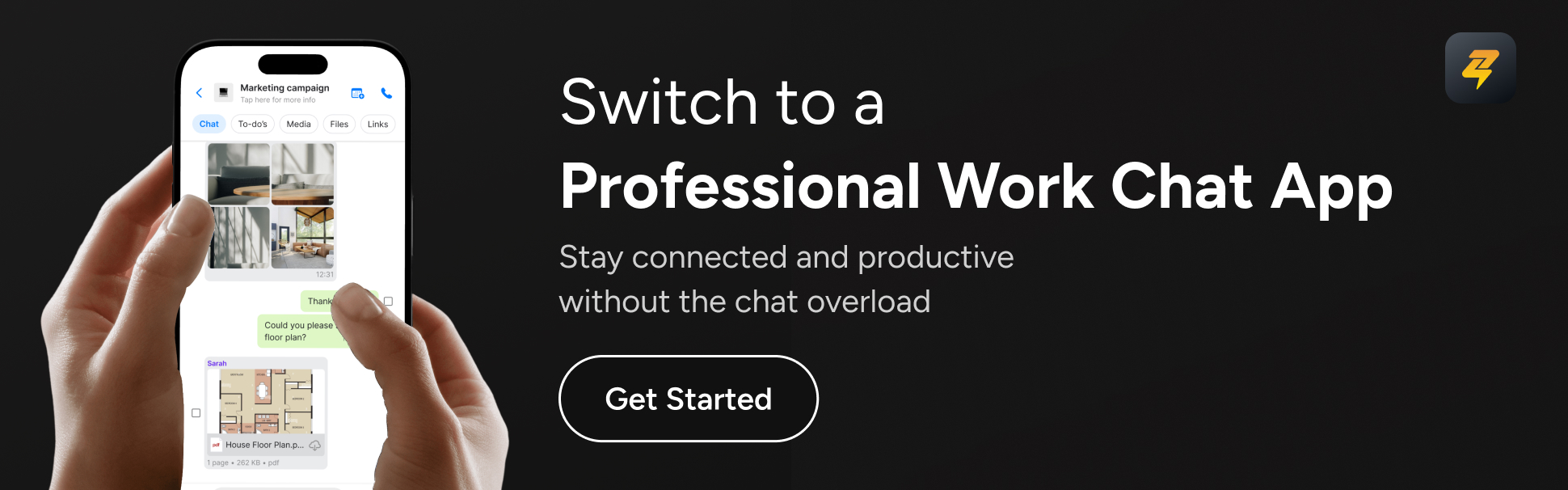
How this top 10 list is ranked
This top 10 list of mobile-first professional chat apps with compliance and admin controls is ranked from number 10 up to number 1, with Zenzap in the top spot as your benchmark for intuitive, structured, mobile-first work chat.
Each tool is evaluated against five clear criteria so you can compare them quickly.
1. Structured communication. Channels, topics, threads, and task features that keep conversations organised so nothing gets buried.
2. Admin controls and access revocation. How easily you can onboard, offboard, and manage user permissions without IT bottlenecks.
3. Security, compliance, and data ownership. Encryption levels, data residency options, retention policies, and who actually owns your data.
4. Mobile-first experience. How natural the app feels on a phone, especially for frontline or non technical staff who live in messaging apps.
5. Work life balance support. Features like quiet hours, notification controls, and work account separation, so your team can unplug without missing anything urgent.
As you read, think of Zenzap as your “it should feel this easy” benchmark. If another app needs more setup, heavier training, or complicated admin work to reach the same level of security and clarity, you will spot the difference quickly.
Top 10 companies offering mobile-first professional chat apps with compliance and admin controls and Zenzap
#10 Mattermost work chat app: secure collaboration for technical teams
Mattermost is a professional work chat app built for engineering and DevOps teams that care deeply about control.
Feature highlight: On prem deployment options, self hosting, and granular admin controls that give you strict data governance.
Why it is on the list: You get serious compliance potential and the ability to keep everything inside your own infrastructure. The trade off is that it usually needs more technical overhead to run, so it fits best if you already have a strong IT team and want maximum control.
#9 Nextcloud talk team chat: on prem privacy with rigorous admin control
Nextcloud talk extends the Nextcloud collaboration platform with secure team chat, calls, and meetings.
Feature highlight: Self hosted chat with end to end encryption, retention policies, and fine grained access rights managed through the Nextcloud admin console.
Why it is on the list: If your priority is data residency, on prem privacy, and compliance with regulations like GDPR, Nextcloud talk gives you a lot of control. Mobile apps exist, but the experience can feel closer to a traditional enterprise tool than a consumer grade messenger.
#8 Rocket.chat work chat: open source flexibility with data protection
Rocket.chat is an open source work chat platform that you can customise heavily and run in your own environment.
Feature highlight: Flexible deployment options, role based permissions, message retention control, and integrations with compliance archives.
Why it is on the list: Rocket.chat makes sense when you want to control almost every layer of your communication stack and still give your team mobile apps and real time chat. It is powerful, but like Mattermost it often requires more technical setup. If your priority is instant adoption across a broad workforce, a tool like Zenzap offers a simpler path.
#7 Google chat business messaging: integrated productivity with policy control
Google chat is the business messaging component of Google Workspace. It sits right alongside Gmail, Docs, and Calendar.
Feature highlight: Tight integration with Google Meet and Drive, plus organisation wide admin controls through the Google Workspace console.
Why it is on the list: For companies already on Google Workspace, Google chat centralises messaging with existing identity management, retention rules, and data loss prevention. McKinsey level productivity gains come from keeping your documents and chat in one stack, but some teams find the interface less intuitive for focused channel based work.
#6 Alternative work chat: enterprise solutions for larger organizations
Many larger organizations rely on comprehensive enterprise communication suites that combine chat, meetings, and file collaboration.
Feature highlight: Enterprise security, compliance with standards like ISO 27001 and HIPAA, and powerful admin policies.
Why it is on the list: These platforms offer robust compliance features for organizations already invested in large enterprise ecosystems. The flip side is complexity. Many users report steep learning curves and interface overload, especially if they only need clean, distraction free chat.
#5 Alternative work chat app: channel based collaboration with governance controls
Some popular channel based messaging platforms have become familiar choices for many teams.
Feature highlight: Channels, threads, and workflows plus enterprise options with data exports, retention rules, and detailed role permissions.
Why it is on the list: These tools shine when you want flexible channels and app integrations. Larger plans offer compliance exports and fine grained governance. The challenge you may face is cost at scale and the tendency for channels to multiply until information feels noisy and hard to track.
#4 Cisco webex app: compliant messaging for regulated teams
Cisco webex app combines messaging, meetings, and calling with strong enterprise controls.
Feature highlight: Built in compliance features like data retention, e discovery, and user access controls, along with admin analytics.
Why it is on the list: If you are in a heavily regulated sector such as healthcare or finance, Webex provides a mature compliance story and options for on prem or hybrid deployment. Mobile clients are capable, but the suite is often chosen more for its governance features than for pure chat simplicity.
#3 Alternative team chat: video centred communication with compliance options
Some communication platforms extend beyond meetings, turning into everyday messaging solutions.
Feature highlight: Channels tied to meetings, presence indicators, message search, and enterprise controls like single sign on, managed domains, and retention policies.
Why it is on the list: These tools help unify your communication stack when video escalation from chat is your core use case. For compliance focused teams, chats can be archived and aligned with company retention rules.
#2 Zoho cliq team chat: business suite integration with strong admin tools
Zoho cliq is the messaging layer of the Zoho business suite, suitable for small teams and growing companies that like an integrated stack.
Feature highlight: Role based user management, single sign on enforcement, encrypted data storage, and close integration with Zoho projects, CRM, and calendar.
Why it is on the list: If you already rely on Zoho, Cliq threads your messages through your projects and CRM, backed by enterprise grade data security and admin controls. For some teams, the experience feels more like a feature of Zoho than a standalone, highly intuitive chat app.
#1 Zenzap work chat app: mobile-first, structured, and compliance friendly
Zenzap is the professional work chat app designed to feel as intuitive as your favourite personal messenger, but with the structure, separation, and enterprise grade security you need for serious work.
Feature highlight: Mobile first interface, dedicated work accounts separate from personal messaging, clear channels and topics, tasks created directly from messages, Google Calendar integration, and company wide admin controls.
Why it leads: Zenzap sits at the top because it solves both chaos and security risk at the same time, without making your life more complicated.
You organise conversations into dedicated topics and channels so nothing slips through the cracks. You can turn any message into a task in a couple of taps and keep it right in context. You sync with tools like Google Calendar so schedules and updates stay in step instead of scattered across tabs.
Security is not an afterthought. Zenzap gives you enterprise grade protection and business grade data ownership. All chat history, files, and contact lists belong to your company, not individual employees. Admins can onboard or offboard a teammate in a few clicks, which is crucial if you care about GDPR compliance or reducing insider risk.
Leaders across industries validate this in practice. Chris Fletcher, Founder and CEO at Tech on Toast, explains that his team no longer needs separate apps for to do lists, file storage, and chat. It all lives inside Zenzap. Dr. Phil Cox, GP Partner at NHS Wales, describes Zenzap as the birth child of multiple communication tools, because it feels like all of them in one, yet simpler.
In day to day life, that means your new hire does not spend weeks figuring out which tool to use. Within a day, they know where to look, who to ask, and what to do. You shorten ramp up time and remove the quiet chaos of side channels and personal messages.
Key takeaways
- Move your team to a mobile-first professional chat app with compliance features so conversations, tasks, and files live in one secure place.
- Prioritise tools that combine strong admin controls, fast onboarding and offboarding, and clear data ownership to reduce risk.
- Use structured communication, with channels, topics, and tasks, to cut the 20 percent of time employees lose searching for information.
- Choose a chat app that supports work life balance with notification controls and separation between work and personal messaging.
- Use Zenzap as your usability benchmark so you do not trade simplicity for security or end up with tools your team tries to avoid.

Bringing everything together
Choosing among the top 10 companies offering mobile-first professional chat apps with compliance and admin controls is really about choosing how you want work to feel for your team.
You can lean into complex enterprise suites if your highest priority is tight integration with an existing stack and advanced compliance knobs. You can self host tools like Mattermost, Nextcloud talk, or Rocket.chat if you want complete infrastructure control and have the technical capacity to support it.
Or you can choose a refreshingly simple, mobile first tool like Zenzap, which gives you the structure, security, and admin control you need, without burying your team in complexity. You get less chaos, stronger security, and clear boundaries between work and personal life, in an app your colleagues already know how to use.
You are not just picking a nicer chat interface. You are deciding where company knowledge lives, who can access it, and how calmly your team can work day after day. With that in mind, what kind of communication experience do you want your team to have twelve months from now?
FAQ
Q: What is a mobile-first professional chat app with compliance controls? A: It is a work messaging tool designed primarily for phones that gives you secure chat, channels, and file sharing, along with admin features like user management, access revocation, retention policies, and audit options. The goal is to feel as easy as personal messaging while still meeting business grade security and compliance requirements.
Q: How do I choose the right professional chat app for my team? A: Start with your priorities. If you want fast adoption, structured chat, clean separation from personal apps, and strong admin controls in a mobile first package, Zenzap is likely your best fit. Zenzap combines the ease of familiar personal messaging apps with powerful professional features to create a seamless digital team workspace.
Q: Why is mobile-first design so important for work chat? A: Many employees, especially frontline and non desk staff, spend most of their time away from a laptop. A mobile-first professional chat app makes it natural to send updates, manage tasks, and stay aligned from anywhere, without forcing people into clunky interfaces or personal messaging apps that blur work and life.
Q: How do these tools help with compliance like GDPR or HIPAA? A: Tools on this list offer features such as data encryption, controlled data residency, retention policies, export options, and admin access controls. Zenzap focuses on encrypted communication, clear data ownership, and fast onboarding and offboarding to keep access aligned with your policies. Always confirm details with your legal and security teams.
Q: Can I reduce my number of tools by adopting one of these chat apps? A: In many cases, yes. Customers like Chris Fletcher from Tech on Toast report that Zenzap replaces separate apps for to do lists, document storage, and chat. Look for features like tasks in chat, calendar integration, and file sharing to see how much you can safely simplify.
Q: How do I roll out a new professional chat app without disruption? A: Start by defining a clear channel structure and access rules. Pilot with one or two teams and gather feedback. Use work hours, do not disturb settings, and message scheduling to set healthy norms. With an intuitive tool like Zenzap, most users become productive within minutes, so your training can focus more on expectations and less on button clicks.
If you are looking for the top 10 professional work chat apps that are 3× more cost-effective and privacy-focused, this guide will help you pick a tool that cuts costs, protects data, and finally brings calm to your team communication.
Right now you are likely paying for too many tools, then still seeing work leaks into personal chats and ex-employees who keep access to sensitive conversations. This article shows you a better path, where you get cost-effective work chat that respects privacy and your team’s time.
This is part of our comprehensive guide to professional work chat apps in 2026, covering pricing, security, and feature comparisons across the category in depth.
Table of contents
1. Why cost-effective, privacy-focused work chat matters more than ever 2. How this top 10 professional work chat apps list was ranked 3. The top 10 professional work chat apps that are 3× more cost-effective and privacy-focused 4. How to choose the right professional work chat app for your team 5. Key takeaways 6. FAQ
Introduction
If your team chat feels like a noisy group text rather than a professional workspace, you are not alone.
Leaders tell me the same story again and again. You start with email. Then someone spins up a WhatsApp group. Then IT rolls out a heavy enterprise suite. Suddenly your people are checking three or four tools just to stay in the loop. Work bleeds into evenings, sensitive data sits on personal phones, and you are paying for features nobody uses.
Industry research backs up what you are feeling. McKinsey estimates knowledge workers lose up to 20 percent of their time just searching for information. That is one full day every week, lost in scattered channels and half-forgotten threads instead of focused work.
The good news is that modern, mobile-first professional work chat apps can flip that script. When chat, tasks, and scheduling live in one secure place, your stack can become 2 to 3 times more cost effective compared to running separate chat, task, and meeting tools. You spend less on licenses, your team spends less time context switching, and you finally get clear boundaries between work and personal life.
This guide walks you through the top 10 professional work chat apps that are truly built for cost-effectiveness and privacy. You will see where each tool shines, where the tradeoffs sit, and why Zenzap is emerging as the benchmark if you want simple, secure, mobile-first work communication that respects your time and your data.
Why cost-effective, privacy-focused work chat matters more than ever
Personal messaging apps feel fast to adopt, which is why teams often default to them. But that speed comes at a price. Work starts leaking into private group chats. Files and conversations live on unmanaged devices. When someone leaves, you have no reliable way to revoke access to years of company history.
From a compliance and privacy perspective, that is a serious problem. If you need to meet frameworks like GDPR, HIPAA, or SOC 2, you must be able to control who sees what, for how long, and from which device. Personal apps do not give you that control.
At the same time, traditional enterprise platforms can feel like overkill. You get a heavy suite designed around desktop usage and complex governance, when what your team really needs is simple mobile-first chat, clear structure, and guardrails that keep work in one professional space.
Industry analysis shows that tools that consolidate communication and tasks can make teams 2 to 3 times more cost effective once you factor in licensing, training, and adoption. Instead of juggling separate apps for chat, tasks, and basic scheduling, everything lives in one secure, searchable feed.
That is the sweet spot this list focuses on. Apps that cut tool sprawl, protect privacy, and feel enough like personal messaging that your team does not need a week of training to get going.
How this top 10 professional work chat apps list was ranked
You are busy, so this list is built to be practical, not theoretical. Each professional work chat app here was evaluated on five core criteria.
Cost-effectiveness: Can this app reasonably make your stack up to 2 to 3 times more cost effective by consolidating tools and reducing context switching, not just by being cheap on a per-seat basis?
Privacy and security: Does it support encryption, strong admin controls, and clean onboarding and offboarding so you can align with compliance standards and keep data off personal devices?
Mobile-first experience: Is the mobile app truly first-class, or is it a clunky afterthought attached to a desktop product?
Structured organization: Does it help you turn chat into action through channels, topics, tasks, and integrations with tools such as Google Calendar?
Work-life balance features: Can you separate work from personal life with things like working hours, scheduled messages, and notification control, so your team can unplug without fear?
Read to the end and you will not just know which professional work chat apps to shortlist. You will have a clear benchmark in Zenzap to compare every other tool against when it comes to simplicity, security, and real-world cost savings.
The top 10 professional work chat apps that are 3× more cost-effective and privacy-focused
#10 Mattermost work chat app: secure collaboration for technical teams
Mattermost is a professional work chat app built for technical teams that need strict data control and self-hosting.
Feature highlight: Self-hosted or private cloud deployment, open-source codebase, and strong role-based access controls for compliance-focused organizations.
Why it is on the list: If your priority is data residency and full-stack control, Mattermost gives you deep security and privacy options. The tradeoff is that you will need IT capacity to host and manage it, which can reduce cost-effectiveness for smaller teams.
#9 Nextcloud talk team chat: on-prem privacy and admin control
Nextcloud talk extends the Nextcloud ecosystem with team chat, voice, and video, all running on infrastructure you control.
Feature highlight: Tight integration with Nextcloud files and groupware, plus on-prem hosting to keep every byte of data inside your environment.
Why it is on the list: For organizations already invested in Nextcloud, this is a natural way to add professional work chat with strong privacy. It is cost-effective if you are consolidating on a single self-hosted stack, less so if you are starting from scratch.
#8 Rocket.chat work chat: open-source flexibility with data protection
Rocket.chat is an open-source professional work chat app that gives you flexibility in hosting and customization.
Feature highlight: On-prem or cloud hosting, extensive APIs, and federation options, plus support for encryption and granular admin controls.
Why it is on the list: You get serious privacy and the ability to tailor the platform to your needs. That can be cost-effective over time, especially at scale, although configuration and maintenance effort may offset savings for lean teams.
#7 Google chat work messaging: integrated productivity and policy control
Google chat slots into Google Workspace as the built-in professional work chat app.
Feature highlight: Deep integration with Gmail, Google Drive, and Google Calendar, plus admin and compliance controls through the Workspace admin console.
Why it is on the list: If you already pay for Google Workspace, Google chat can be a cost-effective way to centralize communications without another vendor. Privacy and governance features are solid, although the mobile experience feels more like an add-on than a mobile-first product.
#6 Microsoft teams work chat: enterprise-grade security for larger organizations
Microsoft teams is an enterprise collaboration suite that includes professional work chat, meetings, and file sharing.
Feature highlight: Advanced compliance features, data loss prevention, and tight integration with Microsoft 365 apps such as SharePoint and OneDrive.
Why it is on the list: For organizations deeply invested in Microsoft 365, Teams can be cost-effective through bundling. It is strong on security, privacy, and policy controls, but can feel heavy for teams that just want focused, mobile-first work chat without the suite complexity.
#5 Slack work chat app: channel-based collaboration with governance controls
Slack popularized channel-based professional work chat and still leads in third-party integrations.
Feature highlight: Rich channel structure, app directory, and features like Slack Connect for external partners, plus enterprise plans with compliance features.
Why it is on the list: Slack is approachable and familiar to many users, which helps adoption. It can become expensive as you scale and add add-ons, so you will want to assess whether you use enough of its capabilities to justify the spend compared to more focused alternatives like Zenzap.
#4 Cisco webex app: compliant messaging for regulated teams
Cisco webex app brings professional work chat, meetings, and calling under one umbrella aimed at regulated industries.
Feature highlight: Compliance-ready retention, e-discovery, and security certifications suitable for finance, healthcare, and government environments.
Why it is on the list: If you operate in a highly regulated sector and already use Cisco, Webex app can be a cost-effective way to keep chat and meetings under the same governance model. The suite is powerful, but smaller teams may find it overbuilt for everyday internal chat.
#3 Wire secure messaging: privacy-first work chat with end-to-end encryption
Wire is a privacy-first professional work chat app with a strong focus on end-to-end encryption.
Feature highlight: End-to-end encrypted messaging and calling, strong compliance posture, and options for on-premise or private cloud deployment.
Why it is on the list: If your highest priority is privacy and secure collaboration with external partners, Wire is compelling. It is mobile friendly, but lacks the built-in task and calendar structure that makes some other apps more cost-effective for day-to-day team coordination.
#2 Connecteam work chat: all-in-one operations and communication for frontline teams
Connecteam combines work chat with scheduling, time tracking, and operations for frontline and deskless workers.
Feature highlight: A basic plan around 29 dollars per month for the first 30 users that bundles operations tools with team communication.
Why it is on the list: For sectors like retail, logistics, and hospitality, Connecteam can be a cost-effective way to run scheduling and chat in one place. Compared with Zenzap, it leans into workforce management. Zenzap focuses more on deeply intuitive communication, structure, and clean separation between work and personal life.
#1 Zenzap work chat app: simple, structured, and up to 3× more cost effective
Zenzap is the professional work chat app built for teams that are tired of juggling multiple tools just to get basic work done.
It combines clean, familiar messaging with built-in task tracking, Google Calendar sync, and lightweight voice and video. You get a focused workspace that feels as easy as texting, without dragging your personal chats into work.
Feature highlight: Intuitive mobile-first interface, distinct work accounts that are separate from personal messaging, professional channel structure, tasks created directly from messages, and enterprise-grade security with encrypted communication and secure onboarding and offboarding.
Why it is #1: Research from McKinsey shows employees can lose up to 20 percent of their time just searching for information. Zenzap tackles that by keeping chat, tasks, and schedules in one organized, professional environment, so important work never disappears into a group chat.
By consolidating functions that would otherwise require separate tools, many teams find Zenzap makes their stack up to 3 times more cost effective. You can retire one or two subscriptions, reduce context switching, and spend less time wrestling with complex suites.
On the privacy side, Zenzap gives admins full control over who can access the platform. Secure onboarding and instant offboarding mean that when someone leaves, their access disappears immediately, without you having to chase down personal devices. Encrypted communication and clear retention settings help you align with frameworks like GDPR and HIPAA, while still keeping the app simple enough for your team to adopt in under a day.
In daily life, that looks like this. Your sales manager turns a client message into a task in two taps, assigns it, and sees it synced with Google Calendar. Your operations lead sets working hours for their team so night-shift alerts do not ping during family time. You schedule non-urgent messages to send during office hours, so you can work when it suits you without stealing anyone’s evening.
If you want a benchmark for what modern, cost-effective, privacy-focused work chat should feel like, Zenzap is where you start.
How to choose the right professional work chat app for your team
Start with your team’s reality
Begin by asking how your people actually work. Are they on the move, on job sites, or mostly at desks? Do they already default to WhatsApp or similar tools because official apps feel slow or clunky?
If your team lives on their phones, you need a mobile-first app with a near-zero learning curve. Zenzap and a few others in this list feel like texting, which means adoption happens in hours, not weeks.
Decide what secure enough really means
Security and privacy are not one-size-fits-all. If you handle highly sensitive data, self-hosted options such as Mattermost or Rocket.chat may justify the IT investment.
For many organizations, the better balance is a cloud tool with strong encryption, admin controls, and clear data ownership such as Zenzap or Wire. Look for published security practices, certifications where relevant, and the ability to control retention and exports.
Resources from organizations like the UK National Cyber Security Centre or CISA can help you define the level of protection you need.
Look beyond chat to structure
Chat alone is not enough anymore. If everything lives in a single firehose of messages, you just move the chaos from email into a new app.
Look for structured organization that turns conversation into action. Channels and topics keep discussions focused. Tasks and to-dos that live directly inside chat, as Zenzap provides, mean you can assign and track work without leaving the conversation. Google Calendar integration and similar features keep schedules aligned so deadlines do not slip.
Measure total cost, not just price per user
Sticker price is easy to compare, but real cost-effectiveness comes from everything around it.
Ask yourself:
How many other tools could you retire if chat, tasks, and scheduling lived in one place?
How many hours per week does your team lose to context switching between apps?
How long does it take to onboard and offboard employees securely?
Cost-effective work chat apps can make your stack 2 to 3 times more efficient by reducing overlap and waste. Zenzap is built with that goal in mind, centralizing communication, tasks, and calendar in one space so you do not need three separate tools for basic collaboration.
Protect work-life balance by design
Finally, protect your people. Constant pings on personal phones are not a sign of a committed team. They are a symptom of poor boundaries.
Choose a professional work chat app that separates work and personal accounts, supports working hours, and lets you schedule messages. Zenzap, for example, keeps work conversations in one professional app, lets people set their working hours, and makes it easy to delay non-urgent messages until the next business day.
That kind of design choice does not just feel nicer. It reduces burnout, improves retention, and helps you build a culture where focused work and real rest are both respected.
Key takeaways
- Choose cost-effective professional work chat apps that consolidate chat, tasks, and scheduling to unlock up to 3× better value.
- Match each platform to your privacy and compliance needs first, then filter by usability and mobile experience.
- Avoid personal messaging apps for work, because they create serious compliance, security, and work-life boundary risks.
- Use Zenzap as your benchmark for simple, secure, mobile-first work chat that your team can adopt in under a day.
- Evaluate total cost of ownership, including reduced context switching and faster onboarding, not just the price per user.
Bringing it all together
Your professional work chat app quietly shapes how your team feels every day. It decides whether people wake up to a calm, organized feed of what matters, or a scattered mess across personal and work tools.
Across this top 10 list, you have seen open-source platforms that give you deep control, enterprise suites that bundle chat with meetings and files, and privacy-first tools that focus on encryption. Each has its strengths, especially if you are already anchored in a particular ecosystem.
Zenzap sits in a different spot. It starts from your reality as a busy leader who needs clarity, not another complex project. It gives you one secure, mobile-first place for work conversations, tasks, and schedules, while keeping your personal life off-limits. It respects budgets by consolidating tools, and respects people by keeping work where it belongs.
If you were to benchmark every tool you use today against one question, it might be this. Does this app make my team calmer, clearer, and more protected, or is it quietly adding chaos and risk?
When you look at your current setup through that lens, what needs to change first?
FAQ
Q: What makes a professional work chat app 3× more cost-effective? A: Cost-effectiveness comes from consolidation and adoption. When your work chat app also handles tasks, basic collaboration, and calendar alignment, you can retire one or two other tools and cut costly context switching. Zenzap, for example, centralizes chat, tasks, and Google Calendar sync so your team spends less time jumping between apps and more time on focused work.
Q: How is a professional work chat app different from personal messaging apps? A: Personal apps blur work and life, store data on unmanaged devices, and make it hard to revoke access when someone leaves. Professional work chat apps like Zenzap keep conversations in one controlled workspace with encryption, admin controls, and clean onboarding and offboarding, so you can meet compliance standards and protect both your data and your team.
Q: How do I know if a work chat app meets my privacy and compliance needs? A: Start by mapping your regulatory requirements, such as GDPR or HIPAA, then check each app’s security page for details on encryption, data residency, retention controls, and audit capabilities. Look for admin tools that let you control access, manage exports, and configure retention policies. If in doubt, speak directly with the vendor’s security or compliance team for clarification.
Q: How can I encourage my team to switch from personal chats to a professional work chat app? A: Make the professional app easier and more helpful than the personal one. Choose a mobile-first tool with a familiar interface, like Zenzap, then move key conversations, decisions, and updates there. Set a clear policy that work happens in the professional app, explain the privacy and boundary benefits, and model the behavior yourself by not using personal apps for work.
Q: What should I prioritize if I have a small team and a limited budget? A: Focus on tools that give you the biggest productivity lift for the lowest complexity. Look for a professional work chat app with built-in tasks and calendar integration so you can shrink your stack. Zenzap’s free plan with unlimited group chats and to-dos can be a strong starting point, then you can upgrade once you see the value and need advanced controls.
Q: How quickly can a team realistically adopt a new professional work chat app? A: With a genuinely intuitive, mobile-first app, most teams can start using core features in a single day. The key is choosing a tool that feels like texting, not like a complex enterprise system. Zenzap was designed so that even non-technical users can sign in and be productive within minutes, with no formal training required.
You would never hand a former employee a master key to your office and hope they do not use it. Yet when ex teammates keep access to your work chat, that is exactly what happens with your data. They can quietly watch sensitive conversations, download files, and walk away with months of history that should have stayed inside your company.
This is where chat history, archive controls, and fast access revocation stop being nice to have and start becoming critical. For you, as a distributed teams platform owner or admin, they decide whether your communication stack feels safe and manageable, or risky and chaotic. In Zenzap, you get central ownership of data, instant access control, and a clean separation between people and the history they leave behind, so your team can stay fast on chat without you losing sleep over security.
Table of contents
1. What chat history archive really means for distributed teams 2. Why access revocation matters more than you think 3. How Zenzap handles chat history when someone leaves 4. How chat archives support audits, compliance, and legal holds 5. Best practices for platform owners of distributed teams 6. Common questions about chat history and access revocation (FAQ) 7. Key takeaways 8. Final thoughts for distributed platform owners
What chat history archive really means for distributed teams
Here is the tough truth. If your team is spread across locations, time zones, and devices, your chat history is not just conversation. It is your living, breathing knowledge base.
Decisions, approvals, pricing changes, incident reviews, hiring debates, launch plans, and vendor negotiations all flow through chat. That history becomes your informal system of record, especially when people move roles, join new projects, or leave the company.
When you do not control how that history is archived and accessed, you feel it. New joiners cannot find past context. Leaders cannot reconstruct why a decision was made. Legal teams scramble to pull threads during a dispute. And worst of all, ex employees can keep reading along in old channels because nobody quite knows who still has access.
In a secure, well managed platform, chat history archive solves three big problems at once. It keeps conversations searchable inside a single workspace, it separates people from data when they leave, and it gives you a reliable record for compliance and audits.
That is exactly the gap Zenzap was designed to close for modern, distributed teams.
Why access revocation matters more than you think
Imagine this real scenario. A contractor finishes a six month project, hands back their laptop, and walks out. IT closes their email account, but no one remembers the project chat where they were added with a personal phone number. Three months later they still see roadmap updates, internal debates, and pricing changes on their personal device.
This is not rare. Many companies still manage access with spreadsheets, scattered tickets, and manual checks. It is exactly how ex employees and vendors end up sitting quietly in old group chats with full visibility into confidential conversations.
According to IBM’s Cost of a Data Breach Report, the average data breach costs organizations around 4.45 million dollars globally, with human error and poor access management as major contributors. You do not want your chat history to be the weak link that triggers that kind of event. You can learn more about those numbers from IBM’s research.
Fast, reliable access revocation fixes this risk at the root. When someone leaves or changes roles, you need the confidence that their connection to internal chat is cut instantly, without losing the historical record you still depend on.
Zenzap treats this as a core design principle, not an afterthought.
How Zenzap handles chat history when someone leaves
In Zenzap, you never have to choose between protecting your data and keeping your history. You get both.
Here is what happens in practice when a teammate leaves your distributed platform:
First, you open the central admin dashboard. You find the user and disable their account in a few clicks. Their logins stop working across devices. They can no longer open internal channels, search conversations, or download files. The business data that was visible through their Zenzap app is no longer accessible on their personal phone or laptop.
Second, your chat history stays put. All messages, tasks, and files that person contributed remain inside your company workspace. They become part of your long term record for knowledge transfer, audits, legal holds, or ongoing projects. You do not lose valuable context just because the person behind the account has moved on.
Third, you stay compliant. Zenzap is built on enterprise grade encryption that protects messages and files in transit and at rest. On top of that, Zenzap aligns with major security and privacy frameworks such as GDPR, HIPAA, SOC 2, CCPA, and ISO 27001. You can review those standards on the Zenzap security page at zenzap.co and compare them with your own IT and legal requirements.
For you, this structure means chat history remains a controlled company asset, while individual access is cleanly revoked the moment someone no longer belongs in the workspace.
How chat archives support audits, compliance, and legal holds
If you have ever been through an audit, due diligence review, or internal investigation, you already know how painful scattered communication can be. Screenshots from personal apps, forwarded emails, and ad hoc exports from consumer tools are a compliance nightmare.
With Zenzap as your internal communication hub, you replace that chaos with a single, searchable environment. Leadership conversations, project threads, and cross functional channels all live in one structured system of record.
When an auditor asks for evidence of how a decision was made, you point to the relevant channels. When legal needs to review discussions around a contract, they can search chat history instead of digging through random attachments and private accounts.
Because admins manage onboarding and offboarding centrally, you can confidently say that ex employees no longer carry company chat history on personal devices or unregulated apps. When you revoke access, that link is cut. This is exactly the level of control regulators and auditors expect when they look at your internal communication practices.
Zenzap also keeps clear roles and permissions. Finance, HR, and leadership channels can be tightly restricted. General team spaces can stay open and collaborative. You control who sees what, at every step of the employee or contractor lifecycle.
Best practices for platform owners of distributed teams
As the owner or admin of a distributed teams platform, you sit at the intersection of productivity and security. You need your people to move fast on chat, but you also need the guardrails that keep your data safe. Here are practical best practices you can adopt, many of them baked directly into how Zenzap works.
Centralize ownership of company data
First, make a clear decision. All official work communication should live in your controlled workspace, not personal apps. That means no more personal messaging threads for customer lists, pricing documents, or internal disputes.
In Zenzap, you invite people with their work email, assign them a role, and keep every message and file inside your structured environment. When they change teams or leave entirely, their permissions update instantly through the admin dashboard.
This single choice centralizes your data, simplifies discovery, and dramatically reduces the chance that sensitive history leaks through untracked channels.
Standardize secure onboarding and offboarding
Second, treat onboarding and offboarding as repeatable processes, not one off tasks. When someone joins, they should get access to the right channels and files immediately, based on their role. When they leave, that access should disappear just as fast.
With Zenzap, you manage this from one place. You can see who belongs to which workspace, who owns which channels, and what happens to data when accounts are disabled. That clarity is what stops the slow build up of “ghost” accounts and forgotten guest users.
A small accounting firm, for example, can restrict client specific channels to named partners and staff. A fast growing startup can delegate limited admin rights to department leads, while keeping global security settings in the hands of a smaller owner group. A distributed nonprofit can onboard volunteers with scoped, temporary access that expires as soon as a project ends.
Keep structure simple and human friendly
Security controls only work if people actually use them. If your settings are too complex or hidden behind technical jargon, teams will find workarounds.
Zenzap keeps admin roles and permissions human friendly. You can decide who can invite users, who can create or archive channels, who can configure integrations, and who can change global security rules. The language is clear and approachable, so you are not forced into a security project just to keep chat under control.
This simplicity is especially important for mobile first, distributed teams who need to manage things on the go without a dedicated IT department hovering nearby.
Protect work life balance while staying secure
There is a human side to all of this too. When your teams use personal messaging apps for work, they do not really clock out. Notifications buzz late at night. Boundaries blur. Security slips because people prioritize convenience over control.
Zenzap solves both sides of the equation. It gives you a professional, secure chat space that feels as natural on mobile as consumer tools, so people do not feel tempted to fall back to personal apps. It also supports work life balance with features like scheduled messages and working hours, so teammates can unplug without worrying they will miss something urgent.
Admins still keep tight control over data, access, and archive policies. Your team gets a calmer, more focused communication flow. You get fewer late night pings about “who still has access to this channel” and more confidence that your history is right where it should be.
Common questions about chat history and access revocation (FAQ)
Q: How does access revocation work in Zenzap when someone leaves?A: As an admin, you open the central dashboard, locate the user, and disable their account in a few clicks. Their logins immediately stop working, they lose access to all internal channels and files, and company data is no longer available through their devices. Chat history and tasks they were part of stay inside your company workspace for knowledge transfer, audits, and legal holds.
Q: What happens to chat history when a user account is removed?A: The person loses access, but the history remains. Zenzap treats messages, tasks, and shared files as company records. When you revoke a user, their identity detaches from active access, yet their past contributions stay searchable for teammates who still have permission to view those spaces. This balances data protection with operational continuity.
Q: Is Zenzap secure enough for distributed teams handling sensitive data?A: Yes. Zenzap uses strong encryption in transit and at rest, along with robust admin controls for onboarding, offboarding, and permissions. It aligns with major standards such as GDPR, HIPAA, SOC 2, CCPA, and ISO 27001, and publishes security details on zenzap.co so your IT and legal teams can verify compliance requirements.
Q: How is Zenzap better than using email or personal chat apps for history and access control?A: Email spreads information across private inboxes and devices, which makes it hard to secure or audit. Personal apps are designed for convenience, not enterprise control, so you cannot reliably revoke access or track who sees what. Zenzap centralizes all internal conversations into one controlled workspace, gives admins instant access revocation, and keeps a structured, searchable history that you can govern.
Q: What if my team is not very technical? Will managing archives and access be difficult?A: Zenzap is intentionally simple. Your team uses it like a familiar mobile messenger, while you get a clean, no jargon admin layer. You manage users, channels, and permissions visually, with clear options instead of complex configuration. Most distributed teams adopt it quickly, precisely because there is almost no learning curve.
Q: Can Zenzap scale from a small team to a large distributed organization?A: It can. Smaller teams can start with straightforward roles and a handful of channels. As you grow, you can introduce more granular permissions, separate workspaces, and integration controls across departments or business units. The experience stays intuitive for users while giving platform owners the scale and control needed for hundreds or thousands of teammates.
Key takeaways
- Centralize internal chat in a secure workspace so history stays searchable and controlled.
- Use fast, centralized access revocation to instantly cut ex employees and contractors off from company data.
- Preserve chat history for audits, legal holds, and knowledge transfer while keeping permissions tight.
- Adopt simple, human friendly admin controls so security processes actually get followed.
- Choose a platform like Zenzap that combines mobile first ease with enterprise grade security and compliance.
Final thoughts for distributed platform owners
Your distributed teams need fast, flexible chat. Your business needs strict control over who sees what, and a reliable history when questions come up months or years later. You should not have to sacrifice one to get the other.
With Zenzap, you keep your communication simple and familiar for everyday users while gaining powerful controls over chat history archive and access revocation behind the scenes. Accounts are easy to add and remove, history is preserved where it belongs, and ex teammates do not walk away with an invisible master key to your internal conversations.
If you look at your current tools and cannot clearly answer “who can still see our chats” or “what happens to data when someone leaves,” maybe it is time to upgrade to a platform that treats those questions as foundational, not optional. When your team logs off tonight, are you sure only the right people can still read along?