


Key Takeaways
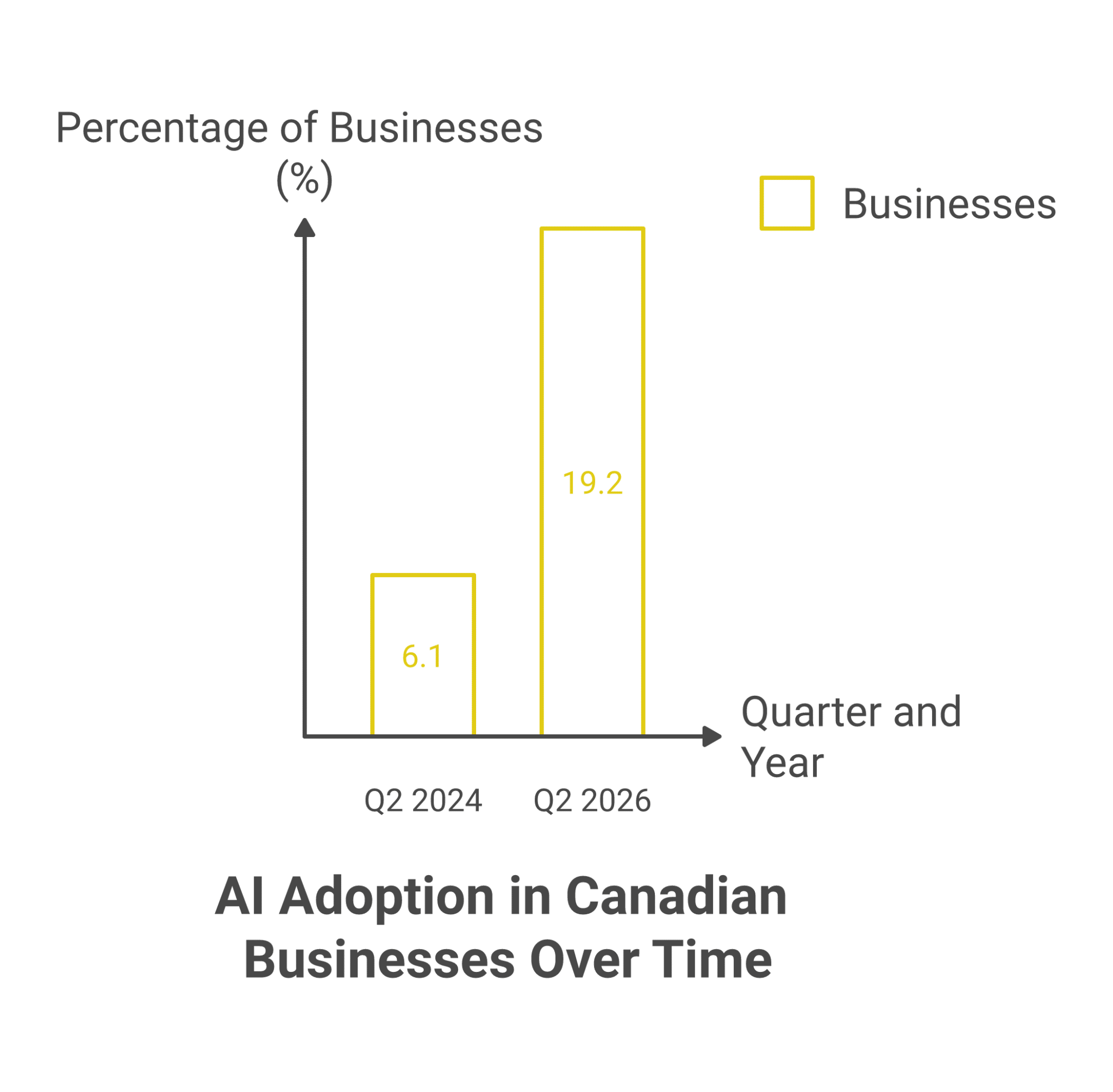
- Canadian businesses are already using AI in real operations, with Statistics Canada reporting 19.2% adoption in Q2 2026, up from 6.1% in Q2 2024.
- The next step is not another chatbot. It is AI agents that take action across tools, summarize chats, flag issues, and move tasks forward inside the same workflow.
- Ease of setup matters because 40.0% of Canadian businesses said AI was not relevant to them, which makes one-click, no-code setup a practical entry point.
- Shared context matters too. When AI agents live in team chats, corrections and approvals become part of the record, which supports audit trails and reduces mistakes.
- The best use cases in Canada are the ones tied to regular work, such as lead routing, invoice processing, support triage, operations reporting, and industry-specific approvals.
Introduction
Canadian businesses are moving from AI experimentation to day-to-day use, and that shift is changing how work moves through teams. The clearest signal comes from Statistics Canada’s Q2 2026 report on artificial intelligence use by businesses in Canada, which found that 19.2% of businesses used AI to produce goods or deliver services over the prior 12 months, up from 6.1% in Q2 2024. That is not a footnote. It is a sign that AI is already inside Canadian operations, even if it is still scattered across tools, people, and approval steps.
You can see the pattern in the numbers. The same report says 40.0% of businesses said AI was not relevant to their business, while 28.2% of AI-using businesses relied on virtual agents or chat bots. That gap tells you where the opening is. Many teams have tried AI in a narrow way, often as a chat interface for one person, but the work still breaks apart when it needs to move across systems, get approved, or be shared with the rest of the team.
The real story in Canada is not about whether AI exists. It is about whether AI can sit inside the daily flow of work and do something measurable. That is where AI agents for work matter, especially for SMBs, directors, and managers who need control, context, and a shorter path from question to action. If you want a practical view of that shift, it helps to study how no-code AI agents produce real workflow results and why collaborative AI agents change how teams work together.
Table of Contents
- Key Takeaways
- Introduction
- How AI Use In Canada Moved Into Operations
- Why Chatbots Are Only The First Step
- The Canadian Workflows Getting The Biggest Payoff
- What One-Click AI Agents Change For Teams
- What To Look For Before You Add An AI Agent
- The Business Case For Shared Context And Approval Controls
- A Practical Way To Start In A Canadian Team
- The Next Layer Of AI Adoption In Canada
- What Does A Strong AI Workflow Look Like In Practice?
- FAQ
- About Zenzap
How AI Use In Canada Moved Into Operations
AI adoption in Canada is no longer limited to pilots, and that shift changes the buying conversation. The new question is how to put AI into production without adding friction, confusion, or risk.
Statistics Canada’s Q2 2026 survey gives you a clear map of where adoption is strongest. Information and cultural industries reported 42.3% AI use, finance and insurance 40.4%, and professional, scientific and technical services 32.4%. At the other end, agriculture, forestry, fishing and hunting stood at 4.5%, wholesale trade at 7.9%, and construction at 9.2%. That spread shows a market that is active but uneven, which usually means buyers need simple entry points rather than more complexity.
The same report says the survey was run from early April to early May 2026 as part of the Canadian Survey on Business Conditions. That matters because it reflects current operating behavior, not old sentiment. If you want a second source that shows how Canadian buyers are being marketed to right now, the Gestisoft guide on AI automation agencies in Canada notes that the automation market is expected to climb toward $33 billion USD by the end of the decade. The message is consistent: AI is moving from interest to process.
Why Chatbots Are Only The First Step
Chatbots are useful, but they stop where the workflow starts. They answer questions, draft text, and summarize content, yet most teams still have to copy, paste, approve, route, and update the actual systems by hand.
That limitation shows up in the adoption mix. Statistics Canada found that among businesses using AI, data analytics led at 36.6%, text analytics followed at 34.5%, and virtual agents or chat bots came in at 28.2%. Those are all valuable use cases, but they still cluster around interpretation and conversation. The next layer is action. That means taking the output of a conversation and turning it into a CRM update, an invoice review, a support ticket handoff, or a report in the right place.
You can see why that distinction matters in practice. A sales manager in Toronto may ask for a lead summary, but the work is not done until the lead is routed, the owner is assigned, and the team can see what happened. A construction manager in Calgary may ask for a daily site update, but the value comes when that update is posted, shared, and tracked without another round of manual admin. For a broader view of how buyers are thinking about AI agent platforms in Canada, Vegavid’s list of AI agent development companies in Canada shows how crowded the category has become.
The Canadian Workflows Getting The Biggest Payoff
The biggest gains come from repeatable work that already happens every week. If a task touches approvals, handoffs, or reporting, it is a strong candidate for an AI agent.
In customer support, a team can route incoming requests, draft replies to common questions, and escalate the rest with full context. In finance, an AI agent can flag invoice exceptions, prepare approval notes, and pull the right records before a manager reviews the request. In healthcare and home care, the same pattern shows up in call notes, appointment follow-up, and issue tracking, where time lost to manual handoffs quickly becomes expensive.
Construction, retail, hospitality, and professional services all have similar pressure points. A construction foreman needs daily reports turned into something usable by a project manager. A retail operator needs stock issues logged and shared before a shelf goes empty. A clinic manager needs patient call details translated into the system without creating a backlog. That is why the best workflows are not abstract. They are the ones where a repeated step can be cut, assigned, or recorded with less effort.
The Numbers Behind the Use Case
The case for workflow automation gets stronger when you look at the cost side. Exotic AI Solutions’ analysis of AI agent workflow automation for Canadian businesses places the software market around $11.8 billion to $12 billion in 2026 and points to automation use across enterprise applications. That gives you a sense of how much spend is already moving toward process automation.
A second signal comes from AY Automate’s summary of McKinsey’s 2025 State of AI findings, which says 88% of organizations use AI in at least one business function, 72% use generative AI, and only 39% can point to measurable bottom-line financial impact. That last number is the one to pay attention to. Adoption is widespread, but proof is still uneven, which is exactly why workflow-level metrics such as hours saved, deals moved, and mistakes avoided are so persuasive.
What One-Click AI Agents Change For Teams
One-click setup changes who can use AI and when they can use it. If you need a developer every time you want to test a workflow, the idea stays stuck in planning. If you can add an AI agent, connect a tool, and start working in minutes, the barrier drops fast.
That is the practical appeal of AI agents for work inside a Canadian SMB. You can start with one person, one process, and one measurable result. A manager can have an AI agent pull weekly reports, summarize updates, or flag exceptions. Once the value is visible, the same setup can move into a group chat where other people can correct it, add context, and use the same record.
For teams that want a step-by-step view of this setup, building collaborative AI agents without coding is the right mental model. If you want to compare what different AI agents actually do in business settings, this breakdown of three AI agents for business gives a useful starting point. The point is simple. The buyer is no longer asking for a clever demo. The buyer wants something that runs inside the work already happening.
What To Look For Before You Add An AI Agent
The first test is whether the AI agent can work where your team already works. If it forces people into another system, you add friction instead of removing it.
The second test is control. Canadian businesses in regulated or process-heavy sectors need approval steps, access rules, and a clean audit trail. That is especially important in finance, healthcare, legal services, and construction, where a wrong update can trigger a larger problem. You want read actions to happen automatically when appropriate, but sensitive write actions should require explicit approval.
The third test is context. An AI agent that only sees a single prompt will miss the history behind the request. A better setup gives it the conversation, the connected tools, and the prior actions in the same topic so it can understand what has already been done. That is also where local, topic-scoped memory matters, because it keeps work separated and avoids cross-topic leakage.
The Business Case For Shared Context And Approval Controls
Shared context changes the quality of the output. When an AI agent sits in a team chat, the corrections are visible, the assumptions are easier to challenge, and the record is easier to trace later.
That structure matters because the business problem is rarely a single answer. It is the chain between the answer and the action. A support lead may want a summary of a customer thread, but the value comes when the next step is assigned and tracked. A sales director may want a deal summary, but the value comes when follow-up is logged before the prospect cools off. A finance manager may want an invoice check, but the value comes when the approval note lands in the right place without a second round of back-and-forth.
Canadian businesses also need infrastructure that reduces overhead. Managed systems matter because no one wants to run servers, patch tools, or build an internal platform before seeing value. A warmed-up agent that starts in about 300 ms, with approval controls and secure tool access, can do a lot more for a small team than a fragile custom setup that needs constant maintenance.
A Practical Way To Start In A Canadian Team
Start with a workflow that repeats every week and already eats time. That gives you a measurable baseline and a clean before-and-after comparison.
A manager in professional services might begin with meeting recaps, action item tracking, and client follow-up. A retail operator might begin with stock alerts and store-level reporting. A construction leader might begin with daily site updates and change-order routing. A healthcare or home care team might begin with note capture and escalation flags. Each of those is specific enough to track, and each can be improved without rewriting the whole business.
You do not need a perfect prompt. You need a clear process, a connected tool, and a team that can see the agent working. That is where the way AI agents learn inside a team chat interface becomes practical rather than abstract. Every correction improves the next run, and every saved step shows up in the workflow.
The Next Layer Of AI Adoption In Canada
The next phase of AI adoption in Canada is about turning scattered use into operating practice. That means moving from isolated experiments to repeatable workflows that can be measured in hours saved, deals moved, mistakes caught, or losses prevented.
Statistics Canada’s 19.2% adoption figure says the market has already crossed the first threshold. The 40.0% relevance gap says there is still room to make the value easier to see. The 28.2% chatbot figure says many teams are still parked at the conversation layer. The companies that move fastest will be the ones that connect AI to tools, approvals, and group workflows instead of treating it like a private drafting assistant.
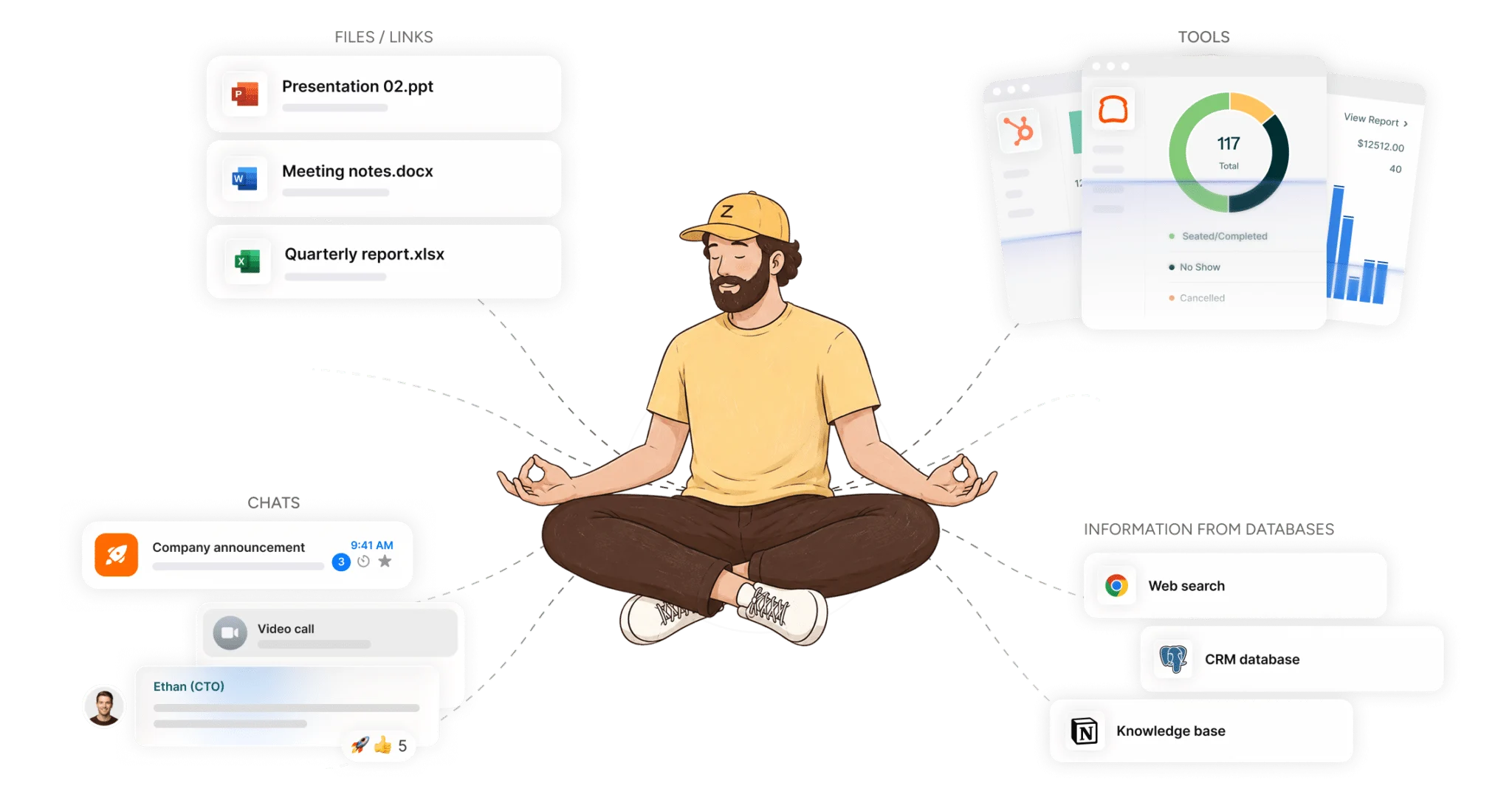
Canada’s strongest opportunity is not a bigger demo. It is a smaller setup with a clearer workflow and a shared record of what happened. Once the agent can work across tools and people in one place, AI stops feeling like an extra task and starts feeling like part of the job.
What Does Strong Adoption Look Like Inside a Real Workflow?
Strong adoption is when the AI agent removes manual steps without removing control. You can see it in a weekly reporting process that no longer needs three follow-up messages, or in a lead handoff that no longer sits in someone’s inbox for a day. You can also see it in the approvals trail, because managers can review what happened without asking for the same context twice.
That is the point where AI use becomes operational. It stops being an experiment and becomes a routine part of work. If you can measure the hours saved, the revenue moved forward, or the errors avoided, you are already past the first stage of adoption.
FAQ
Q: Why are Canadian businesses adopting AI faster now?
A: Canadian businesses are adopting AI faster because the use cases are becoming more practical. The Statistics Canada report shows adoption rising from 6.1% in Q2 2024 to 19.2% in Q2 2026, which suggests AI is moving into regular operations. Teams are seeing value in data analytics, text analytics, and chat, but they also want tighter links to the tools they use every day. That is why workflow automation is getting more attention than general experimentation.
Q: Why is a chatbot not enough for business workflows?
A: A chatbot can answer a question, draft a response, or summarize a thread. It cannot always complete the work after the answer. In a business setting, the real value comes when the result is routed, logged, approved, or turned into a task in the right tool. That is why AI agents that act across connected systems matter more than chat alone.
Q: What kind of Canadian team should start first?
A: The best starting point is a team with repeated admin work and a clear handoff process. That could be sales, finance, support, construction, healthcare, or operations. If a person does the same task every week and has to update more than one system, the workflow is a strong candidate. You want a process with a measurable outcome so you can see whether the AI agent is saving time or reducing mistakes.
Q: How do shared chats improve AI agent results?
A: Shared chats give the AI agent more context, which improves the quality of its work. When people can correct the agent in the same thread, the correction becomes part of the record. That helps the agent learn the team’s preferences and reduces repeated explanations. It also makes approvals and changes easier to trace later.
Q: What should you measure after adding an AI agent?
A: Start with the metric tied to the workflow, not the technology. For support, measure response time and ticket handoff speed. For sales, measure lead routing speed and follow-up completion. For finance or operations, measure hours saved, errors reduced, and approvals completed on time. Those numbers tell you whether the workflow is changing in a useful way.
About Zenzap
Zenzap gives you AI agents that do real work, connected to your tools and your team through a secure chat. Setup takes one click: no code, no developer. Unlike Claude or ChatGPT, the agents come already built and connected. You talk to them like a coworker: tag them into chats, correct them once and they remember. They act across your tools, automate workflows, build reports and graphs, summarize chats, flag what needs attention and coordinate people and tasks. One person gets value alone. Add your team, and every correction makes the agent sharper. Agents start in about 300 ms and run on managed infrastructure. Memory stays isolated by topic, and agents never hold credentials. They reach only approved domains, and sensitive actions need your approval.
Build The Workflow, Not Just The Demo
If the AI agent cannot move a real task forward, it is just another distraction in the queue. Canadian teams already know enough about AI to want something more concrete. They want speed, control, and proof that the system is saving time or preventing mistakes.
That is why the next step is so practical. Pick one repeated workflow, add an AI agent, and measure the result over a few weeks. If the team can see fewer handoffs, fewer missed steps, and faster decisions, you already have the answer. What workflow in your team is ready to move from manual handling to shared AI action?