
.svg)

.svg)

.svg)

.svg)

.svg)

.svg)

.svg)

.svg)

.svg)

.svg)
.svg)























8 Steps for CEOs to Master Team Communication with Zenzap
You are not short of communication tools. You are short of clear, calm communication that your team can actually trust.
Right now, you might be juggling email, WhatsApp, SMS, a legacy chat tool, and maybe a project management app that no one opens on mobile. Important updates get buried, decisions live in random threads, and you end up being the human failsafe who keeps everything (just about) on track.
This article gives you a simple ladder to climb out of that chaos. You will see how to move, step by step, from scattered, insecure, always-on communication to a mobile-first setup where your team knows exactly where to talk, what is urgent, and when they can switch off. Zenzap sits at the center of that upgrade, giving you a single, intuitive work chat app that feels like texting, but operates like a real business system.
Table of contents
1. From digital minefield to clear path
2. Step 1: Define what "great communication" means for your company
3. Step 2: Pick the right platform for instant, stress-free adoption
4. Step 3: Centralize conversations, tasks, and files in one place
5. Step 4: Structure channels around how your business actually runs
6. Step 5: Lock down security without slowing anyone down
7. Step 6: Build daily habits that keep communication organized
8. Step 7: Lead by example as a visible, calm communicator
9. Step 8: Champion work-life balance for yourself and your team
From digital minefield to clear path
It is no secret that for many CEOs, internal team communication feels like walking through a digital minefield. Every day, you are dodging last-minute "Did you see this?" messages, trying to reconstruct decisions from fragments across apps, and hoping that nothing critical slipped through the cracks while you were in back-to-back meetings.
At the same time, your team is drowning too. They bounce between email threads, WhatsApp groups, and a chat tool that only some people use. Work messages ping late at night. Sensitive info lives on personal phones. No one is quite sure where the latest version of anything lives. You feel the cost of this in missed details, slower execution, and creeping burnout.
Mastering mobile-first team communication is not about chasing the latest shiny tool. It is about laying a clear path from chaos to confident leadership. When you get communication right, you get faster decisions, better alignment, and a calmer, more resilient culture. Research from McKinsey suggests that improved communication and collaboration can raise productivity by 20 to 25 percent for knowledge workers. That is a serious upside for fixing something that feels like "overhead."
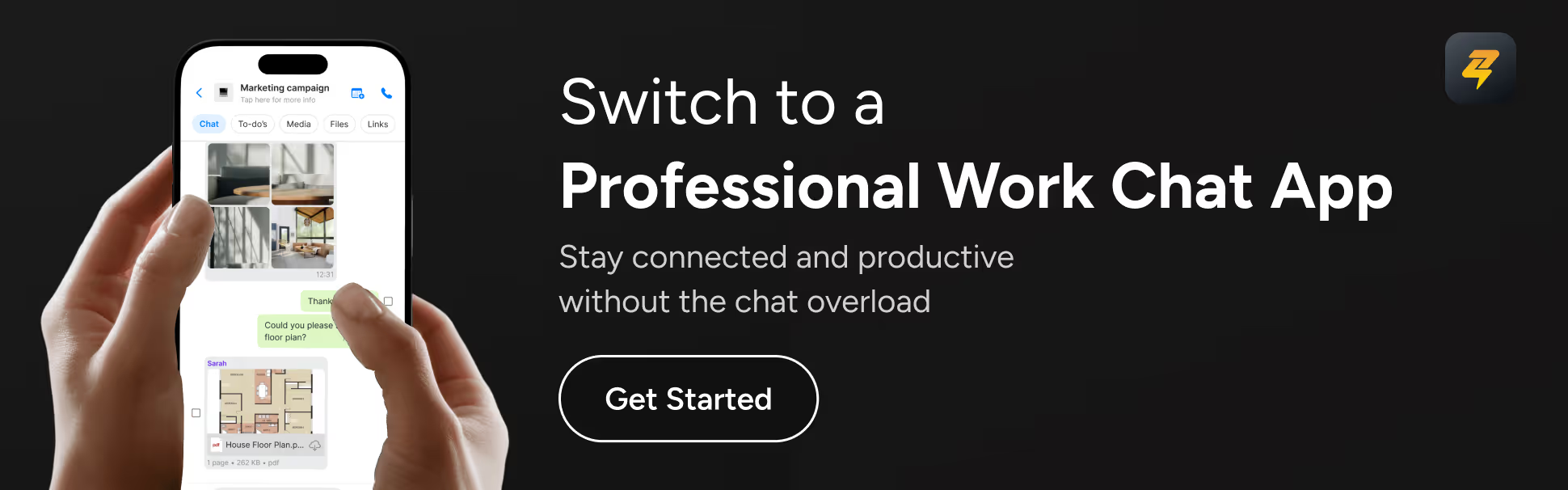
Zenzap exists to make this step change feel simple. It bridges the gap between messy personal messaging apps and overbuilt enterprise platforms. You get the instinctive feel of texting, with structure, task tracking, calendar integration, and bulletproof security built in. Most teams are chatting productively within minutes, not weeks.
This article hands you 8 practical steps that build on each other, like climbing a ladder. You start by defining what "good" looks like. You move into platform choice, structure, and security. Then you lock in habits and culture, so communication runs smoothly without you micromanaging it.
Step 1: Define what "great communication" means for your company
Your first step is not to pick a tool. It is to define the target.
If you asked five people on your leadership team what "good communication" means, you would probably get five different answers. That is exactly why threads spiral, channels multiply, and nobody is quite sure what belongs where.
You need a simple, shared definition that fits how your company actually operates. For most CEOs, that looks like a few core outcomes:
• Everyone knows where to share updates, decisions, and files
• Urgent issues stand out clearly, without turning everything into an emergency
• Information is secure, searchable, and lives in a professional space, not personal apps
• People can disconnect outside working hours, without fear of missing something critical
Start by asking yourself three questions:
1. If communication worked perfectly, what would feel different in my week?
2. Where do we consistently lose time or drop balls today?
3. What communication behavior is acceptable, and what is not, in my company?
Turn your answers into a short, practical communication charter. For example:
• "All work conversations happen in Zenzap, not WhatsApp or SMS."
• "Urgent issues are tagged and assigned as tasks, not buried in long threads."
• "No one is expected to respond outside their working hours unless they are on-call."
This is the base of your ladder. Without it, any tool you choose will slowly collapse into the same chaos you have now.
Step 2: Pick the right platform for instant, stress-free adoption
Once you know what you are aiming for, the next step is choosing a platform your team will actually use.
The wrong tool creates a new problem. You either end up with something so complex that only your power users touch it, or so informal that you are back to unstructured, insecure chats on personal phones.
As CEO, you need three things from your communication platform:
1. Intuitive simplicity, so adoption is instant and almost training-free
2. Enterprise-grade security, so you can finally pull sensitive work out of personal apps
3. Mobile-first design, so your team can work smoothly on the move
Zenzap is built exactly for this balance. It feels familiar, like the messaging apps your team already uses every day, but it adds structure that typical consumer apps lack. You get:
• Work chat and team chat organized by groups that mirror your real company structure
• Built-in tasks inside chats, so action items do not vanish
• Integration with Google Calendar, so meetings and shifts stay in sync
• Admin control over onboarding and offboarding, so former staff lose access instantly
Most teams are communicating productively in under five minutes. Download the app, create your core groups, invite your people, and start chatting. Because it behaves how people expect it to, the platform does not become another "project." It simply becomes the new home for work discussion.
Compare this to rolling out a heavyweight enterprise tool that needs training sessions and IT support. Every week you spend fighting adoption is another week of messages leaking into personal channels and decisions getting lost.
Step 3: Centralize conversations, tasks, and files in one place
With your platform chosen, your next step up the ladder is centralization.
Right now, you probably have information scattered across email, shared drives, chat apps, and offline notes. That fragmentation is not just annoying. It is expensive. According to a report from IBM, poor data quality and accessibility can cost businesses up to 3.1 trillion dollars annually in the United States alone.
Your goal is simple: everything that belongs to work communication lives in Zenzap.
Here is how you tackle it:
1. List your active team groups, projects, and recurring topics
2. Create corresponding Zenzap spaces or chats, for example "Sales Managers," "Ops Team," "Support On-Call," "Marketing x Product"
3. Move active conversations, documents, and task lists into those spaces as you go
In Zenzap, task creation happens directly inside the chat. When someone mentions a deadline or responsibility, your team can turn that message into a tracked task with a few taps. Files and context stay together. No more hunting across three apps trying to reconstruct who agreed to what.
A true-to-life example: an HR manager at a growing startup used Zenzap to set up spaces for recruitment, onboarding, and policy updates. Instead of applicant CVs and contracts living in email or personal drives, everything moved into secure Zenzap chats. Questions, decisions, and documents were all in one place. Nothing slipped by, and handovers between HR and managers became dramatically smoother.
The more you centralize, the more valuable Zenzap becomes. Search works across your whole communication history. Audit trails show exactly who shared what and when. Tasks stop floating in the air and land in a single, visible system.
Step 4: Structure channels around how your business actually runs
Once you are centralizing activity in Zenzap, your next step is to bring structure.
Unstructured chat creates noise. Too much structure creates paralysis. You are looking for a simple, predictable layout that matches how your business actually works.
Start by mapping three layers:
1. Company-wide spaces
2. Team and function spaces
3. Project, shift, or topic-based spaces
For example:
• Company-wide: "Announcements," "All Hands Q&A"
• Teams: "Sales Team," "Operations," "Customer Support," "HR & People"
• Special: "Night Shift," "Major Incident Room," "Product Launch Q1," "Key Accounts"
Zenzap lets you mirror this structure cleanly. Each chat or folder has a clear purpose, so your team knows exactly where to go to share or find something.
As you do this, look for gaps and overlaps. You might see that your marketing and product teams need a shared space for launch coordination, or that client-specific updates deserve their own chats instead of clogging general channels.
The key is to keep it human. You are not trying to create a perfect taxonomy. You are creating a mental model your team can remember instantly.
A useful rule of thumb: if people routinely ask "Where should I post this?", you probably need a clearer space or better naming. If people routinely mute a channel, it may be too broad or off-topic.
Step 5: Lock down security without slowing anyone down
With structure in place, your next step is to protect what you have built.
Using personal chat apps like WhatsApp or SMS for work might feel convenient, but it exposes you to real risk. Devices get lost, staff leave with sensitive conversations in their pockets, and you have almost no control over who sees what.
Zenzap is designed to give you enterprise-grade security without turning your communication into an obstacle course. You get:
• Encrypted communication for all work chats
• Secure onboarding and offboarding, controlled by admins
• Fine-grained control over who can access each group or space
• Audit trails that let you review who sent what and when
As CEO, you should set a clear expectation: work conversations belong in Zenzap, not in personal apps. Tie this to your data protection policies and your responsibility to customers and partners.
Then, work with your leadership and IT teams to:
1. Define which teams or roles get access to which spaces
2. Set up a simple, consistent process for adding and removing users
3. Communicate to staff how this protects them as well as the company
Security should feel like a seatbelt, not a speed bump. Once Zenzap becomes the default home for work chat, people actually feel safer. They know that if they lose a phone, you can revoke access. They know that personal and work conversations are separate. They know where to go if they need to check something later.
If you want to compare your current risk profile, it is worth revisiting guidance from regulators like the U.S. SEC, which has fined major financial firms for failing to maintain proper records because staff used unmonitored personal messaging apps. You may not be in finance, but the principle is the same. You cannot protect or govern what you cannot see.
Step 6: Build daily habits that keep communication organized
By this stage, you have the tool, the structure, and the security. Now you need habits, so everything stays tidy without you pushing it uphill forever.
Zenzap helps you turn good intentions into muscle memory through a few simple practices:
• Turn decisions into tasks in real time
• Use clear naming, tags, or labels inside chats
• Encourage short, focused threads rather than sprawling multi-topic chats
• Schedule messages that are not urgent to send during working hours
• Convert recurring workflows into recurring task lists
For example, during a daily ops check-in in your Zenzap "Ops Team" chat, you might agree on five follow-ups. Instead of saying "I will handle it" and hoping someone remembers, you turn each into a Zenzap task, assign an owner, and set a due date. The conversation and the action stay linked. No one has to maintain a separate spreadsheet or scribbled notes.
Zenzap also makes it easy to build a culture of calm responsiveness, not constant reactivity. If a thought pops into your head at 10 pm, you can schedule your message to land during your team's working hours. That single feature sends a strong signal about respecting boundaries.
To embed these habits, run a short "Zenzap basics" walkthrough for managers. Keep it simple and action-focused. Show how to:
• Create and assign tasks from chat
• Use Google Calendar integration for shifts and meetings
• Set working hours and notification preferences
• Create dedicated spaces for repeated processes, like incident management or onboarding
Once managers see how much easier it is to keep track of things, they will naturally start nudging their teams into these patterns.
Step 7: Lead by example as a visible, calm communicator
The seventh step is where your leadership style really meets the tool.
Even the best-designed communication system will fail if your behavior contradicts it. If you keep making urgent requests over SMS, or expect instant replies at midnight, your team will learn that the real work still happens outside Zenzap.
To avoid that, use Zenzap to model the communication culture you want:
• Post company-wide updates in a dedicated "Announcements" space
• Ask questions in open team chats instead of one-to-one messages when others could benefit
• Convert your own ideas into tasks, to show that nothing is "above the system"
• Respect working hours by scheduling non-urgent messages
For example, imagine you are preparing for a board meeting and need a last-minute metrics update. Instead of texting your CFO and creating a mini crisis, you drop a clear message in your "Exec Team" chat, tag the relevant owner, and turn it into a task with a clear deadline. Everyone sees the request, the context, and the resolution. Panic gives way to process.
Your tone matters too. Zenzap's personable, direct style matches the way you would talk in a room with your team. Use that to your advantage. Speak like a human. Acknowledge the stress of the old system. Celebrate small wins when teams shift big threads into the right spaces or start using tasks consistently.
Over time, your presence in Zenzap becomes a quiet signal. It tells your company, "This is how we communicate. This is where decisions live. This is where you will find clarity."
Step 8: Champion work-life balance for yourself and your team
Your final step on the ladder is about boundaries.
Always-on communication looks productive on the surface, but it slowly erodes performance. The World Health Organization has linked long working hours to higher risks of heart disease and stroke. You do not need a medical study to know that burned out people do not do their best thinking.
Zenzap is built to support true work-life balance, not just talk about it. You and your team can:
• Set clear working hours, so notifications pause outside those times
• Schedule messages to send within work windows
• Separate work and personal communication, so evenings are not spent scrolling through mixed chats
• Create on-call or "Night Shift" groups where only specific people are pulled into after-hours issues
A healthy team is a productive team. When your staff trusts that they will not be pinged for every minor update at all hours, they can actually rest. When they know urgent issues will be tagged, taskified, and routed through the right Zenzap spaces, they can unplug without fear.
This applies to you as well. Use the same controls. Protect your own evenings. When your leadership style reflects balance, your managers feel permission to follow suit. That ripples across the organization.
Imagine the difference between two Mondays. In the old setup, your team arrives already tired from weekend pings, digging through personal apps for half-remembered messages. In the new setup, people arrive rested, open Zenzap, and see a clear queue of tasks and updates that landed during their off hours, ready to process. Which company would you rather lead?
Key takeaways
- Define a clear vision of "great communication" before you touch any tools, then share it with your leadership team.
- Choose a simple, secure, mobile-first work chat platform like Zenzap to make adoption fast and intuitive.
- Centralize conversations, tasks, and files in Zenzap so nothing important slips through scattered apps.
- Structure channels around real teams and workflows, and build daily habits like in-chat tasks and scheduled messages.
- Lead by example and use Zenzap's separation and notification controls to protect real work-life balance.

Final thoughts: reaching the top of the ladder
Mastering team communication as a CEO is not about heroically responding to every message faster. It is about designing a system that works when you are not looking.
Each step you have just walked through builds on the last. You started by defining what "good" looks like. You picked a platform that your team can actually love. You centralized the chaos, brought order through structure, locked down security, and turned good practice into daily habit. Then you used your own behavior to reinforce the culture you want, and set healthy boundaries for everyone.
Zenzap proves that organized, secure, mobile-first communication does not have to be complicated or overwhelming. It can feel natural. It can fit into the flow of your team's day. It can protect both your data and your downtime.
Your next move is simple. Draw a line in the sand. Promise your team a communication upgrade where work stays at work, information does not vanish, and urgent issues never get buried in noise. Then give them the tool and the steps to make it real.
If your communication stack stayed exactly as it is for the next 12 months, what would it cost you in missed clarity, slower decisions, and burned-out people?
FAQ
Q: Why should I move my team off WhatsApp or SMS for work communication?
A: Personal messaging apps are not designed for business. They mix work and personal life, lack proper admin controls, and make it impossible to securely offboard staff. With Zenzap, you centralize work chat in a professional space, keep data encrypted, and control access when people join or leave. Your team also gets clearer boundaries, which reduces stress and confusion.
Q: How long does it take for a team to adopt Zenzap?
A: Most teams are productively communicating in Zenzap in under five minutes. The interface feels familiar, like popular messaging apps, so there is almost no training curve. You download the app, create your main groups, invite your team, and they can start using chat, tasks, and calendar integration right away.
Q: How does Zenzap help me keep conversations and tasks organized?
A: Zenzap lets you turn any message into a task inside the chat, assign an owner, and set due dates. Files and context stay attached to the conversation. You can structure spaces around teams, projects, or topics, and use search to find anything quickly. This reduces the risk of action items getting lost in long threads or scattered tools.
Q: Is Zenzap secure enough for sensitive company information?
A: Yes. Zenzap offers encrypted communication, secure onboarding and offboarding, and admin controls that define who can access each space. Audit trails show who shared what and when, which supports compliance and internal governance. Compared with unmanaged personal apps, this gives you far more control over data access and retention.
Q: How does Zenzap support work-life balance for my team?
A: Zenzap separates work communication from personal apps and lets users set working hours so notifications pause when they are off the clock. You can schedule non-urgent messages to send within business hours and create specific on-call or shift groups so only the right people are contacted after hours. This lets your team unplug confidently, without worrying they might miss something important.
Q: Can Zenzap work alongside the tools we already use, like Google Workspace?
A: Absolutely. Zenzap integrates with Google Calendar so meetings and shifts stay aligned with your chats and tasks. You can also connect other business tools, so updates and files flow into the same structured communication environment. Instead of replacing everything, Zenzap becomes the intuitive communication layer that ties your stack together.

Take Control of Your Team Communication
Chat, organize, and get work done - all in one place.
Other Blog Posts