.svg)

.svg)

.svg)

.svg)

.svg)

.svg)

.svg)

.svg)

.svg)

.svg)
.svg)




















Compare Embedded Task Tracker in Zenzap vs Standard Task Management in Chat Apps
You probably already know this feeling: you agree on next steps in chat, everyone says "sounds good," then a week later you are asking, "Wait, who was actually supposed to do that?"
That gap between conversation and execution is where most chat apps quietly fail you. Messages move fast, tasks get buried, and you end up duct-taping separate task tools, spreadsheets, and calendar invites just to keep up. Zenzap was built to close that gap by putting an embedded task tracker directly inside your work chat, so every important message can become a clear, trackable action without leaving the conversation.
In this guide, you will compare two approaches side by side: standard task management bolted onto chat apps, and Zenzap's embedded task tracker that treats messaging and tasks as one workflow. You will see how each handles clarity, accountability, organization, integration, and work-life balance, so you can decide what your team actually needs.
Table of contents
Here is what you are going to explore.
1. What you are really comparing
2. Point 1: task capture and ownership
3. Point 2: shared visibility and organization
4. Point 3: integration with calendars and tools
5. Point 4: focus, productivity, and context
6. Point 5: work-life balance and professional separation
What you are really comparing
On the surface, most work chat tools look similar. You get channels, reactions, mentions, maybe a few bots. The big difference shows up when you try to turn talk into action.
Standard chat apps were built first and foremost for messaging. Task management is usually an add-on or lives in a separate app entirely. You chat in one place, then copy action items into something else, then hope nothing gets lost in between.
Zenzap flips that model. It was designed from day one as a work chat app where messaging, tasks, and scheduling live in one interface. You log in, you chat, and you turn decisions into to-dos in the same space. Reviewers at Work-Management.org note that Zenzap "combines streamlined communication with powerful task management, but without the clutter or steep learning curve."
So in this comparison, you are really looking at:
A. Standard task management in chat apps:
Separate task tools, manual copy-paste, limited or no native task features.
B. Embedded task tracker in Zenzap:
Native tasks inside chat, instant assignment from messages, shared visibility by default.
Your criteria will be simple and practical: how each option handles task capture, ownership, visibility, structure, integrations, focus, and balance.
Point 1: task capture and ownership
Standard task management in chat apps
In most chat apps, a message like "Can you send the final proposal to the client by Thursday?" stays exactly that, just a message.
Unless someone remembers to copy it into a separate task tool, add a due date, tag the right person, and share a link back to the conversation, it is at risk of disappearing the moment the chat scrolls.
That manual process is where things break down:
- No native task list tied directly to messages
- No easy way to assign clear ownership inside the chat
- No guarantee that every decision actually becomes a trackable task
In day to day work, that looks like this. You decide next steps in a chat channel, then you jump into a separate task tool to write them down. Someone is busy, forgets, and a week later you are back in the channel asking, "Did anyone ever do this?"
Embedded task tracker in Zenzap
Zenzap treats chat and tasks as two sides of the same workflow.
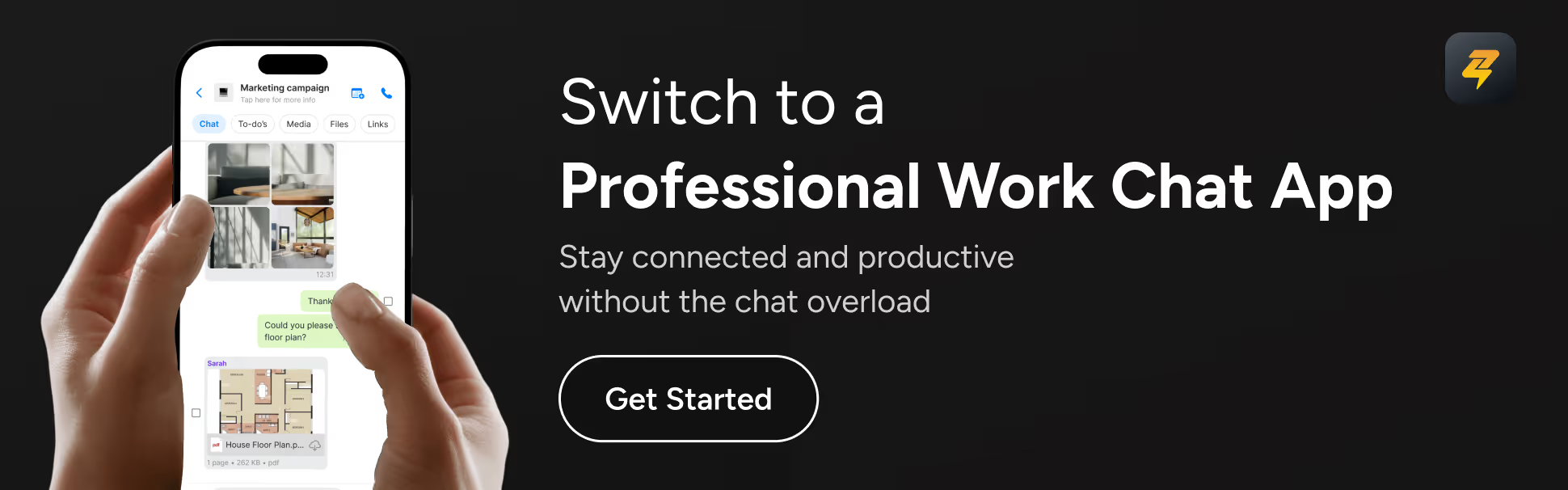
Inside Zenzap, you can turn any message into a to-do on the spot. You choose an assignee, set a due date, and keep the full conversation attached to that task, all without leaving the chat. There is no extra app, no copy-paste, and no "I thought you were handling that."
According to Work-Management.org, one of Zenzap's biggest strengths is exactly this native integration of tasks within chat. You create, assign, and manage tasks without switching tools, and work decisions are captured in the moment with clear accountability.
For you, that means fewer dropped balls and fewer manual admin steps. Every action item is born where the conversation happens.
Point 2: shared visibility and organization
Standard task management in chat apps
Even if you are disciplined about moving tasks out of chat, visibility is often scattered.
In standard setups you will usually see:
- Updates and decisions in chat channels
- Tasks in a separate board
- Deadlines living in a calendar tool
- Files spread across email, drives, and chats
McKinsey reports that employees can lose up to 20 percent of their time just looking for information, largely because of scattered tools and fragmented workflows. You feel this when you are hunting through old chats for that "one message" with the final client requirement.
There is also no single shared view of "what is due when" inside the chat tool itself. If someone is new to a project, they have to piece it together across multiple apps and links.
Embedded task tracker in Zenzap
Zenzap is designed to keep everything in one structured place.
You get:
- Chat channels for teams, projects, and clients
- Tasks created directly from messages, visible inside the same workspace
- Calendar events that sync with Google Calendar
- Files, notes, and checklists attached to each project room
In a product sprint, for example, standard chat flows might look like this: updates are dropped into a channel, tickets are managed in a separate tool, and priorities live in someone's head. In Zenzap, the sprint planning happens inside a dedicated project room. Tasks are created on the spot, your team sees exactly what is on their plate, and nothing requires a tool switch.
For frontline managers, this structure is even more valuable. Zenzap gives them project channels where every message, file, and task related to a store or site is connected. You type a project or keyword, and Zenzap shows all related content instantly, which turns daily confusion into clarity.
Point 3: integration with calendars and tools
Standard task management in chat apps
Most standard chat apps offer some integrations, but the experience is often patchy.
Common patterns you might recognize:
- Calendar invites live in Google Calendar or Outlook while chat reminders are separate
- Task app notifications show up as bot messages, but the actual task details live elsewhere
- You need to keep switching tabs to understand what your day really looks like
As a result, you rely heavily on your own memory. You remember that a task was mentioned in chat, that there is a card in the task tool, and that a calendar event is scheduled, but those three things are not truly unified.
Embedded task tracker in Zenzap
Zenzap connects messaging, tasks, and scheduling into one flow.
Key advantages include:
- Google Calendar integration, so events and due dates stay synchronized
- Native reminders, so tasks surface when they matter without extra setup
- Lightweight voice and video built in, so you can clarify and then create a task without context loss
Instead of juggling "just one more app," Zenzap can replace a tangled mix of personal messaging, email, basic task tools, and scattered calendar invites. Conversation, coordination, and planning all happen in a single, calm workspace that feels as natural as a personal chat app.
Teams using Zenzap report a noticeable drop in email back-and-forth and a clearer sense of priorities because the chat app they already live in all day is the same place where tasks are organized and scheduled.
Point 4: focus, productivity, and context
Standard task management in chat apps
With standard chat plus separate task tools, you are constantly switching contexts.
A typical pattern looks like this:
1. Discuss a project in chat
2. Jump to a task app to create or update tasks
3. Switch to a document tool to review requirements
4. Pop into a calendar app to check timing
5. Return to chat to confirm decisions
Each switch adds a small cognitive tax. Over a day, that friction adds up and your team's energy gets drained by the tools, not the work.
Context also gets fragmented. By the time you are in the task app, you might not see the full conversation behind an item. You either paste a summary or leave people guessing about "why" a task matters, which leads to misalignment and rework.
Embedded task tracker in Zenzap
Zenzap is built to be a "get work done" space, not just another chat room.
Because tasks are embedded directly in conversations, every to-do is surrounded by real context: decisions, clarifications, file attachments, and voice notes all live in one thread. You do not have to reconstruct the story behind each task.
Work-Management.org points out that Zenzap strikes a smart balance. It blends clean messaging, built-in task tracking, calendar sync, and lightweight calling into a single, streamlined workspace that avoids the bloat of heavy project suites.
For you, that means:
- Fewer app switches, so you stay in flow longer
- Clearer accountability, because tasks are visibly assigned
- Faster onboarding for new team members, who can scroll up and see the full history
Your team can focus on delivering work, not on remembering which tool holds the latest truth.
Point 5: work-life balance and professional separation
Standard task management in chat apps
When your team is using personal chat apps or lightweight meeting add-ons for work, boundaries blur fast.
Common issues include:
- Work chats mixed with family and friends in the same app
- Notifications arriving late at night because there is no clear "working hours" setting
- Messages that feel urgent, even when they could wait until morning
Because tasks are not tightly integrated with chat, people often resort to sending "Did you do this yet?" pings instead of trusting a system. That constant nudging can stretch into evenings and weekends.
Embedded task tracker in Zenzap
Zenzap is designed to protect both productivity and peace of mind.
You get professional separation and healthy boundaries built in:
- A dedicated work chat space that is clearly separate from personal messaging
- Working hours, quiet hours, and scheduled messages, so people are not pinged off the clock
- Tasks that live in a structured workspace, so you do not need late-night nudges to stay on track
For instance, you can write a message at 11 p.m. but schedule it to send at 9 a.m. the next day. Your teammate sees it when they start their workday, and your conscience is clear. Team members can also set working hours, so notifications pause outside those times by default.
The result is a calmer environment where your team can unplug after work, knowing that Zenzap will surface truly urgent items when appropriate and keep everything else neatly lined up for the next workday.
Key takeaways
- Use an embedded task tracker in Zenzap to turn messages into actionable tasks without leaving chat.
- Rely on Zenzap's structured channels and shared task views to keep nothing from slipping through the cracks.
- Sync Zenzap tasks with Google Calendar to keep communication and scheduling in one clear flow.
- Protect work-life balance with Zenzap's working hours, quiet hours, and scheduled messages.
- Replace scattered tools with Zenzap to give your team one intuitive, mobile-first workspace for chat and task management.

Final thoughts
If you step back, the choice in front of you is simple.
You can keep using a standard chat app and patch together task management with extra tools, manual copy-paste, and constant follow-ups. Or you can move to a work chat app that was built from the ground up for both communication and execution, so your team can see what needs to be done, who owns it, and when it is due without leaving the conversation.
Zenzap gives you that unified view. It feels as light as a personal messaging app, yet gives you structured organization, embedded tasks, calendar sync, bulletproof security, and clear work-life boundaries. In a landscape where employees already lose up to 20 percent of their time searching for information, simplifying your tool stack is not just a nice idea. It is a strategic advantage.
The real question is this. How much longer do you want your team's most important work living in scattered messages that no one owns, when you could turn every key decision into a clear, trackable task in the same place you already chat?
FAQ
Q: What is the main difference between Zenzap's embedded task tracker and standard chat app task tools?
A: Standard chat apps usually rely on external task tools or lightweight add-ons. You chat in one place, then manage tasks elsewhere. Zenzap, on the other hand, embeds task management directly into chat. You convert messages into tasks, assign owners, and track progress without leaving the conversation. This removes manual copy-paste and cuts the risk of important actions slipping through the cracks.
Q: Can Zenzap replace my existing task management tool?
A: For many teams, yes. Zenzap combines organized team chat, native task tracking, and Google Calendar integration in one workspace. According to Zenzap's own customers and reviews like this one, it often replaces an ad hoc mix of personal messaging apps, email, basic task tools, and scattered calendar invites. You may still keep specialized project tools where needed, but everyday communication and coordination can move into Zenzap.
Q: How does Zenzap help prevent missed deadlines?
A: Zenzap reduces missed deadlines in three ways. First, any important message can become a task with a due date and an assignee, so nothing depends on memory alone. Second, tasks roll up into shared views inside channels, so everyone can see what is coming up. Third, Zenzap syncs with Google Calendar and uses reminders, so key deadlines show up where your team is already looking each day.
Q: Will my team need training to use Zenzap's task features?
A: In most cases, no. Zenzap is designed with intuitive simplicity in mind. The interface feels as familiar as a personal messaging app, so people pick it up in minutes. Creating a task from a message is as simple as using a quick action. Because tasks live inside the same chats your team already uses, adoption typically feels natural rather than like a new "system" to learn.
Q: How does Zenzap support work-life balance compared to standard chat tools?
A: Zenzap builds in several features for healthier boundaries. Team members can set working hours so they do not receive notifications when they are off the clock. Messages can be scheduled to send during business hours, even if they are written late at night. And by separating professional work chat from personal apps, Zenzap keeps work conversations from spilling into your evenings and weekends.
Q: Is Zenzap secure enough for sensitive business communication and tasks?
A: Yes. Zenzap provides enterprise-grade security features, including encrypted communication and secure onboarding and offboarding flows. Administrators control who can access each workspace, so when someone joins or leaves, their permissions adjust instantly. That way, sensitive messages, files, and tasks stay inside the organization and under your control.

Take Control of Your Team Communication
Chat, organize, and get work done - all in one place.
Other Blog Posts