.svg)

.svg)

.svg)

.svg)

.svg)

.svg)

.svg)

.svg)

.svg)

.svg)
.svg)






















How Can CEOs Leverage Zenzap's Secure Workplace Messaging for Better Team Communication?
You are probably not short on communication tools. You are short on clarity.
Your teams are hopping between email, WhatsApp, project boards, and shared drives. Messages get missed, decisions are buried, and you still end up in status meetings that should have been a simple update. At the same time, sensitive discussions are happening on personal apps you cannot control, which opens you up to real security and compliance risk.
This is exactly the gap Zenzap is built to close. It gives you one intuitive, secure workplace messaging hub where conversations, files, and tasks live together in an organized structure that mirrors how your business actually runs. You get visibility without micromanaging, your leaders get alignment, and your people finally get a tool that feels simple instead of overwhelming.
In this FAQ guide, you will see how you, as a CEO, can use Zenzap not just as another chat app, but as a strategic communication system. You will learn how to centralize conversations, tighten security, reduce app overload, and give your teams the work-life balance they keep asking for, while still moving faster as a company.
Think of it as upgrading from scattered noise to a communication backbone that quietly keeps everything and everyone on track.
Table of contents
1. Introduction: why your communication stack is working against you
2. How Zenzap turns chaotic messaging into a strategic asset
3. Frequently asked questions for CEOs
4. Key takeaways
5. Final thoughts for forward-thinking CEOs
6. FAQ
Introduction: why your communication stack is working against you
As a CEO, you are judged on outcomes, not conversations. Yet weak internal communication silently slows almost every outcome you care about, from revenue growth to customer retention.
Research from McKinsey suggests that improved communication and collaboration can boost worker productivity by up to 20 to 25 percent in organizations that adopt social technologies. If your payroll is 10 million dollars a year, that is potentially 2 to 2.5 million dollars in value that is either unlocked or leaking away each year, depending on how you communicate.
The problem is not that your teams are not talking. It is that they are talking in too many places, with too little structure, and almost no security oversight. When messages, files, and decisions are scattered across multiple tools, even your best people waste time hunting instead of executing. Important updates get buried in long chat threads. Sensitive information lives on personal devices outside your control.
Zenzap changes that by centralizing all your work messaging into a secure, intuitive system that your teams will actually adopt. It combines messaging, task management, file sharing, calendar integration, and admin controls in one familiar interface, as highlighted in this overview on TechRSeries. That means fewer tools, less friction, and more focus on real work instead of chasing information.
Instead of layering yet another app onto an already crowded stack, you create a single source of truth for communication that you can trust, manage, and scale.
How Zenzap turns chaotic messaging into a strategic asset
Climb from scattered chats to organized communication
Zenzap is built around a simple idea. Every message should have a clear place and a clear purpose. Instead of random group chats and long DM chains, you structure your workspace by real team and project lines.
You might have spaces like "Leadership," "Sales," "Customer Success," "Product Roadmap," and "All Company." Inside each, topic-specific channels keep conversations on track, for example #pipeline, #product-launch, or #support-escalations. This mirrors the guidance in Zenzap's own playbook on centralization, where teams are encouraged to list out every active group and project, then create dedicated spaces so nothing important gets lost.
For one HR leader at a growing startup, this meant setting up separate Zenzap spaces for recruitment, onboarding, and policy updates. Instead of chasing documents and approvals across email and chat, every discussion and file now lives in the correct space. New hires and managers can quickly find what they need without asking five people where to look.
As CEO, this structure gives you instant visibility. You no longer need to join every meeting to know what is happening. You simply dip into the relevant spaces and channels to see progress, decisions, and blockers in context.
Turn conversations into trackable execution
Most chat apps are where tasks are discussed, not where they are owned. Zenzap closes that gap.
Inside any Zenzap conversation, you can convert a message into a trackable to-do. Assign an owner, set a deadline, and keep the task tied to the original context. No extra tools, no copy-paste into a separate project board. This is crucial if your teams are remote or hybrid, where misalignment often begins with "I thought someone else was on that."
For example, after a customer escalation is shared in #support-escalations, your head of customer success can instantly create a task for the account manager to respond, involve engineering if needed, and mark a due time. Everyone sees what is being done and by whom, without spinning up another meeting.
This workflow helps ensure, in Zenzap's words, that "nothing slips through the cracks and your team always knows what is next." Communication stops being just chatter. It becomes an execution layer that pushes work forward.
Secure every message with enterprise-grade protection
As more teams default to consumer apps like WhatsApp or iMessage for quick coordination, CEOs are inheriting a growing security and compliance headache. Sensitive topics, from payroll details to customer contracts, end up on personal phones you cannot monitor or control.
Zenzap fixes that with end-to-end encryption, detailed admin controls, and secure file storage as the default setup. You decide who can access which spaces, what they can download, and when access is revoked. Audit logs give you a record of activity so you can meet compliance expectations and respond quickly if there is ever a concern.
According to IBM's Cost of a Data Breach Report, the average data breach costs 4.45 million dollars globally (IBM). For a fast-growing company, just avoiding one incident pays for years of a secure messaging platform. With Zenzap, you are not just making work smoother. You are also actively reducing risk.
This is why leaders like Eyal Redler, General Partner at The Garage VC, highlight that Zenzap "allows us to separate business from personal lives." When work discussions stay in a dedicated, secure environment, you protect your business and your people at the same time.
Respect work-life balance while staying responsive
Burnout is expensive. Gallup has linked burnout to a 15 to 20 percent drop in productivity and higher turnover risk. Always-on communication tools are a big part of that problem.
Zenzap is designed to give you and your teams a healthier way to work. You can set work hours, silence non-urgent notifications, and create clear norms that work messages stay in Zenzap, not personal apps. Your people can unplug in the evenings without worrying they are missing something critical.
At the same time, you keep a clean line for urgent communication. Critical alerts, crisis updates, or time-sensitive decisions still reach the right people through structured channels. You get responsiveness where it counts, without the constant low-level noise that drains focus and energy.
Cut tool overload and save real money
Many companies stack three or four communication and collaboration tools to cover messaging, tasks, file sharing, and calendar visibility. The result is fragmentation, higher cost, and poor adoption.
Guy Weiss, CEO of Zenzap, described in an interview with TechRSeries how traditional workplace chat tools often struggle with adoption because they are overloaded with features and complexity. Zenzap's answer is to focus on essential communication and collaboration features, wrapped in an interface that feels instantly familiar.
For CEOs like Chris Fletcher, Founder and CEO at Tech on Toast, the benefits are very concrete. In his own words, "If you are using traditional communication channels, I think you will find that Zenzap will save you a lot of money." By unifying messaging, tasks, and files in one place, you reduce license costs, shadow IT, and time spent switching between apps.
Lower complexity means higher adoption. Higher adoption means better, more consistent communication across your entire organization.
Frequently asked questions for CEOs
Question 1: How does Zenzap improve communication across my leadership team?
Your leadership team needs fast, focused communication that does not drown in noise. With Zenzap, you can create a dedicated leadership space with channels for strategy, financial updates, board prep, and crisis management.
Decisions stay documented in context, not scattered across emails or side chats. When your CFO shares monthly numbers, for example, the deck, discussion, and follow-up actions live together in one thread. If a new VP joins, they can search the history and get up to speed in hours, not weeks.
Read receipts and structured tasks give you quiet accountability. You can see who has viewed a key update and who owns each follow-up, without chasing people or adding more meetings to the calendar.
Question 2: How can I use Zenzap to keep the whole company aligned?
Zenzap makes top-down communication simple and hard to miss. You can create an "All Company" space for announcements, town hall follow-ups, policy changes, and major wins.
Because Zenzap centralizes messaging, tasks, and files, people are already in the app for their daily work. They do not have to check a separate intranet or dig through email newsletters to stay informed. Important updates live where work already happens.
Many CEOs use this to reduce the number of big broadcast emails and status meetings. Instead, they share a concise update in Zenzap, link to relevant documents, and tag the teams who need to act. Managers then pick up those updates in their own team spaces, adding local context without distorting the original message.
Question 3: What makes Zenzap more secure than using personal messaging apps?
Personal apps like WhatsApp or iMessage are built for consumers, not for corporate security, compliance, or admin control. They do not give you central visibility, easy user offboarding, or structured access rights.
Zenzap is designed for business from the ground up. You get end-to-end encryption, role-based permissions, secure file storage, and audit logs as part of the standard package. Admin controls let you revoke access the moment someone leaves the company or changes roles, which is something you simply cannot do with personal apps.
This is critical if you operate in regulated sectors such as finance, healthcare, or professional services. It also matters if you run a distributed team and rely heavily on digital communication to share confidential client or employee information.
Question 4: Will my teams actually adopt Zenzap, or will it just be another unused tool?
Adoption is often the biggest fear when introducing new technology. Zenzap is intentionally designed to feel familiar, so your teams do not need a big training push to get started.
The interface looks and behaves like the messaging tools your people already use daily, but with a more professional structure. Many businesses move from personal apps to Zenzap precisely because the transition is smooth. Onboarding is quick, and leaders report that even non-technical staff are comfortable within a single day of use.
Zenzap also encourages "smart habits" by design, like turning messages into tasks and integrating calendars. As those habits stick, organization becomes automatic, and your team sees tangible benefits in less time wasted and fewer missed details.
Question 5: How does Zenzap support remote and hybrid work?
Remote and hybrid teams live or die by the quality of their communication tools. Zenzap is built to support them end to end.
Real-time instant messaging keeps quick questions and updates flowing without delay. Persistent, searchable history lets people who were offline or in different time zones catch up on their schedule. When someone joins a project late or returns from vacation, they do not need a long recap call. They scroll, search, and they are back in the loop.
Task integration means each action item that comes up in conversation can be captured and managed without spinning up a separate tool. You reduce context switching, which, according to research cited by the American Psychological Association, can cut productivity by up to 40 percent when people constantly shift between tasks and tools.
The result is a remote workplace where communication feels natural and organized, not fragmented or frantic.
Key takeaways
- Centralize leadership and team communication in Zenzap to replace scattered chats with one structured, searchable system.
- Turn conversations into tasks inside Zenzap so accountability is clear and nothing important falls through the cracks.
- Use Zenzap's enterprise-grade security and admin controls to move work off personal apps and reduce compliance and data breach risk.
- Set work-life boundaries with notification controls and dedicated work spaces so your teams can unplug without missing urgent updates.
- Consolidate tools by using Zenzap's messaging, task, file, and calendar capabilities to cut costs and boost adoption across the company.

Final thoughts for forward-thinking CEOs
At your level, communication is not just an operational issue. It is a strategic lever.
When your teams communicate inside a scattered, insecure toolset, you pay for it in slower decisions, duplicated work, higher risk, and burnt out people. When they communicate inside a secure, intuitive, unified platform like Zenzap, you gain speed, clarity, and confidence at every layer of the organization.
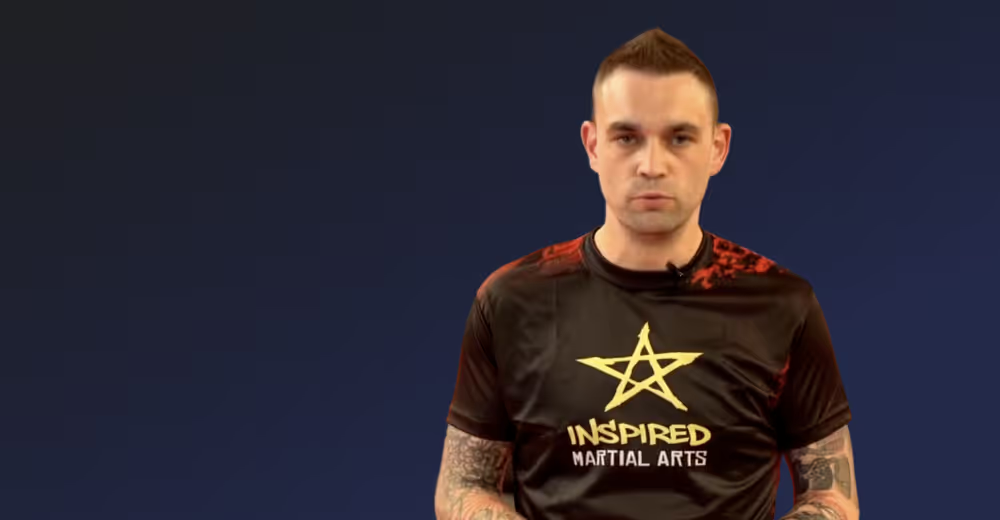
With Zenzap, you are not asking people to learn "yet another tool." You are giving them a calmer way to collaborate, where messages have a home, tasks are owned, data is protected, and work and life have a healthy separation. Leaders like Harry Tyndall at 2gether appreciate simple touches like calendar integration inside messaging. Others, like Jamie Johannes at Inspired Martial Arts, describe communication as "so much better" since adopting Zenzap.
The question is not whether you can keep operating with your current patchwork of tools. You probably can. The real question is, how much clarity, focus, and performance are you leaving on the table by staying there?
If you had one communication system that your entire company trusted and enjoyed using, what could your teams achieve next?
FAQ
Q: How quickly can we roll out Zenzap across the company?
A: Most teams can run a pilot within a week. Start with a leadership group and one or two key departments. Mirror your existing org structure in Zenzap spaces, migrate a few active projects, and set simple norms, such as "all work chat in Zenzap, not WhatsApp." Once people see the benefits of organized, searchable conversations, adoption spreads quickly.
Q: Can Zenzap integrate with our existing tools and workflows?
A: Yes. Zenzap is built to sit comfortably in your current environment. You can integrate calendars, connect file storage, and link with other tools your teams rely on. The goal is to reduce tool hopping, not add another silo, so integrations focus on keeping conversations, tasks, and files aligned without extra steps.
Q: How can I as CEO use Zenzap without becoming a bottleneck?
A: Use Zenzap to broadcast clarity, not to manage every detail. Set up spaces for company-wide updates and leadership discussions. Share strategic direction, key decisions, and expectations in those spaces, then let your leaders drive execution in their own channels. You can dip in to monitor progress and sentiment without inserting yourself into every thread.
Q: What if parts of my team are resistant to changing their communication habits?
A: Start by making Zenzap the easiest path, not just the mandated one. Create clear, well-named spaces, move important updates there first, and stop sharing critical information in old channels. Give quick, hands-on demos that show how to turn messages into tasks and how easy it is to find past decisions. Early wins and visible leadership use are usually enough to shift habits.
Q: Is Zenzap suitable for small teams as well as larger organizations?
A: Absolutely. Smaller teams benefit from having messaging, tasks, and files under one secure roof instead of juggling multiple tools. As you grow, the same structure scales with you. You can add spaces, refine permissions, and introduce more advanced workflows without changing platforms, so you avoid the pain of migrating communication systems mid-growth.
Q: How does Zenzap help me measure the impact of better communication?
A: While the biggest gains are often felt rather than seen in a single metric, you can track faster project turnaround, fewer status meetings, lower tool spend, and improved employee feedback about clarity and focus. Over time, you can correlate these with business indicators such as customer satisfaction, time to market, and retention to see the compound effect of cleaner communication.

Take Control of Your Team Communication
Chat, organize, and get work done - all in one place.
Other Blog Posts