.svg)

.svg)

.svg)

.svg)

.svg)

.svg)

.svg)

.svg)

.svg)

.svg)
.svg)

























How to manage remote work communication tool effectively without losing control
You are probably juggling one too many apps right now.
Instant messaging for quick questions. Email for "official" stuff. Personal chat apps for the people who "hate work tools." Maybe a project board that only 3 people ever open. You are not short on remote work communication tools. You are not short on control.
This article is about fixing that with one simple, practical move. You choose a single, central remote work communication tool, then you design your team's habits around it. Here, you will see why scattered tools quietly drain 20 to 40 percent of your team's productivity, how one structured hub changes that, and how Zenzap helps you keep work communication simple, secure, and actually manageable.
Table of contents
1. Why remote work communication feels out of control
2. The one decision that changes everything
3. How scattered tools slow you down
4. Make one structured hub your "office"
5. Why it works: the hidden benefits of a single remote work communication tool
6. How to roll out Zenzap without the usual chaos
7. Protecting focus and work-life balance in remote teams
8. Keeping data secure while your team moves fast
9. Key takeaways
10. FAQ
11. Final thoughts: your next step
Why remote work communication feels out of control
Remote work is not failing you. Your communication stack is.
Research from APA shows that constant context switching between tools can reduce productivity by up to 40 percent. You feel that every time you jump from chat to email to your project board just to answer one simple question.
On one side, you have heavyweight collaboration platforms that take weeks to configure and even longer for people to adopt. On the other, you have consumer apps that feel easy, but pull you into late-night messages from colleagues, expose company data, and blur the line between work and personal life.
Zenzap was created out of that exact frustration. It gives you a remote work communication tool that feels as simple as texting, yet has the structure, admin control, tasks, calendar integration, and security you need to keep your team organized and protected.
Here is the core idea. You do not need more tools. You need one communication hub that your team actually uses, willingly, every day.
Choose one central, structured work chat hub
Here is the simple fix that lets you manage any remote work communication tool effectively without losing control.
You pick one intuitive, structured, secure work chat app and make it the single source of truth for internal communication. Then you design your team's habits around it.
No partial rollouts. No "we also use personal apps for quick stuff." No "just email me the final version." You centralize, simplify, and standardize in one place.
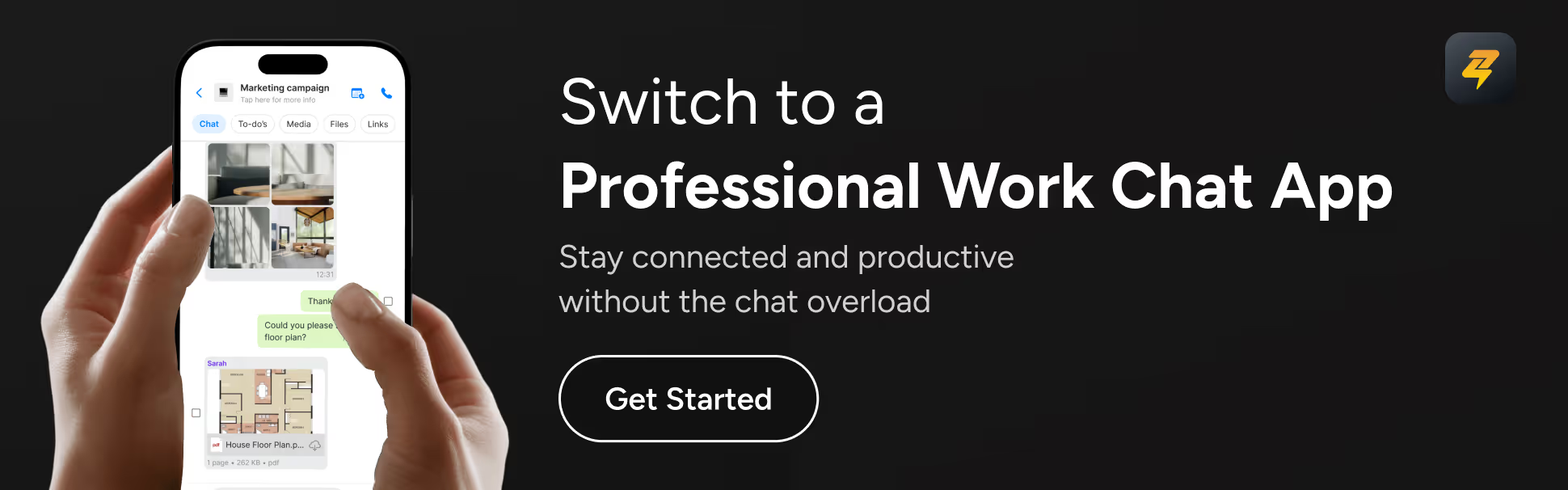
Zenzap is built to be that central hub. It brings real-time messaging, built-in task management, Google Calendar integration, file sharing, mobile and desktop apps, and clear admin controls into one mobile-first workspace your team can adopt instantly.
How scattered tools slow you down
If you feel like remote work communication is getting noisier, not clearer, you are not alone. Multiple chat apps, email, video calls, project boards, cloud storage, and personal texts all compete for your attention.
Here is what usually happens in that setup.
People pick the tool that is most convenient for them in the moment. A project update in chat. A client decision in email. A "quick" approval in a personal messaging app. A file in a random cloud folder with sharing turned on for "anyone with the link."
The result is predictable:
"Where did we talk about this?"
"Who has the latest version?"
"Why did no one tell me we changed the scope?"
This is not a people problem. It is a system problem. You have given your team too many doors to walk through, then expect them to magically choose the same one every time.
Make one structured hub your "office"
Turn your remote work communication tool into home base
The fix is simple. You declare one remote work communication tool as your digital office, then you move your communication habits there on purpose.
In practice with Zenzap, that looks like this.
1. You centralize every work conversation
Zenzap replaces random personal chat groups, scattered chat workspaces, and messy email chains with one clean, structured app. You organize conversations by topic, team, or project so people always know where to go.
Instead of "Where did we talk about this?", your team has "It is in the client-success-q4 channel in Zenzap." Easy to find, easy to search, easy to audit later.
For a marketing team, you might set up channels like "campaign-q3-launch," "creative-requests," and "weekly-metrics." Product teams might use "feature-alpha," "bug-triage," and "customer-feedback." Sales could have "leads," "deals-in-progress," and "renewals."
2. You turn chat into tasks in one click
Every important chat holds hidden decisions and to-dos. In most tools, those disappear into the scroll. In Zenzap, any message can become a trackable task instantly.
You can:
- Convert a message to a task in a tap.
- Assign an owner and a due date.
- Keep the task tied to the original conversation.
That means you never again need a separate tool open just to remember what was agreed. Your remote work communication tool becomes your light project management system as well.
Picture a customer success manager, Aisha, who sees in a channel that a client is waiting on a pricing update. Instead of writing it on a sticky note or creating a separate task card, she turns that message into a Zenzap task, assigns it to finance, and adds a due date for tomorrow. It stays visible, trackable, and on record for everyone.
3. You keep files and decisions in context
According to a report from McKinsey, knowledge workers can spend up to 19 percent of their time simply searching for information. A big part of that comes from files and decisions living in separate places.
Zenzap cuts that friction by keeping files, links, and decisions attached to the conversations that created them.
You share a proposal in the "client-acme" channel, discuss feedback, convert final comments into tasks, and attach the signed PDF in the same thread. When someone new joins, they scroll back and see the full story. No digging across tools, no hunting for attachments in 5 different inboxes.
4. You protect focus with clear notification rules
Remote teams often feel they must be "always on" because messages never stop. That breeds silent burnout.
Zenzap supports healthy focus by giving you smart notification controls tailored for remote work:
- Set working hours so notifications pause automatically when you are offline.
- Schedule messages to send during business hours instead of late at night.
- Use per-channel notifications so people only get pinged for what truly matters.
You still stay reachable for real emergencies, but your team does not have to live inside their phone to feel on top of things.
5. You separate personal and professional communication
One of the biggest hidden stressors in remote work communication is mixing professional and personal messages in the same app.
When a teammate pings you in the same chat app that holds family photos, it becomes almost impossible to switch off. Zenzap solves this by being your dedicated work communication tool.
Work lives in Zenzap, which your company controls. Personal life stays in personal apps. That boundary alone can dramatically improve work-life balance and reduce stress.
Why it works: the hidden benefits of a single remote work communication tool
Choosing one structured hub is not just about tidiness. It delivers measurable gains for you and your team.
Less context switching, more deep work
Every extra tool is an extra decision: "Where should I send this?", "Where did they send that?", "Which app should I check first?" Multiply that by dozens of messages each day and you create constant mental drag.
Teams that simplify to one primary communication hub free up mental bandwidth. People stop playing digital detective and start actually doing work.
Clearer accountability and fewer dropped balls
When all conversations, tasks, and files live in one place, it is obvious who owns what.
In Zenzap, an action item is not an offhand comment. It is a task with a name and date attached. Managers can quickly scan tasks per channel or per person instead of asking for constant status updates.
Faster onboarding for new team members
New hires often spend their first weeks asking "Where do I find this?" more than actually contributing.
With a single remote work communication tool set up as your hub, onboarding looks very different. You add them to the right Zenzap channels and they scroll back through decisions, files, and context. They see how the team communicates and where to ask questions, without guessing which of the 7 tools you use for what.
Better security by design, not as an afterthought
Spreading communication across consumer apps and unsecured email makes it much harder to protect company data. You cannot control personal phones, personal cloud accounts, or informal sharing habits.
Centralizing communication in Zenzap, with encrypted messaging, secure onboarding and offboarding, and admin controls, helps you manage who has access to what. When someone leaves, you remove their access in one place instead of hoping you remembered every tool.
How to roll out Zenzap without the usual chaos
Many leaders worry that introducing a "new tool" will just be more noise. The difference with Zenzap is that you are not adding one more app. You are replacing three or four.
Step 1: set Zenzap as your default communication hub
First, make a clear decision: Zenzap is your primary remote work communication tool.
Zenzap is designed for instant adoption. The dashboard is clean. Core tools such as chats, to-dos, calendar, files, and admin controls sit exactly where you expect them. You do not need a heavy rollout. People can log in and start using it the same day.
Step 2: define your "one place for work" rule
Then set simple, specific rules. For example:
- All project conversations belong in Zenzap.
- All new tasks are created from chat inside Zenzap.
- All files and links are shared in the relevant Zenzap channel.
You do not need a 30-page policy. You only need one line that you repeat often: "If we cannot find it in Zenzap, we treat it like it never happened."
Step 3: create a few high-impact channels
Start lean. A simple structure might be:
- #company-announcements for leadership updates.
- #team-[name] for each team, like #team-marketing or #team-engineering.
- #project-[name] for major initiatives.
- #support or #help-it for internal help requests.
Resist the urge to create 40 channels on day one. Let structure grow from real needs instead of guessing in advance. This keeps your remote work communication tool focused and easy to navigate.
Step 4: connect your calendar and existing tools
Next, bring the tools you actually need into Zenzap so your team pivots naturally to one hub.
With Google Calendar integration, you can move from a chat about "let us meet" to an actual calendar event without switching tabs. Attach key documents from cloud storage and other tools in context. Over time, people learn a simple rule: if it matters, it lives in Zenzap.
Step 5: model the behavior as a leader
Your team watches what you do more than what you say.
If you continue sending decisions by email or approving work in private chats, people will follow your lead. If you consistently move important discussions into Zenzap, convert decisions to tasks, and point people back to channels instead of side threads, they will follow that instead.
Protecting focus and work-life balance in remote teams
One of the most valuable aspects of managing a remote work communication tool effectively is protecting your team's mental health.
Set clear working hours and respect them
With Zenzap, each person can set their working hours so notifications pause outside those times. You can still write messages whenever it suits you. You simply schedule them to arrive during the recipient's workday.
That small habit change sends a powerful signal: "Your time off is yours." Over months, it reduces the low-grade anxiety that comes from constant pings, especially for distributed teams across time zones.
Use channels to avoid unnecessary meetings
Remote work does not have to mean calendar overload.
Instead of a 30-minute status meeting, you can use a "daily-standup" channel in Zenzap where everyone posts a short update each morning. This approach keeps everything inside a single, focused app.
You get visibility without pulling people into unnecessary calls, and your team gets more uninterrupted time to work.
Keeping data secure while your team moves fast
Security is often where consumer tools and patchwork solutions break down.
Control who gets in and what they see
Zenzap is secure by design. It provides encrypted communication, secure onboarding and offboarding processes, and robust admin controls.
Admins can:
- Add or remove users in minutes.
- Restrict access to sensitive channels.
- Ensure leavers do not keep access to company data.
- Enforce company-wide settings for retention and security.
Instead of tracking who still has access to which shared drive or chat group, you control everything at the hub level.
Reduce risky behavior by giving people a better option
People use insecure tools when the "official" ones feel too hard. If your enterprise platform is heavy, slow, or confusing, your team will quietly drift back to email, SMS, and personal messaging.
Zenzap flips that. When the secure option is also the easiest option, you win twice: better security and higher adoption. Zenzap's mobile apps are fast, lightweight, and familiar, even on older devices.
Key takeaways
- Choose one primary remote work communication tool and make it your team's single source of truth.
- Use structured channels, tasks from chat, and in-context files in Zenzap to keep everything organized and accountable.
- Protect focus and work-life balance with working hours, scheduled messages, and smart notifications.
- Strengthen security by centralizing access control and encrypted communication in one hub.
- Lead by example so your team consistently uses Zenzap instead of scattering conversations across other apps.

FAQ
Q: How do I convince my team to move to one remote work communication tool?
A: Start by explaining the cost of scattered tools, such as lost messages, duplicated work, and security risks. Then run a short pilot in Zenzap with one team or project. Keep all communication, tasks, and files in Zenzap for two to four weeks. When people feel the difference in clarity and speed, adoption becomes an easier sell across the company.
Q: We already use email and another chat app. Do we really need Zenzap?
A: Email is useful for external communication, but it is slow and hard to track for internal work. Many legacy chat tools are either too complex or too limited for modern remote teams. Zenzap replaces internal "work happening everywhere" with one structured, mobile-first hub that combines chat, tasks, calendar, and files. You still keep email for clients, but daily collaboration lives in a space designed for it.
Q: How does Zenzap help with time zones and async work?
A: Zenzap supports asynchronous remote work through channels, threaded conversations, and scheduled messages. People can post updates when they are online, and teammates in other time zones can catch up later without missing context. Working hours and notification settings prevent off-hours noise, while keeping urgent updates visible inside the app.
Q: Is Zenzap secure enough for sensitive information?
A: Yes. Zenzap uses encrypted communication and secure onboarding and offboarding workflows. Admins can tightly control who joins, which channels they access, and how data is managed. This is especially valuable for industries like healthcare, education, and technology, where protecting client or patient data is non negotiable.
Q: How long does it take to get started with Zenzap?
A: Most teams can set up core channels, invite users, and start working in Zenzap in a single day. The interface feels familiar, so there is little to no training required. You can start with a small structure, refine it over a few weeks, and grow from there without a heavy change-management project.
Q: Can Zenzap replace our basic project management tool?
A: For many teams, yes. If your main needs are to keep conversations, tasks, deadlines, and files together, Zenzap's built-in task management often covers what lighter project tools provide. For highly complex project workflows, you can still integrate specialist tools while using Zenzap as your communication backbone.
Final thoughts: manage remote work communication without losing control
You do not need yet another tool. You need one place where work lives.
When you choose a single, structured, secure remote work communication tool and build your team's habits around it, everything gets easier. Fewer "Where is that?" messages. Fewer missed tasks. Less burnout from being "always on." More focus, more clarity, and more confidence that you are not dropping anything important.
Zenzap is built to be that home base for your remote team. It feels as simple as the apps your people already love, yet gives you the structure and control you have been missing.
The only question now is this: what would your team's week look like if every conversation, task, and decision finally had one clear place to live?

Take Control of Your Team Communication
Chat, organize, and get work done - all in one place.
Other Blog Posts