.svg)

.svg)

.svg)

.svg)

.svg)

.svg)

.svg)

.svg)

.svg)

.svg)
.svg)























The simple way Track tasks in distributed teams platform without disrupting SME communication software
You already know this feeling. Your team chat is on one app, your tasks live somewhere else, and your calendar is hiding in a third tab. Someone asks, "Who owns this?" and suddenly you are scrolling through five different tools trying to piece the story together.
This article shows you a simpler path. You will see how to track tasks inside the same distributed teams platform you already rely on for SME communication, and how Zenzap gives you a single, calm space where every message, task, and deadline stays connected without adding more complexity to your day.
Table of contents
1. Why your current tools are holding you back
2. Simple fix format: One change that improves everything
3. Introduction :Scattered tools, scattered focus
4. Track tasks where you already talk
5. Why it works: less friction, more focus for distributed teams
6. How Zenzap keeps SME communication software simple
7. Real examples from distributed and SME teams
8. Key takeaways
9. Implement and succeed: make your work chat your work hub
10. FAQ
Simple fix format: One change that improves everything
Here is the simple fix.
Instead of adding yet another project management platform to your stack, you track tasks directly inside your existing team chat, in the same place you already communicate. With Zenzap, that is not a workaround, it is how the app is designed to work.
You keep your distributed team on a single, mobile first internal communication app, and you turn messages into trackable tasks without leaving the conversation. Your SME communication software stays clean and familiar, and your task tracking finally stops living in a separate silo.
Introduction : Scattered tools, scattered focus
Here is the core problem you are probably facing right now.
Your team is distributed. You may have people in three or more time zones, and at least part of your staff is mobile first. You rely on internal chat to keep everyone moving, but tasks are sitting in tools that most of the team never opens.
Research from Asana found that knowledge workers lose up to 60 percent of their time on "work about work", like hunting for information and switching between apps. You see this every day when a simple chat like "Can you handle this?" turns into a mess of copy-paste across multiple apps, email, and a calendar invite.
On top of that, many SMEs end up using personal apps like WhatsApp or iMessage for work coordination. A TecHRSeries feature on Zenzap highlighted how often teams fall back to personal messengers when enterprise tools feel too heavy. That blurs boundaries, complicates offboarding, and creates real data risk.
You do not have a communication problem. You have a fragmentation problem.
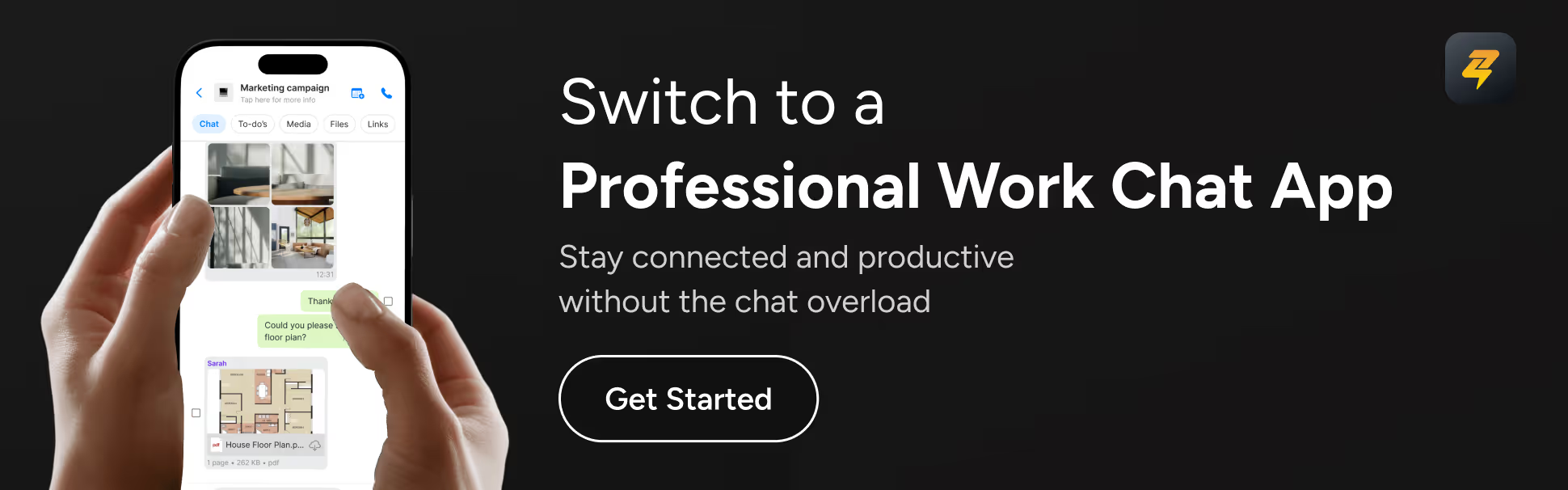
Track tasks where you already talk
Use one distributed teams platform as your communication and task hub
The fix is straightforward. You choose one internal team communication app as your central hub, then you bring task tracking into that same space instead of bolting on separate project tools.
That is exactly what Zenzap is built for. According to the independent Zenzap review on Work-Management.org, Zenzap combines clean messaging, built in task tracking, calendar sync, and lightweight voice or video into a single, streamlined workspace. It is designed to replace scattered tool stacks with something simpler and more focused.
In practice, this looks like:
You are in a topic based chat about a client rollout. Someone drops a message: "We need a revised quote by Wednesday." Instead of copying that into a separate task tool, you convert that message to a task right inside Zenzap. You assign an owner, add a due date that syncs with Google Calendar, and keep the task visible within the topic where the decision happened.
No switching, no duplicate data entry, no "Where did we put that?" two days later.
Turn conversations into tasks in a couple of taps
One of Zenzap's biggest strengths, highlighted in the same Work-Management.org review, is native integration of tasks within chat. Tasks live inside the conversation, not in a separate tab that half your team never checks.
Here is how you can use that in your SME communication software setup:
1. Capture work at the moment of decision. The second your team agrees that something needs to happen, you turn that message into a task. No follow up tool, no extra admin.
2. Assign and clarify ownership. You attach a name, a due date, and any relevant files in the same place you already talked it through.
3. Keep context visible. Since tasks are embedded in the chat, anyone can scroll up and see the "why" behind the work, not just the "what". This matters a lot when your team is spread across different time zones and cannot always jump on a call.
4. Track progress without disrupting the conversation. Updates on tasks can show as status changes, not long email threads. Your communication stays clean, but your accountability improves.
Sync tasks with calendars so deadlines are never a surprise
Deadlines only work if people can actually see them.
Zenzap supports calendar integration with Google Calendar. That means your task due dates can show up in the same calendar where your team already manages meetings and focus time.
Instead of your project deadlines hiding in a separate PM tool, they appear alongside calls, client demos, or shift schedules. The result is a distributed teams platform that respects your team's time and reduces last minute scrambles.
Why it works: Less friction, more focus for distributed teams
Context stays intact across time zones
When your team is scattered from London to Singapore, real time communication is more of a luxury than a habit. Zenzap is explicitly designed to support asynchronous work. Work-Management.org called out that Zenzap makes it easy to respond on your own time without losing context, which is especially helpful for distributed teams.
Because tasks sit inside the same topics as the discussions that created them, people logging in five hours later can see:
• What was decided
• Why it matters
• Who owns what
• When it is due
No one is forced to ask for a recap or dig through separate tools. That reduction in friction is where a lot of your productivity gains show up.
Adoption is easier when the tool feels familiar
According to TecHRSeries, many organizations end up back on personal apps because enterprise communication platforms feel too complex or too heavy for day to day use. Zenzap was built to avoid that trap.
The interface feels familiar, like the messaging apps your team already uses in their personal life, but structured for business with topics, task lists, and admin controls.
The result for you:
• Faster onboarding. Teams can start chatting and tracking tasks immediately, with no formal training cycles.
• Higher adoption. When a tool is intuitive, people actually use it daily, which is the only way your task tracking will stay accurate.
• Less resistance from non technical staff. Healthcare teams, hospitality staff, contractors, and field services can all pick up Zenzap quickly.
Security and boundaries are built in, not bolted on
When you run your SME communication software on personal messengers, you invite problems the day someone leaves the company. Files, conversations, and client details linger on personal phones. You have no way to revoke access centrally.
Zenzap gives you enterprise grade security in a tool that still feels lightweight. The platform complies with GDPR, HIPAA, SOC 2, CCPA, and ISO 27001 standards, as shared on the Zenzap secure messaging page.
For you and your admins, that means:
• Encrypted communication for all internal chats and tasks
• Clear onboarding and offboarding that lets you revoke access instantly
• Data stays in a professional workspace, not on personal devices
Boundaries are also supported in the way you work. Zenzap lets you schedule messages to send during working hours and set work hour boundaries so notifications pause when people are off the clock. You can keep your distributed team aligned without burning them out.
How Zenzap keeps SME communication software simple
Organize by topics so nothing gets lost
Within Zenzap, you structure your internal team communication using topics. Each topic can host its own messages, tasks, files, and links.
For example, you might create topics like:
• Client: Acme rollout
• Operations: Q2 hiring
• Support: VIP tickets
• Marketing: Product launch
Inside each of these, you create tasks directly from messages. When someone in Support flags "We must fix response time for VIPs," you convert that into a task inside the Support topic. Anyone who joins that topic later can see the issue, the decision, and the action in one view.
Integrate with the tools you already rely on
You do not need to rip out your existing SME communication software stack to use Zenzap effectively. Instead, you treat Zenzap as the spine that keeps everything else aligned.
From Zenzap's own site, you can see integrations with tools like Google Calendar and Zoom, plus support for working with internal and external collaborators in one secure platform.
That lets you:
• Keep video calls where they are while centralizing chat and tasks
• Reduce internal emails by handling quick decisions and follow ups inside Zenzap
• Connect your schedule to your work without adopting a heavy PM tool
Your workflows stay familiar, but much smoother.
Real examples from distributed and SME teams
A shift based team that finally dropped WhatsApp
Imagine you run a chain of busy restaurants with managers, servers, and kitchen staff across multiple locations. For years, everything has run through a maze of WhatsApp groups and last minute calls.
Everyone is constantly on their phones, but no one can see the whole picture. Shift swaps, supplier issues, maintenance tasks, and staff updates are all buried in long chat histories.
With Zenzap, you create topics for each location and for shared functions like HR or operations. When a manager spots a broken cooler, they drop a message and convert it to a task on the spot. The operations lead sees it, assigns a contractor, and updates the task in the same thread.
Staff no longer need work chat mixed into their personal WhatsApp, and you get structured, trackable tasks for every important action item.
A remote SME that outgrew email and scattered tools
Now consider a 25 person SaaS company with team members in the US, Europe, and Asia. They used to run on a mix of email and multiple disconnected tools. It worked until it did not.
People started to miss details. Tasks got created but never linked back to the original conversation. Context disappeared. New hires struggled to understand why certain decisions were made.
After moving to Zenzap, they changed one core habit. Any decision that required action got turned into a Zenzap task immediately, inside the topic where the discussion happened. Owners and due dates synced to Google Calendar. Weekly check ins focused on a single task view inside Zenzap instead of four different dashboards.
The tools did not become more complex. They became more connected.
Key takeaways
- Use one distributed teams platform as your central hub for SME communication and task tracking.
- Convert important messages into tasks directly inside chat so context, ownership, and deadlines stay together.
- Sync tasks with Google Calendar so distributed teams see deadlines alongside their meetings.
- Protect data and boundaries by using secure, professional work chat instead of personal messaging apps.
- Leverage Zenzap's intuitive interface and topic structure to boost adoption without extra training.

Implement and succeed: make your work chat your work hub
You do not need another complex platform or a six week rollout to fix how you track tasks across your distributed team. You only need to bring tasks into the SME communication software your people already open every single day.
Zenzap makes that shift easy. It gives you intuitive chat, built in task tracking, calendar sync, strong security, and healthy work life boundaries in one mobile first app. You move from scattered tools and constant context switching to a single place where communication and execution finally line up.
The next step is simple: pick one team or project, move their conversations and tasks into Zenzap, and watch how quickly the noise drops and clarity rises. The question is, how long do you want to keep juggling tools before you let your work chat become the calm, organized hub it should be?
FAQ
Q: How is Zenzap different from using multiple disconnected tools?
A: With scattered tools, you are always switching between apps and trying to link conversations to tasks. Zenzap keeps messaging and tasks in one interface, so you can turn a message into a task instantly and keep all the context in a single place. For distributed teams, that saves time and prevents details from slipping through the cracks.
Q: Will my team need training to start using Zenzap for task tracking?
A: Probably not. Zenzap is designed to feel as intuitive as a personal messaging app, with business structure layered in. Most teams can start chatting, creating tasks, and syncing calendars on day one without formal training. You can still share short guides or recorded walk throughs, but the learning curve is intentionally very low.
Q: Can Zenzap replace our existing project management software completely?
A: For many SMEs and distributed teams, yes. If you mainly need clear communication, task tracking, and calendar alignment, Zenzap can replace scattered tool stacks. If you run very complex, multi year projects with heavy analytics, you might still keep a dedicated PM tool and use Zenzap as your everyday communication and execution hub.
Q: How does Zenzap support work life balance for distributed teams?
A: Zenzap lets you set working hours and control when notifications arrive, so team members are not constantly pulled into work outside their agreed schedule. You can schedule messages to send during work hours and still keep urgent items visible. This is especially helpful when people are in different time zones and you want to avoid late night pings.
Q: Is Zenzap secure enough for regulated industries like healthcare or finance?
A: Yes. Zenzap focuses heavily on security and compliance. According to its secure messaging page, the platform complies with GDPR, HIPAA, SOC 2, CCPA, and ISO 27001 standards. That makes it suitable for healthcare providers, financial services, and other industries that need strong data protection and clear access control.
Q: How can I test Zenzap without disrupting my current SME communication software?
A: You can start with a small pilot. Pick one team or project, sign up for a free Zenzap account, and run that group entirely inside Zenzap for a few weeks. Keep your current tools in place for everyone else. This low risk trial lets you see how well embedded tasks, topics, and calendar sync work for your distributed team before you roll it out more broadly.

Take Control of Your Team Communication
Chat, organize, and get work done - all in one place.
Other Blog Posts