.svg)

.svg)

.svg)

.svg)

.svg)

.svg)

.svg)

.svg)

.svg)

.svg)
.svg)
























What Makes Zenzap the Ultimate Remote Work Communication Tool for Distributed Teams
You already know that remote work is not just office life copied into video calls and chat. When your team is split across time zones, devices, and home offices, every missed message and noisy notification has a real cost.
This article walks you through why Zenzap is built for that reality. You will see how it replaces scattered tools with one calm, structured workspace, how it keeps your data protected without burying you in settings, and how it helps your distributed team stay aligned without living online 24/7.
Table of contents
1. Why remote teams need more than basic chat
2. The big picture: what makes Zenzap different for distributed teams
3. Level 1: core features that fix remote communication chaos
4. Level 2: practical ways Zenzap supports remote work communication
5. Core insight: why simplicity, structure, and security win for distributed teams
6. Key takeaways
7. Final thoughts: building a calmer remote communication culture
8. FAQ
Why remote teams need more than basic chat
Think about your typical remote day. You juggle email, a couple of chat tools, a project board, shared drives, and maybe a personal messaging app where work has started to creep in. Important decisions hide in random threads. Files live in three different places. Your phone buzzes late at night and you are never quite sure if it is urgent or just noise.
You are not imagining it. According to a report from Asana, people spend up to 60 percent of their time on work coordination instead of actual work, much of that lost in communication overload and app switching. When your team is distributed, that problem multiplies. You cannot lean over a desk to clarify something. If the tool does not guide clear, structured communication, you pay for it in confusion, delays, and burnout.
This is exactly the environment Zenzap was created for. It does not just move your office chat online. It rethinks work chat around how remote and distributed teams actually operate.
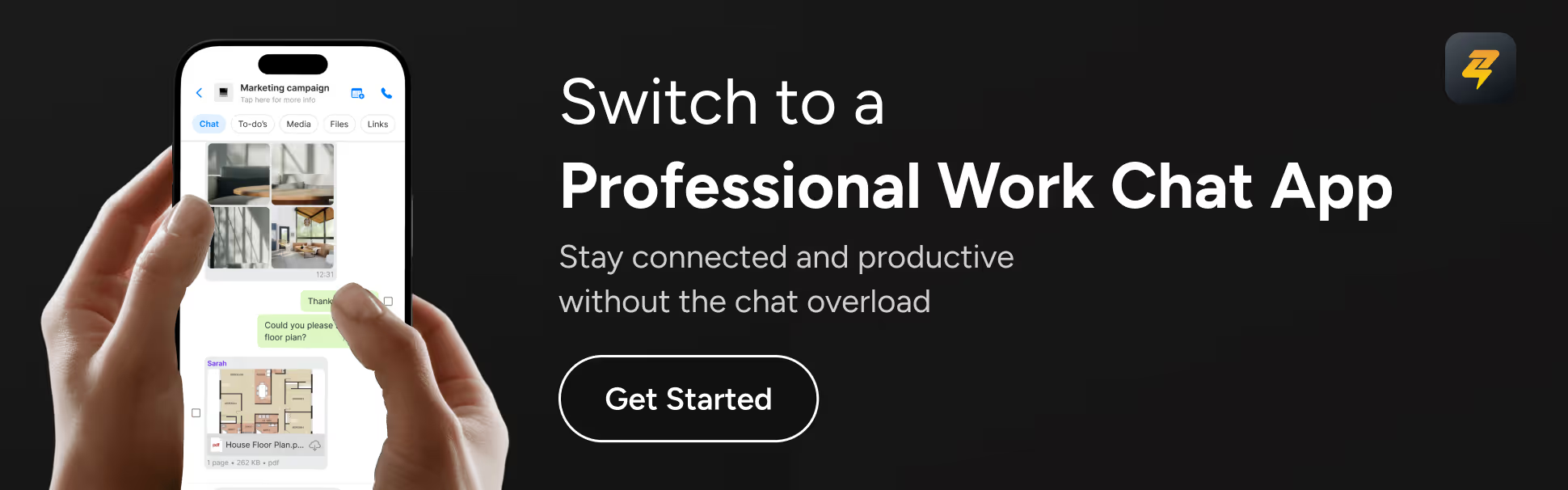
Instead of expecting your people to master complex settings, Zenzap gives them a familiar, mobile-first interface, like the personal messaging apps they already use, but with the structure, security, and work-life boundaries your business needs. You get one place where conversations, tasks, files, and schedules live together, so your team can focus on doing the work, not chasing it.
As one reviewer on Work-Management.org put it, Zenzap is "finally, a clean alternative to traditional messaging platforms." For a distributed team, that clarity is not just nice to have. It is how you ship projects on time without driving everyone into notification fatigue.
The big picture: what makes Zenzap different for distributed teams
Zenzap is an enterprise-grade work chat app, designed from day one for modern remote work communication. It brings together intuitive simplicity, structured organization, bulletproof security, and real work-life separation in one mobile-first workspace.
Instead of cobbling together multiple tools for chat, tasks, calendar, and file sharing, you get a single, focused environment. Messaging, tasks, scheduling, and file sharing live in the same place. That means less context switching and a clearer source of truth for your distributed team.
Three principles sit at the core of Zenzap:
1. It must feel instantly familiar, so adoption is natural, not a fight.
2. It must keep work structured, so nothing important gets lost.
3. It must protect your data by default, without requiring a security engineer on every team.
Zenzap is used across industries that rely on secure, distributed communication, including healthcare, education, technology, nonprofits, and remote-first companies, as shared on the official Zenzap blog at zenzap.co. If your people are spread out and handling sensitive information, Zenzap is designed to feel like the right fit from the first week.
Level 1: core features that fix remote communication chaos
Intuitive simplicity: adoption without training
The biggest risk with any remote work communication tool is that your team quietly avoids it. When that happens, they fall back to personal messaging apps, SMS, and email, and your carefully designed security and structure disappear overnight.
Zenzap tackles this head on with a familiar, consumer-style interface. As highlighted in a piece on TechRSeries, the platform was intentionally designed for quick adoption and ease of use. If your team can use a modern messaging app, they can use Zenzap.
Everything lives where you expect it. Chats feel natural, channels are clearly labeled, and core actions like converting a message into a task or scheduling a message are one tap away. You are not asking your people to learn "a whole new system." You are handing them a better version of something they already know.
Professional work-life separation
Maybe you are already seeing this: work chats creeping into personal apps, late-night pings from clients in a family group thread, confusion about which channel is "okay" for what. It blurs boundaries and quietly adds stress.
Zenzap gives you a dedicated, professional workspace for work chat. Personal messaging stays where it belongs. Work lives in Zenzap. That separation, simple as it sounds, changes how your team feels about logging off.
On top of that, Zenzap builds in healthier habits. You can schedule messages to send during business hours, and your team can set working hours so they do not get notifications when they are off the clock. For distributed teams, this is critical. People in one time zone can move work forward without waking someone up at 2 a.m.
Structured team organization
Remote teams do not have the luxury of hallway catch-ups to fill in missing details. Your tool has to keep everything clear and findable.
Zenzap organizes communication into channels, projects, and topics, so each conversation has a proper home. Instead of endless group chats, you might have:
- A client project channel where all decisions and files live
- A team channel for weekly updates
- A leadership channel for sensitive discussions
- A support channel where queries are tracked as tasks
This approach lines up with what users praise in reviews. Work-Management.org calls Zenzap a "streamlined command center" that blends messaging, tasks, and calendar sync in one place. You always know where to look for the latest decision or document, which cuts confusion and rework across time zones.
Tasks and files built into the chat
For distributed teams, "I did not see that message" can quietly derail a whole sprint. When tasks live in one app and conversation in another, your people end up forwarding screenshots back and forth and building personal workarounds.
In Zenzap, you can turn messages directly into tasks, assign owners, set due dates, and keep everything linked to the original conversation. No more copying to a separate board and hoping people remember to check it.
File sharing gets the same treatment. Zenzap offers secure cloud storage, as highlighted in the Zenzap feature breakdown, and every document, image, or spreadsheet is connected to the relevant chat or project. Files become traceable and organized instead of buried in email or personal drives.
Bulletproof security that your team actually uses
Security is where many tools for remote work communication break down. Either they are too loose and risky, or they are so complex that people bypass them.
Zenzap is built to provide enterprise-grade security, without turning daily use into an obstacle course. You get encrypted communication, strong access controls, and secure onboarding and offboarding, so only authorized people see sensitive data.
For distributed teams, this matters more than ever. People work from home routers, airport wifi, and coffee shops. You cannot control every network, but you can control how information travels within your app. Zenzap focuses on end-to-end protection and clear admin control so security is baked into how your team communicates, not added later as a patch.
Level 2: practical ways Zenzap supports remote work communication
Cutting app overload for remote teams
Gartner has reported that context switching between tools can reduce productivity by up to 40 percent. For remote teams, that context switching often happens between chat, project management, calendar, email, and personal messaging apps.
Zenzap reduces this overload by centralizing what your team uses all day: chat, tasks, files, and calendar. You can:
- Assign tasks directly from messages
- Attach and find files in context
- Use Google Calendar integrations to book meetings from chat
- Keep decisions and next steps in the same place
The result is fewer browser tabs, fewer logins, and less mental friction. Your people know where to go to move work forward.
Supporting async work across time zones
Remote communication is not just live chat at a distance. For distributed teams, you often rely on asynchronous work. People log in at different times, pick up threads, and push projects to the next stage without real-time overlap.
Zenzap is designed for that style of work. Conversations are structured so context is easy to follow, even if someone reads them hours later. Tasks stay linked to the original discussion, so handoffs feel smooth instead of scattered.
Features like message scheduling and quiet hours keep communication respectful across time zones. A manager in London can line up messages to reach a team in New York during their morning, without sending late-night notifications. It sounds small, but over hundreds of days a year, it materially reduces stress and improves trust.
Designed for business, not repurposed social chat
Many teams start remote work communication on consumer apps because they feel easy. Over time, those tools turn into a mess of mixed personal and professional content, with little control or visibility.
Zenzap takes the familiar feel of personal messaging apps, then layers in the structure and professionalism your business needs. From day one it is built as a business tool, not a social platform with a few work features added.
You get:
- Dedicated workspaces for teams and projects
- Clear separation from personal messaging
- A layout that feels familiar but behaves like a professional system
For small businesses and startups moving from personal messaging apps, this reduces friction. The switch feels natural, but you gain real security and control.
Real examples: how teams use Zenzap in practice
Picture a remote-first creative agency with designers in Berlin, developers in São Paulo, and clients in New York.
Before Zenzap, creative briefs arrive via email, feedback lands in a personal messaging group, and deadlines sit in a project tool that only some people check. Designers wake up to long message threads and have to guess what is urgent. Developers miss changes because they were mentioned in an email, but not on chat. Stress becomes part of the job.
After adopting Zenzap, that same agency:
- Runs each client project inside a dedicated channel
- Converts feedback messages into tasks directly in the chat
- Shares design files within Zenzap, linked to the right thread
- Schedules client updates to land during each team's working hours
Work feels calmer, but output actually increases because people waste less time searching and clarifying.
Or take a healthcare provider with clinics in multiple regions. They use Zenzap for internal updates, shift coordination, and secure file sharing. With admin controls and secure onboarding and offboarding, they keep patient-sensitive information protected while still moving quickly across locations.
Core insight: why simplicity, structure, and security win for distributed teams
If you zoom out, you can see a pattern. Distributed teams do not need the communication tool with the most features. They need the one everyone actually uses every day without thinking twice.
The most secure app is not the one with the most complicated settings. It is the one that becomes your single source of truth, because your whole team trusts it and relies on it.
Zenzap brings together three elements that rarely live in the same place:
- Intuitive simplicity, so adoption happens naturally
- Structured organization, so work stays clear instead of scattered
- Enterprise-grade security, so sensitive data is protected by default
Everything else flows from those pillars: better focus, fewer missed messages, clearer handoffs across time zones, and healthier boundaries between work and life.
Key takeaways
- Use a dedicated, mobile-first work chat app like Zenzap to centralize remote work communication and cut app overload.
- Protect your distributed team with enterprise-grade security and simple admin controls, instead of relying on consumer messaging tools.
- Organize conversations into structured channels, projects, and topics so tasks, files, and decisions never slip through the cracks.
- Promote healthier work-life balance with scheduled messages, working hours, and clear separation between personal and professional chat.
- Support async collaboration across time zones by keeping tasks, files, and context together in one intuitive workspace.

Final thoughts: building a calmer remote communication culture
Remote work communication should not feel like "notification roulette" every morning. You deserve a setup where your team knows exactly where to go, what matters, and when they can safely log off.
Zenzap is not about flooding you with more features. It is about giving you one place where conversation, tasks, files, and schedules work together, inside a secure, professional workspace your team can pick up instantly.
If you are serious about building a sustainable, high-performing distributed team, your communication tool is no longer a side choice. It is core infrastructure. The question is simple: will you keep patching together "good enough," or is it time to give your team a calmer, more focused way to stay connected?
FAQ
Q: How is Zenzap different from other team communication tools?
A: Zenzap focuses on being a mobile-first, clutter-free workspace that combines messaging, tasks, file storage, and calendar integrations in one simple interface. It removes unnecessary complexity, offers built-in work-life boundary features, and feels closer to the personal messaging apps your team already uses, but with professional structure and enterprise-grade security.
Q: Is Zenzap suitable for small remote teams or just large enterprises?
A: Zenzap works well for both. Smaller remote teams and startups appreciate that it can replace multiple tools with one unified platform, while still being easy to adopt without training. Larger enterprises benefit from its admin controls, secure onboarding and offboarding, and structured organization across multiple teams and projects.
Q: How does Zenzap support async communication across time zones?
A: Zenzap is built with asynchronous work in mind. Conversations stay organized by topic and project, tasks link directly to relevant discussions, and files live in context. Features like message scheduling and working hours let your team collaborate without interrupting off-hours, which makes handoffs across time zones smoother and more respectful.
Q: What integrations does Zenzap offer for remote work communication?
A: Zenzap integrates with tools your team already uses, including Google Calendar and major business platforms. You can schedule or book meetings directly from chat, sync key events, and keep important files accessible inside your conversations. This reduces app switching and helps maintain a single source of truth for your distributed team.
Q: How secure is Zenzap for distributed teams handling sensitive data?
A: Zenzap uses enterprise-grade encryption and strong access controls to protect messages, files, and user accounts. Admins can manage onboarding and offboarding, enforce appropriate access, and ensure that only authorized people can see sensitive information. The structure and security model help you align with common best practices and regulatory expectations without overwhelming your team with complex settings.
Q: How can I tell if Zenzap is right for my remote team?
A: The most reliable way is to run a short trial with one remote team or project. Move their day-to-day communication into Zenzap, keep tasks and files in the app, and watch what happens to clarity, response times, and stress levels. If your people quickly adopt it and stop bouncing between tools, you have your answer.

Take Control of Your Team Communication
Chat, organize, and get work done - all in one place.
Other Blog Posts