
.svg)

.svg)

.svg)

.svg)

.svg)

.svg)

.svg)

.svg)

.svg)

.svg)
.svg)


























Zenzap vs WhatsApp Business: Which group messaging tool suits frontline team collaboration?
You already know this in your gut: running frontline operations on a personal chat app feels fast at first, then slowly turns into chaos.
Messages mix with memes, files vanish in endless scroll, and when someone leaves, your business conversations walk out the door with their phone. At the same time, the heavy enterprise tools your IT team loves are usually too slow, too complex, and too desktop focused for people on the floor.
This is exactly where the comparison between WhatsApp Business and Zenzap matters. Both live on the phone in your pocket. Both feel familiar. But only one is actually built to keep your frontline teams aligned, protected, and organized without burying them in complexity.
In this guide, you will see how Zenzap and WhatsApp Business stack up, point by point, for frontline team collaboration. You will look at simplicity, structure, security, work life balance, productivity, and admin control, so you can confidently answer a simple question: which tool does your frontline actually deserve?
Here is the short version to keep in mind while you read. WhatsApp Business is convenient chat. Zenzap is professional work chat. One keeps people talking. The other keeps work moving.
Table of contents
1. Why your frontline teams need more than WhatsApp Business
2. How Zenzap and WhatsApp Business handle frontline team communication
3. Point 1: Simplicity and onboarding for busy teams
4. Point 2: Structure and organization of work conversations
5. Point 3: Security, compliance, and data ownership
6. Point 4: Work life boundaries for frontline staff
7. Point 5: Productivity, tasks, and integrations
8. Point 6: Admin control and user management
9. Key takeaways
10. FAQ
Why your frontline teams need more than WhatsApp Business
If your frontline teams are like most, a big chunk of their work conversations already happens in chat. Store managers, field techs, drivers, nurses, site supervisors, all of them rely on quick messages to get through the day.
That is why tools like WhatsApp and WhatsApp Business spread so fast. They are already on everyone's phone, they feel easy, and there is zero training. Industry reports show that over 60 percent of employees admit using consumer messaging apps like WhatsApp for work, even when an official tool exists. That tells you something important: your frontline will always choose the path of least resistance.
The problem is that convenience at scale quickly turns into operational debt. You get scattered chats, no single source of truth, and zero real control over access or data. When someone leaves, you hope they remove themselves from groups. When something goes wrong, you scroll for screenshots.
Traditional enterprise platforms sit at the opposite extreme. They offer powerful features, but they assume people sit at a desk. For a retail supervisor, a warehouse picker, or a field engineer, those tools can feel heavy and over engineered. So they quietly go back to WhatsApp.
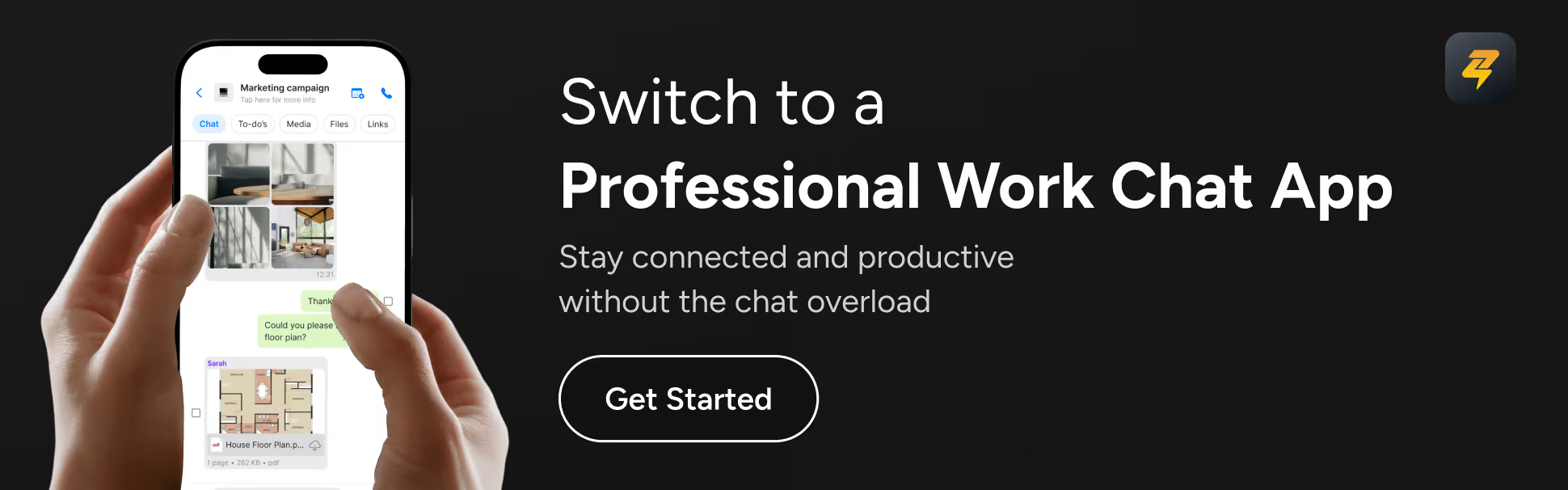
Zenzap is built to close this gap. It keeps the speed and familiarity your teams love, but adds the structure, security, and admin control your business actually needs. Zenzap feels as simple as WhatsApp Business on day one, yet underneath it is purpose built as a mobile first internal team communication app for frontline collaboration.
How Zenzap and WhatsApp Business handle frontline team communication
To make this comparison useful, think of WhatsApp Business as option A and Zenzap as option B.
Option A, WhatsApp Business, is essentially pure messaging with a light business wrapper. You get broadcast lists, quick replies, basic labels, and a shared phone number for customer communication. For internal frontline collaboration, though, most teams still rely on the same group chat model that was designed for friends and family.
Option B, Zenzap, is a dedicated work chat app designed specifically for internal team communication. It combines chat, tasks, files, and calendar sync in one place, then adds clear work personal separation, enterprise grade security, and centralized admin control.
Here is how they compare across the points that matter most for your frontline: simplicity, structure, security, work life boundaries, productivity, and admin control.
Point 1: simplicity and onboarding for busy teams
WhatsApp Business: familiar, but not purpose built
On simplicity alone, WhatsApp Business is hard to beat. Your teams already know how to send a message, share a photo, and record a voice note. For small, informal groups this feels perfect.
The catch shows up when you try to run serious operations through it. Groups multiply. Naming rules vary by person. New hires get added manually by whoever remembers. There is no guided onboarding, no clear workspace, and no way to teach people how communication should flow across locations or roles.
So while WhatsApp Business is extremely familiar, you pay for that familiarity in hidden friction. You rely on people to self organize inside a tool that was never really designed for structured internal collaboration.
Zenzap: familiar feel, guided setup
Zenzap takes that same familiar chat experience, then layers on clarity for frontline teams. The app is mobile first and optimized for phones and tablets, so your people can use it as naturally as a personal messenger, even with patchy connectivity.
Where it stands apart is onboarding. You can roll Zenzap out to a pilot group, such as one store cluster or field team, and have non technical staff up and chatting in minutes, not weeks. Channels match your operations, for example by store, region, or shift. Roles and permissions are pre set. People know exactly where to go for what.
The result is higher adoption and fewer shadow chats. Instead of staff quietly defaulting back to WhatsApp, they stick with Zenzap because it feels just as simple, but clearly designed for their work.
Point 2: structure and organization of work conversations
WhatsApp Business: chat only, everything else somewhere else
WhatsApp Business is still fundamentally a messaging app. It does not handle tasks, calendars, or integrated workflows for internal teams. That forces your managers and supervisors to juggle multiple tools.
Take a typical frontline manager. They might track tasks in a notebook, manage schedules in a separate app or spreadsheet, and share updates in WhatsApp Business groups. Information lives everywhere and nowhere. Things slip through the cracks because nobody has a single view of what needs to happen and by when.
Search is also fragile. You might remember that a crucial instruction was "in the green group" or "sent last Tuesday," but actually finding it in a pile of chats is another story.
Zenzap: chat, tasks, and scheduling in one place
Zenzap gives you a structured digital team workspace instead of a pile of group chats. Messaging, tasks, files, and calendar sync all live together.
You can turn any message into a task on the spot, assign it, set a due time, and keep the whole conversation attached. Need to confirm a delivery window, log a safety check, or follow up on a customer issue? It all stays linked to a task, not lost in scrollback.
Zenzap also integrates directly with tools your teams already use, such as Google Calendar, so shifts, site visits, or inspections line up automatically with conversations. That means less switching between apps and a much higher chance that important work actually gets done on time.
In simple terms, WhatsApp Business helps your people talk. Zenzap helps your people talk and execute, in the same place.
Point 3: Security, compliance, and data ownership
WhatsApp Business: encrypted, but limited control
WhatsApp and WhatsApp Business offer end to end encryption, which is valuable for privacy. For regulated industries or larger organizations, though, encryption alone is not enough.
You still face real risks around data governance and access. Group admins are usually individual employees. When someone leaves, they might still have the full history on their personal device. There is no centralized offboarding, no single place to see who has access to what, and no standard process to remove people from all relevant groups.
At scale, across dozens or hundreds of frontline locations, this becomes almost impossible to manage. You end up with sensitive information spread across personal phones that you do not control.
Zenzap: enterprise grade security you actually control
Zenzap is built as an internal team communication app with enterprise grade security, so compliance and data ownership are core features, not afterthoughts.
You get encrypted communication, secure storage, and a clear admin layer. Access is controlled centrally, not by individual group owners. When someone joins, they are added to the correct channels based on role or location. When they leave, you can remove their access instantly through secure onboarding and offboarding processes, without relying on them to leave chats or delete content.
This matters if you operate in sectors with stricter requirements, such as healthcare, logistics, or financial services. You retain control over your business data and maintain a traceable record of key conversations and decisions, without resorting to screenshots and manual archives.
As one LinkedIn commenter put it when talking about running operations on WhatsApp, "It is not just inefficient, it is fragile." Moving that communication into Zenzap replaces that fragility with clear governance.
Point 4: work life boundaries for frontline staff
WhatsApp Business: one app for everything, all the time
When your teams run work through WhatsApp, you blur the line between personal life and professional life. The same app that holds family photos and weekend plans also pings about shift swaps, escalations, and last minute requests.
This might feel convenient in the short term. Over time, it becomes exhausting. People reply at 2 a.m. because they cannot tell which notifications are urgent. They feel "always on" and struggle to switch off after a shift.
There is also a subtle cultural effect. When work lives in personal apps, your teams never fully get to put work down. That is a recipe for burnout and attrition.
Zenzap: clear separation between work and personal life
Zenzap creates a dedicated professional space for work communication. Your people keep WhatsApp and other personal messaging apps for friends and family, and use Zenzap for everything work related.
This alone reduces mental load. When they open Zenzap, they know they are in work mode. When they close it, they can actually switch off.
Zenzap strengthens that separation with features designed for healthy work life balance. Teams can set their working hours so they do not receive notifications when they are off the clock. You can schedule messages to be sent during business hours instead of firing off pings late at night. Quiet time becomes a default, not a manual effort.
Leaders have described WhatsApp used for work as "not a chat, a leash." Zenzap turns that leash into a tool that respects people's time and boundaries, while still keeping you connected when it truly matters.
Point 5: Productivity, tasks, and integrations
WhatsApp Business: chat first, workflows elsewhere
WhatsApp Business gives you quick communication plus some light business features like labels and auto replies, mainly aimed at customer conversations. For internal frontline collaboration, though, it remains chat only.
Every time you need to assign work, track status, or coordinate schedules, you step outside the app. That might mean spreadsheets, separate task tools, calendar apps, or even paper. Each extra step increases the chance that work gets delayed or forgotten.
Over time, your frontline managers become human routers, copying and pasting information between tools and chasing updates that could have been automated or tracked in one place.
Zenzap: productivity tools built into every conversation
Zenzap is more than a chat room. It is a "get work done" space built around frontline reality.
From any conversation, you can create tasks directly within the chat, assign owners, set due times, and attach files or photos. Need a quick follow up on a broken fixture, a missed delivery, or a safety hazard? Turn the message into a task and keep all the context attached instead of letting it vanish in scrollback.
Zenzap's integrations keep everything moving. Integration with Google Calendar helps align messages with shifts, meetings, and site visits. Integrations with other business tools reduce context switching and manual updates. Your teams stay inside one app more often, which is exactly what busy frontline workers need.
In real life, this might look like a retail supervisor capturing a shelf issue, turning it into a task, and assigning it to the next shift lead with a due time. The task sits in Zenzap alongside the conversation and photos. Nothing is scattered, and nothing is missed.
Point 6: Admin control and user management
WhatsApp Business: no centralized admin, messy handovers
With WhatsApp Business, there is no full featured admin console for your organization's internal collaboration. Group admins are usually whoever created the group. Policies are informal. Onboarding and offboarding happen through personal contacts.
When an employee or contractor leaves, they may still have access to historical messages on their device. They might remain in groups for months. There is no simple way to see a complete list of who has access to which conversations across the company.
At small scale, this is annoying. At large scale, across many locations and rotating frontline staff, it becomes a serious operational and compliance risk.
Zenzap: centralized control without heavy overhead
Zenzap gives you a clear admin layer tailored to the way frontline teams operate.
Administrators have full control over who can access the platform, can add or remove people in seconds, manage permissions by role, site, or region, and see exactly who can access which channels. You no longer rely on local managers to remember every group and chat that needs cleanup.
User onboarding and offboarding are streamlined through secure processes. This is crucial when you work with seasonal staff, contractors, or high turnover roles. New people get the right access from day one. Departing staff lose access centrally, while the conversations, tasks, and files they contributed remain within your organization's control.
In short, WhatsApp Business keeps people connected, but not governed. Zenzap keeps them connected and aligned, while giving you the control and oversight you need as a leader.
Key takeaways
- Choose WhatsApp Business only if you need basic, informal chat and are willing to accept weak structure and limited control.
- Use Zenzap when you want familiar messaging combined with tasks, scheduling, and integrations in a single frontline collaboration hub.
- Protect your organization by moving sensitive work conversations from personal apps into an internal team communication app with enterprise grade security and admin controlled workspace.
- Support your frontline teams' wellbeing with clear work personal separation, scheduled messages, and working hours controls.
- Start small with a pilot group on Zenzap, then scale as teams experience calmer days, fewer missed tasks, and cleaner handovers.

Bringing it all together
When you put everything side by side, the pattern is clear.
WhatsApp Business gives your frontline teams fast, familiar chat. It is excellent for informal coordination and external customer conversations, but it was not designed to run the internal heartbeat of a multi site operation.
Zenzap feels just as familiar, yet it is built from the ground up as a mobile first internal team communication app for frontline collaboration. You get structured channels, integrated tasks, calendar sync, clear work personal separation, encrypted communication, and centralized admin control, all in one intuitive app.
By moving from scattered WhatsApp Business groups to a focused tool like Zenzap, you regain control, your teams regain clarity, and everyone breathes a little easier. The real question is not whether Zenzap is more powerful. It is this: how long do you want your frontline collaboration to depend on tools that were never really built for it?
If you gave your teams one messaging app to run their day, with your data secure and their time respected, which one would you want that to be?
FAQ
Q: Is Zenzap meant to replace WhatsApp Business completely for frontline teams?
A: For internal collaboration, yes, that is usually the best move. Zenzap becomes the dedicated workspace for all work chat, tasks, and files, while WhatsApp or WhatsApp Business can remain for personal use or certain external customer conversations. This clear split reduces confusion, strengthens security, and helps your teams build a simple rule: work in Zenzap, personal in other apps.
Q: How hard is it to move frontline teams from WhatsApp Business to Zenzap?
A: The transition is typically smoother than you expect. Zenzap feels as intuitive as a personal messenger, so frontline staff do not need long training sessions. Many organizations start with one pilot group, such as a store cluster or field crew, make Zenzap the single place for work chat and tasks, then expand as people experience calmer days and cleaner communication.
Q: What if some of my frontline workers are not tech savvy?
A: Zenzap is designed for people who rarely sit at a desk. Messaging, tasks, files, and voice notes are all one tap away and optimized for phones and tablets. Most users can get started in a few minutes. You can also keep initial rules very simple, for example, "All shift updates and task follow ups now happen in Zenzap," then layer in more structure over time.
Q: Can Zenzap handle different locations, roles, and shifts?
A: Yes. You can create structured channels that mirror your real operations, such as by site, region, team, or shift. Permissions can be set by role or location, so people only see what is relevant. This makes it easier to keep information flowing across sites while avoiding unnecessary noise.
Q: How does Zenzap help with compliance and audits compared to WhatsApp Business?
A: With WhatsApp Business, critical conversations are spread across personal devices, and access is controlled informally by group owners. Zenzap centralizes your data, provides encrypted storage, and keeps a traceable record of key messages and decisions inside a managed platform. You gain clearer oversight for audits, investigations, or compliance checks, without digging through individual phones.
Q: What does Zenzap cost compared to using WhatsApp Business for free?
A: WhatsApp Business may look free, but you pay in hidden costs: lost time, missed tasks, security risks, and burnout from boundaryless communication. Zenzap has transparent pricing that reflects its role as an internal team communication app with enterprise features. You gain productivity features, admin control, and work life protections that more than repay the subscription through smoother operations and fewer costly mistakes. You can explore options on the Zenzap pricing page at https://www.zenzap.co/pricing.

Take Control of Your Team Communication
Chat, organize, and get work done - all in one place.
Other Blog Posts