.svg)

.svg)

.svg)

.svg)

.svg)

.svg)

.svg)

.svg)

.svg)

.svg)
.svg)
















7 Ways Founders Can Use Embedded Task Trackers for Better Task Management in Chat
You already run most of your company from chat. Ideas, decisions, and to dos all start as quick messages. The problem is simple. If a task stays trapped in a thread, it quietly disappears.
Embedded task trackers inside Zenzap fix that. Instead of bouncing between chat, notes, and project tools, you turn messages into trackable work in one place. In this article, you will climb a clear set of steps that show you, as a founder, how to turn your daily conversations into organized, accountable execution.
Unlike classic project tools bolted onto chat, Zenzap is built from the ground up so conversations, tasks, files, and schedules share the same intuitive space. Teams using integrated setups like this are up to 42 percent less likely to miss deadlines when tasks live where they actually communicate. You get one mobile first workspace, and your team finally stops asking, "Where did that go?"
In the next sections, you will see seven practical ways to use Zenzap's embedded task tracker to stay on top of everything, without sacrificing your sanity or your evenings.
Think of it like climbing a ladder. You start by centralizing conversations, then step by step you capture to dos in real time, assign owners, connect tasks to time, and keep context, files, and focus perfectly aligned.
Table of contents
1. Stop losing track, start building momentum
2. Step 1: Centralize your startup chat so nothing slips away
3. Step 2: Capture to dos in real time, directly from messages
4. Step 3: Turn conversations into owned tasks with clear accountability
5. Step 4: Link tasks to time with calendar and scheduling
6. Step 5: Track progress in chat and reduce status meetings
7. Step 6: Protect focus and work life balance with smart notifications
8. Step 7: Keep files, context, and updates together in projects
9. Key takeaways
10. Bringing it all together
11. FAQ
Stop losing track, start building momentum
"We literally talked about that, so where did it go?"
If that sentence sounds familiar, you are not alone. As a founder, your day is a rush of threads, channels, DMs, and calls. Decisions get made quickly, but next steps vanish just as fast.
Many chat apps claim to make communication easier, yet most still leave you juggling separate tools for task tracking, scheduling, and file sharing. Context gets scattered, ownership is unclear, and you end up chasing updates instead of driving growth.
Embedded task trackers inside chat flip that script for you. With Zenzap, any important message can become a task with an owner and deadline, in the same space where the conversation happened. No extra tools, no training, no chaos.
In this guide, you will climb seven practical steps to use embedded task tracking in Zenzap for better task management in chat. Each step builds on the last so by the time you reach the top, you have a simple, repeatable way to turn daily conversation into visible progress.
Step 1: Centralize your startup chat so nothing slips away
Your first move is not about features. It is about focus. If your conversations are scattered across personal messaging apps and email, no task system can save you.
Centralizing communication inside Zenzap gives you a single, secure hub where work lives. You replace personal messaging apps with structured, professional channels that mirror how your business actually runs.
For example, you might create channels for:
- Product
- Growth or marketing
- Sales
- Customer support
- Founders
- Investor updates
Every idea, request, and decision now enters a space that is already connected to your embedded task tracker. Instead of "Did we talk about that somewhere?" you can go straight to the right channel and either find the task or instantly create it.
This structure also improves professional separation. Work stays inside Zenzap, where you have enterprise grade security, encrypted communication, and clean onboarding and offboarding controls. Personal chats stay in personal apps, so your team is not mixing sensitive company data with birthday photos.
Step 2: Capture to dos in real time, directly from messages
Once your communication is in one place, you climb to the next step. You stop letting tasks hide in chat, and you capture them in real time.
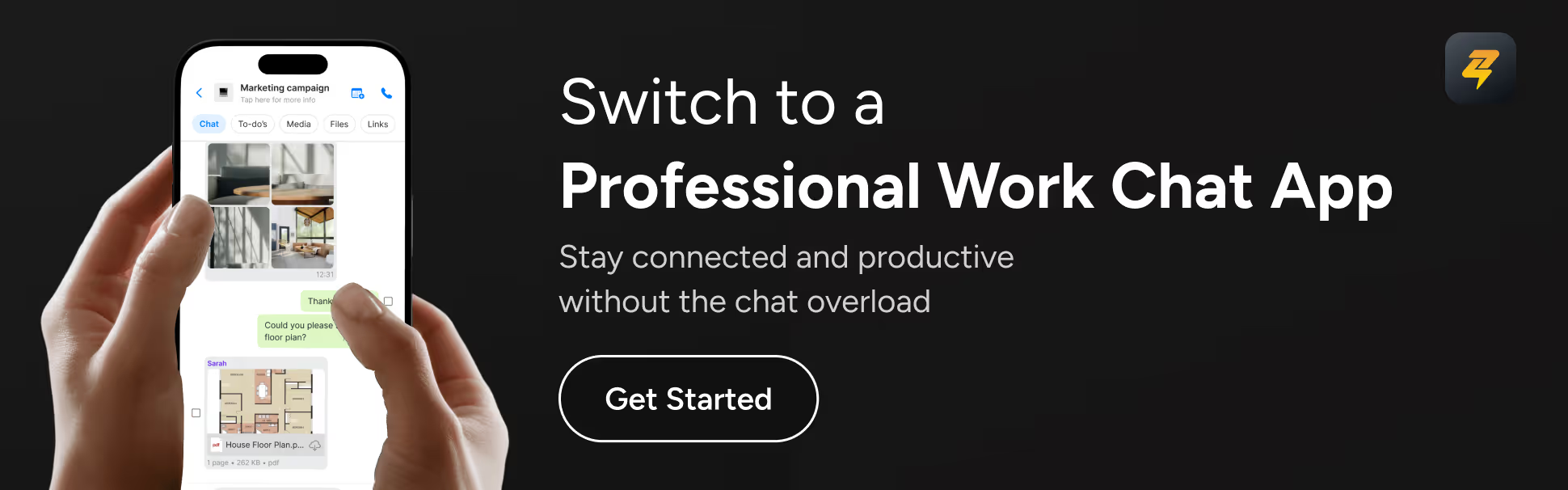
Zenzap's embedded task tracker lets you turn any message into a to do on the spot. Instead of copying text into a separate tool or hoping someone "remembers," you convert the message into a task with a couple of taps.
Here is how you might use it as a founder:
- In a product channel, someone flags a bug from a key customer. You turn the message into a task, assign it to your engineer, and set a due date.
- In the founders channel, you agree to update your pitch deck by next Tuesday. You convert that decision into a task so it does not vanish under the next 50 messages.
- In a growth channel, someone suggests a new onboarding experiment. You create a task in real time instead of saying "let's add that to the backlog later."
This habit is your base technique. Whenever you see a decision, commitment, or action item, you turn it into a task without leaving chat. Over a week or two, your team learns that nothing important stays as "just a message." It always becomes trackable work.
Real time capture in Zenzap cuts waste. You reduce manual copying, and you keep the conversation and the task tightly linked.
Step 3: Turn conversations into owned tasks with clear accountability
Capturing tasks is a strong start, but you climb higher when every task has an owner and a deadline. That is where accountability becomes visible.
In Zenzap, when you convert a message into a task, you can immediately:
- Assign an owner
- Set a due date
- Keep it attached to the original channel and context
For you as a founder, this solves a quiet but costly problem. Many tasks in growing startups die because "everyone" is responsible. Which really means no one is responsible.
Imagine a typical weekly review. In many startups, you leave with a vague list of "we should" items. In Zenzap, you come out with concrete tasks such as:
- "Update pricing page copy" assigned to your marketing lead, due Friday
- "Prepare new churn report" assigned to your ops manager, due next Wednesday
- "Follow up with top 10 trial users" assigned to your sales rep, due Monday
When people see tasks with their name and a date, it changes behavior. It also makes follow up kinder and easier. You no longer have to ask "Who owns this?" because ownership is baked into the system.
Clarity of responsibility is one of the biggest predictors of successful execution. Embedded task tracking in your chat gives you that clarity in a place your team checks all day.
Step 4: Link tasks to time with calendar and scheduling
Next, you connect your task management in chat to your actual schedule. Tasks without time are easy to ignore. As a founder, your calendar is your real source of truth.
Many professionals miss deadlines because they lose track of them among competing priorities. It is not that they do not care. It is that deadlines are not visible where they live their day, in their calendar.
Zenzap solves that gap with built in calendar integrations, including Google Calendar. You can:
- Link tasks with due dates directly to your calendar
- Create calendar events from inside relevant chats
- Keep meeting context, files, and tasks together in one workspace
Picture a sales review. You agree to follow up with 10 priority leads by Friday. In a traditional setup, someone writes it in a notebook or "adds it to the CRM later," and it may or may not happen. In Zenzap, you create a task list right in the sales channel, assign owners, and link a Friday calendar event. When Friday comes, your team is reminded automatically, without you chasing them.
By linking tasks to time, you keep your chat, your commitments, and your calendar aligned. You no longer have to carry every deadline in your head, and your team sees what matters in the same rhythm where they see their meetings.
Step 5: Track progress in chat and reduce status meetings
Once you have tasks captured, owned, and connected to time, you can start cutting the meetings that drain your week. You do not need a one hour call to ask people what they already updated in Zenzap.
Embedded task trackers inside Zenzap surface updates directly in relevant channels. When someone completes a task, the channel sees it. When a deadline approaches, the owner gets a gentle nudge. You get a living status page inside your chat.
This allows you to switch from long, generic status meetings to short, focused check ins. Instead of asking "What is the status?" you ask:
- "What is blocking you?"
- "What changed since last week?"
- "What decision do we need to make now?"
One marketing agency highlighted in Zenzap's customer stories cut a big chunk of their recurring update meetings and finished about 40 percent more projects on time after centralizing messages, tasks, and files in Zenzap. They let the system carry the reporting so humans could focus on problem solving.
For you as a founder, that shift buys back two critical things. Your team gains more maker time for deep work, and you gain more strategic time for hiring, fundraising, and vision.
Step 6: Protect focus and work life balance with smart notifications
At this stage, your embedded task tracker is humming. The final pieces are about making it sustainable for you and your team. That means protecting focus and setting boundaries.
When chat and tasks live in the same place, there is a risk of feeling "always on." Zenzap solves this with work life friendly features such as:
- Working hours, so people do not get pinged when they are off the clock
- Scheduled messages, so you can queue a thought at midnight but deliver it at 9 a.m.
- Channel level controls, so you only get alerts where you truly need to be involved
This combination is powerful for founders. You can capture ideas whenever they hit and still respect your team's time zones and personal lives. You also avoid the constant micro interruptions that kill focus.
Frequent notification context switching can destroy deep work and raise stress significantly. Zenzap gives you the structure to break that pattern.
Founders who adopt this approach report an important psychological shift. They can finally unplug at night without worrying that they are missing something urgent, because anything truly critical will be captured as a task and surfaced in the right way at the right time.
Step 7: Keep files, context, and updates together in projects
The last step in this ladder is about full context. Tasks are not just checkboxes. They sit inside conversations, documents, and decisions. If those pieces are scattered, you still waste time hunting.
Within Zenzap, you store and share files directly in the channels where work happens. Contracts, briefs, designs, reports, and specs sit beside the tasks they relate to. When you turn a message into a task, it keeps a direct line back to that conversation.
For example:
- Your product design task links to the Figma file and the discussion thread where feedback was shared.
- Your investor update task lives beside the latest metrics spreadsheet and the previous update you sent.
- Your customer escalation task stays in the customer support channel with all past messages about that account.
You never have to ask "What was this about again?" because the why is sitting right next to the what. Your future hires benefit too. When a new PM or team lead joins, they can scroll back through channels and see how tasks evolved, which decisions were made, and why certain tradeoffs happened.
That is how you turn your chat into a living knowledge base, not just a real time feed. Tasks, files, and context grow together instead of drifting apart.
Key takeaways
- Centralize all startup communication inside Zenzap so every important message can become a trackable task.
- Use embedded task tracking to convert real time conversations into owned tasks with clear deadlines and context.
- Link tasks to your calendar and use in chat status visibility to reduce manual follow ups and long status meetings.
- Protect focus and boundaries with smart notifications, working hours, and scheduled messages inside Zenzap.
- Keep files, discussions, and tasks together in structured channels so nothing important gets lost or detached from its context.

Bringing it all together
You already know that scattered tools cost you time, focus, and peace of mind. When chat lives in one place and tasks live somewhere else, your startup runs with a constant drag on execution.
Embedded task tracking inside Zenzap removes that drag. You capture decisions as they happen, turn them into owned tasks, connect them to time, and keep every file and message in the same secure, intuitive space. You give your team the clarity they need and reclaim your own mental bandwidth.
Instead of "Did anyone do this?" your company starts to sound more like "Here is what is done, here is what is next." The result is less chaos, more progress, and a healthier work rhythm for everyone around you.
The only real question is this. If you could turn every important conversation into visible, accountable action with almost no extra effort, how long are you willing to keep working the old way?
FAQ
Q: What exactly is an embedded task tracker in chat?
A: An embedded task tracker is task management built directly into your chat app. In Zenzap, any message can become a task with an owner, due date, and status, without opening a separate project tool. Conversation and execution stay in one place so you do not lose context or momentum.
Q: How should I start using Zenzap for task management as a founder?
A: Start with three simple moves. First, centralize your internal communication in Zenzap and create channels that match your teams and projects. Second, set a rule that every decision or action item in chat must be converted into a task with an owner and due date. Third, connect your calendar so key tasks and events show up where you already live your day.
Q: Can I really manage all my team's tasks directly from chat?
A: Yes. With Zenzap, you can mark any chat message as a task, assign it, add details, set deadlines, and track progress, all inside the chat window. You can then use centralized task views to see tasks assigned to you, tasks you assigned to others, and what is overdue or upcoming across all channels.
Q: How does Zenzap help reduce meetings without losing visibility?
A: Because tasks, updates, and reminders appear in relevant channels, you no longer need long status meetings just to share what is already visible. You can replace those with short check ins focused on blockers and decisions. Many teams that adopt this approach finish more projects on time and free up significant working hours each week.
Q: Will task tracking in chat overload my team with notifications?
A: Zenzap is designed to protect focus. You can define working hours, mute specific channels, and schedule messages to send during business time. Task notifications are targeted to owners and appear where the work happens, which reduces random pings across multiple tools and helps everyone stay calmer and more focused.
Q: Is Zenzap secure enough for sensitive startup information?
A: Yes. Zenzap offers enterprise grade security, encrypted communication, and controlled onboarding and offboarding, so only the right people can see your data. This is much safer than using personal messaging apps for work, especially when you are sharing investor updates, contracts, or confidential product details.

Take Control of Your Team Communication
Chat, organize, and get work done - all in one place.
Other Blog Posts
- fskfsfjksofjsj