.svg)

.svg)

.svg)

.svg)

.svg)

.svg)

.svg)

.svg)

.svg)

.svg)
.svg)




















Simplify task management in chat without confusing your distributed teams
You already live in chat. Most of your projects start as a quick message, a fast reply, or a late night idea in a group thread. The trouble begins when that important message quietly turns into a missed task, a confused handoff, or yet another status meeting.
What you really want is simple. You want your distributed team to keep using chat for what it does best, fast communication, without losing control of who is doing what and by when. You want fewer tools, not more training. You want less chaos, not another complex project board that nobody opens. That is exactly where Zenzap and task management in chat work together for you.
Table of contents
1. Introduction, why chat turns into task chaos for distributed teams
2. The simple fix for task chaos in chat
3. How Zenzap keeps task management in chat effortless
4. Why this approach works for distributed and hybrid teams
5. Protecting focus, security, and work life balance while you manage tasks
6. How to roll this out with your team in a few clear steps
7. Key takeaways
8. Putting it into practice
9. FAQ
Introduction, why chat turns into task chaos for distributed teams
Here is the honest problem. Your team is already using chat to decide what needs to happen next, but your actual task management still lives somewhere else. Maybe it is a project tool that only a few people touch. Maybe it is a shared spreadsheet. Maybe it is your own brain.
That gap between "We should do this" and "You are doing this, by Friday" is where projects leak time, money, and trust. For distributed teams across time zones, the impact multiplies. Someone types an action item at 6 p.m., someone else wakes up eight hours later, scrolls through a hundred messages, and completely misses the key request.
Research highlighted by Atlassian shows that constant context switching can waste hours per person every week. Remote teams using integrated communication and workflow tools have seen productivity gains of up to 24 percent compared with fragmented setups. When tasks live separate from the conversations that created them, you pay that "switching tax" every single day.
The good news is that you do not need to rebuild your entire system. You do not need another heavyweight platform or a six month rollout. You only need one simple, consistent habit inside your chat app, then a tool that makes that habit effortless.
That is where Zenzap comes in. It keeps chat as fast and familiar as your favorite messaging app, then quietly adds the structure, security, and organization you need to keep a distributed team aligned.
The simple fix for task chaos in chat
Turn every important message into a task inside chat
Here is the simple fix. Any time a message contains an action, you turn it into a task right there in the chat. You give it an owner, add a due date, and keep it linked to the original conversation.
No copying and pasting. No opening another app. No "I will put this in the project board later" that never actually happens.
In Zenzap, you do this in a couple of taps. You stay inside the same thread, keep the conversation going, and still capture the work in a structured, trackable way. Every task keeps the full context, including who said what, why the decision was made, and which files were shared.
That one move, turning action messages into tasks where they were born, instantly closes the gap between conversation and execution. It also keeps your distributed team aligned without forcing them to learn a new workflow.
If your team is already doing the work in chat, the real question is simple. How long do you want to keep managing the tasks somewhere else?
Why this simple fix works so well
This fix works because it leans into how your team already behaves. People naturally talk first, then act. You are not trying to train everyone to think "Open the project tool" every time they agree on a next step. You simply make it effortless to capture that next step inside the place where it was decided.
When you do that, three powerful things happen:
• Fewer tasks slip through the cracks, because every "can you" and "we should" becomes a concrete item with an owner.
• Less time is wasted on status meetings, because anyone can see what has been decided and what is already assigned by looking at the linked tasks in chat.
• Your distributed team stays aligned across time zones, because tasks and context travel together.
An external review from Work Management highlighted this as one of Zenzap's biggest strengths. It minimizes friction between planning and execution, and it keeps everything inside one intuitive space.
How Zenzap keeps task management in chat effortless
1. Turn any message into a task in seconds
In Zenzap, any message, a quick idea, a detailed spec, a customer request, can become a task in seconds. You tap, convert, assign, and move on. The original message is still there, linked directly to the task, so nobody has to ask "Where did this come from?"
For a project manager, this removes that lonely "glue" role where you are constantly translating chat into tickets. For a team lead, it means you can keep your energy on coaching and decision making, not on data entry into separate tools.
Instead of juggling chat, a task app, a notes app, and a calendar, you let Zenzap be your single, structured workspace.
2. No more tool toggling or context loss
Every time your team has to jump into another app just to write down a task, you create friction. Many people simply skip it. That is exactly how work gets lost, especially when your team is distributed and not all online at the same time.
With Zenzap, task management is integrated directly into chat. You stay inside one screen, keep the conversation open, and still capture the tasks that matter. There is no "I will update the project tool later" step that can be forgotten.
That reduction in tool toggling is not just a comfort benefit. It gives you back real time. The same Atlassian data that highlights context switching also points out how fragmented workflows drain focus and productivity. Zenzap is built specifically to reduce that drain.
3. Alignment across time zones and schedules
Not every team works in real time or in one time zone. Maybe your support team is in one region, your developers in another, and leadership scattered across three more. You cannot rely on everyone being online at the same moment to clarify what needs to happen.
Zenzap lets people reply on their own time without losing context. When tasks sit inside the conversation that created them, linked directly to that thread, nobody is left guessing what happened while they were offline.
Imagine your product team runs a decision heavy discussion in the afternoon. Instead of summarizing the discussion in a separate tool, the team lead turns each clear decision into a task from the same thread. Your developer in another region wakes up, opens Zenzap, and sees two new tasks in their list, each one linked to the original conversation. No recap meeting. No "Can someone paste the meeting notes?"
4. A business owner who finally has one app instead of five
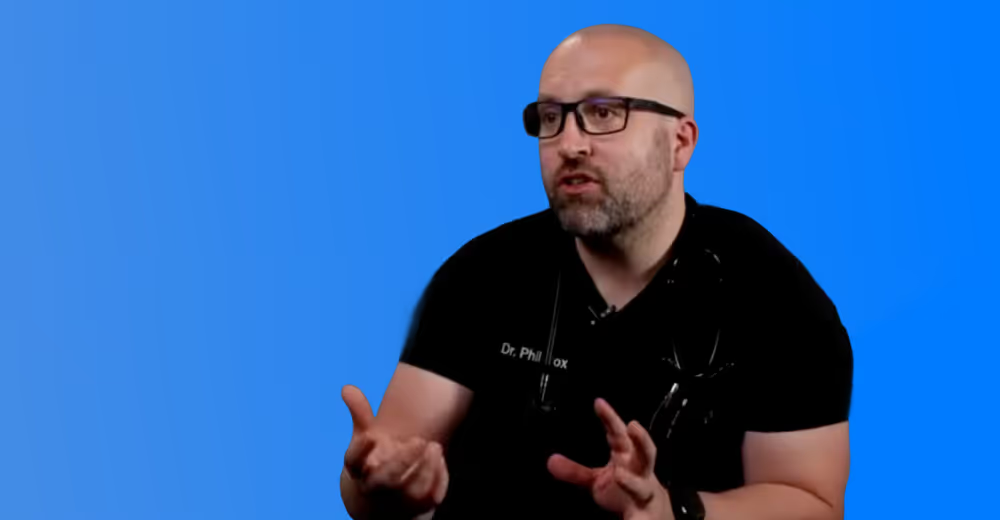
Dr. Phil Cox, quoted on the Zenzap site, puts it plainly. "We do not have a separate app for to do lists, for document storage, for task management. It is all in one app which is fantastic."
That is the mental relief you create when you let chat and tasks live in the same structured space, with files and calendar events alongside them. You cut the noise of multiple apps. Your team stops asking "Where do I put this?" and starts focusing on the work itself.
Chris Fletcher from Tech on Toast has even called Zenzap a genuine money saver, because removing tool overlap cuts both subscription costs and time wasted bouncing between apps.
Why this approach works for distributed and hybrid teams
1. Less context switching, more real work
For remote team leaders, the hidden cost is rarely the price of software. It is the daily drag of context switching. Copying tasks from chat into a project tool. Chasing updates across threads, email, and spreadsheets. Running extra meetings just to confirm what was already agreed in writing.
When you keep task management inside chat with Zenzap, you cut that drag down to almost zero. You turn a message into a task, assign it, and keep working. You see all tasks for a channel, person, or project in one place, with the related conversations right there.
In practice, that means:
• Your project manager is not manually rebuilding yesterday's chat into a backlog.
• Your team leads are not pinging people in three different apps to get a status update.
• Your executives can scan key channels and instantly see both decisions and the tasks that came out of them.
2. Structured organization so nothing slips
Traditional chat tools often promise productivity, then bury you in noisy, unstructured threads. Zenzap flips that approach. It gives you structured channels by team, project, or topic, then connects those channels with built in tasks, files, and schedules.
Every conversation has a logical home. Every task sits where it belongs. You can filter tasks by owner, status, or channel so nothing slips through the cracks.
One reviewer summed it up well. "Zenzap is finally a clean alternative to traditional messaging platforms." You get familiar chat, but with grown up organization that distributed teams need.
3. Instant adoption, zero training
Distributed teams do not have time for complex onboarding. You cannot easily gather everyone in one room for a three hour training session. If your new tool feels confusing, people simply revert to old habits in personal messaging apps or email.
Zenzap is deliberately designed to look and feel as familiar as consumer chat apps, but it is built for professional collaboration. Teams can usually start using it with minimal guidance, often in minutes. You can roll it out with a few simple rules, such as:
• All work chat happens in Zenzap, not personal messaging apps.
• If a message requires action, turn it into a task inside Zenzap.
• Use project or team channels instead of private side chats for shared work.
Because the interface is intuitive, adoption tends to be quick. Once people are comfortable with basic chat, you can introduce task features and integrations step by step.
Protecting focus, security, and work life balance while you manage tasks
1. Professional separation between work and personal life
One of the biggest mistakes teams make is running serious work out of personal messaging apps. You might get short term convenience, but you sacrifice boundaries, security, and clarity. Work pings show up next to family chats. Files float around in private threads. Offboarding becomes a nightmare.
Zenzap solves this by giving you a dedicated professional workspace. Work stays at work. Personal stays personal. Your people do not have to delete apps on weekends just to get a break from notifications.
2. Built for healthy work life balance
Task management inside chat should not mean "on call 24/7." Zenzap bakes in work life balance from the start with features like:
• Working hours, your team can set working hours so they do not get notifications when they are off the clock.
• Scheduled messages, you can write a message when it suits you and schedule it to send during business hours.
• Clear ownership, tasks always have an owner and a due date, so there is less last minute scrambling.
This gives your distributed team permission to unplug without fear of missing something critical. Tasks will be there in the morning, sitting in their organized workspace, ready to go.
3. Enterprise grade security and admin control
When you centralize your task management and communication, security is non negotiable. Zenzap uses encrypted communication and secure onboarding and offboarding processes so that only the right people have access to sensitive information at any given time.
Admins have full control over who can access which workspaces and channels. When someone leaves the company, access can be removed cleanly in one move. Their past contributions stay in the system for knowledge continuity, but they no longer see active projects.
This balance, simplicity for users and control for admins, helps you scale your distributed team confidently.
How to roll this out with your team in a few clear steps
Step 1, choose chat as the home for day to day work
First, commit to a simple principle. Everyday collaboration lives in Zenzap. High level project plans can still sit in your existing tools if you like, but your team does not need to bounce out of chat to capture routine tasks and decisions.
Make it clear that personal messaging apps are not for work. This is about protecting people's time and privacy as much as it is about productivity.
Step 2, use the "every action becomes a task" rule
Introduce one straightforward rule. If a message requires someone to do something, it becomes a task in Zenzap.
In practice, this looks like:
• A client asks for a change in a channel. You turn that line into a task, assign it to the right person, and add a due date.
• A leader shares a priority. You convert it to a task so it does not vanish into the scroll.
• A meeting summary is posted in chat. Each bullet point that involves action becomes its own task, linked to the summary thread.
Within a week, your team will start to trust that if something is important, it will show up in their task list, not just in their memory.
Step 3, model the behavior from the top
Your team will copy what you do, not what you say. If you, as a manager or executive, move important conversations into Zenzap, respond there, and consistently convert actions into tasks, people will follow.
Share your ground rules in a short message or video, then live them. Respect notification boundaries. Use channels instead of side chats for shared work. Ask "Has this been turned into a task?" instead of "Did you see my message?"
Step 4, connect tasks with calendars and existing tools
Once your team is comfortable with basic task management in chat, you can unlock more value by connecting Zenzap to the tools you already rely on.
Because Zenzap integrates with Google Calendar and other business tools, you can push tasks into calendar events with a click. That way you respect people's time, not just their to do list. You see what is scheduled and what is pending in a single, aligned view.
This is where Zenzap moves from "better chat" to a true digital workspace that holds your conversations, your tasks, your files, and your schedule together.
Key takeaways
- Make Zenzap your single home for work chat so distributed teams are not scattered across personal apps and email.
- Apply the simple rule that every actionable message becomes a task inside chat with an owner and due date.
- Use Zenzap's built in structure, channels, and filters so tasks always stay connected to the conversations that created them.
- Protect your team's focus and boundaries with working hours, scheduled messages, and clear task ownership.
- Integrate Zenzap with your calendar and existing tools to reduce context switching and keep projects moving smoothly.

Putting it into practice
You do not need a six month rollout plan to simplify task management in chat. You just need to make one straightforward change and support it with the right tool.
The change is this. Stop letting important action items live as plain messages that rely on memory. Start turning them into tasks inside your chat as soon as they appear. Give them an owner, a due date, and a clear place to live.
Zenzap is built to make that habit feel natural from day one. It keeps the easy, human side of chat, then quietly layers in structure, security, and organization so your distributed team can move faster without burning out.
If your team is already doing the real work in chat, the only question left is: how long will you keep managing the tasks somewhere else?
FAQ
Q: What is task management in chat, exactly?
A: Task management in chat means you create, assign, and track tasks directly inside your work chat app instead of sending them to a separate project tool. In Zenzap, any message can be turned into a task with an owner, due date, and full conversation context, so you manage work where it is already being discussed.
Q: Will this replace my existing project management tool?
A: For day to day execution, yes, Zenzap can usually replace separate task tools. You can keep high level roadmaps or complex Gantt charts where they are, but the actual "who is doing what this week" work can live in Zenzap. That reduces context switching and keeps your team focused.
Q: How do I stop my distributed team from feeling overwhelmed by chat and tasks together?
A: Start with clear channel structure, use the rule that only actionable messages become tasks, and lean on Zenzap's working hours and notification controls. This keeps chat organized, tasks focused, and your team protected from constant pings outside their schedule.
Q: Is task management in chat only useful for small teams or startups?
A: Not at all. While smaller teams love the simplicity, project managers in larger organizations benefit just as much. As your team grows, scattered tools create even more confusion. Task management in chat scales well because conversations and execution live together in one predictable system.
Q: How hard is it to onboard my team to Zenzap?
A: Most teams can get started in minutes. Zenzap feels like a familiar messaging app, so you can roll it out with a few simple rules such as "all work chat happens here" and "turn action items into tasks inside Zenzap." As people get comfortable, you can introduce integrations and advanced views gradually.
Q: How does Zenzap help keep tasks from getting lost in busy channels?
A: Zenzap ties every task to its original conversation and lets you view tasks by channel, owner, or status. You can search by keyword or filter for what is open and assigned to you. That means no more hunting through endless threads for that one decision or that one request that everybody vaguely remembers.

Take Control of Your Team Communication
Chat, organize, and get work done - all in one place.
Other Blog Posts