.svg)

.svg)

.svg)

.svg)

.svg)

.svg)

.svg)

.svg)

.svg)

.svg)
.svg)
















Top 10 market trends 2026 for professional work chat apps transforming team communication
You are probably juggling chats in WhatsApp, schedules in spreadsheets, approvals in email, and urgent issues in yet another app. Your team is talking all day, yet you still chase answers, miss updates, and feel like nothing really lives in one place.
This is exactly why the best professional work chat apps for 2026 are not just "another tool." They are a response to that everyday chaos, built to be mobile-first, simple enough for everyone to use without training, and secure enough that your CEO and IT team can finally exhale. At the front of that shift sits Zenzap, designed to feel like your favorite personal messenger, but built for serious work.
Table of contents
Here is what you will explore in this guide.
- Why work chat is changing faster than your tech stack
- Trend 1: Mobile-first work chat becomes the default
- Trend 2: Zero learning curve becomes a non-negotiable
- Trend 3: Work chat finally separates from personal messaging
- Trend 4: Enterprise-grade security for every size of business
- Trend 5: Structured chat that turns talk into tracked work
- Trend 6: Deep, calm integrations with core business tools
- Trend 7: Work-life balance features built into chat
- Trend 8: Admin control and access governance as standard
- Trend 9: Cost-effective alternatives to bloated platforms
- Trend 10: Calm communication as a competitive advantage
- How Zenzap leads these 2026 work chat trends
- Key takeaways
- FAQ
Why work chat is changing faster than your tech stack
Picture a typical Monday morning.
A shift supervisor pings people in a personal WhatsApp group about rota changes. HR emails an updated policy that lands in cluttered inboxes. A field technician calls their manager because the VPN is down. Meanwhile, leadership drops a strategic update in a separate collaboration tool that half the staff do not open.
Everyone is "connected," but no one is aligned. You lose minutes on every question, hours across every week, and weeks across every quarter. That is before you factor in security risks and blurred personal boundaries.
This is not a tech problem. It is a communication problem that your current tools are amplifying.
Across industries, especially for deskless and shift-based workers, this scattered setup is normal. Managers send schedules via personal apps, HR uses email, operations rely on shared sheets, and frontline teams patch holes with phone calls. Nothing is centralized, and you pay for it in wasted time, missed details, and stressed-out teams.
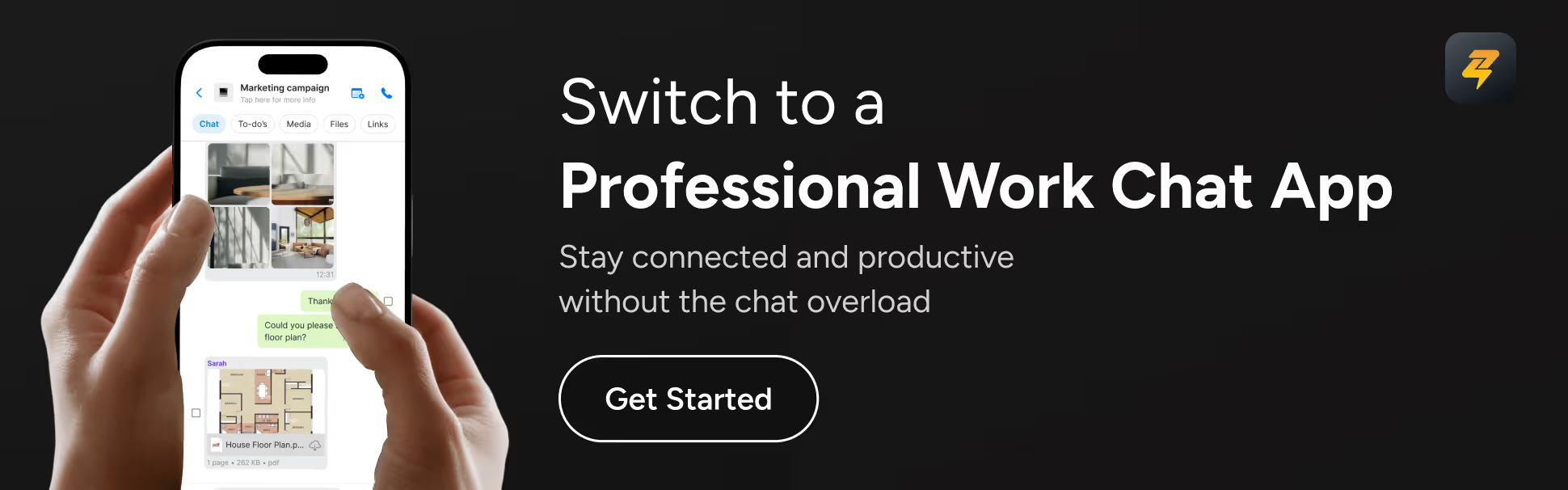
The professional work chat apps rising to the top in 2026 are built to end that pattern. They combine familiar chat, structured organization, strong security, and frictionless mobile use into one calm workspace. Zenzap is one of the clearest examples, created specifically to bridge the gap between consumer messengers and bloated enterprise platforms.
To see where Zenzap shines, you first need to understand the 10 market trends reshaping how teams communicate internally.
Trend 1: Mobile-first work chat becomes the default
Your team is not chained to desks anymore. Even in office-based companies, a big portion of real work happens on the move, between meetings, job sites, and client visits.
That is why mobile-first design has shifted from "nice to have" to baseline expectation. In 2026, the best professional work chat apps are designed for the phone first, then adapted for desktop, not the other way around.
Zenzap is built mobile-first from the ground up. If your team can use WhatsApp, they can use Zenzap in minutes, with no training deck, no rollout drama, and no week-long pilot.
Real-life example: A hospitality group with rotating staff shifts needed to get daily updates to 200 employees across three locations. Their existing tool worked on desktop, but most staff did not sit at a desk. Once they switched to a truly mobile-first app, update read rates climbed, and managers stopped relying on printouts taped to break-room walls.
Trend 2: Zero learning curve becomes a non-negotiable
You no longer have patience for tools that take weeks to configure and months to adopt. Your team is busy. Many are not technical. You need software that fits into their day, not the other way around.
In the best professional workplace chat apps for 2026, a zero or near-zero learning curve is a core buying criterion. You want your whole team using the tool within hours, not weeks, especially frontline or deskless staff who will simply ignore anything that feels heavy or confusing.
Zenzap is built to feel like a personal messaging app, with the professional layer quietly sitting underneath. Channels, tasks, and calendar links are there, but they do not get in the way of sending a simple, clear message.
The alternative is cognitive overload. In real terms, that means slower adoption, more mistakes, and a steady drift back to unapproved personal chat apps.
Trend 3: Work chat finally separates from personal messaging
Using WhatsApp for work felt clever the first week you tried it. Then the group chats multiplied, contacts blurred, and suddenly your team was getting 10pm notifications about next week's rota along with photos from a cousin's birthday.
In 2026, more businesses are drawing a firm line between personal chat and work chat. Not just for professionalism, but for legal, HR, and data protection reasons too.
The shift is driven by three realities:
- Personal apps are built for social use, not compliance or access control.
- Blended threads make it harder for people to unplug and recover.
- Data is nearly impossible to govern when it lives in private accounts.
Zenzap gives you a dedicated, professional space for internal communication. Work lives in Zenzap. Personal life stays where it belongs. With features like scheduled send and working hours, you can protect your team's evenings and weekends without losing control of critical communication.
It is a simple shift with big impact. When your staff understands that "if it is about work, it is in Zenzap," nothing important hides in random personal threads anymore.
Trend 4: Enterprise-grade security for every size of business
Not long ago, "enterprise-grade security" sounded like something only banks and global corporations worried about. In 2026, any company using chat for contracts, pricing, HR conversations, or customer details needs that same level of protection.
Regulators and customers assume your internal chat is secure. If it is not, you carry the risk.
Modern professional work chat apps respond with:
- Encrypted communication by default.
- Secure onboarding and offboarding to control who sees what.
- Granular admin rights so access matches responsibilities.
- Audit-friendly history, because "we lost that in chat" is no longer acceptable.
Zenzap brings those enterprise standards into an interface that still feels light and approachable.
That means your leadership and IT teams get peace of mind, and your staff still get an app that feels as quick and natural as sending a text.
Trend 5: Structured chat that turns talk into tracked work
The problem is not that your team is not talking. The problem is that talk does not reliably turn into tracked work.
In older tools, you might see a lively thread about a customer issue, then have to jump into another app to create a task, loop in operations elsewhere, and hope nothing slips through the cracks.
Professional work chat apps in 2026 are closing that gap. Structure now lives inside the chat itself. You can:
- Turn a message into a task on the spot.
- Pin key decisions to channels so they do not get buried.
- Use channels to mirror your org structure and projects.
- Search across messages, tasks, and files in one place.
Zenzap builds tasks directly into the conversation, which means you cut out context switching between your chat app and your project management tool for everyday work. If someone flags "Client X needs updated pricing by Friday," you can turn that into a task immediately and assign it, all without leaving the thread.
The result is simple but powerful. Less mental juggling. Fewer dropped balls. More work actually finished on time.
Trend 6: Deep, calm integrations with core business tools
You probably already run your business on a handful of core systems. Email and calendar, a CRM, payroll or HR software, maybe a ticketing tool. You do not want your work chat app to replace all of them. You want it to connect them in a way that feels natural.
That is why the top work chat apps for 2026 focus on smart, restrained integrations, not "connect to 1,000 tools and hope for the best."
With Zenzap, you can plug directly into tools like Google Calendar to see what is coming up, share files quickly, and align daily work without spraying noisy, automated messages into every channel. The goal is to reduce app switching without turning chat into a notification firehose.
You want a setup where every automated message earns its place and helps your team act faster.
Trend 7: Work-life balance features built into chat
Burnout is not a side topic anymore. It is a board-level concern. When people never fully switch off, performance and retention suffer.
The right professional work chat app helps you set healthier norms by building work-life balance into the product itself. In 2026, you can expect to see features like:
- Working hours, so staff do not receive notifications when they are off the clock.
- Scheduled messages, so you can write something now and send it later.
- Role-based alerts for urgent issues, so only the right people get woken up.
Zenzap reinforces a clear boundary between home and work. You can plan ahead, respect people's time, and still move quickly when something truly urgent happens. Teams use it as a calm center for communication, not a constant source of stress.
For you as a leader, this is a powerful message. You are not just saying you care about balance. You are wiring it into how your company communicates every day.
Trend 8: Admin control and access governance as standard
If you have ever had to offboard someone from a patchwork of personal apps, shared inboxes, and half-configured tools, you know how nerve-racking that process feels.
In 2026, internal chat needs clean, predictable control over who can see what, and how quickly you can revoke access when roles change.
Modern work chat apps now provide:
- Centralized user management for quick onboarding and offboarding.
- Role-based permissions to match your org chart.
- Channel-level visibility and membership control.
- Clear auditability for compliance-heavy teams.
Zenzap gives administrators full control without forcing them to learn an overly complex console or hire extra IT help. You can confidently bring contractors in, give them the exact access they need, then remove that access when the project ends.
That control is part of why many teams eventually graduate from consumer apps or bundled platforms to a dedicated work chat app built for security and governance.
Trend 9: Cost-effective alternatives to bloated platforms
As budgets get tighter, leadership teams are asking harder questions about software value. Do you really need the platform that tries to do everything and costs accordingly, or would a focused, cost-effective work chat app serve your teams better?
The challenge with complex platforms is twofold:
- They require expensive admin or training time.
- Licensing models do not map well to frontline or part-time staff.
Zenzap is deliberately positioned as a practical alternative. It focuses on the handful of things that actually move the needle for you: clear communication, task follow-through, mobile-first access, and strong security. You are not paying for a long list of underused features.
If you are supporting shift-based or seasonal teams, this difference matters. You can roll out professional-grade work chat without committing to heavyweight enterprise costs.
Trend 10: Calm communication as a competitive advantage
Here is the bigger picture. Internal communication used to be thought of as a hygiene factor. As long as people could kind-of reach each other, it was "good enough."
In 2026, that mindset is changing. The way your teams communicate is now a competitive lever.
When your internal chat is calm, structured, and secure, it becomes easier to:
- Launch new projects quickly, because everyone knows where to go for info.
- Onboard new hires, because the tool they use every day is intuitive.
- Retain staff, because they are not drowning in pings at all hours.
- Protect your reputation, because sensitive discussions stay where they should.
Professional work chat apps that embrace calm communication are quietly reshaping how modern companies operate. Zenzap is built from the ground up around that idea. Simple to use. Structured enough to trust. Secure enough to scale.
How Zenzap leads these 2026 work chat trends
When you line up the top professional workplace chat apps for 2026, you start to see patterns. The leaders all focus on mobile-first design, zero learning curve, built-in structure, serious security, and fair pricing.
Zenzap does not try to be a digital Swiss Army knife. It does one thing exceptionally well, and that is internal work communication that real teams actually use.
It combines:
- Mobile-first design that feels as familiar as personal messaging.
- Tasks directly in chat, so conversations turn into action.
- Integration with tools like Google Calendar and other business apps.
- Enterprise-grade security with simple admin controls.
- Clear separation between work and personal life.
That combination is why teams are moving away from juggling consumer apps and bloated platforms. They are choosing calm, focused tools their people can adopt in a day.
Your job is not to collect the most features. Your job is to pick the app your team will actually use every day with minimal friction, while still giving your business the security and control it demands. If you want instant adoption, clean boundaries between work and personal life, and a mobile-first experience that feels right from the first tap, Zenzap is built for you.
Key takeaways
- Choose professional work chat apps that are mobile-first and have a near-zero learning curve so everyone, including frontline staff, can adopt them quickly.
- Stop relying on personal messaging apps for work, and create a clear separation between personal life and professional communication.
- Look for built-in structure like tasks in chat, organized channels, and strong search so important work does not get lost in message history.
- Prioritize enterprise-grade security, admin control, and access governance, even if you are not a huge enterprise yet.
- Consider Zenzap if you want a simple, secure, and cost-effective work chat app that supports calm communication and healthy work-life balance.

Bringing it all together
Think back to that messy Monday morning where messages were scattered across apps, decisions lived in inboxes, and urgent work depended on who happened to see what and when. Now imagine the same day running through a single, calm, mobile-first work chat app.
Schedules live in dedicated channels. Tasks are created directly from conversations. HR updates are shared once, in one place, and easily found later. Your team checks one app to know what matters today, then switches off without guilt when their workday is done.
That is the shift these 10 market trends are pointing toward, and that is the future Zenzap is building for you. Simple, secure, and structured communication that your people will actually embrace, not resist.
The only real question is this: when you look at how your team communicates today, are your tools helping you get there, or quietly holding you back?
FAQ
Q: What makes a professional work chat app different from consumer messaging apps?
A: Professional work chat apps give you features consumer apps cannot, such as admin controls, secure onboarding and offboarding, structured channels, task management, and better data protection. They are designed for business use, so you can centralize communication, protect sensitive information, and keep a clear line between personal and work messages.
Q: How do I know if my company needs a dedicated work chat app like Zenzap?
A: If your team is using a mix of WhatsApp, email, spreadsheets, and ad hoc tools to coordinate daily work, you are already feeling the cost of fragmentation. A dedicated work chat app becomes essential when you have more than a handful of people, any kind of shift-based or deskless workforce, or when you handle sensitive conversations about customers, pricing, or HR topics.
Q: What are the top criteria to evaluate professional work chat apps for 2026?
A: Focus on mobile-first usability, a near-zero learning curve, enterprise-grade security, built-in structure like tasks and channels, work-life balance features, integration with your existing tools, and fair pricing. If an app is complex to roll out or too light on security, it will either be ignored by staff or rejected by leadership.
Q: How does Zenzap support work-life balance better than other chat tools?
A: Zenzap lets you separate work from personal messaging completely and supports healthy boundaries with features like working hours and scheduled send. Your team can mute notifications when they are off the clock without worrying they will miss something critical, and you can still plan messages ahead to land during their normal working time.
Q: Is Zenzap suitable for non-technical or frontline teams?
A: Yes. Zenzap is designed specifically so that if your team can use a personal messenger, they can use Zenzap in minutes. The interface stays simple and familiar, with structured features like tasks and channels built in quietly. That makes it ideal for frontline, hospitality, retail, and field teams, as well as office staff.
Q: How does Zenzap compare on cost to other platforms?
A: Many platforms come with higher licensing costs, complex setup, and features many non-technical teams do not use. Zenzap focuses on the core capabilities you actually need, which makes it more cost-effective, especially if you have many frontline or part-time employees who need professional chat without heavy overhead.

Take Control of Your Team Communication
Chat, organize, and get work done - all in one place.
Other Blog Posts