.svg)

.svg)

.svg)

.svg)

.svg)

.svg)

.svg)

.svg)

.svg)

.svg)
.svg)
























7 Ways Founders Can Leverage Structured Communication Approaches for SME Success
You are not drowning in work. You are drowning in unstructured communication.
Messages scattered across personal messaging apps, email, and random project tools. Decisions made in calls that never get written down. Tasks that start life in a chat thread, then quietly disappear.
This article shows you a different path. You will see how to climb from chaotic, ad hoc messaging to structured communication that actually drives SME success. And you will see how Zenzap, a mobile-first internal team communication app, becomes the backbone of that structure.
First, you will centralize where work conversations live. Then you will turn decisions into trackable tasks, protect your time with clear working hours, and keep your data secure as you grow. Each step builds on the previous one, so by the time you reach the top, your communication is not just less stressful. It is a competitive advantage.
In short, you will move from "Where was that message?" to "Everything is right where it should be."
Table of contents
1. Why structured communication is your hidden growth lever
2. Step 1: centralize all work conversations in one structured SME communication hub
3. Step 2: design simple spaces and channels that mirror how your SME actually works
4. Step 3: turn everyday conversations into clear, owned, and trackable tasks
5. Step 4: integrate calendars and tools so updates flow into one communication layer
6. Step 5: separate work and personal chat to protect focus and work life balance
7. Step 6: enforce security, ownership, and smooth onboarding or offboarding
8. Step 7: turn structured communication into a repeatable SME growth system
9. Key takeaways
10. FAQ
Let us start at the base and climb one step at a time.
Why structured communication is your hidden growth lever
If you are like most founders, your day is a blur of ideas, requests, and decisions coming at you from every direction. A product tweak in a personal messaging app. A hiring question in email. A customer escalation in a phone call. By the end of the week, you cannot see the full picture, because the full picture lives in ten different places.
This is not just annoying. It is expensive. Research from McKinsey found that employees spend up to 28% of their workweek on email alone, and another 20% searching for information or tracking down colleagues. That is nearly half the week lost to fragmented communication instead of focused execution.
Zenzap was built exactly for this pain. Founders Guy Weiss, Josh Phillips, and Noam Neumann watched teams try to run serious businesses from personal messaging apps. Important messages disappeared into private chats. People left the company and took key information with them. Security, ownership, and clarity were an afterthought.
So they created Zenzap, a simple, secure, structured internal team communication app that feels as intuitive as your favorite personal messenger, but is purpose-built for work. No training manuals. No bloated enterprise complexity. Just one clear place where your SME communication, tasks, and files live together, fully under your control.
In this guide, you will walk through seven practical ways to use structured communication approaches, powered by Zenzap, to grow your SME without growing your chaos.
Step 1: Centralize all work conversations in one structured SME communication hub
Your first step is simple but powerful: bring all internal work communication into one place. Until you do this, any "system" you design will leak.
Today, your team might be bouncing between:
• Personal chat apps
• Email threads that run for weeks
• Project boards that only a few people update
• Ad hoc phone calls that leave no written trace
Every extra place you use creates another chance for tasks to fall through the cracks. That is why structured SME communication starts with a clear rule: work lives in one hub.
Here is how you do that with Zenzap:
1. Create your Zenzap workspace and core channels.
2. Invite your team and set non-negotiable norms, for example, "All work conversations and files now live in Zenzap, not personal apps," or "Decisions are written in the relevant channel, not just discussed in calls."
3. Gradually migrate active work. When an email thread gets heavy, summarize the decision and next steps in a Zenzap channel and keep the discussion there.
A real-life example: a 20-person marketing agency switches from personal messaging groups plus email to Zenzap as their official SME communication system. They create channels like "Client Updates," "Creative Requests," and "Ops Team." Within two weeks, the founder can finally see active projects at a glance without chasing five different threads per client.
Step 2: Design simple spaces and channels that mirror how your SME actually works
Once you centralize communication, the next step is structure. If everything lives in one noisy "General" channel, you have not really solved the problem. You just moved the chaos.
Structured communication means your digital workspace mirrors the way your business actually runs.
That is why Zenzap lets you organize by:
• Workspaces (for example, "HQ," "Retail Stores," "Field Ops")
• Teams (for example, "Sales Team," "Operations," "Customer Support," "HR & People")
• Projects or themes (for example, "Product Launch Q1," "Key Accounts," "Major Incident Room")
A simple starting structure for most SMEs might look like this:
• Company-wide: "Announcements," "All Hands Q&A"
• Leadership: "Exec Team," "Strategy"
• Core teams: "Sales," "Marketing," "Operations," "Customer Support," "Product"
• Special: "Night Shift," "On Call Support," "Top 10 Accounts," "Q3 Product Launch"
Zenzap lets you create these spaces quickly, with clear names that tell everyone where a message belongs. No more guessing. No more "Where do I post this?" hesitation.
A tip: start simple. You can always add more channels later. Your goal is not to create the perfect map on day one. Your goal is to give your team a shared mental model of where things live, so SME communication becomes predictable and easy to search.
Step 3: Turn everyday conversations into clear, owned, and trackable tasks
Centralizing chat is important, but it is only half the climb. Real work is not just talk. It is decisions, owners, and deadlines.
Most founders eventually end up with messy project boards that very few people update. You see tasks assigned to "Sprint 12" and you cannot remember why they mattered or who requested them. The work feels detached from the actual conversations that created it.
Zenzap flips that story. Instead of managing tasks in isolation, you structure them around the conversations and topics where the work actually lives.
Here is how to use Zenzap's structured SME communication to turn chat into action:
1. Whenever someone says "we should" in a channel, highlight that message.
2. Convert it into a task directly inside Zenzap.
3. Assign an owner, set a deadline, and attach any relevant files.
4. Keep the task linked to the original conversation, so context stays one tap away.
Now every "We should follow up with that client" becomes a clear commitment instead of wishful thinking.
Picture a daily ops check-in inside your "Ops Team" channel. Five follow-ups come out of the conversation. Instead of trusting memory or a shared spreadsheet, you turn each into a Zenzap task on the spot, assign the right person, and set due dates. Next week, you can see exactly what got done without replaying the entire chat.
According to a study from the Project Management Institute, poor communication is responsible for about 30% of project failures. By binding tasks tightly to structured communication, you cut that risk dramatically.
Step 4: Integrate calendars and tools so updates flow into one communication layer
Once your conversations and tasks are structured, you can increase your leverage by connecting the rest of your tools. This is where your SME communication really starts to feel seamless.
Zenzap integrates with Google Calendar and other business tools, so your chats, tasks, and schedules work together instead of fighting each other.
Practical ways to use this integration:
• Sync meetings and shifts from Google Calendar so your team always sees what is coming up next to relevant chats.
• Tie task deadlines to calendar events, so important dates are never hidden in a separate app.
• Pull key updates from tools like CRM or ticketing systems into the right Zenzap spaces, so people do not have to chase five dashboards to know what is happening.
This does not mean throwing out your existing stack. As the Zenzap team says, the app becomes the intuitive communication layer that ties your stack together. You keep your specialized tools, but the messy, human part of work - communication and coordination - lives in one structured place.
Imagine a small healthcare clinic. Schedules sit in Google Calendar. Patient tasks sit in a basic EHR. Communication is flying through group texts. By moving all team chat and follow-up tasks into Zenzap and syncing calendars, the clinic manager can coordinate shifts, follow-ups, and handovers without copying data manually or nudging people in three different apps.
Step 5: Separate work and personal chat to protect focus and work life balance
Next, you climb to a step that many founders ignore until it is too late: protecting your team's focus and wellbeing.
When work communication lives inside personal apps, boundaries evaporate. You ping someone "quickly" at 10 pm. They see it next to messages from their family. Over time, stress creeps up, and engagement drops.
A Gallup report found that employees who strongly agree they have a good work-life balance are 21% more productive and far less likely to burn out. Structured SME communication is one of the easiest ways to support that balance.
Zenzap helps you enforce a clean separation between work and personal life:
• All work lives in a dedicated professional app, not in personal chat threads.
• Team members can set working hours. They do not receive notifications outside those windows unless something is truly urgent.
• You can schedule messages to send during business hours, even if you are catching up late at night.
For example, you remember an idea at 11:30 pm. Instead of messaging your team in a personal app and interrupting their evening, you drop it into Zenzap and schedule it for 9:00 am. You capture the thought without becoming the founder who keeps everyone on edge.
The result is simple: your SME communication stays responsive without being invasive. People can unplug confidently, knowing that if something truly critical happens, it will surface properly, and everything else will be waiting for them in one tidy workspace when they return.
Step 6: Enforce security, ownership, and smooth onboarding or offboarding
As your company grows, your internal chat stops being "just chat." It becomes a strategic asset full of customer insights, product decisions, contracts, and sensitive numbers.
At that point, running everything through personal messaging apps is not just inconvenient. It is risky. You cannot control who has access. You cannot easily remove former employees. You cannot prove where decisions were documented.
Zenzap was built with this stage in mind. The app was created after Guy Weiss, Josh Phillips, and Noam Neumann saw firsthand how information and security slip when teams rely on consumer tools for business.
Here is how Zenzap supports secure, structured SME communication:
• Enterprise-grade security, with encrypted communication that protects your data in transit and at rest.
• Admin-level controls so you decide who can access each workspace or channel.
• Clean onboarding and offboarding. When someone joins, they get the right access instantly. When they leave, you remove their access in a controlled way while preserving the history of decisions and tasks they were part of.
This is especially important for SMEs that handle sensitive information, such as healthcare, finance, legal, or education. Moving your SME communication into a dedicated, secure app is a direct investment in risk reduction.
Instead of hoping former staff do not still have critical client information on their personal devices, you know that everything important lives in a managed, auditable system.
Step 7: Turn structured communication into a repeatable SME growth system
The final step is where everything comes together. You are not just cleaning up today's conversations. You are building a communication system that scales with your business.
Once your SME communication is centralized, structured, actionable, integrated, and secure, you gain a powerful set of benefits:
• Faster onboarding. New hires can scroll through relevant spaces to understand how decisions get made, which beats digging through random email chains.
• Better visibility. As a founder, you can dip into key channels like "Key Accounts" or "Product Launch" to see what is really happening without demanding extra reports.
• Fewer missed deadlines. Tasks tied directly to conversations mean less "I did not see that" and more "Here is where we are."
• Less tool fatigue. Your team uses one mobile-first app for most day-to-day SME communication, tasks, and file sharing.
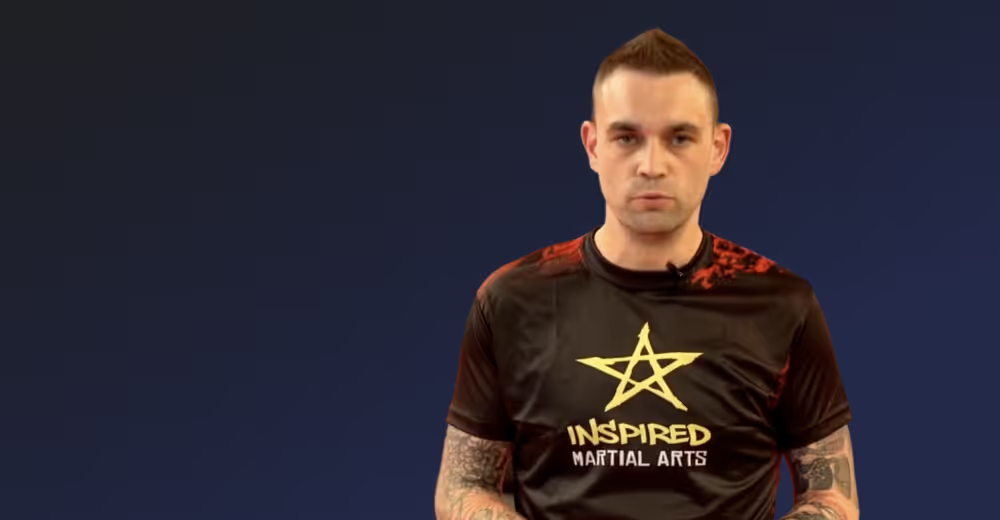
Take the example of Jamie Johannes, Founder at Inspired Martial Arts. After switching to Zenzap, they no longer needed separate apps for to-do lists, document storage, and task management. As Jamie put it, "It is all in one app, which is fantastic." That kind of simplification is not cosmetic. It frees up real mental and operational bandwidth.
When you treat communication as a system instead of a background activity, you create leverage. Every new hire plugs into the same clear structure. Every new project follows the same pattern. Every customer benefit moves through the same well-defined path from idea to task to delivery.
That is what structured communication approaches make possible for SME success, especially when powered by a tool like Zenzap that was designed from the ground up to be intuitive, secure, and mobile-first.
Key takeaways
- Centralize SME communication into one structured hub so conversations, tasks, and files stop scattering across personal apps and email.
- Design clear Zenzap spaces and channels that mirror your teams and projects, so everyone knows exactly where to share or find information.
- Turn important chat messages into tasks with owners and deadlines, keeping work tightly linked to context and reducing missed commitments.
- Use integrations, working hours, and scheduled messages to balance responsiveness with healthy work-life boundaries.
- Leverage Zenzap's security and admin controls to protect data, control access, and maintain a reliable, scalable communication system as you grow.

Reaching the top: from scattered noise to a structured SME advantage
You started at the base, with scattered communication and ad hoc decisions that were hard to track. Step by step, you moved toward a more structured approach: one hub for SME communication, clear spaces that mirror your business, tasks tied directly to conversations, integrated calendars, protected boundaries, and secure ownership of your data.
Each step builds on the last. When everything is centralized, structure works. When structure is in place, tasks become reliable. When tasks are reliable, integrations make your day smoother. When your whole system is secure and respectful of personal time, people feel safe to do their best work.
Zenzap is built to make this climb easier. It feels as simple as the personal apps your team already uses, but it adds the structure, security, and organization your SME needs to actually scale.
The question now is not whether you can keep juggling ten unstructured tools a little longer. The question is: what would your business gain if every conversation, task, and decision finally lived in one structured, secure place that your entire team could trust?
FAQ
Q: Do I still need a separate project management tool if I use Zenzap for SME communication?
A: Many founders find they can reduce or even replace light project tools once they fully use Zenzap's task features. For complex, long-running projects, you might still use a specialized tool, but day-to-day SME communication, follow-ups, and operational tasks can live entirely inside Zenzap. Start by converting decisions in chat into tasks, then review after a month to see how much external tooling you really need.
Q: How do I encourage my team to stop using personal apps for work messages?
A: Set a clear, company-wide policy that all work communication and files live in Zenzap. Model the behavior yourself as a founder. When someone messages you about work in a personal app, reply in Zenzap instead and gently redirect them. You can also phase out informal groups by closing them and posting, "We are moving this discussion to the 'Ops Team' channel in Zenzap so nothing slips through the cracks."
Q: Will Zenzap work with the tools my SME already uses, like Google Workspace?
A: Yes. Zenzap integrates with Google Calendar so meetings and shifts stay aligned with your chats and tasks. You can also connect other key tools so updates flow directly into relevant Zenzap spaces. This turns Zenzap into the communication layer for your existing stack instead of forcing you to rebuild everything from scratch.
Q: How secure is Zenzap compared to typical consumer messaging apps?
A: Zenzap is designed for business use, with enterprise-grade security, encrypted communication, and admin controls over access. Unlike personal apps, you can manage who joins, what they see, and what happens when they leave. This makes it far safer for handling client data, internal documents, and sensitive decisions.
Q: How quickly can a small team adopt Zenzap without heavy training?
A: Zenzap is intentionally mobile-first and intuitive, so most teams can start using it within a day. Begin with a simple workspace structure and a few clear norms, then let people explore. The interface feels familiar to anyone who has used modern messaging apps, so adoption is usually smooth without formal training sessions.
Q: What size of SME benefits most from structured communication in Zenzap?
A: Even a 5-person team benefits from structured SME communication, because you create good habits before chaos sets in. The payoff grows as you reach 15, 30, or 50 people, where miscommunication and lost tasks become much more expensive. If you already feel messages slipping through the cracks, that is a strong sign you are ready for a more structured approach.

Take Control of Your Team Communication
Chat, organize, and get work done - all in one place.
Other Blog Posts
- fskfsfjksofjsj