
.svg)

.svg)

.svg)

.svg)

.svg)

.svg)

.svg)

.svg)

.svg)

.svg)
.svg)
























Everything You Need To Know About Task Management In Chat For Startup Founders
You already live in chat. Most of your product ideas, hiring decisions, and customer promises start as quick messages. The problem is simple: if those messages never become tasks, your startup runs on luck instead of a reliable system.
Task management in chat fixes that. By turning the same messages you are already sending into clear, owned tasks, you cut tool overload, boost accountability, and protect your own sanity. Zenzap is built around this idea, so you can manage work where it actually starts: in conversation.
Table of contents
1. Why task management in chat is a game changer for startup founders
2. How Zenzap turns messages into reliable execution
3. Common questions about task management in chat
4. How this improves accountability and ownership
5. What this means for your work-life balance
6. Key takeaways
7. FAQ
Why task management in chat is a game changer for startup founders
Imagine never having to ask, "Who owns this?" or "Where did we decide that?" again. Every important message in chat is either a task with an owner and deadline, or it is noise you can safely ignore.
Right now, you probably juggle a mix of tools: email for long threads, a personal messaging app for quick questions, a project board for tasks, and maybe a spreadsheet or two. Research estimates that knowledge workers spend up to 28% of their time just managing email. Add chat and project tools on top, and context switching quietly eats your day.
This is where task management in chat changes everything for you as a founder. Instead of hopping between project boards, email, and messaging apps, you manage tasks right where conversations happen. You keep the speed of chat, but add the structure of a real task system.
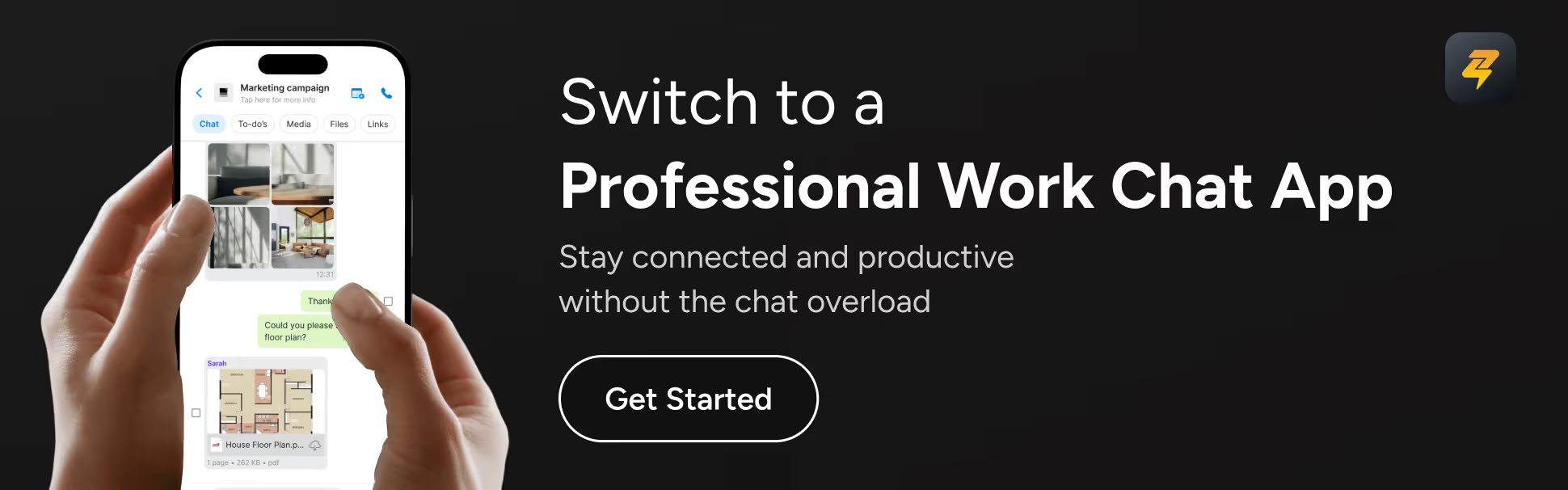
Zenzap, a mobile first internal communication app, is built specifically around this idea. Any message can become an actionable task. You assign it, track it, and close the loop, all inside the same workspace, without asking your team to learn a heavy project management tool.
In practice, this means fewer missed deadlines, fewer "forgotten" promises, and a lot less mental load for you and your leadership team. Instead of running your startup from memory, you run it from a living task system that grows naturally out of your chat.
How Zenzap turns messages into reliable execution
Task management in chat sounds simple, and that is the point. With Zenzap, you handle task creation, assignment, deadlines, and updates directly inside your team chat app.
Here is what that looks like for you as a founder:
You are in a product channel, talking about onboarding friction. Someone types, "We should simplify the trial sign up flow before next month." In a traditional setup, that comment floats away. Maybe someone copies it to a backlog later. Maybe not.
In Zenzap, you highlight that message, convert it into a task, assign it to your product lead, and set a due date. The original conversation stays attached to the task, so nobody has to dig through old threads for context. The task now shows up on that person's plate, visible to the rest of the team.
The same thing happens with client work. An account manager answers a question in chat, attaches the relevant contract, and turns the next steps into tracked tasks within the same thread. Everyone can see what was promised, who owns it, and when it is due.
Common questions about task management in chat
As a founder, you might be asking some very practical questions before you move your team into this way of working. Let us walk through the big ones.
Q: What is task management in chat for startup founders using Zenzap?
A: Task management in chat means you create, assign, and track tasks directly inside your team conversations. In Zenzap, any message can become a task with an owner and a due date. You do not need to open a separate project management tool for daily execution, because the work and the discussion stay in the same place.
Q: How do I start using task management in chat with Zenzap?
A: Start by centralizing your internal communication in Zenzap. Create the core workspaces and channels that mirror how your startup actually runs, such as "Product," "Growth," "Customer Support," and "Founders." Then set one simple rule for your team: whenever a decision or action item appears in chat, highlight the message, convert it into a task, assign it, and set a deadline.
Within one or two weeks, this habit turns your chat into a living task board your team will actually use. Every vague "we should" becomes a specific "who does what by when."
Q: Will task management in chat replace my existing project management tool?
A: For many early stage startups, yes, at least for most day to day work. Zenzap can handle tasks, discussions, and scheduling in one place. If you run large, complex projects that require advanced reporting or external client access, you might keep a lightweight project tool for those edge cases, while letting Zenzap run your internal execution.
Plenty of founders start by using Zenzap for all internal tasks, then slowly retire old tools as they see how much less friction their team experiences.
Q: How does Zenzap integrate with calendars and other tools?
A: Zenzap integrates with Google Calendar, so you can connect tasks directly to time. You can, for example, turn a key task into a calendar event and attach the relevant channel. This reduces missed meetings and deadlines because your team is not juggling separate calendars, spreadsheets, and chat logs.
Zenzap also connects with popular storage and productivity tools. That means you can keep your existing workflows, but you capture and track every next step inside chat instead of spreading them across apps.
How this improves accountability and ownership
As your team grows from three people around a table to ten or twenty across time zones, accountability becomes your main headache. Who is doing what, and how do you know it will actually get done?
Integrated task management shines a spotlight on ownership. With Zenzap, every task has a face and a deadline, not a vague "we" and "sometime soon." You can easily see what is on your plate, what is overdue, and what the team is working on.
In practical terms, that means:
You can turn any message into a to do with a click. You assign it to a teammate, add a due date, and keep the conversation attached.
You can see, inside each channel, which tasks are open, who owns them, and what has changed since they were created.
Your team no longer has to guess who is responsible. Ownership is visible to everyone.
Teams that adopt this approach often report fewer status meetings, fewer "I thought you were handling that" moments, and a lot more predictable delivery. Progress is not buried on a board that nobody checks. It is visible where everyone is already looking, inside chat.
One finance team mentioned in Zenzap reviews put it simply: "When everything is structured, nothing slips through the cracks." That is exactly the feeling you want in your startup, especially when deadlines stack up or investors are watching closely.
What this means for your work-life balance
Founders are famous for working all hours, but that does not mean you want your whole team living that way. If your internal communication runs through personal apps, your people never really switch off. Their phone buzzes, they look, and suddenly they are back at work at 11 pm.
Zenzap fixes this by separating professional chat from personal messaging, and by baking healthy boundaries directly into how task management in chat works.
Here is what that looks like:
Work lives in Zenzap, not in personal messaging apps, so your team can choose when to be "in the office."
People can set working hours, so notifications stay silent when they are off the clock.
You can schedule messages (and the tasks attached to them) to send during their local workday.
Imagine you are based in London and your lead engineer is in Toronto. You finish a late investor call and think of three changes you want in the next sprint. Instead of pinging their phone at 1 am, you write your messages, convert each into a task, and schedule them to send at 9 am their time. Zenzap notifies them when their workday begins, so they stay rested and still see everything on time.
This kind of thoughtful communication protects your culture and your brand as a leader. You still get the benefits of structured task management in chat, but you are not teaching your team that they must respond at all hours to keep up.
Key takeaways
- Centralize your startup communication in Zenzap so every important message can become a trackable task in chat.
- Turn each "we should" into "who does what by when" by converting decisions in chat into owned tasks with clear deadlines.
- Use Zenzap's Google Calendar integration to link tasks to real time and cut missed meetings and deadlines.
- Protect your team's work-life balance by keeping work chat separate from personal apps and using scheduled messages.
- Rely on Zenzap's enterprise grade security to keep internal conversations, files, and tasks protected as you scale.

FAQ
Q: Can I really manage all my startup tasks inside Zenzap chat?
A: Yes. With Zenzap, any message can be converted into a task with an owner and deadline. You handle creation, assignment, updates, and completion directly in chat. For day to day execution, most founders find they no longer need a separate project board for internal work.
Q: How do I keep tasks organized as my team grows?
A: Organize channels around how your business actually runs: by teams, projects, and key clients. Within each channel, keep the habit of turning decisions into tasks. Zenzap keeps tasks attached to their original conversations and makes everything searchable, so even as you scale, you can find who decided what and when.
Q: What about security for sensitive founder and investor conversations?
A: Zenzap provides enterprise grade security, including encrypted communication and secure onboarding and offboarding. Admins control who can access each workspace and channel, and access is removed cleanly when someone leaves. Compared to using personal chat apps for work, this is a significant upgrade in control and compliance. You can read more about secure team chat in Zenzap's content at Zenzap's blog.
Q: How does task management in chat reduce tool fatigue for my startup?
A: Instead of splitting work between chat, email, project boards, and documents, you keep most of your execution in one place. Messages, files, tasks, and schedules live together. That means fewer logins, fewer forgotten tools, and less time wasted jumping between tabs. Studies on context switching, such as those summarized by the American Psychological Association, show that reducing tool switching can significantly protect focus and performance.
Q: What is a simple first step I can take this week?
A: Move one core team or project into Zenzap, such as "Product" or "Customer Support." Agree as a team that every decision or "we should" in that channel must be turned into a task with an owner and due date. Run that experiment for two weeks. You will quickly see fewer dropped balls, clearer ownership, and a calmer mind for you as a founder.
You already know that your startup runs in chat. The real question is whether those conversations quietly disappear, or consistently turn into shipped work. How much longer do you want your most important ideas to live as messages that never become actions?

Take Control of Your Team Communication
Chat, organize, and get work done - all in one place.
Other Blog Posts