.svg)

.svg)

.svg)

.svg)

.svg)

.svg)

.svg)

.svg)

.svg)

.svg)
.svg)























Google Chat vs Zenzap: Comparing subscription chat tools for small business communication
You do not have a communication problem. You have a tool problem.
Your team is probably jumping between email, group chats, WhatsApp, and maybe a project tool, trying to keep work moving. Messages get buried, files disappear, and nobody is quite sure where the latest update lives. At the same time, you know you cannot afford bloated software that needs weeks of onboarding.
This is exactly where the comparison matters for you as a small business. You have Zenzap, a focused, mobile-first work chat app built specifically to keep small teams organized, secure, and sane.
In this article, you will see a clear, point-by-point comparison of subscription chat tools for small business communication. You will see where basic chat is enough, where it holds you back, and how Zenzap turns everyday conversations into trackable, secure, and structured workflows your team can rely on.
By the end, you will know exactly which tool fits your team today and supports where you want to be in 12 to 24 months.
Table of contents
1. Why your small business chat tool matters more than you think
2. Overview of Zenzap
3. Real small business scenarios: which tool actually helps?
4. Pricing, freemium limits, and long-term value
5. Key takeaways
6. Final thoughts
7. FAQ
Why your small business chat tool matters more than you think
If you are like most small businesses, every person wears three or four hats. You cannot afford confusion, repeated work, or missed messages. According to a report by McKinsey, knowledge workers spend up to 28% of their time on email and another large chunk searching for information between tools. That is a huge productivity drain for a five, ten, or twenty person team.
Your internal communication app silently shapes how your team collaborates. When your chat tool is too basic, important decisions are hidden in long threads and forgotten. When it is too complex, your team avoids it or uses WhatsApp instead. Either way, you pay the price in lost time, stress, and avoidable mistakes.
This is why choosing the right chat app is not just a "which app looks nicer" decision. It is about whether your day-to-day communication naturally turns into clear tasks, timelines, and accountable ownership, or whether you are constantly chasing people for updates.
For small businesses that need simple, secure, and structured communication without heavy IT setup, the right chat app can easily pay for itself through time saved, fewer errors, and smoother onboarding.
Now let us look at what Zenzap actually offers.
Overview of Zenzap
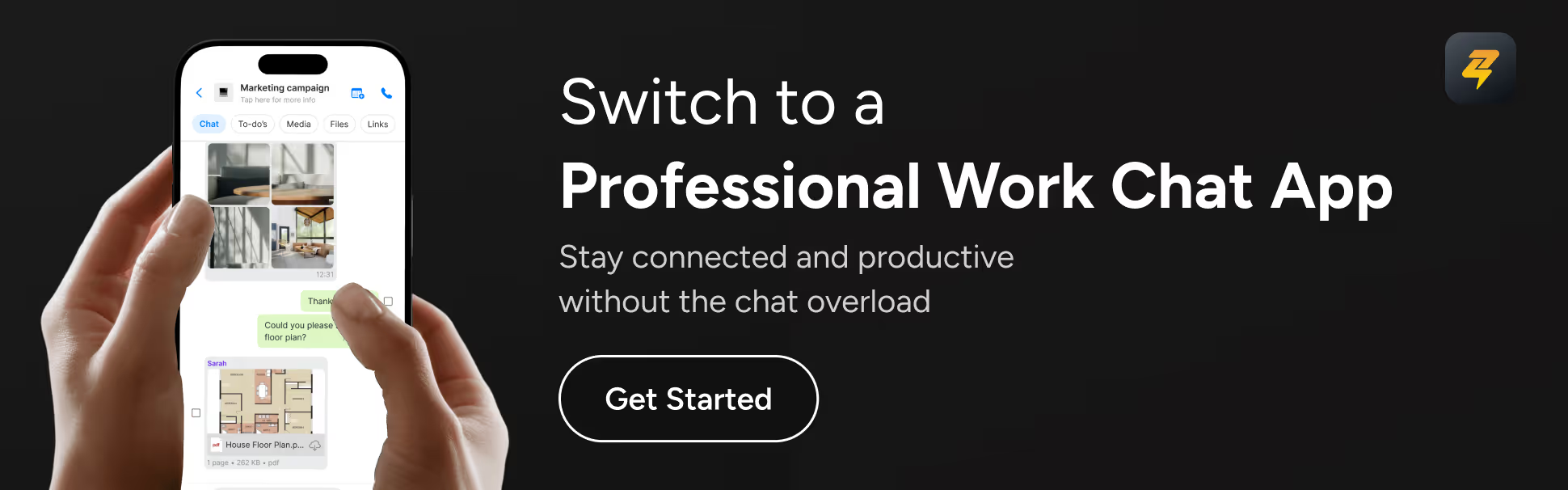
Zenzap is a dedicated internal communication app built for small and medium businesses that want structure without complexity. It is mobile-first, which means your team can adopt it quickly on phones as well as desktops, with almost no training.
Zenzap focuses on:
- Simple, intuitive work chat that feels like a familiar messaging app
- Tasks that sit directly inside conversations
- Unlimited group chats and built-in to-dos, even on the free plan
- Organized chat folders and project channels
- Google Calendar integration so deadlines and events are visible
- Enterprise-grade security, onboarding, and one-click offboarding
- Built-in work-life balance controls such as working hours and scheduled messages
According to the Zenzap pricing page, you can start on a Free Forever plan for up to 20 users, with team access and permissions, unlimited group chats, unlimited built-in to-dos, working hours, scheduled messages, WhatsApp migration, and 1 GB of secure file storage included at £0.
Zenzap brings everything together and includes features that make it the complete solution while staying easy to use.
Key features comparison
Simplicity and onboarding
Google Chat: familiar but basic
Google Chat is easy to start using, especially for teams already inside the Google ecosystem. Because it works alongside Gmail and Google Workspace, many employees can begin chatting without installing new tools or learning a completely new interface.
However, Google Chat's simplicity also means it lacks built-in structure. Messages live primarily inside threads and spaces, which can quickly become long conversation streams where important information gets buried.
Small businesses often find themselves relying on memory or manual follow-ups because the platform does not automatically turn discussions into structured work.
Zenzap: messaging designed for work execution
While Google Chat focuses on conversation, Zenzap is designed for action.
Tasks can live directly inside the chat where the conversation happens. Channels remain organized by project or team, and important items stay visible instead of disappearing in long message threads.
For small teams that want communication to naturally turn into clear ownership and deadlines, this structure becomes a major advantage.
You need a tool your team actually wants to use. If adoption is slow, your carefully chosen chat app turns into yet another unused icon.
Zenzap is designed for instant adoption. The interface looks and feels like modern messaging, so your team can pick it up without training. Channels are clearly organized, tasks live directly inside conversations, and navigation is mobile-first.
From day one, your team sees Zenzap as the dedicated home of work communication. You invite people, set basic permissions, and they are productive within minutes.
Task management and structure
Google Chat: messaging with limited task structure
Google Chat does allow integrations with tools like Google Tasks or other project management apps. However, these tasks are usually managed outside the conversation, meaning teams must jump between multiple tools.
For small businesses trying to keep operations simple, this creates friction. Conversations happen in chat, tasks live somewhere else, and accountability often relies on manual reminders.
Zenzap: tasks built directly into conversations
Zenzap eliminates this gap.
Important messages can become tasks instantly. Those tasks stay connected to the original discussion, with clear owners and deadlines.
Instead of juggling chat plus task software, your team works inside a single structured environment.
For small businesses trying to avoid tool overload, this design dramatically simplifies day-to-day collaboration.
Organization and channels
Google Chat: flexible spaces but limited structure
Google Chat organizes conversations using spaces and threads, which works well for casual collaboration and quick discussions.
However, as the number of conversations grows, spaces can become crowded and harder to navigate. Files, decisions, and tasks often live across multiple tools like Google Drive, Docs, or Sheets rather than inside the chat itself.
This means information may be technically available but still difficult to find quickly.
Zenzap: structured communication for growing teams
Zenzap focuses on structured organization from the start.
Projects can have dedicated channels. Tasks remain visible within those channels. Files stay attached to the conversation that created them.
For a small business managing multiple clients or projects, this structure makes it much easier to maintain clarity as the team grows.
Integration with existing tools
Google Chat: strong integration inside Google Workspace
One of Google Chat's biggest strengths is its connection with the broader Google ecosystem. It integrates naturally with Gmail, Google Drive, Google Meet, and Google Calendar.
For companies that already operate entirely within Google Workspace, this integration can make collaboration convenient.
However, these integrations also mean that work often spreads across multiple Google apps rather than staying centralized in one place.
Zenzap: focused integrations without complexity
Zenzap takes a different approach.
Instead of relying on multiple separate tools, it keeps chat, tasks, and collaboration inside the same workspace.
Integrations such as Google Calendar exist to support workflow, but the goal is to reduce the number of tools your team needs to juggle each day.
For small businesses that value simplicity and focus, this approach can dramatically reduce context switching.
Real small business scenarios: which tool actually helps?
Scenario 1: A 10-person agency juggling client projects
Imagine you run a 10-person marketing agency. You handle six active clients at any time, each with its own deadlines, assets, and approvals.
With Zenzap, each client gets a dedicated channel with:
- Chat, tasks, and files all in one view
- Clear to-dos linked to conversation
- Upcoming deadlines visible through Google Calendar integration
When you onboard a new account manager, you simply add them to the relevant Zenzap channels. They immediately see the full context and outstanding tasks without needing a separate project tour.
Scenario 2: A distributed team on different time zones
Now picture a 15-person remote software company spread across Europe and North America.
Zenzap helps you set clear norms through:
- Working hours for each person, so notifications respect their time zone
- Scheduled messages, so you can write when you are online, but deliver during their working day
This leads to healthier collaboration, fewer interruptions, and better focus blocks for deep work.
Pricing, freemium limits, and long-term value
When you compare chat tools, you need to look at value, not only the line item on your invoice.
According to the Zenzap pricing page, the Free Forever plan includes for up to 20 users:
- Team access and permissions control
- Unlimited group chats
- Unlimited built-in to-dos
- Admin content moderation
- Working hours and notification control
- Scheduled messages
- Organized chat folders
- Chat calendar integration
- WhatsApp groups migration
- Customer support
- 1 GB secure file storage
Paid plans such as Pro and Business+ add more storage, advanced task management, integrations, data controls, and enterprise-level security options at per-user pricing that is competitive for small teams.
The real value is that Zenzap reduces the time you spend onboarding, chasing updates, and recovering from miscommunication. For a small team, even saving one or two hours per person per week quickly outweighs the price of a focused communication tool.
Work-life balance, focus, and burnout prevention
Stressful communication flows are not just uncomfortable. They directly reduce productivity and morale. If your team feels they must react instantly to every message, you get shallow work and constant context switching.
Zenzap bakes work-life balance into the product itself with working hours, notification control, and scheduled messages. It helps you build a culture where deep work and downtime are respected, without losing responsiveness during agreed hours.
This is particularly powerful for small businesses where one burned-out employee has an outsized impact. Protecting your team's focus is not a luxury. It is a competitive advantage.
Security, control, and offboarding
For small businesses, secure communication is often handled informally until there is a problem. Maybe a former contractor still has access to a WhatsApp group. Maybe sensitive files are stored in a shared drive with unclear permissions.
Zenzap treats this as a core use case. Admins can see who has access to what, control permissions centrally, and offboard people with a single action that removes their access to your internal communication and data.
For any small business that has to meet client security expectations, handle audits, or simply sleep better at night, this kind of control is worth prioritizing.
Key takeaways
- Choose a chat tool that turns conversations into visible tasks and workflows, not just more noise.
- Use Zenzap when you need built-in task management, structured channels, and small business-friendly admin control.
- Protect your team's focus with tools like working hours, scheduled messages, and notification control.
- Look beyond the "free" label and compare the total time, tools, and risks involved in each option.

Final thoughts
When you evaluate subscription chat tools for small business communication, you are really choosing between "basic messaging" and "a focused workspace where conversations, tasks, and security all live together."
Zenzap is built for exactly that kind of growth. You get intuitive chat, tasks inside conversations, organized channels, calendar visibility, enterprise-grade security, and thoughtful work-life balance features. You can start on a Free Forever plan, prove adoption with your team, then scale into more advanced plans when you are ready.
The real question is not "which app has more features." It is: which tool will your team happily live in every day, so that communication becomes simple, secure, and stress-free instead of one more thing to manage?
FAQ
Q: What makes Zenzap different from other chat tools for small teams?
A: Zenzap is built specifically for small and medium businesses that want intuitive chat plus structure. You get tasks directly inside conversations, organized channels and folders, working hours, scheduled messages, and one-click offboarding. Zenzap focuses on turning every conversation into clear, secure, and trackable work.
Q: How much does Zenzap cost?
A: Zenzap offers a Free Forever plan for up to 20 users with unlimited group chats, unlimited built-in to-dos, working hours, scheduled messages, and 1 GB of secure storage. Paid Zenzap plans add more storage, advanced tasks, integrations, and enterprise-level security at per-user pricing that is designed for small teams. Visit the Zenzap pricing page for full details.
Q: How does Zenzap help with work-life balance?
A: Zenzap includes explicit features for work-life balance, such as working hours, notification control, and scheduled messages. You and your team can set when you want to be notified, and messages sent outside those hours can be scheduled to arrive later. This provides a system-wide approach to boundaries and healthy responsiveness.
Q: Is Zenzap secure for handling sensitive business information?
A: Yes. Zenzap provides enterprise-grade security including encrypted communication, team access and permissions control, admin content moderation, and one-click offboarding. Higher plans offer SAML, SCIM, SSO, data archiving, audit logs, and enterprise encryption key management. This makes Zenzap suitable for businesses handling client data, financial records, or regulated information.
Q: Can I integrate Zenzap with my existing business tools?
A: Yes. Zenzap integrates with Google Calendar so deadlines and events are visible inside your workspace. It also offers integrations with key business tools and CRMs, plus WhatsApp migration to move group chats into a professional environment. Higher plans provide API integration and custom integrations for deeper connectivity.
Q: How quickly can my team start using Zenzap?
A: Very quickly. Zenzap is designed for instant adoption with a mobile-first interface that feels like familiar messaging apps. Your team can pick it up without training. You simply invite people, set basic permissions, and they are productive within minutes. The intuitive design means no lengthy onboarding process is needed.

Take Control of Your Team Communication
Chat, organize, and get work done - all in one place.
Other Blog Posts