
.svg)

.svg)

.svg)
.svg)

























If you feel like your distributed team is talking more than ever but aligning less, you are not alone. Many teams are stuck juggling personal messaging apps, email, and heavyweight collaboration suites, then wondering why projects still slip and people still burn out.
This article walks you from that big-picture frustration into a clear answer. You will see why traditional tools struggle with modern distributed work, what actually makes a collaboration chat app reliable, how Zenzap stacks up against common alternatives, and how you can give your team simple, secure, structured communication that respects their time and your data.
Table of contents
1. Why distributed teams struggle with collaboration chat apps
2. What "reliable" really means for a collaboration chat app
3. Where popular chat tools fall short for distributed teams
4. How Zenzap gives distributed teams a better collaboration chat app
5. Core insight: choose messaging plus accountability, not just chat
6. Key takeaways
7. A better way forward for your distributed team
8. FAQ
Why distributed teams struggle with collaboration chat apps
Is your "collaboration stack" actually creating more work than it saves?
For many distributed and remote teams, work conversations are scattered across WhatsApp, personal SMS, email, and a patchwork of tools that were never designed to be a single source of truth. Messages get lost, decisions are unclear, and nobody is entirely sure where the latest version of anything lives.
At the same time, your people feel like they are always on. When work chat happens inside personal apps, evenings and weekends blur into one long notification stream. That might look like responsiveness on the surface, but underneath it quietly drains focus, morale, and trust.
The irony is hard to miss. You invest in "collaboration" tools so your distributed team can move faster, yet you end up with more noise, more tabs, and more follow-up meetings to clarify what was supposed to be clear in the first place.
If this sounds familiar, it is not because your team is unorganized. It is because your tools are. And that is exactly the problem Zenzap set out to solve.
What "reliable" really means for a collaboration chat app
When you ask where distributed teams should turn for a reliable collaboration chat app, you are really asking a bigger question: what does reliability look like when your team is spread across locations, devices, and time zones?
It is not just about uptime or whether messages send quickly. Those are table stakes. Reliability for distributed work has five layers:
1. Clarity. Everyone knows where to look for information, who owns what, and what happens next.
2. Boundaries. People can disconnect without fear, and managers can still reach the right person when it is truly urgent.
3. Security. Company data does not live on personal phones or drift away when someone leaves.
4. Accountability. Tasks do not disappear into endless chatter, and you can see progress without micromanaging.
5. Simplicity. If your team needs training to use it, adoption will stall and side channels will thrive.
Research from teams that connect chat directly to tools and workflows has shown productivity gains of around 24 percent when communication and execution live in one place. You feel that shift when discussions turn into documented tasks, calendars stay in sync, and files are easy to find.
A reliable collaboration chat app should make that level of clarity the default, not something you hope people will create manually.
Where popular chat tools fall short for distributed teams
The market is crowded with team chat apps. Some grew out of consumer messaging, others out of heavy enterprise platforms. Each covers part of the problem, but for many distributed teams, there are consistent gaps.
Personal messaging apps and email
If your team still runs significant work communication through WhatsApp, SMS, or personal email, you already see the cracks.
Work conversations sit next to family photos and weekend plans. Employees feel like they are always reachable. When someone leaves, so does your chat history, files, and sometimes sensitive client information. There is no admin control, no clean onboarding and offboarding, and no clear way to separate work from life.
Heavy collaboration suites
On the other side, you have large collaboration suites that are powerful but complex. They were built around meetings, documents, and enterprise identity first, then chat was layered in later.
For many distributed teams, especially smaller businesses, franchises, clinics, field operations, and fast-growing companies, it is too much tool for what you actually need. The result is low adoption, side-channel messaging, and a lot of confusion about which tool to use for what.
Pure chat apps with no operational backbone
Then there are tools that are great at messaging but light on structure and accountability. You can chat, send files, and maybe create channels, but tasks, schedules, and workflows still live somewhere else.
That split might not hurt in a tiny startup, but once you have multiple teams, shifts, or sites, important work gets trapped inside conversations. Managers resort to spreadsheets or separate project tools to track who is doing what and by when.
For a distributed team, a reliable collaboration chat app has to bridge messaging and operations, without turning into a bloated all-in-one that nobody wants to touch.
How Zenzap gives distributed teams a better collaboration chat app
Zenzap was built specifically for internal work chat. Not customer support, not marketing campaigns, but the everyday conversations that keep your business running.
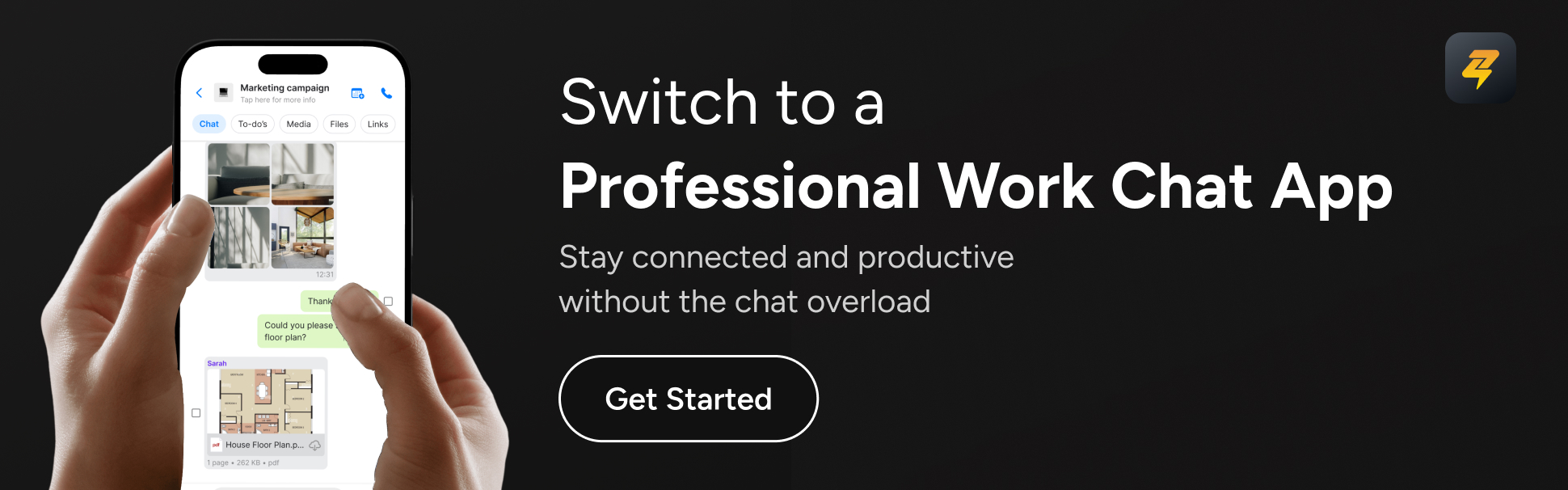
It takes the simplicity of texting, adds the structure of a professional workspace, and wraps everything in enterprise-grade security and admin control. If your team can send a text message, they can use Zenzap on day one. No training, no rollout drama.
Keep work and personal life clearly separate
For distributed teams, boundaries are not a nice-to-have. They are essential if you want people to stay productive and avoid burnout.
Zenzap gives you working hours and scheduled messages so you can protect personal time without losing operational control. Your team sets when they are on the clock. Notifications pause when they are off, and messages can be scheduled to arrive during business hours.
If you have been using WhatsApp or personal texting for work, this single shift reshapes your culture. Work moves into a dedicated professional space. Personal chat stays personal. Managers still have a reliable way to reach people who are on shift, while everyone else can unplug without guilt.
Turn conversations into tasks and accountability
Every distributed leader knows the pain of "talked about but never done." You agree on next steps in a chat or meeting, then two weeks later discover that nobody captured the action items.
With Zenzap, you can turn messages into tasks and checklists directly inside the conversation. Assign owners, set reminders, and track progress in real time. There is no need to copy-paste into a separate project tool unless a task truly belongs in a bigger project.
Because tasks live where the discussion happened, context is always one tap away. That means fewer status meetings, fewer "just following up" messages, and a lot more clarity about who is on the hook for what.
Structure your team chat like your business
Distributed teams work across departments, locations, shifts, and projects. Zenzap lets you mirror that structure in your chat environment.
You can create separate group chats for departments, sites, clients, or initiatives, and you can control exactly who sees what. That gives you clarity over chaos. Discussions stay on topic and easy to find. New hires know where to go for each type of question.
One founder described it this way: "Zenzap was the professional upgrade we needed. Now I can track what is getting done without having to ask." When your chat mirrors your org chart and workflows, everyone moves faster with less friction.
Centralized, secure, company-owned data
For any distributed business, data security is not optional.
With Zenzap, all conversations, files, and media are stored securely in the cloud, not on personal phones. That alone reduces a massive amount of risk compared with consumer messaging apps.
Admins get full control over who can create chats, join groups, access information, and manage the team. Onboarding is instant. New hires get access to the history they need from day one. Offboarding is one click. Accounts are locked, access is revoked, and your data stays where it belongs.
Zenzap also hides personal phone numbers, so employees can communicate professionally without sharing private contact details. For industries like healthcare, logistics, construction, and hospitality, that combination of privacy and control is a major relief.
Built-in integrations that reduce tab overload
A reliable collaboration chat app should pull your tools together, not force you to juggle them.
Zenzap integrates with key business tools like Google Calendar, Zoom, Microsoft Office, and leading cloud drives. That means you can see upcoming events, share documents, and get automated updates right inside the chat where work is actually being discussed.
Teams that link chat directly to their task and calendar tools can see productivity gains of around 24 percent. You feel that in fewer context switches, less manual copying, and smoother handoffs across time zones.
Advanced search so nothing slips through the cracks
Distributed teams generate hundreds of chats every week. If you cannot find what you agreed on, you might as well not have agreed at all.
Zenzap gives you advanced search with smart filters, people, and topic tags so you can locate any message or file in seconds. Need that "Q4 launch plan" message or the latest version of a proposal? One search and you are there, without endless scrolling or guesswork.
Core insight: choose messaging plus accountability, not just chat
If you zoom all the way in, the most important decision for a distributed team is this: do you want another chat app, or do you want a communication layer that also drives accountability and protects your business?
Reliable collaboration for distributed teams is less about adding features and more about aligning a few critical needs:
- One secure, company-owned place for all work communication
- Clear separation between work and personal life
- Built-in tasks, checklists, and reminders so talk becomes action
- Simple, intuitive design that requires no training
- Integrations with your core tools so you are not copy-pasting all day
- Admin controls for fast onboarding, safe offboarding, and data protection
Zenzap was designed around those exact requirements. That is why you see it adopted by franchises, healthcare providers, logistics companies, construction teams, hospitality brands, and small businesses that need to keep staff aligned across many sites and schedules.
When you choose a collaboration chat app that gives you messaging plus accountability, your distributed team stops treating chat as a noisy side channel and starts using it as the backbone of how work gets done.
Key takeaways
- Stop relying on personal messaging apps for work and move your distributed team into a secure, company-owned collaboration chat app.
- Look for features that protect work-life balance, such as working hours and scheduled messages, so your team can unplug confidently.
- Choose a tool that combines messaging with built-in tasks, structured organization, and integrations so conversations reliably turn into action.
- Use admin controls, instant onboarding, and one-click offboarding to keep your data safe as people join and leave.
- Consider Zenzap if you want a simple, mobile-first, business-focused work chat that is easy to adopt and built for accountability.

A better way forward for your distributed team
Your team does not need another overcomplicated platform or another informal group chat. You need a collaboration chat app that your people will actually use, that gives you control over your data, and that quietly reinforces the culture you want to build.
Zenzap gives you that blend of intuitive simplicity, structured organization, bulletproof security, and real work-life boundaries. If you can text, you can use it. If you manage a distributed team, you can finally see what is happening without micromanaging or drowning in tools.
The question is not just "Where should distributed teams turn for a reliable collaboration chat app?" The deeper question is this: how long do you want to keep working around tools that were never designed for the way your team actually works?
FAQ
Q: Why should my distributed team stop using WhatsApp or SMS for work chat?
A: Personal messaging apps mix work and private life, offer no admin control, and store company data on employee phones. When someone leaves, your history and files can leave with them. Moving to a professional work chat like Zenzap centralizes conversations, protects your data, and creates clear boundaries between work and personal time.
Q: How does Zenzap help prevent burnout in distributed teams?
A: Zenzap includes working hours, scheduled messages, and controllable notifications. Your team can set when they are available, mute notifications outside those hours, and still receive scheduled updates when they are back on the clock. That reduces after-hours pressure and lets people truly unplug without missing important information.
Q: What makes Zenzap more reliable for operations than a simple chat app?
A: Zenzap combines chat with built-in tasks, checklists, calendar integration, and structured team spaces. You can turn messages into to-dos, assign owners, and track progress directly in chat. That turns "we talked about it" into "we agreed who will do what and by when," which is crucial for distributed operations.
Q: Is Zenzap difficult to roll out across multiple sites or locations?
A: No. Zenzap is mobile-first and designed for instant adoption. If your team can text, they can use Zenzap with almost no training. Admins can set up structured chats for each site, department, or project, then use one-click onboarding to add people to the right spaces from day one.
Q: How does Zenzap handle security for industries with sensitive data?
A: Zenzap delivers enterprise-grade encryption, granular permissions, and full admin control over access. Messages and files are stored securely in the cloud, not on personal devices, and offboarding is one click. For healthcare, logistics, construction, and other regulated or sensitive environments, this reduces legal and compliance risk compared with consumer apps.
Q: Who is Zenzap best suited for?
A: Zenzap is ideal for businesses of all sizes that need a simple, secure, and structured internal communication platform. It is especially well suited for distributed teams, franchises, field operations, healthcare providers, and any organization looking to replace informal personal messaging with a professional, company-owned work chat solution.
Take Control of Your Team Communication
Chat, organize, and get work done - all in one place.