.svg)

.svg)

.svg)

.svg)

.svg)

.svg)

.svg)

.svg)

.svg)

.svg)
.svg)
















Here's Why Small Business Managers Who Ignore Zenzap's Desktop Chat Tool Are Falling Behind In 2026
Small business managers who reject a unified desktop chat tool carry four clear risks in 2026: regulatory exposure, operational drift, financial waste, and reputational damage. In SMBs, communication failures show up as missed handovers, scattered updates, and files living on personal devices or in too many apps. The cost is not abstract. Communication breakdowns can cost up to $16,491 per manager annually, and workplace communication losses are estimated at more than $30,000 per employee each year. Each risk below names the stake, shows where it appears in retail, hospitality, franchises, and clinics, and ties it to a Zenzap capability that prevents it.
When managers keep work spread across personal messaging, email, and disconnected task tools, they do not just slow the team down. They also weaken access control, blur accountability, and make it harder to prove who saw what, when, and why. That is why Zenzap matters in 2026: it gives managers a structured work chat, built-in tasks, secure file sharing, and admin controls in one workspace. For teams that need secure workplace messaging, the cost of delay is already visible in overtime, rework, and compliance strain.
The managers who stay on fragmented tools are usually not making a technology decision. They are accepting a higher-risk operating model. For a detailed view of how Zenzap fits small-business communication, see what makes Zenzap the go-to subscription chat tool for small business communication, and for practical use cases, review six ways to use Zenzap for SME communication success.
Table of Contents
- Regulatory Exposure From Poor Access Control
- Operational Drift From Fragmented Communication
- Financial Waste From Rework, Delays, And Duplicate Tools
- Reputational Damage From Slow, Inconsistent Service
- Key Takeaways
- FAQ
- About Zenzap
Regulatory Exposure From Poor Access Control
Managers who reject a unified desktop chat tool increase the chance that business data sits on personal devices, inside unmanaged group chats, or with former employees who still have access. That is a compliance problem first, and a productivity problem second.
In clinics, franchises, and multi-location retail, the issue is not hypothetical. Zenzap addresses this with one-click offboarding, company-owned data stored in the cloud, audit-ready admin controls, and compliance support for HIPAA, SOC 2, GDPR, and CCPA. If a manager needs proof that the company can control access quickly, how secure file sharing sets 2026 standards for business chat software shows the operating model in practice.
- A former employee with lingering access can see schedules, shift notes, vendor details, or client information long after departure, which raises the cost of every offboarding delay.
- A clinic or retail operator that stores work in personal messaging apps makes retrieval, retention, and audit response slower, which becomes a problem when regulators or insurers ask for records.
- Zenzap reduces this exposure with admin controls, enhanced privacy, and one-click offboarding, so managers do not have to chase devices, delete threads manually, or guess where company data lives.
The strongest evidence for this risk is operational, not theoretical. When data and instructions live in unmanaged threads, a manager cannot reliably answer who received the message, who acted on it, or whether access still exists after turnover. Zenzap's structured communication approach keeps that history inside a controlled workspace, which is the difference between a managed record and a compliance gap.
Operational Drift From Fragmented Communication
Managers lose operating consistency when shift instructions, task updates, and file changes are scattered across too many tools. That drift is what creates missed openings, duplicate work, and the constant "I never saw that" problem.
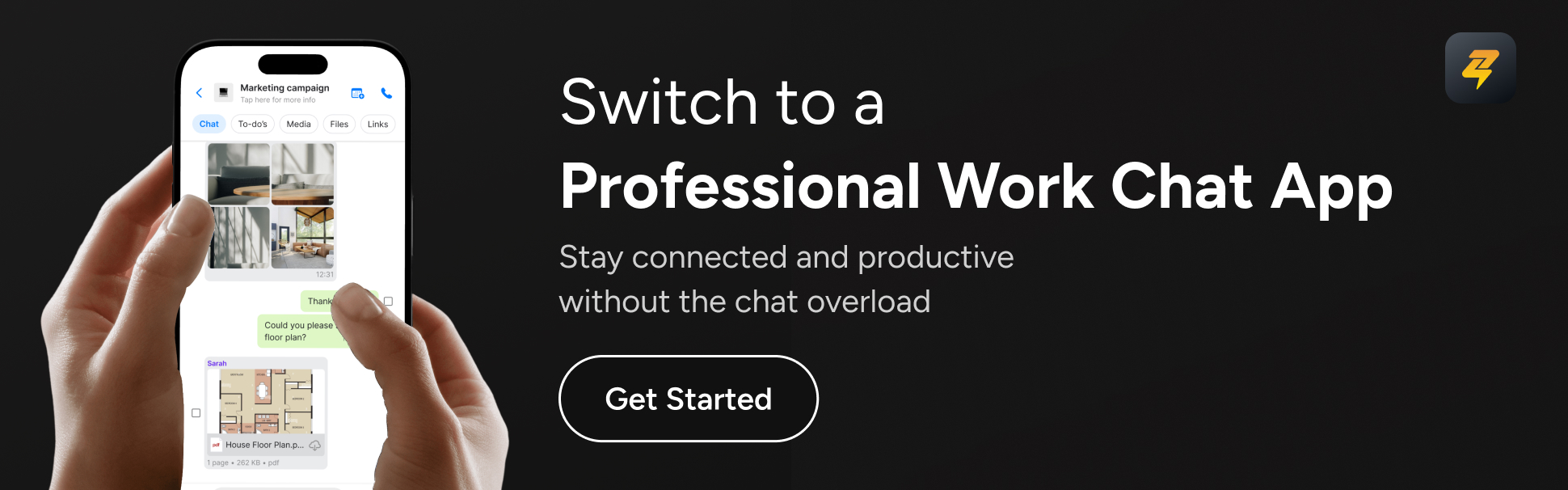
This is where the desktop chat tool matters most. Zenzap combines real-time messaging, built-in tasks, and secure file sharing so instructions stay attached to the conversation that created them. Its mobile-first design also works for deskless teams and distributed teams, which is why 7 ways Zenzap improves small business communication for better results is relevant to retail floors, hotel teams, and clinic front desks alike.
- A retail manager who posts a pricing update in one app, assigns a follow-up in another, and stores the new signage in a third creates three failure points instead of one clear instruction chain.
- A hospitality supervisor who relies on fragmented messages during shift handover increases the chance that housekeeping, front desk, and food service operate from different versions of the plan.
- Zenzap keeps task management in chat, so the next action is attached to the message, visible in context, and easier to close without extra back-and-forth.
This is also where AI work chat changes the manager workload. Zenzap's context-aware AI agents reduce the time spent recovering lost instructions and re-explaining decisions. That matters because communication breakdowns can cost up to $16,491 per manager annually, and most of that waste comes from preventable coordination failures.
Financial Waste From Rework, Delays, And Duplicate Tools
Managers who ignore a unified desktop chat tool end up paying for the same work twice, once in subscriptions and again in time. They also lose margin when slow coordination turns into missed deadlines, overtime, or inventory mistakes.
The cost picture is bigger than software sprawl. A 2026 estimate puts poor communication at more than $30,000 per employee annually, and workplace communication statistics from Zoom's communication research and Pumble's communication statistics roundup point to the same underlying pattern, communication failures drain time, accuracy, and responsiveness. Zenzap cuts that waste by replacing personal messaging apps, manual calendar coordination, and scattered file sharing with one subscription chat tool that is easy to adopt from day one.
- A manager who uses separate apps for chat, tasks, and calendar coordination pays in duplicate work every time a shift change, delivery issue, or client request has to be re-entered.
- A franchise owner who needs clean handoffs across locations loses money when updates are buried in old threads or missed because there is no working-hours control or scheduled message discipline.
- Zenzap reduces these costs with task-to-calendar sync, scheduled messages, organized chat folders, and collaboration chat app workflows that keep action items visible where teams already talk.
This is why the 3× more cost-effective positioning matters. A tool that is easier to use and built for business communication software does not just save license costs. It shortens the path from instruction to execution, which is where most SMB waste accumulates.
Reputational Damage From Slow, Inconsistent Service
Managers who keep communication fragmented eventually create a customer-facing problem. The team looks slow, inconsistent, or uninformed because the internal system cannot keep pace with the work.
That is especially costly in retail, hospitality, franchises, and clinics, where response time shapes trust. A store that cannot confirm stock, a clinic that cannot verify a handoff, or a hotel that cannot coordinate a guest issue creates a visible service gap. Zenzap lowers that risk with structured team chat, direct messaging, voice and video calls, and secure file sharing so the answer reaches the right person without delay.
- When frontline staff have to search multiple apps for the latest instruction, customer-facing service slows down even if the team is technically busy.
- When managers cannot see the live status of a task inside the conversation, they lose the ability to correct issues before a customer notices them.
- Zenzap's internal business messaging model keeps conversations searchable and action-oriented, which helps managers answer faster and with less inconsistency.
For businesses that rely on distributed teams platform workflows, speed is not enough on its own. The response also has to be accurate, traceable, and available to the next person on shift. That is why the structured communication approach is not cosmetic. It is the mechanism that protects reputation when the work gets busy.

Key Takeaways
- Replace personal messaging with a structured work chat so instructions, tasks, and files stay in one controlled workspace.
- Use one-click offboarding and audit controls to reduce access risk the moment someone leaves.
- Keep scheduled messages and working-hours controls in place so teams do not miss updates or burn out on after-hours chatter.
- Centralize task tracking in chat to cut duplicate work, rework, and missed handoffs.
- Choose a mobile-first tool that deskless teams can use from day one without training.
FAQ
Q: Why is a desktop chat tool important for small business managers in 2026?
A: It gives managers one place to manage messages, tasks, and files instead of splitting operations across several apps. That reduces missed updates and makes handoffs easier to verify. It also improves control over who can see business information. For managers in retail, hospitality, franchises, and clinics, that control directly affects service quality and compliance.
Q: What is the biggest risk of using personal messaging apps for work?
A: The biggest risk is that company information lives on devices and accounts the business does not fully control. That creates problems when employees leave or when records need to be recovered. It also makes it harder to enforce privacy and retention rules. A structured work chat app like Zenzap keeps company data in a managed environment.
Q: How does Zenzap reduce operational mistakes?
A: Zenzap keeps the message, task, and file in the same workflow. That means instructions are easier to find, assign, and complete. It also reduces the chance that a team member acts on an old version of a task. The result is less rework and fewer missed handoffs.
Q: Is Zenzap suitable for deskless teams?
A: Yes, because it is mobile-first and built for teams that do not sit at a desk all day. That matters in retail, hospitality, and franchise environments where managers and staff move constantly. It also works across iOS, Android, Windows, Mac, and Web. That makes adoption easier across mixed device environments.
Q: How does Zenzap help with compliance?
A: Zenzap includes enterprise-grade controls and supports HIPAA, SOC 2, GDPR, and CCPA requirements. It also includes admin controls, audit logs on higher tiers, and one-click offboarding. Those features help managers reduce access risk and keep better records. For regulated teams, that is a practical compliance advantage.
Q: What makes Zenzap easier to adopt than complex enterprise platforms?
A: Zenzap is designed for immediate use, so if your team can text, they can use it from day one. That means zero learning curve for most frontline teams. It also avoids the overhead of managing multiple disconnected apps. Managers get a simpler operating model without sacrificing security or structure.
About Zenzap
Zenzap is a modern communication platform designed to streamline messaging across teams and groups in a single, organized workspace. It focuses on combining chat, task coordination, and collaboration tools to reduce the need for multiple disconnected apps. The goal of Zenzap is to improve productivity by making conversations more structured, searchable, and action-oriented.
For small business managers who need a professional work chat app that works across retail, hospitality, franchises, and clinics, that design choice matters. Zenzap combines secure real-time chat, built-in tasks, file sharing, admin controls, and AI support in one mobile-first system, with plans that start free and require no credit card. If you want a tool that reduces communication drag instead of adding to it, Zenzap is built for that operating reality.

Take Control of Your Team Communication
Chat, organize, and get work done - all in one place.
Other Blog Posts
- fskfsfjksofjsj