.svg)

.svg)

.svg)

.svg)

.svg)

.svg)

.svg)

.svg)

.svg)
.svg)
.svg)









How 2026 Will Revolutionize Hospitality Team Chat Market Trends
Picture a Saturday night at your flagship property. Every room is sold out, the bar is standing room only, a wedding party is checking in, and your night shift is already short two people. In the space of ten minutes, housekeeping loses a room status update, front desk misses a VIP arrival note, and a banquet allergy detail gets buried in a WhatsApp thread.
Nothing truly catastrophic happens, but you feel it. Guests wait longer, staff scramble, and your managers spend half their time screenshotting conversations from personal apps so someone can finally see the full story.
This is exactly where 2026 is pushing you to make a choice. Hospitality is getting smarter, quicker, and more AI powered every quarter. According to EHL Insights, the global hospitality market is expected to grow from 5.52 trillion dollars in 2025 to 5.82 trillion dollars in 2026, and the sector will need hundreds of millions more workers over the next decade. At the same time, automation is showing how much of your operation is now data driven.
So you are optimizing pricing with AI, forecasting demand with real time data, and personalizing guest journeys with smart systems. Yet a lot of your internal communication still lives in messy group chats and email chains that were never designed for 24/7 operations or deskless teams.
This is where hospitality team chat is about to be completely redefined, and where tools like Zenzap step in to give you something you probably have not felt in a while when it comes to communication: control, clarity, and calm.
Table of contents
Here is what you will explore next:
- Why 2026 is a turning point for hospitality team chat
- Key 2026 hospitality technology trends that impact team communication
- How hospitality team chat is evolving to support mobile, deskless staff
- Where Zenzap fits into 2026 hospitality team chat market trends
- Real life hospitality scenarios that Zenzap simplifies instantly
- How to future proof your hospitality communication stack by 2026
- Key takeaways
- FAQ
- What this shift means for you as a hospitality leader
Why 2026 is a turning point for hospitality team chat
By 2026, hospitality will not just be about beautiful lobbies and convenient check ins. It will be about how quickly and cleanly your teams coordinate around every guest moment, from pre arrival to post stay reviews.
You already see the pressure building: your teams are more distributed, more mobile, and more message flooded than ever, yet the tools you rely on to stay aligned were built for desk workers and 9 to 5 office days.
Industry data backs up what you feel on every shift:
- EHL Insights highlights that hospitality's GDP impact is moving toward 11.7 trillion dollars globally, with staffing needs expected to climb to more than 460 million employees in the next decade. More people means more communication, more handovers, and more room for things to slip.
- Automation is cutting manual tasks so staff can focus on guest experience. That only works if staff communication is equally streamlined.
- Hotel tech conferences point to AI, contactless experiences, and smart rooms as standard by 2026, which means your back of house tech cannot lag behind.
The old mix of SMS, WhatsApp, personal Messenger threads, and a half used legacy chat app is not just inconvenient. It is risky, especially when ex employees still have access to chat groups that contain guest details, codes, and internal notes.
Key 2026 hospitality technology trends shaping team chat
Automation and AI meet human communication
Automation is freeing staff time across pricing, scheduling, and operations. Real time pricing tools are a good example, where the system adjusts rates instantly based on demand and events, and your revenue manager moves from manual updates to strategic oversight.
That same pattern is now hitting internal communication. You do not want your managers typing the same shift reminders ten times a week or chasing every housekeeping update by phone.
In 2026, you will see:
- Smart routing of messages so the right team or role sees the update instantly.
- Templates and task creation directly in chat, so "Check minibar in 508" becomes a trackable task, not a forgotten message.
- AI assisted summaries that pull out what matters from a long conversation for the next shift lead.
Contactless expectations drive instant coordination
By 2026, contactless technology will be standard. Guests will expect mobile check in, digital keys, and frictionless payments. When guests can move this quickly, your teams must respond just as fast.
If the key integration goes down for ten minutes, you cannot afford a thirty minute lag while IT messages filter through email. You need a single, professional chat space where front desk, IT, and on site managers instantly see the same alert, tag each other, assign ownership, and share updates in real time.
Mobile, deskless staff dominate operations
Most of your people are not sitting in front of laptops. They are flipping rooms, running drinks, checking IDs, or walking the property.
That is why mobile first team chat is becoming non negotiable. Your app has to:
- Work on personal devices securely, without blurring private and work life.
- Be intuitive enough that seasonal staff and casual workers adopt it on day one.
- Handle low connectivity gracefully so messages catch up when they are back online.
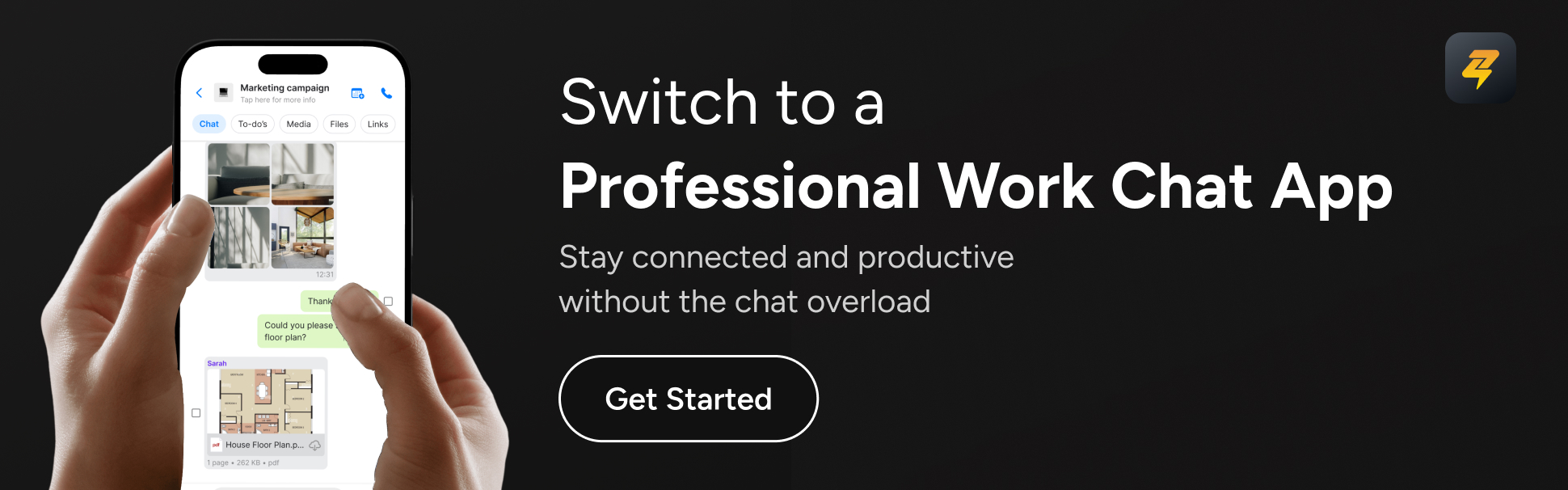
This is exactly the gap Zenzap was designed to fill as a mobile first internal communication tool that feels as easy as WhatsApp but operates with enterprise grade control.
How hospitality team chat is evolving in 2026
So what does next generation hospitality team chat actually look like in practice for you in 2026?
From scattered tools to one structured workspace
Right now, you might be juggling:
- Personal messaging apps for shift swaps and last minute changes.
- Email for long form updates and official memos.
- Phone calls for urgent issues that are hard to trace later.
- A project tool that only managers touch.
In 2026, you cannot waste time decoding which channel has the truth. You need one structured workspace where:
- Each property, department, and shift has a clear home.
- Tasks and calendar events live directly in relevant chats.
- Search actually works so you can pull up "wedding menu gluten free 18 June" in seconds.
Zenzap mirrors this shift with channels and chats that map to real hospitality workflows, plus integrated tasks and Google Calendar, so you do not send people jumping between five different apps.
From always on chaos to controlled availability
Hospitality will always be 24/7. Your people should not be.
As work life balance becomes a serious driver of retention, your team chat needs more than a mute button. It needs built in respect for working hours.
Zenzap supports this by letting your team set their working hours and by allowing you to schedule messages to hit during business time, instead of 1 a.m. when you remember them. You keep control without burning people out.
From insecure group chats to enterprise level security
Guest data, access codes, VIP preferences, payment issues, employee grievances. A lot of sensitive information flows through your internal chat, especially across properties and brands.
Public messaging apps were never meant for this. In 2026, you will see a stronger shift to compliant, encrypted, and admin controlled tools that can handle:
- Secure onboarding and instant offboarding, so as soon as a casual worker leaves, their access is gone.
- Role based permissions, so night audit does not see HR threads, and contractors only see what they need to see.
- Company ownership of data, even if staff access chat on personal phones.
Zenzap was built with this in mind, offering enterprise grade encryption and tight admin controls so you can finally get work out of personal apps without losing convenience.
Where Zenzap fits into 2026 hospitality team chat market trends
With all of this pressure to simplify, secure, and accelerate team communication, how exactly does Zenzap help you in 2026?
Intuitive simplicity for busy hospitality teams
Your seasonal hire should not need a training session just to read a shift note.
Zenzap works the way you expect modern messaging to work: clean, fast, and familiar. If your team can use WhatsApp, they can use Zenzap, but with the right guardrails for business use.
This means you remove one of the biggest adoption barriers that hotel and restaurant leaders complain about in legacy tools. People actually use it because it is not complicated.
Professional separation of work and personal life
One of the biggest sources of stress for hospitality staff is feeling like work follows them home, usually in the form of buzzing group chats that never stop.
With Zenzap, you centralize all work messages in one professional space. Your team can log out, set their availability, and know that if something is truly urgent, it will be handled within the system, not squeezed through personal channels.
For you, this means fewer compliance risks, fewer "I never saw that message" headaches, and a clearer boundary that supports retention and morale.
Structured organization so nothing slips
Because Zenzap brings tasks, chat, and calendar together, you do not rely on memory or manual follow ups.
Imagine this scenario: your front desk agent gets a request for extra pillows and a baby cot at 10 p.m. Instead of firing off a message that gets buried, they create a quick task inside the Zenzap chat tagged to Housekeeping Night, with a due time.
Housekeeping sees it, marks it complete, and the next morning shift can see that it was done. No sticky notes on monitors, no "Did someone handle this?" loops.
Seamless integration with tools you already use
By 2026, your tech stack probably includes a PMS, POS, revenue tools, and more. Zenzap does not try to replace everything. Instead, it integrates with tools like Google Calendar and connects into your existing workflows.
For example, you can sync key events, handovers, and meetings into your shared calendar, all visible inside the same chat environment. Everyone sees what is happening, without hopping between tabs.
Real hospitality scenarios Zenzap simplifies instantly
Scenario 1: Multi property coordination during a citywide event
Imagine a citywide festival weekend. Your three properties are fully booked, and demand is spiking hourly. Revenue is adjusting pricing using automated tools, and operations is running at the edge of capacity.
With Zenzap, you set up:
- A cross property leadership channel for GMs, operations, and revenue.
- Property specific channels for front desk, housekeeping, F&B, and maintenance.
- Event specific threads for group bookings and VIPs.
Rate changes, overbooking alerts, group arrival times, and shift coverage updates all happen inside Zenzap. You stay coordinated without drowning managers in disconnected messages.
Scenario 2: Restaurant shift swaps and last minute changes
In a busy restaurant or bar, staff swaps often live entirely in personal chats. You find out someone traded a shift only when there is a no show.
With Zenzap and its clear channels plus tasks, you can define a simple but reliable flow:
- All shift swap requests must be posted in the "Front of house schedule" channel.
- Manager approves inside the same thread and tags the updated schedule task.
- Calendar reflects the new assignment so nobody is surprised on the day.
You get transparency and traceability, without extra admin work.
Scenario 3: Handling maintenance issues before guests notice
A housekeeper notices a leaking tap and low water pressure in a guest bathroom. Today, they might tell a supervisor in passing, send a quick text, or write it on a paper checklist.
In Zenzap, they drop a photo and note in the "Room maintenance" chat, tag Maintenance, and create a task that links back to that message. When maintenance fixes it, they mark the task complete with a quick update.
If a guest later mentions the issue, front desk can search Zenzap, confirm what was done, and respond confidently.
How to future proof your hospitality communication stack by 2026
Knowing these trends is one thing. Acting on them is what will actually protect your margins and your sleep.
Step 1: Audit how communication really happens today
Forget org charts for a moment. Look at real conversations from the last 30 days. Ask yourself:
- Where did critical updates happen, and on which platforms?
- Where did things go wrong because someone missed a message or an email?
- Which tools are barely used, even though you are paying for them?
You will probably see that many frontline shifts are effectively run out of personal apps and ad hoc calls.
Step 2: Define a simple one place for work chat rule
As you move into 2026, make it crystal clear: all work communication lives in one professional space.
This is where Zenzap becomes your single source of truth for internal messages, tasks, and shift coordination. You can still keep email for external partners and formal updates, but your daily operations flow through a channel that is actually built for it.
Step 3: Start small with a pilot team or property
You do not have to flip your whole portfolio at once. Pick one property or one department, such as housekeeping or F&B, and roll out Zenzap there first. Give them:
- Clear guidelines on which chats to use for what.
- A short, hands on onboarding that shows how tasks and calendar work inside chat.
- Support from one champion who answers questions on shift.
Once they prove it works, expand to other teams and sites with their success stories in hand.
Step 4: Use Zenzap to support people first leadership
EHL Insights notes that people first, emotionally intelligent leaders are four times more likely to retain staff and 22 times more likely to drive high performance.
Your communication tool plays a big role here. With Zenzap, you can:
- Create dedicated channels for recognition and wins, not just problems.
- Set and respect working hours so staff feel their time off is protected.
- Keep feedback and sensitive conversations out of uncontrolled personal chats.
Technology will keep advancing, but the teams that win in 2026 will be those that use it to improve how humans work together, not just how systems talk to each other.
Key takeaways
- Treat hospitality team chat as critical infrastructure, not an afterthought; it needs the same strategic focus as your PMS and revenue tools.
- Move your deskless, mobile teams into a mobile first, structured chat app like Zenzap so nothing important lives in scattered personal messages.
- Use Zenzap's integrated tasks, calendar, and channels to keep operations tight during peak periods, events, and multi property coordination.
- Protect work life balance and data security with professional separation, clear working hours, and enterprise grade onboarding and offboarding.
- Start with a focused pilot, then standardize Zenzap across properties to future proof your communication before 2026 pressures intensify.

FAQ
Q: Why is 2026 such a crucial year for hospitality team chat?
A: By 2026, hospitality will be more automated, data driven, and guest centric than ever. Market growth toward 5.82 trillion dollars and rising staffing needs mean more complexity and more communication. If your internal chat is still scattered across personal apps and email, you will struggle to keep up with guest expectations, protect data, and retain staff. Standardizing on a mobile first, secure tool like Zenzap helps you match the pace of change.
Q: How is hospitality team chat different from generic business chat tools?
A: Hospitality teams are mostly deskless, work across shifts, and rely on fast handovers and real time updates. Generic tools are often built for office workers. Hospitality team chat must work flawlessly on mobile, handle mixed full time and casual staff, support structured channels for properties and departments, and respect work life boundaries. Zenzap is designed around those realities, not around 9 to 5 desk jobs.
Q: Can I really move my staff away from WhatsApp and personal messaging apps?
A: Yes, if you make the alternative easier and safer. Zenzap feels as simple as personal chat, so adoption is quick, especially when you set a clear rule that all work communication must happen there. Managers gain better visibility, staff keep their personal apps personal, and you reduce risk from ex employees or lost devices that still hold sensitive chats.
Q: How does Zenzap help during peak periods and special events?
A: During high pressure days, you can create event specific channels, tie tasks directly to messages, and keep leadership, front line staff, and support teams aligned in one place. For example, during a citywide festival you can track group arrivals, rate changes, staffing gaps, and maintenance issues in structured Zenzap channels rather than chasing updates across calls and scattered chats.
Q: Is Zenzap suitable for small independent properties as well as larger groups?
A: Absolutely. Smaller hotels, boutiques, and restaurants feel the cost of messy communication even more, because every person wears multiple hats. Zenzap gives you the professionalism and security of an enterprise tool with the ease and price point that make sense for lean teams. As you grow, you can extend the same structure to new properties without reinventing your communication stack.
Q: How quickly can my team get up and running on Zenzap?
A: Most teams can get started within a day. Because the interface feels familiar, frontline staff typically need minimal training. You can pilot Zenzap with a single department or site, refine your channel structure and guidelines, then roll it out more broadly. The faster you move work into one clean space, the faster you reduce mistakes, stress, and tool fatigue.
What this shift means for you as a hospitality leader
By 2026, guest experiences will be smarter, more personalized, and more immediate. The real question is whether your internal communication will keep pace or keep holding you back.
You have a choice. You can let team chat remain a patchwork of personal apps, missed messages, and late night pings. Or you can claim it as a strategic asset, move your people into a tool designed for how hospitality actually works, and give your teams the clarity and calm they need to deliver their best.
Zenzap was built for leaders like you who are tired of chaotic communication and ready for something that simply works, on every shift, in every property. The only thing left to decide is this: when your guests and teams look back on 2026, will they remember a year of constant firefighting, or the moment you finally made communication simple, secure, and stress free?

Take Control of Your Team Communication
Chat, organize, and get work done - all in one place.
Other Blog Posts