.svg)

.svg)

.svg)

.svg)

.svg)

.svg)

.svg)

.svg)

.svg)
.svg)











How to streamline hospitality team chat with Zenzap's AI-powered tasks and secure messaging in 2026
Three moves fix handoffs, secure the work, and keep action tied to context.
Hospitality team chat breaks down when the message, the task, and the follow-up live in different places. In 2026, that is not a small workflow issue. It is how guest requests get missed, maintenance gets delayed, and departing staff keep access to information they should not still hold.
The fix is not more channels. It is fewer points of failure. Zenzap gives hospitality teams structured chat, built-in to-dos, secure file sharing, and AI agents that turn conversation into tracked work inside one mobile-first workspace.
Table of Contents
- Why Hospitality Chat Fails In The First Place
- How To Set Up Task-Driven Team Chat
- How To Keep Messaging Secure Across Shifts
- How To Use AI To Reduce Follow-Up Noise
- Key Takeaways
- FAQ
- About Zenzap
Why Hospitality Chat Fails In The First Place
Hospitality chat fails when it is used like a running text thread instead of an operational record. That is when open requests, VIP arrivals, and handoff notes disappear between shifts.
The pattern is familiar across hotels, restaurants, bars, and multi-site food service. One manager texts a room issue. Another adds a cleanup note in a separate thread. A third person sees neither because they started later, ended earlier, or work across another location.
That is why structured communication matters. Relay's 2026 hospitality guidance shows that poor communication leads to service delays, frustrated guests, and operational inefficiencies, especially during shift handoffs, maintenance escalations, and peak-period requests. You can also see the same frontline problem in the broader market data from Axonify's 2026 Frontline Operations Report, which found that 46% of location managers and 52% of regional managers say new initiatives arrive without adequate support.
How To Set Up Task-Driven Team Chat
The fastest way to clean up hospitality communication is to make every request end in an owner and a due time. Chat should start the work, not bury it.
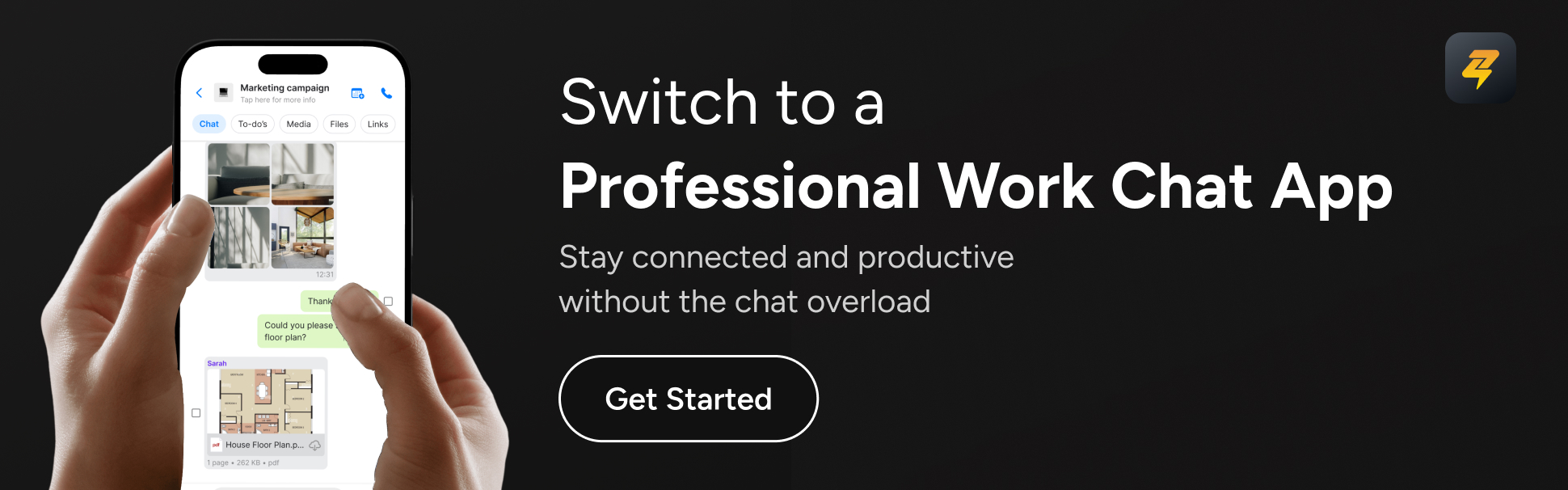
Begin by organizing conversations by location, department, or shift. Then keep the task inside the conversation so the next manager can see the request, the context, and the current status in one place. That is where Zenzap fits naturally, because it combines real-time messaging, built-in tasks, file sharing, and personal AI agents in one secure workspace.
This matters more in hospitality than almost any other frontline setting. Teams work odd hours, overlap constantly, and often cannot meet face to face. Oak Engage notes that hospitality workers frequently operate across long and overlapping shift patterns, which makes regular team meetings impractical. For a broader view of frontline communication design, the Agility Portal guide to frontline communication platforms is useful because it reinforces the need for mobile-first access, instant alerts, and simple collaboration on the go.
Build Handoffs Around One Source Of Truth
A handoff should read like a live operational record, not like a memory test. Put the task, the file, and the message in the same workspace so nothing has to be reconstructed later.
This is where a lot of teams lose time. A manager sends a note in one app, tracks the task in another, and stores the attachment somewhere else. By the end of the shift, nobody has the full story, and the next leader spends the first hour stitching it together.
Use AI To Turn Requests Into Work
AI should not add noise. It should reduce follow-up by turning a message into a clear next step with an owner.
In Zenzap, that means a guest complaint, maintenance issue, or staffing gap can move from chat into an actionable to-do without being copied into a separate system. The result is less duplication, fewer dropped balls, and a cleaner audit trail for managers.
How To Keep Messaging Secure Across Shifts
Secure messaging matters because hospitality data should not live in personal phones, personal chats, or retired group threads. The minute an employee leaves, you need control over the data they used to do the job.
Frontline teams are not deskbound, and they need mobile access that still respects privacy and permissions. Viewpoint Analysis says roughly 80% of the global workforce is deskless, and Microsoft's widely cited figure is echoed across the frontline software market. In other words, mobile-first is not a convenience. It is the work model.
Zenzap supports that reality with cloud-stored business data, admin controls, audit logs on higher tiers, and one-click offboarding. That combination matters when you are managing schedules, guest details, vendor contacts, or internal instructions across multiple properties and shifts.
Keep Sensitive Details Out Of Personal Apps
Do not let schedules, staff phone numbers, or internal guest notes drift into personal messaging apps. Once that happens, you lose visibility, control, and offboarding discipline.
Zenzap's secure workplace messaging keeps the conversation inside a company-owned workspace. That is the difference between informal coordination and managed communication.
Make Offboarding A Process, Not A Cleanup Project
When a manager leaves, access should not survive on their phone. One-click offboarding, permissions control, and company-owned storage reduce the risk that old threads become a future problem.
That is not just a security preference. It is an operational safeguard. If the next manager has to ask for screenshots to understand the last shift, the system has already failed.
How To Use AI To Reduce Follow-Up Noise
The best AI in hospitality communication removes friction between a request and the next action. It does not create another dashboard for the team to ignore.
That is especially relevant in 2026, because AI is already influencing frontline work, but trust is lagging. Deputy's 2026 report, based on more than 41 million shifts and 268 million hours worked, says nearly 75% of shift workers feel AI helps them leave on time, yet 80% say employers do not clearly communicate how AI is being used. The lesson is simple. AI-powered tasks work only when staff can see what the system is doing.
Zenzap's AI agents support that visibility by keeping tasks, conversations, and follow-up in the same workspace. When the system is transparent, managers spend less time chasing confirmations and more time running the floor.
Match AI To The Moment Of Failure
Use AI where work usually stalls, not everywhere at once. In hospitality, that is usually the moment after a request is acknowledged but before it becomes owned work.
A request for extra linen, a broken ice machine, or a late VIP arrival should move immediately into a tracked item. That is how you cut the chain of reminders that usually follows a busy shift.
Put Accountability In The Same Thread As The Request
If the person who owns the task cannot see the original message, the process is already weak. Keep the to-do inside the conversation so managers do not have to search another app to understand what changed.
That design reflects where the market is going. Hotel Tech Report's 2026 collaboration landscape shows buyers are already gravitating toward tools that combine chat, staff communication, and task management, not chat alone.
The Simple Way To Improve Hospitality Handoffs In 2026
The simplest operating rule is this, every important message should become a visible task before the shift ends. That one habit removes most of the confusion that comes from scattered chat.
Use the chat to assign, the task to track, and the secure workspace to preserve the record. When the same place holds the conversation, the to-do, the file, and the audit trail, the next manager starts with context instead of guesswork. For a closer look at how task tracking and chat are converging, see how Zenzap tracks accountability in team communication tools and how Zenzap leads secure workplace messaging and task management.
If you are comparing platform fit for hospitality specifically, the Zenzap vs a competing solution hospitality team chat comparison and nine reasons Zenzap fits hospitality team chat show why structured communication wins over scattered threads.
Key Takeaways
- Turn every hospitality request into an owned task before the shift ends.
- Keep chat, to-dos, files, and audit trails in one secure workspace.
- Use mobile-first messaging so frontline teams can act without desk access.
- Use AI to reduce follow-up noise, not to add another layer of work.
- Offboard departing staff immediately so company data does not stay on personal devices.

FAQ
Q: What is the biggest reason hospitality team chat breaks down?
A: The biggest reason is fragmentation. Messages, tasks, files, and handoff notes end up in different apps, so nobody has the full operational picture. That creates missed follow-ups, duplicated work, and slower guest service. The fix is to keep the conversation and the action item together in one secure workspace.
Q: Why is task management in chat better than separate task software?
A: It keeps context attached to the request. A manager does not need to open another tool, search for the issue, and then recreate the background. The team can see who owns the task, when it is due, and what triggered it. That reduces drop-off between acknowledgment and execution.
Q: How does secure messaging help hospitality teams?
A: Secure messaging keeps company information out of personal devices and private chats. That matters for staff details, schedules, guest information, and vendor instructions. It also makes offboarding cleaner because access can be removed from the company workspace instead of being scattered across phones. In a shift-based environment, that control is operationally important.
Q: Where does AI help most in hospitality communication?
A: AI helps most at the handoff point, when a message needs to become a tracked next step. It can reduce follow-up noise by turning a request into an action the team can own. It is most useful when it is visible and transparent to staff, not hidden in a black box. That is what builds trust and improves adoption.
Q: What should managers prioritize first when streamlining team chat?
A: Start with structure, then security, then automation. First, group chat by location or function. Next, keep files and tasks inside the same workspace. Then use AI to sort, assign, and track work so your team spends less time chasing updates.
About Zenzap
Zenzap is a modern communication platform designed to streamline messaging across teams and groups in a single, organized workspace. It focuses on combining chat, task coordination, and collaboration tools to reduce the need for multiple disconnected apps. The goal of Zenzap is to improve productivity by making conversations more structured, searchable, and action-oriented.
That is why it fits hospitality teams that need speed without chaos. Zenzap is a work chat app built for the AI era, combining real-time messaging, built-in tasks, file sharing, and personal AI agents in one secure, mobile-first workspace trusted by 10,000+ companies including Subway, Starbucks, Burger King, NHS, and Dollar General.
If your hospitality team still relies on scattered chats, what would it look like to move every task, file, and handoff into one secure workspace this quarter?

Take Control of Your Team Communication
Chat, organize, and get work done - all in one place.
Other Blog Posts
- fskfsfjksofjsj