.svg)

.svg)

.svg)

.svg)

.svg)

.svg)

.svg)

.svg)

.svg)

.svg)
.svg)




















Remote Work Communication Tools: Key Features for Distributed Team Collaboration and Success
You are not short on tools. You are short on tools that actually help your remote team feel clear, connected, and off the hook at the end of the day.
This article looks at what really matters in remote work communication tools, then narrows into the specific features that keep distributed teams aligned and sane. Along the way, you will see how Zenzap, a mobile first team chat app, turns those must have features into something refreshingly simple your team will actually enjoy using.
Table of contents
1. Why remote communication tools make or break distributed teams
2. Hidden costs of the wrong remote communication stack
3. Key features every remote work communication tool should include
4. How Zenzap turns key features into everyday benefits
5. Practical examples of distributed team success with better tools
6. How to choose the right remote work communication tool for your team
7. Key takeaways
8. Frequently asked questions
Why remote communication tools make or break distributed teams
Think about your last fully remote week. How much of your energy went into actual work, and how much went into just figuring out where conversations happened, which ping to answer first, or what you missed overnight?
You are not alone. According to a 2023 study from Buffer, 17 percent of remote workers cite collaboration and communication as their top struggle, and another 15 percent highlight difficulties staying focused. A big part of that friction comes from tools that were never really designed for distributed work at scale.
When your team is spread across time zones, your communication stack effectively becomes your office. If that digital office is cluttered, noisy, and confusing, your people feel the impact every hour of the day.
Get the tools right and two things happen fast. Collaboration feels lighter, and your team can actually log off without anxiety about what they are missing. That is the shift you are aiming for.
Most teams already know this in theory. The gap is in execution. You are likely juggling a patchwork of chat, email, task apps, and calendar tools that grew over time. They all do something useful. Together, they quietly drain your team's focus.
Hidden costs of the wrong remote communication stack
On paper, most modern collaboration tools look great. In practice, using the wrong mix creates real business costs you can feel but rarely quantify.
Context switching and cognitive overload
Research from the American Psychological Association notes that frequent task switching can cost up to 40 percent of productive time. If your people are bouncing between email, personal chat apps, project tools, and a separate task manager, you are paying that tax every day.
A sales manager in a 30 person agency recently admitted that her mornings started with scrolling through three apps just to reconstruct what happened overnight. By 10 a.m., she already felt behind.
That is what tool overload looks like in real life. It is not dramatic. It is quietly exhausting.
Scattered conversations and lost decisions
Another common issue is fragmented communication. A quick update lives in a personal messaging app. The detailed follow up sits in email. The related task is somewhere in a project management board.
The result is predictable. People miss context, duplicate work, or repeat the same alignment conversation in three different channels. When your team is remote, you cannot rely on hallway chats to patch those gaps.
Security and compliance blind spots
Tools that feel comfortable for personal use, such as consumer messaging apps, often slip into work communication. It feels convenient. It is also a security risk.
For regulated industries or teams handling sensitive data, that risk is not optional. You need clear access controls, secure onboarding and offboarding, and confidence that company conversations are not scattered across personal devices with no oversight.
Blurry work life boundaries
Remote work promised flexibility. Without the right guardrails, it often delivers constant availability instead. Late night pings, weekend quick questions, and the sense that you should always be reachable all add up.
In a survey from the American Psychological Association, 58 percent of workers reported negative mental health effects when work regularly spilled into their personal time. Your tools can either normalize that pattern or actively prevent it.
Key features every remote work communication tool should include
So what should you actually look for in remote work communication tools for distributed teams? This is where it helps to move from broad pain points to concrete features that protect your team's time, focus, and security.
1. Intuitive, low friction messaging
Your tool should feel as easy as the personal chat apps your team already uses, without sacrificing professional structure. That means:
- Fast, responsive mobile apps
- Clear channels or spaces organized by team, project, or topic
- Simple ways to start 1:1 and group conversations
- Minimal onboarding or formal training
If people need a playbook to send a message, they will revert to what feels easier. That is how personal tools creep back into work and fragment your communication again.
2. Built in structure so nothing slips
Real collaboration needs more than free form chat. Your communication tool should support structure without becoming complex.
Look for features like:
- Channels tied to departments, clients, or initiatives
- Clear search so past decisions are easy to find
- Threads or replies that keep topics grouped
- Ability to turn important messages into tasks
This last point is critical. When a customer issue pops up in your support channel, you do not want to copy and paste it into another tool and hope nothing gets lost. The handoff should stay inside the chat.
3. Integrated tasks and calendars
Remote work thrives on clarity around who is doing what, and by when. Teams that keep communication and execution totally separate often end up with beautifully written messages and very little follow through.
Strong remote work communication tools:
- Let you create tasks directly from chat messages
- Show due dates and owners inline
- Integrate with calendars, such as Google Calendar, so meetings and focus time are in sync
- Reduce the number of separate tools your people must juggle
The closer your tasks are to your conversations, the less gets dropped. Connecting chat, tasks, and calendars in one place cuts the time your team spends on coordination and keeps everyone moving in the same direction.
4. Enterprise grade security that is actually usable
Security is not just an IT checkbox. It is a trust signal for your team and your customers. Look for chat tools that offer:
- Encrypted communication
- Admin control over who can join and what they can access
- Clean onboarding and offboarding so access is updated instantly when people join or leave
- Support for company policies and compliance needs
This matters especially if your team has been relying on personal messaging apps for quick work messages. Centralizing communication in a secure space is one of the fastest ways to reduce hidden risk.
5. Respect for work life boundaries
The best remote communication tools do not just allow boundaries. They encourage them. Features to look for include:
- Working hours per person or time zone
- Scheduled messages so you can write now and send during business hours
- Quiet hours or notification controls that are easy to set and respected by default
- Clear signals for availability, such as statuses or presence indicators
This is where asynchronous communication really shines. When your tools make it normal to delay messages and protect off hours time, your culture follows.
6. Seamless integration with your stack
Your chat app will not live in a vacuum. It needs to play nicely with the tools you already rely on, such as:
- Google Workspace or Microsoft 365
- Video meeting platforms such as Zoom or Google Meet
- File storage like Google Drive or OneDrive
- CRM or ticketing tools where customer work is tracked
The goal is not to chain together fifteen tools. It is to have a central communication hub that connects to other systems where it makes sense.
How Zenzap turns key features into everyday benefits
This is where Zenzap comes in. It was built from a simple belief: if remote communication is not simple, structured, and genuinely pleasant to use, your team will not stick with it.
Instead of becoming another complex platform that requires weeks of setup, Zenzap focuses on clarity, mobile first speed, and a clean separation between work and personal life.
Intuitive simplicity that feels familiar
Zenzap looks and feels like the messaging apps your team already uses every day, but with the guardrails and structure your business needs. There is no steep learning curve, no lengthy documentation, and no unpaid internal champion trying to coach everyone through onboarding.
For small to mid sized teams that do not have a dedicated IT admin to configure everything, that simplicity is the difference between everyone is in and using this within a day and half the team quietly ignoring it.
Structured organization, without the clutter
Zenzap gives you clear, focused workspaces and channels so people do not wonder where to post. Teams regularly report that after a few weeks with Zenzap, they feel lighter. Communication becomes purposeful instead of scattered.
Tasks tied directly to chat
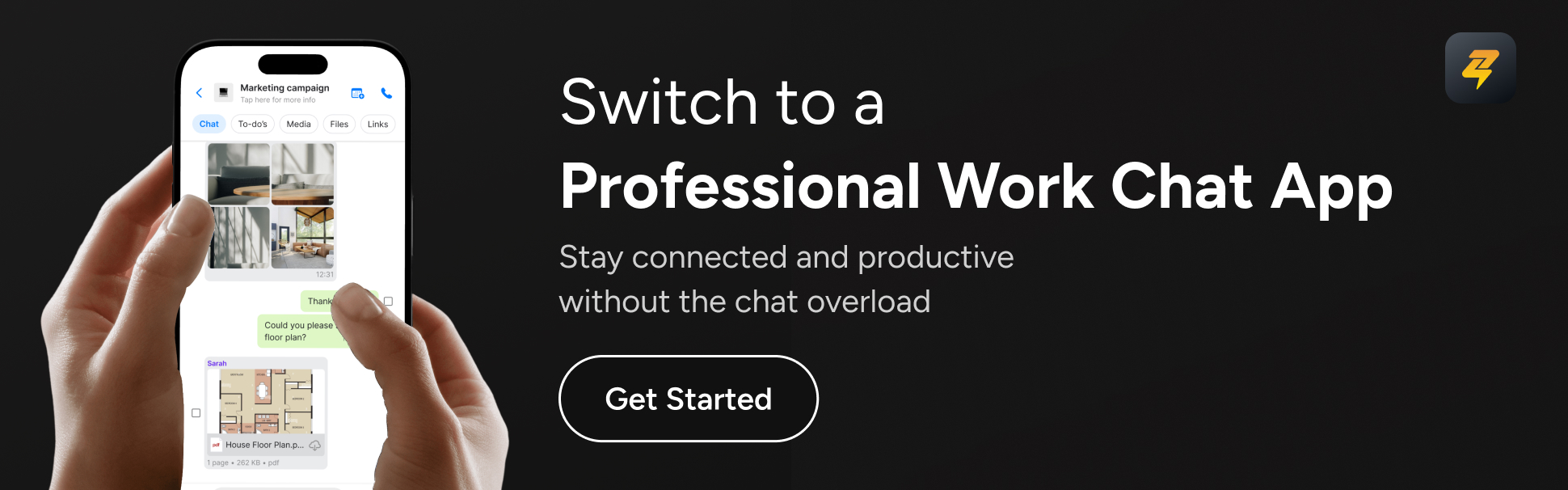
One of Zenzap's standout features is its tight link between chat and tasks. If an issue comes up in a conversation, you can turn that message into a task right there. No switching to a separate project tool. No manual copying of context.
That simple link closes a big gap for distributed teams. It keeps execution directly attached to the conversation that created it, so anyone can see the reason behind the work.
Mobile first speed for truly distributed work
Whether your people are in the field, traveling, or simply away from their desks, Zenzap's mobile first approach keeps them connected without feeling tethered. Messages send fast, navigation is clean, and your team can stay aligned from anywhere.
For async teams across time zones, that mobile first design is not a nice to have. It is essential.
Built in work life balance features
Zenzap is designed with boundaries in mind. You and your team can set working hours so notifications respect personal time. You can schedule messages to send during business hours, which means you can capture your thoughts when they occur without pinging someone at 11 p.m.
Having everything in one professional space, separate from personal chat apps, makes it easier to truly unplug in the evening and start each day with a clear head.
Security and admin control you can trust
From encrypted communication to secure onboarding and offboarding, Zenzap keeps your internal conversations in a safe, controlled environment. Admins can easily manage who has access, so when someone joins or leaves, you are not scrambling to revoke permissions across a patchwork of tools.
Practical examples of distributed team success with better tools
Sometimes the real difference shows up in everyday stories, not feature charts.
A marketing team tired of channel chaos
A 20 person marketing agency used a mix of email and multiple project tools for client work. Over time, client feedback, internal discussions, and task assignments became fragmented. Account managers spent up to two hours per day just catching up across tools.
After switching to Zenzap, they created channels per client and tied tasks to client conversations. Weekly status updates moved into Zenzap with clear task owners and due dates. Within a month, leadership saw fewer missed deadlines and shorter internal status meetings, simply because everyone could see the full picture in one place.
An async product team across three time zones
A small SaaS product team had people in North America, Europe, and Asia. They struggled with pings at odd hours and the feeling that no one could truly log off. They adopted Zenzap's working hours and message scheduling features.
Product managers began writing updates in the evening but scheduling them to arrive during each region's morning. Engineers adjusted notifications to only allow truly urgent alerts after hours. Within a few weeks, the team reported feeling more rested and focused. They stayed aligned without the constant background anxiety of what am I missing right now.
How to choose the right remote work communication tool for your team
You do not need another long comparison spreadsheet. You need a clear lens for evaluating tools against what actually matters to your team.
Start with your pain points
Ask yourself:
- Where do things fall through the cracks today?
- When do people feel most overwhelmed or distracted?
- Which tools do people quietly avoid or bypass?
- How often are personal messaging apps used for work?
These answers give you a starting point for the features you should prioritize.
Look for tools that reduce, not add, complexity
Your goal is to shrink your stack, not expand it. A strong remote communication tool should:
- Replace at least one or two existing tools
- Reduce context switching
- Make it clearer who owns what, without extra overhead
Prioritize adoption over edge case features
The most powerful system is useless if only a fraction of your team is comfortable using it. When evaluating tools, prioritize:
- Ease of use for non technical team members
- Clean, intuitive mobile apps
- Minimal setup required to get value
This is where Zenzap's philosophy of being pleasant to use pays off. When people enjoy the tool and understand it instantly, they use it consistently. That is when you start to see real communication and collaboration improvements.
Test for boundaries and well being, not just productivity
During trials or pilots, pay attention to how the tool affects work life balance. Notice:
- Are people messaging late at night more or less?
- Do scheduled messages and working hours feel natural to use?
- Does the tool make it easier to unplug?
Healthy boundaries are not a nice to have. They are a long term productivity strategy.
Key takeaways
- Choose remote work communication tools that simplify, not complicate, your digital office and reduce context switching.
- Prioritize structured organization and chat to task workflows so nothing slips through the cracks in distributed teams.
- Demand enterprise grade security with easy admin controls to keep work communication out of personal apps.
- Protect work life balance with features such as working hours, scheduled messages, and clear notification controls.
- Consider Zenzap if you want an intuitive, mobile first work chat app that your team can adopt quickly without training.

Bringing it all together
When you zoom out, remote work communication looks like a simple problem. Just stay connected. Zoom in, and you see how much of your team's day gets eaten by tool juggling, scattered conversations, and always on expectations.
The path forward is clear. Start with the fundamentals of remote collaboration. Narrow into the specific features - like structured chat, integrated tasks, security, and boundaries - that protect your team's focus. Then go even tighter to the tools that embody those features in a way your people will actually use.
Zenzap sits at that core insight. It bets on simplicity, mobile first speed, and real work life separation instead of more complexity. That is why teams often say they feel lighter after a few weeks with it. Their communication tool quietly removes cognitive load instead of adding to it.
The question for you is simple: if your communication tool could help your team collaborate clearly and then log off with a clear mind, what would that change in how you work this year?
FAQ
Q: What are the most important features in remote work communication tools for distributed teams?
A: Focus on intuitive messaging, structured channels, integrated tasks, calendar connections, strong security, and features that respect work life boundaries such as working hours and scheduled messages. These directly impact focus, follow through, and team well being.
Q: How does Zenzap support remote collaboration?
A: Zenzap focuses on intuitive simplicity, mobile first speed, and a clean separation between work and personal life, making it ideal for small to mid sized teams that want fast adoption without complex setup. Its built in tasks, calendar integration, and working hours features keep distributed teams aligned and calm.
Q: Can Zenzap replace multiple tools in my current remote work stack?
A: In many cases, yes. Zenzap combines team chat, integrated tasks, and calendar connections in one place. That means you can often consolidate separate chat, basic task management, and notification workflows into a single app, which reduces context switching and confusion.
Q: How does Zenzap support async collaboration across time zones?
A: Zenzap lets you set working hours, schedule messages to send during business time, and fine tune notifications. This makes it easier to share updates when it works for you, without interrupting teammates in other time zones. People wake up to clear, organized information instead of scattered late night pings.
Q: Is Zenzap secure enough for teams that handle sensitive information?
A: Zenzap uses encrypted communication and provides admin controls over user access and workspaces. Onboarding and offboarding are managed centrally, so you can quickly adjust access when team members join or leave, helping protect sensitive conversations and data.
Q: How quickly can my team get up and running with Zenzap?
A: Most teams can start using Zenzap within a day, because its interface feels familiar to anyone who has used modern messaging apps. Instead of weeks of configuration, you can create key channels, invite your team, and begin consolidating conversations and tasks almost immediately.

Take Control of Your Team Communication
Chat, organize, and get work done - all in one place.
Other Blog Posts