.svg)

.svg)

.svg)

.svg)

.svg)

.svg)

.svg)

.svg)

.svg)

.svg)
.svg)
























Secure workplace messaging: What it is and why every CEO needs it now
If someone quietly removed every chat tool from your company tonight, how much work would actually stop tomorrow morning?
When you look closely, you see that real work already lives in messaging. Strategy debates, incident responses, pricing decisions, and HR issues all flow through chat. At the same time, your people are juggling email, legacy collaboration suites, and personal apps just to get basic tasks done, which spreads conversations everywhere and makes them nearly impossible to protect or govern.
By the end of this guide, you will know exactly what secure workplace messaging really is, why you personally (not just your CIO) need to care, and how to roll out a simple, secure, and stress free solution with Zenzap that your team will actually love using.
Table of contents
Here is what you will walk through step by step:
1. What secure workplace messaging really means for you as CEO
2. Why scattered chat tools quietly increase your risk and cost
3. What "enterprise grade" security should look like in practice
4. How Zenzap turns secure workplace messaging into a strategic asset
5. Step by step: how to choose and roll out secure workplace messaging
6. Key takeaways
7. FAQ
Step 1: Understand what secure workplace messaging really is
Start with this: secure workplace messaging is not just "chat with encryption". It is the protected nervous system of your company.
In practical terms, secure workplace messaging means you have one place where work conversations, tasks, and decisions are:
• Encrypted and access controlled
• Searchable and structured
• Clearly separated from personal apps and numbers
• Governed under your company's policies, not a consumer platform's rules
When CEOs treat messaging as a strategic layer, not a side project for IT, everything shifts. You are no longer hoping that confidential topics stay inside random personal chat groups. You are running a controlled, visible, and compliant environment that your organization actually owns.
Think of a typical week: leadership debates pricing, HR runs a sensitive performance process, customer success handles a critical outage. If those conversations are spread across personal phones and unmanaged tools, you simply cannot see or secure what is happening. As security experts like to say, you cannot govern what you cannot see.
With the right secure workplace messaging platform, that changes. You get:
• Clear workspaces for teams and projects
• Role based access to sensitive channels
• Chat, tasks, and files living together in one encrypted space
• Admin level visibility and quick controls when people join or leave
Step 2: See why every CEO needs secure workplace messaging now
You probably already feel the strain of scattered tools. Maybe you have one tool in one corner, a legacy suite in another, and then all the "unofficial" personal messaging groups you only hear about when there is a problem.
This patchwork might feel flexible, but it quietly increases four types of risk.
Legal and regulatory risk
If your team shares customer data, HR details, or financial information in chat, then every message is part of your data protection story. Under GDPR, for example, mishandling personal data can trigger fines of up to 20 million euros or 4 percent of global annual turnover, whichever is higher, as the European Commission explains on its site at https://commission.europa.eu/law/law-topic/data-protection_en.
When those conversations live in unmanaged consumer apps, you have no clean way to document, control, or delete them. That is a compliance nightmare waiting for an audit or an investigation.
Security and access risk
Every hire and departure is a security event. If work lives in personal apps, you are relying on people to leave groups, delete files, and "do the right thing" on their own devices. That is not a process, it is a wish.
With secure workplace messaging, onboarding and offboarding are controlled and fast. A new joiner gets access only to the workspaces they need from day one. When they leave, you revoke all access in a few clicks. You are not guessing which personal chats they still see or which files they downloaded months ago.
Shadow IT and data sprawl
When your official tools are clunky or overcomplicated, people naturally reach for what is easy. As Zenzap CEO Guy Weiss has seen across many teams, staff defaulted to convenient consumer apps, not secure ones, simply because those apps felt lighter and quicker.
The result is shadow IT: parallel systems that your security and compliance teams do not control. Messages and files scatter across devices, apps, and accounts. You lose visibility into who said what, when, and where.
People risk and burnout
Secure workplace messaging is not only about protecting data. It is also about protecting your people from the constant pressure of mixed work and personal apps.
When someone's work chat lives beside family photos and group memes, the line between "on" and "off" blurs fast. Late night pings become normal. People feel they have to be always available. Over time, that grind turns into burnout, attrition, and a reputation as a place where nobody can ever really switch off.
As CEO, you own this culture. A secure, professional messaging app like Zenzap gives you the tools to set healthier norms while keeping urgent work visible.
Step 3: Define what "enterprise grade" security should look like
"Enterprise grade" gets thrown around a lot. For secure workplace messaging, it should mean very specific things that you can verify.
Robust encryption and data protection
Your messaging platform should provide strong encryption in transit and at rest, with messages and media stored securely in the cloud, not left scattered on personal phones.
Look for alignment with key frameworks such as:
• GDPR
• SOC 2
• HIPAA (if you handle health information)
• ISO 27001
These standards, explained in more detail by bodies like the International Organization for Standardization, exist to prevent the kinds of leaks that end up in headlines. They cover how data is encrypted, where it is stored, who has access, how access is logged, and how quickly it can be removed.
Strong access control that respects your org chart
Enterprise grade secure workplace messaging should let you define exactly who can access each workspace, channel, and file. You should be able to grant, limit, or revoke access instantly, without opening a support ticket or waiting days.
In practice, that means you can:
• Create dedicated leadership channels that are invite only
• Restrict HR or legal channels to specific roles
• Keep board prep and M&A conversations away from broad company chats
• Offer open, discoverable project channels where collaboration needs to be fast
With Zenzap, non technical admins can handle this with a few clicks. You decide who joins which workspace, who can create channels, and where sensitive conversations live. That keeps confidential topics protected yet easy to manage.
Secure onboarding and offboarding
In a secure workplace messaging platform, onboarding and offboarding are systematic. When a new person joins, they see only what they need to see from day one. When they leave, you remove their access everywhere in a few clicks, and their historical visibility stops instantly.
Compare that with personal apps, where chat history and files can sit for months or years on a former employee's phone. One leak or screenshot in the wrong hands can create legal, financial, or reputational damage that takes years to repair.
Audit logs and compliance readiness
For CEOs working in finance, healthcare, or any regulated sector, you need more than comfort. You need evidence.
Your secure workplace messaging platform should provide:
• Detailed audit logs of access and admin actions
• Clear data access management features
• Support for eDiscovery and legal holds when needed
That makes it far easier for your legal and compliance teams to sign off, prepare for audits, and respond quickly if something goes wrong.
Step 4: See how Zenzap turns security into a strategic asset
Most "enterprise" messaging tools fall into one of two traps. Either they try to be everything for everyone and end up heavy and confusing. Or they are consumer apps with security bolted on after the fact.
Zenzap was built specifically to avoid that fate. It gives you the essentials your company actually needs and nothing that gets in the way.
Intuitive simplicity, no training needed
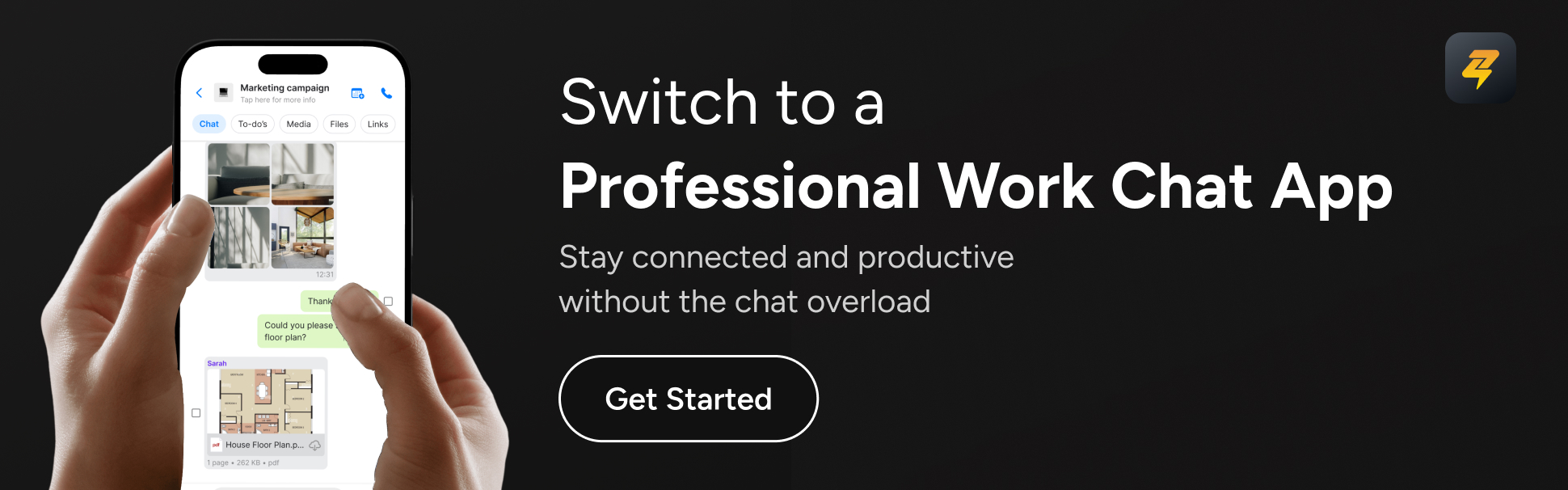
Zenzap feels as light as your team's favorite personal messenger, yet it is built for serious work. The interface is clean and mobile first. People send messages, create channels, and assign tasks in minutes, not weeks.
That intuitive simplicity matters for security. When tools are easy to use, people stay inside them. You spend less time fighting shadow IT and more time knowing that important conversations live in one secure place.
Structured organization that keeps work moving
Secure workplace messaging only helps if work does not get lost in endless threads.
Zenzap gives you:
• Clear spaces for teams, projects, and topics
• Tasks built directly into conversations
• Searchable history so new team members can catch up fast
• Integration with Google Calendar and other tools so deadlines stay visible where work happens
Imagine your customer success team running a major incident. In Zenzap, the incident channel holds messages, tasks, and files in one place. The CEO, CTO, and support managers can dip in, see exactly what is happening, and trust that follow ups have owners and due dates. Nothing hides in side conversations or forgotten notebooks.
Professional separation that protects work life balance
One of Zenzap's most important design choices is the separation between work and personal life.
Your team uses Zenzap for work chat, tasks, and file sharing. They keep personal apps for friends and family. That line is reinforced with features like:
• Working hours that limit notifications outside agreed times
• Do Not Disturb modes and channel level mutes
• Scheduled messages that you can write now but send during business hours
The result is simple. Work stays at work. Personal stays personal. Your people can unplug without worrying that the next crisis is hiding in a private group chat. When something truly urgent happens, it shows up in the one app designed for work and governed by your company.
Compliance built in, not bolted on
Zenzap is designed from the ground up as a secure workplace messaging app, not a consumer tool attempting to play business. Security and compliance are not extra toggles or hidden add ons.
You get:
• End to end encryption for communication
• Controlled access to workspaces and channels
• Clear onboarding and offboarding flows
• Admin visibility and granular permissions
• Controls aligned with global standards such as GDPR, SOC 2, HIPAA, CCPA, and ISO 27001
That means the workflows your team uses every day already align with good data protection practices. You spend less time policing behavior and more time focusing on actual work.
Step 5: Roll out secure workplace messaging in your company
Now bring this down to a practical plan. Here is how you can introduce secure workplace messaging, using Zenzap as your example, in a way that sticks.
Step 5.1: Map your current messaging reality
Start by asking a simple question in your leadership meeting: "Where do our most important conversations actually happen?"
Have leaders list:
• Official tools (email, collaboration suites)
• Unofficial tools (personal messaging apps and unmanaged platforms)
• High risk topics currently handled in those places (customer PII, HR, finance, legal)
You will likely discover that critical decisions are being made in a patchwork of personal apps. That is your baseline. You now have a clear picture of what needs to move into a secure workplace messaging platform.
Step 5.2: Define your must have requirements
With that map in hand, define what your secure workplace messaging solution must deliver. For most CEOs, the non negotiables look like this:
• Enterprise grade security and encryption
• GDPR and relevant industry standard alignment
• Strong admin controls and audit logs
• Clear separation of work and personal apps
• Simple mobile first experience that requires little or no training
• Built in task management and integrations with key tools like Google Calendar
Use this as your evaluation checklist when you compare vendors. If a platform looks powerful but your team will quietly avoid it, keep moving.
Step 5.3: Pilot with one or two critical teams
Next, choose one or two teams where clarity and security are non negotiable. For example:
• Leadership and HR
• A customer support team handling sensitive client data
• A healthcare unit coordinating shift handovers
Move their communication into Zenzap for a 30 or 60 day pilot. Set up:
• A leadership workspace with invite only channels for board prep, strategy, and HR
• Project or client workspaces with clear channel structures
• Notification norms so people know what is urgent and what can wait
Use this phase to refine your channel naming, permission model, and off hours rules. Capture feedback from managers and front line staff. What feels easy? What needs tweaks?
Step 5.4: Scale out with clear norms and training
Once the pilot teams are comfortable and you have evidence that Zenzap works, scale it across the company.
Provide simple guidance, not a 50 page manual. For example:
• "Use Zenzap for all internal work chat and tasks. Do not use personal messaging apps for work."
• "Set your working hours in the app. Use Do Not Disturb outside those hours unless you are on call."
• "Use the urgent tag only for true emergencies. Everything else can wait for working hours."
A short live demo or recorded walkthrough is enough for most teams. Because Zenzap is built to feel familiar, adoption is usually fast. The payoff shows up in reduced chaos, fewer missed messages, and cleaner audits.
Step 5.5: Measure impact and keep improving
To stay accountable, track a few simple metrics before and after rollout:
• Number of unofficial apps used for work chat
• Time to onboard and offboard employees from communication channels
• Incidents or near misses related to misrouted or lost messages
• Employee feedback on focus, stress levels, and ability to unplug
Look at patterns every quarter and adjust your norms. For example, you might tighten access to certain workspaces, refine which channels are announcement only, or tweak notification defaults.
Key takeaways
- Treat secure workplace messaging as a strategic layer that protects core conversations, not as an IT side project.
- Replace scattered consumer apps with one secure, searchable, access controlled platform that your company owns.
- Insist on enterprise grade security, clear access control, and compliance alignment with GDPR, SOC 2, HIPAA, and ISO 27001.
- Use Zenzap to combine intuitive messaging, built in tasks, and structured channels with strong work life separation.
- Roll out secure workplace messaging in stages, starting with high impact teams, and back it up with simple, clear norms.

Bringing it all together
Secure workplace messaging is no longer a nice to have or a compliance checkbox you delegate and forget. It sits at the center of how your company thinks, decides, and moves.
When messaging is insecure or fragmented, you carry legal, financial, and reputational risk that no insurance policy can fully absorb. You also carry human risk, as your people try to keep up with a blur of apps, late night alerts, and blurred boundaries.
When you make secure workplace messaging a priority, you give your teams something different. One professional space where work lives. One app where conversations, tasks, and files stay organized, searchable, and protected. One environment where admins have control and employees have clarity and calm.
Zenzap was built to be that environment. It combines intuitive simplicity with enterprise grade protection. It keeps work chat away from personal apps. It gives you structured organization, seamless integrations, and onboarding and offboarding you can trust.
The real question is no longer "Which tool has more features?" The real question is "Which secure workplace messaging platform will your team still be happily using in six months, without you having to push them?"
As CEO, you get to answer that question. The next move is yours: will you keep relying on scattered tools and hope nothing breaks, or will you choose a secure workplace messaging app that finally matches the way your company actually works?
FAQ
Q: What exactly is secure workplace messaging?
A: Secure workplace messaging is a company controlled chat environment where work conversations, tasks, and files are encrypted, access controlled, and separated from personal apps. It is designed for internal business communication, with features like role based permissions, audit logs, and compliance friendly data handling, so you can protect sensitive information without slowing teams down.
Q: Why should I, as CEO, care personally about this and not leave it to IT?
A: Because messaging is where real work happens. Strategy, incidents, pricing, HR, and customer issues all flow through chat. If that environment is insecure or scattered, the risk is not just technical. It is legal, financial, and reputational, and it lands on your desk. When you lead the shift to secure workplace messaging, you protect core conversations, reduce shadow IT, and model the work life boundaries you want for your people.
Q: How is Zenzap different from consumer apps like personal messaging tools for work?
A: Consumer apps are built for casual, personal use, not for structured, secure company communication. They lack central admin controls, clean onboarding and offboarding, and compliance ready data handling. Zenzap gives you a dedicated professional workspace, with encrypted communication, granular permissions, built in tasks, and admin visibility. Work stays under company control, and personal apps stay personal.
Q: Will my team actually adopt a new secure messaging tool?
A: Adoption depends on simplicity. Zenzap is mobile first and intentionally familiar, so most people can get started in minutes without formal training. If you pair Zenzap with clear norms, such as "use this for all internal work chat" and "set your working hours in the app," your team quickly experiences less chaos and fewer missed messages, which reinforces adoption naturally.
Q: Can secure workplace messaging really improve work life balance?
A: Yes, if it is designed for it. Zenzap helps by separating work from personal apps, letting people set working hours, and allowing you to schedule messages for business time. Urgent alerts can still reach the right people, but everyday chatter no longer leaks into evenings and weekends. Over time, that clarity significantly reduces burnout and makes your company a more sustainable place to work.
Q: How do I start using Zenzap for secure workplace messaging in my company?
A: Begin by mapping where your important conversations currently happen and where the biggest risks are. Then pilot Zenzap with one or two critical teams, such as leadership and HR or a support team handling sensitive data. Use that pilot to refine your channel structure and norms, then roll it out more widely with simple guidance. You can explore Zenzap and start a trial directly at https://www.zenzap.co/ and work with your leadership team to set a clear go live date.

Take Control of Your Team Communication
Chat, organize, and get work done - all in one place.
Other Blog Posts
- fskfsfjksofjsj