.svg)

.svg)

.svg)

.svg)

.svg)

.svg)

.svg)

.svg)

.svg)

.svg)
.svg)



















Task tracking at work: What founders need to know about task tracking in chat
If a task is agreed in chat but never tracked, did it really exist?
As a founder, you live inside your work chat. Product ideas, bug reports, hiring plans, investor prep, customer feedback, it all flows through a handful of channels and DMs. Yet the moment someone says "We should do this" there is a good chance it quietly disappears into the scroll.
This guide shows you how to fix that pattern by turning your chat into a reliable task tracking system using Zenzap. You will see how embedded task tracking in chat cuts missed deadlines, reduces meetings, protects your team's focus, and gives you a calmer way to run execution. By the end, you will have a step by step playbook to turn every important message into a clear owner, due date, and outcome, all without bolting on another heavy tool.
What you will achieve with this guide
By following this process, you will:
1. Turn your work chat into a single source of truth for daily execution.
2. Capture decisions as tasks in seconds so nothing slips through the cracks.
3. Reduce tool overload and status meetings by keeping work where conversations already happen.
4. Protect your team's attention with sane notification rules and work life boundaries.
5. Use Zenzap to get up to a 40 percent boost in on time delivery, based on real customer data.
Table of contents
1. Why task tracking belongs inside your work chat
2. What task tracking in chat actually looks like in Zenzap
3. Step 1: centralize work communication in a professional chat space
4. Step 2: turn every decision into a task
5. Step 3: connect tasks to time and calendar
6. Step 4: protect focus with smart notification and work life settings
7. Step 5: use task tracking to cut status meetings
8. Step 6: stay secure and in control as you scale
9. Zenzap vs standalone project management tools
10. Key takeaways
11. FAQ
12. Bringing it all together
Why task tracking belongs inside your work chat
Most startups run on a messy mix of tools. You chat in one app, manage projects in another, track docs in a third, and live out of Google Calendar. Every context switch costs time and attention. According to research highlighted by McKinsey, workers can spend up to 20 percent of their week just hunting for information or trying to reconnect threads.
Task management inside a team chat app cuts that waste. Instead of bouncing between chat, a project board, and spreadsheets, you keep work where the conversation happens. With Zenzap, any message can become a task with an owner and a due date, plus all the original context. You get a direct line from "we should" to "who does what by when" without adding another complicated platform that your team will quietly avoid.
This is not just theory. Internal Zenzap customer data shows that startups who keep tasks directly tied to chat and files see up to a 40 percent boost in on time project completion, simply because they remove silos and tool fatigue. Similar findings from a Gartner briefing on digital workplace tools suggest teams that keep tasks and calendar events in their daily communication flow are about 42 percent less likely to miss meetings or deadlines. When work lives where people already look, reliability improves without extra overhead.
As a founder, that reliability is everything. You get fewer nasty surprises, fewer dropped balls, and far less time spent chasing "Did anyone do this?" across random channels and tools. Instead, you see tasks, owners, and progress in the same intuitive workspace your team already uses all day.
And because Zenzap is mobile first and familiar, your people can adopt this new way of working in a day, not a quarter. You do not need training sessions or consultants to get value. You just need a clear process, which you will walk through step by step in the sections below.
What task tracking in chat looks like in Zenzap
Before you dive into the process, it helps to picture how task tracking in chat actually works when it is done well.
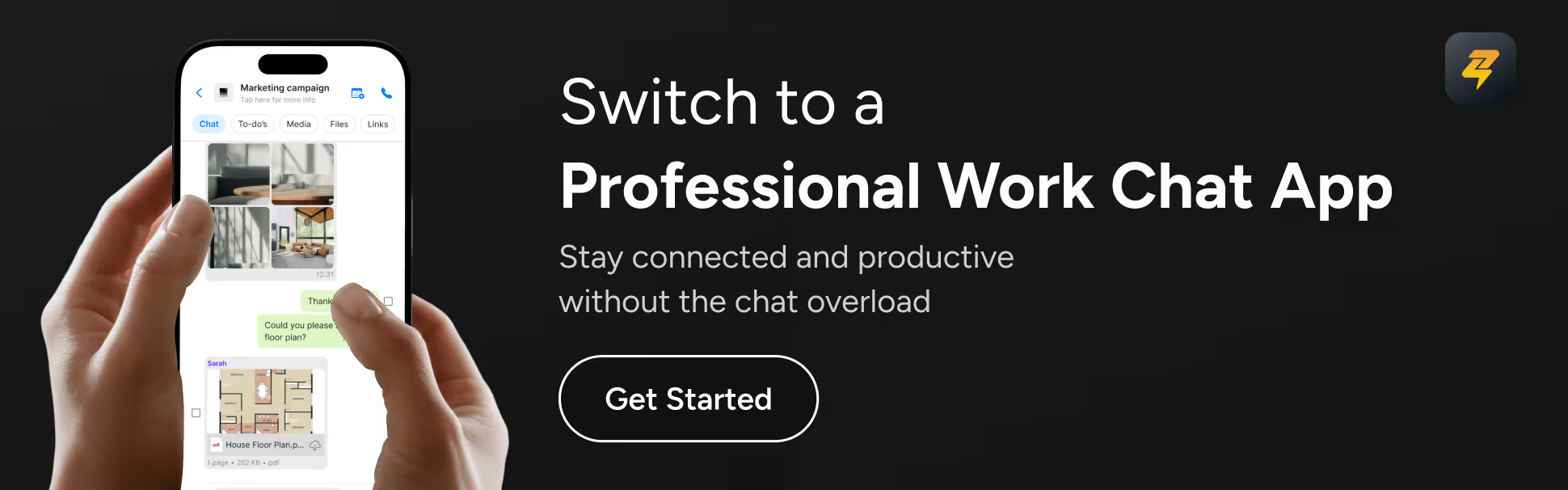
In Zenzap, every important moment in a chat can turn into a tracked task in a couple of taps. A product idea in your #product channel becomes "Ship new onboarding flow" with a single owner and a clear due date. A bug report from customer support becomes "Fix billing edge case" assigned to your backend engineer, with the original screenshots and conversation attached.
From there, Zenzap quietly keeps everything in sync. Tasks sit in the same channels where they were created. Owners can update status without leaving the thread. Due dates connect to Google Calendar so upcoming work and real time events live in one place. You no longer have to copy notes into a separate tool or retype context into a card just to keep track of work.
The result is a living task board that basically builds itself from your daily conversations. Within a week or two of using Zenzap this way, your chat stops feeling like a firehose. It starts behaving like a structured workspace where every important "we should" becomes a visible "who is doing this and by when."
Step 1: centralize work communication in a professional chat space
The first step is simple but crucial. You need one clear, professional home for work chat and task tracking.
If your team is still using personal messaging apps for work, you already feel the pain. Conversations are split between multiple apps, email, and ten random threads. Work leaks into nights and weekends. Sensitive information lives on personal devices you cannot control.
Move that work into Zenzap. Create clear channels for topics like #product, #support, #sales, and #founders. Encourage everyone to use these spaces for work messages so communication stays professional and separate from their personal apps. This one decision already cuts confusion and reduces the risk of company data ending up in private chats.
For example, imagine your customer success lead, Anika, currently runs most of her work via personal messaging apps and a long email thread. When she moves the team into a dedicated #customers channel in Zenzap, two things happen immediately. First, all customer related tasks now have a single home. Second, when those chats turn into tasks, you are not mixing them with photos from the family group or weekend plans.
Step 2: turn every decision into a task
Next, you want a simple habit. Whenever someone says "We should," "Can you handle this," or "Let us do this by Friday," that message becomes a task. Not later, not "when we have time to organize the board," but right there in the chat.
As a founder, you set the tone. When you ask for something in Zenzap, tap on your own message, turn it into a task, assign the owner, and set a deadline. Your team will copy what you do much faster than they will follow a written process doc.
Picture your weekly product review. You say, "We should update the onboarding emails before next week's launch." In many startups, this idea just sits in the channel. Someone might remember it, someone might not. In Zenzap, you convert that line into a task in seconds: "Update onboarding emails before launch," assigned to your marketing lead, due next Tuesday. The full conversation, comments, and relevant files stay attached.
Over a few weeks, this habit shifts your culture. Vague "we should" items become specific "who, what, when" commitments that everyone can see. Accountability stops relying on memory and starts living in the system.
Step 3: connect tasks to time and calendar
Tasks only become real when they touch time. That is where Zenzap's calendar integration comes in.
When you turn a message into a task, you do not just set an abstract due date. You can connect it directly to Google Calendar so the work and the event stay in sync. That investor call next Thursday does not just live on a calendar. The prep checklist for that call lives as tasks in Zenzap with the deadline anchored to the exact meeting.
Here is how it might look in practice:
1. Your co founder drops a note in #fundraising: "We need a one page update for Maya before next Thursday's call."
2. You convert that message into a task and assign it to your ops lead.
3. You set the due date to Wednesday at 4 p.m. and link it to the investor call in Google Calendar.
4. The full conversation, draft deck, and feedback all stay attached to the task in Zenzap.
5. On Wednesday afternoon, your ops lead gets a gentle reminder. On Thursday, you head into the meeting prepared.
This is the heartbeat of effective task tracking at work. Decisions in chat turn into tasks, tasks connect to time, and your calendar reflects reality instead of wishful thinking.
Step 4: protect focus with smart notification and work life settings
When you put chat and task tracking together, you gain power and you also face a risk. It can start to feel like you are always on. Zenzap tackles that head on with work life friendly controls.
Inside Zenzap, your team can:
1. Set working hours so they do not get pinged when they are off the clock.
2. Schedule messages, so you can queue a thought at midnight but deliver it at 9 a.m.
3. Fine tune channel level notifications so people only get alerts where they truly need to be involved.
This matters. Research on context switching, such as studies shared by the American Psychological Association, shows that frequent interruptions can significantly reduce deep work and increase stress. When every new task comes with a random ping, your team never gets the focus they need to do real work.
With Zenzap, you still capture ideas the moment they hit, but you respect time zones and personal lives. For example, if you are in New York and your engineer Leo is in Berlin, you can schedule task related messages to arrive during his morning instead of dropping into his phone at 2 a.m. Over time, this trust pays off. Your people stop dreading notifications and start seeing Zenzap as a calm, predictable work space.
Step 5: use task tracking to cut status meetings
Once tasks are captured, owned, and tied to time, you can shrink a lot of meetings.
Today, many founders sit through long status calls where everyone simply reads out what they did that week. Those updates could have been a channel post. When task tracking is embedded inside chat, updates appear where they belong, so you do not need a one hour meeting to hear what is already visible.
In Zenzap, when someone completes a task, the channel sees it. When a deadline approaches, the owner gets nudged. You get a living status page inside your chat. That lets you swap long, generic status meetings for short, focused check ins.
Instead of asking "What is the status?" you ask:
1. "What is blocking you?"
2. "What changed since last week?"
3. "What decision do we need to make now?"
A marketing team using Zenzap, for example, might replace their weekly one hour status meeting with a ten minute async check in in #marketing. Everyone reviews the visible task list, sees what is in progress or overdue, and only hops on a short call if there are real decisions or blockers. Teams that adopt this pattern often finish more projects on time and free up meaningful work hours every week.
Step 6: stay secure and in control as you scale
As your company grows, security, admin control, and clean offboarding matter as much as speed.
Zenzap is built for that. You get enterprise grade security with encrypted communication, strong access controls, and centralized admin management. That means you decide who joins, which channels they see, and how long data is retained. When someone leaves, you can revoke access in seconds while keeping the history and tasks available for the rest of the team.
This is especially important if you have contractors, agencies, or temporary team members. You can give them access to specific channels, limit what they can see, and then turn off access as soon as a project ends. Sensitive discussions stay inside your professional workspace, not scattered across personal chats and unmanageable email threads.
At the same time, this structure reinforces healthy professional separation. When your team is in Zenzap, they are in work mode. When they step out of the app, work stays contained so they can disconnect without fear of missing something urgent at midnight.
Zenzap vs standalone project management tools
Once you see how smooth task tracking in chat can be, you might wonder if you still need a standalone project management tool at all.
For most startups, the honest answer is: not for day to day execution. Zenzap lets you turn any message into a task, assign owners, add deadlines, connect to Google Calendar, and track progress in the same place you already talk. Many founders keep a light, separate tool only for long term roadmaps or complex Gantt charts, while Zenzap becomes the source of truth for weekly and monthly work.
This hybrid approach gives you the best of both worlds. Strategic planning still has a home. Execution and communication live together in one intuitive chat based workspace. You avoid the heavy process overhead of forcing every small task into a big project board, and you stop asking your team to manage five different apps just to ship a feature.
Most importantly, you respect how work actually flows in your company. Conversations drive decisions. Decisions become tasks. Tasks connect to time. In Zenzap, that chain happens naturally so your people can focus on moving the company forward instead of moving cards around.
Key takeaways
- Bring all work conversations into Zenzap so task tracking and chat live in one professional, secure space.
- Turn every "we should" decision in chat into a task with a single owner and clear due date.
- Connect tasks to Google Calendar so time, meetings, and execution stay in sync.
- Use working hours, scheduled messages, and channel controls to protect deep work and work life balance.
- Rely on embedded task tracking in Zenzap to cut status meetings, boost on time delivery, and keep your startup calm and focused.

FAQ
Q: What is task tracking in chat for founders?
A: Task tracking in chat means you create, assign, and follow tasks directly from your team conversations. In Zenzap, any message can become a task with an owner and due date, so execution stays close to the discussion. You cut copying notes into other tools and significantly reduce the risk of missing action items.
Q: Can I really replace my existing project management tool with Zenzap?
A: For most startups, yes, at least for day to day work. Zenzap lets you capture tasks from messages, assign owners, add deadlines, link to Google Calendar, and track progress inside channels. Many founders keep a lightweight roadmap tool for multi month planning, while Zenzap becomes the main execution and communication hub.
Q: Will task tracking in chat create too many notifications for my team?
A: Not if you use Zenzap's controls. You can define working hours, mute specific channels, and schedule messages so updates arrive at the right times. Task notifications are targeted to the relevant owners and channels, which actually reduces random pings across multiple apps and helps your team stay calmer and more focused.
Q: How does task tracking in chat improve accountability?
A: Embedded task tracking brings ownership into the flow of conversation. When you convert a message into a task in Zenzap, you assign one clear owner and a deadline, in front of the team. Everyone sees who is doing what by when, which makes follow up easier and eliminates "Who owns this?" confusion.
Q: Is Zenzap secure enough for sensitive startup information and tasks?
A: Yes. Zenzap uses enterprise grade security, encrypted communication, and strong access controls. Admins decide who can join, which channels they see, and what data is retained. Onboarding and offboarding are centralized. When someone leaves, you can revoke access in seconds while keeping the history and tasks available for the rest of the team.
Q: How quickly can my team adopt Zenzap for task tracking at work?
A: Very quickly. Zenzap is designed to feel like the intuitive chat apps your team already knows, with task tracking layered in. Most teams can adopt it in a day without training. The key is to set a few simple rules from the start, such as "every decision becomes a task," and lead by example as a founder.
Bringing it all together
You already know that chat is where your company's real work happens. The question is whether you let those moments vanish into the scroll, or you turn them into a calm, reliable task tracking system your whole team can lean on.
By centralizing work communication in Zenzap, turning every decision into a task, connecting tasks to calendar time, and protecting focus with smart notification rules, you move from scattered tools and missed follow ups to clear ownership and steady momentum. You cut status meetings, ease the pressure on your team, and still ship more on time.
Zenzap keeps all of this mobile first, intuitive, and secure, so your startup can adopt it quickly without adding complexity to your stack. The result is simple: less chaos, more progress, and a work rhythm that respects your people as much as your growth targets.
The only real question left is this: if your chat is already where work happens, how long will you let your tasks live somewhere else?

Take Control of Your Team Communication
Chat, organize, and get work done - all in one place.
Other Blog Posts
- fskfsfjksofjsj