.svg)

.svg)

.svg)

.svg)

.svg)

.svg)

.svg)

.svg)

.svg)
.svg)
























The Chat App Decision Most Small Businesses Get Wrong in Year One
You already know communication can make or break your first year. What you may not realize is that the quiet choice of "which chat app should we use?" often decides whether your team feels calm and focused or constantly scattered and on edge.
Most small businesses either lean on personal messaging apps like WhatsApp or overcorrect into heavy enterprise platforms. In both cases, you end up paying in confusion, burnout, and things slipping through the cracks. This article unpacks why that happens, why your internal chat tool becomes the operating system of your daily work, and how Zenzap helps you avoid the most common first-year mistake.
Table of contents
1. Why your first chat app choice matters more than you think
2. The two traps most small businesses fall into
3. Level 1: The real cost of getting chat wrong in year one
4. Level 2: What a focused work chat app must do for you
5. How Zenzap flips the script on small business communication
6. Protecting work life balance without losing responsiveness
7. Core insight: Treat chat as your operating system, not a side tool
8. Key takeaways
9. FAQ
Why your first chat app choice matters more than you think
Imagine your business one year from now. You have more customers, more staff, more moving parts. At that scale, your internal communication tool is not "just another app." It quietly becomes where work lives.
Every shift change, delivery update, project tweak, and urgent issue flows through it. When you choose the wrong chat app in year one, you are not just picking an interface. You are locking in habits, expectations, and chaos or calm for the next few years.
For small and mid sized businesses, the team communication app you choose quickly becomes the operating system of daily work. It shapes how fast people respond, how clearly tasks are handed off, and how confident you feel that nothing is slipping through the cracks.
Get this decision wrong and you feel it every single day. You see it in constant context switching, confused staff, security risks from using personal apps, and the sinking feeling that you can never fully unplug. Get it right and you gain a quiet superpower. Everyone knows where to go for answers, what needs to happen next, and when it is okay to be offline.
That is why this seemingly small decision in year one is actually one of the most strategic choices you make as an owner or manager.
5,000 other business tools
The two traps most small businesses fall into
When you start out, you rarely sit down and design a communication system from scratch. You grab whatever is handy and familiar. That is how most small businesses fall into one of two predictable traps.
The decision underneath both traps is the same: founders pick a chat tool based on what's cheapest or most impressive on a sales call, instead of what actually fits how a 10-to-100-person team works day to day.
Trap 1 is running the company on personal messaging apps. WhatsApp, iMessage, Facebook Messenger, or a messy mix of all three. It feels easy at first. Everyone already has the app. Messages are fast. Group chats spin up in seconds.
Then reality hits. Work bleeds into every corner of your team's personal lives. You ping someone about a shift change and it lands on top of their family group chat. Sensitive files float around in personal threads that you will never see again if that person leaves. There is no structure, no ownership, and no clean way to offboard anyone.
Trap 2 is adopting enterprise tools that are far too complex for a 10 to 100 person team. The feature list looks impressive. The sales demo is polished. But your people are not sitting at desks all day and they are not "power users." So the tool becomes a ghost town, while real work drifts back to texts and ad hoc group chats on personal apps.
You either drown in noise or you drown in setup. Neither helps you run today's shift, project, or event.
Level 1: The real cost of getting chat wrong in year one
On the surface, sticking with personal messaging apps or a free chat tool looks like a money saver. No new software, no training, no change management. Underneath, you start paying hidden costs that grow with every new hire.
First, you lose boundaries. People feel like they are always on call, because the same app that pings about family plans also pings about a broken fridge in the restaurant or a last minute route change. Over time, that drains morale and leads to burnout. A joint WHO and ILO study found that working 55+ hours a week is linked to a significantly higher risk of stroke and heart disease compared to a standard 35–40 hour week.
Second, you lose control. When work lives in personal apps, you do not own the data. If someone leaves, you cannot revoke access in one click. Your company information remains scattered across personal phones and private threads. That is a legal and security headache, especially if you operate in regulated sectors like healthcare or logistics, where data control really matters.
Third, you lose time. A McKinsey study found that improved internal communication and collaboration tools can raise the productivity of knowledge workers by 20 to 25 percent. When your staff are constantly hunting across email, text, and multiple apps, that time disappears into pure friction.
In practical terms, that looks like a supervisor scrolling through six different group chats trying to find one photo, or a manager calling three people to confirm if a task mentioned in a message ever got done. Multiply that by weeks and headcount, and the cost is real.
Level 2: What a focused work chat app must do for you
If "more tools" is not the answer, the real question becomes: what should one focused work chat app actually do for your business?
When communication feels broken, it is tempting to add another platform. A project management tool here, a scheduling service there, a new messaging product for urgent issues. The result is a patchwork of tools that nobody fully uses, and your team still leans on whatever feels easiest in the moment.
You do not need more tools. You need one that finally matches how your team truly works. For most small and mid sized businesses, that means:
Simple, intuitive chat. If someone can send a text, they should be able to use your work chat app from day one. No manuals. No hour long onboarding sessions.
Tasks and files in the same place. Messages, tasks, and files need to sit in the same chat, so your team can talk and take action without bouncing between three apps.
Clear structure that mirrors your business. Organized spaces for sites, teams, and projects so that updates reach the right group without cross posting everywhere, and you avoid the "one huge group chat" problem.
Mobile first, but not mobile only. Your frontline workers might live on their phones, while managers need a desktop view. The tool should serve both without compromise.
Real admin control. You decide who sees what, you onboard in clicks, and when someone leaves, you remove access instantly. No lingering logins, no invisible exposure.
How Zenzap flips the script on small business communication
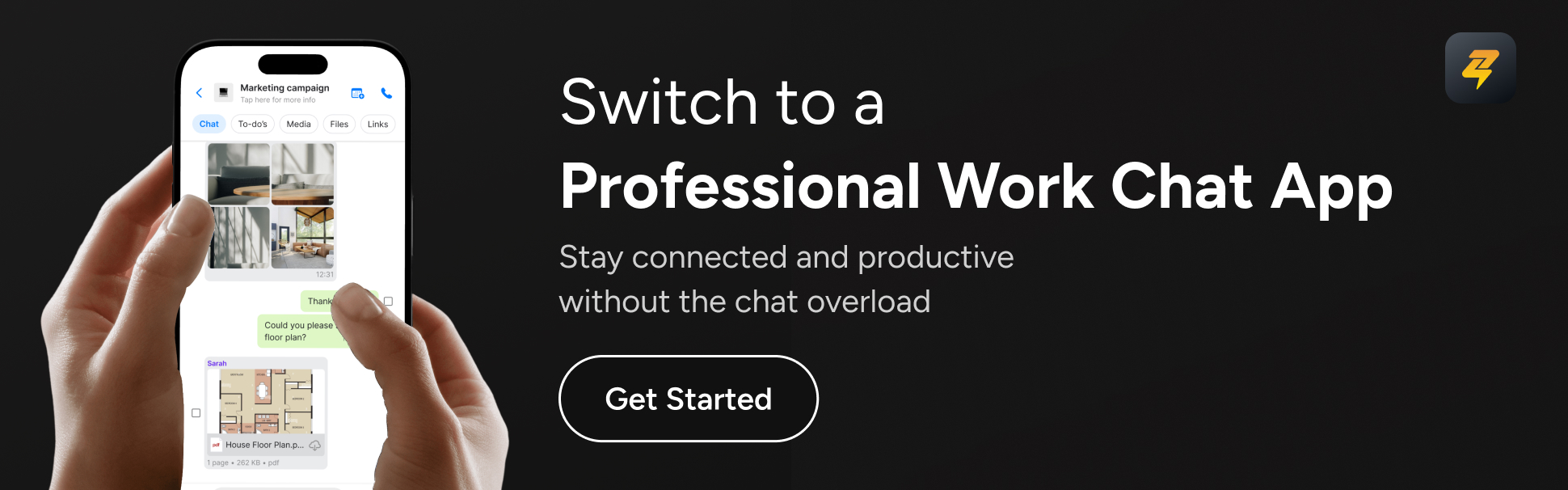
This is exactly the gap Zenzap was built to close. Zenzap is a professional work chat app built for small and mid-sized teams around the world. It takes the ease of the consumer messaging apps your team already loves, then layers on the structure, security, and control your business actually needs.
Zenzap is mobile first. That means your frontline staff, field teams, and non desk workers can participate fully in the same organized workspace without training sessions or manuals. If they can text, they can use Zenzap on day one.
Messages, tasks, and files live together inside conversations. You can attach tasks directly to a message, connect chats with your Google Calendar events, and connect with thousands of other business tools through Zapier, giving you access to virtually any app your team already uses. Instead of reading a note in a personal app, opening a separate task app, and then checking a calendar, you stay in one space.
This structure prevents the "all in one massive group chat" mess that personal apps create. People spend less time scrolling and more time acting on what matters. Managers can see what is going on without demanding status updates for everything.
On the security side, Zenzap gives you complete ownership of your company data. Messages and files are stored securely in the cloud, not on employees' personal devices. Admins have full control over who can access what, plus one click onboarding and offboarding. When someone leaves, you revoke their access instantly, so your information does not walk out the door with them.
If you want to compare this against other options built for small teams, see our guide to the best work chat apps for small businesses.
Protecting work life balance without losing responsiveness
A lot of owners hesitate to roll out a dedicated work chat app because they are afraid of becoming "always on." If everyone has a work chat on their phone, will they ever be able to switch off?
This is where Zenzap's work life separation features matter. Instead of blending work into personal apps, you pull it into its own clear container. That gives you more control over when work can reach your people, not less.
For a deeper look at how always-on messaging affects teams generally, see our full breakdown of messaging platforms and work-life balance.
Set working hours for your team
In Zenzap, each team member can set their working hours. During their shift, they get real time notifications. Outside those hours, notifications stay quiet unless something is truly urgent and deliberately escalated.
This simple habit does two important things. It respects people's time and reduces burnout by removing vague pressure to be reachable 24 or 7. It also makes on call expectations clear. If someone is on call, they know it, and the app reflects that, instead of everyone silently wondering if they should be checking messages at night.
Use message scheduling to avoid late night pings
You can also schedule messages to send during business hours. So if you remember something at 11 p.m., you capture it, but your team member sees it with their morning coffee, not on their nightstand.
With a focused app like Zenzap, updates flow into structured team spaces. Night managers can schedule next day prep notes. Leaders can check in on each location's performance without flooding staff with after hours messages. Work stays in work, and people get their evenings back.
Core insight: Treat chat as your operating system, not a side tool
Here is the core insight that ties this all together. Your chat app is not "just chat." For a 10 to 100 person company, it quietly becomes your operating system. It is where decisions get made, where tasks are assigned, and where culture lives.
If you treat it as a throwaway choice in year one, you almost always default into one of the two traps. You run work through personal apps and lose boundaries and control. Or you pick a tool that is impressive on paper, then watch your team ignore it and drift back to whatever feels easiest.
A purpose built, mobile first, intuitive work chat app like Zenzap lets you avoid both traps. You get:
Intuitive simplicity. No training required. If your team can text, they can use Zenzap.
Professional separation. Work communication moves into its own app, separate from personal life.
Bulletproof security and admin control. Enterprise grade protection with easy onboarding and offboarding, and full control over access.
Structured organization. Chats organized by site, team, and project, so nothing slips through the cracks.
Seamless integration. Connect Zenzap with your existing tools like Google Calendar and thousands of other apps.
Real work life balance. Working hours and message scheduling so your team can unplug without missing something genuinely urgent.
When you move from a broad view of "we just need something for chat" to a narrow, focused understanding of what your operating system should do, your decision gets easier. You are not hunting for features. You are choosing the calm, controlled way you want work to flow through your business.
Key takeaways
- Treat your first team chat app as a core operating system decision, not a quick tech choice.
- Avoid running work through personal messaging apps, which blur boundaries and strip away data control.
- Skip heavy enterprise tools that your 10 to 100 person team will not actually adopt in daily use.
- Choose a focused, mobile first work chat app like Zenzap that combines intuitive chat, tasks, files, and calendars in one place.
- Protect work life balance with clear working hours, message scheduling, and a clean separation between work and personal apps.

FAQ
Q: Why is using WhatsApp or iMessage for work such a big problem in year one?
A: In year one, using personal messaging apps feels quick and free, but it creates habits that are hard to undo later. Work mixes with personal chats, you have no real admin control, and sensitive information lives permanently on personal devices. When someone leaves, you cannot remove access or retrieve history. As you grow, this becomes a serious security, legal, and culture issue.
Q: My team is not very tech savvy. Will they actually use a new team communication app?
A: Yes, if it feels as familiar as tools they already use. Zenzap is designed so that if someone can send a text, they can use it from day one. Start with a few essential chats, show how tasks sit directly inside conversations, and let early adopters model the behavior. Because the app is mobile first and intuitive, adoption tends to follow quickly without heavy training.
Q: How long does it take to move our communication into Zenzap?
A: Most small businesses can make the core shift in about a week. Begin by mapping where communication currently lives, then set a clear go live date where all new internal messages move into Zenzap. Start with active projects, locations, and teams, then gradually retire old channels like personal group chats and long internal email threads.
Q: Will switching to a dedicated work chat app make my team feel more "always on"?
A: It has the opposite effect when you use the right features. With Zenzap, your team sets working hours and uses message scheduling, so they receive notifications when they are actually on the clock. You move work into its own app and remove it from personal channels, which creates a healthier and more respectful boundary between work and home.
Q: How does Zenzap help me stay compliant and secure as we grow?
A: Zenzap gives you enterprise grade security with small business simplicity. You own the data, messages and files live in the cloud under your control, and admins can add or remove users in clicks. This reduces the risk of ex employees walking away with years of chat history on personal phones, and it supports compliance needs in sectors like healthcare, logistics, and hospitality where access control and audit trails matter.
Q: What if I already use tools like Google Workspace, calendars, or other business apps?
A: Zenzap is built to sit on top of your existing stack, not replace it. You can connect chats with Google Calendar, tie tasks to conversations, and connect with thousands of other business tools through Zapier and existing connectors. That means less context switching for your team, smoother workflows, and clearer ownership of who does what, when.
Bringing it all together
Your first year is full of big, loud decisions. Hiring. Pricing. Marketing. The chat app you choose rarely makes the list, yet it quietly shapes every workday that follows. If you treat chat as a side tool, you drift into noise, fragmentation, and blurred boundaries. If you treat it as the operating system of your daily work, you can design for calm, clarity, and control from the start.
Zenzap exists to give you that kind of operating system - one that your team will actually use and that your business can fully trust. The question now is simple. In your next year of growth, do you want your communication to happen by accident, or by design?

Take Control of Your Team Communication
Chat, organize, and get work done - all in one place.
Other Blog Posts
- fskfsfjksofjsj