.svg)

.svg)

.svg)

.svg)

.svg)

.svg)

.svg)

.svg)

.svg)

.svg)
.svg)




















Where does a team communication tool excel in task management in chat for distributed teams?
You already know that talking is not your team's problem. The real gap is getting from "we should do this" in chat to "it is done" in a clear, trackable way. This article explores exactly where a modern team communication tool shines for task management in chat, especially when your people are scattered across locations and time zones, and how Zenzap turns that messy gap into a calm, connected workflow.
You will see why keeping work scattered across email, personal messaging apps, and separate project boards keeps your distributed team stuck, and how one structured, mobile-first workspace changes the whole picture. Along the way, you will learn how Zenzap blends intuitive work chat, internal team communication, and built-in task management so your team can adopt it instantly and execute without chaos.
What if every important message in your team chat either became a clear task or a documented decision, automatically visible to the right people, at the right time, in the right place?
If you are running a distributed team, that question hits close to home. Conversations race through channels, tasks hide in follow-up emails, and you wake up wondering what slipped through the cracks overnight in another time zone. You spend more time hunting for "that message from Tuesday" than actually moving work forward.
Team communication tools were supposed to fix this. Yet many traditional platforms added more complexity, more notifications, and more places for tasks to disappear. The result is familiar. Your people use one app for chat, another for tasks, another for calendars, and their own personal messengers when the "official" tool feels too heavy.
Zenzap was built as a reset button for this problem. It gives you one secure, structured, mobile-first workspace where your team can chat, turn messages into tasks, connect schedules, and keep work neatly separated from personal life. If your team can use a personal messaging app, they can use Zenzap, with almost no training.
In this guide, you will move from the broad picture of team communication tools, into specific ways task management in chat helps distributed teams, then down to practical tactics and the core insight that ties it all together.
Table of contents
1. Why distributed teams struggle with task management in chat
2. What a great team communication tool does differently
3. Where chat based task management truly excels
4. How Zenzap turns talk into trackable work
5. Real examples from distributed teams using Zenzap
6. Core insight: communication must live with execution
7. Key takeaways
8. Frequently asked questions (FAQ)
9. Final thoughts
Why distributed teams struggle with task management in chat
Here is a question that might sting a little.
If someone asked you right now to list every open task your team agreed to in chat this week, could you do it with confidence?
If you are like most leaders of distributed teams, the honest answer is no. Not because your team is lazy, but because your tools are working against you.
Right now, you might be bouncing between:
• Email for "official" updates
• A legacy chat tool that half the team ignores
• Texts for "quick" questions that never stay quick
• WhatsApp or iMessage for urgent issues
• A project management tool that only a few power users touch
In that setup, tasks fall through the cracks by design. Decisions happen in one place, tasks live in another, and updates are scattered everywhere. By the time you realise something slipped, the deadline is already behind you.
Research has consistently shown that knowledge workers lose hours each week just switching between tools and hunting for information. For fully distributed teams, that cost multiplies across time zones and roles.
What a great team communication tool does differently
At their best, team communication tools are not "just chat." They become your digital workspace, especially for distributed teams who cannot walk over to someone's desk.
A strong team communication tool for remote work and task management in chat lets you:
• Chat in real time in focused spaces such as teams, projects, or topics
• Share files where the related conversation already lives
• Turn messages into tasks with owners and deadlines
• Coordinate schedules with calendar integration
• Search across messages, files, and tasks in one place
Instead of splitting work across email, personal apps, and calls, everything important lives in one professional space. For small and mid sized or fully distributed teams, that usually means less confusion, faster decisions, and better retention of knowledge when people move on.
In other words, the real magic happens where communication and execution meet, right inside the chat where work is already being discussed.
Where chat based task management truly excels
So where does a team communication tool really excel in task management in chat for distributed teams?
It excels in the gaps that traditional setups leave wide open.
Turning fleeting chat into accountable work
Most of your team's decisions start in chat. Someone says "I will handle this" or "Let us ship this by Friday." In a basic chat app, that promise disappears into the scroll.
With built in task management in chat, those moments are captured. Any message can become a task, with:
• A clear owner
• A due date
• Status tracking
• Full conversation context
You are no longer hoping someone copies action items into a project tool later. The conversation directly produces structured work.
Keeping tasks in context for distributed teams
For distributed teams, context is everything. People join threads late, work across time zones, and often rely on async updates.
When tasks sit right beside the conversation that created them, no one is guessing what "Update client deck" really means. They can scroll up, see the decision, the file, and the comments, even if they are starting their day while others log off.
This is especially powerful when you organize by team, project, or client. For example, a distributed sales team can handle it like this:
• Territory updates in a "Sales team" channel
• Client specific questions in "Client: Acme" or "Client: Northwind" channels
• Follow up tasks created directly from messages
• Calendar invites generated from chat for the next call
Everyone knows where to look, even if they were not online when the conversation happened.
Reducing tool sprawl and context switching
Every extra app your team has to open is an opportunity to get distracted or drop something.
When your team communication tool includes task management, you often remove the need for a separate day to day task tool. High level roadmaps can stay in your project platform, but the real "who is doing what this week" work lives inside chat.
That means:
• Your project manager is not manually rebuilding yesterday's chat into a backlog
• Your team leads are not pinging people in three different apps for status updates
• Your executives can scan key channels and see both decisions and tasks in one place
For distributed teams in particular, this reduction in tool sprawl can reclaim hours every week.
How Zenzap turns talk into trackable work
This is exactly the gap Zenzap is built to fill for distributed and hybrid teams.
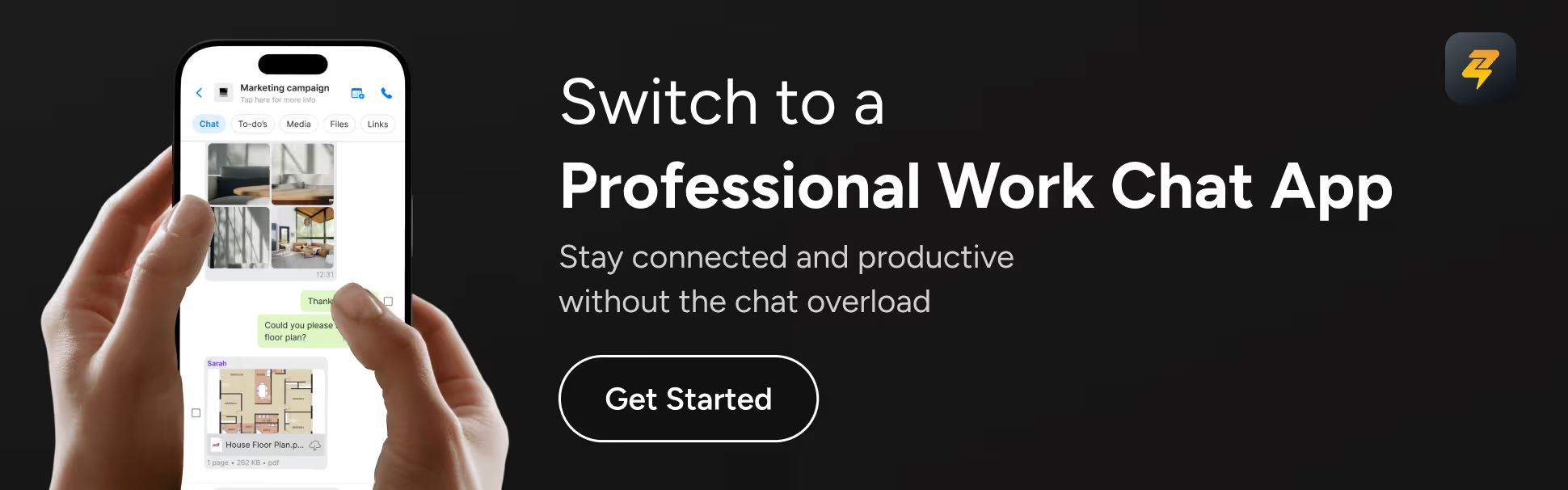
Zenzap is a mobile first internal communication app that blends work chat, built in tasks, Google Calendar integration, secure file sharing, and clear working hours, all in one structured workspace. It is not a resized desktop app. It is designed for thumbs, not mice, so your team has full power in their pocket instead of a watered down mobile companion.
Instant adoption with familiar chat, grown up structure
Distributed teams do not have time for complex onboarding or three hour training sessions.
Zenzap deliberately looks and feels as familiar as a consumer chat app, but with professional features layered in. Teams usually start using it within minutes, especially when you roll it out with a few simple rules, such as:
• Every team or project gets its own channel
• Every actionable message becomes a task
• Decisions are pinned in relevant channels
• Work hours are set so people can unplug
One reviewer put it simply, "Zenzap is finally a clean alternative to traditional messaging platforms." You get the ease of chat with the structure distributed teams need.
Tasks created directly from messages
In Zenzap, any message can become a task with a couple of taps. You can:
• Assign an owner
• Set a due date
• Attach related files
• Keep the full conversation connected
A quick note like "Can someone update the promo signage before Friday?" becomes a structured task in that same channel, with a deadline and a clear owner. No copy pasting to another tool. No risk of forgetting it once the chat moves on.
Structured organization so nothing slips
Structure is where your tool either becomes a calm headquarters or another noisy group chat.
Zenzap flips the usual chaos. It gives you:
• Channels by team, project, client, and topic
• Clear ways to pin decisions and announcements
• Tasks filtered by owner, status, or channel
• Search that surfaces messages, files, and tasks together
Every conversation has a logical home. Every task sits where it belongs. You can see the full picture of work without opening five tabs.
One marketing agency that moved to Zenzap finished 40 percent more projects on time, simply by keeping messages, tasks, and files together in one app, according to their internal reporting.
Seamless scheduling with Google Calendar integration
Zenzap connects to Google Calendar so your team can create calendar invites straight from chat. When a conversation lands on "Let us review this with the client on Tuesday," you can spin up the meeting from the same thread.
For distributed teams working across time zones, that tight link between chat and calendar is crucial. It keeps schedules aligned without endless email chains.
Security and professional separation by design
Zenzap is built as a professional internal team communication app, not a personal messaging tool reused for work.
You get:
• Encrypted communication
• Secure onboarding and offboarding
• Admin controls for who can access what
• Working hours and scheduled messages
This protects your company data and your team's wellbeing. You keep work and personal life separate, while still feeling confident that you will not miss truly urgent updates.
Real examples from distributed teams using Zenzap
A distributed sales team that keeps client work aligned
Picture a sales team spread across three regions. Before Zenzap, they were chasing updates across email threads, chat tools, and CRM notes.
With Zenzap, they set up:
• A "Sales leadership" channel for strategy and targets
• Territory channels for local updates
• Client channels like "Client: Acme" or "Client: Northwind" for deals
• Tasks for follow ups created right from chat
• Calendar invites generated in channel for demos and QBRs
When a rep promises, "I will send the revised proposal by Thursday," that message becomes a task on the spot. The manager can see at a glance which follow ups are due this week, who owns them, and what was discussed with the client.
A service business that stopped mixing everything together
Chris Fletcher at Tech on Toast used Zenzap to split communication into customer support, HR, and project channels. Before that, support questions, hiring updates, and internal projects were all jumbled together.
Once they moved to Zenzap:
• Support conversations lived in dedicated channels
• HR updates had their own space
• Project tasks sat right inside project channels
Critical details stayed where they belonged and were searchable in seconds. No one had to scroll through a general chat or dig through personal apps to find important information.
A distributed team that simplified task management in chat
Another distributed team used to rely on multiple tools for chat and execution. Action items lived in comments, direct messages, and meeting notes, and someone had to manually rebuild the backlog every week.
After switching to Zenzap, they adopted a simple rule: if it is actionable, it becomes a task in the channel where it was discussed.
In practice, that meant:
• No more manual task reconstruction
• Channel views that showed both decisions and tasks
• Quicker onboarding for new hires who could see work in context
They reported faster handoffs between time zones and fewer "Did this ever get done?" conversations.
Core insight: communication must live with execution
Let us narrow this right down to the core insight.
For distributed teams, your team communication tool only truly excels in task management in chat when it becomes the structured heart of your workflow, not just a messaging front end for other systems.
Chat alone is not enough. A project tool alone is not enough. The power lies in letting conversations directly produce, organize, and track work without leaving the place where that work is discussed.
Zenzap is built around that principle. Messaging, tasks, files, and schedules share the same space, secured and structured for business use, and optimized for mobile so your team can act wherever they are.
Key takeaways
- Make your team communication tool the single home for work chat and day to day task management in chat, especially for distributed teams.
- Apply a simple rule that every actionable message becomes a task with an owner and due date in the same channel.
- Use structured channels, pinned decisions, and task filters so nothing slips through the cracks when people work across time zones.
- Protect focus and wellbeing with working hours, scheduled messages, and clear separation between work and personal communication.
- Integrate your work chat with calendar and existing tools so conversations naturally turn into meetings, tasks, and follow ups.

FAQ
Q: What is task management in chat for distributed teams?
A: Task management in chat means you create, assign, and track tasks directly inside your team communication tool instead of sending them to a separate project app. For distributed teams, this keeps work visible in the same channels where it is discussed, so people in different time zones can see decisions, context, and ownership without chasing multiple tools.
Q: Can a team communication tool replace my project management software?
A: For day to day execution, usually yes. A tool like Zenzap can handle "who is doing what this week" through chat based tasks, channels, and filters. You might still keep long term roadmaps or complex Gantt charts in a dedicated project platform, but your weekly coordination and follow up can live entirely in your communication tool.
Q: How does Zenzap help prevent important tasks from slipping through the cracks?
A: Zenzap lets you turn any message into a task, organize work by team, project, or client channel, and filter tasks by owner or status. Decisions can be pinned in channels, and search spans messages, files, and tasks together. That combination makes it easy to see what is open, what is blocked, and what has been completed, without hunting through different apps.
Q: Is Zenzap a good fit if my team already uses Google Workspace?
A: If your team lives heavily in Gmail, Docs, and Drive, Zenzap complements that stack by giving you a dedicated mobile first hub for work chat and tasks. It integrates with Google Calendar so you can schedule meetings from chat. Zenzap offers deeper built in task tracking and internal task alignment with less reliance on extra integrations or spreadsheets.
Q: How does a mobile first communication tool help remote and frontline workers?
A: For distributed and frontline workers, the phone is the primary device. A mobile first tool like Zenzap is designed around how people actually tap, scroll, and respond in short bursts. Messages, tasks, and calendar connections are easily managed from mobile, so your team does not need a laptop to stay aligned or update task status during their day.
Q: How does Zenzap support work life balance for distributed teams?
A: Zenzap includes working hours and scheduled messages so people can unplug without worrying they will miss something important. You can write a message now and schedule it for business hours in the recipient's time zone. Admin controls and clear separation from personal chat apps also help reinforce boundaries between work and home.
Final thoughts
If you feel like half your job is just chasing where decisions live, your current setup is not serving you or your distributed team.
The real advantage of a modern team communication tool is not faster messages. It is the way it joins communication and execution so tightly that tasks, context, and accountability always travel together.
Zenzap is built to be that calm, structured center for your team. It takes the familiar ease of chat, adds grown up organization, and wraps it in security and mobile first design so distributed teams can finally breathe a little easier.
The question is, if your conversations could reliably turn into clear, trackable work without leaving chat, how much more would your team actually get done?

Take Control of Your Team Communication
Chat, organize, and get work done - all in one place.
Other Blog Posts