
.svg)

.svg)

.svg)

.svg)

.svg)

.svg)

.svg)

.svg)

.svg)

.svg)
.svg)


























Why Remote Teams Switch Chat Apps Twice (And How to Skip the Second Move)
You are not imagining it. Choosing a team chat app once is hard. Having to choose it twice is exhausting.
Most remote teams follow the same pattern. First, you grab whatever chat app feels quick and familiar so everyone can start talking. Then the cracks appear, messages get lost, security gets worrying, and people quietly move critical work somewhere else. Before long, you are planning a second migration you never wanted.
Table of contents
Here is where you are headed in this guide:
- Why remote teams switch chat apps twice
- Step 1: Get honest about where your communication is breaking
- Step 2: Learn the three phases of a remote team chat app
- Step 3: Avoid the second switch by choosing for future you
- Step 4: See how Zenzap skips the chaos stage
- Step 5: Roll out a new chat app without burning your team out
- Key takeaways
- Final thoughts
- FAQ
Why remote teams switch chat apps twice
How many different places do you check before lunch just to know what is going on at work?
For most remote teams, it is too many. You jump from email to a chat app to group texts to a project tool, then back to another group chat that someone spun up "just for this client." It feels busy, but it is not real productivity. It is constant context switching that makes it easy for important work to disappear.
That is usually when someone says, "We need a proper work chat app."
The team picks the first tool that ticks a few boxes, everyone piles in, and for a while it feels better. Then reality hits. Permissions are confusing. Guests are hard to manage. People cannot separate work and personal life. Security questions surface that no one can answer. Integrations are half working. The result is scattered conversations, unclear ownership, and a growing sense that the tool is working against you rather than for you.
Now you are facing a second, harder decision: migrate everything again or live with a chat app that fights you.
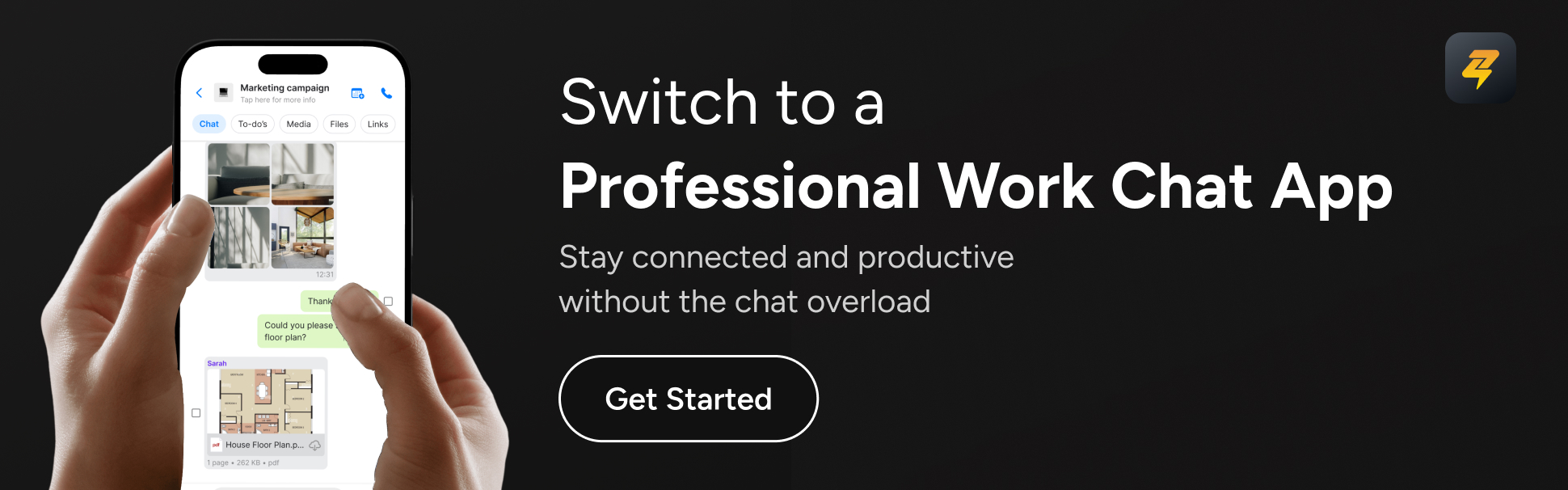
You can skip that second move if you approach the decision differently. Instead of asking "What is easy today?" you ask, "What will still feel simple, secure, and sustainable two years from now?"
That is where Zenzap, a mobile-first internal team communication app, comes in. It feels as easy as texting, yet it is designed from the ground up for remote work communication, security, and work-life balance.
Step 1: Get honest about where your communication is breaking
Before you can choose a chat app you will not outgrow, you need a clear view of what is actually broken today.
Spot the hidden cost of scattered tools
Ask yourself a few blunt questions:
How many apps does your team use daily just to talk about work? Email, one or two chat tools, text messages, maybe a project management tool with built-in messaging.
It's common for remote teams to bounce between five or more tools before lunch just to stay on top of work email, chat, texts, and a project tool with its own notifications. That constant switching doesn't just waste time. It increases the odds that a message, decision, or file gets lost.
Notice where things actually fall through the cracks
Look back at the last 30 days. Where did things go sideways?
- A client update buried in a personal messaging thread
- An urgent message that pinged at 11:30 pm in a personal group chat
- A task discussed in chat that never made it into your task tool
- An offboarded employee who still has sensitive chat history on their personal phone
These are not "little annoyances." For a remote team, they are structural risks. They are also the exact issues that push teams into that second costly switch.
Map communication to real outcomes
Next, tie your chat problems to business impact:
- Response times: Are decisions slower because people cannot find the latest message?
- Security: Do you know who owns your data and who still has access?
- Onboarding: How long does it take a new hire to find the right channels, documents, and people?
- Wellbeing: How many people quietly resent the "always on" culture created by late-night pings?
When you see the full cost, it becomes obvious that a chat app is not "just another tool." It is where your team's work, knowledge, and culture live.
Step 2: Learn the three phases of a remote team chat app
Remote teams do not wake up and say, "Let us switch chat apps twice." It happens in three predictable phases. When you understand them, you can make different choices.
Phase 1: The quick fix
This is where most teams start. You grab whatever is fastest to roll out.
Often, that looks like:
- Using a consumer messaging app "just for a while"
- Letting different teams choose their own tools
- Adopting a complex enterprise solution because it comes bundled with something else
In the moment, it feels smart. You get instant adoption because people already know the app. There is no training, and within a day you have a dozen active chats.
The problem is that Phase 1 decisions are made for speed, not for scale or security. You have no clean separation between personal and professional, no clear admin controls, and limited structure.
Phase 2: The friction curve
As you grow, friction kicks in. Complex tools combined with complex setups create complex problems. Friction often shows up as:
- Confusing guest access and permission configurations
- Data stuck in personal accounts when people leave
- Too many side channels, group texts, and back-door conversations
- Notifications that ignore time zones or working hours
- Security and compliance questions that have no clear answers
At this stage, leaders start asking, "Is this still the right tool for us?"
Phase 3: The second move
Here is where the real cost hits.
By the time you switch chat apps the second time, you are no longer moving just messages. You are moving workflows, habits, and knowledge. You are training your entire team again. You are trying to cleanly offboard people from the old app while ensuring no data walks out the door with them.
This is also when you realize that what you actually needed from the beginning was not "a chat app." You needed a dedicated, secure, structured digital workspace built for remote work communication.
Step 3: Avoid the second switch by choosing for future you
Now that you see the pattern, you can step off the ride. The way to avoid a second switch is to choose a chat app that serves your future team, not just the team you have today.
Define what "will not break later" means for you
Start with clear non-negotiables. For most remote teams, these include:
- Intuitive simplicity: Your team should be productive within minutes, not weeks. If someone has ever used a messaging app, they should understand your work chat without training.
- Professional separation: Work must live in its own professional space, separate from personal chats, numbers, and contact lists.
- Bulletproof security: Encryption, secure onboarding and offboarding, and clear admin controls are not "nice to have." They are baseline requirements.
- Structured organization: Channels, topics, and tasks must be easy to create and even easier to find later.
- Seamless integration: Your chat app needs to play well with tools like Google Calendar, file storage, and other business software.
- Real work-life balance: Working hours, scheduled messages, and smart notifications should be built in, not hacked together.
When you use these as filters, a lot of popular options drop away. Some are too consumer-focused, others are powerful but overly complex, and many do not have a real answer for security or offboarding.
Test against real use cases, not feature lists
Feature checklists can be misleading. Instead, run through real scenarios:
- "A client wants a status update. Where do we chat, where do we store files, and how do we make sure only the right people see it?"
- "A teammate leaves. How quickly can we remove access and keep all their conversations and files inside the company?"
- "A teammate in a different time zone needs to move work forward without waking colleagues."
- "A new hire joins. How long until they have everything they need in one professional workspace?"
If your current or candidate tool cannot handle these smoothly, you are setting yourself up for that second painful move.
Step 4: See how Zenzap skips the chaos stage
This is where Zenzap fits in as a different kind of remote work communication app. It is built to feel as simple as a personal messaging app, but with the controls and structure your business actually needs.
Simple, intuitive work chat your team already knows how to use
In an independent review on RemoteWize, Aleksandra Ivanovska notes that there's no steep onboarding process required, and that she was able to navigate Zenzap within the first few minutes of testing it.
The interface is clear. Conversations live in one clean stream instead of getting buried in side threads. You can reply, forward, edit, copy, or turn any message into a to-do with a tap.
That intuitive simplicity is what makes Zenzap effective as a "first and last" chat app. You get fast adoption without sacrificing long-term structure.
Work stays at work, personal stays personal
Zenzap is a dedicated professional workspace, not another consumer messaging thread. All company communication, contacts, and files live inside Zenzap, not on personal phone numbers or social apps. New employees join your workspace - they do not add their boss or clients to their personal contacts.
This clear separation does three things for you:
- Reduces legal and security risk by keeping business data in company-controlled systems
- Makes onboarding and offboarding clean and fast
- Protects personal time, because work notifications are tied to work accounts and working hours
Enterprise-grade security with human-friendly controls
Security is where many teams realize they chose the wrong chat app. Zenzap was built with that in mind.
Out of the box, you get encrypted communication and secure onboarding and offboarding flows. Admins can add or remove people in a few clicks. When someone leaves, their access to chats and files is revoked immediately, while the company retains full ownership of the data.
This is the exact blind spot that personal chat apps create. People leave with years of chat history, client numbers, and files on their own devices. With Zenzap, the company owns the workspace, not the individual phones.
Built-in structure so nothing slips through the cracks
Communication without structure is noise. Zenzap keeps things organized without feeling heavy.
You can create topic-based channels for teams, projects, or clients. Every conversation can turn into action, because you can convert any message into a task directly in the chat, assign an owner, and set a due date.
Files are shared, stored, and searchable right inside conversations. You do not have to remember if that PDF was in a drive folder, an email, or some buried group chat. It is exactly where you shared it.
Integrations that support, not complicate
Zenzap integrates with core tools like Google Calendar and other business software. That lets you stay in flow without adding more tabs or complexity.
You can schedule messages, coordinate around calendars, and keep key context connected to your chats instead of spread across five different tools.
Work-life balance as a product feature
Many remote teams talk about work-life balance, then blow it up with late-night messages. Zenzap bakes healthier behavior right into the product.
Each person can set working hours, so they do not receive notifications outside those windows. You can schedule messages to send during business hours, so you never feel guilty about typing something at midnight.
Smart notifications mean only truly urgent issues break through. Colleagues in other time zones can move work forward without waking anyone in the middle of the night.
Step 5: Roll out a new chat app without burning your team out
Even when you choose the right tool, poor rollout can make it feel like the wrong one. Here is how to introduce Zenzap or any new chat app so you do not end up planning another migration.
Start with a focused pilot
Zenzap itself recommends this: try it with a pilot team, watch how quickly they adopt it, and then evaluate.
Pick one cross-functional group, for example, sales plus customer success. Move their day-to-day conversations, tasks, and files into Zenzap. Set clear expectations that all work communication for that group happens there.
After a few weeks, ask simple questions:
- How many tools are you opening now compared to before?
- Do you feel more or less in control of your work?
- Are you getting fewer late-night interruptions?
- How easy is it to find what you need?
Codify a few simple communication rules
A great tool cannot fix unclear norms. Use the rollout as a chance to reset how you communicate.
For example:
- All project conversations live in named channels in Zenzap
- No work conversations in personal messaging apps
- Use tasks in Zenzap for commitments and deadlines, not just "Got it" replies
- Respect working hours and use scheduled messages
Keep the rules short enough to remember. The point is to make Zenzap the single trusted place where work communication lives.
Plan onboarding and offboarding from day one
One reason teams switch chat apps twice is that they never quite fix the mess of who has access to what.
With Zenzap, you can build onboarding and offboarding into your operations:
- New hire checklist: create their Zenzap account, add them to relevant channels, share key files and guides
- Offboarding checklist: remove Zenzap access, transfer ownership of any tasks or files, confirm no company data sits in personal tools
The more consistent this is, the less likely you are to face security surprises that force another switch.
Key takeaways
- Do not choose a remote team chat app only for today - choose one that will not break when you grow.
- Avoid the second migration by demanding intuitive simplicity, strong security, and real work-life balance from day one.
- Use real scenarios, not just feature lists, to evaluate whether a chat app will support your workflows.
- Let Zenzap centralize work communication, tasks, and files in one secure, professional workspace.
- Roll out any new chat app with a clear pilot, simple communication rules, and tight onboarding and offboarding.
Final thoughts
Remote teams rarely regret the moment they decide to get serious about their communication. They regret doing it twice.
The first switch is about escaping chaos. The second switch is about repairing the damage: scattered files, fuzzy ownership, burnout from late-night messages, and security risks hiding in personal devices.
You can take a different path. When you choose a remote work communication app like Zenzap, you are not just picking a place to chat. You are choosing where your team's work will live, how safe it will be, and how sustainable your pace will feel for the people doing that work.
So before you commit your team to another "quick fix," ask yourself one question: what would it be worth to choose a work chat app once and never have to switch again?
FAQ
Q: Why do remote teams so often switch chat apps more than once?
A: Most teams pick their first chat app for speed and familiarity, not for long-term fit. They start with consumer apps or complex tools that seem convenient, then run into issues with security, structure, and work-life balance as they grow. Those problems eventually force a second move to a tool that is actually designed for remote work communication.
Q: How does Zenzap help me avoid a second chat app migration?
A: Zenzap is built to be simple enough for instant adoption and robust enough to scale with your business. It combines intuitive messaging, built-in tasks, file sharing, and integrations with enterprise-grade security, admin controls, and clear work-personal separation. That balance makes it far less likely that you will outgrow it or need to patch it with extra tools.
Q: Is Zenzap really different from using personal messaging apps for work?
A: Yes. Consumer apps are designed for social conversations, not for running a business. With personal messaging tools, your data lives on personal devices, onboarding and offboarding are messy, and work constantly leaks into personal time. Zenzap gives you a dedicated professional workspace where the company owns the data, admins control access, and features like working hours and scheduled messages protect your team's time.
Q: What about security and compliance for sensitive industries?
A: Zenzap uses encrypted communication and secure onboarding and offboarding to protect your information. Admins can manage who joins the workspace, remove access instantly when someone leaves, and keep all chat histories and files under company control. This is a significant improvement over personal chat apps, where data often walks away with employees.
Q: How does Zenzap support work-life balance for remote teams across time zones?
A: Each person can set their working hours in Zenzap, so notifications pause outside those times. You can schedule messages to send during business hours and rely on smart notifications so that only truly urgent issues break through. Colleagues in other time zones can keep work moving without waking or interrupting each other at night.
Q: What is the best way to try Zenzap without disrupting my whole company?
A: Start with a focused pilot. Choose one cross-functional team, move their daily communication and tasks into Zenzap, and agree on simple rules such as "all work talk lives here" and "no work in personal apps." After a few weeks, review adoption, clarity, and stress levels. Use that learning to refine your rollout plan, then expand to the rest of the organization.

Take Control of Your Team Communication
Chat, organize, and get work done - all in one place.
Other Blog Posts
- fskfsfjksofjsj