


.svg)













You already run your clinic in chat. You just do not have the tools to prove it.
Every day, your team fires off messages like "Can you call this patient?", "Please repeat labs", or "Update the family about the results." Those messages are where real work starts. The problem is that in most clinics, they vanish into long threads, personal apps, and scattered inboxes. There is no tracking, no clear owner, and no easy way to see what actually got done.
This is exactly where task management in chat changes the game. In 2026, leading clinics are turning casual chat messages into structured, trackable tasks, right where conversations happen. When you pair that with a secure, mobile-first app like Zenzap, you get something powerful. You keep the speed of chat, add the discipline of task management, and finally get a clinic communication system you can trust.
In this article, you will see why task management inside chat is becoming the next big thing for clinic communication, how it supports secure team communication, and why Zenzap is built for the way your staff already works.
You will walk through a real clinic story, unpack the core problem, explore the "here is why" behind in-chat tasks, and leave with practical steps to bring calmer, clearer communication into your clinic in 2026.
Table of contents
1. The story: when chat runs your clinic, but nothing is tracked
2. The core issue: why traditional tools are failing your team
3. Here is why task management in chat is taking over clinic communication
4. How Zenzap turns clinic conversations into structured action
5. Real clinic scenarios where in chat tasks change outcomes
6. Work life balance and staff wellbeing in 2026
7. How to roll out task management in chat in your clinic
8. Key takeaways
9. FAQ
The story: when chat runs your clinic, but nothing is tracked
Picture a typical afternoon in your outpatient clinic.
Your front desk sends a message to a nurse: "Can you call Mr. Harris about his lab results?" A GP texts a colleague: "Please repeat labs for Mrs. Lee tomorrow." A resident leaves a note in the EMR, then emails admin to "make sure family is updated." Everyone is doing the right thing. Yet no one can see all the moving parts.
By the end of the shift, you are relying on memory, goodwill, and guesswork. Did anyone actually call Mr. Harris? Did those repeat labs get ordered? Who was supposed to update Mrs. Lee's family? When a patient or regulator asks what happened, you are left piecing together evidence from chat logs, EMR notes, and inboxes.
That is not a workflow. That is a patchwork. And in 2026, it simply is not enough.
The good news is that your existing habits are not the problem. Your tools are. Your team already lives in chat. You just need a way to turn chat into action, without piling on more software, more tabs, and more confusion.
The core issue: why traditional tools are failing your team
There is a clear reason clinics are looking for something better in 2026. The old mix of pagers, email, and personal messaging apps is no longer fast enough, safe enough, or sustainable for your staff.
Here is what you are likely seeing right now.
Scattered communication and invisible work
Most real clinic workflows are already in chat. Yet standard chat apps treat actionable messages as casual lines. There is no way to assign ownership, no due dates, and no clear record of completion.
For you, that means:
- Follow ups that depend on memory
- Handoffs that rely on "Did you see my message?"
- Leadership visibility that is limited to whoever was in the chat at that moment
In a 15 provider clinic, that can turn into hours of admin time each week spent hunting for messages instead of caring for patients.
Context switching that kills productivity
Even if you use a separate task tool, your staff has to jump between apps. A nurse sees a message, opens a task system, creates a task, then flips to the EMR to check context. That is three tools to complete one simple action.
According to Forbes, heavy context switching like this can reduce productivity by up to 40 percent. When you multiply that across every nurse, provider, and admin, you are burning a lot of clinical time on pure friction.
Personal apps that create risk and burnout
Many clinics still rely on personal apps for quick coordination. It feels convenient in the moment. In reality, it mixes protected health information with personal photos, family chats, and weekend plans.
That is not just uncomfortable. It is risky. HIPAA fines can reach $50,000 per violation when PHI lives on personal devices. On top of that, constant pings in personal apps blur the line between work and home. Your staff never truly switches off. Burnout creeps in, and retention gets harder every year.
Here is why task management in chat is taking over clinic communication
In 2026, healthcare organizations are not just asking for secure messaging. They are asking for actionable messaging. That is where task management inside chat becomes the next big step.
From throwaway lines to accountable tasks
Instead of treating "Can you call this patient?" as a casual note, modern work chat tools let you turn that message into a structured task, right inside the conversation.
With Zenzap, you can:
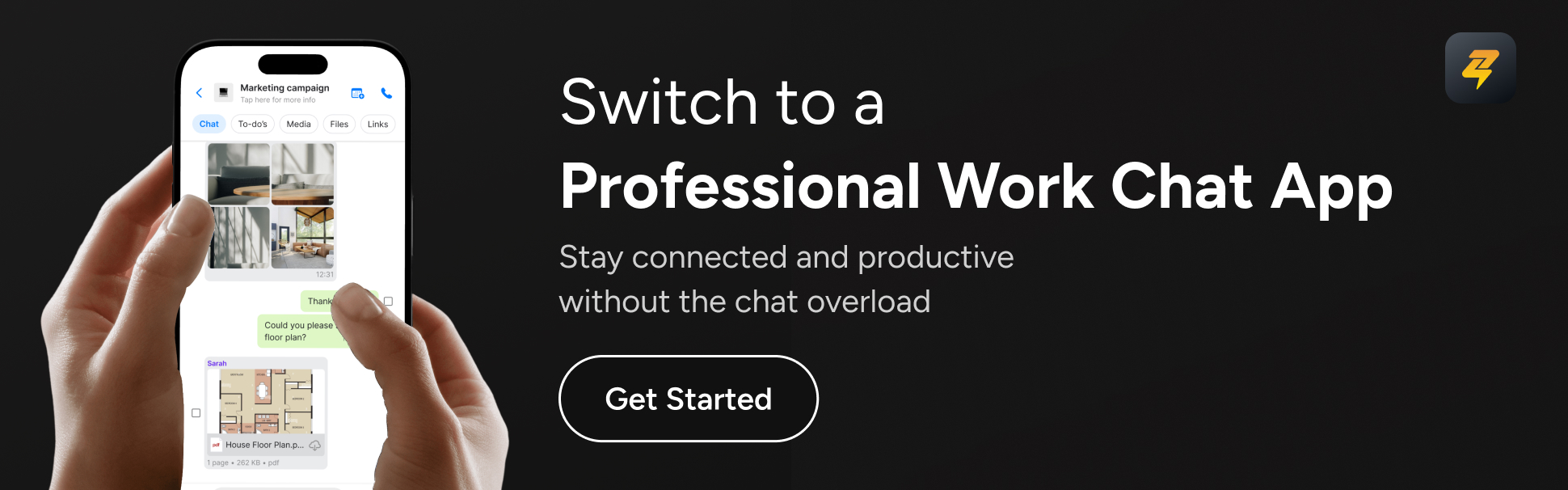
- Convert any message into a task in one tap
- Assign it to a specific owner
- Add a due date that syncs with Google Calendar
- Track completion without leaving the chat
This is the difference between hoping something happens and knowing it will. You no longer rely on memory or goodwill. You have a visible, shared list of next steps, tied to the exact conversation where the work started.
Everything lives where the work happens
When tasks live inside chat, your team no longer has to jump across tools. The chat, the tasks, the files, and the patient context sit together.
For example, Zenzap integrates with EMRs and calendars. New patient events can automatically open a dedicated chat linked to the patient. Lab results, admission updates, and discharge plans appear in the same place where the care team is already coordinating.
No more wondering who saw what. No more searching five apps to rebuild the story.
Safer, audit ready communication
Leading secure team communication tools are moving beyond "just chat" by adding:
- Built in task management
- Channels that mirror departments or patient journeys
- EMR and calendar integrations
- Search that works under pressure
When tasks are attached directly to messages, you have a clean audit trail. You can show when a task was created, who owned it, when it was due, and when it was completed. That matters for quality improvement, incident reviews, and regulatory audits.
Instead of combing through screenshots and inboxes, you search one secure, clinic owned system and see the full history.
How Zenzap turns clinic conversations into structured action
Zenzap is built around one core idea. You should not have to choose between the simplicity of chat and the structure of a project tool. You deserve both in one secure, clinic friendly app.
Instantly turning messages into tasks
In Zenzap, the workflow is simple. Someone types "We need to follow up on Mrs. Lee's blood test results tomorrow." You tap once, convert that message into a task, assign it to a nurse, and set tomorrow's date. It appears immediately in the task list inside that same chat.
No one needs training. If your staff can text, they can use Zenzap. That mobile first, intuitive simplicity is why clinics adopt it quickly, without long rollouts or months of change management.
Organizing chats so nothing slips through the cracks
Zenzap becomes most powerful when you structure it to match how your clinic actually works. You can organize chats by:
- Team, such as "Pediatrics" or "Dental hygienists"
- Location, such as "Clinic A front desk"
- Patient, through secure, patient specific chats linked to your EMR
- Topic, such as "Infection control" or "Quality improvement"
Inside those chats, you can pin key messages, store files, and build task lists. A manager can post daily priorities as tasks in a "Daily huddle" chat, and nurses tick them off through the shift. At the end of the day, you see what was completed and what carries forward.
Security and admin control built in
Security is not optional in healthcare. Zenzap treats it as a first principle.
Messages and files are stored securely in the cloud, not on personal devices. Admins can revoke access in one click when someone leaves, so you are not depending on ex staff to leave chat groups on their own.
With enterprise grade security, encrypted communication, and clear onboarding and offboarding, you keep PHI where it belongs, under your clinic's control.
Real clinic scenarios where in chat tasks change outcomes
To see the impact, it helps to look at real scenarios that play out in clinics like yours every day.
Scenario 1: follow up that actually happens
Before Zenzap, a provider messages a nurse in a personal app: "Please call Mr. Navarro with his imaging results next week." The nurse reads it between rooms, intends to remember, then gets pulled into something urgent. A week later, the follow up is late and the patient is frustrated.
With Zenzap, that same message is converted into a task in the patient specific chat. It is assigned to the nurse, given a due date that syncs with Google Calendar, and sits in a visible task list. If it is not completed on time, it stays open and visible until it is handled.
Patients feel looked after. Your team feels less stressed. No one is relying on memory to bridge the gap.
Scenario 2: smoother shift handovers
Handovers are where details get lost. In a busy clinic, verbal updates and quick texts do not always capture everything.
With Zenzap, you can run handovers inside a dedicated channel with a simple checklist. Open tasks from the previous shift are clearly marked. Each item has an owner, a due time, and patient context attached. The incoming team sees at a glance what is still outstanding.
In audits or incident reviews, you can go back to that channel to see the exact flow of decisions and actions.
Scenario 3: cross site coordination that actually feels calm
For large providers operating across multiple locations, coordination is even harder. Some organizations coordinate care across dozens of facilities covering vast distances. Before Zenzap, they relied on a mix of email, phone calls, and older systems that were never designed for modern healthcare communication.
With a secure, task aware chat tool like Zenzap, distributed teams can:
- Create dedicated care teams per patient
- Attach tasks to specific cases and workflows
- Give leadership real time visibility into priorities and progress
- Reduce email overload and endless threads
That kind of structure is not just operational. It supports safer care and more sustainable work for staff.
Work life balance and staff wellbeing in 2026
Task management in chat is not just about speed or productivity. It is also about protecting the people who keep your clinic running.
Built in boundaries instead of constant pinging
In 2026, leading healthcare communication tools are building work life boundaries into the product itself, not leaving them to chance.
With Zenzap, your team can:
- Set working hours so non urgent notifications pause when they are off shift
- Schedule messages to send during business hours instead of late at night
- Keep work communication in a dedicated app, away from personal chat
This is not a nice to have. It is one of the most effective ways to reduce burnout and keep experienced clinicians in the profession longer.
Professional separation that your staff can feel
When work lives in Zenzap and personal life stays in a separate personal app, your staff feels a clear mental divide. They can close the work app at the end of the day, knowing that anything truly urgent will still reach the right on call person without waking the entire team.
The result is a calmer digital environment where people can focus when they are on shift and actually rest when they are not.
How to roll out task management in chat in your clinic
You do not need a massive digital project to bring this to life. In fact, one reason clinics choose Zenzap is that it feels familiar from day one.
Step 1: pick a pilot area
Start with one unit or workflow where communication pain is clear, such as:
- An outpatient clinic with heavy follow up
- A front desk team juggling calls and messages
- A specialty team with complex handovers
Define a simple goal. For example, "No follow up calls missed this month" or "All handover tasks visible with owners."
Step 2: mirror your real structure
Set up Zenzap channels to match how you already think about your clinic. Create chats by team, patient, or location so people instantly know where to go.
Pull in your EMR and calendar integrations where possible. That way, new patient events or key dates appear automatically in the right conversations.
Step 3: make "turn it into a task" the new habit
Encourage a simple rule. If a message contains a next step, turn it into a task.
"Can you call this patient?" becomes a task. So does "Order repeat labs by Friday" or "Update shared protocol file." The more consistent you are, the more reliable your system becomes.
Because Zenzap feels like a personal chat app, you can cover this in a light 20 minute training and refine from there.
Step 4: review, refine, and expand
After a few weeks, sit down with your pilot team and ask:
- Which tasks helped avoid dropped balls?
- Where did people still fall back to old tools?
- What channels or task lists need adjusting?
Use that feedback to refine your setup. Then expand to other teams and workflows once you see the benefits in real numbers, such as fewer missed follow ups or faster handovers.
Key takeaways
- Turn actionable messages into tasks inside chat so follow ups never rely on memory.
- Organize Zenzap by team, location, patient, or topic so clinic communication stays structured and searchable.
- Use EMR and calendar integrations to keep conversations, context, and deadlines in one secure place.
- Protect staff wellbeing with built in work hours, scheduled messages, and a clear line between work and personal chat.
- Start with a focused pilot, make "turn it into a task" a habit, then scale once you see fewer dropped balls and calmer shifts.

Why task management in chat is the next big thing for clinic communication in 2026
By 2026, secure, mobile first team communication tools have become the practical middle path for clinics. Old tools like pagers, email, and personal messaging apps are too slow, too risky, and too fragmented. Heavy enterprise suites are too complex for frontline teams who live on their phones.
Task management inside chat is the missing layer that makes clinic communication truly work. It brings structure to the way you already operate, without slowing anyone down.
With Zenzap, you get a single, secure work chat app where:
- Conversations, tasks, and files live together
- Patient specific chats link straight to your EMR
- Every "I will take care of it" has an owner and a due date
- Staff can unplug from work without losing control
Your clinic moves from firefighting to proactive coordination. You reduce the risk of missed follow ups and miscommunication. You give your team a calmer digital space where they can focus on what they trained to do, which is care for patients.
The real question for 2026 is simple. If your clinic already runs on chat, how much longer do you want that work to stay invisible?
FAQ
Q: What exactly is task management in chat for clinics?
A: Task management in chat means that every actionable message inside your clinic chat can be turned into a structured task with an owner, due date, and status, without leaving the conversation. In Zenzap, you tap a message like "Call Mrs. Lee tomorrow" and instantly create a task that appears in the shared task list for that chat. This keeps follow ups visible, trackable, and tied to the right patient or team channel.
Q: How is this different from using a separate project or task app?
A: Separate task tools force your staff to switch context. They read a message in one app, then recreate it as a task in another, often losing context or forgetting to do it at all. With in chat tasks, the conversation, the decision, and the next step all stay in one place. That reduces context switching, which Harvard Business Review notes can cut productivity by up to 40 percent, and makes your workflows much easier to follow under pressure.
Q: Is Zenzap suitable for both small clinics and larger healthcare organizations?
A: Yes. Zenzap is used by outpatient clinics, specialty practices, care homes, and large providers that coordinate across dozens of facilities. Smaller teams benefit from the simple interface and accessible entry tier, while larger organizations can use advanced admin controls to manage complex structures and stricter compliance needs.
Q: How does task management in chat support compliance and audits?
A: When tasks attach directly to messages in a secure, clinic owned app, you create a clear audit trail. You can see when a task was created, who owned it, when it was due, and when it was completed, all in the context of the original conversation. Combined with encrypted storage and centralized admin control, this makes it far easier to respond to incident reviews, internal quality checks, and external regulators than digging through personal apps or fragmented email chains.
Q: Will my staff need a lot of training to use Zenzap for tasks?
A: Not at all. Zenzap is intentionally designed to feel like the personal chat apps your team already uses, just with professional features layered on. Most clinics introduce it with a short 20 minute walkthrough that covers core habits like "turn actionable messages into tasks" and "organize chats by team or patient." From there, staff usually adopt it quickly because it actually makes their day easier instead of adding more admin work.
Q: How does Zenzap help with work life balance for clinicians?
A: Zenzap separates work and personal communication. Your team can keep work conversations in Zenzap, set working hours so non urgent notifications pause when they are off shift, and schedule messages to send during business hours. This lets clinicians fully disconnect when they are not on duty while still ensuring that truly urgent issues reach the right on call person. The result is less burnout, clearer boundaries, and a better chance of keeping your best people long term.
Take Control of Your Team Communication
Chat, organize, and get work done - all in one place.