.svg)

.svg)

.svg)

.svg)

.svg)

.svg)

.svg)

.svg)

.svg)

.svg)
.svg)
























8 steps small business owners should follow to optimize remote work communication tools
You do not have a communication problem. You have a too-many-tools, no-clear-rules, everyone-is-exhausted problem.
If you are like most small business owners, your team is scattered across email, video calls, task apps, and text. Messages get missed, expectations blur, and your day disappears into meetings and pings. The good news: with the right steps, you can turn that chaos into a clean, focused system that just works for you and your team.
Table of contents
Here is how you will climb from scattered to streamlined, step by step:
1. Clarify the remote work challenge you are solving
2. Step 1: Choose the right core communication stack
3. Step 2: Set clear expectations and availability rules
4. Step 3: Establish simple communication norms
5. Step 4: Schedule the right cadence of meetings
6. Step 5: Protect security and data in your tools
7. Step 6: Build trust instead of micromanaging
8. Step 7: Train your team and document workflows
9. Step 8: Review, measure, and keep improving
10. Key takeaways
11. FAQs
12. Bringing all 8 steps together
Brief introduction
Remote work can either make your small business lean, flexible, and focused, or it can bury you in endless notifications and unclear expectations. The first two ideas in the source material highlight how much hinges on choosing the right tools and scheduling intentional communication. When you pair a smart tech stack with consistent check-ins, your remote team has the clarity, structure, and support they need to do great work without you hovering.
In this guide, you will walk through 8 practical steps to optimize remote work communication tools so they actually serve your business, instead of stealing your time and sanity.
Along the way, you will see how you can create a setup where:
- Conversations live in the right place, not scattered everywhere
- Your team knows exactly when and how to respond
- Security is handled without scaring people away with complexity
- You can unplug at night without worrying you missed something urgent
Think of this as a ladder. Each step builds on the last, until your communication system is simple, secure, and sustainable for the long term.
Clarify the remote work challenge you are solving
Before you tweak tools or buy new ones, you need a clear target.
Ask yourself a few blunt questions:
- Where are messages currently slipping through the cracks?
- Where are you duplicating effort, repeating yourself, or re-explaining tasks?
- Which tools feel intuitive, and which feel like a chore?
- Where is security a real risk, not just a theoretical concern?
For many small businesses, the real problem is not that remote work makes communication hard. It is that communication is happening in tools that were never designed for structured work, like personal messaging apps or ad hoc email threads.
When you know the exact friction points, each step that follows becomes a targeted fix, not another "nice idea" you never implement.
Step 1: Choose the right core communication stack
Your first step is to simplify and standardize. One tool for quick messages, one place for structured work chat, one place for meetings, and one place for tasks. That is it.
Many small businesses start with a mix of tools for chat, video, and task tracking. Those are solid choices, but only if your team actually uses them in a consistent way.
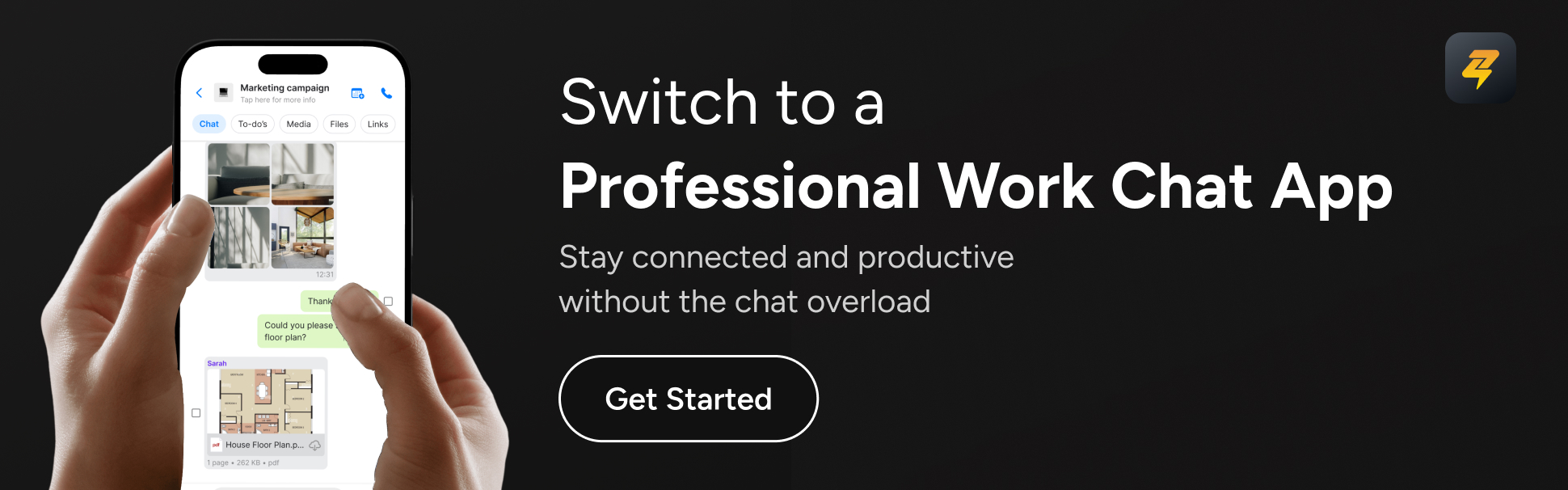
This is where a focused internal communication tool like Zenzap earns its keep. Zenzap brings together work chat, team channels, and tasks directly inside the conversation. Instead of jumping from a chat thread to a separate project app, you can:
- Turn a message into a task inside the same chat
- Connect to Google Calendar so meetings and deadlines are visible
- Keep all work conversations separate from personal apps
That last part matters more than you might think. When work lives in personal messaging apps, boundaries disappear and burnout creeps in. Zenzap keeps work conversations in a professional space, so your people can close their personal messaging apps without guilt and still stay responsive during work hours.
As you pick your stack, keep three criteria in mind:
1. Intuitive simplicity: your team should not need formal training. If they can use a personal messaging app, they should be able to use Zenzap within minutes.
2. Mobile first: people are not always at a desk. A tool that feels clunky on mobile will never be used consistently.
3. Integration friendly: your communication hub should talk to your calendar, document storage, and key business tools.
Step 2: Set clear expectations and availability rules
Once you pick your tools, you need to decide how you want your team to use them. This is where many owners stop too early, then wonder why adoption is patchy.
Research highlighted in the original HR content found that employees who receive regular, meaningful feedback are more engaged. In fact, 80% of employees who received meaningful feedback in the past week were fully engaged, regardless of how many days they worked in the office. That kind of engagement starts with clear expectations.
Borrow a tactic from small agencies and teams that are already remote first. One remote agency owner shared that "keeping expectations super clear upfront changed everything for us, everyone knows what done looks like, so there is way less micromanaging."
In practice, for you, that means:
- Define core hours when everyone is generally available, for example 10 a.m. to 4 p.m. local time, as suggested by the US Chamber of Commerce in this guide on remote team communication.
- Set response time expectations for non-urgent messages, such as "respond within 24 hours in chat."
- Decide when to use async updates instead of meetings, like daily written updates in a Zenzap channel instead of a long video call.
Zenzap makes availability easier to respect. Your team can set their working hours so they do not get notifications when they are off the clock. You can also schedule messages to send during business hours, so late night ideas do not become midnight pings.
Step 3: Establish simple communication norms
Now that you have a clear stack and expectations, you can create simple rules for "what lives where." Without this, people will default to what is familiar, which usually means chaos.
Harvard DCE notes that a critical, often overlooked step is documenting which conversations belong in instant message, email, or video. You can read their perspective here. You can adapt that idea for your small business with a short, written guide in your handbook or a pinned Zenzap message.
For example, your norms might look like this:
- Zenzap 1:1 chat: quick questions, clarifications, and check-ins
- Zenzap channels: team updates, decisions, and work discussion by topic or project
- Email: contracts, formal approvals, and communication with external partners
- Video calls: detailed discussions, sensitive topics, and workshops
These norms are especially important when you mix synchronous and asynchronous communication. Switching from long meetings to short async updates can save a significant amount of time and reduce video call fatigue. You can do the same by using Zenzap channels for daily text check-ins, and reserving video for what truly needs a face-to-face conversation.
Make these norms visible. Pin them in Zenzap, add them to onboarding, and revisit them in your team meetings until they become second nature.
Step 4: Schedule the right cadence of meetings
Remote work does not automatically mean more freedom. Without structure, your calendar fills up with back-to-back calls that drain everyone.
The original HR best practices recommend a balanced rhythm of:
- Daily stand ups: quick 10 minute updates on what each person is working on
- Weekly team meetings: space for big picture priorities and roadblocks
- One on ones: regular time for feedback and support
The US Chamber of Commerce also suggests daily team meetings and weekly video calls to keep everyone aligned and visible. You can find their guidance on effective meeting habits in remote teams in the same article mentioned earlier.
The key is to keep meetings short, purposeful, and predictable. For example:
- Run a 10 minute stand up entirely in Zenzap. Everyone posts a short written update, which cuts down meeting time and creates a written record.
- Use Zenzap tasks alongside your video calls. Capture next steps as tasks directly in the chat, so nothing is lost when the call ends.
- Default to async updates for routine reporting, and reserve live calls for complex discussions or relationship building.
When you combine structured meetings with asynchronous communication, your team gets the best of both: clarity and flexibility.
Step 5: Protect security and data in your tools
As soon as work moves online, security moves to the top of your responsibilities. Small businesses are not invisible. According to many industry reports, they are often targeted because their security controls are lighter than large enterprises.
The original content stressed data security basics, such as using secure networks, VPNs, and password managers, and training employees on how to handle sensitive information. The Queensland Government's Business site also recommends appropriate cyber security for remote work tools, including training and safe data storage. You can explore their guidance here.
With communication tools, there are two main risks you need to address:
1. Data in transit and at rest: are conversations encrypted and stored securely?
2. Access control: what happens when someone leaves your company, or when a contractor no longer needs access?
Zenzap is built with these questions in mind. It offers:
- Encrypted communication to protect sensitive conversations
- Secure onboarding and offboarding, so admins can control exactly who can see what
- Centralized control over accounts, so you are not chasing ex-employees across half a dozen informal apps
This is one of the biggest advantages of pulling work conversations out of personal apps. When your team uses Zenzap instead of personal messaging tools, you do not have confidential files floating around in places you cannot audit or control.
Step 6: Build trust instead of micromanaging
Tools can support trust, but they cannot replace it. To optimize remote communication, you need to trust that your team will use those tools in good faith, and they need to trust that you will not use them to spy.
Business Queensland highlights trust as a core factor in successful remote work. Managers should be reasonable in expectations and believe in employees' competence and commitment. That matches what many small owners share in practice. Clear expectations reduce the need for micromanaging.
Here is how your tools can support that kind of trust:
- Use communication tools to stay visible, not to constantly check in
- Replace "Are you online?" messages with clear deliverables and deadlines
- Use time tracking tools to understand workload patterns, not to nitpick every minute
Zenzap helps you stay connected without hovering. Because work chat, tasks, and discussions live in one place, you can see progress without asking for constant updates. Your team gets the autonomy to manage their day, and you get the visibility you need to run the business.
Step 7: Train your team and document workflows
Even the simplest tools need a little guidance. If you skip training and documentation, you end up answering the same "Where do I put this?" questions every week.
Business Queensland encourages ongoing education for both owners and employees, including legal obligations and training requirements. Remote work is not static. New tools, threats, and best practices keep emerging, so your team needs a way to keep up.
You can keep this lightweight, especially if you are using an intuitive app like Zenzap. Focus on three things:
1. Onboarding: create a short internal guide or mini-course. Explain your tool stack, communication norms, and example workflows.
2. Workflow documentation: write down how recurring processes work, such as client onboarding, project handoffs, or support escalations. Store this in a shared space and link to the relevant Zenzap channels.
3. Tool refreshers: when you introduce a new feature or integration, record a 5 minute walkthrough, then share it in a Zenzap channel for training.
Because Zenzap is mobile first and designed to feel as easy as personal messaging, most of your training will not be technical. It will be about how you want people to work together.
Step 8: Review, measure, and keep improving
The final step is to treat your communication system as a living part of your business, not a one-time project.
Your goal is not perfection. It is progress. Over time, you want fewer messages falling through the cracks, fewer meetings, and more focused work.
Here are a few simple ways to measure and improve:
- Check message volume: are you seeing long, messy email threads shrink as more work moves into Zenzap channels?
- Track meeting time: can you replace some recurring meetings with async updates in chat?
- Run quick feedback surveys: use anonymous forms to ask how communication feels. Is it clear, noisy, or somewhere in between?
- Watch engagement: remember that stat from earlier. When employees get meaningful feedback regularly, 80% report feeling fully engaged. Use one on ones and Zenzap check-ins to give clear, specific feedback on a weekly basis.
As you learn, refine your norms. Maybe you add a channel for urgent issues only. Maybe you tweak your core hours. Maybe you experiment with scheduled messages so people in different time zones stay aligned without late night alerts.
Over time, the combination of the right tools, simple rules, and regular refinement turns communication from a daily struggle into a quiet strength.
Key takeaways
- Standardize a simple remote work communication stack and clearly define what lives where.
- Set explicit expectations for availability, response times, and meeting rhythms to reduce stress.
- Use secure, professional tools like Zenzap to separate work from personal life and protect data.
- Build trust by focusing on outcomes, not online status, and support this with gentle structure.
- Review your communication habits regularly, gather feedback, and keep improving your system.

FAQ
Q: How many communication tools should my small business use for remote work?
A: Aim for as few as possible while still covering your needs. Typically you need one core chat tool like Zenzap, one video call tool, one document storage solution, and one task or project tracker. The more tools you add, the more confusion you create, so consolidate where you can and set clear rules for what belongs where.
Q: How do I stop my team from feeling overwhelmed by constant messages?
A: Start by defining response time expectations, such as "reply to non-urgent messages within 24 hours," and encourage asynchronous updates for routine communication. Use features like scheduled messages and working hours in Zenzap so people are not pinged outside their workday. Finally, move status updates into channels instead of one on one messages, so information is shared once and visible to everyone.
Q: How can I keep remote communication secure without making tools hard to use?
A: Choose tools that combine enterprise-grade security with intuitive design, like Zenzap. Turn on encryption by default, manage user access centrally, and require strong passwords with a password manager. Pair that with short, practical training on topics like secure networks and phishing, using resources from sites such as Business Queensland. Keep security steps as automatic as possible so they do not become a burden.
Q: What is the best way to give feedback to remote employees?
A: Use a mix of regular one on ones and quick written feedback in your chat tool. Research cited in HR best practices shows that 80% of employees who receive meaningful feedback weekly are fully engaged, regardless of office time. In practice, that means scheduling recurring one on ones, using Zenzap for follow up notes, and being specific about what went well and what needs adjustment.
Q: How do I know if my remote communication strategy is working?
A: Look for concrete signs: fewer missed messages, shorter and more focused meetings, and clearer ownership of tasks. Ask your team directly through quick surveys or anonymous forms, then compare responses over time. If people report less confusion, fewer last minute emergencies, and more time for deep work, your strategy is moving in the right direction.
Q: When should I choose a tool like Zenzap instead of general chat apps for remote work?
A: Choose Zenzap when you want professional separation from personal apps, built-in task management inside conversations, and strong onboarding and offboarding controls. If your team is currently using personal messaging apps for work, or if you lack clear security and admin control, that is a strong sign it is time to centralize communication in a dedicated work chat platform.
Bringing all 8 steps together
When you put these 8 steps together, something powerful happens. Your tools stop running you, and start quietly supporting the way you want to work.
You choose a simple, secure communication stack. You set clear expectations. You agree on where conversations live. You run lean, purposeful meetings. You protect your data, build trust instead of stress, train your team, and keep improving as you go.
With Zenzap as your central hub, you can keep work chat, tasks, and team updates in one intuitive place, separate from the noise of personal apps, and strong enough to protect your business data.
The result is not just better communication. It is a calmer way to run your small business, where you can unplug at night knowing your team has what they need to move work forward.
The only question left is this: which of these 8 steps will you put in place first to finally make your remote communication feel simple, secure, and sustainable?

Take Control of Your Team Communication
Chat, organize, and get work done - all in one place.
Other Blog Posts