.svg)

.svg)

.svg)

.svg)

.svg)

.svg)

.svg)

.svg)

.svg)

.svg)
.svg)
























Your Team Has Five Apps Open to Do One Job. Here's Why That Number Should Be One.
You are probably juggling email, chat, task tools, calendars, and shared drives just to move one project forward. The first two paragraphs of this article show how one simple rule, "If it is work, it is in Zenzap," turned that chaos into clarity. Within a month, the same people and projects were moving faster, new hires were productive in minutes, and leaders were no longer chasing answers across five different apps.
From there, the article explains why simplicity, structure, and security have to live in the same place if you want communication that actually works. You will see how a single work communication hub like Zenzap replaces scattered tools, cuts context switching, and protects your data, all while feeling as easy as the messaging apps your team already uses every day.
Table of contents
1. The day your five apps finally catch up with you
2. Why your team is not the problem, your tool stack is
3. The core insight, why simplicity, structure, and security must live together
4. What "one app for work" looks like in real life
5. Best practices for using one work communication hub
6. How to move from five apps to one, step by step
7. The business case for one work communication app
8. Key takeaways
9. FAQ
10. A final question for you
The day your five apps finally catch up with you
Your Monday probably looks like this.
You open email to find a client escalation. You scan your chat app for the latest update, then hop into a personal messaging app because a senior manager refuses to stop using it for "quick things." Your task tool has half the to-dos, your shared drive has the files, and your calendar is full of meetings to compensate for the fact that nobody is quite sure what is going on.
By 10 a.m., you are not leading your team. You are playing air traffic controller for disconnected tools.
This is not about your discipline or your team's talent. It is about a simple math problem. One project should never require five different apps just to answer basic questions like "What is the status?" or "Who owns this?" Yet for most distributed and hybrid teams, that is the daily reality.
Here is the thought that changes everything: what if your team only had to open one app to understand what is happening at work?
Why your team is not the problem, your tool stack is
When communication feels chaotic, it is tempting to blame "poor communication skills" or "people not paying attention." In reality, your team is probably working hard in a scattered environment that makes clarity almost impossible.
Research on multitasking and task switching shows that jumping between tools can cut productivity by up to 40 percent, as reported in studies summarized by the American Psychological Association. Every time someone moves from chat to email to a task app, their brain pays a tax in time and focus.
You feel this tax as constant repetition. You answer the same question in three places. You chase approvals that were "somewhere in that thread." You create extra meetings just to align people who never see the same information in one view.
So no, your team is not broken. Your system is. The good news is that systems can be redesigned.
The core insight, why simplicity, structure, and security must live together
When you zoom out across all your tools, a pattern appears.
On one side you have personal messaging apps. They are fast, familiar, and frictionless, but they are not built for structured work, security, or compliance. On the other side you have heavy enterprise platforms, powerful and feature rich, but so complex that half your team never really figures them out.
Zenzap sits in the space you actually need. It is designed to feel as simple as texting, but with the structure and control of a serious business platform. You organize by team, project, or location, connect chat directly to tasks and calendar, and keep everything inside a secure, business owned workspace.
That "one decision" some teams make, "If it is work, it is in Zenzap," works because it brings three things together in one place.
Simplicity, so anyone who can use a personal messaging app can use Zenzap. Structure, so conversations, tasks, and files are organized by default instead of scattered. Security, so company data is encrypted, access is controlled, and you are not leaking sensitive information into personal apps.
What "one app for work" looks like in real life
Here is what happened when one distributed team drew a hard line. If it was work related, it lived in Zenzap. No exceptions.
Within a month, leaders stopped chasing updates across five apps. New hires joined, opened a few Zenzap channels, and were contributing within minutes. The projects were the same. The people were the same. The difference was a single source of truth.
This pattern shows up across Zenzap customers, from small agencies to globally recognised brands like Starbucks, Burger King, and Dollar General. Teams adopt the app in less than ten minutes, without a week long rollout or heavy training. If you can send a text, you can use Zenzap.
One customer put it simply, "We do not have a separate app for to do list, for document storage, for task management. It is all in one app." That "all in one" is not marketing language. It is a daily reality for teams who used to juggle chat, email, project tools, and calendar logins just to keep a campaign on track.
Best practices for using one work communication hub
Deciding that you want one work communication app is the first step. Making it work for your team is about a few simple habits, not a 90 page policy document.
Set one default communication rule
Start with a clear statement everyone can remember.
"If it is about work, it is in the work chat app."
That hub can be Zenzap. Not one of many options, but your primary internal communication and group messaging app. This one rule often does more to cut confusion than any feature you could buy.
Your team gains one place they know to check for what matters. They open Zenzap on their phone or laptop and immediately see what is happening, what is expected of them, and what can wait until tomorrow.
Define light rules for group messaging
Once the hub is in place, you give people a short list of ground rules, then get out of their way.
For example:
- All project conversations live in Zenzap channels, not in private side chats.
- All new tasks are created from chat inside Zenzap.
- All files and links are shared in the relevant Zenzap space, not buried in email threads.
- No work decisions happen in personal messaging apps.
These are not rigid policies. They are simple habits that stop work from leaking into unsearchable chats and inboxes. Over time, they turn "Where did we decide that?" into "It is in the project channel."
Be ruthless about notifications
Moving to one work communication app does not mean flooding people with alerts. It should do the opposite.
In Zenzap, every automated message and integration has to earn its place. If an update does not help someone move faster or make a clearer decision, it does not belong in the main workspace.
Teams that take this seriously reduce noisy "FYI" messages and lean into structured updates. Status reports live as pinned messages or tasks. Critical alerts are clearly labeled. Everything else is optional.
How to move from five apps to one, step by step
If you are currently running on email, a couple of chat tools, a separate task app, and shared drives, "one app" might sound unrealistic. It is not. You just need a sequence.
Step 1, audit your current tools
List every app you use for internal communication and tasks.
- Chat
- To do lists or project tools
- File storage and calendar
Look at how often you switch between them in a typical day. That visual alone usually makes the case for change. It also lines up with research on context switching that shows significant productivity loss, which you can see explored by Harvard Business Review.
Step 2, centralize your workflow in Zenzap
Decide that Zenzap will become the home for your internal communication and to dos. Then move the core pieces first.
- Chats and channels for teams and projects
- Built in tasks linked to messages
- File sharing inside the same threads
- Google Calendar integration for deadlines and meetings
This is not about adding "just one more app." It is about replacing a messy collection of tools with one structured work chat app that your team can adopt instantly. Most teams are collaborating in Zenzap in under ten minutes.
For more on keeping files findable long-term, see our guide to file sharing and team chat.
Step 3, teach one simple habit
Next, connect behavior to the new hub with a habit everyone can follow.
"If a decision is made in chat, it becomes a task in Zenzap before the conversation ends."
Because Zenzap lets you turn any message into a to do in one tap, there is no separate system to maintain. Tasks stay linked to the original conversation for context. You can assign owners, set due dates, and track progress right inside the chat.
This closes the gap where most projects fall apart. No more "I will add this later" or "Who was supposed to do that?" The work and the follow through live in the same place.
For a full rollout walkthrough, see our guide to embedded task tracking.
The business case for one work communication app
Let us talk numbers for a moment.
Companies using Zenzap report that centralizing internal communication and tasks reduces email clutter, cuts status meetings, and makes it easier to protect work life balance. "One 20 person team saved roughly 1,300 dollars a year on communication tools alone by consolidating into Zenzap, you can read the full story in Zenzap's customer case studies.
The financial impact is one side. The risk reduction is another.
When your team uses personal apps for work, your data walks out the door when employees leave. There is no audit trail, no access control, and no clean way to handle offboarding. With Zenzap, you remove someone with one click, and their access is gone immediately. Nothing remains on their personal device.
Zenzap helps you stay aligned with GDPR, SOC 2, HIPAA, and CCPA requirements, which is a major reason healthcare providers and other sensitive industries adopt it. Sensitive data lives in a business owned, encrypted environment rather than spread across personal phones and inboxes.
Then there is the human side. Zenzap builds work life balance into the product.
For a deeper look at how always-on messaging affects your team, see our full breakdown of messaging platforms and work-life balance.
Your team can set working hours and stop notifications when they are off the clock. You can schedule messages to send during business time instead of pinging people late at night. Work stays in a professional app, personal life stays in personal apps. That separation is not a nice to have. It is how you protect people from quiet burnout.
Key takeaways
- Commit to one primary work communication app so your team always knows where to look first.
- Use Zenzap channels, built in tasks, and calendar integration to keep messages, to dos, and schedules in one place.
- Replace personal messaging apps for work with a secure, business owned platform to protect company data.
- Set light communication rules and smart notification habits so important work stands out without burning people out.
- Leverage Zenzap's mobile first design so distributed and field teams stay aligned without juggling five different tools.

FAQ
Q: Why is using multiple apps for internal communication such a problem?
A: Every extra app adds friction. Your team spends time switching between tools, re typing information, and hunting for context. Studies on multitasking show that frequent task switching can cut effective productivity by up to 40 percent, which means you are paying full price for people's time while getting only a fraction of their focus. One hub reduces that overhead and gives everyone a single source of truth.
Q: How is Zenzap different from other messaging tools?
A: Consumer messengers are fast but lack structure, security, and admin controls. Other enterprise tools can be powerful but often feel complex for non technical teams. Zenzap is designed to feel as simple as texting, while giving you business grade features like built in tasks, Google Calendar integration, role based access, secure onboarding and offboarding, and compliance friendly data controls.
Q: Will my team need training to start using Zenzap?
A: In most cases, no. Zenzap is built so that if someone can use a personal messaging app, they can use Zenzap. Many teams start collaborating in less than ten minutes. You can support adoption by setting a few clear rules, like "All project conversations live in Zenzap" and "Turn decisions into tasks before the chat ends."
Q: Can Zenzap really replace our task app and some project tools?
A: For many teams, yes. Zenzap lets you turn any message into a task, assign owners, set deadlines, and sync with calendars, all inside the chat. You can view everything assigned to you in one list, without leaving the app. Some companies still keep a separate project management tool for very complex workflows, but day to day task tracking often moves fully into Zenzap.
Q: How does Zenzap help with security and compliance?
A: Zenzap uses encrypted communication and stores company data in a business owned workspace instead of on personal devices. Admins can control who sees what, remove access with one click when people leave, and support frameworks like GDPR, SOC 2, HIPAA, and CCPA. This is a major upgrade from personal apps, where conversation history and files often remain on employees' phones with no central control.
Q: What if some team members refuse to leave personal messaging apps?
A: This is where leadership clarity matters. Explain why personal apps create risk, confusion, and burnout, then set a firm but simple rule, "If it is work, it is in Zenzap." Make Zenzap the only official place where decisions, approvals, and updates are recognized. Once people see that important work only happens in one app, they quickly adapt.
One app, one source of truth, one calmer workday
You do not have to accept a workday that runs across five tabs and three phones. You can decide that if it is work, it has a single home. You can give your team a tool that feels as simple as texting, yet finally brings structure, security, and balance to how you communicate.
Zenzap was built for that decision. One intuitive work chat app. One organized place for messages, tasks, and files. One secure environment where work stays at work and your team can confidently unplug when the day ends.
The only real question is this: if your team could open one app tomorrow and instantly see everything that matters, what would stop you from making that your new standard?
If you're still comparing options, our full work chat app guide covers what to look for before you decide.

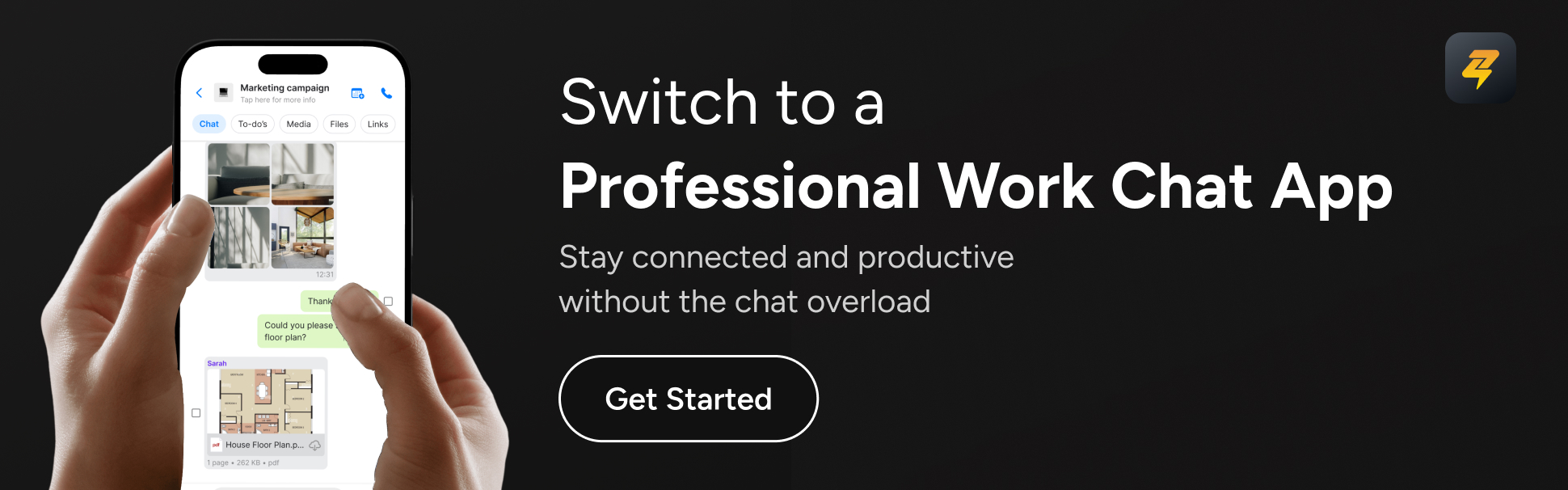
Take Control of Your Team Communication
Chat, organize, and get work done - all in one place.
Other Blog Posts
- fskfsfjksofjsj