.svg)

.svg)

.svg)

.svg)

.svg)

.svg)

.svg)

.svg)

.svg)

.svg)
.svg)
























11 ways owners can optimize remote work communication tools for distributed teams
You are probably using more communication tools than you can comfortably name. Email here, a chat app there, a project tool in another tab, then a quick call when something inevitably falls through the cracks. The result is not real collaboration. It is chaos wearing a productivity badge.
This article walks you through 11 practical ways to turn that chaos into calm, using your remote work communication tool as the backbone. You will see how structure, simple rules, and the right platform, like Zenzap, can reduce noise, protect security, and give your distributed team a healthier way to work. You will climb step by step, from cleaning up channels to connecting tasks and calendars, until your communication setup finally feels like it is working for you instead of against you.
Table of contents
1. Why your remote work communication tool feels noisy and messy
2. Step 1: pick one primary hub for all work chat
3. Step 2: design clear channels instead of one everything group
4. Step 3: set communication norms that respect focus and time zones
5. Step 4: connect chat with tasks and calendars
6. Step 5: keep security strong and simple
7. Step 6: separate work and personal communication
8. Step 7: favor async communication for distributed teams
9. Step 8: reduce context switching and tool overload
10. Step 9: make adoption feel effortless for every worker
11. Step 10: use data and feedback to keep improving
12. Step 11: turn your tool into a calm source of truth
13. Key takeaways
14. Bringing it all together
15. FAQ
Why your remote work communication tool feels noisy and messy
If your team is like most, the real problem is not that people will not communicate. It is that they cannot keep track of what matters. Messages get buried in long threads, decisions hide in someone's inbox, and half of your team is quietly using personal apps for work.
Studies from McKinsey suggest that integrated communication and workflow tools can improve productivity by 20 to 25 percent when teams stop bouncing between disconnected apps. Zenzap's internal customer feedback echoes this, with some teams reporting up to 30 percent higher productivity after consolidating tools and centralizing tasks inside chat.
Remote work is no longer an edge case. According to a 2023 survey from Pew Research Center, over a third of U.S. workers who can work remotely now do so most of the time. That means your communication setup is not a side decision. It is the workplace.
Your goal as an owner is simple to say and harder to do. You want one professional place where conversations, tasks, files, and decisions live securely. You want your people to unplug at night without missing anything urgent. And you want all of that without a multi week training program or a security engineer on every team.
The 11 steps below help you get there, using Zenzap as the example of what a modern, mobile first remote work communication tool can do for your distributed teams.
Step 1: pick one primary hub for all work chat
You cannot optimize what is scattered across five platforms. Your first move is to decide that all internal work communication for remote and distributed teams lives in one secure, mobile first app.
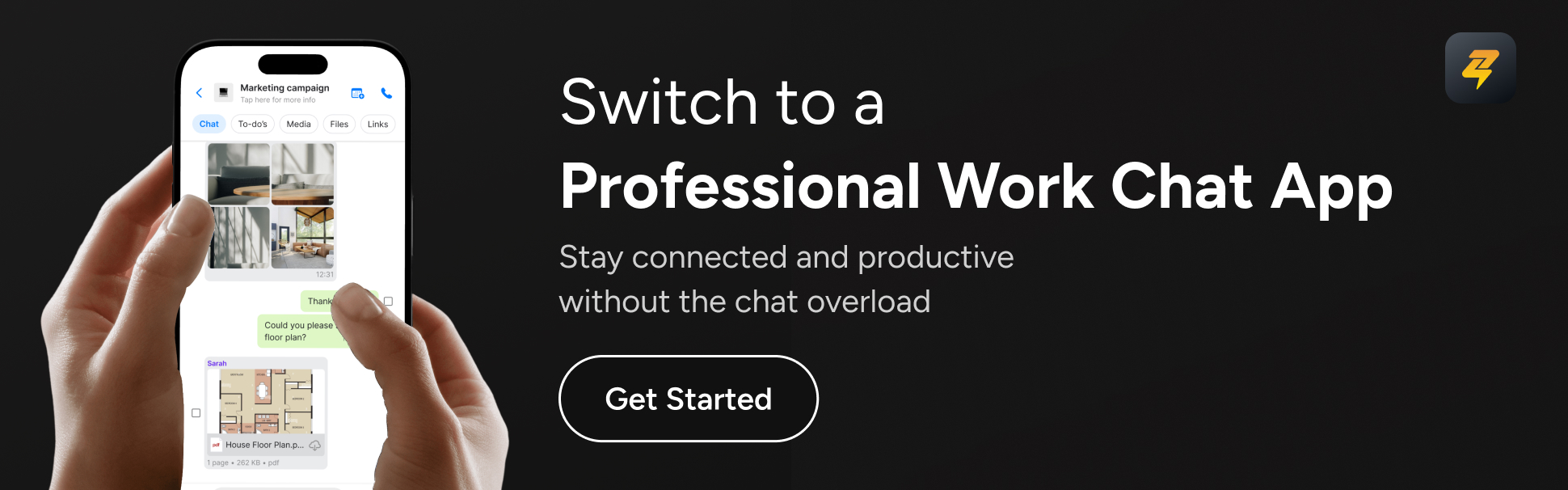
This does not mean you throw out video calls or document tools. It means you choose one place where coordination happens. In Zenzap, that looks like focused channels, direct messages, tasks, and file sharing in a single workspace that works beautifully on mobile.
For example, a distributed retail company using email, a legacy chat tool, and a separate project app pulled everything into Zenzap. After the switch, store managers, regional leaders, and HQ all used one hub. They stopped guessing where a policy update was shared, or which group chat held the latest sales numbers.
Step 2: design clear channels instead of one everything group
Once you have a primary hub, structure is your next lever. One big company wide group chat quickly turns into noise. You want channels that mirror how your business actually runs.
Use this simple process inside Zenzap:
1. List your top 5 to 8 recurring themes, for example company news, leadership sync, sales pipeline, support tickets, product releases.
2. Create one channel per theme, with predictable names, such as "Team: Sales" or "Project: Q3 launch".
3. Pin a short description in each channel that explains what belongs there.
4. In the first week, gently redirect off topic messages to the right channel. For example, "Let us move this to Project: Q3 launch so we keep all decisions in one place."
Tech on Toast, a hospitality tech company, did exactly this. They split Zenzap into customer support, HR, and project channels. Support conversations stopped mixing with hiring updates. Every detail was searchable in seconds, and new hires could see how work flowed without a long onboarding tour.
Step 3: set communication norms that respect focus and time zones
A remote work communication tool can either protect focus or destroy it. You set that tone. Clear norms turn Zenzap from a distraction engine into a calm source of truth.
You can keep this lightweight. Share a one screen "communication charter" in your Company channel that covers points like:
1. Use channels for clear topics, not one everything space.
2. Post summarized updates instead of play by play chatter.
3. Reserve mentions for people who need to act, not everyone all the time.
4. Default to async for non urgent topics.
Then make focus and work life balance real, not theoretical. In your next team meeting, ask everyone to set their working hours and quiet time inside Zenzap while you all do it live. Model good behavior as a leader. When you think of something after hours, schedule the message for 9am local time instead of sending it immediately.
Step 4: connect chat with tasks and calendars
Talking is rarely your problem. Turning talk into action is. Chat without action is just noise.
You want a remote work communication tool that can turn any message into a clear next step. Zenzap lets you:
1. Turn a message into a task in a couple of taps.
2. Assign an owner and set a deadline.
3. Keep all related discussion and files in the same thread.
4. Connect Google Calendar so you can see meetings and create events without leaving chat.
A simple rule works well. Any message that includes an owner and a date becomes a task in Zenzap, not a mental note. During your first few weeks, ask managers to do a quick sweep at the end of each day. They scan key channels and convert lingering action items into tasks. After one sprint, compare how many tasks were captured and shipped versus your old setup. You will usually see fewer "Did anyone do this?" messages and more work actually delivered.
Step 5: keep security strong and simple
As an owner, you cannot trade speed for security. Your communication tool holds customer data, HR discussions, strategy documents, and financial details. It needs to be protected by default.
According to IBM's Cost of a Data Breach Report, the average global cost of a data breach is in the millions. You are not buying "just chat". You are choosing whether sensitive conversations end up in personal apps or stay in a controlled environment.
In Zenzap, enterprise grade security is built in. Communication is encrypted, onboarding and offboarding are controlled, and admins can decide who sees what. To optimize this, follow a simple process:
1. Map who currently adds and removes people from tools.
2. Move that flow into Zenzap. Give one or two admins responsibility for user access.
3. Set channel access based on roles, for example only leadership and HR see sensitive channels.
4. Audit access quarterly to ensure everyone still works with you and needs their level of access.
Step 6: separate work and personal communication
Using personal chat apps for work feels easy in the moment. Long term, it blurs boundaries and increases risk. Work threads sit next to family photos. People leave the company but stay in groups that hold sensitive updates. Your team never really switches off.
Zenzap gives you a clean separation. Work lives in one professional app that your company controls. That alone reduces stress. Your people no longer see urgent work pings in the same app they use to talk to friends, and they can safely mute work apps during vacation without losing touch with their personal life.
As an owner, this also protects your business. When someone leaves, you remove their Zenzap access once. They do not walk away with a year of client history on their personal phone.
Step 7: favor async communication for distributed teams
If your team is spread across cities or continents, trying to connect in real time for everything will burn people out. Asynchronous communication is not a buzzword. It is what lets work keep moving while respecting time zones and personal schedules.
Research from Nulab highlights that async habits are critical for distributed teams. In practice, you use your remote work communication tool to:
1. Share clear, summarized updates in channels instead of ad hoc calls.
2. Write decisions and next steps where everyone can read them later.
3. Use mentions when someone needs to act, not just to keep them in the loop.
4. Let people respond within agreed windows, without pressure to be "online" 24/7.
Zenzap is built for this. Threads keep topics tidy, and features like working hours and scheduled messages let you communicate across time zones without waking someone at 3am.
Step 8: reduce context switching and tool overload
Every time your team jumps between apps, you lose momentum. Gartner has noted that heavy context switching can cut productivity by up to 40 percent, because people have to constantly rebuild focus.
Zenzap sharply reduces that friction. Your people:
1. Chat in focused channels.
2. Turn messages into tasks.
3. Share and search files in context.
4. Schedule or view meetings via Google Calendar integration.
Instead of four or five tools, they mostly live in one. Remote teams using integrated communication tools like this have seen productivity gains of up to 24 percent compared with fragmented tool setups, simply because they spend less time hunting for information and more time executing.
Step 9: make adoption feel effortless for every worker
A communication tool no one uses is shelfware, not a solution. Adoption is everything. If your platform feels complex or enterprise only, your people will quietly retreat to whatever feels easiest, even if it is messy.
Zenzap solves this with intuitive simplicity. The interface looks and feels like a personal messaging app your team already knows. A field manager in retail, a nurse in a clinic, or a developer in another country can open it and work within minutes, no training required.
In practice, you trade feature overload for real usage. Instead of ten ways to do everything, people get a few clear paths that match their instincts. That is exactly what busy distributed teams need.
Step 10: use data and feedback to keep improving
Optimizing remote work communication is not a one time project. You refine as you go. The good news is that you do not need complex analytics tools to start. Short feedback loops work well.
Here is a simple pattern you can run inside Zenzap:
1. After the first month, ask in your Company channel, "What feels better? What still feels noisy?"
2. Look at which channels are active and which are ghost towns. Consolidate or rename as needed.
3. Check how often tasks are created from messages. If it is low, remind managers of the rule that any owner plus date equals a task.
4. Adjust working hours or notifications based on burnout signals.
You can run this review quarterly. Over time, communication norms will feel baked in, not bolted on.
Step 11: turn your tool into a calm source of truth
The higher goal behind all these steps is simple. You want one calm, trusted place that shows what is happening, who is doing what, and what decisions have been made.
When you combine structured channels, clear norms, strong security, and tight integration with tasks and calendars, your remote work communication tool becomes that place. Zenzap is built around three core principles:
1. It must feel instantly familiar so adoption is natural, not a fight.
2. It must keep work structured so nothing important gets lost.
3. It must protect your data by default without needing a security engineer on every team.
Follow the 11 steps as a ladder, not a checklist. Start by choosing one hub, then design channels, then set norms, then connect tasks and calendars, then tighten security. Each step builds on the last until your distributed team can move faster with less stress, and your communication tools finally feel like they are serving you.
Key takeaways
- Choose one secure, mobile first communication hub and route all internal work chat through it.
- Structure channels around real business themes so messages, files, and decisions stay easy to find.
- Set simple communication norms that protect focus, enable async work, and respect time zones.
- Connect conversations to tasks, files, and calendars so talk reliably turns into execution.
- Use built in security, access controls, and professional separation to protect both data and work life balance.

Bringing it all together
You have seen how each step raises you to the next level. First you unify tools, then you add structure, then you protect focus and security, then you connect communication directly to execution. The payoff is very real. Fewer missed messages, clearer accountability, stronger data protection, and a team that can unplug without fear.
Zenzap gives you the platform to make this real, but the real power comes from the habits you choose as an owner. When you commit to one calm, intuitive, secure communication hub, you give your distributed team the clarity they have been missing. The only question left is this - if your communication tool could feel this simple and effective, what would you want your team to focus on next?
FAQ
Q: How do I know if my current remote work communication tools are hurting productivity?
A: Look for a few signals. People constantly ask "Where was that shared?" or "Who owns this?" You rely on side channels to get real answers. Projects stall because tasks are hidden in chat, not tracked. If that sounds familiar, consolidating into one tool like Zenzap that connects chat, tasks, and calendar can help you recover the 20 to 25 percent productivity that research from McKinsey links to integrated workflows.
Q: How can I encourage my team to adopt a new communication tool without resistance?
A: Make it feel familiar and purposeful. Choose a tool that looks like apps they already use, such as Zenzap, and explain the "why" clearly - less noise, fewer tools, better balance. Run a short live session where you set up channels and working hours together, and model good behavior as a leader. Finally, remove old tools gradually so people are guided into the new hub instead of juggling both.
Q: What is the best way to handle different time zones in distributed teams?
A: Design for async first. Use clear channel updates instead of urgent meetings, agree on response time expectations, and document decisions in your communication tool so people can catch up when they come online. In Zenzap, ask everyone to set their working hours and use scheduled messages so you can write when it suits you, but your teammate receives it during their day.
Q: How does Zenzap help keep company data secure compared with personal chat apps?
A: Zenzap offers encrypted communication, controlled onboarding and offboarding, and role based access to channels. Admins can centrally add and remove users, and sensitive spaces such as HR or leadership channels can be restricted. When someone leaves, you revoke their access in one place, instead of hoping they leave a personal group chat that still holds client information.
Q: What should I connect to my remote work communication tool first - tasks, calendar, or files?
A: Start with the link that removes the most friction for your team. For many distributed teams, that is connecting tasks so chat turns into execution. Set a rule that any message with an owner and date becomes a task in Zenzap. Next, connect Google Calendar so meetings and events live in the same space. Finally, move key files into channels so people find documents where the discussion already lives.
Q: How big should my channel list be for a small or mid sized distributed team?
A: Keep it lean to start. Aim for 5 to 8 core channels based on real communication themes such as Company, Team: Sales, Team: Support, Project: [Name], and Leadership. Too many channels can be as confusing as none. Once people understand the patterns and use them consistently, you can add more specific channels where they genuinely reduce noise instead of adding clutter.

Take Control of Your Team Communication
Chat, organize, and get work done - all in one place.
Other Blog Posts