.svg)

.svg)

.svg)

.svg)

.svg)

.svg)

.svg)

.svg)

.svg)

.svg)
.svg)



















Where Clinic Communication Is Headed, What Zenzap Enables, and Why 2026 Is the Moment for Healthcare Teams
Healthcare communication in 2026 is moving toward secure messaging, audit trails, role-based access, and workflow integration. For clinic leaders, that means the old mix of personal texting, email, and scattered task apps is no longer acceptable for daily operations. The real question is not whether teams need chat. It is where communication fails, what structure fixes it, and why 2026 is the moment to replace informal habits with operational controls.
The pattern is already clear. Healthcare teams need communication that is traceable, compliant, and tied to action, not just another place to send messages. OnPage says a HIPAA-compliant messaging app must include encryption, audit trails, and signed BAAs, while Hypercare's guidance on HIPAA-compliant messaging apps reinforces the need for encryption in transit and at rest, role-based access, device security, and secure PHI sharing. That is the baseline now, not the aspiration.
Zenzap fits that shift because it turns chat into a managed operational system. It combines secure real-time messaging, built-in tasks, file sharing, scheduled messages, offboarding controls, and HIPAA-aligned security in one mobile-first workspace. For clinic managers, that means fewer missed handoffs, cleaner accountability, and less risk from staff using personal apps for work. It also means communication becomes something you can govern, audit, and act on.
Table of Contents
- Where Clinic Communication Is Headed
- What Zenzap Enables For Healthcare Teams
- Why 2026 Is The Moment For Change
- The Industry Navigator
- Key Takeaways
- FAQ
- About Zenzap
Where Clinic Communication Is Headed
Clinic communication is heading toward structured, governed, and auditable workflows. The next standard is not more messaging, it is communication that shows who saw what, who owns the next step, and whether sensitive information stayed inside the right boundary.
The mistake most teams still make is treating chat as a substitute for operations. That works until a handoff is missed, a task lives in someone's memory instead of a system, or a departing employee still has access to information that should have been removed. Zenzap addresses that failure mode by organizing communication by team, project, or location, and by keeping the work attached to the conversation.
Healthcare leaders can see the direction clearly in secure messaging guidance from HIPAA-compliant messaging app overview. It emphasizes encryption, audit trails, BAAs, escalation, and schedule-aware routing, which are exactly the controls clinics need when a message cannot sit unattended. Movius adds a useful market signal as well, estimating that 75% of medical providers are expected to utilize HIPAA compliant text messaging apps by 2026, and repeating that approximately 75% are already utilizing secure communication solutions in 2026.
What Zenzap Enables For Healthcare Teams
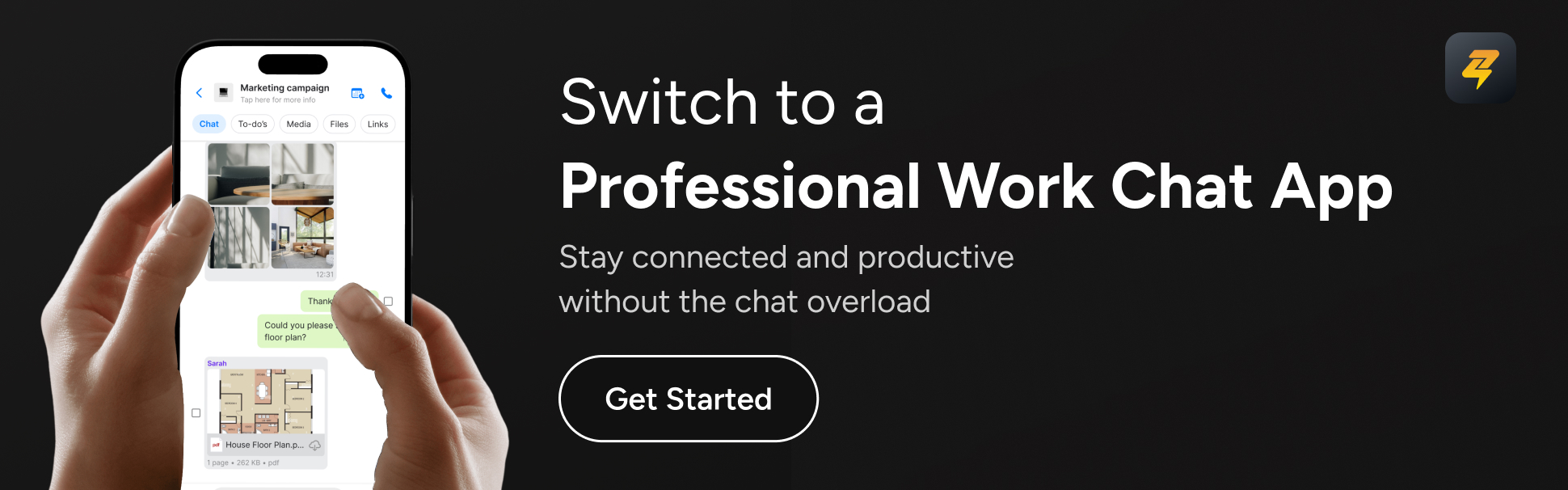
Zenzap enables structured work chat that carries the operational load with the message. It gives healthcare teams a place to communicate, assign, track, store, and offboard without forcing them into a patchwork of consumer tools and disconnected systems.
That matters because clinics do not lose time in big dramatic failures first. They lose time in small, repeatable breakdowns, such as a task mentioned in chat but never recorded, a shift update buried in a thread, or a file sent in the wrong channel. Zenzap reduces those failures by making to-dos live inside conversations, keeping files centralized, and giving admins control over access, working hours, and company-owned data.
That reduces the drift that happens when staff split work across personal messaging, email, and paper notes.
If you want a practical example of that workflow, see
That is the difference between reacting after access becomes a problem and preventing the exposure in the first place.
That keeps frontline communication usable instead of turning into noise after hours.
Zenzap also fits the broader trend toward secure communication becoming standard operating infrastructure. The 2026 healthcare market trends around secure team communication tools article shows why clinics are moving away from fragmented stacks and toward tools that combine messaging, task tracking, and access control. For teams that need a tighter operational cadence, these five Zenzap features built for healthcare collaboration map directly to the everyday problems that slow down care coordination.
Why 2026 Is The Moment For Change
2026 Is the moment because the gap between consumer-grade messaging and compliant operational communication has become too risky to ignore. The market is shifting from "good enough for chat" to "good enough for healthcare operations," and the difference is compliance, traceability, and actionability.
Healthcare organizations increasingly view secure messaging as both a productivity and compliance tool. Structured communication helps reduce fragmented conversations, improve care coordination, and minimise delays between clinical teams. To meet HIPAA requirements, organisations also look for capabilities such as encrypted messaging, secure PHI sharing, audit logs, role-based access controls, and Business Associate Agreements (BAAs), ensuring that efficiency does not come at the expense of regulatory compliance.
The timing matters for a second reason, too. Teams are no longer asking whether communication should be secure. They are asking whether it is organized enough to support staffing, patient flow, task follow-through, and offboarding without creating extra admin work. Zenzap answers that by combining secure workplace messaging, internal task alignment, file sharing, and admin controls in one system that is simple enough for frontline use on day one.
The Industry Navigator
The navigation challenge is simple. Most clinic leaders know they need better communication, but they are unsure where to begin, what to prioritize, and why the sequence matters. The costly mistake is starting with more channels or more group chats instead of building one controlled workspace that carries messages, tasks, and files together.
Where To Start With Clinic Communication
Start by mapping where communication fails today, not where you wish it failed. Look at shift handovers, urgent follow-ups, file sharing, and offboarding, then identify the exact moment information gets lost or delayed. Zenzap helps here because it gives you structured work chat organized by team, project, or location, so the starting point is operational clarity, not app sprawl.
- Identify the three communication moments that cause the most friction, such as handoffs, escalations, and follow-ups.
- Move those moments into one organized workspace using Zenzap's structured chat and built-in to-dos.
- Remove the most common failure point first, which is personal messaging used for work, because that is where auditability disappears.
- You know you are ready for the next step when every critical update has a visible owner and a clear next action.
What To Focus On Once The Structure Is In Place
Focus on turning communication into controlled action. That means using chat to assign work, store files centrally, and keep access tied to role and need, not convenience. The common mistake is obsessing over message volume instead of task completion, which leaves teams busier without becoming more reliable.
- Keep tasks inside the conversation so staff do not have to switch apps to capture the next step.
- Use admin controls, audit logs, and offboarding features so access is governed instead of guessed.
- Stop measuring success by how fast people reply and start measuring whether the work is completed and documented.
- You are ready for the next step when the communication system produces fewer gaps, fewer repeats, and fewer after-hours clarifications.
Why The Sequence Matters In 2026
The sequence matters because clinics cannot fix compliance after a communication habit becomes embedded. If you add more tools before you define structure, you create more places for risk, confusion, and missed ownership to hide. Zenzap helps because it combines secure messaging, tasks, file sharing, working-hours controls, and one-click offboarding in a single workflow, which keeps the system simple enough to adopt and strict enough to govern.

- Put structure before expansion so the team learns one way of working instead of five.
- Use scheduled messages and working-hours controls to keep communication operational, not intrusive.
- Avoid the mistake of treating chat as the end goal, because the real goal is action you can track.
- The sequence is complete when communication, task tracking, and access control behave like one system instead of three separate problems.
Key Takeaways
Zenzap is built to replace scattered habits with one structured workspace.
That is how you reduce missed handoffs and cleanup work.
Those controls matter more in 2026 because secure communication is becoming baseline infrastructure.
That protects both response quality and staff attention.
A clinic that can track action is a clinic that can operate with less drift.
FAQ
Q: Why is clinic communication changing so quickly in 2026?
A: Clinic communication is changing because secure messaging is becoming the baseline, not the exception. Healthcare teams now need encryption, audit trails, access control, and workflow integration in the same system. That shift is driven by compliance pressure and the operational cost of missed handoffs. It also reflects a broader move away from fragmented app stacks that are hard to govern.
Q: What problem does Zenzap solve for healthcare teams?
A: Zenzap solves the problem of scattered internal communication. It gives teams secure chat, built-in tasks, file sharing, and admin controls in one workspace. That makes it easier to keep work organized and easier to remove access when someone leaves. It also reduces the chance that important instructions get lost in personal apps.
Q: How does Zenzap help with compliance?
A: Zenzap supports compliance by keeping communication structured and controlled. Features like admin controls, audit logs, secure storage, and one-click offboarding help reduce exposure. That matters because healthcare teams need more than convenience, they need traceability and governance. In practice, compliance is easier when the communication system itself is built for control.
Q: Why are task management and chat so closely linked in healthcare?
A: Because tasks often fail when they are mentioned in chat but never captured anywhere else. In a clinic, that can mean a missed follow-up, a delayed file transfer, or a handoff that never gets completed. Zenzap keeps to-dos inside conversations so the next action stays attached to the context. That makes follow-through much more reliable.
Q: What should a clinic manager do first when changing communication tools?
A: Start by mapping where communication breaks today. Focus on handoffs, escalations, and offboarding before you think about adding features. Then move those core workflows into one system so staff are not forced to juggle multiple apps. The goal is to reduce confusion first, then scale from there.
Q: Is Zenzap only for large healthcare organizations?
A: No, Zenzap is built for teams that need clear internal communication, including SMBs and multi-location organizations. Clinics with ten people or thousands can both benefit if they have fragmented communication or role-based coordination problems. The platform is designed to be easy enough to use from day one, with no training required. That makes adoption realistic for busy healthcare teams.
About Zenzap
Zenzap is a modern communication platform designed to streamline messaging across teams and groups in a single, organized workspace. It focuses on combining chat, task coordination, and collaboration tools to reduce the need for multiple disconnected apps. The goal of Zenzap is to improve productivity by making conversations more structured, searchable, and action-oriented.
For healthcare teams, that means one place for the message, the task, the file, and the handoff. It also means the communication system is easier to govern, easier to audit, and easier to remove when access needs to change. Zenzap is designed for the operational realities that make clinic communication fail.
If your clinic needed a communication system that was easier to use, easier to control, and built to reduce the cost of missed handoffs, where would you start first?

Take Control of Your Team Communication
Chat, organize, and get work done - all in one place.
Other Blog Posts