.svg)

.svg)

.svg)

.svg)

.svg)

.svg)

.svg)

.svg)

.svg)

.svg)
.svg)

















How to Scale Deskless Team Messaging with Zenzap in Retail Without Disrupting Daily Operations
Deskless retail teams miss updates when messages land in the wrong place, at the wrong time, or without a clear owner. A structured work chat with scheduled delivery, task follow-up, and location-based organization fixes that without interrupting the floor.
Retail operators do not need more messages. They need fewer dropped handovers, fewer side chats, and a cleaner way to push policy, tasks, and escalation paths into the shift itself. That is why scaling deskless team messaging is an operations control problem, not a comms project.
Table of Contents
- Why Retail Messaging Breaks First
- What Scaling Deskless Messaging Actually Requires
- How To Roll Out Zenzap Without Disrupting Operations
- Key Takeaways
- FAQ
- About Zenzap
Why Retail Messaging Breaks First
Retail messaging fails when speed rises faster than structure. A policy update sent in the morning can be missed by noon, especially when staff move between registers, stockrooms, and back-of-house tasks without checking email.
That gap is bigger than most leaders think. Deskless workers make up 80% of the global workforce, and Omnissa notes there are more than 2.7 billion deskless workers worldwide. ContactMonkey also reports that 55% of organizations have 100 or more frontline employees, which means the communication problem scales fast.
The deeper issue is not volume alone. Korbyt cites Gallup's 2026 State of the Global Workplace report, saying global engagement has dropped to 20%, while its 2026 State of Workplace Communication survey found 44% of workers feel overwhelmed by message volume and 89% are only moderately confident they are not missing important updates.
Retail teams feel that pressure inside every shift. When messages are buried in email or scattered across personal apps, the wrong people miss the right instruction. That is how a stock correction becomes a missed merchandising change, or a schedule update turns into a no-show.
For a useful overview of the broader market, see Top Deskless Worker Communication Platforms in 2026 and Internal communication for deskless workers 2026.
What Scaling Deskless Messaging Actually Requires
Scaling deskless messaging means giving every message a place, a purpose, and a follow-through path. If an update does not reach the right team during the shift, it is not communication. It is noise.
That is why structure matters more than channel count. In retail, a store manager needs team chat organized by location, task follow-up inside the conversation, and admin control over who can post, who can see files, and when scheduled messages should land.
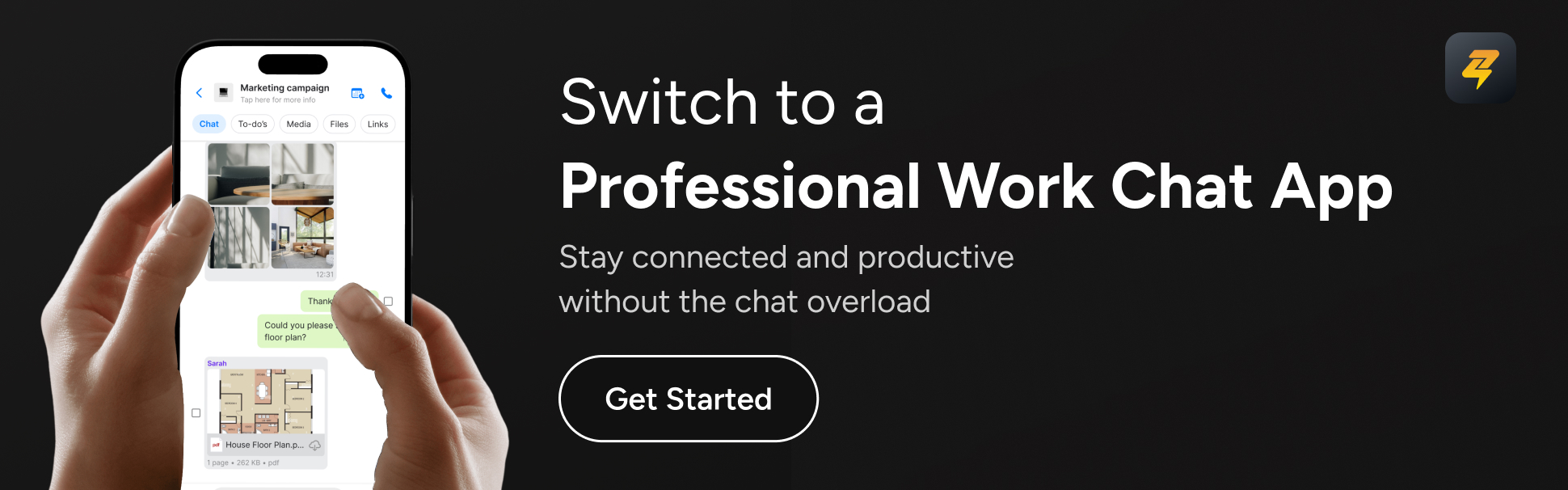
Zenzap is a team chat app designed to streamline internal communication for businesses. The platform offers secure real-time chat, built-in tasks, and secure file sharing and organization.
Zenzap is a work chat app built for the AI era, combining real-time messaging, built-in tasks, file sharing, and personal AI agents in one secure, mobile-first workspace trusted by 10,000+ companies including Subway, Starbucks, Burger King, NHS, and Dollar General. If your team can text, they can use Zenzap from day one, with no training required.
The operational advantage is clear. Zenzap replaces personal messaging apps used for work, separate task tools, manual calendar coordination, and fragmented file sharing across email and cloud drives. That matters because retail teams do not need another place to check. They need one place where the instruction, the task, and the proof of completion stay together.
How To Roll Out Zenzap Without Disrupting Operations
The simplest rollout starts with one location, one workflow, and one rule: keep daily operations moving while communication moves into one controlled workspace. Use the rollout to remove friction, not add it.
This usually means shift handovers, policy updates, store walk-through notes, and manager escalations. Zenzap's structured work chat organized by team, project, or location keeps those updates from getting buried in side conversations.
Built-in to-dos that live inside conversations turn "please handle this" into an assigned action with context. That reduces the biggest retail failure point, where the message is seen but the task is never tracked.
With working hours controls and scheduled messages, store leaders can send updates during business hours instead of interrupting staff at 11 p.m. This keeps communication useful without turning it into background noise.
The reason this works is simple. Zenzap brings the message, the task, and the file into one operational thread. That is why it fits retail teams that need speed without chaos, and it is also why 8 tips for managers to improve deskless team messaging with Zenzap and 6 simple ways retail teams stay aligned with a team chat app without slowing the shop floor are useful companions to this rollout.
The most common failure point is still the handoff. If the update lives in one app, the task in another, and the file in a third, the shift starts with confusion and ends with rework. That is where retail operations lose time, accuracy, and trust.
Key Takeaways
- Start with one location and move the updates that fail most often, not every message at once.
- Keep shift handovers, tasks, and files inside the same conversation thread.
- Use scheduled messages and working-hours controls so updates land when staff can act on them.
- Give managers admin controls and auditability so ownership is clear and offboarding is not a manual cleanup job.
- Roll out structured chat by team or location so daily operations stay stable while communication gets cleaner.

FAQ
Q: What is the main benefit of using Zenzap for retail messaging?
A: The main benefit is control. Zenzap keeps updates, tasks, and files in one structured workspace so store teams do not have to search across personal apps, email, and scattered group chats. That reduces missed handovers and makes it easier to see what was sent, who owns it, and whether it was completed. It also gives managers a cleaner way to scale communication without adding disruption to the floor.
Q: How does Zenzap help with shift handovers?
A: Shift handovers work better when the instruction and the follow-up live together. In Zenzap, managers can post the update in a location-based thread and attach a built-in task so the next team knows exactly what needs attention. That reduces the chance that a detail gets lost when one shift ends and another begins. It also creates a clearer record for accountability.
Q: Can Zenzap reduce after-hours message noise?
A: Yes. Working hours controls and scheduled messages let leaders send non-urgent updates during business hours instead of interrupting staff at night. That keeps employees from tuning out important messages because everything feels urgent. It also supports better work-life boundaries, which matters in retail environments with rotating shifts and part-time staff.
Q: What should a retailer pilot first?
A: Start with one store, district, or operational workflow that already breaks often. Shift handovers, policy updates, and task follow-up are usually the best first candidates because the value is easy to measure. Once those are stable, expand to other locations with the same structure. This keeps the rollout low-risk and shows managers quick wins.
Q: Why is structured chat better than a general group message thread?
A: General group threads are fine for informal conversation, but they break down when the work becomes operational. Structured chat in Zenzap organizes communication by team, project, or location, which makes it easier to find the right instruction later. It also gives leaders a cleaner way to manage access, tasks, and files. That is the difference between chatting and running an operation.
About Zenzap
Zenzap is a modern communication platform designed to streamline messaging across teams and groups in a single, organized workspace. It focuses on combining chat, task coordination, and collaboration tools to reduce the need for multiple disconnected apps. The goal of Zenzap is to improve productivity by making conversations more structured, searchable, and action-oriented.
That design matters in retail because speed without structure creates rework. Zenzap gives managers admin controls, secure file sharing, audit logs on higher tiers, one-click offboarding, and mobile-first access across iOS, Android, Windows, Mac, and Web. It is built for teams that need to move fast without losing control of the message, the task, or the record.
If you want retail messaging to scale without disrupting daily operations, what would you standardize first: shift handovers, task follow-up, or location updates?

Take Control of Your Team Communication
Chat, organize, and get work done - all in one place.
Other Blog Posts