.svg)

.svg)

.svg)

.svg)

.svg)

.svg)

.svg)

.svg)

.svg)

.svg)
.svg)












How 5 Hospitality Businesses Fixed Team Communication
Somewhere in your operation right now, an important message might be sitting unread. Maybe it's a maintenance issue buried in a group text, a schedule question sent to the wrong chat, or a printed memo half your team never saw.
Hospitality businesses run into some version of this whenever team communication lives on a mixture of personal messaging apps, email, phone calls, and paper.
The five businesses below all reached the point where missed messages and blurred work-life boundaries were costing them, and each fixed it by moving their team onto a dedicated work chat app.
Here's what they changed, in their own words.
Green Dragon Hotel: From Printed Memos to Organized Department Chats
Green Dragon Hotel is one of the oldest hotels in the United Kingdom, with a team of around 65 people working shifts around the clock. Before the switch, the hotel relied on a mix of paper, diaries, and personal messaging apps, and important information kept slipping through the cracks.
“Historically you have people who don't know things. You've been on holiday, you've missed a memo, you've printed it off and nobody's read it. So there's always difficulties in trying to make sure that messages are received by everybody so that everyone's working off the same page,” says Samantha Mason, Hotel Manager at Green Dragon.
The fix came down to structure and separation. Every department now has its own group chat in Zenzap, with full team and mixed department chats alongside them, so the right people see the right information. Work messages no longer sit next to personal ones, and staff don't have to hand out their phone numbers to coworkers.
“We made the decision to switch to Zenzap for two reasons. One, that it allows the team to have a better work-life balance and to switch off when they're not here. And secondly, from a GDPR point of view, it means that the team don't have to give out their phone numbers,” Mason says.
For a 24-hour operation, scheduled messages made a difference on their own. Managers and night teams write messages at whatever hour suits them and set them to send at a reasonable time, so nobody gets woken up. And when a message needs action, it goes straight into a to-do list in the chat instead of getting buried.
The result, in Mason's words: “Since we implemented Zenzap, our communication is much faster. Things that need to be done are done much more quickly in a timely manner that means that our guests are being looked after as quickly as they need to be.”
Three Horseshoes Country Inn and Spa: Notifications That Turn Off When the Shift Ends
Three Horseshoes Country Inn and Spa is a family-run venue in the United Kingdom with 26 bedrooms, a pub and dining area, a wedding venue, and a spa. Co-owners Steven and Mark Kirk had grown the business well past the point where WhatsApp could keep up.
“One of the biggest challenges with using WhatsApp is that it wasn't private because you'd use WhatsApp for your own personal chats. And I'm always a believer in keeping work separate from personal life,” one of the co-owners explains in the case study.
With Zenzap, staff set notifications to their working hours, and the boundary holds itself: “Zenzap allows all my employees to set the notifications for when they're only working. So when they go home at the end of the night, the notifications will automatically be turned off and they won't get notified of any issues that's going on at work.”
Onboarding and offboarding got easier too. Adding a new hire used to mean several groups on different platforms, and removing a former employee meant hunting down every chat they were in.
Now it's one step each way: “When a new employee starts, we'll add that employee to Zenzap, we'll then add them to their specific groups, and then more importantly, when an employee leaves, we just simply deactivate that one employee from Zenzap and that will remove that person from all the chats.”
The owners summarize the result this way: “I would describe Zenzap as a tool that keeps your employees happy by keeping their private lives separate from their work lives.”
Sterling Restaurants: Reliable Team Communication Across Locations
Sterling Restaurants is one of the largest Moe's Southwest Grill franchise groups in the US, operating over 80 locations in multiple states. The group had tried consumer chat apps and long text threads, and neither could reliably reach every team member.
“The challenges that we saw were sometimes people wouldn't get the group messages. They wouldn't get notifications sporadically. Sometimes the communication differences between an Android and an iPhone, it would start different groups and stuff like that,” one of the group's district managers recalls.
Moving to one work chat app ended the device problem. iPhone and Android users see the same messages at the same time, and managers can work from a computer instead of running a multi-state operation from a phone.
“I really like being able to have basically the same systems on my Mac, on my iPhone, on my iPad and everything. So, no matter what device I'm on, I can use it to communicate and see the messages from my team.”
Structure did the rest. When a new product rolls out, the message moves from district managers to general managers to store-level managers to employees through one organized chat, and district leadership can check that it landed.
“Anytime that we're rolling out a new product, I post it to my GMs and assistant managers and then make sure that they share it to their store level managers and then that it goes down to the employees.”
Cali BBQ: Team Communication That Stays When People Leave
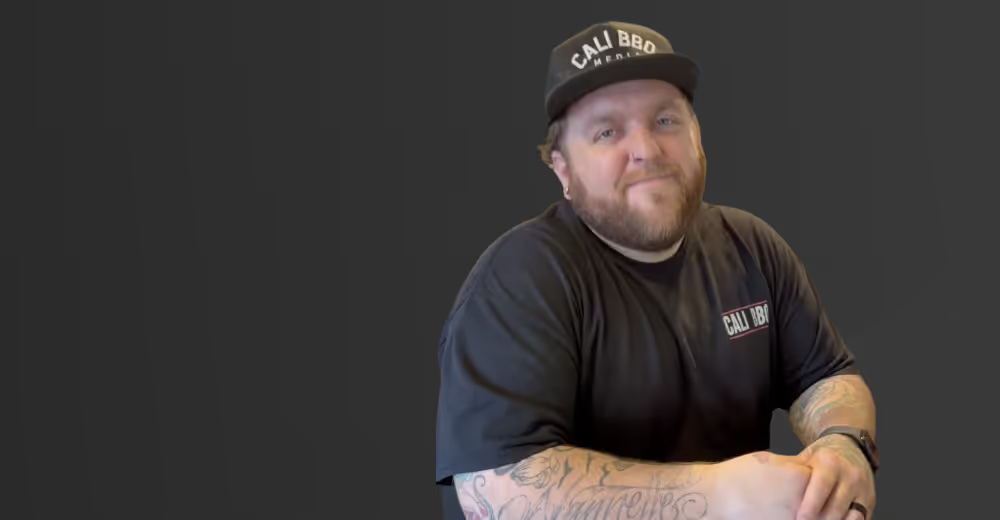
Cali BBQ is a multi-location BBQ restaurant in the US built on craft barbecue and a serious commitment to hospitality. Its communication problem was continuity. Everything lived in personal group chats and scattered text threads, so what the team knew belonged to whoever happened to be in the conversation.
“When somebody left, the conversation left with them. When somebody new came on, we were basically starting from scratch,” the team says in their case study.
Now every conversation stays with the business, searchable by anyone who needs it: “In Zenzap, everything lives on. It's searchable, and our new hires can get up to speed quickly. It's fantastic. It's huge for us.”
The team also turns messages into tasks without leaving the chat, and they connected their shift scheduling tool so a notification lands in the team chat every time a new schedule goes out. “We set up a workflow to notify us directly in the Zenzap chat when schedules are published to hold everybody accountable so everyone's on the same page.”
Their own conclusion says it best: “The heart of hospitality is communication. And with Zenzap, we can fulfill that goal.”
The Kolache Place: Every Company Announcement in One Place
The Kolache Place is a family-run, multi-location food service business in the US that does one thing exceptionally well: breakfast kolaches. Before the switch, team communication ran through text messages and a scheduling tool, with no single place where everyone got the same information.
“I've worked for other restaurants where communication was literally a notepad and a piece of paper,” says Josh Hubri, the company's Total Quality and Human Resources Manager.
Adoption was the deciding factor. “We decided to switch to Zenzap because it was very easy to use. It was user-friendly, and it just made you feel like you were in any other chat system that you use on your phone,” Hubri says.
The team now runs a company-wide chat for announcements and flyers, plus dedicated chats for cooks, catering, and other functions, so everyone gets the same message at the same time.
And offboarding went from a manual chore to a single click: “Offboarding is just a one-click remove from the workspace, and it also removes them from all the chats, which is very handy and easy to use.”
What These Five Businesses All Got Right
Five different businesses, two countries, one pattern. Each one moved work communication off personal messaging apps and into a work chat app the business controls. And when you line up what they praise most, the same things keep coming up:
- Work and personal life stay separate, so staff can switch off after a shift.
- Chats are organized by department, location, and team, so the right people see the right information.
- Onboarding means adding someone once, and offboarding takes one click.
- Conversations, files, and decisions stay with the business and stay searchable, even after people leave.
- The app feels like the messaging apps staff already know, so they use it without being pushed.
The Kolache Place chose Zenzap because it felt familiar from day one, and Green Dragon’s rollout worked because adoption was immediate.
Zenzap is an intuitive and easy-to-use work chat app for hospitality businesses, giving them the control and structure they need. That is why all five businesses in these stories switched to Zenzap.
Where to Start if Your Team Still Uses Personal Messaging Apps for Work
You don't have to be an 80-location franchise group to hit these problems, and you don't need a complicated rollout to fix them.
Every business in this article started the same way: they picked a work chat app built for how their teams work, moved the conversations over, and organized chats by department and location from the start.
Start with the pain that costs you most. If your staff can't switch off, look for working-hours notifications. If messages keep getting missed, look for organized group chats and to-do lists. If turnover keeps taking your chat history with it, look for searchable history and one-click offboarding.
The five businesses above found all of it in one place, and their stories show what that can look like in practice.
Frequently Asked Questions
Why do hospitality businesses move off personal messaging apps for team communication?
Hospitality businesses move off personal messaging apps because work messages get buried, staff can't switch off after their shift, and the business doesn't own its own conversations.
Every business in this article ran into some version of those problems, from Green Dragon's unread memos to Cali BBQ losing its chat history every time a manager left.
What should a hospitality business look for in a work chat app?
A hospitality business should look for a work chat app that keeps work and personal messages separate, organizes chats by department and location, makes onboarding and offboarding fast, and keeps conversations searchable and owned by the business. It also has to feel as familiar as the messaging apps your staff already use, or they won't stick with it.
Will hotel and restaurant staff actually use a new team chat app?
Staff will use a new team chat app if it feels like the messaging apps they already know. The Kolache Place chose Zenzap because "it just made you feel like you were in any other chat system that you use on your phone," and at the Green Dragon Hotel, the rollout was fast, and adoption was immediate.
What happens to work conversations when an employee leaves?
What happens to work conversations when an employee leaves depends on where those conversations are stored.
On personal messaging apps, all messages and files shared are retained on the employee's device.
In a work chat app the business controls, the conversations stay with the business, and removing a former employee's access takes one click, which is exactly how Three Horseshoes and The Kolache Place handle offboarding now.

Take Control of Your Team Communication
Chat, organize, and get work done - all in one place.
Other Blog Posts