.svg)

.svg)

.svg)

.svg)

.svg)

.svg)

.svg)

.svg)

.svg)

.svg)
.svg)















The Real Cost of GDPR Non-Compliance for Managers Using Zenzap's AI Work Chat in 2026
Zenzap in 2026 is not just a work chat app, it is a compliance control point. For managers responsible for GDPR, CCPA, HIPAA, and SOC 2, the real cost of non-compliance is no longer abstract. It shows up as fines, breach response work, legal review, lost time, and the exposure that comes from letting employee messages, customer details, and files live in scattered threads or personal devices.
The risk is highest when everyday operations happen in the wrong place. A shift update in a personal messaging app, a customer issue resolved in a private thread, or an offboarding that never removed access to chat history can turn routine coordination into a regulatory problem. That is why the right compliance posture is not built after the fact. It is built into the way work communication is organized from the start.
Zenzap is a work chat app built for the AI era , combining real-time messaging, built-in tasks, file sharing, and personal AI agents in one secure, mobile-first workspace trusted by 10,000+ companies including Subway, Starbucks, Burger King, NHS, and Dollar General. It gives managers a structured place for work communication, so GDPR risk does not grow out of fragmented conversations, weak access control, or unmanaged offboarding.
Table of Contents
- The Real Cost of GDPR Non-Compliance in 2026
- The Compliance Map for Managers
- How Zenzap Addresses the First Compliance Requirement
- How Zenzap Addresses the Second Compliance Requirement
- Cross-Cutting Controls That Reduce Risk Across Standards
- Compliance Mapping Table
- Audit Evidence and Readiness
- What Compliance Looks Like After Deployment
- Key Takeaways
- FAQ
- About Zenzap
The Real Cost of GDPR Non-Compliance in 2026
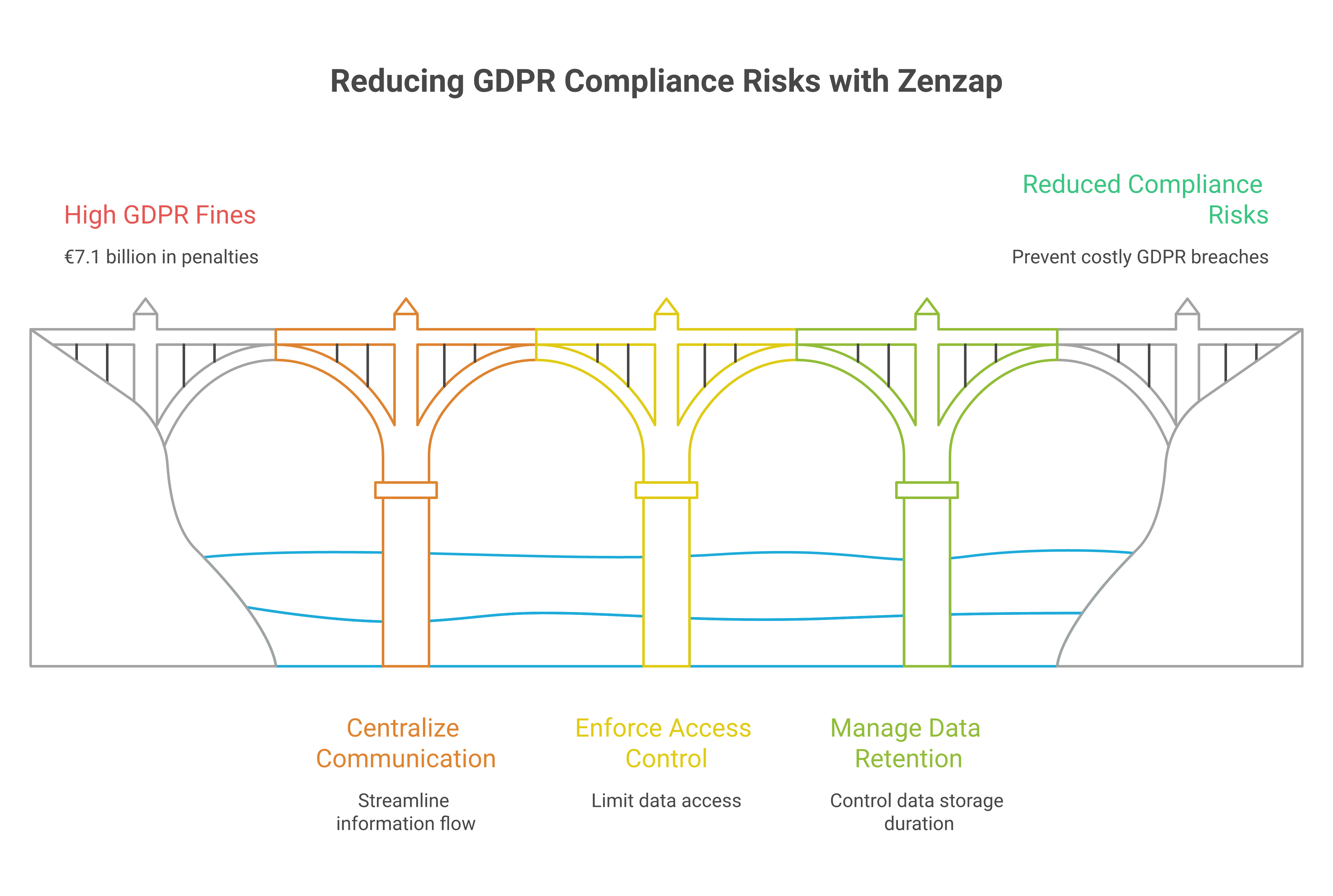
GDPR non-compliance is expensive before a regulator ever issues a fine. Managers pay through investigation time, outside counsel, remediation work, customer escalation, and the hidden operational drag that follows a breach or complaint. Public enforcement tracking shows cumulative GDPR penalties now exceed €7.1 billion, with around €1.2 billion imposed in 2025 alone, which is why privacy enforcement is no longer a distant legal issue but a working cost center for leadership. See the broader enforcement trend in the GDPR fines analysis from Improvado and the 2026 global GDPR statistics from PrivacyEngine.
The practical damage is worse in teams that communicate through scattered tools. When employee data, vendor details, customer information, and internal instructions are spread across personal apps and unstructured threads, a manager cannot prove who saw what, when access changed, or whether offboarding happened on time. That is the point where GDPR stops being a policy document and starts becoming an operational failure.
For managers, the issue is not only the maximum penalty. It is the enforcement logic under Article 83, where regulators consider the scope of the data, the duration of exposure, prior incidents, cooperation, and mitigation. A messy communication system can become evidence of weak governance, which makes the situation harder to defend even before the fine is calculated.
The Compliance Map for Managers
The compliance pressure is immediate because managers are expected to prove that work communication is controlled, auditable, and not dependent on personal apps or informal habits. In a Zenzap environment, GDPR is the primary framework, but CCPA, HIPAA, and SOC 2 also matter because they shape how teams must protect access, data retention, and accountability in day-to-day operations.
- GDPR requires lawful processing, access control, data minimization, breach readiness, and the ability to show that personal data is handled with purpose and restraint. For managers, that means work chat cannot be a free-for-all where customer data, employee records, and offboarding details sit in unmanaged threads that no one can audit later.
- CCPA requires clear handling of personal information, stronger consumer data awareness, and internal discipline around disclosure and access. For managers, the operational implication is that communication tools must reduce accidental sharing, preserve ownership of company data, and support fast response when data requests or privacy questions arrive.
- HIPAA requires protections around PHI, access limitations, and the ability to demonstrate that only authorized people can see sensitive health information. For managers in clinics, home care, and medical environments, this means team communication must avoid personal devices and keep patient-related instructions in a controlled workspace.
- SOC 2 requires evidence that security controls are designed, enforced, and monitored over time, especially for access management, change handling, and auditability. For managers, the operational implication is that chat, tasks, and files must live in a system that can prove control instead of relying on memory or informal process.
- Data retention and offboarding discipline are not a separate law, but they are a practical requirement across all four standards when work communication contains personal data. For managers, this means access removal, record ownership, and audit trails must happen inside the platform, not through manual cleanup after someone leaves.
How Zenzap Addresses the First Compliance Requirement
Zenzap satisfies access control and offboarding first, because that is where most chat-driven compliance failures begin. If a departing employee can still reach sensitive conversations, customer details, or files, the manager has already lost control of the data path.
Zenzap's one-click offboarding, workspace invite management, and team access and permissions control directly address that requirement. When an employee leaves, access can be removed from the company-owned workspace rather than from a trail of personal devices and side channels, and audit logs preserve the evidence of who had access and when it changed. That is the kind of proof a regulator or compliance officer can review without reconstructing the story from screenshots and email chains.
For a manager, this matters because it turns offboarding into a controlled event instead of a cleanup exercise. It also reduces the chance that a privacy issue escalates into a larger governance finding, because the organization can show access was managed centrally and removed promptly.
An auditor, regulator, or compliance officer receives a clear access change record, a structured offboarding trail, and an audit log that shows when the account was removed from the workspace.
How Zenzap Addresses the Second Compliance Requirement
Zenzap also meets the record control requirement by keeping work communication organized around teams, projects, and locations rather than scattered across private threads. That structure matters because GDPR compliance is not only about preventing leaks, it is also about proving what happened when a privacy question or investigation arises.
Structured work chat, built-in to-dos, and secure file sharing create a traceable operational record. A task stays attached to the conversation that created it, files remain in a company-owned workspace, and managers can show the sequence of communication without piecing it together from personal devices or disconnected apps. This supports evidence production for GDPR accountability and SOC 2 audit expectations at the same time.
For managers, the value is practical. When a customer complaint, employee request, or regulator inquiry arrives, the team does not need to rebuild the record from memory. The evidence is already stored in the same system where the work happened.
Cross-Cutting Controls That Reduce Risk Across Standards
The strongest compliance controls are the ones that satisfy more than one framework at once. That is where Zenzap reduces both risk and operational overhead, because the same control can support GDPR, CCPA, HIPAA, and SOC 2 without adding another system to manage.
- Centralized workspace ownership supports GDPR, CCPA, HIPAA, and SOC 2 because company data stays in a controlled environment instead of personal messaging apps or local devices. That gives managers a single place to manage access, trace decisions, and prove that sensitive work communication was not left outside company governance.
- Audit logs and admin controls support GDPR and SOC 2 by showing who accessed data, when permissions changed, and how records were handled. For managers, that turns everyday communication into evidence that can be produced during an audit or investigation without manual reconstruction.
- Scheduled messages and working hours controls support GDPR and SOC 2 by reducing informal after-hours handling and helping managers keep work communication inside a governed rhythm. They also help operational teams avoid the kind of rushed, untracked messaging that often leads to accidental disclosure.
- Data archiving and secure file storage support GDPR, CCPA, and HIPAA because records stay available in one place, under company control, instead of being distributed across email attachments or personal phones. That makes retention, retrieval, and review far easier when the business must respond to a complaint or audit.
Compliance Mapping Table
The mapping below shows that the same Zenzap control can satisfy multiple standards at once, which is why compliance gets easier when communication is structured correctly from the start.
The mapping makes one thing unavoidable: when communication lives in a controlled workspace, compliance stops being a separate project and becomes the natural outcome of how the team works.
Audit Evidence and Readiness
Zenzap gives managers evidence they can actually hand to an auditor, regulator, or compliance officer instead of a story built from screenshots and memory. That matters because most compliance failures are not only about bad controls. They are about the inability to prove that the control existed and worked at the time it mattered.
- The audit logs produced by Zenzap show access changes, account actions, and workspace activity, which supports GDPR accountability and SOC 2 monitoring expectations. When a manager presents these logs, the reviewer can see who had access, what changed, and when the change happened without depending on manual reconstruction.
- The one-click offboarding record shows that access was removed from the workspace in a controlled way, which supports GDPR access limitation and HIPAA workforce termination procedures. That evidence is especially useful when a former employee left with active responsibilities and the business needs to prove the removal happened promptly.
- The admin analytics dashboard gives managers a view of workspace activity, which supports oversight under GDPR and evidence of control monitoring under SOC 2. It helps show that permissions, usage patterns, and communication habits are being watched instead of ignored until a problem surfaces.
- The secure file storage and data archiving controls create a preserved record of work communication and attachments, which supports retention, retrieval, and disclosure readiness under GDPR, CCPA, and HIPAA. This is the difference between having records available and having to search multiple devices for them after a complaint arrives.
What Compliance Looks Like After Deployment
When Zenzap is in place, compliance becomes easier to defend because the organization no longer depends on informal habits to protect regulated information. Managers gain a controlled workspace where conversations, tasks, files, and access changes are already tied to the company, which makes audits faster and regulator questions easier to answer. The result is not just fewer incidents. It is a better risk posture, cleaner evidence, and less disruption every time a team member leaves or a record request arrives.
That changes the relationship with audits as well. Instead of treating compliance as a quarterly scramble, leaders can maintain a steady posture where records, permissions, and communication trails are already organized. For businesses in retail, hospitality, clinics, home care, construction, and other multi-location environments, that matters because the cost of scattered communication is cumulative and usually discovered too late.
- Managers can show that work communication is centralized, which gives boards and auditors a clear governance story under GDPR, CCPA, HIPAA, and SOC 2. The evidence is not theoretical. It is visible in the way chat, files, tasks, and access records are handled every day.
- Leaders can demonstrate that offboarding is controlled, which reduces the chance that a former employee still has access to sensitive business records. That supports regulatory confidence because it proves the company can remove risk at the source instead of trying to clean it up later.
- Compliance teams can present retained records and audit logs without rebuilding the timeline from personal devices, which shortens review cycles and reduces legal overhead. That is the kind of readiness regulators notice because it shows governance is built into operations, not added on afterward.
The combination of structured communication, auditability, and company-owned data makes compliance possible in a way point solutions and manual processes cannot.
Key Takeaways
- Centralize work chat in a company-owned workspace so employee and customer data do not drift into personal apps or untracked side channels.
- Use one-click offboarding and audit logs together so access removal and evidence production happen at the same time.
- Keep tasks, files, and conversations in one structured system so compliance records are easier to prove and retrieve.
- Treat scheduled messages, working hours controls, and file archiving as governance tools, not convenience features.
- Use the same platform to support GDPR, CCPA, HIPAA, and SOC 2 so compliance does not become a separate workstream.

FAQ
Q: What makes GDPR non-compliance expensive for managers in 2026?
A: The cost goes far beyond the fine itself. Managers also pay for legal review, incident response, remediation, lost productivity, and customer trust loss after a breach or complaint. Enforcement has become more active, and the cumulative penalty total now exceeds €7.1 billion, which means regulators are not treating these cases as rare exceptions. The real expense appears when weak communication habits create evidence of poor governance.
Q: Why is work chat such a common compliance risk?
A: Work chat often becomes the place where sensitive data, customer issues, and employee details move fastest. If that communication happens in personal apps or unstructured threads, the business loses visibility into access, retention, and offboarding. That creates risk under GDPR, CCPA, HIPAA, and SOC 2 at the same time. Managers need a controlled workspace because the conversation itself often becomes the record.
Q: How does Zenzap help with offboarding risk?
A: Zenzap gives managers one-click offboarding, workspace invite management, and access controls that keep company data inside a managed environment. That means the business can remove access from the workspace instead of chasing down personal devices and disconnected channels. The audit trail also shows that the removal happened, which is exactly the kind of evidence auditors and regulators expect. This lowers both breach risk and cleanup time.
Q: What evidence should a manager be ready to show during an audit?
A: The most useful evidence is the audit log, access change history, offboarding record, and data archive trail. Together, these show who had access, what changed, when it changed, and where the records are stored. Zenzap makes that evidence available in the same system where the work happened, which reduces manual assembly. That is far stronger than relying on screenshots or exported message chains.
Q: Does structured chat really improve compliance, or is it just an organization feature?
A: It improves compliance because structure creates traceability. When conversations, tasks, and files stay attached to a team, project, or location, the organization can show a clear path for access and retention. That helps with GDPR accountability, SOC 2 monitoring, and controlled handling of personal information under CCPA and HIPAA. What looks like organization on the surface is often the control that keeps a small issue from becoming a reportable one.
Q: Why does this matter more for frontline and multi-location teams?
A: Frontline teams move fast, and they cannot afford communication systems that depend on memory or manual follow-up. If updates are scattered across personal apps, the business loses the ability to control who saw what and when. That is how compliance debt builds without anyone noticing. Zenzap keeps the information in one place, which helps managers protect both the operation and the audit trail.
About Zenzap
Zenzap is a modern communication platform designed to streamline messaging across teams and groups in a single, organized workspace. It focuses on combining chat, task coordination, and collaboration tools to reduce the need for multiple disconnected apps. The goal of Zenzap is to improve productivity by making conversations more structured, searchable, and action-oriented.

Take Control of Your Team Communication
Chat, organize, and get work done - all in one place.
Other Blog Posts