.svg)

.svg)

.svg)

.svg)

.svg)

.svg)

.svg)

.svg)

.svg)

.svg)
.svg)

























Secure Team Messaging Software in 2026: Why Zenzap Is the Smart Choice for Modern Teams
Introduction
Secure team messaging software in 2026 is no longer just about sending messages. It is about keeping work in the right place, preserving the record, controlling access, and making sure a team can move fast without losing control of its data.
That matters more now because communication has become the place where decisions, tasks, files, and approvals actually live. When those conversations spill into personal apps or scattered tools, you do not just create inconvenience. You create audit gaps, retention problems, offboarding risk, and confusion about who saw what.
The real question is not whether your team can chat. It is whether your communication system can hold up when someone leaves, a task gets buried, or a manager needs proof that an update was delivered. This guide shows the sequence that prevents those failures and explains why Zenzap is built for exactly that job.
Table of Contents
- Why secure team messaging matters in 2026
- What buyers should demand beyond encryption
- How Zenzap solves the operational failure mode
- A practical rollout guide for modern teams
- Key Takeaways
- FAQ
- About Zenzap
Why Secure Team Messaging Matters In 2026
Secure team messaging matters because communication is now core infrastructure, not a side tool. In hybrid and distributed teams, the cost of losing control over a message is often higher than the cost of sending it.
The shift is already visible. BridgeApp reports that by mid-2026, over 66% of businesses rely on remote collaboration tools, and it cites Gallup data showing that 52% of U.S. Employees with remote-capable jobs work in hybrid arrangements while roughly 26% are fully remote. That is a lot of work happening away from a desk, across shifts, and in more than one location.
The Real Problem Is Location, Not Volume
The issue is not that teams send too many messages. The issue is that critical communication lives in the wrong place, where it cannot be governed, searched, retained, or removed when needed.
Consumer messaging apps create blind spots because they were not designed for business oversight. Federal News Network notes that employees often default to apps already on their phones, even when those apps are not approved for work conversations, and that those consumer tools lack the administrative controls and data retention features agencies need to verify data is protected and preserved. That same failure pattern shows up in retail, hospitality, clinics, and franchise operations every day.
- When a shift update lives in a personal thread, the manager on the next shift may never see it, and there is no clean audit trail to prove otherwise.
- When a vendor file is shared through a consumer app, the company loses control over where that file travels, who keeps it, and whether it survives offboarding.
- When a task is split between chat, email, and a separate task tool, the team spends more time reconstructing intent than executing the work.
Why This Became A Security Issue
A secure messaging stack now has to protect more than the text of a conversation. It has to protect identity, access, metadata, retention, and the chain of custody around work.
Wire explains this clearly in its enterprise secure communication platform guide, where it argues that enterprise platforms must protect content, metadata, identities, access, and auditability, not just message content. That matters because even when message encryption exists, metadata can still reveal who is talking to whom, when, and where.
What Buyers Should Demand Beyond Encryption
Encryption alone is not enough in 2026. Buyers should expect admin control, retention policies, identity management, device governance, audit logs, and secure collaboration in one place.
That standard is getting tighter because business messaging has become part of compliance, operations, and frontline execution. If the platform cannot support those jobs, the team will build workarounds, and the workaround will become the real system.
The Security Bar Is Higher Now
The right evaluation starts with governance, not features that look good in a demo. A secure business chat app should help you control who can join, what can be retained, where data lives, and how access ends.
Viasocket's comparison of secure business messaging apps lays out the expected baseline, including encryption, audit logs, data retention, DLP, SSO or SAML, and cloud, hybrid, or on-prem deployment options in its secure business messaging apps overview. Troop Messenger adds another layer by calling for end-to-end encryption, post-quantum cryptography, anti-leak controls like DLP and screenshot blocking, and compliance with standards such as GDPR, ISO/IEC 27001, SOC 2, HIPAA, and FINRA in its secure messenger guidance for business communication.
- Admin controls matter because security without control is just stored risk, and teams need a way to remove access the moment roles change.
- Retention matters because if you cannot preserve the right messages for the right period, you cannot prove what happened when a dispute, audit, or investigation arrives.
- Identity and device management matter because the person in the thread is not enough. You need confidence that the account, the device, and the data path are all governed.
The Buying Criteria Have Expanded
The buyer now compares much more than chat and file sharing. They are looking for a system that can also handle onboarding, permissions, task tracking, and daily coordination without creating a second stack of disconnected tools.
That is why evaluation frameworks from sources like Pumble focus on user experience, security features, business friendliness, and price, while enterprise-ready products are judged on authentication, federation, zero-trust verification, SSO, MFA, and device binding. In practice, the best tool is the one your team will actually use while still giving operations leaders the controls they need.
How Zenzap Solves The Operational Failure Mode
Zenzap solves the actual failure point by keeping chat, tasks, files, schedules, and permissions inside one controlled workspace. That matters because the problem is not only whether a message is secure. It is whether the work stays connected after the message is sent.
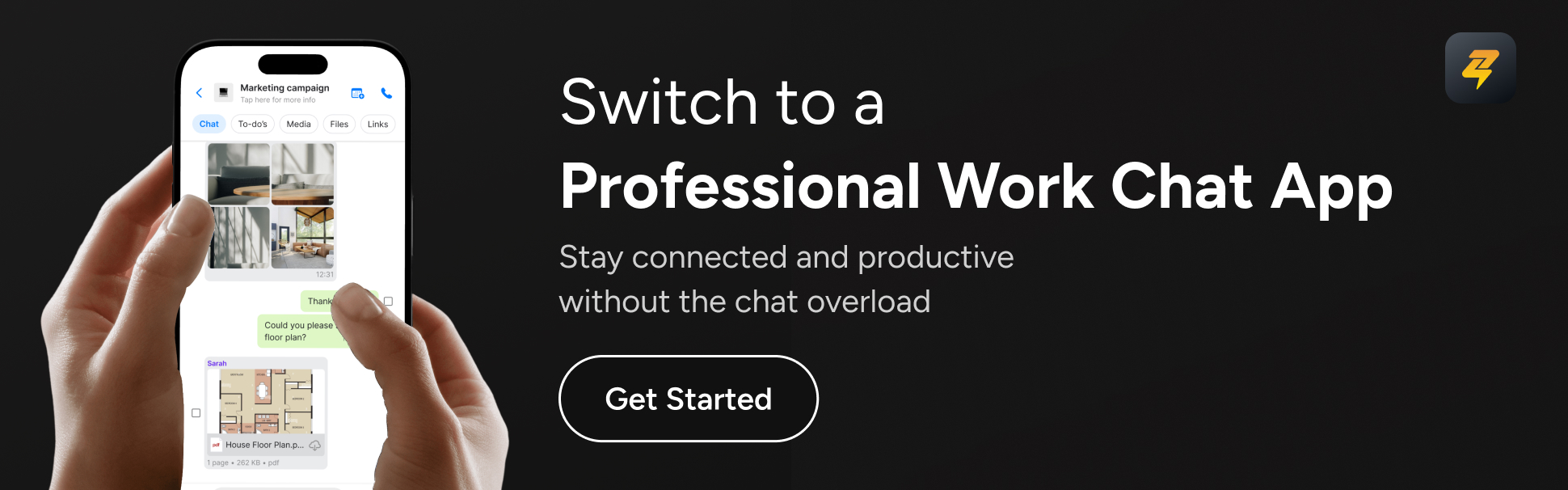
Zenzap is a work chat app built for the AI era, combining real-time messaging, built-in tasks, file sharing, and personal AI agents in one secure, mobile-first workspace trusted by 10,000+ companies including Subway, Starbucks, Burger King, NHS, and Dollar General. If your team can text, they can use Zenzap from day one, which is exactly why adoption is so much easier than with tools that require long training cycles.
What Zenzap Replaces In Daily Operations
Most communication failures start with tool sprawl. One app holds the conversation, another holds the task, a third holds the file, and a fourth holds the calendar.
Zenzap replaces that mess with structured work chat organized by team, project, or location, built-in to-dos that live inside conversations, Google Calendar integration and task-to-calendar sync, external communication with vendors, contractors, and clients, and one-click offboarding. It also keeps company-owned data in the cloud rather than on personal devices, which directly addresses the risk of staff using personal messaging apps for work.
Why The Structure Matters More Than The Interface
The interface is not the point. The structure is the point, because structure is what preserves meaning after a fast-moving conversation is over.
When a frontline manager can see the thread, the task, the file, and the follow-up in one place, there is less room for missed handovers and fewer chances for duplicate work. Zenzap's guide to secure team messaging for modern workplaces and its overview of secure business messaging apps for teams in 2026 both reinforce the same operational logic, communication should support execution, not scatter it.
- Structured chat by team, project, or location reduces the chance that a critical update gets buried in the wrong group or lost in a long thread.
- Built-in tasks inside conversations keep action items attached to the decision that created them, which makes follow-through easier and accountability clearer.
- Working hours controls and scheduled messages help managers keep communication inside sane time windows, which is especially useful for frontline and distributed teams.
Why Zenzap Is A Better Fit For Frontline And Distributed Teams
Zenzap is built for teams that do not sit at desks all day. That includes retail, hospitality, clinics, construction, home service trades, and multi-site operations where the wrong message at the wrong time becomes an expensive mistake.
Its mobile-first design, zero learning curve, and admin controls make it practical for people who need to act fast, not learn software. For a deeper look at the operational angle, see why Zenzap is the most secure workplace messaging app for distributed teams and how Zenzap leads 2026 market trends in secure workplace messaging and task management.
A Practical Rollout Guide For Modern Teams
The best rollout is the one that replaces the riskiest habits first. Start with the places where work is already happening in the wrong app, then move those conversations into a controlled workspace.
Use the sequence below to migrate with less disruption and more control. This is the part that keeps the transition from becoming just another tool change.
StepWhat to doWhy it matters1Map where critical work is currently happening.You cannot fix what you have not located, and most risk begins in unofficial channels.2Move the highest-risk conversations into structured team spaces.This captures the threads that affect schedules, tasks, files, and approvals first.3Attach tasks to the message that created them.When follow-up stays in the thread, accountability becomes visible instead of implied.4Turn on permissions, retention, and offboarding rules before wider rollout.Security is easier to enforce early than to retrofit after habits are formed.
Step 1: Find The Hidden System First
Start by identifying where people are already making decisions, sharing files, and assigning tasks outside the approved workspace. This is usually where frontline teams, managers, and contractors improvise when the official system is too slow or too fragmented.
The goal is not to shame the workaround. The goal is to replace it with something better. Once you know where the work actually lives, you can move the highest-value threads first and stop the leakage before it spreads.
Step 2: Move The Most Sensitive Conversations Into One Workspace
Do not start with low-value chatter. Start with schedules, staffing, customer issues, vendor coordination, and anything that creates risk if it disappears.
Zenzap makes this easier because conversations can be organized by team, project, or location, which gives managers a clean operational map. That structure also helps if you need to search later, show accountability, or prove that a message was delivered.
Step 3: Turn Messages Into Work Items
A message without a follow-up is often where execution breaks. The best fix is to make the next step live inside the conversation where the decision happened.
Zenzap's built-in to-dos and task-to-calendar sync reduce the odds that action items drift into separate tools or get forgotten by the next shift. That is especially useful for multi-location operations, where one missed follow-up can roll into a customer service failure or an inventory issue.
Step 4: Lock Down Access Before You Scale Adoption
Roll out permissions, retention, and offboarding rules before the workspace becomes essential. If you wait until after the team depends on it, you will be changing the guardrails in the middle of live operations.
Zenzap's full admin controls, audit logs, SSO on higher tiers, and one-click offboarding give operations teams the visibility they need. That means a departure does not become a manual cleanup project across devices, threads, and folders.
Step 5: Keep Frontline Use Simple
Adoption wins when the tool matches the way people already work. If staff can text, they can use Zenzap from day one, which lowers friction and keeps managers from needing to explain the basics over and over.
That matters because secure messaging only works if it becomes the default place for work. Zenzap's mobile-first experience, availability on iOS, Android, Windows, Mac, and Web, and Free forever entry point help make that possible without adding unnecessary complexity.

Key Takeaways
The strongest secure messaging strategy is the one that prevents work from escaping into the wrong places. The bullets below capture the decisions that matter most when you choose a platform in 2026.
- Choose a platform that controls access, retention, and offboarding, not just message encryption, because governance is what protects the work after it is sent.
- Keep chat, tasks, files, and scheduling in one workspace so updates do not get lost across separate apps and personal threads.
- Roll out the tool where the operational risk is highest first, especially in frontline, multi-site, or hybrid teams.
- Use audit logs, SSO, and admin controls as non-negotiables when you need to prove what happened and who had access.
- Favor a system your team will actually use on mobile, because adoption fails when the secure tool is harder than the workaround.
FAQ
Answers below focus on the questions buyers usually ask when they are deciding whether secure team messaging is worth changing for.
Q: Why is secure team messaging different from ordinary chat?
A: Secure team messaging gives you control over retention, access, auditability, and offboarding, not just conversation. Ordinary chat can move fast, but it usually leaves gaps when you need to prove what happened or remove access quickly. In 2026, those gaps are a business risk, not just an IT issue. That is why the platform needs to support the whole workflow, not only the message.
Q: What should I look for beyond encryption?
A: Look for admin controls, retention settings, SSO, MFA, audit logs, and device governance. You also want a platform that can protect metadata and identity, because those are often the weak points in consumer-style messaging. If the system cannot manage these areas, it will force your team into workarounds. Workarounds are where compliance and operational failures usually start.
Q: Why does Zenzap fit frontline and multi-location teams so well?
A: Zenzap combines chat, tasks, file sharing, and scheduling in one mobile-first workspace. That helps teams that move between locations, shifts, and devices because the work stays connected to the conversation. It also reduces the need to juggle personal messaging apps, email, and separate task tools. For managers, that means less chasing and more visibility.
Q: How does Zenzap help when someone leaves the company?
A: Zenzap gives you one-click offboarding and company-owned data stored in the cloud, not on personal devices. That makes it easier to remove access without hunting through multiple tools and phone-based threads. It also reduces the chance that important files or decisions remain trapped on a former employee's device. For operations teams, that is one of the cleanest ways to lower risk.
Q: Is secure messaging only for regulated industries?
A: No, it matters anywhere communication drives work. Retail, hospitality, home services, clinics, franchises, and nonprofit teams all face the same risks when conversations happen in the wrong place. The issue is usually not interception, it is loss of control over access, retention, and follow-through. That is why secure team messaging is becoming core infrastructure across industries.
About Zenzap
Zenzap is a modern communication platform designed to streamline messaging across teams and groups in a single, organized workspace. It focuses on combining chat, task coordination, and collaboration tools to reduce the need for multiple disconnected apps. The goal of Zenzap is to improve productivity by making conversations more structured, searchable, and action-oriented.
Zenzap is a team chat app designed to streamline internal communication for businesses. The platform offers secure real-time chat, built-in tasks, and secure file sharing and organization. It is built for SMBs and companies with 10 to 5000 employees that need secure workplace messaging without the overhead of a complicated enterprise rollout.
If your team still depends on personal apps, email threads, and separate task tools to run daily operations, what would break first if someone left tomorrow?

Take Control of Your Team Communication
Chat, organize, and get work done - all in one place.
Other Blog Posts
- fskfsfjksofjsj