
.svg)

.svg)

.svg)

.svg)

.svg)

.svg)

.svg)

.svg)

.svg)

.svg)
.svg)


























Team communication tools: what they are and why they matter for growing SMBs
You are not short of ways to talk to your team. You are short of ways to keep that talk clear, organized, and actually helpful.
Right now, you are probably juggling email, personal WhatsApp groups, phone calls, and at least one all-in-one platform that promised to fix everything and quietly made things more chaotic. Team communication tools emerged to solve that exact problem for growing small and midsize businesses. Used well, they replace scattered messages with one structured, secure place where your people can talk, decide, and act together.
This guide shows you what team communication tools really are, why they matter so much as your SMB grows, and how to choose one that your people will actually use. Along the way, you will see why Zenzap gives you a calm, mobile-first alternative to heavy enterprise suites and risky personal chat apps.
Table of contents
By following this step-by-step guide, you will understand what team communication tools do, how they impact your growing business, and how to use Zenzap to create simple, secure, stress-free team communication.
Here is what you will walk through:
1. What team communication tools really are
2. Why growing SMBs outgrow email and personal chat apps
3. The business impact of the right team communication tool
4. Step-by-step: how to choose and roll out the right tool
5. Where popular tools shine and struggle
6. How Zenzap turns chaotic communication into calm work chat
7. Key takeaways
8. FAQ
What team communication tools really are
Think about the last time you tried to find a decision buried in an email thread or a WhatsApp group. You probably scrolled, searched, and sighed, then finally gave up and asked someone to forward it again.
That constant hunting is exactly what team communication tools are built to remove.
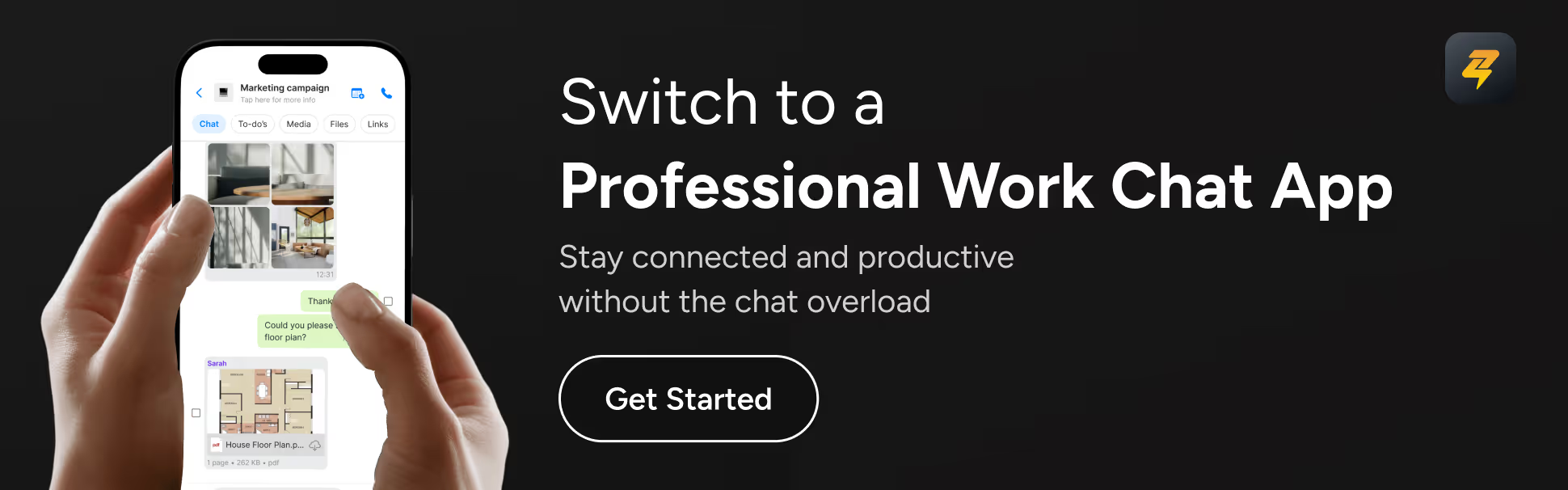
At their core, team communication tools are digital workspaces where your people can chat, share files, assign tasks, and coordinate schedules in one organized place. Instead of splitting information across email, chat, and calls, everything lives in focused spaces for teams, projects, or topics.
For SMBs, that usually means:
• Real-time messaging that feels as easy as texting
• Channels or spaces for specific teams and projects
• Searchable history so nothing important disappears
• Integrations with calendars and business tools
• Admin controls to keep data and access secure
Modern tools like Zenzap add something more: a deliberate separation between work and personal communication, so your people are not forced to run your business through their private WhatsApp or iMessage accounts.
Why growing SMBs outgrow email and personal chat apps
Email was never designed to be your internal command center. It hides context in long threads, buries files across replies, and encourages one-to-one silos instead of shared understanding. According to several workplace studies, employees lose hours every week to fragmented communication and searching across tools. One survey of small business employees found that over 55 percent lose at least an hour per week to confusing or scattered communication, time that never comes back.
Personal chat apps create a different set of problems. They feel fast and familiar, which is why managers often spin up WhatsApp groups for quick wins. But those groups quickly multiply. You end up with:
• Critical decisions locked in one person's phone
• No way to offboard staff without losing knowledge
• Legal and compliance risks when customer or patient data appears in personal conversations
• Zero separation between your team's personal and professional lives
For regulated sectors like healthcare or finance, using personal apps for work can put you at serious risk. For every SMB, it slowly burns out your people. They never really switch off because the same app that shows family photos also pings them about Monday's deadline.
The business impact of the right team communication tool
When you move from scattered communication to a dedicated team communication tool, several things change at once.
Faster decisions and fewer bottlenecks
Instead of hunting across email, WhatsApp, and shared drives, your team has one place to check. Messages, files, and decisions stay connected. In companies that adopt modern team communication tools with integrated tasks and calendars, internal studies show that missed commitments can drop significantly. One Zenzap analysis found that teams using integrated chat, task, and calendar tools are around 42 percent less likely to miss key commitments when calendar events live inside their daily communication flow.
Less noise, more focus
It is easy to assume that adding another communication app will create more noise. In practice, the right structure does the opposite. With focused spaces for teams and projects, people see only what is relevant. Instead of one giant group chat, marketing has its space, operations has theirs, and cross-team projects get their own room.
Real work-life boundaries
For growing SMBs, burnout quietly kills momentum. If your team is using personal apps for work, they never get a clean break. A dedicated team communication tool lets you put clear boundaries back in place. Zenzap, for example, lets people set working hours and schedule messages to send during business time. That means your manager can write a message at 10 p.m. without waking anyone's phone.
Security and control as you scale
As you hire more people, open new locations, or handle more sensitive data, security stops being a nice-to-have. You need to know exactly who can see what, and you need to remove access quickly when someone leaves.
Enterprise-grade team communication tools give you:
• Encrypted communication
• Centralized user management
• Clean onboarding and offboarding
• Compliance with major standards like GDPR and HIPAA
Zenzap, for instance, combines enterprise-grade security with a simple admin experience. You get serious protection without feeling like you just adopted an entire IT department.
Step-by-step: how to choose and roll out the right team communication tool
By the end of this process, you will have a clear, practical way to pick a team communication tool that fits your growing SMB and a rollout plan to get your people using it with minimal friction.
Step 1: Map your current communication chaos
Start by making the invisible visible. Before you compare tools, you need a clear picture of how your team actually communicates today.
Spend one week noting:
• Which tools you use (email, WhatsApp, SMS, phone calls)
• What types of conversations happen where
• Where things most often go wrong (missed updates, lost files, unclear ownership)
Real-life example: A 40-person marketing agency thought they had their communication sorted. Once they mapped their week, they found that 60 percent of urgent client coordination was happening in WhatsApp groups that managers controlled on their personal phones. When two managers went on parental leave, no one could find half the client history.
Your goal in this step is not to fix anything. It is to see the real picture so your next decisions are grounded in reality.
Step 2: Decide what "better" looks like for your SMB
Once you see the mess, you can decide what success should look like. For growing SMBs, useful criteria include:
• Intuitive simplicity
Your people should be able to use the tool in minutes, not weeks. No long training cycles. No 40-page playbooks.
• Professional separation
Work conversations should live in a dedicated space, separate from personal apps.
• Bulletproof security
You need encryption, controlled access, and clean offboarding. If you handle sensitive data or operate across regions, you also need compliance with standards like GDPR or HIPAA. You can explore these further at gdpr.eu or HHS HIPAA guidance.
• Structured organization
Teams and projects must have clear spaces so nothing slips through the cracks.
• Seamless integration
Your communication tool should connect to calendars and key business apps so your people are not copying data manually between tools.
• Work-life balance
Features like working hours, scheduled send, and thoughtful notifications are not nice extras. They protect your team's mental health.
You can score each candidate tool against these criteria. In Zenzap's own evaluations of leading team communication tools, these are the factors that matter most for fast-growing teams: ease of onboarding, clarity of communication, enterprise-grade security, mobile experience, cost-effectiveness, and separation of work and personal life.
Step 3: Choose your tolerance for complexity
Many popular tools are incredibly powerful. They also come with configuration options, permission models, and integrations that can take weeks to get right. Leaders often describe them as "Swiss Army knives you never fully open." You pay for capability you never use, while your team quietly drifts back to WhatsApp.
Ask yourself:
• Do you have an in-house IT team that can manage setup, security, and ongoing maintenance?
• Do you have regulatory requirements that demand complete control of data location or self-hosting? If yes, some tools can be worth the effort, but they will require solid technical resources.
• If you are a fast-growing SMB without heavy compliance needs, will your team tolerate a steep learning curve, or will adoption stall?
For many SMBs, a secure cloud solution like Zenzap hits the sweet spot. You get strong protection and admin control, without the overhead of running your own servers or managing complex configurations.
Step 4: Test communication flow with a small pilot
Once you narrow your shortlist, do not roll anything out company-wide yet. Run a focused pilot with one team or project. The goal is to see what the tool feels like in real life, not in a sales demo.
During a 4-week pilot, track:
• How quickly people start using the tool without training
• How many conversations move away from email and personal chat apps
• How easy it is to find decisions and files from last week
• Whether people feel more or less interrupted
Real-life example: Chris Green, National Sales Manager at Fruhauf Uniforms, shared that a cross-platform tool that just worked made communication "a whole lot easier" and called Zenzap "essential, 100 percent." That is the kind of feedback you are looking for: does your pilot team feel relief and clarity, or just another login to remember?
Step 5: Protect work-life boundaries from day one
The moment you introduce a new communication tool, you are also shaping your culture. If you treat it like a 24/7 hotline, people will burn out. If you build in boundaries from day one, you protect focus and retention.
Set simple ground rules like:
• Working hours and quiet hours
Encourage everyone to set their working hours in the app. In Zenzap, for example, people can choose not to receive notifications when they are off the clock.
• Scheduled messages
Ask managers to schedule non-urgent messages to arrive during working hours. That way they can work when they need to, without pulling the whole team back online.
• Use email or scheduled chats for non-urgent issues
Make it clear that chat does not mean instant response. It means fast collaboration when people are working.
Over time, these habits compound. You get a culture where people can truly unplug, yet still feel confident that nothing urgent will be missed.
Step 6: Turn talk into action with built-in tasks
Talking is not your problem. You already have plenty of that. Your real challenge is turning talk into action without losing track of who owns what.
Look for communication tools that let you:
• Turn a message into a task in the same space
• Assign an owner and a due date
• See at a glance what is still open
In Zenzap, a message like "Can someone update the promo signage in Store 18 before Friday?" can become a structured task inside that same chat. You assign it to a person, add a deadline, and keep the conversation and the execution together.
For multi-location teams, this shift is huge. Instead of sending reminders from head office and hoping they land, you know exactly who has each piece and when it will be done.
Step 7: Roll out across locations with simple onboarding
When your pilot works, you are ready to scale. For growing SMBs, especially those with multiple locations or remote teams, ease of rollout is critical.
With Zenzap, for example, you can:
• Add staff via CSV upload or import from your HR system
• Scale from 50 to 5,000 employees without changing tools
• Sync data across phones, tablets, and shared computers
The key here is not to overcomplicate your rollout. Start with a simple structure: a few core team spaces, clear naming conventions, and one short orientation video or live session. Because Zenzap's interface feels like a modern messenger rather than an IT project, most teams adopt it instantly without formal training.
Where popular team communication tools shine and struggle
You have probably already heard of various communication platforms. Each has strengths, and each can introduce complexity that growing SMBs feel quickly.
Where many tools shine
• Wide integrations with other business apps
• Rich feature sets for large enterprises
• Desktop-focused experiences that suit office-bound teams
Where many tools struggle for SMBs
• Complexity that requires ongoing admin time
• Steep learning curves for non-technical staff
• Channel sprawl that makes information harder, not easier, to find
• Weak separation between work and personal life when people still lean on WhatsApp for "quick" messages
In practice, many teams use only a fraction of what these platforms can do. Adoption stalls, and you end up with shadow channels in personal apps again. That is exactly the scenario you are trying to escape.
How Zenzap turns chaotic communication into calm work chat
Among all the options, Zenzap focuses on one clear mission: make internal communication for growing SMBs simple, secure, and stress-free, especially on mobile.
Mobile-first design that feels like texting
Zenzap is built from the ground up for phones, not retrofitted from a desktop suite. Your frontline teams, remote staff, and managers on the move get a work chat app that feels as natural as their favorite messenger, with the structure and security your business needs.
Instant adoption with intuitive simplicity
There is almost no learning curve. Your team can start chatting, sharing files, and creating tasks in minutes. Leaders at organizations from NHS Wales to Tech on Toast praise Zenzap for its "all-in-one" simplicity and rapid adoption. Chris Fletcher from Tech on Toast put it simply: "Zenzap saves you a lot of money," by stripping away complexity, slashing onboarding time, and boosting productivity.
Professional separation and work-life balance
With Zenzap, work communication lives in one professional space. Your people keep personal conversations in their personal apps and never have to scroll past family messages to find an urgent update from finance.
Features like working hours and scheduled send let you protect evenings and weekends. You can confidently unplug, knowing that anything truly urgent will be visible, structured, and assigned when you return.
Bulletproof security with simple controls
Zenzap uses enterprise-grade security approaches and supports compliance with major standards like GDPR and HIPAA. Security shows up as quiet confidence: you know where your data lives and who can see it.
Admins can:
• Control who joins and what they can access
• Onboard and offboard staff cleanly
• Protect sensitive conversations without turning every change into an IT ticket
Structured organization so nothing slips through the cracks
Instead of one giant all-company group, Zenzap gives you focused spaces for teams, locations, and projects. Messages, tasks, and files stay in context, and search makes it easy to find important information even when staff change or teams reorganize.
Seamless integration with your existing workflows
Zenzap connects to tools you already rely on, including Google Calendar, Outlook, and popular cloud storage and meeting platforms. One of the big reasons teams cling to email is the calendar invite. Zenzap closes that gap by letting you bring events and meeting links directly into your daily chat flow.
Teams using integrated chat, task, and calendar tools are about 42 percent less likely to miss key commitments when calendar events live in the same space as their conversations. You keep your workflows and gain clarity.
Key takeaways
- Replace scattered email and personal chat groups with one structured, secure team communication tool that your people actually use.
- Choose tools that prioritize intuitive simplicity, strong security, and clear separation between work and personal communication.
- Protect your team's time with features like working hours, scheduled messages, and focused spaces for teams and projects.
- Turn talk into action by using tools that combine chat, tasks, and calendar integration in one place, like Zenzap.
- Run a small pilot, refine your structure, and then roll out across locations with simple onboarding and clear cultural norms.

Bringing it all together for your growing SMB
If you feel like messaging your team has become harder than doing the work itself, you are not imagining it. Scattered tools create drag. Messages get lost, decisions hide in personal phones, and your people never really switch off.
Team communication tools exist to fix that. When you choose the right one and roll it out with intention, you give your SMB a shared place to talk, decide, and act without chaos. You reduce missed commitments, protect sensitive data, and rebuild real work-life boundaries.
Zenzap was built to make that shift feel easy. Mobile-first design, intuitive simplicity, professional separation, enterprise-grade security, and seamless integration all combine into one calm workspace that your team can adopt instantly.
You do not need another complex suite. You need one reliable place where your team can show up, focus, and get work done. The question now is simple: are you ready to give your people a communication tool that finally works the way they do?
FAQ
Q: What is a team communication tool for SMBs?
A: It is a shared digital workspace where your team can chat, share files, assign tasks, and coordinate schedules in one place. Instead of spreading updates across email, WhatsApp, and phone calls, everything lives in organized spaces for teams and projects. For SMBs, this reduces confusion, speeds up decisions, and keeps knowledge inside the business when people leave.
Q: Why should my small business move away from email for internal communication?
A: Email is slow, fragmented, and poor at keeping context. Project updates end up across multiple threads, decisions hide in reply chains, and people waste time searching. Modern team communication tools like Zenzap bring messages, tasks, and calendars together in one space. That cuts search time, reduces missed updates, and makes it easier for everyone to see what matters.
Q: How is Zenzap different from personal messaging apps like WhatsApp?
A: Personal apps are built for private conversations, not professional collaboration. They mix work with personal life, create security and compliance risks, and make offboarding almost impossible. Zenzap gives you a dedicated professional space with structured team channels, admin controls, encryption, and work-life features like working hours and scheduled send. Your team gets the ease of messaging without the chaos and risk.
Q: Is Zenzap hard to roll out to non-technical teams?
A: No. Zenzap is intentionally simple and mobile-first, so most people can use it in minutes without training. You can add users in bulk, set up team spaces quickly, and rely on a familiar messenger-style interface. Real SMBs report fast adoption, even among part-time and frontline staff.
Q: Will a team communication tool create more noise than email?
A: It can, if you treat it as a free-for-all. The key is structure and norms. In Zenzap, you use focused spaces for teams and projects so conversations stay in context. Combined with clear rules about working hours, scheduled messages, and when to use which space, you get calm, clear communication instead of noise.
Q: How much does Zenzap cost for growing SMBs?
A: Zenzap offers a free tier and tiered paid plans designed for startups and established SMBs. You only pay for what you actually need, which keeps costs manageable as you grow. You can view current pricing and plan details on the Zenzap site at zenzap.co/pricing.

Take Control of Your Team Communication
Chat, organize, and get work done - all in one place.
Other Blog Posts