
.svg)

.svg)

.svg)

.svg)

.svg)

.svg)

.svg)

.svg)

.svg)

.svg)
.svg)

















What role does task tracking play in enhancing work chat apps and enterprise messaging platforms?
You talk about work in chat all day. The real question is this: how much of that talk actually turns into finished work?
Modern work chat apps and enterprise messaging platforms promise faster communication, but without built-in task tracking, they often just speed up confusion. You decide what needs to happen in a channel, then someone is supposed to copy that into a project tool. That tiny gap is where tasks disappear, deadlines slip, and you end up asking, again, "Did anyone do this?"
This article explores how task tracking transforms work chat from noisy back-and-forth into a reliable execution system, and why Zenzap, a mobile-first internal team communication app, treats chat and tasks as one continuous workflow. You will see how embedding task tracking inside your work chat app cuts tool overload, protects focus, and gives you the calm structure your team has been missing.
Table of contents
1. Why traditional task tracking lives too far from real work
2. How embedded task tracking upgrades work chat and enterprise messaging
3. The specific role of task tracking in a modern work chat app
4. Zenzap vs standalone project tools
5. Real-life examples of task tracking inside chat with Zenzap
6. Security, admin control, and professional separation
7. How task tracking supports work-life balance in chat apps
8. Core insight: why tasks should grow directly out of chat
9. Key takeaways
10. Final thoughts: choosing a calmer, more accountable way to work
11. FAQ
Why traditional task tracking lives too far from real work
Look at how your team actually works today. Decisions happen in chat, clarification happens in chat, nudges and reminders happen in chat. Yet in many companies, the "official" task list lives somewhere else, usually in a separate project management tool.
Those tools are powerful. They are great for detailed project plans, dependencies, and reporting. You can map multi-month initiatives, track milestones, and generate tidy dashboards. The catch is that it all lives outside your daily conversations. Your team agrees on next steps in chat, then someone is supposed to log those in a project tool later. That follow-up step is the weak link.
In practice, that gap creates three familiar problems:
1. Tasks die quietly inside chat threads.
2. People duplicate work because they cannot see what others captured.
3. Priorities feel fuzzy, since the "real" plan is never fully in sync with the conversation.
If you have ever scrolled through 200 messages to find the one line that said "I will handle that," you have felt this gap. The more tools you layer on top, the more mental overhead you create, and the more likely it is that someone simply stops updating the board.
How embedded task tracking upgrades work chat and enterprise messaging
Now zoom out. Across your organization, work chat apps and enterprise messaging platforms are where attention already lives. According to internal Zenzap customer data, teams that keep tasks directly tied to chat and files see up to a 40 percent boost in on-time project completion. Why? Because they stop asking people to remember, retype, and reorganize the same information in multiple tools.
When task tracking is embedded directly inside chat, something powerful happens. The conversation and the work stop fighting each other. Instead of bouncing between a channel, a task board, and a calendar, you keep everything in one structured communication layer. Messages become tasks, tasks have owners and deadlines, and your calendar sits in the same space.
This approach turns your work chat app into more than a stream of messages. It becomes a live execution surface where "we should" instantly turns into "you will, by this date", visible to everyone who needs to know.
The specific role of task tracking in a modern work chat app
Task tracking is not just a nice-to-have feature bolted onto messaging. It plays a strategic role in four core areas of your daily work.
1. Turning decisions into owned tasks
In a standard chat app, you might see messages like "Can someone follow up with the client?" or "Let us ship this by Friday." These sound like decisions, but they are not tasks until someone writes them down with an owner and a date.
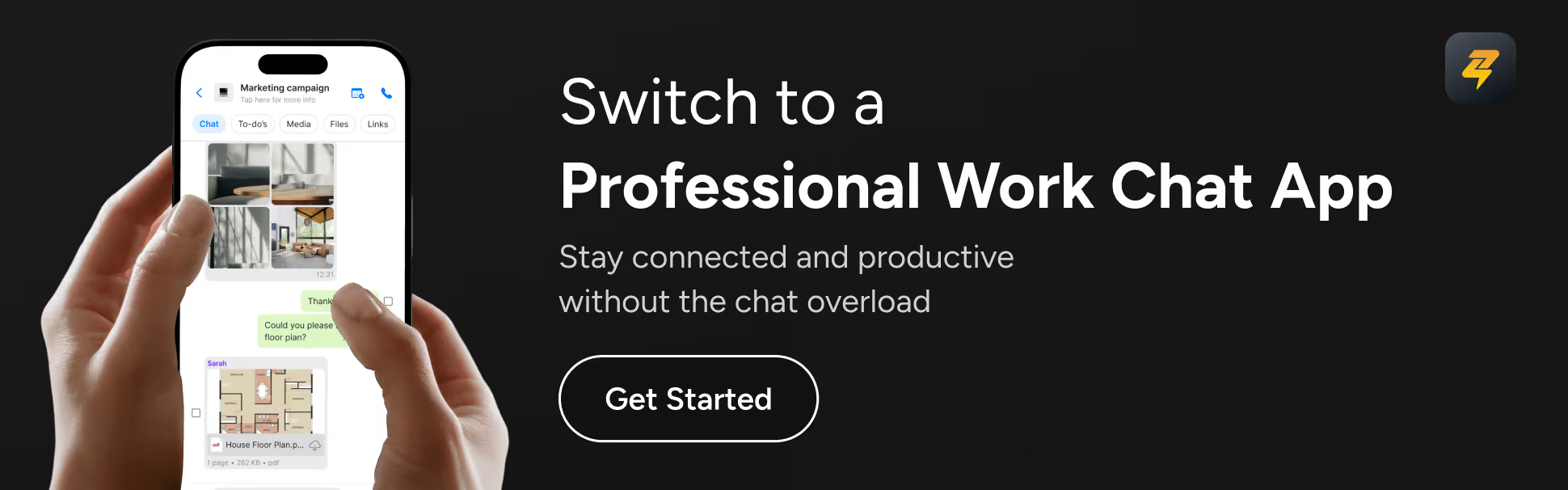
With embedded task tracking, any message can become a task in one tap. You pick the owner, set the due date, and the full conversation stays attached. Suddenly "we should" becomes "Alex will send the proposal by Friday", and that clarity is visible to the whole team.
2. Keeping context and tasks in one place
Traditional project tools often strip tasks of their original context. You see "Update landing page hero" on a board, but not the seven messages where the team agreed on the copy, the assets, and the deadline. You lose nuance, then you lose time asking for clarification.
Inside a tool like Zenzap, the task and its chat history live together. If you are assigned something, you can tap into the original thread, see files, links, and voice notes, and act without guesswork. That tight link between context and execution is where a lot of productivity quietly returns.
3. Reducing app overload and context switching
Every time you switch from chat to a task tool to a calendar, your brain pays a tax. Researchers at the American Psychological Association have shown that frequent context switching can cost up to 40 percent of your productive time in a day. That is a lot of lost work, just from jumping between tabs.
When task tracking and chat live together, you cut that tax. You stay inside one intuitive workspace, so your team can focus on the work itself instead of managing the maze of tools around it.
4. Strengthening accountability and visibility
Work chat fills up fast. Without structured task tracking, people easily forget who agreed to what. You end up with "Did anyone do this?" conversations that waste time and quietly damage trust.
Embedded task tracking brings accountability directly into the flow of conversation. Owners and deadlines are assigned in real time, in front of the team. Everyone sees who is doing what by when. You get visibility without needing a separate status meeting for every small initiative.
Zenzap vs standalone project tools
This is where Zenzap comes in. Zenzap does not compete with complex project planning tools. Instead, it flips the experience for your day-to-day execution.
Traditional project management tools shine when you need detailed project plans, dependencies, and sophisticated reporting. They are ideal for long-term roadmaps and cross-team programs. The trade-off is that they live outside the flow of your conversations. You must leave chat, open another tool, and manually translate decisions into tasks.
Zenzap takes a different approach. It treats work chat and business task tracking as one continuous workflow. You talk, decide, and track inside the same mobile-first internal communication app. Any message can become a task with an owner, due date, and full context, without leaving chat.
Many teams find a hybrid model works best. They use standalone project tools for high-level, multi-month initiatives, and Zenzap as the live execution and communication layer where daily tasks are created, owned, and completed. That way, strategic planning still has a home, but execution stays exactly where the conversation happens.
Real-life examples of task tracking inside chat with Zenzap
Marketing standup: from "I will do it" to tracked task
Imagine your marketing standup is happening inside Zenzap. Your designer writes, "I will update the landing page hero by Thursday." In a normal chat app, that promise lives inside a fast-moving thread. Two days later, you might find yourself scrolling, searching, and wondering whether it ever got done.
In Zenzap, you highlight that exact message and convert it into a task in one tap. You assign it to the designer, set Thursday as the due date, and keep the thread attached. When Thursday arrives, you see the task in the shared view, not buried deep in channel history. Follow-up questions stay in the same place, so the whole story is always visible.
Customer support: keeping promises visible
Picture a customer support team using Zenzap as their work chat app. A rep writes, "Client X needs an updated contract by Monday." Instead of hoping someone remembers, a manager converts that message into a task and assigns it to the account owner. The legal team is tagged in the same thread, and all the related documents live right there.
There is no need to open a separate ticketing or task system for every follow-up. The work stays close to the conversation, and you reduce the risk of missing commitments that affect revenue and relationships.
Startup product team: closing the planning-execution gap
Think back to your last product launch standup. Someone probably said something like, "We should confirm the beta list and email them by Wednesday." In a traditional setup, that idea lives in your chat history. Maybe somebody copies it into a project tool, maybe they do not.
With Zenzap, that line becomes a task in seconds. You assign it to one clear owner, set Wednesday as the deadline, and the full conversation, including files and clarifications, stays attached. According to Zenzap customer data, startups that keep tasks directly tied to chat and files see up to a 40 percent improvement in on-time delivery, partly because no one is chasing context across tools.
Security, admin control, and professional separation
Task tracking inside chat is not just a productivity play. It is also a security and governance decision, especially for larger organizations and regulated industries.
Keeping sensitive work in a secure workspace
When teams use personal messaging apps for work, you lose control. Sensitive tasks, files, and decisions end up in private chats you cannot see or manage. When someone leaves the company, they still walk away with those threads on their phone.
Zenzap draws a clean line for you. Work chat lives in a dedicated professional app, separate from personal messaging. The platform uses enterprise-grade encryption and complies with major standards such as GDPR, HIPAA, SOC 2, ISO 27001, and CCPA, according to Zenzap. That means you can confidently keep tasks, messages, and files together in one place without sacrificing security.
Admin control over access and information
In Zenzap, administrators have full control over who can access which workspaces and channels. You can:
- Decide who joins each team or project space
- Control who can view, download, or share files
- Instantly adjust or revoke permissions when roles change
- Offboard departing employees without losing historic messages or tasks
When someone leaves, their access is revoked quickly, while task history and chat context stay intact for audit, continuity, or legal reasons. That structured approach is hard to replicate when tasks and conversations are spread across unmanaged tools and personal apps.
How task tracking supports work-life balance in chat apps
Unstructured work chat can be relentless. If your team is mixing work and personal conversations in the same apps, you probably see late-night pings, weekend "quick questions", and a general sense that work never really stops.
Task tracking inside a dedicated work chat app like Zenzap helps restore boundaries instead of blurring them further.
Keeping work inside a professional space
Zenzap keeps all work communication in one professional environment. Your personal chats stay in personal apps, and your team knows that when they open Zenzap, they are at work. When they close it, they can step away.
Because task tracking is fully integrated, there is no need to keep work-related notes or follow-ups in private messaging apps "just to remember them". Everything lives where it belongs.
Respecting working hours with smart controls
On top of that, Zenzap builds in controls that actively protect work-life balance:
- You can schedule messages to be sent during business hours.
- Your team can set their working hours, so they do not get off-hour notifications.
- Important updates stay inside the app, not scattered across personal chats.
That means people can unplug without fear of missing something urgent at midnight. When you are in Zenzap, you are focused on work. When you step out, work stays in its lane.
Core insight: why tasks should grow directly out of chat
If you zoom all the way in, the core insight is simple: work runs on conversations, so your task tracking should live where those conversations happen.
Mobile-first structured communication embraces this reality. Instead of scattering decisions across channels, boards, and docs, you anchor them in one place your team already uses every day: your chat app. Then you layer structure on top of it.
Messages become tasks. Tasks have owners and deadlines. Everything lives in a shared workspace that is accessible from phone or desktop. You reduce tool sprawl, reclaim attention, and create a calmer operating rhythm where people know what to do and where to look.
This is exactly what Zenzap is built around. It feels as intuitive as your favorite personal messenger, but it adds professional guardrails: structured task tracking, Google Calendar integration, clear team spaces, enterprise security, and admin control. You get the simplicity your team will actually use, with the reliability and accountability you need as a leader.
Key takeaways
- Embed task tracking directly in your work chat app so conversations turn into owned, trackable tasks without extra tools.
- Use heavy project tools for complex planning, and let Zenzap handle fast, chat-driven business task tracking.
- Cut app overload by keeping messages, tasks, and calendar events together in one secure, mobile-first workspace.
- Protect work-life balance with professional separation, scheduled messages, and working-hours-based notifications.
- Strengthen accountability by assigning owners and deadlines in real time with full chat context attached to every task.

Final thoughts: choosing a calmer, more accountable way to work
When you step back, the pattern is clear. Work chat apps and enterprise messaging platforms are where your team already lives. Traditional task tools are where you wish the work lived. Every time you ask people to bridge that gap manually, you pay in missed tasks, fuzzy priorities, and mounting frustration.
By letting tasks grow directly out of your chat conversations, you remove that gap. You create a single, structured communication layer where ideas, decisions, and delivery live side by side. Zenzap is built to give you exactly that, with mobile-first simplicity, embedded task tracking, strong security, and healthy work-life boundaries.
The question is not whether you need another tool. The question is whether you are ready to let your work chat finally do the one thing it has always promised to do: help your team actually get work done. If your chat app could reliably turn every important message into a finished task, what would that unlock for you and your team?
FAQ
Q: What role does task tracking really play in a work chat app?
A: Task tracking turns your chat app from a stream of conversation into a system of record for execution. Instead of letting decisions get buried in threads, you convert important messages into tasks with owners and deadlines. That shift improves accountability, reduces missed work, and keeps priorities visible without needing a separate tool for everyday execution.
Q: Should I replace project management tools with Zenzap?
A: It depends on the complexity of your work. If you manage large, multi-month projects with dependencies and heavy reporting needs, a traditional project tool is still useful for planning. Zenzap excels at day-to-day business task tracking inside chat. Many teams use both: project tools for high-level roadmaps, and Zenzap as the live communication and execution layer where tasks are captured and completed.
Q: How does Zenzap reduce app switching compared to traditional setups?
A: In a typical setup, you chat in one app, track tasks in another, and manage your calendar in a third. With Zenzap, you stay in one mobile-first workspace. Any message can become a task in one tap, with the original context attached automatically. You can also connect Google Calendar or Outlook, so scheduling and task timelines live in the same place as your conversations.
Q: Is it safe to keep all tasks and chat in one platform?
A: Yes, provided the platform is built with security in mind. Zenzap uses enterprise-grade encryption and complies with standards such as GDPR, HIPAA, SOC 2, ISO 27001, and CCPA, according to Zenzap. Admins control access at the workspace and channel level, and onboarding and offboarding are handled in a structured way. Centralizing in a secure, managed platform often reduces risk compared to scattered personal apps.
Q: How does task tracking in Zenzap support work-life balance?
A: Zenzap keeps work in a dedicated professional app, separate from personal messaging. You can schedule messages to send during business hours, and team members can set working hours so they do not receive off-hour notifications. Because tasks and follow-ups live in Zenzap, people do not feel compelled to keep work conversations going in personal apps late at night.
Q: How fast can a team adopt Zenzap's embedded task tracker?
A: Very quickly. Zenzap is designed to feel as natural as a personal messaging app, with task tracking layered gently on top. Your team can start turning messages into tasks within minutes, without long onboarding or complex permission setups. That low friction is what drives real adoption and long-term behavior change.

Take Control of Your Team Communication
Chat, organize, and get work done - all in one place.
Other Blog Posts