.svg)

.svg)

.svg)

.svg)

.svg)

.svg)

.svg)

.svg)

.svg)

.svg)
.svg)

























Zenzap vs Microsoft Teams: Which company messaging tool offers better security and task management in chat?
If your team is already chatting all day, why are you still chasing tasks in separate tools and worrying about who can see what?
You feel it every week. Messages scattered across apps. Tasks buried in boards no one opens. Sensitive conversations living in tools that were never built for business. Meanwhile, your people just want one simple, secure place to talk and actually get work done.
This is where the choice between Zenzap and Microsoft Teams really matters. You are not just comparing features. You are deciding which work chat your team will happily use every day, which tool keeps your data safe without IT drama, and which one turns conversations into finished work instead of digital clutter.
Here is the short version. Microsoft Teams gives you rich features and deep Microsoft 365 integrations, but often at the cost of complexity, IT overhead, and scattered task experiences. Zenzap focuses on secure workplace messaging, tasks directly in chat, and a mobile-first interface that feels instantly familiar, so your team actually adopts it.
In this guide, you will see a clear, point-by-point comparison of Zenzap vs Microsoft Teams for two things that matter most: secure workplace messaging and task management in chat. You will see where each tool shines, where it adds friction, and which one fits the way you and your team really work.
Table of contents
1. Why this comparison matters for your business
2. Secure workplace messaging and control
3. Task management in chat
4. Mobile experience and adoption
5. Work-life balance and notification control
6. Key takeaways
7. Final thoughts
8. FAQ
Why this comparison matters for your business
You are not short on tools. You are short on tools your team will actually use without pushing, training, or constant reminders.
Research estimates that workers switch between apps more than 1,200 times a day, which adds up to hours of lost focus every week. When chat lives in one place and tasks in another, you feel that context switching everywhere: missed follow-ups, "who owns this?" confusion, and yet another status meeting to sync what should already be visible.
At the same time, security expectations have shifted. Over 80 percent of organizations have experienced at least one data breach tied to human error or misconfigured tools. If your work chat mixes with personal apps or old accounts stay active after people leave, your risk goes up fast.
So your real question is simple. Which internal team communication tool gives you secure workplace messaging, clear ownership of tasks, and a setup your people can learn in minutes not weeks?
That is where understanding how Zenzap approaches security and task management in chat becomes critical.
Secure workplace messaging and control
Zenzap security: Enterprise-grade encryption without friction
Zenzap is built for secure workplace messaging without feeling heavy or complex. Every message, task, and file is encrypted. Your company data lives securely in the cloud, and admins can control access in a few taps.
If someone loses a phone or leaves the company, you keep control. You revoke access instantly, wipe their connection to workspaces, and keep your permissions clean. You do not have to hunt through a separate admin portal or wait for IT to step in.
The real difference is how security feels in day-to-day use. Many "secure" tools slow teams down. Many "easy" tools create risk because anyone can join, forward, or export data. Zenzap is intentionally designed to sit right in the middle: enterprise-grade security that still feels as intuitive as a personal chat app.
Independent platforms like Software Advice rate Zenzap highly in practice, with an overall 4.7 out of 5 rating and 4.8 for Ease of Use and 4.8 for Customer Support. That combination matters if you want strong protection without constant handholding or training.
Microsoft Teams security: Enterprise power with IT overhead
Microsoft Teams delivers strong enterprise security features as part of the Microsoft 365 ecosystem. You get identity management, data loss prevention, audit logs, and advanced compliance policies that large organizations and regulated industries rely on.
The catch is where and how those controls are managed. Most serious security and compliance settings live inside Microsoft 365 admin centers. To configure them properly, you usually need IT expertise, clear governance rules, and time.
If you are running a smaller or mid-sized business without a dedicated IT team, this can introduce friction. You might stick with default settings for too long, delay updates, or avoid configuring advanced policies simply because they feel intimidating.
In practice, that means Microsoft Teams can be extremely secure, but only if you have the resources and knowledge to set it up and maintain it. For many lean teams, security becomes another project, not a given.
Task management in chat
Zenzap tasks: Work grows directly from conversation
Zenzap is built around one simple idea. Most of your tasks already start in chat. So why force your team to copy them into a separate tool?
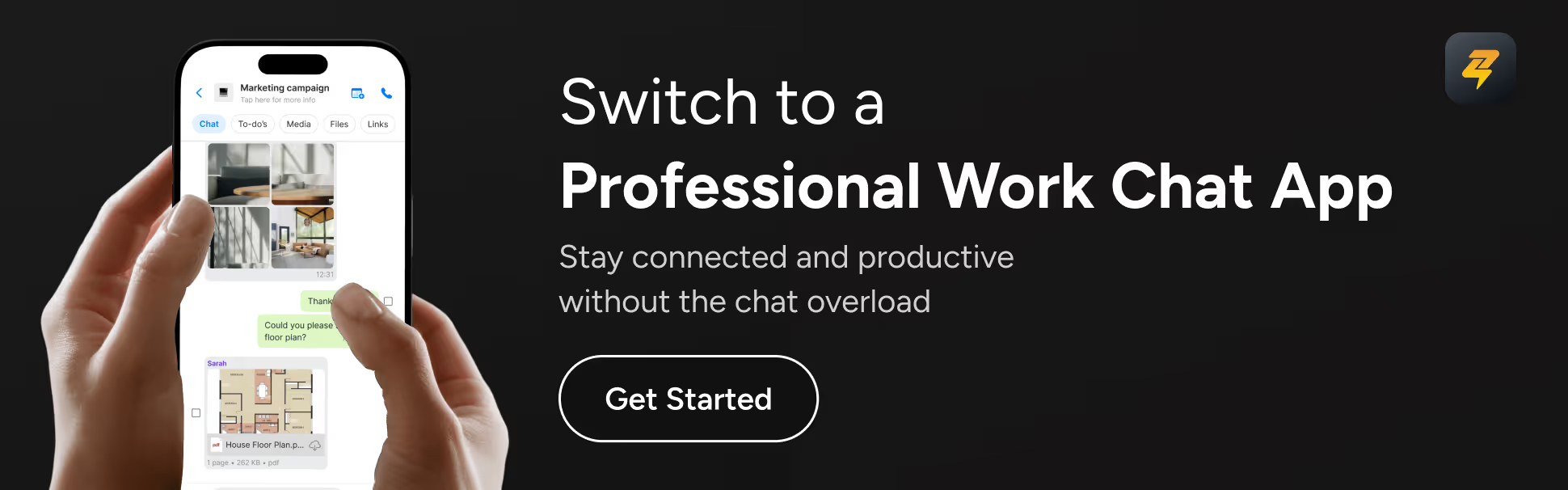
In Zenzap, you can turn any message into a task, right inside the chat where the discussion is happening. You assign an owner, add a due date, and keep that task visible alongside the conversation.
No extra tabs. No duplicate typing. No hoping someone remembers to move it into a project board later. Conversations and execution live together.
Picture a retail manager running several stores. A supplier issue pops up in a group chat. In Zenzap, the manager converts that message into a task in seconds, assigns it to a specific store lead, and tracks completion, all in the same place. Everyone sees the decision, the owner, and the status without leaving the thread.
This kind of embedded task management in chat is not just convenient. It cuts down on "I thought you were handling that" moments, reduces status meetings, and gives your team a real-time, searchable record of what was decided and done.
Microsoft Teams tasks: Powerful but spread across tools
Microsoft Teams does support task management, typically through integrations such as Planner and Microsoft To Do. These tools are robust, especially if you already live in the Microsoft 365 environment.
The tradeoff is separation. Tasks often live in tabs, boards, or separate views outside the main chat thread. To capture work, someone has to move from the conversation into Planner, create or update the task, then keep the board maintained.
For structured projects with PMs and formal processes, this can work well. For fast-moving teams that just want to capture and complete work as it comes up in chat, it creates friction and, over time, neglect.
In many companies, you see the same pattern. People agree on something in Teams chat. A few tasks get logged in Planner at the start of a project. Then, as pressures rise, everyone goes back to chatting and “remembering” instead of maintaining the board.
You end up with half your work in tasks, the rest scattered across chat history.
Mobile experience and adoption
Zenzap mobile: Built for people who are not at a desk
Zenzap is mobile-first. That is not a slogan, it is the core design choice.
Everything in Zenzap, from messaging to tasks to file sharing, is optimized for fast thumbs-on-glass use. Your frontline staff, technicians, drivers, and retail teams can open the app, see their work chat and tasks, and act in seconds.
A facilities company with cleaners and maintenance staff across 50 sites, for example, can use Zenzap so each worker receives tasks, shares photos, leaves voice notes, and closes jobs from one simple chat. No juggling multiple apps, no digging through email, and no temptation to use personal messaging apps for company issues.
If your people are often on the move or rarely touch a laptop, this mobile-first approach is not a nice-to-have. It is the difference between a tool that is actually used and one that lives in the background.
Microsoft Teams mobile: strong features, desktop-first mindset
Microsoft Teams offers a capable mobile app and deep integration with Microsoft 365 on desktop. For office-heavy teams already using Outlook, OneDrive, and SharePoint, this ecosystem can be a strong advantage.
However, Teams has historically been designed with desktop collaboration at the center. The mobile experience mirrors a lot of that structure, which can feel heavy for frontline or field workers who just need to see today’s tasks, share updates, and move on.
Features like channels, tabs, and integrated apps are powerful in a browser window. On a small screen, they can add taps and time that busy staff do not have.
So if most of your work happens in offices and your people are already trained on Microsoft tools, Teams’ mobile app may be “good enough.” If your workforce is truly mobile-first, Zenzap’s stripped back, chat-plus-tasks approach is usually easier to adopt.
Work-life balance and notification control
Zenzap boundaries: Work stays in a dedicated, controlled space
One of the hidden risks of using personal messaging apps for work is that your team never really switches off. Work pings arrive in the same place as family photos and group chats. The line between "on" and "off" hours disappears.
Zenzap solves this by giving your company its own dedicated work chat space, separate from personal apps. That alone helps your team mentally clock in and clock out.
On top of that, Zenzap lets people set working hours and control notifications tightly. You can schedule messages to send during business hours, so you do not accidentally ping someone at midnight. Team members can silence non-urgent notifications outside their set hours and still know that if something truly critical happens, it will surface correctly.
This design supports healthier habits without sacrificing responsiveness for urgent issues. Your people can unplug confidently, knowing they will not miss what actually matters.
Microsoft Teams boundaries: rich controls, more setup
Microsoft Teams also provides notification settings, presence indicators, and status messages to help manage work-life balance. You can set quiet hours, adjust alerts per channel, and use “Do Not Disturb” states.
The difference is again in simplicity. Because Teams sits inside the broader Microsoft ecosystem, configuring notifications often involves more menus and options. Power users can fine-tune everything. Casual users may leave defaults on, which leads to notification overload or complete silence.
For organizations with strong IT and HR support, you can create guidelines and training around notification best practices. For leaner teams, Zenzap’s clear separation of work chat plus straightforward working hours settings is usually faster to understand and adopt.
Key takeaways
- Choose secure workplace messaging that your team will actually use, not just a long feature list on paper.
- Tasks that flow directly from conversation in Zenzap eliminate the need for separate boards and reduce missed follow-ups.
- For mobile-first and frontline workers, Zenzap's mobile design and simple interface reduce friction and speed up adoption.
- Enterprise-grade security with simple admin controls means you can onboard and offboard securely without dedicated IT resources.
- A dedicated work chat space with working hours and scheduled messages helps your team unplug without losing control.

Final thoughts
Both Zenzap and Microsoft Teams can keep your team connected. The question is how much effort you want to invest to get there, and how naturally work flows from conversation to action in each tool.
If you already run a large organization with a dedicated IT department and deep Microsoft 365 usage, Microsoft Teams can be a good fit for complex collaboration and compliance, as long as you are ready to manage the admin overhead and teach people how to use tasks across tools.
If you want a simple, secure workplace messaging app that keeps chats, tasks, and files together, Zenzap is built for you. Enterprise-grade encryption, instant onboarding and offboarding, tasks directly in chat, and a mobile-first experience mean your team can adopt it quickly without manuals or long training sessions.
So step back and ask yourself one thing. Six months from now, which tool are your people more likely to still be using happily every day to keep work organized, secure, and stress-free, without you having to push them?
FAQ
Q: What makes Zenzap secure for workplace messaging?
A: Zenzap provides enterprise-grade encryption for all messages, tasks, and files. Administrators have full control over who can access the platform, with secure onboarding and offboarding processes. You can instantly revoke access when someone leaves, ensuring no unauthorized personnel can access sensitive information. All your company data lives securely in the cloud with tight permission controls.
Q: How does task management work in Zenzap chat?
A: In Zenzap, tasks live directly inside chat. You can turn any message into a task, assign an owner, add a due date, and keep it next to the original conversation. This eliminates the need to switch between tools or maintain separate task boards. Your team gets a real-time, searchable record of what was decided and done, all in one place.
Q: Is Zenzap suitable for mobile-first or frontline workers?
A: Yes, Zenzap is specifically designed with a mobile-first approach. Everything from messaging to tasks to file sharing is optimized for quick, thumb-friendly use on a phone. Frontline staff, field workers, retail teams, and technicians can open the app, see their work chat and tasks, and act in seconds without juggling multiple apps.
Q: Will my team need training to adopt Zenzap?
A: Very little. Zenzap is intentionally designed to feel like familiar personal messaging apps, then adds professional structure in the background. Most teams understand the core action of turning a message into a task within minutes, which keeps training time close to zero and speeds up adoption.
Q: How does Zenzap support work-life balance?
A: Zenzap creates a clear line by giving you a dedicated work chat app, separate from personal tools. You can schedule messages to be sent during business hours, and your team can set their working hours so they will not get notifications when they are off the clock. This separation helps your team unplug outside their set times without missing critical updates.
Q: Can Zenzap replace my existing project management tool?
A: For many startups and small to mid-sized teams, yes, at least for day-to-day execution. Zenzap brings tasks, chat, scheduling through Google Calendar integration, and integrations with other business tools into one place, which covers most internal collaboration needs. If you run very large, complex projects that need advanced reporting, you might keep a lightweight project tool for those cases while using Zenzap as your primary internal communication and execution space.
Q: What integrations does Zenzap offer?
A: Zenzap integrates with Google Calendar for seamless scheduling and meeting coordination, plus other business tools you already use. These integrations create a cohesive digital team workspace where you can stay organized and focused without constantly switching between apps.

Take Control of Your Team Communication
Chat, organize, and get work done - all in one place.
Other Blog Posts
- fskfsfjksofjsj