.svg)

.svg)

.svg)

.svg)

.svg)

.svg)

.svg)
.svg)























Everything you need to know about the 8 ways team communication tools improve execution
Talking is not your problem. Turning talk into action is. You are probably already sending messages all day, jumping between chats, email, and project tools. Yet somehow, critical tasks still slip, decisions get lost, and you are left asking, "Who is actually doing this?"
Team communication tools, when they are done right, close that gap. They do more than help you talk. They help you execute. Zenzap takes the simplicity of personal messaging, adds structure, security, and built in tasks, and turns your daily conversations into a quiet engine for reliable follow through.
If someone can send a WhatsApp message, they can use Zenzap. That is why most teams are productive in minutes, not days, and why Zenzap is rated 4.7 out of 5 on platforms like Capterra and has been recognized with "Best Value Team Communication Software" awards in 2024 and 2025. In this FAQ style guide, you will see exactly how modern team communication tools, especially Zenzap, improve execution in 8 practical ways and how you can put them to work in your own business.
Along the way, you will see how to separate personal and work chat, reduce chaos across multiple locations, protect sensitive data with enterprise grade security, and give your people real work life balance without sacrificing responsiveness. Think of this as your playbook for moving from "Did you see this?" to "We know who owns it and when it will be done."
Let us walk through what makes a communication tool a real execution partner instead of just another noisy app on your team's phones.
Table of contents
1. Why communication, not effort, is your real problem
2. One simple shift that reduces chaos fast
3. The 8 ways team communication tools improve execution
4. How Zenzap turns talk into trackable action
5. Common questions about team communication and execution
6. Key takeaways
7. Final thoughts
8. Frequently asked questions
Why communication, not effort, is your real problem
Your people are not slacking off. They are just drowning in scattered channels. Email, WhatsApp, SMS, legacy intranets, project tools, handwritten notes, quick calls. Every extra tool multiplies confusion and fragments context.
The cost is real. Research from McKinsey suggests that integrated digital collaboration can boost productivity by up to 20 to 25 percent. On the flip side, constant context switching cuts performance and increases errors. You feel it as missed handovers, conflicting instructions, and slow follow through.
What looks like "execution problems" is usually a communication system problem. Information is not reaching the right people at the right time in a structured way. That is what team communication tools, used intentionally, are designed to fix.
One simple shift that reduces chaos fast
If you do nothing else, do this: centralize work messages in one professional team communication tool and get them out of personal apps.
In hospitality, retail, and other multi location teams, leaders who make this change see fewer "I never saw that" moments within weeks. When every work related message, update, and task lives in one place, you instantly cut noise and confusion.
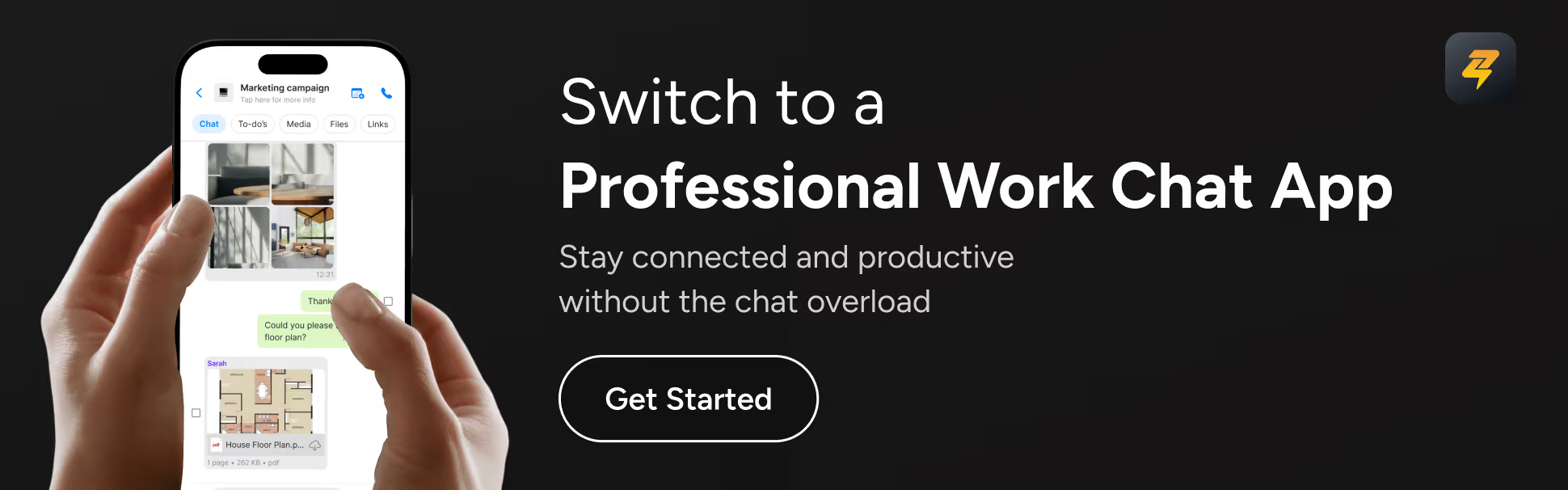
Zenzap is built exactly for this. You give your team a familiar, mobile first chat app that feels like the personal messengers they already use, but it is clearly labeled as "the work app." Work conversations go into Zenzap. Personal chats stay in personal apps. Your staff can install it on their phones and still enjoy evenings without work messages mixed between family photos.
The 8 ways team communication tools improve execution
Let us break down the 8 core ways a modern team communication tool, like Zenzap, improves execution for you and your teams.
1. Turning conversations into tasks without switching tools
Talking is easy. Remembering and tracking everything that is said is hard. A proper team communication tool lets you turn those "Can someone..." moments into tasks in seconds.
In Zenzap, a quick note like "Can someone update the promo signage in Store 18 before Friday?" can become a structured task in the same chat, with an owner and a due date. No copy paste into a separate project tool. No separate to do list that nobody checks.
This shift from loose chat to trackable responsibility is huge, especially when you run multiple locations. It means less "Did anyone see this?" and more "We know who owns it and when it will be done." Over time, your chats become a live record of commitments, not just a stream of comments.
2. Creating structure instead of one giant group chat
One huge group chat is fine for a family vacation. It falls apart for a growing business.
In a multi location setup, you need structure that matches how you actually work. That might mean:
- A space for each store or site
- Region or area manager groups
- Function based channels, like "Visual Merchandising" or "Maintenance Requests"
When your communication tool lets you define clear workspaces, you avoid flooding everyone with every message. Store 108 does not need blow by blow updates for Store 214. Managers get what they need, frontline staff see what is relevant to them, and HQ can still broadcast critical alerts when needed.
Zenzap makes this kind of structure simple. You create spaces that mirror your real workflows. Then you keep each thread focused and easy to scan, instead of letting it grow into a 1,000 message noise factory.
3. Connecting chat with calendars and routines
Execution is not just about one off tasks. It is also about recurring routines that happen reliably and on time.
When your team communication tool integrates with calendars and key business tools, those routines stop living in someone's memory and start living in a predictable system. Zenzap, for example, integrates with Google Calendar and more than 100 focused business tools.
You might:
- Link daily briefings to your calendar so everyone knows when updates go out
- Attach task lists to recurring inspections, audits, or promotions
- Trigger reminders for key deadlines directly inside the chat where the work is discussed
Instead of bouncing between a chat app, a calendar, and a task tool, your team sees what is due and when, right where they talk about it. That alone can give you a meaningful productivity lift, as many integrated workflow studies suggest.
4. Giving you mobile first execution, not desktop leftovers
Your people are on the move. Store managers, shift leads, and technicians live on their phones, not sitting in front of a laptop all day.
So your communication tool needs to be designed for phones first, not as a clunky desktop app squeezed into a small screen. Zenzap is built mobile first. Sending a message, sharing a photo from the shop floor, managing a task, or checking a schedule feels as simple as using a personal messenger.
Real example: Chris Green, National Sales Manager at Fruhauf Uniforms, shared that having something that works cross platform made communication "a whole lot easier" and called Zenzap "essential, 100 percent." When tools feel natural and quick on mobile, people actually use them. That is when execution improves.
5. Building accountability without micromanaging
You do not want to chase people all day. You just need to know that critical messages were seen and tasks are moving.
Good team communication tools build light touch accountability into everyday workflows. On the Zenzap side, you have features like:
- Read indicators so you can see who has viewed important updates
- Tasks within chat so ownership and deadlines are visible to everyone
- Channels structured by project, store, or department for quick progress scans
Instead of sending "Just following up on this" messages or scheduling another status meeting, you glance at the relevant chat or task list. You see who is on track and where a nudge is needed. Accountability becomes part of how you communicate, not a separate management ritual.
6. Protecting data with enterprise grade security
Using personal messaging apps for work feels convenient until something goes wrong. A lost phone, a staff member who leaves with client chats still on their device, or a sensitive photo sitting in someone's personal gallery.
Zenzap is designed to keep you away from those risks. Communication is encrypted, and admins control who can access what. You can:
- Manage onboarding and offboarding in minutes
- Define access by role, store, or function
- Keep all company data inside a dedicated, secure app instead of scattered across personal devices
When someone leaves your company, their access to Zenzap is removed. Conversations and files remain safely in your workspace. You do not have to chase ex employees to delete chats or worry about sensitive information sitting unprotected in personal apps like SMS or WhatsApp.
7. Protecting work life balance and reducing burnout
Always on communication looks productive at first, but it quietly burns out your best people. The World Health Organization has linked long working hours to higher risks of heart disease and stroke, and you do not need a study to know that exhausted teams make more mistakes.
Modern team communication tools can actually help you build healthier boundaries. In Zenzap, your team can:
- Set working hours so notifications pause when they are off the clock
- Schedule non urgent messages to send during business hours
- Keep work chat in a separate app, so evenings are not spent scrolling past work threads to see family messages
For you, that means you can queue a late night idea to send the next morning. For your staff, it means they can rest confidently, knowing that urgent issues will be tagged and routed through the right channels, and everything else will wait until they are back on.
8. Creating continuous improvement with feedback loops
Execution is not a one time project. It is something you tune constantly.
Team communication tools shine when you use them to make feedback and process improvement part of normal work. For example, in Zenzap you might:
- Create a "Feedback on how we work" channel where people share what is confusing or working well
- Run monthly pulse checks by posting three simple questions: What should we stop, start, and continue?
- Ask frontline staff to flag patterns they see in guest complaints, stockouts, or promotion confusion
Because feedback lives in the same app as daily work, it feels natural to respond, refine, and try small experiments. You catch issues early instead of discovering them in a painful post mortem.
How Zenzap turns talk into trackable action
Zenzap is built around a simple idea: if you keep the speed and familiarity of personal messaging and add just enough structure, your teams can move from messy chatter to reliable follow through.
Here is how you put that into practice.
Instant adoption with intuitive simplicity
Zenzap looks and feels like a modern messenger, not a heavy corporate system. If someone can send a message in a personal app, they can send one in Zenzap. That is why teams usually start using it productively within minutes.
For you, that means no long training sessions every time you open a new location or bring in seasonal staff. You invite them, they join, and they are up and running. The barrier to adoption is low, which is essential when you manage frontline, distributed, or hourly teams.
Mapping spaces to how your business really works
You start by mapping your communication spaces to your real world structure. For example:
- "Store 101", "Store 102"... for local conversations
- "All Managers" for leadership updates
- "Ops Team", "Support On Call", "Marketing x Product" for cross functional work
As you go, you move active conversations, documents, and task lists into these spaces. With the right group structure, your teams respond instantly when something is unclear. They post photos of displays, flag stock issues, ask quick questions, and HQ can clarify instructions on the spot instead of waiting for a report two weeks later.
Keeping communication and execution in one place
Whenever a decision is made or a new task emerges inside a chat, you turn it into a Zenzap task in real time. You assign an owner, set a due date, and keep files attached to that same thread.
Imagine you are in your "Ops Team" chat and agree on five follow ups. Instead of saying "I will handle it" and hoping someone remembers, you convert each item into a task with a couple of taps. The conversation and the action stay linked. No separate spreadsheet. No scribbled notes.
Over time, your team stops asking "What did we agree to in that meeting?" and starts checking the relevant Zenzap space, where all decisions and tasks live.
Common questions about team communication and execution
Q: How do I know if my current tools are hurting execution?
A: Look for these signs: people say "I did not see that" often, you have to resend the same information in multiple places, tasks are agreed verbally but not tracked anywhere, and simple updates require live meetings. If that sounds familiar, you are dealing with a communication system that is slowing your execution.
Q: Do I need to replace all my existing tools to use Zenzap?
A: No. Your goal is not to rip out everything. Your goal is to simplify the core experience. Start by listing every tool you use for internal coordination. Circle what is essential, then choose one primary communication platform to handle day to day coordination. Zenzap can sit at the center and integrate with calendars, document storage, and existing task systems where it makes sense.
Q: What about teams that "already use WhatsApp effectively"?
A: Personal apps might feel efficient, but they come with hidden costs. Security risks, no clear offboarding, mixed personal and work chats, and zero structure for tasks. When you centralize into a dedicated work app like Zenzap, you keep the speed while gaining control, privacy, and professional boundaries.
Q: Will a new tool just add more noise?
A: It will if you treat it as "just another channel." The key is to decide, as a leadership team, that work communication lives in one place. You set simple rules for what belongs in Zenzap, how spaces are structured, and which types of messages deserve a meeting instead of a chat. One central hub beats five scattered tools, every time.
Key takeaways
- Centralize all work messages in a dedicated, mobile first team communication tool to cut chaos and missed updates.
- Turn conversations into tasks directly inside chat so ownership, deadlines, and context stay together.
- Map communication spaces to your real structure, like stores, regions, and functions, so people only see what is relevant.
- Protect your data and your people by moving off personal messaging apps and using enterprise grade security with clear access controls.
- Use features like working hours and scheduled messages in Zenzap to support real work life balance without sacrificing responsiveness.

Final thoughts
Your teams are already working hard. Effort is not the issue. The real question is whether your communication setup helps that effort turn into consistent, on time execution, or quietly fights against it.
When you choose a tool like Zenzap, you are not just "adding another app." You are giving your business a shared place where decisions live, tasks are tracked, and work conversations stay professional, secure, and human. You are also sending a clear signal to your team about how you want work to feel: focused, organized, and respectful of personal time.
The sooner you reduce tool chaos, connect chat to tasks and calendars, and move away from personal messengers, the sooner you feel that 20 to 25 percent productivity lift that integrated workflows promise in real life, not just in reports.
The next move is yours. Are you willing to redesign how your teams communicate so execution finally matches the effort you are already investing?
Frequently asked questions
Q: How many communication tools is "too many" for a team?
A: If your staff cannot answer "Where do I go to see what I need to do today?" in one sentence, you probably have too many. As a rule of thumb, choose one primary tool for day to day communication and tasking, one place for documents, and one system for formal records. Anything more than that should have a clear, unique purpose.
Q: How can I introduce Zenzap without overwhelming my team?
A: Start with a pilot group, such as one region or department. Define a few simple spaces, agree that all work messages go there, and move one or two recurring workflows into Zenzap tasks and calendars. Once people feel the benefits, expand gradually. Keep training light and focused on real scenarios, not feature tours.
Q: What is the best way to replace status meetings with chat updates?
A: Pick a dedicated channel, for example "Weekly Status," and agree on a simple template like "Yesterday, Today, Blocked." Ask each owner to post their update before a specific time. Use meetings only for decisions or complex topics that cannot be handled asynchronously. Over a few weeks, you will see which meetings can shrink or disappear.
Q: How can I make sure frontline staff actually use the tool?
A: Make it the easiest place to get what they need. Post schedules, shift changes, and key announcements in Zenzap first. Encourage managers to respond quickly to questions there. Use Zenzap for practical wins, like turning guest or customer issues into tasks that get resolved visibly. When staff see that "If it is about work, it is in Zenzap," they naturally adopt it.
Q: How does Zenzap help leaders stay informed without micromanaging?
A: Leaders can join high level spaces, such as "All Managers" or "Ops Leadership," and skim read indicators, task boards, and summary posts instead of reading every message. You get a clear line of sight into what is moving and where help is needed, without jumping into every thread. That keeps you present and supportive, not overbearing.

Take Control of Your Team Communication
Chat, organize, and get work done - all in one place.
Other Blog Posts